
Robinhood has evolved from a commission-free stock app into a multi-asset platform spanning crypto, prediction markets, AI trading tools, and international wealth management, competing closely with Coinbase for retail finance dominance.
+36 sources across the wider coverage universe
 Ark Invest buys $12.2M of SpaceX while trimming positions in Block, Bullish, and Robinhood as Cathie Wood continues rebalancing ETF portfolios2026-07
 Charles Schwab launches direct BTC/ETH trading via new Schwab Crypto arm to rival Robinhood at 0.75% fee.2026-04
 Uniswap adds beta launchpad aggregator after 340K Robinhood Chain tokens drive $3.6B July volume2026-07
 Robinhood Chain Reaches $325M as Trading Activity Cools2026-07
 Robinhood Chain TVL climbs to $325M, but DEX volume, active users, and trading activity continue to decline as memecoin-driven launch momentum fades2026-07
 Robinhood Chain's tokenized real-world assets surge 5x as onchain stocks gain traction, with multiple tokenized equities now exceeding $500K in daily volume2026-07
Robinhood Markets is a U.S.-based retail brokerage that pioneered commission-free stock trading and has since evolved into a multi-asset financial platform spanning equities, options, cryptocurrency, prediction markets, and wealth management.
From Disruptor to Platform
When Robinhood launched in 2013 and opened for public trading in 2015, it did one thing well: it eliminated per-trade commissions, forcing every major retail broker — Schwab, Fidelity, TD Ameritrade — to follow suit or lose customers. That singular act of disruption reshaped how retail investors interact with markets. But the zero-commission model was always a means to an end. The longer-term ambition, now increasingly visible, is to absorb every financial service a person might need into a single app.
The company went public on Nasdaq (ticker: HOOD) in July 2021, raising roughly $2.1 billion in a listing that itself became a meme-stock episode when retail traders bid the shares up more than 50% on its second day of trading before a sharp reversal. That volatility foreshadowed a broader pattern: Robinhood's fortunes track closely with retail trading sentiment, crypto cycles, and speculative enthusiasm in markets generally.

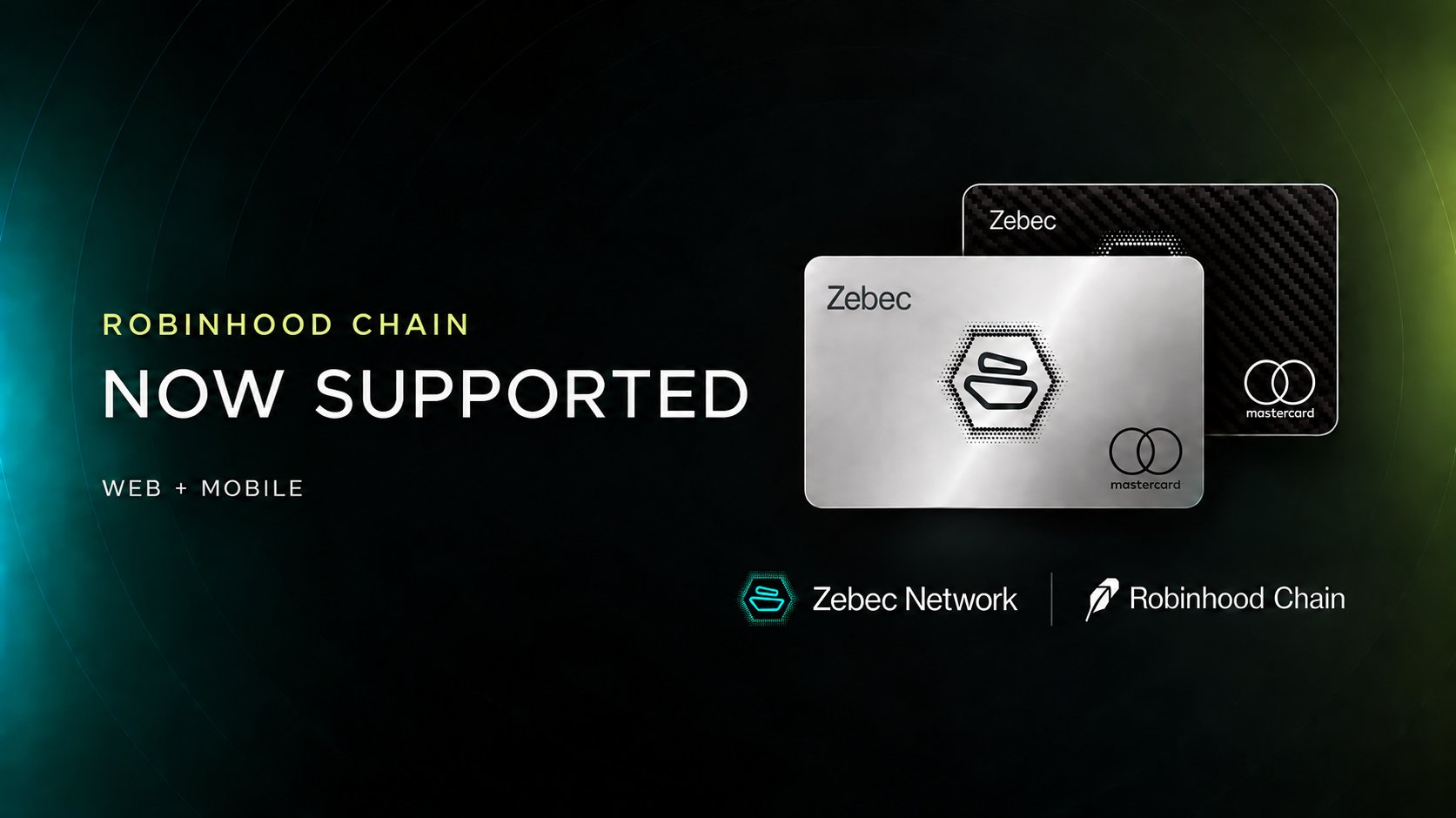
Robinhood Chain goes live on Zebec Cards, bringing network support to web and mobile with ETH integration planned next for everyday spending
Crypto as a Core Business Line
Cryptocurrency trading arrived on Robinhood in 2018, initially limited to Bitcoin and a handful of large-cap assets viewed through a custodied interface — users could buy and hold but could not withdraw to external wallets. That design drew sustained criticism from the crypto community, which argued it made Robinhood a price-exposure product rather than a genuine crypto platform.
The self-custody gap was addressed with the launch of Robinhood Wallet in 2022, a non-custodial wallet that lets users hold private keys and interact with decentralized applications. Further buildout followed: Robinhood Connect enabled third-party apps to use Robinhood as an onramp, and the platform progressively expanded its listed assets. By mid-2026, tokens ranging from established layer-ones like Solana and Zcash to newer DeFi and DeSci assets — including Pyth Network, MegaETH, and BIO — were being added to Robinhood Legend, its advanced trading interface.
Crypto revenue is materially important to Robinhood but also volatile. The company cut approximately 10% of its staff in a round that coincided with a period of declining crypto trading volumes, illustrating the dependence on market cycles that has dogged the business since its early days. Coinbase faces the same structural challenge, but has addressed it more aggressively by diversifying into staking, institutional custody, and onchain infrastructure — a divergence that analysts at firms including Ark Invest have flagged as significant when comparing the two companies.
Readers click Robinhood crypto coverage not for retail trading drama but for the compliance paradox: the single most-licensed, lawyer-heavy fintech in America still can't crack crypto legality, making it the canary-in-the-coal-mine for whether TradFi-DeFi convergence is even possible under current US rules.
The Prediction Markets Breakout
The clearest evidence of Robinhood's evolution beyond conventional brokerage is its prediction markets business. Prediction markets allow participants to take positions on the outcome of real-world events — elections, economic data releases, sports results — rather than on the price of a security. U.S. regulatory attitudes toward these products shifted materially after the 2024 election cycle, when Polymarket and Kalshi demonstrated large-scale retail demand.
Robinhood moved quickly. By May 2026, the platform had traded a record 3.9 billion prediction market contracts in a single month — more than ten times the volume recorded in September 2025, according to The Block. That growth rate is difficult to overstate: it reflects both genuine product-market fit and the compounding effect of Robinhood's existing retail user base providing instant distribution for new product lines.
The competitive landscape in prediction markets is converging fast. Coinbase has built out its own event contracts offering. Kalshi, which won a key legal battle over CFTC jurisdiction, operates as a designated contract market. Polymarket remains a dominant onchain venue operating outside U.S. jurisdiction. And in mid-2026, Charles Schwab announced it would enter the space through a partnership with Cboe, offering yes/no S&P 500 options — a product that brings binary event contracts squarely into traditional finance infrastructure. The entry of Schwab validates the market but also signals that Robinhood's first-mover advantage in prediction markets will erode unless it continues to expand contract types and improve liquidity.
Analysts at Bernstein noted that upcoming high-profile events — including the FIFA World Cup — could drive further record prediction market volumes on Robinhood, providing what they called "strong tailwinds" for the platform's transaction revenue.
Onchain Expansion and the Infrastructure Play
A quieter but strategically significant thread running through Robinhood's recent moves is its increasing engagement with onchain finance. The company signed onto the Open Transaction Layer initiative alongside eToro and MetaMask — a coordination effort aimed at standardizing how onchain transactions are routed and settled across fragmented blockchain infrastructure. The participation signals that Robinhood sees the onchain ecosystem not as a competitor but as an extension of its distribution surface.
Separately, protocols like Raydium on Solana — which crossed $1 trillion in cumulative trading volume and listed the RAY token on Robinhood — represent a new dynamic: onchain liquidity venues becoming accessible through regulated retail interfaces. This convergence is what projects like GMTrade describe as "building an onchain Robinhood" — using decentralized infrastructure to replicate the low-barrier, commission-light experience that Robinhood pioneered in traditional equities, this time for perpetual futures and pooled trading on blockchains like Solana.
Coinbase has pursued a more vertically integrated version of this strategy by building its own Layer 2 network (Base), creating a captive onchain ecosystem. Robinhood's approach appears more federated — connecting to external onchain venues rather than owning the rails — though that distinction may narrow over time.
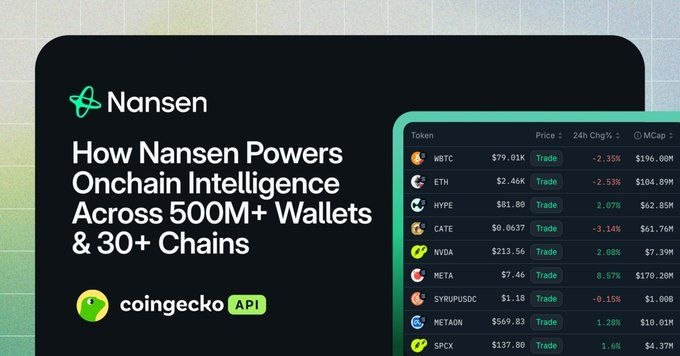
Nansen extends agentic trading platform to Robinhood Crypto Chain, now supporting 30+ chains
Robinhood Chain: Owning the Rails
That distinction narrowed decisively in mid-2026. Robinhood Chain — the company's own Layer 2, built on Arbitrum technology and first announced in 2025 alongside its European tokenized-equity push — was live and busy by late July 2026: Arbitrum reported the chain processed 100 million transactions in its first three weeks. The figure comes from the chain's technology partner rather than a neutral measurement firm, but even read conservatively it describes a launch with genuine throughput, not a press release with a block explorer.
An ecosystem formed around it quickly. Arkham added Robinhood Chain data and API support in late July, giving traders and analysts flow-level visibility into the new network. Clanker deployed more than 90 stock-paired tokens on the chain by its own count — an early signal that third-party builders see Robinhood's rails the way an earlier generation saw Base: distribution first, product experiments second.
The same month supplied a caution about what crypto-native distribution costs. Robinhood said CEO Vlad Tenev's X account was compromised and used to promote a fake "VLAD" token. No Robinhood product was involved, but the episode illustrates a new operational reality: when a brokerage runs its own chain, its executives' social accounts become market-moving surfaces — and securing them becomes part of the product.
The first-month surge now has a more useful test: whether capital turns into repeatable activity. The Block’s July 28 analysis put Robinhood Chain’s TVL at about $325 million, but its daily DEX volume had slipped to a $553 million average, down 27% week over week, while active accounts averaged roughly 275,000, down 7%. Its turnover measure fell from 9.25x in the second week of July to 1.68x by late July, indicating that capital was arriving faster than it was being traded. The crucial question is no longer whether Robinhood can attract liquidity; it is whether yield deposits and a fading memecoin surge can give way to transactions users return for.
- 01Uniswap/DeFi on-ramp deals
Three separate Uniswap-Robinhood integration stories collectively drew the most clicks, signaling readers see this partnership as the clearest test of whether a regulated broker can plug directly into permissionless DeFi rails.
- 02Regulatory compliance impossibility
The headline quoting that even Robinhood — with every securities license available — can't figure out compliant crypto offering crystallized a systemic failure readers found more alarming than any single enforcement action.
- 03Bitstamp acquisition signal
Readers tracked the Bitstamp deal as a strategic tell: buying an established exchange with derivatives licenses was Robinhood's workaround for the regulatory wall it kept hitting organically.
- 04RWA and equity tokenization push
Robinhood's 42-page SEC proposal for a federal RWA framework and its tokenized stock contracts attracted clicks because they represent the most concrete attempt by any retail broker to define the legal plumbing for on-chain equities.
- 05Prediction markets into retirement accounts
The Massachusetts investigation and the Kalshi/Robinhood push to bring event contracts into 401(k)s pulled readers in because it merges two regulatory fault lines — gambling law and retirement savings — into one product.
- 06European expansion as regulatory arbitrage
Solana staking, crypto transfers, and a blockchain-based US securities platform built for European markets drew clicks as readers recognized Robinhood was using EU jurisdiction to pilot products blocked at home.
International Expansion: The WonderFi Acquisition
One of Robinhood's most concrete strategic moves of the current cycle was its acquisition of WonderFi, a Canadian crypto company, for approximately C$250 million (around USD $180 million). The deal closed in 2026 and gave Robinhood immediate access to the Canadian market through WonderFi's operating subsidiaries: Bitbuy, a regulated crypto exchange, and Coinsquare, one of the longest-running crypto platforms in Canada. Together, those assets brought roughly 300,000 funded customers into the Robinhood ecosystem.
Canada is a meaningful beachhead for several reasons. Its regulatory environment for crypto is more settled than the U.S. framework that prevailed through much of the 2020s; securities regulators have issued clear guidance on exchange registration. The country has high rates of retail investment participation, and Bitbuy in particular had established a reputation for regulatory compliance. For Robinhood, the acquisition demonstrates a willingness to grow through M&A in regulated markets rather than relying solely on organic expansion.
AI and the Copilot Layer
Across fintech broadly, artificial intelligence is being integrated into the trading workflow — not as a novelty but as a practical tool for surfacing research, flagging portfolio drift, and, increasingly, executing trades based on defined parameters. Robinhood, Coinbase, and Kraken have each moved to incorporate AI into their platforms, with the underlying architecture shifting toward what the industry is calling "AI trading copilots": integrated agents that handle research, portfolio monitoring, and execution within a single interface.
This framing — AI as a coordinating layer across financial services — intersects with the "financial superapp" thesis. If a user's brokerage account can also field natural-language questions about their portfolio, flag macro events relevant to their holdings, and route orders automatically under defined rules, the switching cost of leaving the platform increases substantially. It also raises meaningful questions about best-execution obligations and how algorithmic trading at the retail level will be regulated as these tools mature.
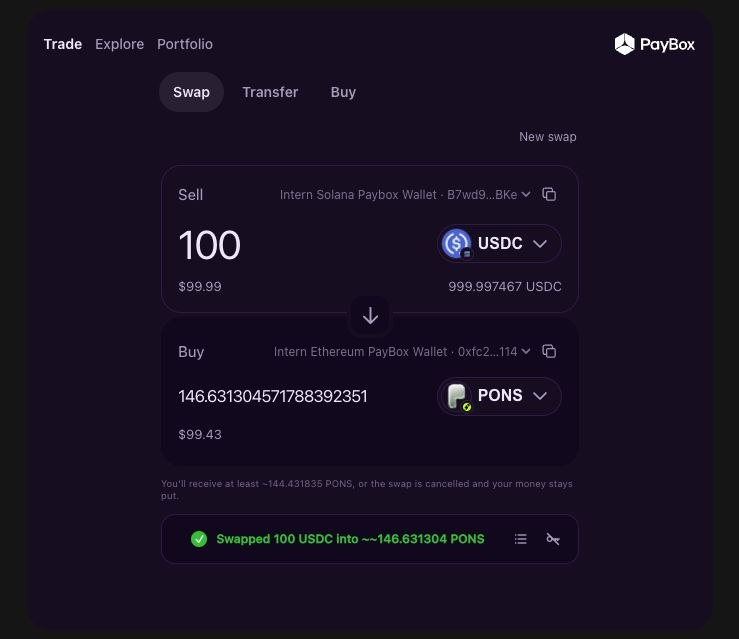
Robinhood Chain tokens can now be traded directly inside Claude, ChatGPT, and Grok via PayBox
Wealth Management and Displacing Traditional Finance
In 2026, Robinhood and TradePMR — a custodian platform serving registered investment advisers — showcased a joint offering at the SYNERGY26 conference, pointing toward Robinhood's ambitions in the registered investment adviser (RIA) and wealth management space. This is a significant expansion of scope: wealth management involves ongoing client relationships, fiduciary standards, and fee structures quite different from transactional brokerage.
The broader framing, echoed by observers of both Robinhood and Kraken, is one of financial displacement: the progressive absorption by fintech platforms of services traditionally provided by banks, wealth managers, and brokerages. Commission-free trading eliminated one revenue line from traditional brokers. Crypto custody took a share of a business dominated by custodian banks. Prediction markets are a new asset class that has no incumbent at scale. The question is whether Robinhood can compound these moves into durable, diversified revenue rather than cycling through whichever speculative category happens to be hot.
The Ark Invest portfolio adjustment — buying $18 million in Coinbase shares while trimming $29 million in Robinhood — reflects a view among at least some institutional observers that Coinbase's deeper infrastructure bets (tokenized stocks, Base network, institutional custody) position it more durably than Robinhood's primarily retail-transactional model. That may overstate the gap: Robinhood's prediction markets growth and international expansion represent genuine diversification. But the comparison underscores that Robinhood's competitive position is not static, and that Coinbase is the most direct benchmark for where crypto-forward retail finance is heading.
- 2021-12regulatory
Robinhood pays $45M SEC penalty for securities violations including identity theft and system failures
- 2023-08milestone
Robinhood agrees to buy back 605.8M shares seized from SBF by US government
- 2024-05regulatory
SEC issues Wells Notice to Robinhood Crypto for alleged securities violations
- 2024-06milestone
Robinhood announces acquisition of Bitstamp exchange
- 2024-10launch
Robinhood Wallet partners with Arbitrum for in-app token swaps
- 2025-01launch
Uniswap integrates Robinhood Connect for crypto purchases inside Uniswap mobile app
- 2025-03regulatory
Massachusetts opens investigation into Robinhood's March Madness prediction market linked to brokerage accounts
- 2025-06governance
Robinhood files 42-page SEC proposal for federal RWA token framework with on-chain settlement
Regulatory Context
Robinhood's crypto business has operated under substantial regulatory uncertainty for several years. In the U.S., the question of which crypto assets constitute securities — and therefore fall under SEC jurisdiction — remained unresolved through much of the early 2020s. Robinhood was among the platforms that received Wells Notices and navigated enforcement uncertainty by limiting which assets it would list.
A more favorable regulatory posture from U.S. financial regulators beginning in late 2024 and into 2025–2026 opened new product lines. The permission extended to Coinbase and Robinhood to offer crypto perpetual futures to U.S. retail customers — a product previously unavailable domestically — was significant both commercially and symbolically, signaling that U.S. regulators were prepared to allow retail participation in instruments common on offshore venues. Perpetual futures give traders leveraged exposure to crypto prices without an expiry date, and their availability on regulated U.S. platforms represents a meaningful expansion of the accessible product set.
The Multi-Venue Contest
Prediction markets are becoming a distribution business as much as a product category. The Block, citing the Wall Street Journal, reported that Robinhood is in talks with Crypto.com about adding that exchange's event contracts to its app. The report says a deal would let Robinhood supplement its present mix of Kalshi, ForecastEx, and Rothera contracts, although the talks may not result in an agreement. If the talks become a deal, they would widen Robinhood's supply of contracts; for now, they show how quickly the fight for retail liquidity is moving beyond a single venue.
Outlook
Robinhood enters the second half of the 2020s as something considerably more complex than the commission-free stock app that made its name. Its prediction markets business is scaling at a rate that few anticipated; its crypto platform is deepening through wallet infrastructure, asset expansion, and international acquisitions; and its AI integration and wealth management moves suggest it is serious about competing across the full financial services stack.
The key variables are execution and cycle management. The company's revenues remain sensitive to retail trading sentiment, which correlates strongly with crypto prices and general risk appetite. Managing staffing and cost structure through downturns — while maintaining product momentum — is the operational challenge that has tripped up fintech platforms in prior cycles. The competition from Coinbase, Schwab, and emerging onchain venues is intensifying rather than easing.
Whether Robinhood becomes the defining retail financial platform of the next decade or remains a high-beta proxy for speculative markets will depend largely on how it navigates that tension between growth and durability.
Latest Robinhood news
Robinhood Chain goes live on Zebec Cards, bringing network support to web and mobile with ETH integration planned next for everyday spendingNansen extends agentic trading platform to Robinhood Crypto Chain, now supporting 30+ chainsRobinhood Chain tokens can now be traded directly inside Claude, ChatGPT, and Grok via PayBox NetNet partners with OlympusDAO and Origami Finance on Robinhood Chain for hOHM bonding and liquidity
 HANDO launches robotics data network on Robinhood Chain, paying users in stock tokens for recording everyday tasks
 Retain launches liquidity tool for Robinhood Chain's tokenized asset pools
Sources
7 records from 5 domains
coindesk.com
cointelegraph.com
info.arkm.com
twitter.com
theblock.co
Community notes
Spot something off or out of date? Drop a note. Editors review topic notes daily and roll accepted fixes into the explainer — contributors are recognized in the monthly $SQUID drop.
Loading notes…
Help improve this topic
Have a story or tip about this topic? Submit it. See something missing? Leave a note. Editors review daily; accepted submissions and fixes count toward the monthly $SQUID drop.