
Deep dive on how the S&P 500 works, why it anchors global risk markets, and how its exposure is migrating onchain via prediction markets, tokenized index funds, and licensed perps—plus what this means for Bitcoin, DeFi, and crypto traders.
+14 sources across the wider coverage universe
 Artemis, S&P and Pantera launch the S&P Pantera Digital Asset Index, introducing standardized revenue metrics and outstanding supply to benchmark fundamentally strong crypto assets2026-07
 Base launches tokenized S&P 500 exposure via Centrifuge, enabling 24/7 onchain equity trading as Coinbase backs deRWA framework to bridge institutional assets with DeFi liquidity2026-05
 Hedgebook maps S&P 500 risks to Kalshi Prediction Markets. Ziminsky, a former fintech founder, sees it as a move toward complete markets where every risk has a tradable price on a regulated U.S. platform. Feedback praised its sleek design and hedging potential, though some questioned liquidity for real-world scale.2026-05
 S&P Dow Jones licenses the S&P 500 to crypto exchange Hyperliquid for the first 24/7 perpetual futures on the index, highlighting Wall Street’s push to tokenize traditional assets on blockchain2026-03
 Crypto majors slip as cooling Bitcoin ETF flows leave them lagging a nine-week S&P 500 rally, with HYPE the lone large-cap gainer2026-05
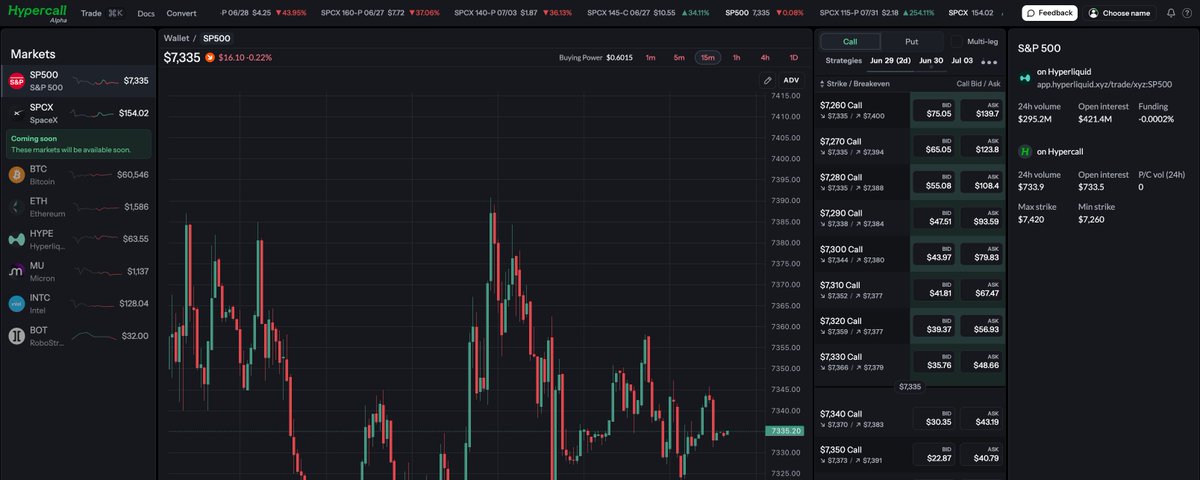 Hypercall brings S&P 500 options live next to SPCX with calls, puts, spreads, and strategy templates2026-06
S&P 500 And Crypto: Wall Street’s Benchmark In A Tokenized World
As Wall Street’s flagship equity benchmark, the S&P 500 tracks the share performance of 500 leading U.S. companies and has become the default yardstick for everything from pension funds to Bitcoin ETFs. As prediction markets, tokenized index funds, and onchain derivatives proliferate across platforms like Coinbase, Hyperliquid, and Base, understanding how the S&P 500 works—and how its risk, return, and valuation regimes spill over into crypto—is rapidly becoming foundational knowledge for digital-asset traders and builders.
What “S&P” Actually Means
In everyday markets discourse, “S&P” is shorthand for the S&P 500, a stock market index that tracks 500 of the largest and most influential public companies listed on U.S. exchanges. The index is maintained by S&P Dow Jones Indices, a joint venture majority owned by S&P Global, and is constructed as a public-float, capitalization‑weighted index, meaning each company’s weight is proportional to the value of its freely tradable shares. While it contains 500 constituents, the S&P 500 captures roughly 80% of the total market capitalization of U.S. public companies, making it an unusually comprehensive snapshot of the U.S. large‑cap equity universe. Because of that coverage and its long history, the S&P 500 has evolved into the primary benchmark against which professional money managers, ETFs, and even central‑bank policy outcomes are informally judged.
For a crypto audience more accustomed to tickers like BTC, ETH, or SOL, it is useful to think of the S&P 500 as a blue‑chip “index token” representing a diversified slice of corporate America, but implemented through conventional equity markets rather than blockchains. Each listed company issues shares that trade on stock exchanges such as the NYSE or Nasdaq; the S&P 500 aggregates the prices and free‑float shares of those stocks into a single index level according to a transparent formula. The index’s level does not represent investable capital by itself, but rather a calculated value derived from its constituents; investors gain exposure through mutual funds, ETFs, futures, options, and increasingly, tokenized and onchain derivatives that reference the index. As crypto infrastructure matures, more of these S&P exposures are being wrapped into forms that look and feel like onchain assets while still relying on traditional market data feeds and legal structures.
The S&P 500 also needs to be distinguished from the broader S&P brand, which spans credit ratings, sector indices, thematic benchmarks, and region‑specific composites. S&P Global’s credit ratings arm assigns ratings to sovereign and corporate debt, while S&P Dow Jones Indices manages thousands of indices across geographies and asset classes. For crypto traders, this ecosystem matters mainly as the licensing and data backbone behind products such as S&P‑linked perpetuals on Hyperliquid or tokenized index funds like deSPXA on Base, both of which rely on official S&P DJI data and intellectual property. When builders talk about “bringing the S&P onchain,” they are generally referencing the S&P 500, but they are tapping into a broader industrial infrastructure of index calculation, corporate actions processing, and real‑time data dissemination that has been refined over decades in traditional finance.
Importantly, the S&P 500 is not a static basket; it is curated by a committee, which periodically adds and removes companies based on criteria such as market capitalization, liquidity, financial viability, and sector representation. This curatorial process has implications for tokenized products and prediction markets because it means that “S&P 500 exposure” is not exposure to the same set of firms over time, but to an evolving list that tends to overweight the most successful large‑cap issuers and purge those that shrink or falter. For crypto‑native investors who often treat BTC or ETH as fixed‑supply, protocol‑defined assets, this dynamic rebalancing is conceptually different: owning the S&P 500 means owning a live, managed portfolio that automatically tilts toward the winners of the U.S. corporate economy and away from its losers.

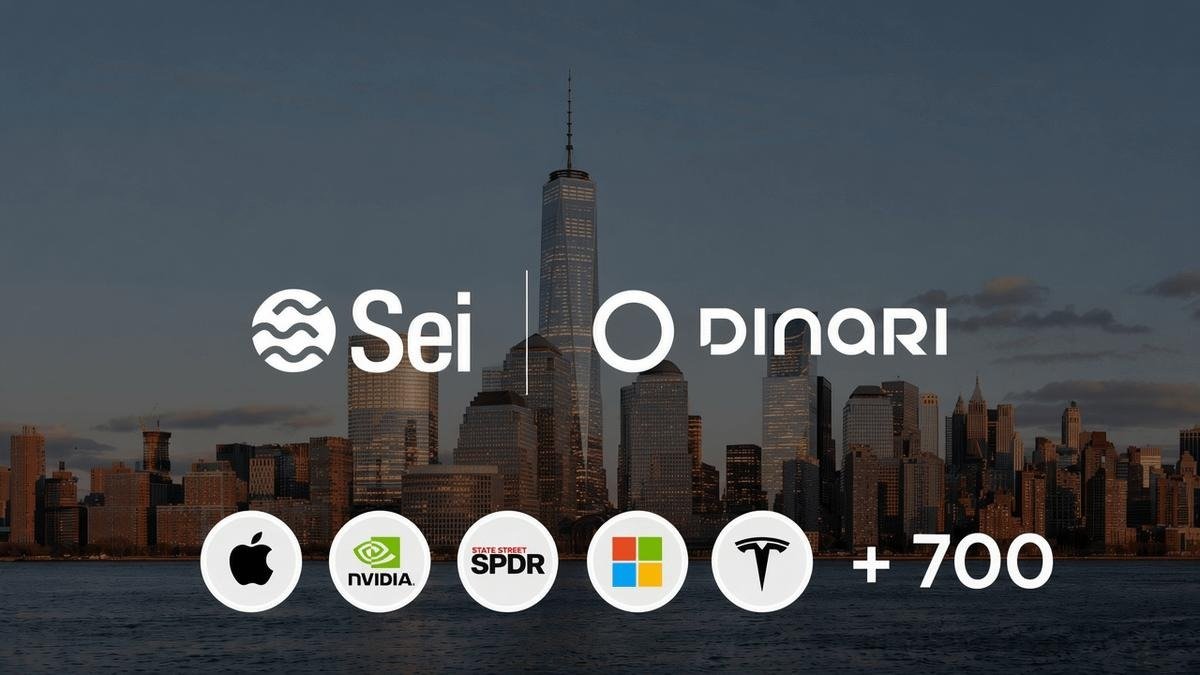
Tokenized S&P 500 stocks for U.S. investors are coming to Sei via DinariGlobal's dShares
How The S&P 500 Shapes Traditional Markets
The centrality of the S&P 500 in traditional finance stems from its role as both a performance benchmark and a risk‑transfer hub. In performance terms, the overwhelming majority of U.S. equity mutual funds and ETFs either track the S&P 500 directly or measure their success relative to it; fee disclosures and marketing materials routinely highlight “S&P 500 outperformance” or “tracking error” as key metrics for evaluating managers. Passive funds that faithfully mirror the index have become the default core holding in retirement accounts, 401(k) plans, and sovereign portfolios, reinforcing the S&P 500’s status as the de facto representation of “the U.S. stock market” in global asset allocation. This ubiquity matters for crypto because BTC, ETH, and tokenized RWAs are increasingly evaluated in relation to the opportunity cost of simply owning the index.
The S&P 500’s role as a risk‑transfer hub is equally important. Over time, a deep ecosystem of derivatives has grown around the index, including standardized futures, listed options, structured notes, and volatility products. Index futures allow institutional investors to hedge or gain exposure to broad U.S. equities with a single instrument, while options on the S&P 500 are among the most heavily traded derivatives in the world and are routinely used to express macro views on growth, inflation, and policy. The entire VIX ecosystem, for example, is built on implied volatility derived from S&P 500 options, making the index a key input into how markets price fear and uncertainty. That derivative superstructure is now being partially replicated in crypto through BTC and ETH options, but the original design space was sketched out in S&P 500 products over decades.
Valuation metrics built around the S&P 500 also anchor broader debates about bubbles, risk premia, and expected returns. One of the most widely cited tools is the cyclically adjusted price‑to‑earnings ratio, often called the Shiller PE or CAPE ratio, which smooths earnings over a decade to reduce the influence of the business cycle. In simplified form, the CAPE ratio equals the current index price divided by the inflation‑adjusted average earnings per share over the previous ten years, that is \( \text{CAPE} = \frac{P}{\text{average real earnings over 10 years}} \). Historically, elevated CAPE readings for the S&P 500 have often preceded periods of lower subsequent returns, such as after the late‑1990s dot‑com bubble, whereas lower readings have corresponded with more attractive long‑run entry points. When commentators argue that U.S. equities are “expensive” or approaching dot‑com‑era valuations, they are frequently referencing variants of this ratio applied to the S&P 500.
For crypto investors, the practical significance of these traditional valuation measures is twofold. First, they help determine the relative attractiveness of Bitcoin or other digital assets versus owning a broad portfolio of equities. If the S&P 500’s CAPE ratio is very high and expected forward equity returns look compressed, proponents of BTC’s “digital gold” narrative may find it easier to pitch Bitcoin as a superior store of value over a multi‑year horizon. Second, these valuations inform macro policy and asset‑allocation decisions among large institutions whose flows can indirectly influence crypto markets. When pension funds or family offices rebalance away from richly valued equities into alternatives, some of that capital may find its way into crypto funds, onchain strategies, or tokenized real‑world assets, even if the connection is second‑order.
Another critical dimension is concentration. Because the S&P 500 is capitalization‑weighted, a small handful of mega‑cap technology and growth stocks now account for a disproportionate share of the index’s level and daily moves. Stocks tied to artificial intelligence and cloud computing, such as Nvidia, have at times become the largest constituents in the index, meaning their earnings reports and guidance can move not only the S&P 500 but also correlated asset classes, including AI‑themed crypto tokens. Market commentary around Nvidia’s earnings frequently notes that a major beat or miss can ripple across everything from equity indices to commodities and speculative altcoins, reflecting the extent to which the S&P 500 acts as the nexus of cross‑asset risk sentiment. For crypto traders monitoring volatility in BTC and altcoins, tracking S&P 500 concentration and sector leadership is no longer optional.
Finally, the S&P 500 serves as the reference point against which alternative assets advertise outperformance. Studies of private markets, real estate, and niche categories like professional sports franchises often benchmark returns against the S&P 500 to highlight excess performance. One analysis of sports investments, for example, found that over six decades, sports assets have outperformed the S&P 500 by approximately 3% per year on average. While those figures may be attractive, access to such opportunities is typically reserved for ultra‑high‑net‑worth individuals and institutions, underscoring a recurring theme: the S&P 500 represents the accessible baseline, and outperforming it usually requires taking on additional illiquidity, complexity, or concentration risk. Crypto‑based tokenization efforts increasingly position themselves as a way to democratize these alternative return streams relative to the S&P 500 benchmark.
Crypto readers engage with 'S&P' as a three-register instrument simultaneously: a macro crash early-warning system where the index's worst days predict crypto contagion, a credentialing gatekeeper whose ratings and membership decisions validate or exclude crypto assets, and a product to tokenize — with the tension between those roles (not any single one) driving peak engagement.
S&P 500 Versus Bitcoin And Crypto: Returns, Cycles, And Correlations
The S&P 500’s importance for crypto becomes sharpest when comparing its performance profile to Bitcoin and other digital assets. Over long horizons, Bitcoin has dramatically outperformed the S&P 500 in total return terms, but with far greater volatility, sharper drawdowns, and heavier reliance on liquidity cycles and speculative sentiment. A historical comparison from 2011 to 2026 shows that over the latest ten‑year period, Bitcoin’s average annualized return was about 66.7%, versus roughly 15.0% for the S&P 500 over the same decade. Even over the most recent five‑year window, Bitcoin posted an average annualized return around 6.4% compared with approximately 13.9% for the S&P 500, reflecting how multi‑year drawdowns and sideways periods can compress realized returns for crypto even when cumulative gains from the early years are enormous.
On shorter horizons, the relationship can invert. In one recent twelve‑month period, the S&P 500 generated a total return of about 27.4%, while Bitcoin delivered a loss of roughly 21.3%, highlighting how equities can outperform crypto during phases when digital assets are consolidating or suffering from narrative fatigue. This pattern is visible in month‑to‑month flows as well. At one point in 2026, Bitcoin fell more than 16% over a single month while the S&P 500 gained around 5%, a divergence attributed partly to capital rotating into AI‑themed equities, gold, commodities, and high‑profile IPOs. In that episode, Bitcoin’s underperformance was framed by some large market participants as a loss of “momentum‑trade appeal,” underscoring how investor positioning can swing between BTC and the S&P 500 depending on which asset class offers the strongest combination of trend and liquidity.
The relative performance of crypto and the S&P 500 is therefore not a one‑way story of digital assets always beating stocks. In some years, crypto majors lag a grinding equity bull market, especially when Bitcoin ETF inflows cool and traders chase new themes in listed stocks instead. Commentaries have noted periods when crypto majors slipped as Bitcoin ETF flows cooled and the S&P 500 notched a nine‑week rally, with only a handful of large‑cap crypto tokens, such as HYPE on Hyperliquid, outperforming in an otherwise subdued digital‑asset tape. In other periods, the situation flips, with Bitcoin staging dramatic breakouts that leave equity indices behind; during those phases, cross‑asset traders may view the S&P 500 as a funding source for chasing crypto upside or as a hedging overlay against parabolic BTC gains.
From a macro‑risk perspective, both Bitcoin and the S&P 500 are sensitive to U.S. growth expectations, inflation trajectories, and Federal Reserve policy, but their correlation is unstable across cycles. When liquidity is abundant and real yields are low, both assets can rally together as part of a broader “risk‑on” environment, while during acute risk‑off episodes—such as pandemic shocks or systemic banking scares—both can sell off simultaneously as investors rush toward cash or short‑term Treasuries. In between those extremes, structural narratives can differentiate them. Bitcoin’s supply‑capped design and halving cycles underpin an investment thesis that it should outperform the S&P 500 over long horizons by absorbing monetary debasement and offering uncorrelated upside. Michael Saylor, for instance, has argued that Bitcoin could triple S&P 500 returns over time, suggesting an expected annual growth rate of roughly 30% for BTC versus approximately 10% for the index. Whether that forecast proves accurate, it reflects the prevailing expectation among many Bitcoin advocates that BTC should outrun traditional equities in exchange for higher volatility and drawdown risk.
At the same time, some of the speculative dynamics that drive Bitcoin also appear in S&P 500 options and leveraged equity products, blurring the distinction between “traditional” and “crypto” manias. Analysts have occasionally warned that speculative frenzies in S&P 500 options—manifested in extreme call buying, elevated implied volatilities, and concentrated positioning in mega‑cap tech names—could impact Bitcoin’s rally by altering hedge‑fund risk budgets and cross‑asset risk management. In one notable period, market‑making firm Wintermute described a sharp Bitcoin rally as resembling a short squeeze more than a “healthy” breakout, noting that while BTC climbed above key price levels, open interest jumped significantly and U.S. equities, including the S&P 500 and Nasdaq, continued pressing to fresh highs. That episode illustrates a key point: even when Bitcoin appears to be moving on idiosyncratic flows, the broader backdrop of S&P 500 risk appetite and positioning in related derivatives often shapes how sustainable those moves prove to be.
For Ethereum and other smart‑contract platforms, the analogy to the S&P 500 sometimes runs through historical comparisons. Analyst Tom Lee has likened Ethereum’s bottoming process to the S&P 500’s recovery after the 1987 crash, noting that at certain points ETH has traded materially below measures of realized value in ways reminiscent of equities after violent but ultimately non‑terminal episodes. While such analogies are imperfect, they highlight a growing tendency to interpret crypto price action using the same toolkit of valuation metrics, cycle analysis, and historical precedents that investors developed over decades in the S&P 500. As tokenized S&P exposures multiply onchain, that analytical cross‑pollination is likely to deepen.
To crystallize the return profile contrast, consider the following simplified comparison derived from long‑term historical data:
| Index | Last year total return | Last 5 years annualized | Last 10 years annualized |
|---|---|---|---|
| Bitcoin | −21.3% | 6.4% | 66.7% |
| S&P 500 | 27.4% | 13.9% | 15.0% |
These figures, drawn from backtests of Bitcoin and S&P 500 performance between 2011 and 2026, underscore that while Bitcoin’s ten‑year annualized returns dwarf those of the S&P 500, shorter windows can look very different, and diversification across both asset classes can meaningfully change a portfolio’s risk‑return profile.
Binary Options, Event Contracts, And S&P 500 Prediction Markets
One of the most striking developments at the intersection of the S&P 500 and crypto culture is the rise of prediction‑market style products that let traders express yes‑or‑no views on future index levels. In traditional derivatives markets, S&P 500 exposure historically came through linear instruments like futures and options, where payoffs depend smoothly on the difference between the realized index level and the strike price. Event contracts and binary options, by contrast, offer fixed payouts based on whether a specific condition is met, such as the S&P 500 closing above a certain threshold on a given date. This structure mirrors the “prediction market” designs popularized in crypto, where users buy tokens representing “yes” or “no” outcomes and the market price converges toward an implied probability.
On regulated U.S. platforms like Kalshi, S&P 500‑linked event contracts allow participants to trade on questions such as where the index will close at year‑end or how high it will get during a given year. Kalshi’s markets are structured so that each contract pays \(1\) dollar if the specified condition holds and \(0\) otherwise, with the trading price in cents corresponding to the implied probability that the event will occur. For instance, Kalshi lists a market on the S&P 500’s maximum level during 2026, with one contract resolving “Yes” if the index trades above 7,799.99 between the start of 2026 and January 1, 2027. At one point, the “Yes” side of that contract traded around 79 cents, implying a crowd‑sourced probability near 79% that the S&P 500 would reach that threshold before year‑end. Crucially, Kalshi emphasizes that such contracts can be used not only for speculation but also for hedging, allowing traders with direct S&P 500 exposure through instruments like 401(k)s to offset macro risk related to broad equity moves in a simple, cash‑settled format.
Other regulated brokers have begun to adopt similar structures. Robinhood, for example, offers event contracts that let users take positions on whether specific outcomes will occur, including financial benchmarks. Each event contract on Robinhood is a binary derivative where traders choose “Yes” if they think an outcome will happen or “No” if they think it will not, and the contract settles at \(1\) dollar if the selected outcome is correct or \(0\) if it is wrong. Robinhood stresses that these are financial derivatives, not bets, and requires customers to open a dedicated derivatives account with eligibility criteria such as being a U.S. resident, holding an individual brokerage account, and residing in a state where such contracts are permitted. The trading interface presents prices in cents, making the implied odds intuitive to users familiar with crypto prediction markets or sports‑betting style interfaces, even though the underlying regulatory regime treats them as derivatives rather than gambling products.
Crypto‑native platforms have taken the concept further by embedding S&P 500 questions directly into onchain prediction markets. Polymarket, an Ethereum‑based prediction platform, regularly hosts more than a hundred active markets tied to the S&P 500, covering topics such as whether the index will outperform Bitcoin and gold over a given period. A typical market might pose a question like “Bitcoin vs. Gold vs. S&P 500 in 2026,” allowing traders to buy outcome shares in the asset they believe will exhibit the best performance. Each outcome is tokenized, and the price of a “Yes” share at, for example, 30 cents would correspond to a 30% implied probability that that outcome wins. Markets resolve based on official results sourced from recognized data providers, and Polymarket aggregates more than two million dollars in trading volume across its S&P‑related markets, offering a real‑time window into crowd sentiment about the index’s future trajectory.
Major U.S. crypto exchanges have begun to experiment as well. Coinbase has introduced prediction‑market style contracts where each position represents a binary payoff of \(1\) dollar if an event happens and \(0\) if it does not, with the price reflecting the market’s assessment of the event’s probability. While Coinbase’s early prediction markets span a variety of topics, the design closely mirrors Kalshi‑style event contracts and Polymarket’s onchain markets, suggesting that S&P 500‑linked questions could easily be integrated into crypto exchange products as a user‑friendly way to trade macro views. The convergence of user experience between regulated derivatives platforms and onchain prediction markets is a notable trend: regardless of whether settlement occurs in dollars in a CFTC‑supervised clearinghouse or in USDC on a smart contract, the core mechanic of buying a binary payoff tied to the S&P 500 is similar.
The most significant development on the traditional brokerage side is Charles Schwab’s reported plan to work with Cboe on S&P 500 “yes‑or‑no” binary options contracts, effectively joining the prediction‑markets race from within mainstream brokerage infrastructure. According to reports, Schwab and Cboe are exploring retail‑facing event contracts linked to daily S&P 500 outcomes, structured as “yes or no” instruments whose payoffs resemble prediction‑market trades but are packaged as options or event contracts within existing derivatives frameworks. Cboe has been studying options on event contracts as demand for simple yes/no market structures grows, and any Schwab product would likely require regulatory approval and careful design to fit within U.S. derivatives rules. The key nuance is that, unlike crypto prediction tokens, these would not be onchain assets or decentralized markets; instead, they would represent a traditional wrapper that brings prediction‑market logic into legacy brokerage accounts, potentially at massive scale.
Bridging these worlds, specialized apps like Hedgebook are emerging to translate stock‑specific risk into S&P 500 event‑contract exposures. Hedgebook has launched a mobile application that maps roughly 500 S&P 500 companies to 47 macro event contracts listed on Kalshi, allowing investors to hedge equity portfolios through regulated prediction markets instead of conventional options. The app connects traditional equity holdings to Kalshi’s event‑contract infrastructure and positions itself as a new tool for hedging macroeconomic risks, such as interest‑rate paths or index‑level ranges, in a more granular and capital‑efficient way. By linking S&P 500 stocks to a menu of macro contracts, Hedgebook effectively creates a distribution layer for prediction markets that traditional offshore platforms like Polymarket cannot easily replicate under U.S. law. For crypto‑native traders accustomed to DeFi dashboards and composability, this kind of “hedging middleware” offers a hint of how S&P‑linked prediction markets could ultimately plug into wallets, portfolio trackers, and custodial interfaces.
For a crypto audience, the takeaway is that the S&P 500 is increasingly being sliced into yes/no propositions across both regulated and onchain venues. Binary structures inspired by crypto prediction platforms are migrating into mainstream brokers like Robinhood and potentially Schwab, while onchain markets like Polymarket and Coinbase predictions experiment with similar designs using stablecoins and smart contracts. This convergence suggests a future where macro risk transfer—traditionally the province of S&P 500 futures and options—is partially mediated by binary S&P 500 event contracts that feel culturally closer to crypto than to legacy finance, even when the settlement rails remain offchain.

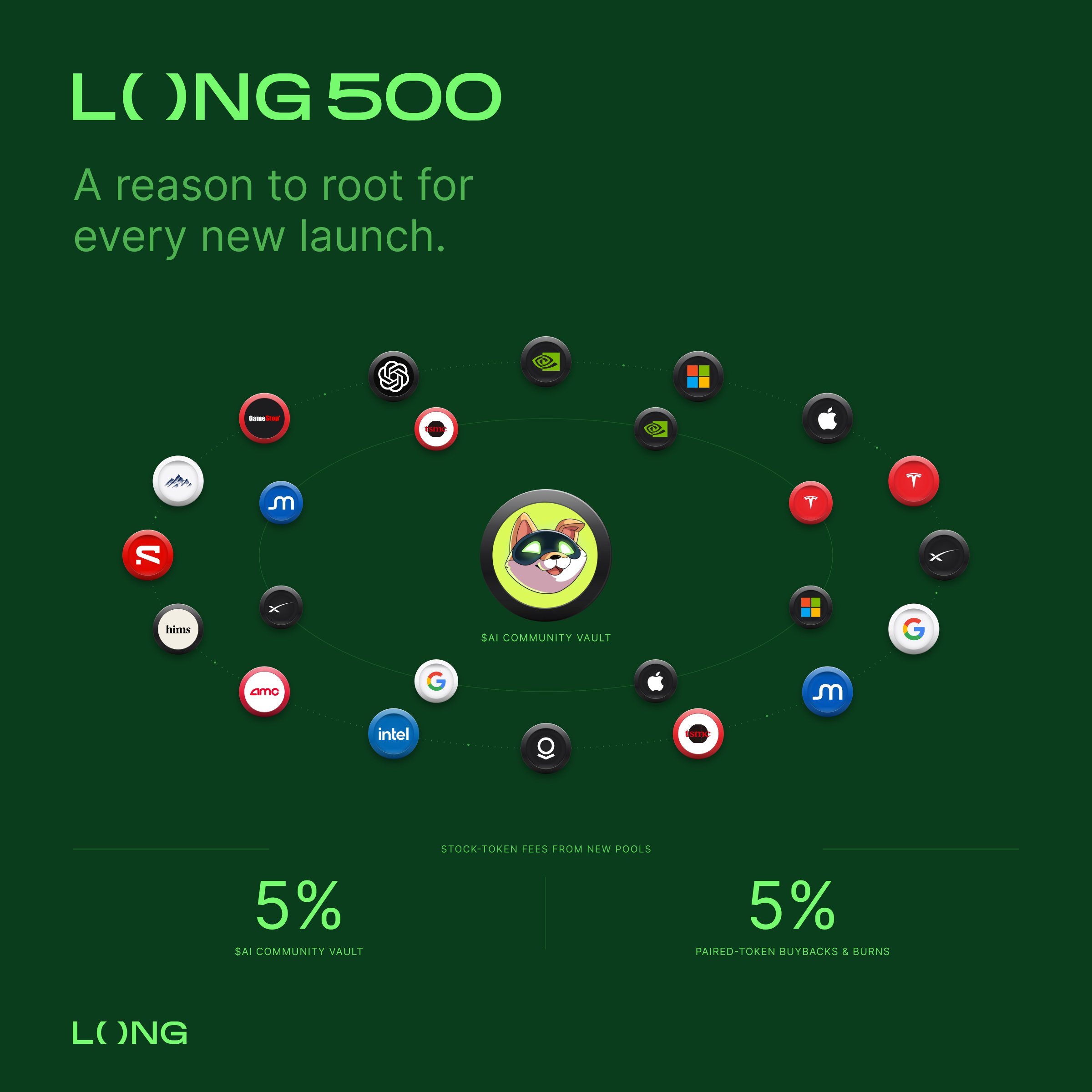
LONG unveils LONG 500, aiming to become the S&P 500 of tokenized stocks
Onchain S&P Exposure: Tokenized Indices, RWAs, And Perpetuals
Beyond betting on S&P 500 outcomes, crypto markets are beginning to offer direct, tokenized exposure to the index itself. One prominent example is deSPXA, a tokenized asset launched by Centrifuge on the Base blockchain, which provides non‑U.S. users with exposure to the Anemoy S&P 500 Index Fund (SPXA). SPXA is built under license from S&P Dow Jones Indices and is managed by Janus Henderson, a major asset‑management firm, ensuring that the underlying index exposure is anchored in conventional fund structures and official S&P data. The deSPXA token represents a claim on this offchain fund and lives on Base, a permissionless Ethereum Layer 2, where it can be held in wallets, used in DeFi protocols, and potentially integrated into onchain lending markets. This design effectively wraps S&P 500 exposure into a crypto‑native form without discarding the regulatory and operational apparatus of a traditional index fund.
Centrifuge frames deSPXA as an example of “productive RWAs,” emphasizing that S&P 500 index exposure that functions as usable collateral is a key differentiator between passive tokenized assets and real‑world assets that meaningfully expand DeFi’s balance sheet. In this framing, a token that merely tracks the S&P 500 price is less interesting than one that can be rehypothecated into lending protocols, used to back stablecoins, or combined in structured products, turning yield from the underlying equities into composable onchain cash flows. By integrating deSPXA into DeFi money markets, protocols can allow users to borrow against diversified U.S. equity exposure, similar to how they currently lend against ETH, liquid‑staking tokens, or tokenized U.S. Treasury bills. This creates a new collateral tier that blends traditional equity beta with crypto‑native financial engineering.
At the derivatives layer, S&P 500 exposure is also moving onchain through perpetual futures. S&P Dow Jones Indices has licensed the S&P 500 to Trade[XYZ] to launch a perpetual derivative contract on Hyperliquid, a decentralized derivatives platform. This product is notable for being described as the first and only officially licensed S&P 500 perpetual, powered directly by institutional‑grade index data from S&P DJI rather than synthetic or reverse‑engineered feeds. The S&P 500 perpetual on Hyperliquid offers non‑U.S. investors leveraged exposure to the index via a digitally native product designed for 24/7 trading on a decentralized platform, extending a benchmark traditionally accessible only during U.S. market hours into the always‑on crypto trading environment. Because it is a perpetual swap rather than a dated future, positions can be held indefinitely, with funding‑rate mechanisms used to keep the contract price anchored to the underlying S&P 500 index level.
This Hyperliquid listing represents the extension of S&P DJI’s trusted benchmark exposure into the rapidly growing market for crypto perpetual derivatives. In contrast to unlicensed synthetic S&P products that have appeared in the past, the partnership ensures that index levels, corporate actions, and rebalancing are all governed by the same institutional‑quality data used by traditional asset managers. For crypto traders, the implications are significant. They can now place leveraged S&P 500 trades using stablecoins or other crypto collateral, manage basis trades between onchain perps and offchain futures, and integrate equity beta into onchain strategies without relying on centralized intermediaries during execution. At the same time, the presence of an official license underscores the importance of intellectual‑property and regulatory compliance when bringing marquee traditional indices into DeFi.
Tokenized S&P 500 exposure via products like deSPXA and Hyperliquid’s S&P perpetual also interacts with Bitcoin and ETH narratives. If onchain users can seamlessly toggle between BTC, ETH, and S&P 500 exposure in the same wallet, on the same chain, using the same interfaces, the mental boundary between “equities” and “crypto” begins to erode. A user might post S&P 500 collateral in a lending market, borrow stablecoins against it, and then deploy those stablecoins into DeFi yield strategies or leverage up on BTC via onchain derivatives, all without touching a traditional brokerage account. That workflow turns the S&P 500 into just another building block in composable onchain finance, even if the ultimate economic exposure still rests on U.S. corporate earnings.
- 01S&P 500 macro crash contagion
Single-day multi-trillion-dollar wipeouts and tariff-driven futures drops pulled readers who treat S&P as the primary leading indicator for whether risk-off conditions will cascade into crypto markets.
- 02Tether vs S&P ratings authority
S&P assigning USDT its lowest possible stablecoin stability score — citing opaque reserves and weak collateral — and Tether's CEO publicly calling the agency a TradFi defender sparked the sharpest legitimacy fight between crypto and institutional ratings infrastructure to date.
- 03S&P 500 onchain perpetual trading↗
Hyperliquid's licensed 24/7 S&P 500 perp hitting $100M volume on day one proved that tokenized TradFi index products have immediate product-market fit with crypto traders who want round-the-clock equity exposure.
- 04Coinbase S&P 500 index inclusion
Coinbase replacing Discover Financial in the index was read as an industry-wide legitimacy inflection point and seeded immediate speculation about which crypto firm joins next and whether the index itself eventually migrates onchain.
- 05Tokenized S&P 500 DeFi collateral↗
Centrifuge's licensed SPXA fund on Base — tradeable, borrowable against, and deployable in stablecoin vaults 24/7 — represented the DeFi-native endgame of bringing regulated equity index exposure fully onchain.
- 06AI-model S&P drawdown scenarios
Citrini's projection of a 38% S&P drawdown driven by agentic AI structurally impairing the mortgage market attracted readers connecting macro AI disruption risk directly to crypto portfolio hedging strategy.
S&P 500 As Collateral, Benchmark, And Foil In The RWA Era
The expansion of S&P 500 products into tokenized form is part of a broader trend toward real‑world assets (RWAs) becoming core to DeFi. Industry participants like Morpho’s Paul Frambot have argued that RWAs—including U.S. Treasuries, private credit, and equity indices such as S&P 500 exposure via deSPXA—represent the largest untapped market for onchain lending. In this vision, the S&P 500 serves as both a collateral layer and a benchmark for evaluating the risk‑adjusted returns of DeFi strategies that involve tokenized offchain assets. A lending protocol might compare the expected yield on loans backed by S&P 500 collateral against those backed by U.S. Treasury tokens or by volatile crypto collateral, using the index’s historical volatility, drawdown profile, and correlation with crypto markets to calibrate risk parameters.
Sports assets provide a useful foil here. Over the past six decades, investments in professional sports franchises have reportedly outperformed the S&P 500 by roughly 3% annually, highlighting the appeal of niche real‑world assets as potential sources of excess return. Yet, despite this performance, access remains extremely limited: an estimated three billion sports fans worldwide have little direct opportunity to invest in equity stakes of their favorite teams, and the aggregate opportunity in sports assets has been estimated in the trillions of dollars. Tokenization advocates often argue that bringing fractionalized sports ownership onchain could democratize that outperformance relative to the S&P 500, but the index remains the baseline comparator for whether such tokenized assets are delivering “alpha.” In a similar way, tokenized S&P 500 exposures function as the baseline RWA building block, against which other tokenized assets—from invoices to private credit to sports revenue shares—are measured.
Within DeFi portfolios, S&P 500‑backed tokens can operate as pseudo‑stable collateral that still participates in global growth. Unlike stablecoins pegged to fiat, S&P 500 tokens embed equity risk and upside; unlike ETH or governance tokens, they are tied to underlying earnings and dividends from hundreds of companies. This hybrid profile could make them attractive as base collateral in money markets, particularly for sophisticated users who want their collateral to appreciate over time rather than remain fiat‑anchored. From a risk‑management perspective, protocols need to consider how S&P 500 drawdowns interact with crypto market stress. During systemic selloffs, both equities and crypto may fall together, weakening the diversification benefits of S&P collateral. On the other hand, in scenarios where equities grind higher while crypto trades sideways or corrects, S&P collateral could improve protocol solvency and reduce liquidation risks.
The S&P 500 also remains the benchmark against which flagship crypto narratives are tested. When commentators observe that “the S&P is at all‑time highs but people cannot afford gas,” they are highlighting perceived dislocations between financial asset performance and real‑economy conditions, which in turn bolster arguments for alternative systems of value storage like Bitcoin. Similarly, critiques that “less than ten companies own the future” are, in part, critiques of the S&P 500’s concentration, where a handful of mega‑cap tech firms account for an outsized share of index returns. Those critiques resonate in crypto circles that emphasize decentralization and open access, even as crypto markets themselves often exhibit winner‑take‑most dynamics in the form of dominant layer‑1s or DeFi protocols. In this context, tokenizing S&P 500 exposure onchain and using it as collateral may be seen both as co‑opting and subverting the existing system: DeFi protocols are using Wall Street’s benchmark yield to bootstrap permissionless financial primitives.
Practical Uses Of S&P 500 Signals And Products For Crypto Traders
For active crypto traders, the S&P 500 is not just a background index; it is a practical trading signal and a source of hedging and relative‑value opportunities. On a basic level, crypto desks track intraday and multi‑day S&P 500 moves as a proxy for global risk sentiment. Sustained rallies in the S&P 500 often correspond to risk‑on conditions that are supportive of BTC and altcoin flows, while sharp index drawdowns can presage liquidations and deleveraging in crypto perps, especially when driven by macro events like central‑bank surprises or geopolitical shocks. Traders monitor correlations and beta estimates between BTC and the S&P 500 to size positions and set hedge ratios, even though those relationships are inherently unstable over time.
With the advent of onchain S&P 500 perpetuals on Hyperliquid, crypto users can now trade index risk alongside BTC and ETH on the same margin and collateral stack. A fund might, for instance, express a relative‑value view that Bitcoin will outperform U.S. equities by going long BTC perps and short S&P 500 perps in a delta‑neutral or beta‑neutral configuration. Alternatively, a crypto‑native market‑maker might keep a small S&P 500 hedge book onchain to offset exposure to tokenized RWAs or stablecoins whose value may be sensitive to U.S. equity risk. Because Hyperliquid’s S&P 500 perp runs 24/7 using live S&P DJI data, traders can also use it to hedge weekend risk between Friday’s U.S. stock market close and Monday’s open, a period traditionally associated with gap risk in equity indices.
Prediction markets and event contracts add another layer of tools. A crypto investor with a large BTC position but limited S&P 500 exposure might still have a view on whether U.S. equities will finish a year above or below a given level. Instead of trading index futures, they could buy or sell Kalshi contracts that pay \(1\) dollar if the S&P 500 closes within a specified range at year‑end, using relatively small amounts of capital to express directional or hedging views. For example, a cautious investor might buy “Yes” contracts on Kalshi’s question about the S&P 500’s year‑end level falling in a lower range as a hedge against a broad equity market selloff that could also pressure crypto. Similarly, users of Coinbase’s prediction markets or Polymarket could position around questions like whether the S&P 500 will outperform Bitcoin over a given year, turning macro asset‑allocation views into explicit, tradable propositions.
Products like Hedgebook show how S&P 500 prediction markets can be combined with stock‑specific portfolios to create hedging overlays for both equity and crypto investors. By mapping hundreds of S&P 500 companies to a curated set of 47 Kalshi event contracts, Hedgebook enables users to plug their existing portfolios into a macro hedging layer that is simpler and more standardized than bespoke options trades. A similar approach could be applied in crypto, where a portfolio of tokenized S&P 500 exposures and BTC might be linked to a basket of S&P 500 event contracts and BTC options on a central venue or DEX, creating a multi‑asset risk‑management stack that blurs the line between prediction markets and conventional hedging. In that world, the S&P 500 is both the underlying risk factor and the reference for how effectively a combined crypto‑equity strategy is performing.
Retail‑friendly event contracts from brokers like Robinhood and, potentially, Schwab further democratize access to S&P 500 binary payoffs, but they also introduce significant risk for inexperienced users. Because each contract settles at either \(1\) dollar or \(0\), small changes in implied probability late in the life of the contract can translate into large percentage swings in contract value, especially when traders employ leverage or layer multiple event bets. Crypto traders accustomed to volatile perp exchanges and high‑leverage DeFi platforms may find these dynamics familiar, yet the S&P 500 underlying can lull some into a false sense of safety. The reality is that event contracts on benchmark indices can be just as unforgiving as meme‑coin trades if mismanaged, particularly when concentration in index heavyweights amplifies day‑to‑day volatility around earnings or macro news.
In building and evaluating onchain products around the S&P 500, developers must also navigate complex regulatory and intellectual‑property terrain. Using S&P 500 branding and official index levels typically requires licensing agreements with S&P Dow Jones Indices, as demonstrated by the deSPXA token’s linkage to an S&P‑licensed index fund and Hyperliquid’s officially licensed S&P 500 perpetual. Synthetic or unlicensed attempts to replicate S&P 500 exposure onchain may run into legal friction or data‑quality issues, whereas licensed products must balance compliance with DeFi’s preference for permissionless composability. The emerging pattern suggests that serious S&P 500 onchain products will increasingly be built through collaborations between crypto teams, traditional asset managers, and index providers rather than as purely grassroots experiments.
- 2025-02milestone
S&P 500 begins shedding $3.6T from Feb 18 peak amid tariff escalation
- 2025-04milestone
S&P 500 single-day $2.4T loss — steepest drop since March 2020
- 2025-05regulatory
Trump tariffs on Apple iPhones and 50% EU tariff proposed; Dow futures fall 500 pts
- 2025-06milestone
Coinbase added to S&P 500, replacing Discover Financial
S&P Dow Jones licenses S&P 500 index to Hyperliquid for first 24/7 crypto perpetual futures
- 2025-08regulatory
S&P Global Ratings constrains Tether with lowest stablecoin stability score; Tether CEO publicly rejects ruling
Centrifuge launches SPXA — first licensed S&P 500 index fund on Base, usable as DeFi collateral
Morpho integrates deSPXA as productive collateral asset in onchain stablecoin vaults
Outlook
The S&P 500 has long stood at the center of global finance, but its relationships with crypto markets are deepening and becoming more structurally important. For Bitcoin and other digital assets, the index functions simultaneously as a benchmark competitor, a macro risk barometer, and an increasingly interoperable onchain building block. Tokenized S&P 500 exposures like deSPXA, officially licensed S&P perpetuals on platforms such as Hyperliquid, and the proliferation of S&P‑linked prediction markets on Kalshi, Polymarket, Coinbase, and soon mainstream brokers like Schwab and Robinhood, all point to a world where equity index risk is tradable on the same rails and with the same cultural grammar as crypto assets.
For crypto traders and builders, the practical imperative is clear. Understanding how the S&P 500 is constructed, valued, and traded—across spot, derivatives, event contracts, and tokenized wrappers—is no longer a niche concern. It is a prerequisite for navigating cross‑asset flows, designing robust DeFi protocols, and evaluating whether Bitcoin or other tokens are delivering returns commensurate with their risk relative to the long‑established benchmark of U.S. large‑cap equities. As onchain finance matures, the S&P 500 will likely persist as both the yardstick and the counterparty: the baseline return to beat, the macro factor to hedge, and increasingly, a programmable, composable exposure embedded directly into crypto’s evolving market structure.
Latest S&P news
Sources
19 records from 15 domains
en.wikipedia.org
tradingview.com
x.com
kalshi.com
coinbase.com
centrifuge.io
curvo.eu
lynalden.com
spglobal.com
predictionnews.com
wublockchain.xyz
pluang.com
morningline.io
robinhood.com
polymarket.com
Community notes
Spot something off or out of date? Drop a note. Editors review topic notes daily and roll accepted fixes into the explainer — contributors are recognized in the monthly $SQUID drop.
Loading notes…
Help improve this topic
Have a story or tip about this topic? Submit it. See something missing? Leave a note. Editors review daily; accepted submissions and fixes count toward the monthly $SQUID drop.