
Deep explainer on crypto seed phrases: how BIP‑39 mnemonics work, why they’re “master keys” for Bitcoin and multi‑chain wallets, real‑world theft and recovery cases, security best practices, legal/tax implications, and emerging seedless wallet designs.
+10 sources across the wider coverage universe
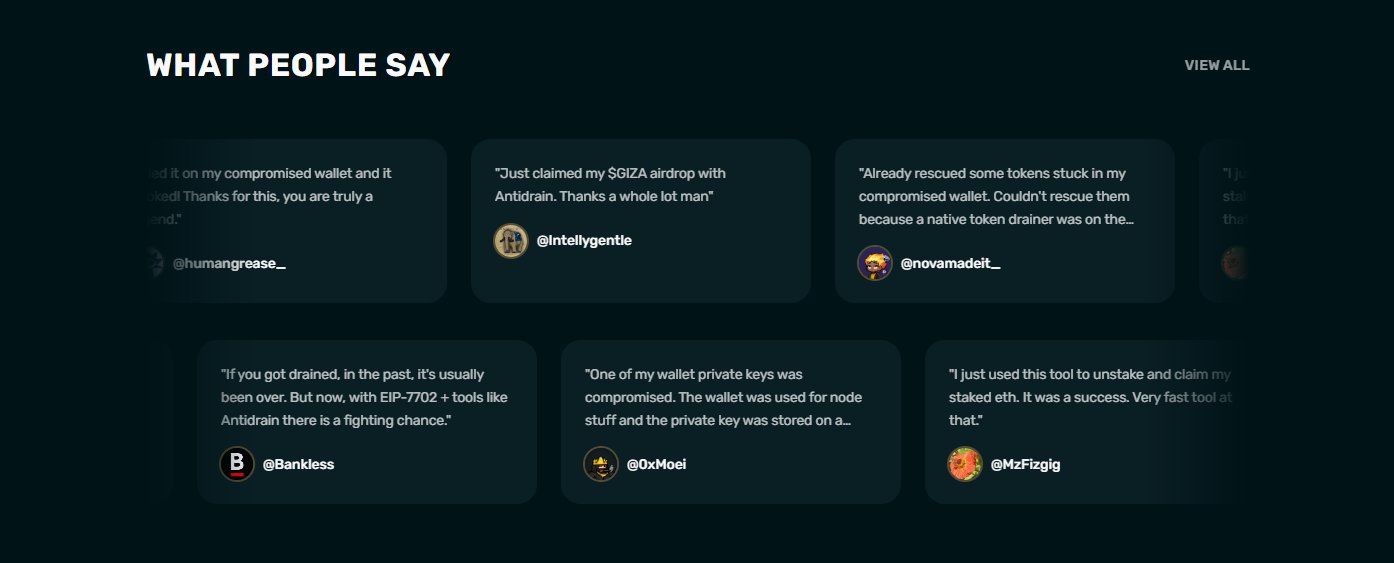 Solo developer launches 5 working products from seed recovery tool to batch bridging and NFT rescue, highlighting speed of execution and low barrier to building in crypto today2026-04
 Microsoft warns Tor-based crypto clipper spreads via USB shortcuts to steal seed phrases and swap wallet addresses2026-06
 Kaspersky exposes active OkoBot malware targeting hundreds across 25+ countries with crypto wallet and seed phrase theft2026-07
 Counterfeit Ledger Nano S Plus with embedded WiFi sold on Chinese marketplace, steals seed phrases via fake Ledger Live2026-04
 UK court in awe after woman is allegedly accused of stealing 2,323 BTC worth $176M after allegedly using CCTV to capture husband’s seed phrase and wallet access2026-03
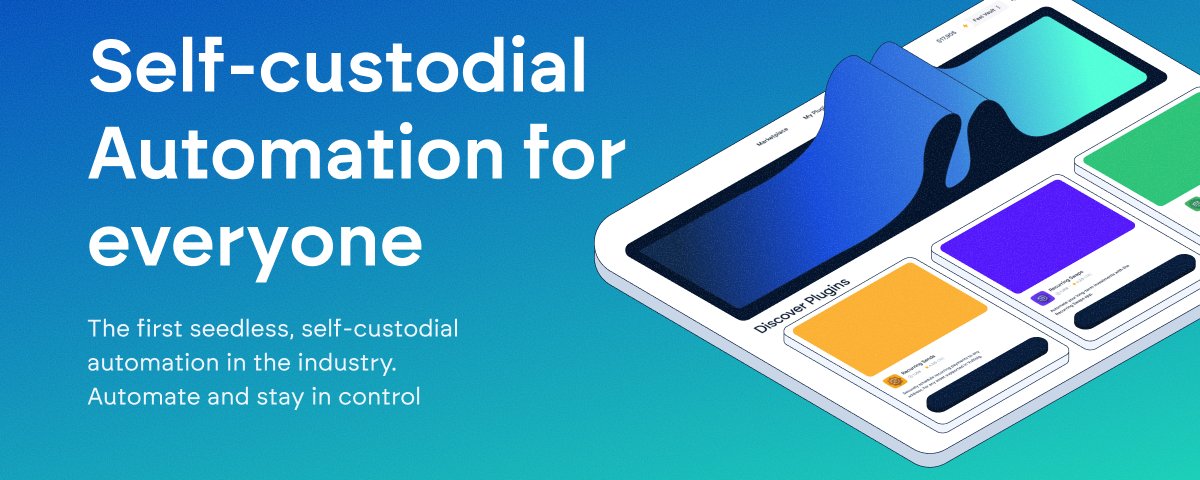 Vultisig launched its Plugin Marketplace, introducing the first fully self-custodial, on-chain automation layer that enables DCA, payroll, and other automated actions across 30+ chains without exposing keys or seed phrases.2026-02
Seed Phrases: The Master Keys of Self-Custodial Crypto
A seed phrase is a sequence of 12–24 human-readable words that encodes the cryptographic secret from which a crypto wallet can deterministically regenerate all of its private keys and addresses, making it a single point of backup—and a single point of failure—for self-custodied digital assets. In modern Bitcoin and multi-chain wallets, these phrases are typically generated under the BIP‑39 standard, which transforms high-entropy random numbers into strings of words drawn from a fixed 2048‑item list, allowing users to restore entire wallets across compatible apps and devices while concentrating extreme security risk in a deceptively simple piece of text.
What Is a Seed Phrase?
The term seed phrase refers to a standardized way of representing a cryptographic secret as a series of ordinary words, such as “garden taxi moon …,” that a person can read, write down, and re‑enter into software. Wallets also describe this secret as a recovery phrase, backup phrase, or mnemonic phrase, but in each case the underlying concept is the same: the words encode all of the data needed to regenerate the private keys that control your coins or tokens on public blockchains. In a typical non‑custodial wallet, this phrase is shown to the user once during setup, with strong warnings to record it offline and keep it hidden, because anyone who later learns the phrase can reconstruct the same keys and spend the associated assets without further permission. The phrase itself is never stored on chain; it is a local representation of secret key material that stays, in principle, entirely in the user’s possession.
Although seed phrases feel like passwords, they are conceptually different from login credentials used for centralized exchanges or banking apps. A password authenticates you to a server that keeps its own database of accounts; a seed phrase, by contrast, is the root of a mathematical process that generates your keys, which in turn are the only way to authorize transactions recorded on a public ledger like Bitcoin or Ethereum. If you lose your exchange password, the operator can reset it after verifying your identity; if you lose your seed phrase and any device that still holds it, there is no help desk, because the blockchain protocols themselves do not know who you are or what your seed once was. Conversely, if someone steals your seed phrase, you cannot “revoke” it in the way you might cancel a stolen credit card; the thief can simply import the phrase into another wallet, derive the same private keys, and empty the accounts at will.
In everyday discourse, people sometimes conflate seed phrases with private keys, but technically a seed phrase, as defined by BIP‑39, encodes the entropy from which a wallet derives a binary seed value, which then feeds into a hierarchical deterministic (HD) wallet scheme such as BIP‑32 to generate many private keys from a single root. A private key is a single 256‑bit number that proves control over one blockchain address, whereas a seed phrase is a compact representation of the root data from which potentially thousands of private keys and addresses can be deterministically generated. For this reason, security experts often describe the seed phrase as a kind of fingerprint or “master key” for all assets held in a BIP‑39–compliant wallet, and they emphasize that protecting it is even more critical than protecting any individual private key. The design choice to let one seed regenerate many keys is what allows users to back up complex wallets with a single phrase, but it also means that a single leak can compromise an entire portfolio across multiple chains and accounts.
The language and standards around seed phrases emerged from the Bitcoin ecosystem as the community converged on BIP‑39, a proposal that introduced mnemonic codes for deterministic wallets. Before HD wallets, users had to back up each private key or wallet file separately, a process that was cumbersome and error‑prone, especially as people began to generate new addresses for privacy. BIP‑39 addressed this by specifying how to convert a block of random bits into a sequence of words from a precisely defined list, making it straightforward to write down or engrave a backup that could later be loaded into any compatible wallet implementation. Although BIP‑39 was engineered in the context of Bitcoin, its simplicity and interoperability have led to widespread adoption across multi‑currency software and hardware wallets, including those that support Ethereum, Solana, and many other networks, which means a single phrase can now anchor a cross‑chain portfolio.
To clarify how seed phrases relate to other core concepts, it is useful to compare them directly with private keys and with optional wallet passphrases, which are sometimes called a “25th word.”
| Concept | What it represents | Typical form | What it controls | Where it usually lives |
|---|---|---|---|---|
| Private key | A single secret number used to sign transactions for one or more blockchain addresses | 256‑bit value, often hex | One account or a small set of addresses | Inside wallet software or hardware device |
| Seed phrase | Human‑readable encoding of entropy from which a wallet derives a seed and then many private keys | 12–24 words from a fixed list | All accounts and assets under a deterministic wallet | Written offline; sometimes securely in hardware |
| Wallet passphrase | Optional extra password combined with the mnemonic to derive a different seed | Arbitrary text chosen by user | A distinct or “hidden” wallet derived from same words | Only in user’s memory or secure notes |
This structure underlines why modern crypto culture treats seed phrases as sacred secrets. They are not mere convenience features; they are the linchpin of non‑custodial control, the element that separates true self‑sovereign ownership from accounts managed by exchanges or fintech apps. At the same time, they have become a focal point for both human error and sophisticated attacks, from malware designed to scrape clipboard contents to elaborate social engineering that tricks victims into typing phrases into fake support pages.

Solo developer launches 5 working products from seed recovery tool to batch bridging and NFT rescue, highlighting speed of execution and low barrier to building in crypto today

Five products all handling seed phrases, bridging, and NFT recovery — every one sitting at the layer where a single bad dependency means total fund loss. The EVM tooling stack (viem, multicall, bridge SDKs) genuinely makes this solo-dev velocity possible now, but "unaudited tool that touches your private keys" is also the exact profile of most wallet drainers on Ethereum. Niche is real though — big protocols won't build recovery and batch tooling for power users — just verify source before handing over key material.
How Seed Phrases Work Under the Hood
Under the BIP‑39 standard, generating a seed phrase begins with raw randomness, known in cryptography as entropy. The wallet first creates an initial entropy value of \(ENT\) bits, where \(ENT\) must be one of \(128, 160, 192, 224, 256\) bits, with 128 bits corresponding to a 12‑word phrase and 256 bits to a 24‑word phrase. This entropy is typically sourced from operating system random number generators, hardware noise, or dedicated secure elements in hardware wallets, and its unpredictability is crucial; if the entropy is biased or predictable, an attacker could feasibly guess the resulting phrase. Higher entropy means more possible combinations and therefore more resistance to brute‑force guessing, which is why 24‑word phrases with 256 bits of entropy are considered extraordinarily strong by current cryptographic standards.
Once the wallet has generated the entropy, BIP‑39 requires a checksum step to help detect errors when the phrase is written or typed. The wallet computes the SHA‑256 hash of the entropy and takes the first \(ENT/32\) bits of this hash as a checksum, then appends these checksum bits to the end of the original entropy. For example, if the entropy is 128 bits, the checksum length is \(128/32 = 4\) bits, producing a total of 132 bits; for 256‑bit entropy, the checksum adds 8 bits, for a total of 264 bits. This combined bitstring is then segmented into groups of 11 bits, because \(2^{11} = 2048\), exactly matching the size of the standardized BIP‑39 wordlist. Each 11‑bit group is interpreted as an integer index from 0 to 2047, which selects one word from that list; the sequence of words, in order, becomes the mnemonic sentence shown to the user.
The construction of the word list itself is an underappreciated piece of engineering. In the English list, there are 2048 carefully chosen words, and one design goal is to avoid ambiguity and minimize confusion when the words are written by hand or read over a noisy channel. Notably, the list is crafted so that the first four letters of each word are unique, which means that even if a user later truncates each word after four letters when re‑entering or verifying, software can still unambiguously determine the intended full words. For instance, the word “access” appears in the list, and no other word begins with “acce,” so these four letters are enough to identify it. The list also avoids words that are offensive, extremely similar to each other, or easily misspelled, striking a balance between memorability and robustness in multiple languages.
After the mnemonic sentence is created, most wallets do not use the words directly as keys. Instead, BIP‑39 specifies a key‑stretching step that transforms the mnemonic into a binary seed using the PBKDF2 function with HMAC‑SHA‑512. In this process, the mnemonic, normalized as UTF‑8 text, is used as the password input, and the salt is the string “mnemonic” concatenated with an optional passphrase, again encoded in UTF‑8. The PBKDF2 function is run with 2048 iterations and outputs a 512‑bit (64‑byte) seed, which is then used as the root input for a deterministic wallet scheme such as BIP‑32. This stretching step serves several purposes: it adds defense against brute‑force attacks by increasing the computational cost of testing each candidate mnemonic, incorporates the optional passphrase, and outputs a uniform seed that downstream wallet code can handle without concern for the original word configuration.
At the next layer, hierarchical deterministic (HD) wallets, of which BIP‑32 is the canonical example, define how to derive a tree of private and public keys from a single seed in a repeatable way. Each branch of the tree can correspond to a different blockchain, account, or change address, and standard derivation paths have been adopted so that different wallet implementations can agree on which sequence of keys corresponds to, say, a Bitcoin receiving address versus an Ethereum ERC‑20 token account. The key point for users is that as long as the same mnemonic and passphrase are provided, the wallet will reproduce the same entire structure of accounts, balances, and transaction histories, regardless of whether it is running on a hardware device, a mobile app, or a desktop client. This portability is what allows someone to lose a phone or hardware wallet and yet fully regain access to their funds on a new device simply by restoring from the seed phrase.
The optional passphrase feature, sometimes colloquially described as a “13th word” for 12‑word seeds or “25th word” for 24‑word seeds, adds another dimension of security and flexibility. Technically, the passphrase is not drawn from the BIP‑39 word list and is not constrained in the same way; it can be any string of characters chosen by the user, such as a sentence, a code phrase, or a long random password. During seed derivation, the wallet concatenates this passphrase with the word “mnemonic” to form the salt passed into PBKDF2, meaning that even if two users have identical mnemonic word sequences, differing passphrases will yield entirely unrelated seeds and therefore unrelated wallets. This property allows advanced users to create “hidden” wallets that look innocuous without the passphrase while holding significant funds behind a passphrase‑protected version, providing a form of plausible deniability if the basic mnemonic is ever coerced or exposed. However, it also introduces a second secret that must be remembered or backed up; if the passphrase is lost or mis‑recorded, the wallet derived with it becomes unrecoverable even if the mnemonic words remain intact.
From a security perspective, the size of the BIP‑39 key space is enormous. A 12‑word mnemonic with 128 bits of entropy has \(2^{128}\) possible combinations, while a 24‑word mnemonic with 256 bits has \(2^{256}\) possibilities, numbers so vast that exhaustive brute force is effectively impossible with any conceivable classical computing technology. Educational demonstrations of “seed cracking” exploit the much smaller search space that arises when only one or two words are missing and the rest are known; for example, if a single 11‑bit word is missing and the checksum structure is leveraged, a consumer computer can iterate through a few hundred or a few thousand possibilities in seconds or minutes. With two missing words, the number of combinations grows into the millions, which is still tractable for optimized software and modern hardware over hours or days, but once three, four, or more words are unknown, the combinations explode into the billions and beyond, making recovery increasingly impractical. Security educators emphasize that anyone claiming to “crack” an entire lost seed phrase or guess half of it is almost certainly running a scam, often designed to trick victims into revealing partial seed information or other wallet secrets.
Tools such as mnemonic recovery utilities illustrate both the possibilities and the dangers of this partial search approach. Open‑source projects exist that allow users to input a seed phrase with one or two unknown words, specified by placeholders, and have the software iterate through all valid BIP‑39 combinations to identify the one that corresponds to a given wallet address or balance. When run offline by technically competent users, such tools can help recover funds from slightly corrupted backups, such as where handwriting has smudged or one word is illegible. However, the same tools, when offered through web interfaces or closed‑source binaries, pose enormous risk; entering a full or nearly full seed phrase into any untrusted software or website can instantly compromise the associated assets. For this reason, wallet manufacturers and security experts advise extreme caution with any “seed recovery service,” especially those that ask users to upload their phrase or even photographs of handwritten backups.
Readers click seed phrase stories not for cryptographic mechanics but for institutional betrayal: the highest-engaged headlines all feature a trusted party — police bodycams, a hardware wallet company's own firmware, a government tax agency, a spouse — as the exposure vector, not a remote hacker.
Seed Phrases in the Broader Crypto Stack
Seed phrases sit at the heart of self‑custodial crypto, but their role and visibility vary dramatically depending on whether a user is interacting through a non‑custodial wallet, a centralized exchange, or a newer “seedless” interface that abstracts keys away entirely. In traditional non‑custodial software wallets such as browser extensions and mobile apps, the user is responsible for safeguarding the seed; the wallet encrypts the keys locally with a password or biometrics, but it never sends the seed phrase to a server, and there is no way for the provider to restore access if the phrase is lost. Phantom’s Solana wallet is a clear example: when a bug in an iOS update reset some users’ apps, those who had not stored their recovery phrases found themselves locked out of their accounts with no recourse, forcing the company to remind users that as a non‑custodial provider, it cannot recover lost seeds or funds. This model delivers strong sovereignty but places a heavy operational burden on individuals.
In contrast, custodial exchanges such as major centralized trading platforms typically do not expose seed phrases to end users at all. Instead, the exchange generates and manages private keys on its own infrastructure, mapping them to user accounts in an internal database. Customers log in with email and passwords, two‑factor codes, or hardware security keys, but they never see the underlying seeds that actually control the on‑chain funds. This model simplifies the user experience and permits password resets, customer support, and compliance processes familiar from traditional fintech, but it means that users must trust the operator not only to secure its keys but also to remain solvent and honest. Some companies straddle both worlds: Coinbase, for example, offers a custodial exchange alongside a non‑custodial wallet product where users set up their own 12‑word recovery phrases and are explicitly warned that anyone with that phrase can import the wallet and drain it. The existence of both models within a single brand can sometimes blur user expectations about who is actually holding the keys.
The line becomes even more complex with services built on top of self‑custodial infrastructure. Coinbase Commerce, designed for merchants to accept crypto payments, became the center of a seed‑phrase controversy when a withdrawal page at a Coinbase Commerce subdomain prompted users to type their 12‑word seed phrases into a web form to recover funds as the product wound down. Security researchers from firms such as SlowMist and independent on‑chain analysts criticized this flow because it normalized the act of entering a seed phrase into a website, directly contradicting a core security norm that “no legitimate service will ever ask for your recovery phrase.” Critics warned that the page, and easily cloneable lookalike sites, created a highly effective phishing template precisely because it was hosted at an official Coinbase domain and instructed users to do something they are otherwise told never to do. Although Coinbase has offered alternative withdrawal methods considered safer by some researchers, the incident illustrates how even major industry players can inadvertently undermine hard‑won user education around seed phrase handling.
At the opposite end of the spectrum, a new generation of “seedless” user experiences aims to remove phrases from the onboarding process entirely. A high‑profile example is Kraken’s integration of on‑chain trading for over 2500 Solana‑based tokens directly within its mobile app, positioned explicitly as requiring “no extra wallets, no seed phrases, no complicated setup.” From the user’s perspective, this looks and feels like trading on a centralized exchange, yet behind the scenes, Kraken is routing orders through on‑chain venues on Solana, handling key management internally so customers never see a recovery phrase. Similarly, experimental platforms and rollups in the decentralized AI and DeFi space promote flows where users log in with familiar identities such as Google accounts, swipe cards, or make API calls without installing MetaMask or writing down phrases, often leveraging account abstraction or multi‑party computation to manage keys in a more transparent way for developers.
Even in these newer architectures, however, seed phrases or equivalent root secrets almost always exist somewhere in the system, whether in user devices, secure enclaves, or distributed among multiple parties in a threshold scheme. Multi‑party computation (MPC) wallets split signing authority among several servers or devices so that no single machine ever holds the full private key, yet the system still embeds a root key whose compromise could be catastrophic if the MPC implementation is flawed. Similarly, automation platforms like Vultisig’s plugin marketplace, which advertises self‑custodial on‑chain actions such as dollar‑cost averaging and payroll across many chains “without exposing keys or seed phrases,” still rely on underlying cryptographic secrets that must be generated and stored somewhere, even if the user never interacts with them directly. The shift is less about eliminating seeds at a technical level and more about changing where and how they are managed and who bears responsibility for their protection.
The multi‑chain nature of modern crypto magnifies both the power and the risk of seed phrases. A single BIP‑39 phrase can often be imported into different wallets that each focus on different ecosystems, such as Bitcoin, Ethereum, or Solana, and, depending on derivation paths, it may unlock corresponding accounts and balances on each network. This interoperability is convenient, allowing users to carry a single backup rather than a separate secret for every coin, but it also means that a leak can expose a wide array of assets, some of which the holder may have forgotten about. Hardware wallets such as Ledger devices emphasize this by framing the recovery phrase as a “fingerprint” or “master key” for all blockchain assets secured by the device, regardless of the number of accounts or supported coins. The more value and diversity of assets anchored to a single phrase, the stronger the incentives for attackers—and the more pressing the need for careful storage strategies that account for theft, fire, water damage, and eventual inheritance.

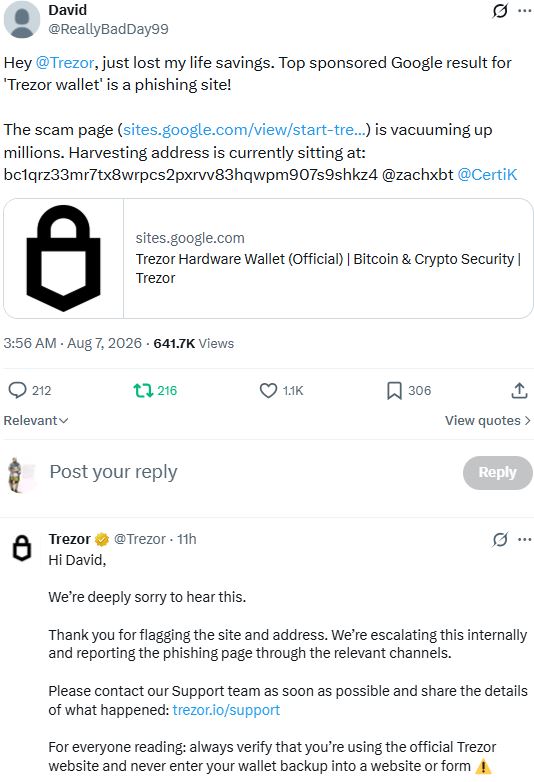
Crypto user loses life savings to fake Trezor ad on Google; Trezor apologizes and warns against entering seed phrases on websites.
Security Risks and Real-World Incidents
Because a valid seed phrase grants its holder total, irrevocable control over all assets derived from it, it has become one of the highest‑value targets in the digital world. Unlike passwords for centralized services, which can be reset or invalidated, a seed phrase is inextricably linked to the keys that govern on‑chain accounts, and blockchains are designed precisely to resist arbitrary reversals or rollbacks. This means that once an attacker learns a phrase—whether through malware, phishing, physical theft, or social engineering—they can typically import it into their own wallet software, generate the same private keys, and initiate transactions to move funds to addresses they control, with no practical way for the victim or any authority to claw the assets back. The decentralization and censorship resistance that make public blockchains attractive also remove many of the safety nets that users take for granted in systems like credit cards or bank transfers.
Modern malware ecosystems have adapted aggressively to target crypto assets, including seed phrases. Microsoft’s threat intelligence team recently documented a Windows‑based cryptocurrency clipper campaign that combines clipboard inspection, wallet‑address replacement, and Tor‑based command‑and‑control, spreading via worm‑like propagation through malicious shortcut files on removable drives. Once installed, this malware monitors clipboard contents for anything that resembles a crypto address and silently replaces it with an attacker‑controlled address when the user attempts to paste it into a transaction form, a tactic designed to redirect outgoing payments without being noticed. The same malware can also inspect clipboard or file contents for sequences that look like mnemonic phrases or private keys, exfiltrating them via a local SOCKS5 proxy on localhost port 9050 to remote operators. Microsoft recommends hardening against such attacks by restricting script engines like WScript and PowerShell, disabling AutoRun for removable media, and monitoring for suspicious combinations of script execution and Tor traffic, highlighting how deeply the presence of crypto has penetrated enterprise security considerations.
Phishing and fake software represent another major vector for seed theft. Cybersecurity researchers have uncovered counterfeit versions of widely used hardware wallets, such as Ledger Nano devices, being sold through online marketplaces, sometimes modified with extra components like Wi‑Fi modules or flashing instructions that direct buyers to fake “Ledger Live” interfaces. In some cases, victims have been tricked into entering their seed phrases into malicious apps or websites posing as official wallet software, immediately exposing their funds to theft. Because legitimate wallets and manufacturers repeatedly emphasize that they will never ask users to divulge their 12‑ or 24‑word recovery phrases outside of the device’s secure setup or recovery process, any external request for such a phrase should be treated as a red‑flag indicator of fraud. Nonetheless, social media platforms periodically see waves of fake accounts impersonating major projects and wallets, inviting users to “verify” their accounts, connect wallets, or share seed phrases to claim airdrops or resolve support tickets, exploiting confusion among newer participants.
The Coinbase Commerce incident, in which a legitimate Coinbase subdomain hosted a page asking merchants to enter their 12‑word seed phrases into a plain‑text web form to withdraw funds, illustrates how even trusted brands can inadvertently erode this crucial norm. While the page was designed to help businesses transition as Coinbase Commerce was wound down and directed users to import their phrases into other wallets, security experts criticized it for normalizing behavior that scammers constantly try to induce. Researchers noted that because the front‑end code was easily cloneable, attackers could quickly spin up fake versions that looked nearly identical, further confusing users about when, if ever, it is safe to type a phrase into a browser. Despite Coinbase offering alternative withdrawal methods that did not require direct seed entry, the decision to keep the seed‑phrase page online drew sustained criticism within the security community, underscoring how fragile and contested seed‑handling conventions remain even more than a decade into Bitcoin’s history.
Not all seed compromises are digital. Some of the most dramatic thefts and losses have arisen from physical exposure or inadvertent leaks in photographs and videos. In South Korea, a tax authority accidentally included a clear image of a seized hardware wallet and a handwritten sheet showing the wallet’s full mnemonic phrase in a press release related to a tax enforcement action. Shortly after the photo was published, roughly 4.8 million dollars’ worth of tokens associated with the wallet were transferred out to unknown addresses, prompting investigations into how quickly attackers had noticed and exploited the mistake. The episode starkly demonstrated that a seed phrase photographed and posted online, even briefly, should be considered immediately compromised, and that agencies handling seized crypto must cultivate operational security practices as stringent as any private asset holder’s.
Another widely discussed case, now proceeding through courts in the United Kingdom and referenced in U.S. legal commentary, involves allegations that an estranged wife used home surveillance cameras to capture her former husband’s hardware wallet seed phrase and later transferred 2,323 bitcoin, worth over 170 million dollars, to addresses she controlled. Legal analyses of the case note that in jurisdictions like California, cryptocurrency acquired during marriage can be treated as community property, and spouses have fiduciary duties to disclose such assets during divorce. They also highlight how a seed phrase exposed even momentarily to household cameras, phones, or shared spaces can be captured without the owner’s knowledge, transforming domestic disputes into high‑stakes cyber‑crime investigations. Family law experts now advise clients to treat seed phrases like social security numbers—never writing them where cameras can see them, never leaving them accessible in shared homes, and ensuring that any backups are locked away in safes or safety deposit boxes beyond the reach of casual observation.
Platform bugs and user error reveal a different facet of seed‑phrase risk: the danger of not having a secure, accessible backup when something goes wrong with wallet software or hardware. Phantom’s iOS wallet incident, in which an update caused some users’ apps to reset and appear empty, left affected users dependent on their recovery phrases to restore access to their funds. Phantom stressed that only those who had their recovery phrases securely stored could regain control, while those who relied solely on the app’s continued operation faced permanent loss, because as a non‑custodial provider the company does not store or know user keys. Similar scenarios arise when phones are lost, hardware wallets are destroyed in fires or floods, or laptop drives fail; in each case, the seed phrase is the only bridge back to the on‑chain assets. These incidents underscore that while seed phrases are a primary target for thieves, they are also a critical safety net for honest users and that neglecting backups can be as dangerous as mishandling them.
Law enforcement and regulatory agencies are increasingly encountering seed phrases during investigations, sometimes using them to seize criminal proceeds and other times accidentally endangering assets through mishandling. In Australia, for example, the AFP‑led Criminal Assets Confiscation Taskforce reported restraining around 9.3 million dollars’ worth of cryptocurrency linked to an alleged criminal enterprise after a data specialist deciphered the account’s seed phrase by analyzing digital devices seized during a raid. With that phrase, authorities could access the suspect’s wallet and transfer the funds into secure law enforcement custody, illustrating how forensic analysis of confiscated phones and computers now routinely includes searching for wallet backups and mnemonic phrases. At the same time, the South Korean tax office leak shows that once such phrases are in the hands of government agencies, any failure to protect them can result in the same sort of irreversible theft that private holders face, raising questions about operational standards for public institutions holding seized crypto.
Human stories of loss and recovery highlight both the brittleness and resilience of the seed‑phrase model. Newsrooms have reported on individuals who, after years of believing their coins were irretrievably lost, rediscovered old notebooks containing fragments of seed phrases or wallet backups and used modern tools, including AI chatbots, to piece together the correct combinations and recover significant sums. In one widely discussed case, a man reportedly recovered five bitcoin, nearly 400,000 dollars at contemporary prices, after a large‑scale brute‑force attempt on wallet passwords failed but an AI assistant helped match an old handwritten seed phrase from college notes to a 2019 backup file. Stories like this underscore that even when other credentials are forgotten, the persistence of a correctly recorded seed phrase can preserve wealth across many years and software generations. By contrast, countless anecdotes—often impossible to verify but entirely plausible given the math—describe fortunes that will remain forever inaccessible because the only copies of their owners’ seed phrases have been lost, burned, or thrown away.
These narratives intersect with more technical recovery efforts such as those described by educators who analyze the feasibility of reconstructing wallets from partially missing mnemonic words. Creators have documented on‑chain rescues where one missing BIP‑39 word required tens of thousands of attempts to find the correct combination, a tractable but non‑trivial computational challenge. In broader public education, experts emphasize that while such partial recovery can sometimes succeed when only one or two words are missing and the rest are known, there is no realistic method for recovering a seed phrase that has been entirely forgotten or reduced to vague memories, because the search space is simply too large. The same mathematical properties that protect honest users from brute‑force attacks also make true loss permanent, heightening the stakes around how seed phrases are generated, stored, and used.
- 01surveillance and physical exposure↗
Stories where a camera — bodycam during an arrest or home CCTV in a divorce — became the attack surface hit hardest, because they collapse the security model down to a single line of sight.
- 02hardware wallet company trust↗
Ledger's firmware update extracting encrypted seed phrases and a counterfeit Ledger sold with embedded WiFi forced readers to ask whether the device meant to protect them was itself the threat.
- 03seed phrase alternatives going mainstream↗
Launches from Avara, Coinbase, Vultisig, and Consensys/Web3Auth all promised to eliminate seed phrases entirely, signaling that the UX tradeoff is being resolved and readers are tracking who gets there first.
- 04law enforcement forensics cracking wallets↗
AFP's Operation Kraken and the bodycam arrest showed that seed phrase security now cuts both ways — what protects a legitimate holder can also shield a criminal, and investigators are finding ways through.
- 05partial seed recovery and rescue tools↗
The story of brute-forcing a wallet from one missing word resonated because it sits at the intersection of catastrophic loss and unexpected salvation — a scenario every holder quietly fears.
- 06malware and supply-chain theft vectors↗
A Tor-propagating USB clipper and a WiFi-embedded counterfeit hardware wallet showed readers that seed phrase theft has moved beyond phishing into persistent, worm-like and physical-layer attacks.
Best Practices for Generating, Storing, and Using Seed Phrases
Given the enormous power and corresponding risk of seed phrases, the crypto industry has converged on a set of best practices for their generation and storage, even as details vary by threat model and user sophistication. For most people, the safest and simplest approach is to let reputable wallet software or hardware generate the phrase using built‑in cryptographic random number generators that conform to BIP‑39, ensuring that the entropy and checksum are correctly computed. Well‑designed wallets display the phrase only once, require the user to confirm or re‑enter some or all of the words to verify correct recording, and then encourage secure offline storage, often with strong language about the irreversibility of loss or theft. Because the quality of randomness and correctness of implementation are critical, users are generally advised to avoid obscure or unvetted wallets, especially those that deviate from standard BIP‑39 behavior or attempt to “improve” on it in proprietary ways without open scrutiny.
For highly security‑conscious users who wish to reduce trust in wallet software, manual generation methods based on physical randomness are sometimes recommended. One such approach involves using fair dice and the published BIP‑39 wordlist: the user rolls dice repeatedly to generate a string of random numbers, then maps these numbers to indices in the wordlist, constructing a seed phrase without relying on the wallet’s internal random number generator. Another variation uses calculators with random functions or other offline tools to create entropy that is then converted to a mnemonic via known algorithms, sometimes implemented in open‑source scripts that can be audited and run on air‑gapped machines. While these methods can, in principle, increase assurance that the seed is not influenced by malware or backdoors, they also introduce opportunities for human error and are generally recommended only for advanced users capable of verifying each step and keeping detailed, secure records of the outputs. For most retail participants, the marginal security gain may not outweigh the complexity and the risk of mistakes.
Regardless of how a seed phrase is created, a few core principles dominate advice on storage. First, the phrase should be kept offline, meaning it should not exist in any form on internet‑connected devices such as cloud notes, email drafts, phone photo galleries, or password managers, because these are all vulnerable to remote compromise. Incidents such as the South Korean tax authority’s accidental publication of a seed phrase photo and ongoing waves of phishing and malware attacks illustrate how quickly a digital copy can leak and be exploited. Second, the phrase should be recorded in a durable medium that can withstand accidents; while writing on paper is a common starting point, experts recommend laminating paper backups to protect against water and considering metal backup devices made from steel or similar materials that can survive fires and floods. Hardware wallet companies and security services now market purpose‑built metal plates and capsules for this purpose, and many guides suggest storing them in fireproof home safes or bank safety deposit boxes.
Determining how many backups to create and where to store them involves balancing redundancy against exposure. Having only a single copy of a seed phrase stored in one location, such as a home safe, concentrates risk in that site; a burglary, fire, or natural disaster could render it inaccessible and permanently strand the associated assets. Creating multiple backups, perhaps in separate secure locations such as a personal safe and a bank deposit box, reduces the risk of physical loss but increases the number of opportunities for theft or inadvertent disclosure. Security professionals advise tailoring this balance to the value of the assets and the user’s personal risk profile; for example, an individual with modest holdings might accept slightly higher theft risk to avoid overly complex storage schemes, while a fund managing substantial treasuries might employ multi‑site, multi‑factor arrangements with strict access controls, audits, and contingency plans. In all cases, users are warned never to leave seed phrases visible to cameras, cleaners, guests, or co‑workers, and to avoid using everyday office supplies like sticky notes or unlocked drawers for long‑term storage.
Operational hygiene also extends to when and how a seed phrase is used. In principle, a user should only need to input their phrase during two types of events: initial wallet setup (where the wallet displays it and asks for confirmation) and wallet recovery or migration (where the user re‑enters it to reconstruct keys on a new device). Outside these contexts, any request for the full phrase should be treated with extreme skepticism. Security guidance repeatedly emphasizes that a seed phrase should never be typed into a website, entered into a browser form, shared over chat or email, or spoken aloud to anyone claiming to be support staff, regardless of whether the request appears to come from an official account or domain. The Coinbase Commerce controversy shows that exceptions created by legitimate platforms can sow confusion, so users are increasingly advised to adopt the simple personal rule that they will never, under any circumstance, type their seed phrase into a standard web page, even if a help article suggests doing so.
When performing legitimate recovery, experts recommend doing so in as controlled an environment as possible. This may mean temporarily disconnecting from the internet, using a clean or dedicated computer, and verifying that no remote‑access software, screen‑recording tools, or clipboard‑monitoring programs are running, in order to reduce exposure to malware such as crypto clippers. After recovery, the phrase should not remain in any temporary files, screenshots, or auto‑complete caches; users should avoid pasting it into text editors or password managers that sync to the cloud. Some hardware wallets allow recovery entirely within the device, using small screens and physical buttons so that the phrase never passes through a general‑purpose computer or smartphone at all, further reducing attack surface but requiring more careful manual entry. For larger balances, security professionals sometimes advise splitting holdings across multiple wallets and phrases, using one “hotter” wallet for everyday transactions and keeping the bulk of funds in a “cold” wallet whose seed phrase is rarely if ever exposed after initial setup.
Advanced strategies can increase resilience but also add complexity. Introducing an optional passphrase effectively creates a two‑factor key: the mnemonic words plus the passphrase, both of which must be correct to derive the intended wallet. This can protect against scenarios where a seed phrase is discovered without the additional secret, such as a burglar finding a backup or an adversary coercing disclosure of the words but not the memorized passphrase. However, because the passphrase is never written into the mnemonic and is not stored by wallet manufacturers, losing it can render funds permanently inaccessible even if the seed phrase itself is still known. Multisignature (multisig) setups—where spending requires signatures from multiple keys, often stored in separate locations or controlled by different people—distribute trust and can protect against both individual key compromise and theft, but they typically involve multiple seed phrases or key shards and demand careful planning around backup, recovery, and governance.
Techniques inspired by Shamir’s secret sharing offer another layer of sophistication by allowing a seed phrase to be split into several shares such that any subset of a threshold number of shares can reconstruct the original secret, while fewer shares reveal nothing. For example, a “2‑of‑3” scheme might distribute shares among a personal safe, a trusted attorney, and a safety deposit box, ensuring that no single theft or loss can compromise assets and that at least two locations must be accessible for recovery. Implementations of Shamir‑like schemes in consumer wallets aim to make this process more user‑friendly, but mismanagement of shares—such as storing them together, labeling them poorly, or forgetting which threshold was chosen—can negate the benefits. As with all advanced setups, the value protected must justify the complexity and the potential for errors in documentation.
Planning for inheritance, divorce, and taxes complicates seed‑phrase management further, because legal systems and human relationships intersect with cryptographic realities. In family law contexts like California’s, cryptocurrency acquired during marriage can be considered community property, and spouses have legal obligations to disclose and not misappropriate such assets, regardless of who holds the seed phrase. Cases where one spouse hides or secretly transfers coins using a phrase unknown to the other can lead to severe legal consequences, including courts awarding the entire asset to the wronged spouse plus attorney’s fees if misappropriation is proven. At the same time, if a holder dies or becomes incapacitated without leaving clear, secure instructions for trusted heirs to access their seed phrases or recovery mechanisms, significant wealth can be lost forever, since courts cannot order blockchains to reassign funds and wallet providers may not have any technical ability to help.
Crypto tax enforcement also interacts with seed‑phrase practices. Agencies like South Korea’s National Tax Service, which seized and then lost crypto after leaking a wallet’s seed phrase in a photo, demonstrate that governments are both seizing on‑chain assets and grappling with the operational challenge of securing the associated keys. As law enforcement units such as Australia’s Operation Kraken deploy analysts capable of extracting and deciphering seed phrases from seized digital devices, it becomes clear that sophisticated forensic techniques can sometimes pierce the veil of anonymity that users expect, particularly when they have stored phrases or partial clues in insecure ways. For ordinary, law‑abiding users, this landscape implies that secure storage of seed phrases should be designed to thwart theft and casual compromise, not to evade legal obligations; separate documentation—potentially held with estate planners or tax professionals—can record asset holdings and instructions without revealing the full phrases themselves.
Microsoft warns Tor-based crypto clipper spreads via USB shortcuts to steal seed phrases and swap wallet addresses
The Future of Key Management: Are Seed Phrases Here to Stay?
From a purely technical standpoint, BIP‑39 seed phrases remain a robust and efficient way to encode cryptographic secrets for human interaction, and there is little sign that they will be rendered obsolete by cryptanalysis or immediate protocol changes. The entropy levels used in standard 12‑ and 24‑word phrases, 128 and 256 bits respectively, are far beyond what attackers can brute‑force today, and the underlying primitives such as SHA‑256 and HMAC‑SHA‑512 are widely trusted in the security community. Even discussions of future quantum computing impacts often focus on different parts of cryptocurrency systems, such as elliptic‑curve signatures, rather than on the hash functions and key‑stretching algorithms underpinning BIP‑39, which are believed to be more resistant to quantum attacks. In this sense, the cryptographic foundation of seed phrases looks stable for the foreseeable future.
The more pressing challenge for seed phrases is user experience and human factors. Many people find writing down and hiding a 12‑ or 24‑word phrase cumbersome or intimidating, particularly when the words are in English but the user is not, or when they lack access to secure storage such as safes or deposit boxes. Mainstream expectations, shaped by cloud services and mobile apps, favor account recovery mechanisms like password resets, biometric logins, and social account verification, all of which conflict with the non‑custodial ethos that seed phrases embody. As a result, product teams building consumer‑facing crypto apps often face a tension between encouraging best practices around self‑custody and reducing friction to adoption; the Coinbase Commerce and Phantom incidents illustrate how even careful design can run afoul of this tension when edge cases like product shutdowns or mobile OS bugs arise.
In response, a wave of innovation is aimed at abstracting or eliminating direct seed‑phrase handling from the onboarding and day‑to‑day use of crypto. Kraken’s on‑chain Solana integration, which offers trading for thousands of tokens within its app “with no extra wallets, no seed phrases, no complicated setup,” exemplifies the custodial version of this trend. Users get exposure to on‑chain assets through a familiar account model, while the provider handles keys internally and potentially aggregates or automates on‑chain interactions. Other projects pursue similar ease‑of‑use goals through account abstraction and smart contract wallets, where a user’s on‑chain “account” is a programmable contract controlled by multiple devices, guardians, or recovery mechanisms, allowing logins via email or OAuth and enabling social recovery if a phone is lost. These architectures often hide seeds and private keys entirely from users, replacing them with figurative “account keys” in the form of device registrations or recovery modules.
Schemes based on multi‑party computation and threshold signatures blur the line between custody and self‑custody. MPC wallets can allow institutions and even individuals to distribute key shares across multiple providers, devices, or cloud environments such that no single entity, not even the wallet provider, can sign transactions unilaterally. At the same time, automated platforms like Vultisig’s plugin marketplace claim to orchestrate on‑chain actions such as payroll and trading across many chains in a way that never exposes keys or seed phrases, effectively embedding key operations behind programmable interfaces. Here too, a seed or master secret exists somewhere, but its lifecycle is managed by a combination of hardware, software, and policy rather than a user’s handwritten backup. For highly regulated entities and large treasuries, these models may be increasingly attractive, as they can be audited, monitored, and integrated with compliance systems in ways that handwritten seed phrases cannot.
Regulatory and institutional pressures may accelerate the shift away from raw seed‑phrase handling without eliminating it. Companies holding client assets are required to implement rigorous internal controls, access logs, and segregation of duties, all of which are difficult to reconcile with a single person storing a 24‑word phrase in a safe. Multi‑signature schemes, MPC, and hardware security modules provide better fits for corporate governance and audit requirements. On the other hand, as law enforcement becomes more adept at locating and seizing crypto through seed phrases found on devices, as in Operation Kraken, individuals concerned about privacy and self‑sovereignty may double down on offline backups and advanced strategies like passphrases and Shamir‑style splits. The South Korean tax office leak, where a government agency’s mishandling of a seed phrase led to immediate theft, also demonstrates that institutional actors can be just as fallible as individuals in securing this kind of secret.
Education remains a central bottleneck. Every major incident involving seed phrases—from malware campaigns and fake hardware wallets to social‑engineering scams and accidental leaks—reveals that attackers thrive on gaps in user understanding. Teaching newcomers not to store phrases digitally, not to photograph them, and never to type them into websites or share them with anyone is an ongoing process, complicated by exceptions and edge cases and undermined when well‑known companies deviate from established norms. News coverage of thefts following seed leaks, such as the South Korean case and the alleged CCTV‑captured seed in the UK divorce dispute, plays a role in shaping public perception and driving home the stakes. At the same time, positive stories of recovery, like the man who rediscovered an old notebook with a seed phrase and used modern tools, including AI assistants, to reclaim long‑lost bitcoin, highlight the resilience of the underlying design when users do manage to store phrases correctly over years or decades.
It is likely that the crypto landscape will remain heterogeneous for some time, with raw seed phrases continuing to underpin hardcore self‑custody and advanced setups, while seedless or seed‑abstracted experiences dominate consumer‑facing applications and institutional workflows. For serious holders of Bitcoin and other permissionless assets, especially those motivated by censorship resistance and self‑reliance, the discipline required to generate, store, and use seed phrases securely is unlikely to become obsolete; if anything, as attack sophistication and asset values rise, the margin for error will shrink. For many others, trust‑minimized but not fully trustless models—combining professional key management, programmable wallets, and user‑friendly recovery paths—may offer a more acceptable balance between security, usability, and compliance. In every scenario, understanding what a seed phrase is, what it controls, and how it fits into your chosen stack remains a foundational piece of crypto literacy.
BIP-39 mnemonic seed phrase standard ratified
Ledger Recover firmware update sparks global backlash over encrypted key extraction
Counterfeit Ledger Nano S Plus with embedded WiFi discovered on Chinese marketplace
South Korea tax agency leaks seized wallet seed phrase; $4.8M transferred instantly
UK High Court allows £176M BTC theft lawsuit alleging CCTV seed phrase capture to proceed
Consensys acquires Web3Auth to replace MetaMask seed phrases with social login recovery
Microsoft warns of Tor-based USB worm targeting seed phrases and clipboard wallet addresses
Outlook
Seed phrases sit at the intersection of cryptography, user experience, and law. They condense enormous power into a short string of words, enabling any individual to hold and move assets globally without reliance on intermediaries, but they also expose those assets to irreversible loss if mishandled. As recent events have shown—from malware campaigns targeting wallets, to institutional blunders like the South Korean seed leak, to domestic disputes where CCTV cameras become instruments of crypto theft—the weakest link is almost always human behavior, not the BIP‑39 standard or its underlying math. Over the coming years, we can expect continued experimentation with seedless interfaces, MPC‑based custody, and smart contract wallets that promise less friction and fewer chances to mishandle phrases, even as demand for traditional seed‑based self‑custody persists among users who value direct, protocol‑level control.
For a crypto news audience, this implies two parallel responsibilities. On one side, staying informed about technical developments, emerging attacks, and regulatory shifts will be crucial to understanding how the role of seed phrases evolves in infrastructure such as exchanges, wallets, and on‑chain applications. On the other, reinforcing basic seed‑phrase hygiene—offline storage, minimal exposure, skepticism toward any request to enter or share the phrase—remains essential for user safety, regardless of whether they primarily use Bitcoin, Solana, Ethereum, or newer Web3 platforms. The stories that will be told in future cycles, whether of spectacular thefts or remarkable recoveries, will depend in no small part on how well the community internalizes and transmits these practices as crypto weaves itself deeper into everyday financial life.
Seed phrases written on paper or displayed on screen can be captured by CCTV, bodycams, or shoulder-surfing with no technical exploit required, as demonstrated in both the UK £176M BTC case and the US arrest footage incident.
Counterfeit Ledger Nano S Plus units sold on Chinese marketplaces shipped with embedded WiFi that exfiltrated seed phrases to remote servers, bypassing all software-layer defenses.
Ledger's opt-in Recover firmware demonstrated that a closed-source hardware wallet manufacturer can ship code capable of extracting and transmitting an encrypted copy of a user's seed phrase, even if the user never opts in.
Microsoft documented a Tor-based crypto clipper spreading via USB shortcut files that specifically harvests seed phrases from clipboard and local storage across Windows systems.
Australian Federal Police cracked a $6M wallet under Operation Kraken by identifying human-made pattern tweaks in the seed phrase, establishing that sufficiently motivated state actors can defeat user-generated entropy.
Self-custody means a single missing or corrupted seed word can permanently lock funds; the 24,576-attempt recovery story and the Phantom iOS wipe incident illustrate that there is no support desk fallback.
Latest Seed Phrase news
Solo developer launches 5 working products from seed recovery tool to batch bridging and NFT rescue, highlighting speed of execution and low barrier to building in crypto todayCrypto user loses life savings to fake Trezor ad on Google; Trezor apologizes and warns against entering seed phrases on websites.Microsoft warns Tor-based crypto clipper spreads via USB shortcuts to steal seed phrases and swap wallet addressesKaspersky exposes active OkoBot malware targeting hundreds across 25+ countries with crypto wallet and seed phrase theft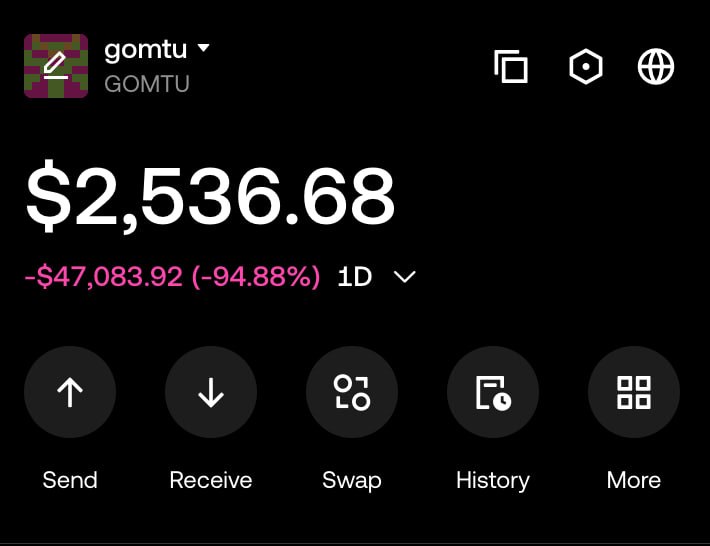 Crypto user loses $49K after fake Homebrew install steals Google session and seed phrase from DriveCounterfeit Ledger Nano S Plus with embedded WiFi sold on Chinese marketplace, steals seed phrases via fake Ledger Live
Sources
18 records from 15 domains
youtube.com
coinbase.com
github.com
ledger.com
blog.trezor.io
world.org
3rditeration.github.io
unchained.com
tradingview.com
divorce.law
microsoft.com
crypto.news
x.com
afp.gov.au
bitpay.com
Community notes
Spot something off or out of date? Drop a note. Editors review topic notes daily and roll accepted fixes into the explainer — contributors are recognized in the monthly $SQUID drop.
Loading notes…
Help improve this topic
Have a story or tip about this topic? Submit it. See something missing? Leave a note. Editors review daily; accepted submissions and fixes count toward the monthly $SQUID drop.