
Spark Protocol is MakerDAO's DeFi lending arm, offering USDS borrowing and savings rates. With $3B+ TVL, institutional products like Spark Prime, and a conservative risk record, it's reshaping on-chain credit.
+28 sources across the wider coverage universe
 Meta launches Muse Spark, a multimodal reasoning model with tool-use, visual chain-of-thought & multi-agent orchestration, debuting Contemplating mode to rival frontier AI systems2026-04
 Galaxy launches GOFR to blend Aave, Morpho and Spark rates with up to $100M in first-loss capital2026-07
 Spark's January rsETH delisting leaves SparkLend liquid while Aave freezes across five networks2026-04
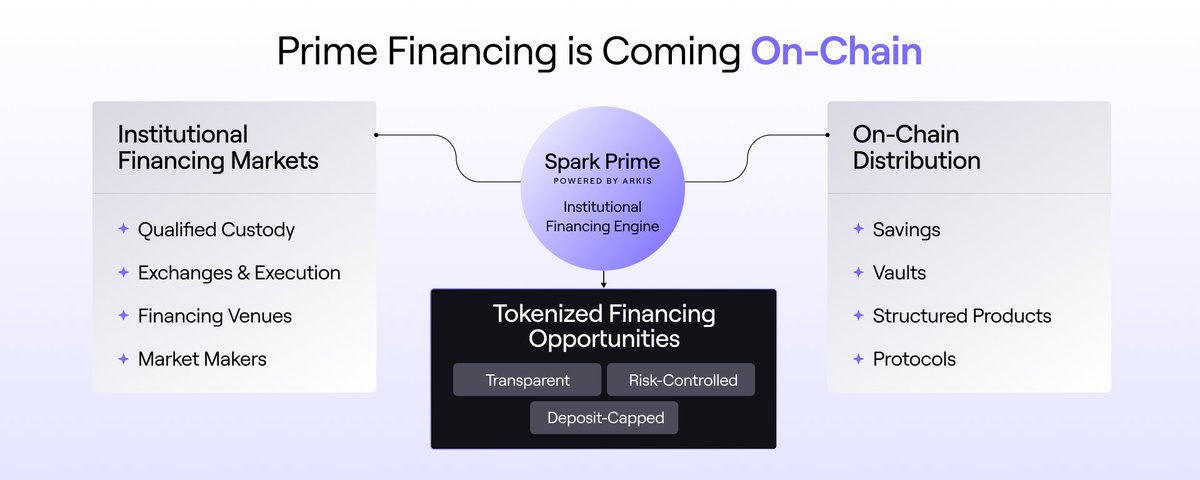 Spark unveiled Spark Prime, an institutional financing platform powered by Arkis that brings portfolio-margin lending on-chain, expanding access to funding-rate and crypto-backed yield strategies2026-06
 Polymarket enables instant BTC deposits over Lightning via Spark, cutting 10-60 minute onchain waits2026-07
 Spark seeds Uniswap v4 with $150M in USDS-PYUSD and USDS-USDT liquidity for stablecoin FX layer2026-06
Spark Protocol is a decentralized lending and liquidity platform built within the Sky (formerly MakerDAO) ecosystem, designed to let users borrow the stablecoin USDS against crypto collateral while earning yield through integrated savings rates.
What Spark Protocol Is
Launched in 2023 by Phoenix Labs — a development company seeded by MakerDAO governance — Spark Protocol entered a crowded DeFi lending market with a specific structural advantage: deep integration with the DAI/USDS monetary system underpinning one of crypto's longest-running decentralized stablecoins. Where competitors like Aave operate as standalone money markets, Spark functions as a semi-captive borrowing venue for the Sky ecosystem, meaning its interest rate dynamics and liquidity backstop are partly shaped by MakerDAO governance parameters rather than purely by open-market supply and demand.
The core product is SparkLend, a fork of Aave v3's battle-tested smart contract architecture adapted to support native USDS (the rebranded DAI) lending. Users deposit accepted collateral — Ethereum, liquid staking tokens, wrapped Bitcoin, and approved stablecoins — borrow against it, and pay variable interest rates calibrated to Sky's broader monetary policy goals.

Meta launches Muse Spark, a multimodal reasoning model with tool-use, visual chain-of-thought & multi-agent orchestration, debuting Contemplating mode to rival frontier AI systems

First closed-weight model in Meta's history drops while half the AI agent protocols on-chain are still running inference on Llama 4. 10x compute efficiency over Maverick sounds great until you realize those weights aren't yours anymore — every project that built its agent stack on Meta's open-weight promise needs to reassess dependency risk yesterday. Multi-agent orchestration shipping as a default to 3B users also compresses the moat for standalone agent tokens fast.
How SparkLend Works
At its most basic, SparkLend functions like any collateralized debt position (CDP) market: post collateral above a required ratio, withdraw a loan denominated in USDS, and pay interest until the position is closed. Liquidation occurs automatically if the collateral value falls below the required threshold.
What distinguishes it from generic money markets is the USDS Savings Rate (USR), the DeFi equivalent of a policy rate. When a user deposits USDS into the savings contract (sUSDS), they earn the USR passively — a mechanism that also pulls idle capital back toward the protocol during periods of elevated rates. This creates a flywheel: rising demand for USDS loans allows governance to set an attractive savings rate, which in turn draws more deposits, deepening liquidity.
Interest rates on SparkLend are not set by a pure utilization curve. Instead, they reference the Sky protocol's borrowing cost, making them more predictable than pure algorithmic markets and often more competitive for USDS-denominated borrowing specifically.
Readers click Spark not for its lending rates but for its role as a DeFi liquidity switchboard — the dominant engagement signal is capital-rotation and institutional integration (Aave→Spark flows, PayPal PYUSD, Ethena SLL) rather than yield mechanics, revealing that informed readers treat Spark as infrastructure risk, not yield risk.
The Aave Rivalry and Capital Migration
Spark's growth has been partly a story of capital leaving Aave. The most dramatic episode came in January 2025, when rsETH — a liquid restaking token issued by KelpDAO — suffered an exploit. Aave had rsETH listed across five networks with significant open positions; the resulting bad debt risk caused roughly $15.1 billion in deposits to exit Aave in under four days, about a third of its total TVL at the time.
Spark had already quietly delisted rsETH from SparkLend weeks earlier, in early January, citing concentration risk. The delisting was controversial at the time — it reduced yield options for depositors — but it left SparkLend's liquidity intact during the crisis while Aave faced network-wide freezes. Spark's TVL jumped to $3.2 billion in the immediate aftermath as capital sought safer alternatives.
The broader migration has continued. Spark pulled approximately $2.4 billion in net new deposits between mid-April and mid-May 2025, with specific rotations visible on-chain: Mellow Protocol redirected roughly $180 million of Aave redemptions toward Spark, and Instadapp vault users added $88 million. The longer trajectory shows roughly $10 billion rotating out of Aave into Spark and shorter-duration stablecoin products as DeFi depositors recalibrated risk appetite following multiple collateral incidents at competing venues.
This does not represent a permanent zero-sum shift — Aave has since recovered significant TVL through aggressive safety module reforms and governance responses — but it illustrated that Spark's more conservative asset-listing approach is a viable competitive strategy in an era when a single bad collateral call can wipe out months of yield for depositors caught in a freeze.
Ripple's RLUSD joins Spark's stablecoin FX layer on Uniswap V4

Risk Architecture: The rsETH Lesson
Spark's approach to collateral risk is worth examining in detail because it has become a defining differentiator. Phoenix Labs has historically maintained tighter asset-listing criteria than Aave's broader governance community, which tends toward inclusion. Spark's risk team uses a "pre-crime" framing: model tail scenarios for each collateral type and ask whether the protocol could survive a correlated unwind, not just a mild price decline.
For rsETH specifically, the concern was not the token's creditworthiness in normal conditions but the reflexive nature of restaking leverage. If rsETH's peg slipped under stress, liquidators would dump restaked ETH positions into an already thin market, accelerating the depeg and triggering cascading liquidations. Spark governance chose to remove the exposure rather than hold out for higher yield. Aave's governance, balancing different stakeholder incentives, did not move as quickly.
The broader lesson for DeFi observers: collateral committees with clear authority to act unilaterally — and governance structures willing to accept short-term yield compression for safety — are increasingly relevant as the asset universe in DeFi expands to include more exotic instruments like liquid restaking tokens, real-world asset (RWA) wrappers, and tokenized securities.
Institutional Expansion: Spark Prime and Regulated Access
The most significant strategic development in Spark's trajectory has been the push toward institutional capital. In mid-2025, Spark unveiled Spark Prime, a portfolio-margin lending platform built in partnership with Arkis, a prime brokerage infrastructure provider. The product targets hedge funds, market makers, and trading desks that want on-chain access to funding-rate strategies and crypto-backed yield without giving up cross-margining — the ability to use a single pool of collateral across multiple positions.
Portfolio-margin lending is standard in traditional prime brokerage but has been difficult to replicate in DeFi because smart contracts typically enforce isolated, per-position collateral rules. Arkis handles the cross-margining logic off-chain while settlement occurs on-chain, a hybrid approach that accepts some trust assumptions in exchange for capital efficiency.
Simultaneously, BitGo — a regulated qualified custodian serving institutional clients — announced it would provide access to both Aave and Spark for its clients, framing decentralized lending as a component of a regulated finance stack rather than an alternative to it. This matters because BitGo's clients are subject to anti-money-laundering, know-your-customer, and fiduciary requirements that most DeFi interfaces simply do not address. BitGo's integration suggests a path toward institutional capital accessing on-chain yields within a compliance wrapper.
RedStone, a modular oracle network, has built data infrastructure that brings Spark's institutional collateral pricing on-chain in real time, addressing one of the longstanding criticisms of DeFi lending to institutions: the dependence on oracle systems that can lag or be manipulated in volatile markets. RedStone's approach uses a pull-based model where price updates are included in transactions rather than pushed to the chain at intervals, reducing latency and improving manipulation resistance for large positions.
Together, these integrations point toward a version of Spark that is less a retail DeFi product and more a layer of programmable credit infrastructure sitting between traditional finance and on-chain capital markets.
Galaxy launches GOFR to blend Aave, Morpho and Spark rates with up to $100M in first-loss capital
The SPK Token
Spark has its own governance token, SPK, which also serves as a buyback target for protocol revenue. In the protocol's first completed buyback cycle, 26.6 million SPK tokens were repurchased for approximately 572,000 USDS using fee revenue generated by SparkLend. The buyback is a common tokenomics mechanism borrowed from corporate finance — using operating cash flow to reduce circulating supply — but the scale relative to total token supply is modest, and the protocol itself acknowledged uncertainty about price impact.
The SPK token gives holders influence over risk parameters, asset listings, interest rate models, and fee distribution within Spark's governance system. It functions alongside MKR (MakerDAO's governance token) in a layered structure: MKR governs the broader Sky monetary system, while SPK governs the Spark-specific lending layer. The relationship creates potential tension if Spark's risk decisions conflict with MakerDAO's preferred monetary stance, though in practice the two governance bodies have operated in alignment.
Treasury management is an ongoing concern. The buyback program draws on protocol revenue that could alternatively fund development, risk buffers, or liquidity incentives. At current TVL and rate levels, the tension between returning value to SPK holders and building protocol reserves is a live governance debate.
- 01Spark Liquidity Layer integrations
The SLL's string of nine-figure deals (Ethena $1.1B, Aave $1.5B, PayPal $1B, USDT/Curve) made it the clearest signal that Spark was becoming stablecoin plumbing, not just a lending fork.
- 02Capital rotation from Aave
Back-to-back headlines about $10B leaving Aave and Spark TVL spiking after the rsETH exploit drew readers watching which protocol wins when a competitor stumbles.
- 03Spark airdrop and token
Two distinct airdrop headlines — Ignition check eligibility and the live drop — generated combined clicks that show airdrop-hunters treating Spark as an active opportunity.
- 04Spark as MakerDAO SubDAO pioneer
Readers engaged with Spark's governance identity — its SubDAO structure, MakerDAO Endgame positioning, and Rune Christensen's strategic commentary — as a model for how DAOs can spin off execution arms.
- 05Institutional pivot away from retail app
The pivot headline — Spark dropping its crypto app to chase PayPal-scale deals — crystallized a strategic bet that institutional liquidity infrastructure beats consumer UX, a non-obvious directional call that readers noticed.
- 06Morpho DDM debt ceiling creep
Sequential 50M DAI ceiling increases on the sUSDe vault (350M → 400M → 450M) were clicked as incremental risk accumulation stories, not routine governance updates.
Markets Context: Where Spark Sits in Macro DeFi
Spark's rise corresponds to a broader DeFi market dynamic in which stablecoin lending has attracted outsized capital relative to more speculative on-chain activities. In risk-off periods — when Bitcoin prices are uncertain, altcoin markets are volatile, and the macroeconomic environment is unclear — cash-equivalent DeFi yields become attractive to capital that might otherwise sit idle. The USDS Savings Rate, when set competitively, positions Spark as a destination for this capital.
The Trump administration's policy environment has added complexity to this backdrop. Regulatory uncertainty around crypto staking products has pushed some institutional capital toward lending protocols rather than staking, on the theory that collateralized lending has a clearer legal analogy to existing financial services. At the same time, macro volatility — oil price swings, interest rate uncertainty, geopolitical risk — has kept on-chain lending rates elevated relative to what they might be in a calmer environment, benefiting platforms with stable TVL like Spark.
The AI dimension is less direct but increasingly present. AI trading agents and autonomous market-making bots are expected to become significant DeFi participants in the next two to three years, and on-chain lending protocols will be among their primary tools for leverage and yield. Spark's relatively predictable rate model and deep USDS liquidity make it a plausible candidate for integration into automated strategies.
Security and Audits
SparkLend's smart contract foundation — Aave v3's codebase — carries a substantial audit history from its prior deployment. Spark has conducted additional audits specific to its USDS integrations and parameter changes. The protocol has a bug bounty program and a formal risk framework maintained by Phoenix Labs, which publishes risk assessments for each collateral asset listed. The January rsETH delisting was a real-world test of that framework; the protocol's willingness to forgo yield to remove a tail risk before it materialized is the strongest evidence to date that the risk process has operational teeth.
No major smart contract exploit has occurred on SparkLend as of mid-2025, though the protocol operates in an adversarial environment where oracle manipulation, flash loan attacks, and governance attacks are all real threat vectors.
- 2023-05launch
Spark launches as MakerDAO's first SubDAO
- 2024-10governance
50M DAI additional allocation to Spark sUSDe Morpho vault; DDM ceiling hits 400M DAI
- 2024-12milestone
Ethena integrates into Spark Liquidity Layer, unlocking up to $1.1B in USDe/sUSDe holdings
- 2025-01governance
Spark delists rsETH from SparkLend, maintaining liquidity while Aave freezes across five networks
- 2025-01governance
Spark Morpho DDM debt ceiling raised to all-time high of 450M DAI
- 2025-04milestone
Spark pulls $2.4B in net deposits in days following Aave rsETH exploit and capital rotation
- 2025-04launch
Spark Liquidity Layer integrates with Aave to deploy up to $1.5B across Core, Prime, and Base markets
- 2025-05milestone
PayPal taps Spark for $1B PYUSD liquidity integration; Spark pivots away from retail app toward institutional infrastructure
Outlook
Spark enters the second half of 2025 with its clearest competitive advantages — conservative risk management, deep Sky ecosystem integration, and institutional product development — more validated than when it launched. The Spark Prime rollout will be a key indicator of whether DeFi lending can credibly serve institutional demand at scale, or whether compliance and counterparty requirements will keep traditional capital at arm's length.
The SPK token's trajectory depends on whether governance can balance buyback programs with capital reserves, and whether the protocol continues to attract net new deposits rather than just absorbing capital rotating out of competitors. The broader question for Spark, as for all DeFi lending platforms, is whether on-chain credit infrastructure can become a genuine component of global financial markets — not just a niche product for crypto-native users, but a settlement layer for institutional strategies that demand programmability, transparency, and 24/7 settlement.
The rsETH episode demonstrated that disciplined risk management is worth more than yield maximization in stressed conditions. If Spark's governance can hold that discipline as it scales, it is positioned to be one of the few DeFi lending protocols that survives the next market cycle intact.
Latest Spark news
Meta launches Muse Spark, a multimodal reasoning model with tool-use, visual chain-of-thought & multi-agent orchestration, debuting Contemplating mode to rival frontier AI systemsRipple's RLUSD joins Spark's stablecoin FX layer on Uniswap V4Galaxy launches GOFR to blend Aave, Morpho and Spark rates with up to $100M in first-loss capitalSpark's January rsETH delisting leaves SparkLend liquid while Aave freezes across five networksSpark unveiled Spark Prime, an institutional financing platform powered by Arkis that brings portfolio-margin lending on-chain, expanding access to funding-rate and crypto-backed yield strategiesPolymarket enables instant BTC deposits over Lightning via Spark, cutting 10-60 minute onchain waitsCommunity notes
Spot something off or out of date? Drop a note. Editors review topic notes daily and roll accepted fixes into the explainer — contributors are recognized in the monthly $SQUID drop.
Loading notes…
Help improve this topic
Have a story or tip about this topic? Submit it. See something missing? Leave a note. Editors review daily; accepted submissions and fixes count toward the monthly $SQUID drop.