
Uniswap turned automated market making into core DeFi infrastructure. Its next test is whether a widening product surface—from concentrated liquidity and Unichain to lending and launch aggregation—can create durable value without obscuring the risks.
+12 sources across the wider coverage universe
 Uniswap Auctions rolls out guide to Continuous Clearing Auctions, detailing bidding strategy, FDV pricing, and how users can adapt when prices move out of range mid-auction2026-04
 Paxos Labs raises $12M from Blockchain Capital and Uniswap, launches Amplify embedded finance stack2026-04
 Uniswap launches Developer Platform with AI-first tools, API dashboard, and liquidity endpoints, enabling builders to integrate swaps and LPing across 18+ chains2026-04
 AllUnity expands MiCA-regulated euro stablecoin EURAU to Uniswap, Raydium, and Tempo via Flowdesk2026-04
 Uniswap adds beta launchpad aggregator after 340K Robinhood Chain tokens drive $3.6B July volume2026-07
 Uniswap adds MegaETH swaps, LPing, and API support with 100,000 TPS and 10ms blocks2026-06
The largest decentralized exchange by trading volume, Uniswap is an Ethereum-native protocol that uses automated market-making smart contracts to let users swap tokens without a centralized intermediary or order book.
Launched in November 2018 by former Siemens mechanical engineer Hayden Adams, Uniswap pioneered the constant-product formula x * y = k, which became a template for decentralized finance. Rather than matching individual buyers and sellers, the protocol holds assets in liquidity pools and calculates prices from the changing ratio between the two tokens.
That distinction is foundational. Uniswap is not an exchange in the conventional sense so much as a public settlement and pricing system: traders interact with code, while liquidity providers supply the inventory against which trades execute. The design makes markets continuously available without a professional market maker standing behind every pair, but it transfers pricing risk and inventory management to the people funding the pools.
How Uniswap Works
At its core, Uniswap is a set of smart contracts deployed on Ethereum and a growing collection of compatible chains. Anyone can use those contracts to swap tokens, provide liquidity or create a pool for an ERC-20 pair without asking a central listing committee for approval.
A swap trades one token against the reserves in a pool. As a trader removes one asset and adds the other, the pool changes the quoted price automatically. Large trades move that ratio further than small ones, producing slippage. Deeper liquidity generally means a trade can be absorbed with less price movement.
Liquidity providers deposit assets into pools and receive a share of the trading fees those pools generate. The return is not free yield. LPs accept impermanent-loss risk: if the relative prices of the deposited assets change, the pool continuously rebalances their inventory, and the resulting position may be worth less than simply holding the original tokens. Fees can compensate for that opportunity cost, but they do not guarantee that they will.
Permissionless pool creation is similarly double-edged. It lets new assets acquire an onchain market without negotiating with an exchange, but it also means a pool's existence says nothing about the quality, legitimacy or liquidity of the token inside it. Uniswap supplies market infrastructure, not an endorsement layer.
Version History
V1 (2018) introduced pools pairing tokens with ETH. V2 (2020) enabled direct ERC-20-to-ERC-20 markets, flash swaps and onchain price-oracle functionality. V3 (2021) introduced concentrated liquidity, allowing LPs to allocate capital within selected price ranges rather than across every possible price.
Concentrated liquidity made the same amount of capital more productive when the market stayed inside an LP's chosen range. The cost was active management: once the price moved outside that range, the position stopped earning trading fees. V3 therefore shifted liquidity provision closer to professional market making—more configurable and potentially more efficient, but less forgiving of passive deployment.
V4 (2024) added hooks, custom logic attached to pools at deployment. Hooks can modify pool behavior to support features such as dynamic fees or order-like execution without requiring an entirely separate trading protocol. This reclassifies Uniswap from a fixed AMM design into a programmable market factory. The gain is a much larger design space; the cost is that users must distinguish the core protocol from the behavior introduced by a particular hook.
Each version operates independently onchain, so newer deployments do not automatically retire older pools. Liquidity can consequently fragment across versions, fee tiers, price ranges and chains. Routers help users find an execution path through that fragmented landscape, but the underlying markets remain separate.

CME Group plans to launch Bitcoin Cash and Uniswap futures on Oct. 19, adding BCH and UNI to its growing lineup of regulated crypto derivatives
The UNI Token and Governance
Uniswap launched UNI in September 2020 through a retroactive airdrop that distributed 400 tokens to every historical user of the protocol. UNI holders can propose and vote on governance decisions through the Uniswap DAO, which controls a substantial treasury denominated largely in UNI.
Governance has long revolved around a basic economic tension: Uniswap can be an extremely useful protocol without necessarily making UNI a direct claim on the activity it facilitates. Debate therefore focused for years on the fee switch, a mechanism designed to redirect part of pool economics away from liquidity providers and toward the protocol. That creates an unavoidable trade-off. Direct value accrual can strengthen the token's economic case, but reducing LP compensation can make competing venues more attractive and can complicate the token's regulatory profile.
The Uniswap Foundation proposed a modified fee-switch structure in 2024, continuing a broader governance discussion about how token holders should participate in protocol economics. The DAO also advanced a vote to reclaim approximately $42 million in UNI loans previously extended to third parties. Treasury recovery can improve governance flexibility and liquid resources, but the deeper question is still allocation: a large treasury matters only if governance can deploy it without turning grants, delegation and voting power into permanent sources of political friction.
UNI should therefore be evaluated separately from Uniswap usage. Protocol volume, interface revenue, treasury assets and token-holder value accrual are related variables, not synonyms. The practical test is whether governance decisions create a durable and observable economic link between activity on Uniswap's rails and demand for UNI.
Readers click Uniswap stories not to track DeFi innovation but to audit whether UNI token holders retain any real power — every top story is either Labs acting unilaterally (UI fees, governance relegation, HEX delisting) or the DAO failing to act collectively (fee switch killed twice, contributor exits).
The Developer Ecosystem and API
Uniswap has expanded from a swap interface into a broader infrastructure layer. Its API and routing engine allow wallets and applications to obtain quotes and route trades without reproducing the entire execution stack themselves.
Blockworks data previously found that Uniswap's API won 52.4% of more than 554,000 Ethereum swap-routing decisions measured through MetaMask, while Uniswap infrastructure powered roughly 31% of MetaMask's Ethereum-mainnet swap volume. The comparison matters because an API is valuable only when outside applications repeatedly select its execution. Those figures describe meaningful distribution through a major wallet, although they represent a measurement period rather than a permanent market share.
Uniswap introduced a Developer Platform in mid-2025 with AI-assisted tools, an API dashboard and liquidity endpoints spanning at least 18 chains. The strategic objective is clear: make Uniswap the default component developers reach for when an application needs a swap or liquidity function. This is closer to payments infrastructure than to a standalone exchange website. The opportunity is distribution through products Uniswap does not own; the dependency is that those products can change routers when another provider offers better execution or economics.
The Uniswap App and Product Expansion
The consumer-facing app at app.uniswap.org has grown beyond a simple swap screen. It incorporates a self-custodial wallet, portfolio and profit-and-loss tracking, and crosschain swaps across 11 networks without requiring users to perform every bridging step manually.
The direction is vertical integration. Uniswap began as contracts that any interface could access, then added the wallet, routing and portfolio layers through which users discover and manage positions. Owning more of that journey can reduce friction and improve retention, but it also expands the surface on which users must evaluate custody, routing, third-party dependencies and application security.
Lending is part of that expansion. Uniswap's product announcement describes the integration directly: Uniswap adds Morpho-powered lending vaults for USDC, USDT and ETH to Web App and Wallet on Ethereum Mainnet. This moves the app beyond exchange execution into yield distribution. Economically, Uniswap is acting as an access layer while the underlying lending mechanism comes from Morpho. Users therefore need to separate interface convenience from protocol risk: opening a position inside Uniswap does not make the lending exposure equivalent to an AMM swap.
Discovery is widening too. Uniswap's launch-aggregator announcement supplies the relevant scale and product status: Uniswap adds beta launchpad aggregator after 340K Robinhood Chain tokens drive $3.6B July volume. A launch aggregator treats fragmented token creation as an indexing and distribution problem. That can make new markets easier to find, but greater discoverability is not the same thing as quality control; when hundreds of thousands of tokens compete for attention, filtering becomes as important as access.

Paxos launches PAXGy, bringing tokenized gold lending onchain via OKX, Uniswap, X Layer, 0x and ether.fi

Unichain: Owning More of the Rails
Uniswap Labs announced Unichain in late 2024 as an Ethereum Layer 2 built on the OP Stack and designed around DeFi activity. The network promised blocks settling in under two seconds and lower transaction costs than Ethereum mainnet, while the Uniswap app added a direct route for bridging assets to it.
Unichain represents Uniswap's largest infrastructure expansion because it changes the project's position in the stack. A protocol deployed on many chains competes for users wherever liquidity already lives; a protocol with its own chain can shape blockspace, execution and application distribution around its own ecosystem. The gain is greater control over the trading environment. The cost is another liquidity destination that must attract assets, applications and users in a market already divided among many networks.
That makes Unichain's success measurable. The important indicators are not merely whether the network is live, but whether liquidity remains deep, independent applications deploy, users return and activity persists without incentives doing all the work.
- 01fee switch governance failures
Two separate fee switch proposals failing drew combined 736 clicks — readers are tracking whether UNI holders can ever actually capture protocol revenue.
- 02regulatory pressure Wells Notice CFTC
The SEC Wells Notice and CFTC fine landed in the same window, making Uniswap the highest-profile DeFi enforcement target, which readers followed closely for precedent.
- 03Labs unilateral UI fee extraction
Uniswap Labs charging a 0.25% UI fee without a DAO vote — then hitting $1M in a month — crystallized the Labs-vs-protocol tension readers were already tracking.
- 04V4 launch and Unichain expansion
Hooks architecture, a new L2, and a $165M treasury plan gave readers a concrete product narrative to follow across multiple months of previews and launches.
- 05mainstream brokerage integration
The Robinhood partnership was the single most-clicked Uniswap headline, signaling readers see retail distribution as the breakout story above all protocol internals.
- 06DAO power concentration and exits
Governance rights being relegated toward Optimism stakeholders and a prominent contributor publicly quitting revealed structural capture that readers found more alarming than routine governance votes.
Real-World Assets and Institutional Adoption
Tokenized real-world assets have appeared in Uniswap pools, including instruments representing exposure to companies such as SpaceX, Apple, Tesla and NVIDIA. Their presence points toward a larger possibility: public blockchains could become distribution and settlement layers for assets that originated in traditional markets.
Yet a tokenized asset is not automatically identical to the security or property it references. The issuer, custody arrangement, redemption terms, jurisdiction and trading hours determine what the holder actually owns. Uniswap can provide liquidity for a token, but its AMM contracts cannot eliminate the offchain legal and counterparty risks embedded in that token.
Standard Chartered's digital-assets research team previously projected UNI at $6.50 by the end of 2026 and $100 by 2030, citing tokenized assets as a potential source of demand for decentralized liquidity. Those figures are a bank's analytical opinion, not a protocol guarantee or investment guidance. They establish that at least one institutional research desk viewed Uniswap as a possible beneficiary of tokenization; they do not establish that asset issuers will choose permissionless pools, that liquidity will consolidate on Uniswap or that protocol growth will accrue to UNI holders.
The stronger thesis is structural rather than numerical. If tokenized instruments trade continuously across public networks, AMMs can supply always-available liquidity for markets that would otherwise depend on bilateral dealer inventory. But the test is execution: spreads, depth, redemption reliability and legal enforceability must be competitive with the systems those assets are intended to supplement.
Regulatory Context
Uniswap Labs disclosed in 2024 that it had received a Wells Notice from the U.S. Securities and Exchange Commission, a notification that SEC staff intended to recommend an enforcement action. The underlying dispute concerned whether activity facilitated through Uniswap implicated U.S. securities rules.
Regulatory uncertainty reaches beyond a single enforcement question. Permissionless token creation means the protocol can be used for assets whose legal classification is contested, while directing protocol economics toward UNI holders could affect how regulators analyze the token. At the same time, smart contracts, an interface company, token issuers, liquidity providers and governance participants occupy different roles. Treating them as one undifferentiated entity obscures the actual policy problem.
For users and developers, the relevant variables are whether interfaces restrict access, whether token issuers comply with applicable rules and whether governance changes alter UNI's economic rights. Those outcomes matter more than regulatory rhetoric in isolation.
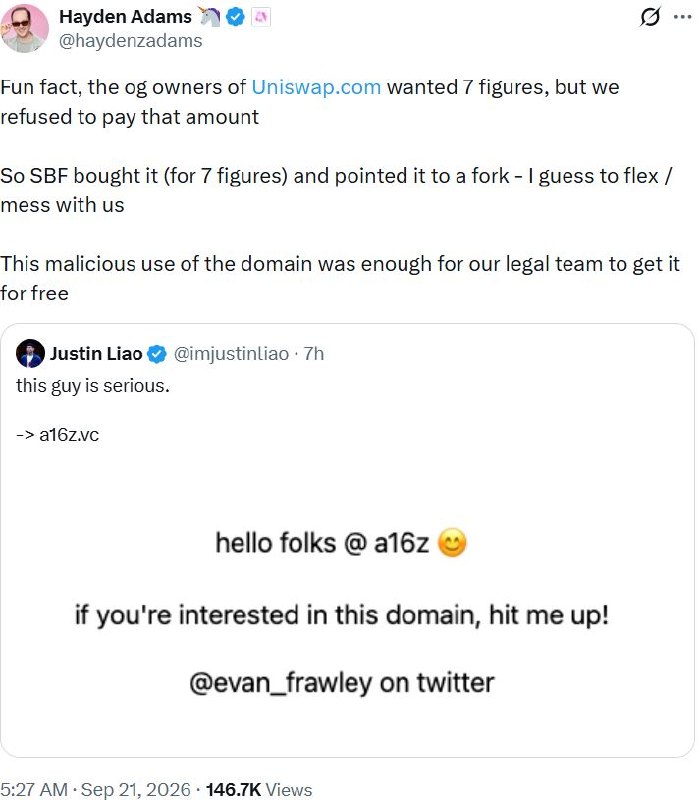
Hayden Adams says Uniswap got Uniswap.com for free after SBF bought it and pointed it at a fork
Security Risks and Scam Awareness
Uniswap's recognition makes it a valuable impersonation target. In a documented 2025 incident, scammers placed fake Uniswap advertisements in Google's sponsored search results, positioning malicious links above the genuine app. Onchain analysts identified at least $400,000 drained from people who clicked the fraudulent advertisements and connected wallets.
That attack illustrates the difference between protocol security and access-layer security. An AMM contract can behave as designed while a user still loses funds to a counterfeit website, malicious token approval or compromised integration. Typing the known URL directly or using a verified bookmark reduces search-ad exposure, while reviewing wallet prompts helps limit approvals that grant broader authority than the intended transaction requires.
The same distinction applies to software built around Uniswap. DefimonAlerts attributed one loss to an exposed function in a trading bot: Attacker drains $31.7K from Uniswap V3 arbitrage bot on Base through unprotected arbitrary-call function. That incident concerns an arbitrage bot interacting with Uniswap V3, not evidence that the core AMM was drained. It shows why the security boundary must include every contract and permission in the transaction path: integrations can introduce arbitrary execution even when the underlying pool contracts remain intact.
Uniswap's core contracts have undergone repeated audits and have not suffered a critical exploit at the core AMM level. That history is meaningful evidence about the deployed designs, but it is not a guarantee covering every token, hook, router, bot, wallet or third-party application that uses them.
- 2023-10milestone
Uniswap Labs introduces 0.15% UI swap fee
- 2023-11governance
Governance vote kills fee switch proposal
- 2024-04regulatory
SEC issues Wells Notice to Uniswap Labs
- 2024-04milestone
Volumes approach $3B despite Wells Notice
- 2024-09regulatory
CFTC fines Uniswap Labs $175,000
- 2024-10launch
Unichain quietly soft-launched, then trading halted
- 2025-01launch
Uniswap v4 launches across 10 chains
- 2025-02milestone
Robinhood integrates Uniswap with $10 USDC promotion
Liquidity Provider Tools
A supporting ecosystem has emerged to help LPs manage concentrated-liquidity positions. Tools such as SetTheTick offer range optimization for V3 and V4 positions without requiring wallet connections, helping users compare fee opportunities against the likelihood of moving out of range.
The existence of these tools says something important about V3's design. Concentrated liquidity improved capital efficiency by turning price-range selection into a parameter, but that parameter also created a recurring management problem. LP tooling is therefore not merely an accessory; it is part of the operational stack required to make sophisticated AMMs usable by people who do not want to monitor every price movement manually.
Outlook
Uniswap enters the latter half of the 2020s as both an AMM protocol and a widening distribution stack. Its contracts supply permissionless markets; its router and API connect outside applications; its app and wallet own more of the user journey; Unichain extends the project into blockspace; and lending and launch aggregation push the interface beyond swaps.
That breadth creates a strategic advantage and a clarity problem in equal measure. More products give Uniswap more ways to attract users, but each additional layer brings risks that do not originate in the core AMM. A wallet, a lending vault, a newly issued token and a liquidity pool may all appear inside one interface while carrying fundamentally different assumptions.
The durable investment and governance question remains value capture. Usage establishes that Uniswap's rails matter; it does not by itself establish that UNI holders receive the economics of that activity. If governance creates a sustainable link between protocol demand and UNI without driving away liquidity, if Unichain develops persistent rather than subsidized activity, and if the app can add financial products without blurring their distinct risks, Uniswap can remain foundational infrastructure. If those links fail, the protocol may continue to thrive while the token and product stack capture much less of that success than headline volume implies.
Latest Uniswap news
CME Group plans to launch Bitcoin Cash and Uniswap futures on Oct. 19, adding BCH and UNI to its growing lineup of regulated crypto derivativesPaxos launches PAXGy, bringing tokenized gold lending onchain via OKX, Uniswap, X Layer, 0x and ether.fiHayden Adams says Uniswap got Uniswap.com for free after SBF bought it and pointed it at a forkSources
3 records from 2 domains
x.com
blog.uniswap.org
Community notes
Spot something off or out of date? Drop a note. Editors review topic notes daily and roll accepted fixes into the explainer — contributors are recognized in the monthly $SQUID drop.
Loading notes…
Help improve this topic
Have a story or tip about this topic? Submit it. See something missing? Leave a note. Editors review daily; accepted submissions and fixes count toward the monthly $SQUID drop.