
Standard Chartered is building an integrated institutional crypto stack spanning custody (Zodia), Hong Kong stablecoin issuance, fiat rails, and RWA tokenisation research — while publishing Bitcoin and Ethereum price targets that move markets.
- theblock.co11
- newsroom.airasia.com1
- asia.nikkei.com1
- reuters.com1
- coindesk.com1
- cointelegraph.com1
- av.sc.com1
+14 sources across the wider coverage universe
 GSR taps Standard Chartered-backed tokenization firm in web3 investment bank push2026-04
 Visa, Stripe, and Standard Chartered's Zodia Custody become validators on Tempo payments blockchain2026-04
 Standard Chartered weighs folding Zodia Custody into corporate bank arm as crypto push deepens2026-04
 Standard Chartered initiates coverage on Morpho with a $60 price target by 2030, projecting the DeFi lending token will outperform both Bitcoin and Ethereum2026-07
 Standard Chartered executes first live Bitcoin and ether prime brokerage trades with LMAX2026-07
 Standard Chartered and Circle launch launch first G-SIB-led integrated access to USDC minting and redemption.2026-07
One of the world's largest trade-finance banks, Standard Chartered has emerged as a primary institutional bridge between traditional finance and the crypto economy — combining active research coverage, direct infrastructure investment, and a regulated custody and stablecoin footprint across Asia and beyond.
What Standard Chartered Is
Founded in 1969 through a merger of two Victorian-era colonial banks, Standard Chartered (ticker: STAN) is a London-headquartered, Asia-Pacific-focused international bank with roughly $800 billion in assets. Unlike domestic retail lenders, its franchise is built on cross-border trade, treasury, and financial markets — which makes it structurally aligned with the infrastructure demands of tokenised assets, stablecoins, and digital settlement rails. The bank does not operate a large U.S. retail network, which has historically given it more regulatory flexibility to engage with crypto markets than Wall Street peers.
Its digital-assets push spans four distinct lanes: market research and price forecasting, custody infrastructure, regulated stablecoin issuance, and venture capital via its innovation arm SC Ventures.

GSR taps Standard Chartered-backed tokenization firm in web3 investment bank push
$57M for Autonomous + Architech last month, now leading Libeara's round — GSR went from market maker to full-stack token lifecycle shop in under 30 days. Same entity advising on token design, running the issuance infra, AND providing launch liquidity is exactly the bundling conflict TradFi spent decades litigating. StanChart simultaneously pursuing full Zodia acquisition for custody means they're assembling a complete onchain institutional stack — Libeara for issuance, Zodia for custody, GSR for distribution — and the $30B tokenized asset market is barely the opening act.
The Research Voice: Geoffrey Kendrick and Price Targets
Standard Chartered's public profile in crypto markets is driven largely by Geoffrey Kendrick, its head of digital assets research. Kendrick's calls are closely tracked because they arrive with the institutional weight of a global bank rather than a crypto-native desk.
His most prominent standing positions:
- Bitcoin at $100,000 by year-end. After Bitcoin pulled back to roughly $59,000 in early 2025, Kendrick called it the cycle low and maintained his $100K target, describing the setup as "the buying zone" and declaring that "winter is over — welcome back to crypto spring." He flagged three on-chain and macro signals he watches for a Bitcoin bottom, with Strategy's (formerly MicroStrategy) Monday buying behavior among the leading indicators he monitors.
- Ethereum at $4,000 by year-end, following a surge of roughly 22% that Kendrick partly attributed to his own earlier price target publication. The bank has separately identified Ethereum as one asset it believes can outperform Bitcoin in a given cycle.
- Uniswap (UNI) at $100 by 2030, with an intermediate target of $6.50 by end-2026. The thesis is structural: Standard Chartered argues that as tokenised real-world assets (RWAs) migrate on-chain, decentralised exchanges like Uniswap become indispensable liquidity venues. The report prompted a double-digit rally in UNI on the day of publication. The bank's forecast is explicitly tied to the RWA tokenisation wave rather than speculative momentum — a distinction worth noting when evaluating the time horizon.
These targets carry market-moving weight not because they are necessarily more rigorous than crypto-native analysis, but because they signal to pension funds, family offices, and corporate treasuries that a regulated, ratings-sensitive institution is comfortable publishing them under its own brand.
Readers click Standard Chartered not as a crypto convert but as an institutional infrastructure builder — the pull is that a top-10 global bank is quietly becoming load-bearing plumbing for tokenization, custody, and stablecoins rather than merely issuing price targets.
Custody: The Zodia Acquisition
The most consequential operational move Standard Chartered has made in crypto infrastructure is its decision to acquire full ownership of Zodia Custody, the institutional digital-asset custodian it originally co-founded with Northern Trust in 2020.
The deal involves Standard Chartered absorbing Zodia Custody's core business — the regulated, bank-grade storage of private keys for institutional crypto holdings — while spinning out a separate entity called Zodia Solutions to handle ancillary technology services. The move consolidates custody under Standard Chartered's regulated balance sheet, which matters because institutional clients increasingly require their custodian to carry the same regulatory standing as a prime broker or clearing bank.
Custody is a foundational layer for institutional crypto adoption. Before an asset manager, sovereign wealth fund, or corporate treasury can hold Bitcoin or tokenised securities, it needs a custodian that satisfies its own compliance, insurance, and audit requirements. Zodia Custody was already serving that function; bringing it fully in-house lets Standard Chartered offer an integrated product — fiat settlement, custody, and trade finance — without relying on a joint venture counterparty.
The custody business has also expanded beyond simple cold storage. Zodia Custody has become a validator on the Tempo payments blockchain, alongside Visa and Stripe, giving Standard Chartered a node in a network that collectively processes trillions of dollars in payments annually. Separately, when OKX integrated BlackRock's tokenised money-market fund BUIDL as trading collateral, Standard Chartered's Zodia handled the off-exchange custody arrangements — a signal that the bank is trusted as a neutral custodian even in complex three-party arrangements involving a rival asset manager (BlackRock) and a crypto exchange (OKX).
Visa, Stripe, and Standard Chartered's Zodia Custody become validators on Tempo payments blockchain
Three major financial players — Visa, Stripe, and Zodia Custody (Standard Chartered's crypto custodian) — are stepping up from design partner status to actually running validators on Tempo, the Stripe/Paradigm-backed payments L1 that launched mainnet in March. Tempo previously ran just four team-operated validators, so onboarding institutional validators from payments and banking giants signals real progression toward the decentralized validator set the chain promised. The move puts TradFi firms directly into blockchain infrastructure operations rather than just building on top of it.
Stablecoins and Hong Kong
Standard Chartered's most strategically significant regulatory win came in Hong Kong, where the Hong Kong Monetary Authority (HKMA) granted a Stablecoin Issuer Licence to Anchorpoint, a consortium backed by Standard Chartered. HSBC received a parallel licence in the same tranche — the first such approvals under Hong Kong's new stablecoin regulatory framework.
Hong Kong has positioned itself as the primary regulated gateway for Western and Asian institutions to access digital assets, particularly given mainland China's continued restrictions on private crypto. A stablecoin licence from the HKMA is meaningful for several reasons:
1. It permits fiat-backed stablecoin issuance under banking supervision, meaning the reserves, redemption mechanics, and audit requirements are subject to the same scrutiny as a bank deposit product. 2. It opens the door to institutional-grade alternatives to USDC and Tether for Asian settlement — particularly relevant for trade finance corridors that Standard Chartered already dominates. 3. It positions Standard Chartered at the intersection of the RWA tokenisation stack: a bank that can issue a regulated stablecoin, custody the digital assets denominated in that stablecoin, and settle trades across its existing correspondent banking network is a vertically integrated infrastructure provider.
The stablecoin licence complements a separate development: China has enrolled Standard Chartered among 26 financial institutions signed onto its cross-border digital yuan (e-CNY) payment network. This gives the bank a foot in both the emerging Western-standard regulated stablecoin world and the state-directed CBDC infrastructure of the world's second-largest economy — a dual positioning few institutions can claim.
Fiat Rails and Institutional Partnerships
In parallel with its custody and stablecoin work, Standard Chartered has moved to become a fiat settlement layer for crypto-native firms.
Coinbase tapped Standard Chartered to expand multi-currency funding rails for institutional clients — a deal that lets Coinbase's institutional trading desks access fiat liquidity across more currency corridors using Standard Chartered's existing correspondent banking relationships. For Coinbase, which has struggled with banking access in some jurisdictions, the partnership provides a credentialled, systemically important bank as a settlement counterparty. For Standard Chartered, it is a fee-generating service attached to one of the highest-volume crypto venues globally.
This is a pattern repeating across the industry: crypto exchanges and asset managers need compliant banking rails; traditional banks need fee income and distribution into high-growth markets. Standard Chartered's geographic footprint — spanning Africa, the Middle East, South Asia, and Southeast Asia, corridors where dollar-denominated crypto flows are structurally large — makes it a natural partner for exchanges seeking non-U.S. fiat access.
Standard Chartered weighs folding Zodia Custody into corporate bank arm as crypto push deepens
SC Ventures and the Tokenisation Bet
SC Ventures, Standard Chartered's innovation and fintech investment arm, has made a strategic investment in GSR, a cryptocurrency market-making and trading firm. The investment makes SC Ventures the first external shareholder in GSR and is explicitly framed around deepening tokenisation ties and accelerating institutional crypto market infrastructure.
The strategic logic: as tokenised real-world assets — bonds, equities, trade receivables, real estate — migrate onto blockchain rails, they require the same market-making, liquidity provision, and price discovery infrastructure that traditional assets have. GSR already operates that infrastructure for crypto-native tokens; Standard Chartered is betting that the same firms and the same code will handle liquidity for the tokenised version of the $100 trillion-plus traditional asset universe.
Standard Chartered's own research desk has published forecasts that tokenised RWAs will reach $16 trillion to $30 trillion by 2030–2034, up from roughly $30 billion today — a 500-to-1,000x expansion. That forecast is not unique to the bank (Boston Consulting Group has published comparable figures), but Standard Chartered is unusual in having a commercial infrastructure bet — custody, stablecoins, fiat rails — that is directly sized to benefit if the forecast proves correct.
- 01Libeara tokenization platform
A bank-grade RWA tokenization layer earning a Moody's AA rating on Ethereum and Stellar signaled that institutional-quality tokenized funds were arriving, not just promised.
- 02Stablecoin macro displacement thesis
Standard Chartered's projections of a $2 trillion stablecoin market pulling $1 trillion from emerging-market banks framed stablecoins as a systemic banking threat, not a payments curiosity.
- 03SC Ventures strategic investments
The bank's venture arm taking equity stakes in GSR and backing a $100M crypto startup fund through SBI Holdings positioned SC Ventures as an active market-maker in institutional crypto infrastructure.
- 04Zodia Custody institutional buildout
Readers tracked Zodia's expansion — Metaco integration, Tempo validator role, potential absorption into the corporate bank — as a bellwether for whether bank-owned custody could dominate the institutional stack.
- 05Kendrick BTC/ETH price targets
Geoffrey Kendrick's $120K Bitcoin and $40K Ethereum forecasts, plus his Ethereum treasury company thesis, gave readers a named sell-side voice to agree with or argue against.
- 06HKD and EM stablecoin issuance
The Animoca/HKT joint venture for a Hong Kong dollar stablecoin and the AirAsia-linked Ringgit stablecoin exploration showed Standard Chartered operationalizing stablecoin infrastructure in Asia before Western peers.
Regulatory Positioning
Standard Chartered's willingness to lean into crypto is partly explained by its regulatory geography. Its primary supervisors are the UK's Prudential Regulation Authority and the HKMA, both of which have adopted more permissive stances on digital assets than U.S. regulators have historically taken. The bank does not carry the same exposure to Securities and Exchange Commission enforcement risk as U.S. banks, and its Hong Kong franchise benefits directly from the city's deliberate effort to attract crypto-related financial activity.
This does not mean the bank operates without constraints. Its Zodia Custody entity was structured as a separately regulated subsidiary precisely to ring-fence the bank's regulated balance sheet from direct crypto-asset exposure. The stablecoin issuer licence requires reserve segregation, regular audits, and redemption guarantees. And its fiat-rail partnerships with exchanges like Coinbase still require robust Know Your Customer and Anti-Money Laundering compliance — Standard Chartered was fined $1.1 billion in 2019 for historical sanctions violations, a reminder that its compliance posture is under continuous scrutiny.
What It Means for Markets
When Standard Chartered publishes a price target, it is not simply an analyst opinion. It is a signal about the bank's own risk appetite, client demand, and operational readiness. The UNI target at $100 by 2030 is inseparable from the bank's RWA tokenisation thesis and its GSR investment. The Bitcoin $100K target arrives alongside a custody product designed to hold that Bitcoin for institutional clients. The Hong Kong stablecoin licence is the settlement layer for the fiat-crypto flows that flow through its Coinbase partnership.
The coherence of these positions — research, custody, stablecoins, fiat rails, market infrastructure — distinguishes Standard Chartered from banks that publish a crypto white paper but have no operational skin in the game. Whether the individual price targets prove accurate is secondary to the structural question: a $70 billion market-cap international bank has staked commercial revenue on the tokenisation thesis.
- 2023-11launch
SC Ventures launches Libeara tokenization platform with Singapore-dollar government bond fund
- 2024-03milestone
Moody's assigns AA rating to inaugural Libeara fund on Ethereum and Stellar
- 2024-06launch
Standard Chartered, Animoca Brands, and HKT form HKD-backed stablecoin joint venture
- 2024-09milestone
SC Ventures becomes first external shareholder in GSR via strategic investment
- 2025-01milestone
OKX integrates BlackRock BUIDL fund as collateral with Standard Chartered handling custody
- 2025-04launch
Crypto.com partners with Standard Chartered to launch retail services across 90+ countries
- 2025-06milestone
SBI Holdings commits $100M to crypto startups through Standard Chartered unit
- 2025-09governance
Standard Chartered weighs integrating Zodia Custody into corporate banking arm
Outlook
Standard Chartered's crypto strategy is at an inflection point. The Zodia Custody acquisition consolidates infrastructure that was previously shared. The Hong Kong stablecoin licence converts regulatory approval into a distributable product. The Coinbase partnership turns fiat-rail capability into recurring fee income. And the SC Ventures investment in GSR gives the bank exposure to the market-making layer of a tokenised asset future.
The near-term test is whether institutional RWA adoption accelerates on the timeline the bank's own research projects — and whether the HKMA stablecoin framework attracts enough issuer and merchant adoption to make the licence commercially meaningful rather than a regulatory trophy. If tokenised bond and trade-finance markets scale as projected, Standard Chartered's integrated position across custody, settlement, and liquidity infrastructure could prove to be one of the more consequential institutional bets made during the current crypto cycle.
Latest Standard Chartered news
GSR taps Standard Chartered-backed tokenization firm in web3 investment bank pushVisa, Stripe, and Standard Chartered's Zodia Custody become validators on Tempo payments blockchainStandard Chartered weighs folding Zodia Custody into corporate bank arm as crypto push deepens Standard Chartered sets a $10 end-2030 target for Arbitrum’s ARB, implying a roughly 70-fold increase, and expects the token to outperform Bitcoin and Ether
 Standard Chartered begins spot crypto trading via Dubai exchange platform
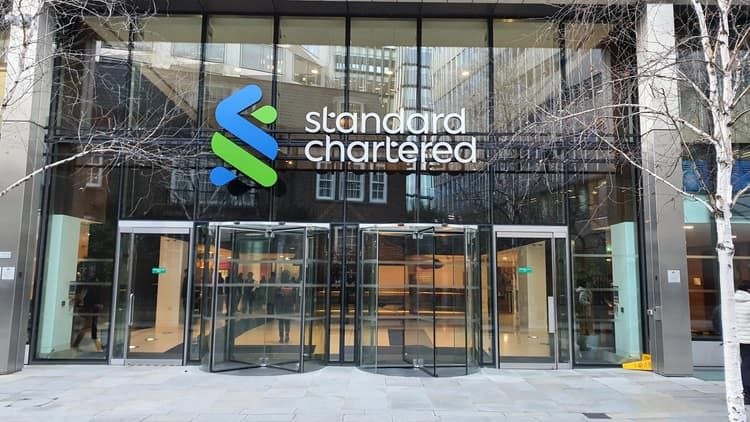 Standard Chartered becomes first bank to distribute Hong Kong dollar stablecoin HKDAP, offering Anchorpoint’s token to eligible clients and partners
Community notes
Spot something off or out of date? Drop a note. Editors review topic notes daily and roll accepted fixes into the explainer — contributors are recognized in the monthly $SQUID drop.
Loading notes…
Help improve this topic
Have a story or tip about this topic? Submit it. See something missing? Leave a note. Editors review daily; accepted submissions and fixes count toward the monthly $SQUID drop.