
Deep explainer on Starlink’s global LEO satellite internet, how it works, its economics, security and geopolitical risks, and why it matters for crypto access, inclusion, BTC exposure and a potential SpaceX/Starlink IPO.
+1 sources across the wider coverage universe
Starlink: Satellite Internet, Space Infrastructure, and the Crypto Edge
Starlink is a low-Earth-orbit (LEO) satellite internet constellation built and operated by SpaceX that provides high-speed broadband and emerging direct-to-cell connectivity to homes, businesses, vehicles, and smartphones around the world. By mid‑2026 it comprised more than ten thousand active satellites and over twelve million subscribers, making it the dominant commercial space network and an increasingly important backbone for digital finance, remote work, and global crypto adoption.
What Starlink Is And Why It Matters
At its core, Starlink is an attempt to turn space into an extension of the internet’s physical infrastructure. SpaceX began launching Starlink satellites in 2019, using the company’s reusable Falcon 9 rockets to deploy thousands of small, mass-produced spacecraft into LEO. Operating at altitudes far lower than traditional geostationary satellites, these spacecraft relay internet traffic between user terminals on the ground and gateway stations connected to fiber and other terrestrial backbones. The result is a satellite network that can deliver broadband-style speeds with latency closer to a good 4G or mid‑tier fiber connection than to legacy satellite services.
From a macro perspective, Starlink’s significance is threefold. First, it directly targets the “last mile” problem in connectivity by bypassing the need to run physical cables to remote or sparsely populated areas where traditional telecom economics break down. Second, it effectively transforms SpaceX from a launch provider into a vertically integrated telecom and data infrastructure company, with Starlink now accounting for the majority of SpaceX revenues and operating income by 2025. Third, for a crypto-native audience, Starlink is rapidly becoming a crucial on-ramp for people who want to participate in global markets, including cryptocurrency trading, remittances, and decentralized finance, from places that have never had reliable broadband access.
By June 2026 the network included approximately 10,413 Starlink satellites in orbit, of which around 10,397 were operational. That figure means Starlink alone represents roughly three quarters of all active maneuverable satellites around Earth, a concentration that explains both its transformative potential and the growing concern among regulators, astronomers, and national security analysts. On the ground, Starlink reported more than 12 million subscribers spread across about 160 countries and territories, after adding more than 4.6 million new customers and 35 additional countries in 2025 alone. This scale makes Starlink one of the fastest-growing telecom platforms ever built, and it is still expanding into new markets from the Kyrgyz Republic to remote Pacific islands.
For people in crypto, this matters because the basic ability to send and receive data—quickly, cheaply, and reliably—is a prerequisite for using permissionless networks. If you want to run a Bitcoin node, arbitrage prices across global exchanges, or provide liquidity in a DeFi protocol, you need stable connectivity that is not limited to the downtown cores of rich cities. Starlink is increasingly the way remote schools, villages, ships, and even off-grid cabins are plugging into that global conversation.

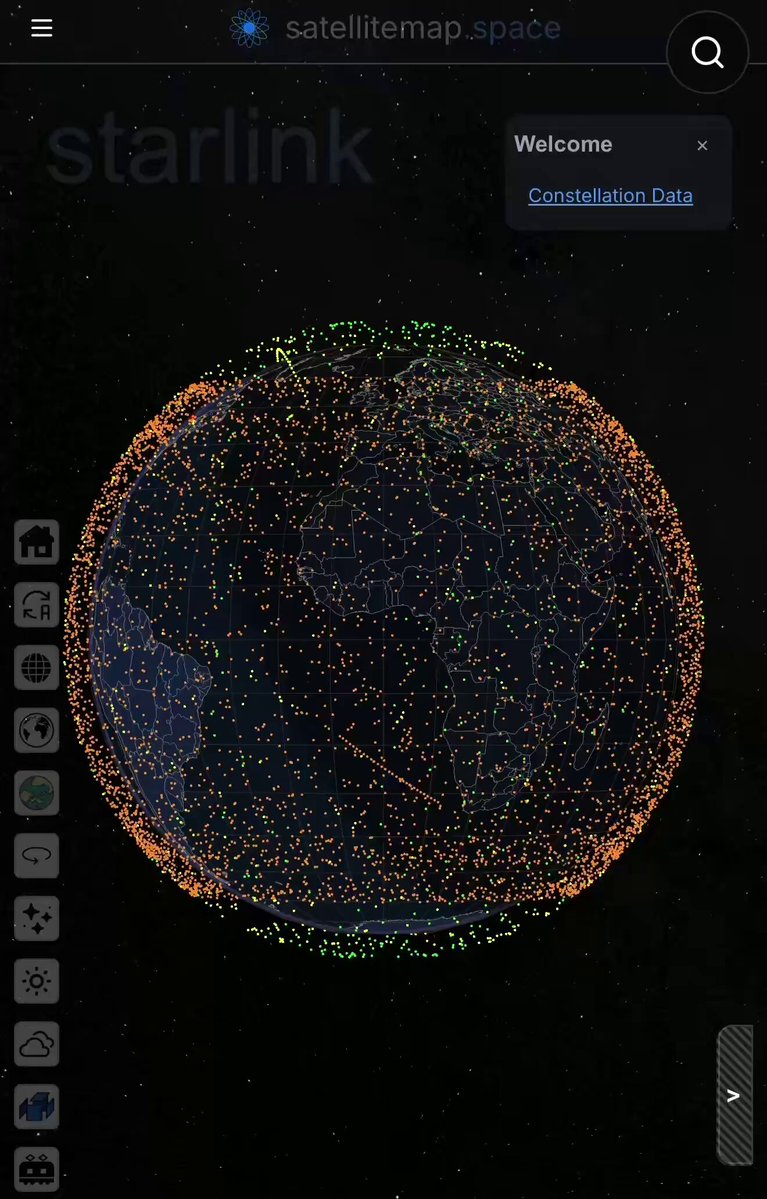
Starlink has become one of the largest and fastest infrastructure builds in history, with over 11,400 satellites launched and nearly 10,000 active, delivering global high‑speed internet coverage

Man is on track to build the one best thing everyone wants
How Starlink Works: Constellation, Ground Network, And Direct-to-Cell
The LEO Constellation And Launch Cadence
Starlink’s engineering advantage is tied directly to its choice of orbit. Traditional geostationary satellites operate at approximately 35,786 kilometers above Earth, which allows one spacecraft to cover vast areas but imposes a round‑trip latency of well over 500 milliseconds even in ideal conditions. In contrast, Starlink satellites orbit in low Earth orbit, typically a few hundred kilometers up, so signals travel a much shorter physical distance. That design produces much lower latency, with early public testing reporting 20–40 millisecond pings and download speeds of 50–150 Mbps, and later studies of in‑flight connectivity showing typical latencies under 40 milliseconds and median downlink throughput around 85 Mbps.
SpaceX achieves this by launching satellites in batches—often 20 to 60 at a time—on reusable Falcon 9 rockets, then raising them to operational orbits where they maintain tight formations using onboard propulsion and autonomous navigation. The high launch cadence has been made possible by SpaceX’s rapid turnaround and reuse of boosters, allowing Starlink to add thousands of satellites in just a few years and to replenish failed or deprecated units before performance materially degrades. Each new generation of satellites adds capabilities such as improved antennas, higher throughput, laser crosslinks for inter-satellite routing, or dedicated direct-to-cell payloads, gradually upgrading the constellation without waiting for multi‑decade refresh cycles.
Laser inter-satellite links are particularly important for Starlink’s long‑term architecture. Instead of routing all traffic strictly up and down between users and the nearest ground station, laser-linked satellites can pass data directly between one another in space, creating a mesh that reduces dependence on any single country’s ground infrastructure and potentially shortens routes between distant points on Earth. For crypto markets that rely on millisecond-level differences in latency for high‑frequency trading or cross-exchange arbitrage, this vision of “alien-like internet from space” is more than marketing poetry: it hints at a future where satellite networks carry latency-sensitive financial flows across borders along entirely new physical paths.
User Terminals, Performance, And Power Demands
On the ground, Starlink’s consumer service is accessed via proprietary user terminals sometimes called “dishes,” though modern versions are flattened phased-array antennas roughly the size of a large pizza box. These terminals electronically steer their beams to track Starlink satellites as they pass overhead, handing off between spacecraft in a way that is invisible to the end user. A Wi‑Fi router distributes the signal inside the home or business, while mounting hardware keeps the dish oriented with a clear view of the sky.
Real-world performance varies by location, network load, and equipment generation, but several characteristics are relatively consistent. Latency is much lower than older satellite systems and often good enough for video calls, gaming, and real-time financial trading. Download speeds for residential plans commonly fall in the 100–300 Mbps range under favorable conditions, as seen in both provider disclosures and user experiences in regions such as Bolivia and rural North America. Upload speeds tend to be significantly lower, often in the 15–30 Mbps range, which can be a constraint for activities like running publicly reachable nodes, streaming, or uploading large datasets. Starlink itself advertises more than 99.9% average uptime, though users in congested cells or obstructed sites can experience service degradation.
Power consumption is a less visible but increasingly important dimension, especially for off‑grid users, ships, and mobile crypto setups. Starlink terminals draw materially more power than a typical home router and modem, to the point that some off‑grid cabin users report substantial drain on battery systems unless they add significantly more solar capacity or use direct DC power solutions. Marine and RV installations face similar trade‑offs, particularly when using high‑performance in‑motion variants designed to maintain connectivity on vessels or vehicles in motion. For crypto miners, node operators, or remote trading desks contemplating satellite-based setups, this power overhead must be factored into system design, especially where energy is scarce or expensive.
Direct-to-Cell And Satellite-To-Mobile Integration
One of Starlink’s most strategically consequential moves is its push into direct-to-cell connectivity, in which satellites talk directly to unmodified 4G/LTE smartphones using spectrum and partnerships with terrestrial mobile operators. In this model, a user with a compatible phone can send messages and potentially light data traffic by connecting straight to a Starlink satellite when no ground-based cellular coverage is available, without needing a Starlink dish or terminal.
Trials in Africa illustrate how this technology works in practice. Airtel Africa, one of the continent’s major mobile operators, has partnered with SpaceX to test Starlink Mobile services across its 14 markets, focusing on areas with no terrestrial signal. In successful test phases, ordinary 4G smartphones were able to connect to Starlink’s constellation of several hundred direct-to-cell–enabled satellites, enabling “light data” applications such as WhatsApp calling, Facebook Messenger, and even financial transactions via Airtel’s mobile app in zones that previously had no connectivity at all. Similar services, branded as “light data” offerings through local operators like Kyivstar, allow smartphones to automatically switch to a Starlink satellite link when regular mobile coverage fails, maintaining basic messaging and mapping functionality during outages or blackouts.
For crypto and digital finance, direct-to-cell is particularly intriguing because it erodes the boundary between “on-grid” and “off-grid” users. A subsistence farmer, market trader, or fisher in a remote coastal area could, in principle, use stablecoin wallets, decentralized lending platforms, or NFT marketplaces over the same handset they use today, as long as they can intermittently connect to satellites to synchronize transactions. It also opens possibilities for censorship-resistant communication in crisis zones, although the extent of that resilience depends on how governments regulate and potentially pressure both Starlink and its local partners.
Aviation, Maritime, And Enterprise Connectivity
Beyond fixed and mobile consumer use, Starlink has moved aggressively into aviation, maritime, and enterprise networks. Airlines have begun equipping aircraft with Starlink Aviation terminals, which use the LEO network to deliver in‑flight Wi‑Fi that is significantly faster and lower latency than earlier satellite systems. A research study analyzing connectivity on 25 commercial flights across multiple airlines found that Starlink-equipped flights typically experienced latencies below 40 milliseconds and median downlink bandwidth of roughly 85 Mbps, compared to more than 550 milliseconds latency and about 6 Mbps downlink on geostationary providers. Starlink clients on planes dynamically connect to different ground gateways as the aircraft moves, shortening the satellite path and reducing dependence on fixed Internet points of presence.
For ships, offshore platforms, and remote industrial sites, Starlink offers maritime and business plans that can replace or augment legacy VSAT solutions. This is particularly relevant to the offshore energy sector, shipping, and remote mining, where high‑capacity connectivity can support everything from safety systems and telemetry to real-time market data feeds for commodities and crypto trading desks onboard vessels. However, these high-performance systems often have even greater power draw than residential terminals, raising concerns about battery drain on smaller vessels and underscoring a risk our newsroom has highlighted: Starlink’s high power appetite can create new reliability issues if not properly provisioned, particularly in harsh or resource‑constrained environments.
Leviathan readers click Starlink as a BTC-treasury-and-IPO arbitrage story, not as a connectivity infrastructure story — the 78-click dominant headline fuses SpaceX's 8,285 BTC position with a $1.75T 2026 IPO, while purely operational headlines (launches, school access, speeds) collectively draw fewer than 10 clicks total.
Business Model, Economics, And The Path Toward An IPO
Starlink Within SpaceX’s Corporate Structure
Starlink is operated by Starlink Services, LLC, a subsidiary of SpaceX, and over a remarkably short period it has become SpaceX’s largest business segment by revenue. According to public reporting and Starlink’s own progress updates, by the end of 2025 the service had generated approximately 11.4 billion USD in revenue and 4.4 billion USD in operating income, surpassing the launch business as the main driver of SpaceX’s cash flow. This shift marks a fundamental strategic transformation: SpaceX is no longer just a rocket company selling launches to governments and commercial customers; it is also a global telecom carrier with recurring subscription revenue that can help finance ambitious projects like Starship, Mars missions, and next-generation satellites.
From an economic perspective, the synergy is clear. The same rockets and reusability technologies that reduced launch costs now serve as in‑house logistics for Starlink satellites, while Starlink revenue reduces dependence on external launch contracts. Analysts have long suggested that the total addressable market for global satellite internet could exceed tens of billions of dollars annually, and some Chinese research institutions have estimated that by 2030 the satellite internet market alone could surpass 45 billion USD globally. For investors eyeing a potential Starlink or SpaceX initial public offering (IPO), this recurring revenue stream is a central part of the bullish thesis.
Pricing, Regional Models, And Unit Economics
Starlink’s pricing strategy has evolved as the network has scaled and as competition from terrestrial providers and other satellite constellations has intensified. During its early public beta, the service in the United States charged around 499 USD for the terminal and 99 USD per month for service. Over time, Starlink has introduced multiple plans—residential, business, mobility, maritime, aviation, and now direct-to-cell—each with different price points, prioritization levels, and fair-use policies, often varying by country and regulatory regime.
Examples from emerging markets illustrate how Starlink tailors its positioning. In Bolivia, which opened to Starlink only in early 2026 after the government passed a decree allowing low-Earth-orbit satellite operators to enter the market, residential Starlink plans start at around 460 Bolivianos per month. Publicly available data suggest these plans offer download speeds between approximately 135 and 310 Mbps, positioning Starlink as a genuinely broadband-grade connection for classroom and household use rather than a slow backup. The Bolivian government has framed internet access as a basic utility on par with electricity and water, particularly for rural schools and health centers that traditional infrastructure has bypassed, and sees Starlink partnerships with the state-owned operator Entel as a long-term infrastructure strategy rather than a short-term pilot.
Contrasts with wealthier markets are instructive. In North America and parts of Europe, Starlink competes more directly with cable and fiber providers, and pricing dynamics reflect competitive pressures and capacity constraints. Performance there can be excellent, but in saturated cells some users report variability during peak hours, and the total cost of ownership—including terminal, mounting, and possibly roof work—can be higher than entry-level fiber or cable for urban customers. This reinforces a broader economic pattern: Starlink’s value proposition is strongest where terrestrial alternatives are absent or poor, but in dense urban cores with robust fiber infrastructure it may function more as a backup link, niche solution, or premium low-latency option.
IPO Speculation, Valuation Narratives, And BTC Exposure
Because Starlink is currently nested within SpaceX, investors and crypto-savvy observers have closely watched signals about a potential IPO or spin-out. Reports in financial media have suggested that SpaceX is preparing an initial public offering that could raise around 75 billion USD by selling hundreds of millions of shares at a fixed price, although details remain preliminary and subject to change. Separate commentary from market watchers and on-chain intelligence firms has speculated about an eventual valuation for Starlink itself that could approach the upper hundreds of billions or more, with some social media posts touting a theoretical 1.75 trillion USD figure for a future Starlink-related listing. These numbers are not official guidance, but they illustrate how central Starlink is to the investment narrative around SpaceX.
On the crypto side, one of the more notable disclosures has been that SpaceX reportedly holds 8,285 BTC on its balance sheet, worth in the mid‑hundreds of millions of dollars at recent market prices. These holdings, surfaced by blockchain analytics firm Arkham, position SpaceX as a significant corporate Bitcoin holder alongside more familiar names in the public markets. For a company whose primary growth engine is Starlink, that BTC exposure creates an unusual convergence between satellite infrastructure, internet connectivity, and the Bitcoin monetary network. It also prompts questions about how a future Starlink or SpaceX IPO might be valued by a market increasingly comfortable with Bitcoin treasuries, and whether Starlink could eventually integrate Bitcoin or other crypto-native payment rails into its own billing and settlement systems.
Crypto investors contemplating a Starlink-related equity offering, whether through a SpaceX IPO or a dedicated Starlink spin-out, will likely pay close attention to several metrics: subscriber growth and churn, average revenue per user by region, capital expenditure for replacement and next-generation satellites, regulatory risks in key markets, and the pace at which direct-to-cell and enterprise services ramp. Viewed through that lens, Starlink becomes less a “space stock” and more a hybrid of cloud infrastructure, telecom, and fintech, operating in markets where crypto itself is a parallel alternative to legacy finance.
- 01SpaceX BTC treasury exposure↗
Readers treating Starlink's impending IPO as a de facto Bitcoin proxy — SpaceX's 8,285 BTC hoard makes any public listing a leveraged bet on both satellite dominance and crypto treasury strategy simultaneously.
- 02Starlink IPO at $1.75T↗
The $1.75T 2026 IPO figure reframes Starlink not as a telecom play but as a valuation event that would dwarf most public companies, pulling in readers speculating on pre-IPO positioning.
- 03Satellite infrastructure moat↗
11,400+ satellites launched and ~10,000 active represents a physical-layer monopoly that readers recognize as the hard-to-replicate asset underpinning both the IPO premium and BTC treasury credibility.
- 04Security and geopolitical risk↗
Expert warnings that Starlink's single-operator architecture creates a critical infrastructure vulnerability drew readers interested in the adversarial case against the bull thesis.
- 05Emerging market expansion↗
Africa, Central Asia, and Latin America rollouts signal addressable market expansion that supports the IPO valuation narrative, drawing low but consistent reader interest.
Global Expansion And Digital Inclusion: Case Studies
Remote Schools And Islands: Kenya, Bolivia, And Beyond
One of the most visible narratives around Starlink’s expansion has been its role in connecting remote schools and communities that were previously offline. In Kenya, Starlink has been deployed to dozens of schools, including a blend of senior and junior institutions, bringing reliable internet to more than 32,000 students and roughly 1,000 teachers who had never before had stable connectivity. This rollout enables basic digital literacy, access to online educational resources, and participation in global learning platforms, while also providing staff with administrative tools and communication channels that are taken for granted in urban schools.
In Bolivia, Starlink’s arrival in 2026 was framed explicitly by the government as part of a universal service and poverty alleviation effort. Within months of commercial launch, Starlink had reportedly reached about 40,000 active connections in the country, with a focused initiative connecting more than 1,000 students and teachers across 14 rural schools. The country’s challenging geography—stretching from Andean highlands to Amazonian lowlands—has made terrestrial fiber deployment prohibitively expensive in many areas; satellite internet sidesteps those terrain constraints entirely. For Bolivian students, this means the ability to stream lessons, access cloud-based educational software, and even explore coding or blockchain concepts in real time, using the same tools as peers in wealthier nations.
Elsewhere, Starlink has been used to bring high-speed internet to some of the world’s most remote islands, enabling schools, clinics, and micro‑businesses to interact with global markets and educational platforms. While each island context is different, the pattern is similar: where there was once limited or no connectivity, Starlink terminals now beam in broadband-grade service from orbit, often installed on school roofs or community centers. These networks provide the foundational infrastructure for introducing digital payments, e‑commerce, and crypto-based remittance channels, especially in communities where banking penetration is low and cross-border transfers are slow or expensive.
Kyrgyz Republic, Lesotho, And Airtel Africa: Regulatory And Partnership Models
Starlink’s entry into the Kyrgyz Republic demonstrates how smaller states can integrate a global satellite player into their national connectivity strategy. In Kyrgyzstan, Starlink is now officially available, with the country listed as covered on the Starlink website and a dedicated information page published in both Kyrgyz and Russian. The stated objective is to deliver high-speed internet to remote and hard-to-reach areas that have historically suffered from poor infrastructure. For a landlocked, mountainous republic with many rural communities, the combination of Starlink and existing mobile networks offers a path to expand digital services without waiting for expensive and slow fiber build-outs.
In Lesotho, a small mountainous state inside South Africa, Starlink’s arrival has sparked a more contested debate about digital sovereignty. Local commentary has highlighted the benefits of high-speed internet access for public safety networks and remote locations, but also raised pointed questions about whether reliance on a foreign, privately controlled satellite network means trading away a measure of digital independence for convenience. These concerns mirror broader geopolitical debates about who controls the backbone of the global internet and how that power could be used in times of political tension, sanctions, or conflict.
Across Africa more broadly, Starlink has increasingly pursued partnership models with incumbent operators. Airtel Africa’s collaboration with SpaceX to roll out Starlink direct-to-cell services across 14 markets is a leading example. Instead of bypassing mobile carriers, Starlink integrates with them, using their spectrum and billing relationships to deliver satellite-based messaging and data to ordinary smartphones when terrestrial networks are unavailable. For Airtel’s roughly 174 million subscribers, this promises a form of backup connectivity that could be crucial in rural areas, during disasters, or in regions where infrastructure is fragile. For Starlink, it provides a distribution and regulatory partner embedded in national markets, potentially smoothing approvals and aligning incentives.
Pushback, Ownership Rules, And Digital Sovereignty
Starlink’s expansion is not frictionless. In South Africa, regulators initially denied Starlink a license because it did not meet a requirement that 30% of the local operation be Black-owned under the country’s economic empowerment rules. Subsequent policy changes, including an Equity Equivalence Investment Program, have been discussed as a possible path to compliance, but the episode illustrates that satellite constellations are still subject to domestic telecom and ownership laws even when their satellites are literally above the jurisdiction. Similar tensions could arise in other republics and kingdoms as they weigh the benefits of rapid connectivity against industrial policy, local ownership, and national security concerns.
Internationally, Starlink’s ability to operate in a given country hinges on landing rights and spectrum coordination under International Telecommunication Union (ITU) frameworks, as well as the decisions of national regulators. Although Starlink’s coverage map now shows near-global reach, including polar regions, regulatory approvals have historically lagged behind physical coverage, with Starlink only able to provide broadband services in around 115 countries as of mid‑2025. This friction creates a patchwork of accessibility that matters for crypto users. In some jurisdictions, Starlink might be a straightforward way to connect a local node or trading setup; in others, the service may be technically visible from orbit but legally unavailable to residents.
Crypto’s ethos of permissionless access and censorship resistance sits uneasily alongside the reality that Starlink is a centrally controlled, heavily regulated infrastructure provider that must negotiate with states. For communities hoping to use Starlink as a way to escape unstable or censorious local networks, these dynamics mean that legal and geopolitical risk is part of the equation, alongside the technical performance and price.
First 60 Starlink satellites launched on Falcon 9
Starlink public beta ('Better Than Nothing Beta') opens
Starlink surpasses 1 million active subscribers globally
White House security experts warn Starlink poses infrastructure minefield risks
Constellation exceeds 10,000 active satellites, achieving near-global coverage
Airtel Africa completes Starlink direct-to-cell testing across 14 markets
Arkham Intelligence confirms SpaceX holds 8,285 BTC ahead of reported $1.75T IPO
Performance, Reliability, And Capacity Risks
Comparing Starlink With GEO And Terrestrial Networks
From a user-experience perspective, the main performance metrics of interest are latency, throughput, jitter, and uptime. Starlink’s LEO architecture gives it a decisive latency advantage over geostationary competitors. While GEO satellites typically impose round‑trip latencies of 550 milliseconds or more, Starlink services often deliver under 40 milliseconds, making them viable for interactive applications like gaming, videoconferencing, and high-frequency trading that GEO systems struggle with. Studies of in-flight connectivity have quantified this advantage, with Starlink-equipped flights showing an order-of-magnitude improvement in latency and roughly 15 times higher median downlink bandwidth than GEO-based in-flight Wi‑Fi.
Compared to terrestrial broadband, the picture is more nuanced. In many rural or underserved regions, Starlink’s speeds and latency are far superior to legacy DSL or congested mobile networks, effectively leapfrogging them into modern broadband performance. In dense urban areas with fiber-to-the-home, gigabit cable, or modern 5G, Starlink often cannot match the highest available throughput or stability, particularly under heavy load. But even in those markets, it offers a compelling backup path and, in some scenarios, lower median latency to certain destinations depending on routing and peering arrangements. Research has shown that Starlink’s end-to-end performance can be affected by terrestrial factors such as content filtering and DNS-based geolocation decisions, which can introduce unnecessary delays beyond the satellite hop itself.
For crypto use cases, these characteristics translate to a spectrum of possible roles. In a remote village, Starlink might be the only link that enables access to centralized exchanges, decentralized apps, and on-chain governance. In an urban trading firm, Starlink might serve as a secondary, low-latency route to certain regions or a redundancy channel for critical infrastructure, including cold storage monitoring and risk systems. The key is that Starlink can deliver a level of performance that is “good enough” for most financial applications, with the caveat that local congestion and peering policies still matter.
Reliability, Power, And Physical Installations
Reliability is a function not just of satellite uptime but also of ground conditions. Starlink advertises average uptime exceeding 99.9%, but individual users can experience intermittent outages due to local weather, obstruction, or maintenance events in their particular satellite cell. User reports and independent tests suggest that installations with clear views of the sky—free from trees, buildings, or mountains—achieve the best consistency, while those in cluttered environments may see periodic dropouts as satellites pass behind obstacles. Proper mounting, often at higher elevations or on poles, mitigates this risk but adds installation complexity and potentially cost, especially for renters or institutions.
Power reliability is a subtler but critical dimension. Because Starlink dishes are active phased-array systems rather than passive antennas, they require continuous electrical power for tracking, beam steering, and communication. Off-grid users who rely on solar and batteries have reported that Starlink’s power draw can significantly deplete their energy reserves, particularly when combined with other loads and during periods of low insolation. Some mitigate this by wiring Starlink to run on direct DC power, avoiding inverter losses, and by adding substantial solar capacity or scheduling usage during daylight hours. Ships and RVs face analogous challenges, especially when using in-motion high-performance terminals that draw even more power than fixed residential units.
In practical terms, this means that anyone planning to use Starlink for critical financial operations—whether that is a Bitcoin mining operation, a rural ATM backed by stablecoins, or a small off-grid trading office—must design their power system carefully. Redundant supplies, battery buffers sized for Starlink’s consumption, and perhaps alternative backup connectivity (such as legacy mobile or HF radio for emergency messages) may be necessary to avoid the paradox in which your internet link is available, but your batteries die when you need them most.
Capacity, Congestion, And Scalability Risks
As Starlink’s subscriber base has grown, so has concern about capacity and congestion. Satellite beams and ground gateways have finite throughput, and in areas where Starlink has attracted dense clusters of users—suburban regions underserved by fiber, for example—peak-time performance can degrade. Starlink manages this through a mix of capacity upgrades, spectrum reuse, beam shaping, and traffic management policies, but the fundamental physics of shared wireless medium remain. For crypto traders who require consistent low-latency performance even during global volatility spikes—precisely when everyone else may also be online—this capacity risk is nontrivial.
Starlink attempts to address scalability by continuously launching more satellites, upgrading gateways, and refining the network stack, including the use of congestion control algorithms such as BBR that can achieve higher goodput at the cost of more retransmissions. However, that same research notes that not all performance bottlenecks are in space; DNS routing and distant content filtering proxies can add avoidable latency even when the satellite hop is efficient. This underscores a recurring theme: Starlink is only one part of the end-to-end path. Peering relationships, content delivery network architectures, and regional internet governance will continue to shape user experience, including for blockchain nodes and DeFi front-ends.
SpaceX holds 8,285 BTC as it launches Starlink satellites and eyes $1.75T 2026 IPO

Elon Musk saying "Hi, I want my eggs in different basketd"
Security, Surveillance, And Geopolitics
Network Security And Encryption Concerns
Starlink’s rise has attracted scrutiny not only for its performance and economics but also for its security posture. Experts have raised concerns about the cryptographic and operational security of Starlink deployments in sensitive contexts, most prominently at the highest levels of government. Reporting that Starlink terminals had been installed in the White House and associated facilities triggered warnings from security analysts, some of whom described the setup as a “security minefield” and questioned the wisdom of relying on a privately controlled satellite network, donated by a billionaire, in such a sensitive environment. Commentators like Karl Bode have noted that it is highly unusual and potentially dangerous to integrate a third-party consumer-grade system into the core communications environment of a national leadership residence, especially without transparent audits of its hardware, firmware, and encryption.
The broader concern is that satellite networks are complex, software-defined systems with many potential attack surfaces: user terminals, ground gateways, satellite links, routing infrastructure, and the management planes that coordinate them. While Starlink uses encryption to protect user traffic, the specifics of its security model are not fully public, and any vulnerabilities—whether in key management, firmware update channels, or cross-satellite routing—could be exploited at massive scale. For crypto users who rely on Starlink as their primary link, this raises questions about confidentiality, integrity, and availability of their internet traffic, especially in jurisdictions where adversaries may have both technical capacity and legal leverage over infrastructure providers.
It is important to distinguish between SpaceX’s Starlink and similarly named but unrelated systems, such as Subaru’s STARLINK connected vehicle service. The latter suffered a serious vulnerability in 2024 that allowed attackers to take over user accounts, access sensitive personal data, and even remotely control vehicle functions, including location tracking and door locks. Although this incident did not involve the satellite internet service, it serves as a cautionary tale about how internet-connected systems branded as “Starlink” or similar can harbor significant security flaws if authentication and authorization mechanisms are not robust. The lesson for SpaceX and for users is the same: scale amplifies both benefits and risks, and security must be engineered and audited at every layer.
National Defense, Dual-Use, And Militarization
Beyond consumer security, Starlink has become entangled in national defense and geopolitical debates. Analysts in China and elsewhere have described Starlink as possessing characteristics that could pose new threats to other countries’ national security. As a low-orbit satellite internet system with global coverage, Starlink can in principle provide “dead zone-free” reconnaissance, communication, and command-and-control support to military forces, including those of the United States and its allies. Its rapid deployment, resilience against single-point failures, and ability to dynamically route traffic make it attractive for military use, as has already been seen in conflict zones where Starlink terminals have been used to maintain communications under conditions that degrade traditional networks.
From the perspective of other states, this dual-use character—commercial broadband on one hand, potentially military-grade communications on the other—creates strategic dilemmas. Some fear that Starlink could be leveraged to support offensive operations, espionage, or sanctions enforcement, or that its dominance of LEO could crowd out other nations’ satellite projects. Others worry about scenarios in which Starlink becomes a de facto gatekeeper for connectivity in their territory, with the ability to selectively cut access for political reasons or under pressure from foreign regulators. These concerns intersect with debates about digital sovereignty in places like Lesotho, where citizens and policymakers question whether relying on a foreign satellite network undermines national control over critical communications infrastructure.
For the crypto community, the militarization and politicization of Starlink highlight a core tension. On one hand, a resilient, global, high-bandwidth network provides vital redundancy and freedom to transact, especially under repressive regimes or during conflict. On the other hand, if that network is perceived as an extension of a particular state’s strategic assets, it may itself become a target in cyber or kinetic conflict, with direct consequences for users whose livelihoods depend on it.
Safety, Reliability, And The Starship Live Feed
Another vector for concern is the use of Starlink in safety-critical or high-risk environments, such as rocket launches, emergency services, and real-time telemetry. During SpaceX’s Starship test flights, Starlink terminals have been used to stream high-definition video and a considerable amount of telemetry from the vehicle back to Earth in real time, even during atmospheric reentry. This is an impressive demonstration of the network’s robustness under extreme conditions, showcasing the ability of Starlink links to function during dynamic, high-speed operations with significant thermal and radio-frequency challenges.
Yet the same feat has raised questions about whether Starlink’s increasing ubiquity and perceived reliability might encourage over-reliance on a system that has not yet been fully proven in all contingencies. If emergency services, aviation safety systems, or critical infrastructure monitoring come to depend heavily on Starlink, any systemic outage—whether caused by software bugs, solar storms, cyberattacks, or regulatory actions—could have cascading effects. Our newsroom’s coverage has highlighted that Starlink, while impressive, is still a young system, and that its reliability in edge cases and adversarial conditions remains an area to watch. For crypto: if your hardware wallets, custody infrastructure, or trading engines assume persistent Starlink connectivity as a given, you should plan carefully for failure modes.
A single private company (SpaceX) controls the ground stations, satellite constellation, user terminals, and BTC treasury, creating a single point of failure for both the network and any downstream financial exposure.
South Africa's denial of a Starlink license over black ownership rules illustrates that national regulators can block market entry outright, threatening the global-coverage thesis that underpins the IPO valuation.
A $1.75T IPO target for a pre-revenue-at-scale entity with a BTC treasury introduces correlated drawdown risk — a crypto bear market could deflate both the BTC holdings and investor appetite for the IPO simultaneously.
Documented vulnerabilities in Starlink-connected hardware (e.g., Subaru Starlink exploit) and White House expert warnings confirm that the satellite-to-ground attack surface is active and inadequately hardened.
Starlink remains privately held; there is no public market for direct exposure, forcing crypto-native investors into indirect plays (SpaceX secondary markets, BTC correlation) with wide bid-ask spreads and transfer restrictions.
Dual-use satellite infrastructure has drawn scrutiny from multiple governments over military and surveillance implications, creating a regulatory tail risk that could fragment Starlink's global operating licenses.
Starlink, Crypto, And The Future Of Borderless Finance
Financial Inclusion And Access To Global Markets
The most obvious way Starlink intersects with crypto is through basic access. In regions where banks are scarce, remittance costs are high, and local currencies are unstable, crypto offers an alternative path to savings, payments, and investment—but only if people can get online reliably. Stories from Kenya, Bolivia, remote islands, and the Kyrgyz Republic show that Starlink is often the first broadband connection communities have ever had, enabling not just online education but also participation in the global digital economy. For a farmer in rural Kenya or a student on a Pacific island, Starlink is the bridge that turns a smartphone into a gateway to global work, marketplaces, and financial tools.
Crypto networks extend that bridge further. Once connected, individuals can open non-custodial wallets, receive remittances in stablecoins, participate in microtask platforms, or sell digital goods and services to a worldwide audience. Entrepreneurs can accept crypto payments from tourists or overseas customers without needing merchant accounts from traditional banks. Local co-ops or community entities can issue tokens representing shared assets, from fishing rights to solar panels, and manage them through decentralized autonomous organizations (DAOs). None of this is possible without connectivity; Starlink makes it practical in places where laying fiber would take decades.
Nodes, Miners, And Satellite-Backed DeFi
For the crypto infrastructure layer, Starlink opens intriguing possibilities. Running full nodes for Bitcoin, Ethereum, or other major chains requires sustained, reasonably fast connectivity to sync blocks and propagate transactions. In regions where terrestrial internet is unreliable, Starlink can provide the baseline connectivity needed to host these nodes, diversifying the geographic distribution of the network’s infrastructure. In theory, miners could also rely on Starlink links for block template updates and transaction propagation, though the relatively high power cost of Starlink terminals and the economics of mining in remote regions would need careful consideration.
DeFi applications, which often involve high-frequency interactions with smart contracts, benefit from low latency and reliable connectivity as well. Starlink’s combination of sub‑50‑millisecond latencies and broadband speeds in many regions makes it viable for participants in liquidity pools, derivatives platforms, and NFT marketplaces who are physically far from major internet hubs. For trading desks on ships or in remote energy installations, Starlink can provide access to both traditional markets and on-chain venues, allowing for integrated arbitrage and hedging strategies that transcend national borders.
At the same time, using Starlink for crypto infrastructure requires acknowledging its centralization. Unlike radio-based block relay or mesh networks, Starlink relies on a closed hardware stack and a proprietary, centrally managed constellation. If regulators or corporate policies were to restrict access in certain regions or for certain traffic types, crypto nodes and miners depending on Starlink could be affected. For genuinely censorship-resistant infrastructure, Starlink is a valuable supplement but not a substitute for diversity in physical and logical communication paths.
BTC On The Balance Sheet And Corporate Signaling
SpaceX’s reported holdings of 8,285 BTC add a symbolic and practical bridge between Starlink and the crypto ecosystem. Corporate Bitcoin treasuries are often interpreted as signals about a company’s views on macroeconomics, inflation, and the long-term role of digital assets. In SpaceX’s case, the fact that its primary growth engine is a satellite internet service gives this signal additional resonance. When a firm that is literally launching the physical infrastructure of the global internet into orbit also chooses to hold Bitcoin as part of its reserves, it underscores the alignment between open, borderless communications and open, borderless money.
For a future Starlink or SpaceX IPO, these BTC holdings may influence both valuation narratives and investor composition. Crypto-native funds and high-net-worth individuals who prioritize Bitcoin exposure may view Starlink exposure as a way to combine infrastructure and monetary bets. Conversely, traditional telecom investors might see the BTC position as an additional risk factor. Either way, the presence of Bitcoin on SpaceX’s balance sheet ensures that Starlink will remain of interest not only to space and telecom analysts but also to the crypto community.
Censorship Resistance, Centralization, And “Network States”
The rise of Starlink also intersects with emerging ideas about “network states” and digital republics: communities that organize politically and economically online rather than solely through territorial nation-states. Crypto networks are the financial substrate of these experiments; Starlink and similar constellations are the physical substrate. Together, they enable the creation of transnational communities that can coordinate, transact, and govern themselves across borders, anchored less in geography and more in shared protocols and values.
However, relying heavily on a centrally controlled satellite network introduces a paradox. Crypto is built around the idea of minimizing trust in centralized intermediaries, yet Starlink is a single point of control that can, in principle, be pressured by states or subject to corporate strategy shifts. For digital republics and network-native communities, this suggests a layered approach: use Starlink as one connectivity option among many, combine it with terrestrial ISPs, mesh networks, and perhaps even alternative satellite providers, and design governance mechanisms that do not assume any single infrastructure provider is always available.
Environmental, Astronomical, And Long-Term Risks
Space Debris, Kessler Syndrome, And Orbital Commons
With Starlink now accounting for approximately 75% of all active maneuverable satellites in Earth orbit, concerns about congestion and debris are unavoidable. Every satellite represents a potential collision risk; thousands in similar orbits magnify that risk. While Starlink satellites are equipped with propulsion systems and automated collision-avoidance capabilities, the sheer volume of objects in LEO, including defunct satellites and fragments from past anti-satellite tests, creates a non-zero chance of cascading collisions, sometimes called Kessler syndrome. Such an event could degrade orbital environments for decades, affecting not just Starlink but all satellite services, earth observation, and space exploration.
SpaceX has committed to deorbiting end-of-life Starlink satellites and has designed newer models to burn up more completely in the atmosphere, reducing debris. However, the effectiveness of these measures remains to be fully tested at scale, and they rely on continued functioning of propulsion and control systems. For crypto users, the long-term concern is indirect but real: if the orbital environment becomes so cluttered that satellite constellations become harder, more expensive, or politically contentious to maintain, the cost and availability of services like Starlink could change dramatically, particularly in lower-income regions.
Astronomy, Light Pollution, And Scientific Trade-offs
Astronomers have also raised alarms about Starlink’s impact on night-sky observations. Bright satellite trains can interfere with optical and radio telescopes, complicating the detection of faint objects and introducing noise into datasets. SpaceX has experimented with “darker” satellite coatings and other mitigation measures, but as the number of satellites grows, so does the challenge of managing their aggregate impact on astronomy. The tension here is between democratizing connectivity for billions and preserving the dark sky as a scientific and cultural resource.
While this may seem distant from crypto, it reflects a broader theme: technologies that expand digital freedom and economic opportunity can impose externalities on shared commons, whether those are planetary (climate), orbital (space debris), or cultural (night sky). For a community that often talks about “public goods funding” and on-chain mechanisms to support common resources, Starlink’s externalities present a potential domain for experimentation. One could imagine DAO-led initiatives that fund astronomical mitigation or orbital debris tracking, financed by fees from users who benefit from satellite connectivity.
Cost, Access, And The Risk Of Unequal Benefits
Finally, there is a risk that Starlink’s benefits may accrue disproportionately to those who can afford it, leaving the poorest still offline or reliant on intermittent access. Residential prices in many markets, while lower than some legacy satellite services, remain high relative to local incomes. Hardware costs, power requirements, and regulatory hurdles can further limit uptake among the most marginalized communities. In maritime contexts, our newsroom has highlighted the risk that Starlink’s unproven role in poverty relief at sea may be overshadowed by high costs and unequal access on vessels, with owners of large, well-funded operations benefiting far more than small-scale fishers.
For crypto’s promise of financial inclusion to be realized through Starlink, sustainable models will be needed: community-owned terminals, shared access points at schools or clinics, subsidized connectivity for critical services, and perhaps on-chain funding mechanisms that compensate local stewards. Without such models, Starlink could inadvertently deepen digital divides even as it narrows geographic ones.
Outlook
Starlink has moved from a speculative idea to a sprawling, operational piece of global infrastructure in just a few years. With more than ten thousand satellites in orbit, over twelve million subscribers, high-speed connections to aircraft and ships, and partnerships stretching from the Kyrgyz Republic to Airtel Africa’s fourteen markets, it is reshaping who can get online, where, and on what terms. For the crypto world, Starlink is both an enabler and a dependency: it brings remote communities, mobile users, and offshore operations into the orbit of global digital finance, but it also centralizes a crucial layer of connectivity in the hands of a single, heavily regulated corporate actor.
In the coming years, several uncertainties will define Starlink’s relationship with crypto and the broader digital economy. The trajectory of a potential SpaceX or Starlink IPO, including how markets value its recurring revenue, BTC holdings, and regulatory risks, will shape capital flows into space-based infrastructure and possibly influence how aggressively competitors and national constellations emerge. The maturation of direct-to-cell technology will determine whether billions of smartphone users can rely on satellites as a seamless backup or even primary link, with direct implications for mobile wallets, Web3 apps, and on-chain governance. Regulatory choices—from South Africa’s ownership rules to Lesotho’s sovereignty debates—will test how much control states retain over sky-borne networks, and how that power interacts with crypto’s aspirations for borderless finance.
Security will remain a central theme. From White House deployments to conflict-zone operations, Starlink’s encryption, resilience, and governance will be under constant scrutiny, with any significant breach or outage likely to trigger both political and market reactions. And in the background, long-term questions about orbital congestion, environmental impact, and scientific externalities will shape public and regulatory attitudes toward mega-constellations, potentially affecting pricing and availability.
For crypto builders, investors, and users, the most pragmatic stance is to treat Starlink as a powerful new tool rather than an unshakeable foundation. It can bring markets, education, and self-sovereign money closer to people who have been structurally excluded, but its centralization, regulatory sensitivity, and environmental footprint mean it should be complemented with diverse connectivity paths and resilient protocol designs. The future of borderless finance will not be written solely in code or solely in rockets and satellites; it will emerge from the interplay between open monetary networks and the physical infrastructures—like Starlink—that make those networks reachable from almost anywhere on Earth.
Latest Starlink news
Sources
19 records from 13 domains
en.wikipedia.org
facebook.com
- facebook.com· spacefans1 / posts / a-major-connectivity-breakthrough-is-reaching-remote-classro…
- facebook.com· spacefans1 / posts / a-major-connectivity-boost-is-reaching-lesothos-public-safet…
- facebook.com· groups / starlinkrv / posts / 1120635799472323
- facebook.com· groups / starlinkrv / posts / 611175227085052
starlink.com
interpret.csis.org
westoahu.hawaii.edu
youtube.com
x.com
spaceinafrica.com
basenor.com
qazinform.com
itbrew.com
spacex.com
danielja.ng
Community notes
Spot something off or out of date? Drop a note. Editors review topic notes daily and roll accepted fixes into the explainer — contributors are recognized in the monthly $SQUID drop.
Loading notes…
Help improve this topic
Have a story or tip about this topic? Submit it. See something missing? Leave a note. Editors review daily; accepted submissions and fixes count toward the monthly $SQUID drop.