
Deep explainer on how SpaceX’s IPO, Bitcoin holdings, AI push and record launch capacity intersect with tokenized stocks, Hyperliquid perps and multi‑chain RWAs, making SPCX a flagship real‑world asset for crypto markets.
+33 sources across the wider coverage universe
 Intel partners with Elon Musk's SpaceX, xAI, and Tesla on Terafab to scale chip production toward 1TW/year of compute, targeting massive AI and robotics acceleration2026-04
 Bitget opens tokenized pre-IPO trading with SpaceX as first asset on new IPO Prime platform2026-04
 Ark Invest buys $12.2M of SpaceX while trimming positions in Block, Bullish, and Robinhood as Cathie Wood continues rebalancing ETF portfolios2026-07
 SpaceX holds 8,285 BTC worth $603M steady as xAI costs flip $8B profit to nearly $5B loss ahead of IPO2026-04
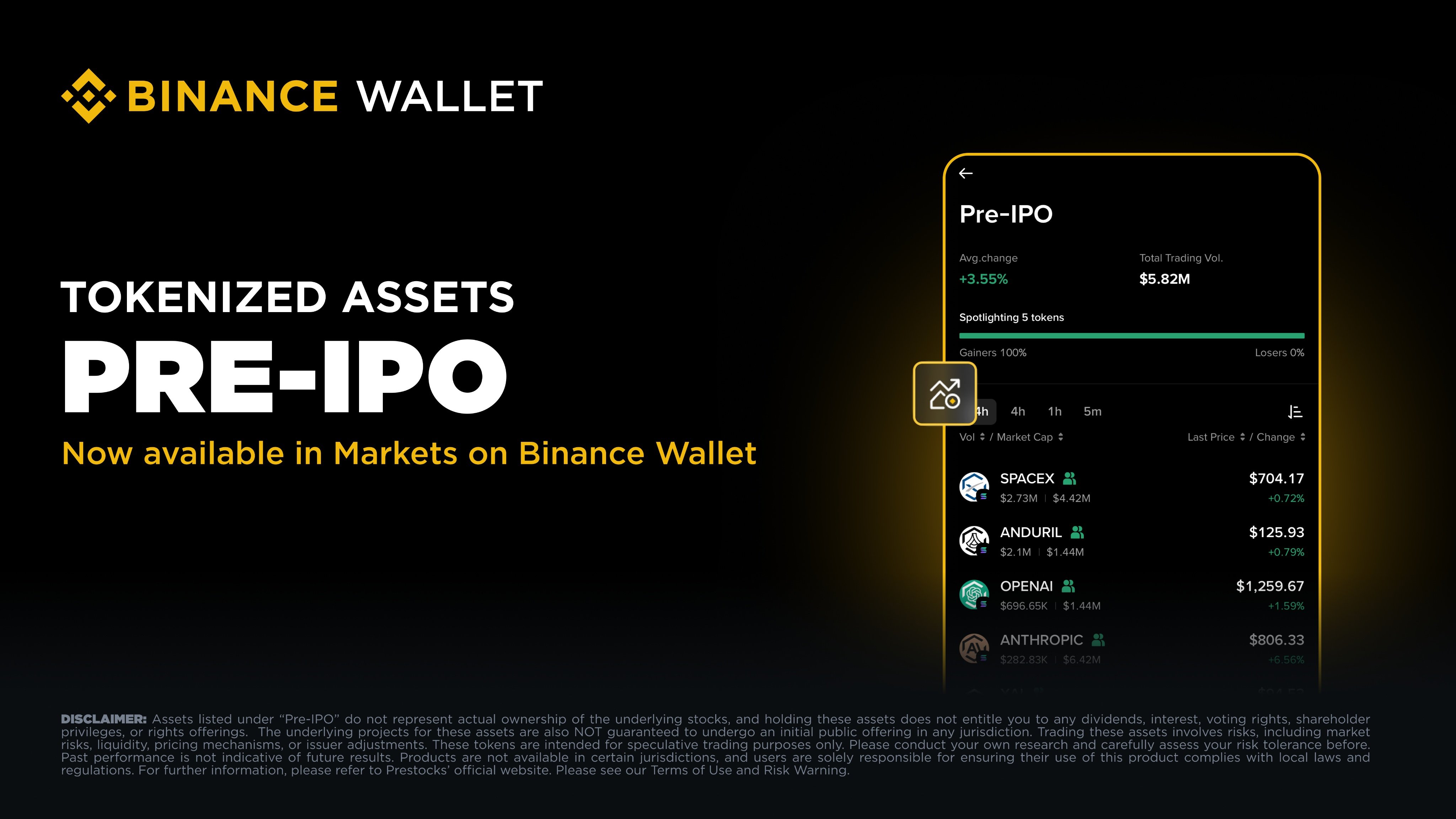 Binance Wallet launches onchain pre-IPO section with tokenized SpaceX and OpenAI among first five assets2026-04
 AI agents are beginning to replace expensive Wall Street research workflows as one autonomous system produced a SpaceX IPO memo using paid onchain APIs2026-05
SpaceX, Crypto, and the New On‑Chain Equity Frontier
The world’s most valuable space company has quietly become one of crypto’s most important real‑world assets, turning rockets, satellites and AI into a new kind of market primitive that trades 24/7 across blockchains. For a crypto audience, SpaceX now sits at the crossroads of tokenized stocks, perpetual futures, Bitcoin treasuries and AI infrastructure, offering a live case study in how traditional equity and on‑chain markets are starting to converge.
SpaceX as Infrastructure: From Rockets to “Mass to Orbit”
To understand why SpaceX matters so much to crypto markets, it helps to begin with the core business. SpaceX designs, manufactures and launches advanced rockets and spacecraft, with an explicit mission to “revolutionize space technology” and ultimately enable human life on other planets. The company was founded in 2002 by Elon Musk and has since pioneered reusable launch systems, commercial crew transport for NASA, and mass‑produced satellites under the Starlink brand. Unlike many aerospace contractors, SpaceX is heavily vertically integrated, building engines, airframes, avionics and software largely in‑house, which gives it a technology‑company cadence that resonates with crypto builders and investors.
A key concept in the company’s S‑1 filing is “mass to orbit”, defined as the total kilograms of payload delivered to space. This metric captures in a single number the effective capacity of the world’s launch industry, much as “blockspace” captures the throughput of a blockchain. In a 2025 update, SpaceX noted that even in the most prolific year in the history of orbital launches, only about 3,000 tons of payload were sent into orbit globally, predominantly on expendable rockets. For crypto readers used to thinking about throughput, the implication is striking: the world’s orbital “bandwidth” is still tiny relative to the economic value riding on it.
SpaceX’s response to this bottleneck is Starship, a fully reusable super‑heavy launch system designed to deliver over 100 metric tons to low Earth orbit (LEO) in its baseline reusable configuration. Independent analyses and SpaceX’s own Starship Payload Users Guide describe payload capacity in the 100–150 ton range to LEO, depending on mission profile and reuse assumptions. Reusability is central: while Falcon 9 already lands and reuses first stages, Starship aims for full reuse of both booster and upper stage, analogous to lowering gas costs not by incremental optimizations but by redesigning the protocol from first principles.
The impact on “mass to orbit” is hard to overstate. If Starship matures to a high‑frequency cadence—SpaceX and external analysts have speculated about eventual hourly launches from a network of pads—then annual payload capacity could be two orders of magnitude higher than today’s global total, even if other launch providers meaningfully scale their operations. For crypto markets, that level of orbital infrastructure matters because it underpins global communications, remote sensing, AI training and potentially orbital compute, all of which can interact with decentralized networks. The same way abundant blockspace enabled DeFi and NFTs, abundant mass‑to‑orbit could unlock entirely new application layers, from space‑based data feeds to off‑planet secure hardware.
Starlink, SpaceX’s satellite broadband constellation, is already a core part of this story. Starlink satellites are mass‑produced LEO spacecraft that provide high‑speed internet to consumers, enterprises and governments worldwide, with a growing role in critical infrastructure and defense communications. For crypto users, Starlink offers censorship‑resistant access routes for running nodes, trading, or simply staying online in jurisdictions with fragile networks or capital controls. Although this is not yet a mainstream use case, the combination of Starlink connectivity, hardware wallets and stablecoins is already part of the mental model for some crypto‑native investors looking at SpaceX as more than “just” a launch company.
Finally, the S‑1 makes clear that SpaceX is not purely a rocket or satellite business but increasingly a software and AI company. The filing explicitly references ambitions to “augment human operation of computers” and to create a “fully AI‑operated software company,” signaling that autonomous systems and machine learning are strategic pillars rather than side projects. That positioning will later intersect directly with SpaceX’s AI acquisitions and the broader AI–crypto convergence.

Google to launch TPU-powered AI data center test in orbit on SpaceX Falcon 9 next week

The Record‑Breaking IPO and a New Kind of Market Benchmark
SpaceX’s transition from private “unicorn” to public market benchmark is central to why tokenized SpaceX has become a flagship real‑world asset on‑chain. According to public coverage and filing data, the company listed on Nasdaq under the ticker SPCX at an initial public offering (IPO) price of around \(135\) dollars per share, implying a valuation near \(1.8\) trillion dollars and marking the largest IPO ever recorded by offering size and market capitalization. Early reports indicated that SpaceX aimed to sell roughly 555–556 million shares at this price, raising about 75 billion dollars in fresh capital while floating only a modest slice of the company relative to its implied value.
One distinctive feature of the offering was the unusually high retail allocation. Commentators noted that about 30% of the IPO float was directed to retail channels via mainstream brokerages, significantly higher than the 5–10% typical in large US listings. For crypto natives who often feel shut out of traditional equity offerings, this broader distribution was symbolically important, even though international investors without US brokerage access still needed intermediaries or synthetic exposure. It also set up a natural experiment in how public‑market price discovery interacts with pre‑IPO secondary sales and on‑chain derivatives that had been trading for months.
Post‑IPO, the stock quickly became one of the world’s most valuable listed companies. Social media coverage from reputable financial outlets documented that SpaceX extended its post‑IPO rally by more than 40%, pushing its valuation to roughly 2.5 trillion dollars after shares jumped more than 19% in a single session. At that point, SpaceX was briefly worth nearly twice the entire market capitalization of Bitcoin, a fact that resonated across crypto communities that had long seen BTC itself as the benchmark non‑sovereign asset. The comparison underscored that equity in a single, extremely capital‑intensive infrastructure company could rival or exceed a decade‑old monetary network in market value, even while many crypto investors sought tokenized routes to get SpaceX exposure rather than buying the stock directly.
The derivatives market around SpaceX also matured at extraordinary speed. Traditional options markets saw tight spreads but very high margin requirements, reflecting extreme volatility in the underlying. Derivatives educators noted that a naked short put on, for example, the \(170\)-dollar strike could require tens of thousands of dollars in buying power, leading many traders to favor defined‑risk vertical spreads rather than outright short options, a microcosm of how constrained balance sheets still are in traditional venues when dealing with hyper‑volatile large caps. This is precisely the niche where on‑chain perpetual futures and tokenized equity products have stepped in, offering 24/7 leverage with lower perceived friction—albeit with their own severe risk profile.
Parallel to the listed equity, blockchain‑based markets developed their own, sometimes divergent view of SpaceX’s value. In one widely cited episode, a short squeeze in SpaceX perpetual futures on decentralized exchange Hyperliquid briefly pushed the company’s implied valuation to around 3 trillion dollars, significantly above the contemporaneous Nasdaq market cap. That episode became a talking point both for skeptics, who saw it as evidence of speculative excess in on‑chain markets, and for proponents, who argued it illustrated how 24/7, globally accessible derivatives can lead in price discovery and stress‑test investor positioning in a way traditional markets cannot.
This blend of traditional IPO dynamics, highly financialized derivatives, and real‑time on‑chain price signals set the stage for SpaceX to become a canonical case study in how crypto rails and Wall Street interact around a single, hugely consequential asset.
Readers clicked SpaceX content not out of interest in rockets or Musk, but because every major crypto venue — Bybit, Binance, Coinbase, Kraken, Hyperliquid — raced to tokenize private SpaceX equity before an IPO, turning a company with no public shares into the dominant synthetic-asset battleground of 2026.
SpaceX on Crypto Rails: Tokenized Stocks and On‑Chain Price Discovery
What Tokenized SpaceX Actually Is (and Is Not)
For a crypto‑native audience, “SpaceX on chain” essentially means exposure to tokenized stocks, broadly defined as digital tokens that track the price of an underlying equity. The details of how those tokens are structured matter enormously. Some designs involve direct or indirect claims on actual shares, while others are purely synthetic instruments with no linkage beyond a price feed.
One class of product is the fully backed token issued by an intermediary that holds SpaceX shares via a special‑purpose vehicle (SPV). PreStocks, for example, describes its “PreStocks” tokens as instruments that track the price of pre‑IPO companies, fully backed by SPV exposure to the private equity and freely tradable 24/7. In practice, an SPV domiciled in a jurisdiction like the Cayman Islands or Liechtenstein buys SpaceX shares in the secondary market through platforms such as Forge Global or EquityZen, then issues tokens one‑for‑one that represent a beneficial economic interest in those shares. Token holders own a fraction of the SPV’s portfolio, not the underlying SpaceX stock itself, and their rights are contractual and governed by the SPV’s terms of participation.
A second design involves synthetic notes that track SpaceX’s price without any guaranteed backing by actual shares. In these structures, the platform issues a contractual claim whose payout is linked to SpaceX’s valuation, typically keyed off secondary market pricing or, after listing, the public stock price. The token may be labeled as “SpaceX” exposure, but the investor’s legal counterparty is the issuing platform, not an SPV that owns equity. Notably, some such notes use a fixed “reference price” locked at the time of issuance, so that ultimate payouts depend on the ratio between the IPO price and that initial reference, as documented in educational breakdowns of tokenized private equity products. If SpaceX never IPOs or the platform defaults, token holders may end up with little or nothing despite nominal “exposure.”
A third, increasingly important category is perpetual futures—derivative contracts that track an implied SpaceX share price without any equity backing at all. On venues like Hyperliquid, traders can go long or short SPCX‑USDC perpetual futures, with all positions settled in stablecoins and no delivery of shares. These contracts behave like crypto perps on BTC or ETH; they are designed for speculation and hedging, not for building voting or dividend rights.
The spectrum of products can be summarized as follows:
| Tokenized exposure type | Typical venue or brand | Underlying linkage | Legal claim for holder |
|---|---|---|---|
| Fully backed SPV token | PreStocks, some Solana tokens | SPV holds SpaceX shares via private secondary markets | Beneficial interest in SPV; no direct cap‑table presence |
| Synthetic note token | Certain CeFi RWA platforms | No guaranteed share ownership; price feed tracking | Contractual payout promise from platform; credit risk |
| Perpetual futures | Hyperliquid, SynFutures | No share or SPV; purely derivative price exposure | Derivative contract settled in crypto; no equity rights |
This taxonomy is crucial because the ownership illusion around tokenized equities is pervasive. As one widely circulated explainer on tokenized private shares emphasized, token holders almost never appear on the company’s cap table, have no voting rights, and rarely receive dividends unless explicitly passed through by the SPV. They are structurally downstream of both corporate governance and the SPV or platform that intermediates the equity. For SpaceX, that means no token currently confers the same bundle of rights as owning SPCX through a regulated brokerage account, even when marketing language emphasizes phrases like “1:1 backed.”
Hyperliquid, HIP‑3 and Pre‑IPO SpaceX Perps
The most prominent on‑chain venue for trading SpaceX exposure has been Hyperliquid, a high‑throughput decentralized derivatives exchange that introduced a significant protocol upgrade known as HIP‑3. This upgrade allowed any builder who staked 500,000 HYPE tokens—worth tens of millions of dollars at prevailing prices—to deploy perpetual futures markets on essentially any underlying asset, including real‑world stocks and commodities. In practice, HIP‑3 turned Hyperliquid into a platform where pre‑IPO giants like SpaceX could be traded via perps long before they listed on traditional exchanges.
The flagship example is SPCX pre‑IPO perpetual futures. Launched by the TradeXYZ interface on top of Hyperliquid’s L2, the SPCX‑USDC contract allowed traders worldwide to take long or short positions on SpaceX’s implied share price without needing accredited investor status or access to private secondary equity platforms. Open interest in the market quickly exceeded 100 million dollars, with volume surging as the IPO date approached. CoinMarketCap’s market‑structure analysis reported that even before the first Nasdaq trade, more than 270 million dollars had already flowed through SPCX perps on Hyperliquid, while daily trading volume across tokenized stocks and related derivatives hit a record 5.16 billion dollars in June.
Crucially, Arkham’s detailed research on SPCX emphasized that these pre‑IPO contracts do not convert into actual stock at listing. Instead, when SpaceX completes its IPO, existing SPCX positions transition into standard stock‑linked perpetual futures that track the live price of the listed equity, with no delivery of underlying shares. The role of SPCX perps before IPO is therefore best understood as a price discovery mechanism and speculative venue, not an early allocation channel. This is one reason they sometimes trade at a premium to the eventual IPO price: traders may be paying for the privilege of early access and leverage rather than for equity itself.
Pricing dynamics bear this out. Arkham noted that pre‑IPO SPCX perps implied a valuation around 2.01 trillion dollars and a share price near 154 dollars, representing a sizable premium to the roughly 1.7–1.8 trillion dollar valuation targeted by underwriters. A separate analysis by Arrakis compared six different venues’ final pre‑listing marks for SpaceX, which clustered between 173 and 177 dollars per share—15–18% above the stock’s 150‑dollar opening trade and 7.5–10% above its first 30‑day average price. These spreads illustrate both the informational content of on‑chain markets and the distortions that can arise when leveraged crypto capital chases a gatekept real‑world asset.
After IPO, Hyperliquid’s SPCX market remained one of the protocol’s largest. Reporting from analytics teams and DeFi commentators highlighted that on IPO day alone, Hyperliquid processed roughly 1.4 billion dollars in SpaceX‑linked volume, with cumulative trading across SPCX perps reaching about 3.1 billion dollars over a nine‑day window straddling the listing. Equity and commodity perps broadly accounted for roughly 35% of Hyperliquid’s total activity, while the protocol’s tokenomics funneled about 99% of trading fees into buying back HYPE, resulting in over 2 billion dollars’ worth of cumulative buybacks and propelling HYPE into the top tier of crypto assets by market cap. In effect, a decentralized exchange token became partly an equity‑market proxy, its value increasingly tied to the flow in on‑chain stock and commodity derivatives.
The downside of that reflexivity was laid bare during the aforementioned short squeeze that briefly drove SpaceX’s implied on‑chain valuation to around 3 trillion dollars. With funding rates, liquidations and highly leveraged positions feeding into each other, the SPCX perp became an object lesson in how crypto‑style leverage can decouple prices from fundamentals, even for an asset with a deep traditional market. For traders, the main takeaway was that pre‑IPO and post‑IPO perps are powerful but dangerous tools, closer to memecoin leverage than to sober long‑term equity investment.
Multi‑Chain Tokenization: Solana, Ethereum, BNB and Base
Beyond derivatives, the SpaceX IPO catalyzed a wave of spot tokenization across major smart‑contract networks. On the same day SpaceX went public on Nasdaq, Backpack, a Solana‑native wallet and exchange project, launched a tokenized version of SPCX on Solana, making SpaceX shares tradeable as an SPL token. This Solana SPCX was marketed as being redeemable one‑for‑one for underlying shares, providing a bridge between traditional brokerage custody and on‑chain liquidity. Within weeks, analytics outlets reported that Solana had surged to the forefront of real‑world asset distribution, with tokenized SpaceX shares driving the number of unique addresses holding RWA instruments on the network to a record 285,971. That address count became a headline data point for proponents arguing that tokenized equities were finally “going mainstream” on high‑throughput chains.
SpaceX tokens also proliferated on other networks. Binance’s bStocks product wrapped its centralized tokenized equity offering into a BNB Chain asset dubbed SPCXB, which could be traded 24/7 on PancakeSwap and other BNB‑native venues, effectively turning a CeFi stock derivative into a DeFi instrument with permissionless liquidity provision. While detailed technical documentation varies by platform, the general pattern is that a regulated or offshore entity holds or synthetically tracks the underlying shares, then issues a chain‑specific representation that can be deposited into pools, used as margin, or integrated into DeFi protocols much like any other token.
On Base, the Ethereum L2 incubated by Coinbase, derivatives protocol SynFutures announced that SpaceX had “landed” on its platform alongside more than fifty other tokenized stocks, bringing RWA exposure to Base at scale. SynFutures focuses on permissionless futures markets, so its SpaceX instruments fall into the “perpetual derivative” category rather than fully backed spot tokens, but the branding and marketing nonetheless emphasize the idea of on‑chain equity access. For Coinbase itself, which operates a regulated US exchange and is scrutinized by the SEC, direct listing of tokenized US equities remains fraught; to date it has focused its RWA efforts on assets such as USDC and tokenized treasuries. Crypto‑native investors on Base thus turn to third‑party protocols like SynFutures for equity‑style exposure rather than to Coinbase’s core exchange.
Ethereum mainnet and various L2s host additional SpaceX‑linked instruments via platforms like PreStocks and XStocks (the latter associated with Kraken), which issue pre‑IPO or IPO‑linked tokens backed by SPVs holding private or public shares, subject to KYC and jurisdictional restrictions. Chinese investors and others facing capital controls have reportedly used USDT or other stablecoins to route around foreign‑exchange caps when acquiring such tokenized pre‑IPO exposure, although this sits in a legal gray zone and underscores the regulatory tension baked into tokenized securities.
The result is a multi‑chain lattice of SpaceX tokens and derivatives: Solana and BNB Chain for high‑speed spot trading of fully or partially backed tokens, Ethereum and L2s for SPV‑based pre‑IPO instruments and synthetic perps, and Hyperliquid’s own chain for deep derivatives liquidity. For users, this abundance of options offers flexibility but also fragmentation and complex cross‑platform risk.
Cancellations, Token Launch “Busts” and Liquidity Mismatches
The enthusiasm around tokenized SpaceX did not translate uniformly into smooth launches. On the eve of the IPO and in the days immediately following, several high‑profile crypto platforms struggled to secure enough underlying shares to fulfill tokenized allocations, leading to last‑minute cancellations and customer frustration.
An illustrative case came from a coordinated offering of tokenized pre‑IPO SpaceX allocations across major crypto venues such as Binance Wallet, Bybit and Bitget. According to a widely discussed post‑mortem by a DeFi research group, these platforms collectively booked around 1 billion dollars in tokenized SpaceX orders but ultimately delivered zero shares, canceling the tokens and refunding participants due to a shortage of available equity. The episode highlighted how constrained the real‑world float still was and how difficult it can be for crypto platforms to source large blocks of private or newly public stock on short notice, especially when competing with traditional institutions.
Newsroom coverage described SpaceX tokens on certain platforms as a “bust” on IPO day, with thin liquidity, wide spreads and abrupt listing halts, but stressed that the core issue was a supply–demand mismatch rather than an inherent flaw in tokenization technology itself. In effect, platforms had oversold access to an asset that remained tightly controlled by underwriters, insiders and long‑standing private shareholders. Unlike a native crypto TGE where the issuer can mint more tokens at will, tokenized equities are constrained by the supply of real or synthetically hedged shares—constraints that become most binding precisely when retail demand spikes.
The fallout from these misfires was not limited to disappointed would‑be shareholders. Some traders, having earmarked capital for tokenized SpaceX allocations that never materialized, pivoted into more speculative venues, including SpaceX‑themed memecoins and high‑leverage perpetuals pitched by lesser‑known derivatives platforms such as MYX V2. This migration amplified volatility in instruments far removed from the actual equity, a kind of secondary speculative wave triggered by the failure of primary tokenized offerings to meet demand. The pattern is familiar from broader crypto history: friction in accessing a fundamentally desirable asset often spills into adjacent, higher‑risk tokens marketed as proxies or derivatives.
From a market‑structure perspective, the key lesson is that tokenized stocks are only as robust as their underlying share sourcing, hedging arrangements and legal plumbing. Marketing copy that emphasizes “24/7 trading” and “instant access” can obscure the dependence on brokers, custodians and SPVs whose capacity is finite, especially around compressed events like an IPO. The SpaceX token “busts” are likely to shape how future offerings set expectations, reserve inventory, and design contingency plans.
Risks, Ownership Illusions and the Regulatory Perimeter
For all their innovation, tokenized SpaceX products sit squarely within securities regulators’ field of view. Educational commentary from lawyers and market analysts has emphasized that there is no regulatory escape hatch for tokenized private equity or tokenized stocks: if a token represents exposure to pre‑IPO equity in a company like SpaceX, it is economically a security, and US regulators such as the SEC retain jurisdiction regardless of whether the token lives on Solana, Ethereum or a bespoke chain. This legal reality explains why US‑domiciled exchanges like Coinbase have so far refrained from listing tokenized US equities, even as offshore platforms and DeFi protocols push ahead.
Beyond regulatory classification, there are structural risks specific to the SPV and synthetic note models. In the SPV case, token holders are creditors or beneficiaries of a Cayman or Liechtenstein entity whose assets are the SpaceX shares; they do not have direct contractual relationships with SpaceX, and in bankruptcy scenarios their claims are only as strong as the SPV’s ring‑fencing and the robustness of its custodian and administrator. If the SPV’s broker mishandles the shares, or if the SPV itself becomes embroiled in litigation, token holders may find themselves deep in a legal stack far removed from the underlying corporate actions.
In the synthetic note case, the risks are even sharper. When a platform issues a token that promises to pay out based on SpaceX’s eventual IPO price relative to a fixed reference valuation, the token’s performance depends entirely on the platform’s solvency and its willingness to honor the contract. One prominent example in educational materials described a note keyed to a 400‑billion‑dollar reference valuation for SpaceX; if the company IPOs at 1.75 trillion dollars, the platform owes tokenholders a cash payout reflecting that 4.375× uplift, but not any actual shares, and certainly no ongoing governance rights. If SpaceX never lists, or if the platform collapses, tokenholders could receive cents on the dollar or nothing at all.
Market risk compounds these structural vulnerabilities. Because many tokenized equity products rely on thin or delayed secondary market pricing, their oracles can lag real developments, leading to situations where tokens trade 40% above or below the best available estimate of SpaceX’s valuation. The episodic nature of private secondary markets means that off‑chain price marks may themselves be stale, while on‑chain liquidity can evaporate in a risk‑off regime, trapping holders at unfavorable exchange rates. The SpaceX short squeeze to a 3‑trillion‑dollar implied valuation on Hyperliquid showcased how quickly on‑chain prices can overshoot even for heavily covered names.
The deeper problem is psychological. As one critic of tokenized private shares put it, “never ever confuse exposure with ownership.” For many tokenholders, the attraction of “owning SpaceX on chain” is as much emotional as financial; the token represents participation in an iconic company’s journey. But the legal reality is that tokenization, at least in its current forms, offers exposure without corporate power. No token currently grants a say in SpaceX’s strategic direction, its Starship cadence, its AI investments, or its Bitcoin treasury policy. For long‑term, governance‑minded investors, traditional equity remains the primary instrument; tokenized products sit in a more speculative, yield‑seeking corner of the market.
- 01Pre-IPO perp venue race↗
Six or more crypto exchanges launched competing SpaceX pre-IPO perps or tokenized products within weeks, signaling that synthetic private-equity access has become a product category, not a novelty.
- 02SpaceX Bitcoin treasury↗
A $373MM BTC writedown followed years later by a $152M on-chain transfer made SpaceX one of the most watched corporate Bitcoin holders, with every move treated as a macro signal.
- 03IPO valuation and SEC filing↗
A reported $1.75T confidential SEC filing would make SpaceX the largest IPO in history, and readers tracked every leak as a potential catalyst for both crypto and broader risk markets.
- 04Tokenized shares vs real equity↗
Multiple pieces dissecting the gap between owning a SPCX perp and owning actual SpaceX equity drew readers who wanted to understand the legal and settlement risk before trading.
- 05AI agents replacing IPO research
An autonomous agent producing a full SpaceX IPO memo using paid onchain APIs captured readers who see this as proof that traditional Wall Street research is being automated away.
- 06IPO capital rotation out of crypto↗
Concern that a record-scale SpaceX raise would drain shared liquidity from crypto markets drew readers looking for macro positioning signals ahead of the offering.
SpaceX, Bitcoin and Crypto Market Dynamics
Bitcoin on the Balance Sheet
Separate from tokenization, SpaceX has become a significant corporate holder of Bitcoin, adding another thread to its entanglement with crypto markets. Regulatory filings and Bloomberg coverage revealed that SpaceX holds around 18,712 BTC as a treasury asset, acquired at an average purchase price near 35,000 dollars per coin. The total acquisition cost was roughly 661 million dollars, while the mark‑to‑market value of the holdings at the time of disclosure was about 1.3 billion dollars, illustrating the embedded unrealized gains. SpaceX has not been a net seller of its Bitcoin since at least the end of 2024, according to those same disclosures.
Executives and commentators framed this Bitcoin position as a treasury reserve asset, analogous to how corporations park excess cash in short‑term bonds or money‑market funds. The logic, as articulated in interviews, is that Bitcoin can serve as a hedge against inflation and fiat debasement over a multi‑year horizon, while also aligning SpaceX symbolically with the broader tech–crypto zeitgeist. In the context of a 1.8–2.5 trillion dollar enterprise value, a 1.3‑billion‑dollar Bitcoin stash is numerically small, but narrative‑rich: it signals that SpaceX is willing to hold volatile non‑sovereign assets on its balance sheet, a stance still rare among industrial companies and defense contractors.
The IPO made this Bitcoin exposure more salient to both equity and crypto investors. Public shareholders now have to assess not only Starship’s launch cadence and Starlink’s subscriber growth but also the volatility and accounting treatment of Bitcoin holdings, which can introduce swings in reported earnings under fair‑value rules. For Bitcoin investors, SpaceX’s reserve position adds another large, high‑profile corporate holder to the ecosystem, alongside earlier adopters like MicroStrategy and Tesla. The interplay is subtle: if SpaceX’s stock is increasingly held by institutions that also trade Bitcoin and other digital assets, correlations between SPCX and BTC may strengthen in risk‑on and risk‑off regimes, even if the balance sheet exposure is modest in percentage terms.
Looking forward, the presence of Bitcoin on SpaceX’s balance sheet also raises interesting questions about multi‑asset capital allocation. As a company that simultaneously operates rockets, satellites, AI infrastructure and financial engineering around tokenized equities, SpaceX sits at a junction where traditional capital budgeting meets crypto treasury management. Decisions about whether to hold incremental free cash flow in dollars, treasuries, Bitcoin or even other digital assets will be watched by both Wall Street and crypto markets, especially as the cost of capital and inflation expectations evolve.
SpaceX as a Macro Asset Relative to Bitcoin and Ethereum
With a 2.5‑trillion‑dollar post‑IPO valuation at one point in its early trading, SpaceX briefly eclipsed the market capitalization of Bitcoin by a factor of nearly two, and dwarfed Ethereum and the rest of the crypto complex individually. On blockchain‑based markets, the speculative short squeeze that drove SPCX perps to a 3‑trillion‑dollar implied valuation stretched that gap even further. For macro‑oriented crypto investors, these numbers invite comparison: is a vertically integrated space‑and‑AI company “worth” more or less than a global, neutral settlement network like Bitcoin?
CoinMarketCap’s analysis of tokenized stocks framed this in terms of on‑chain equities as the new altcoins, arguing that tokens like SPCX effectively function as high‑beta, narrative‑rich assets that sit alongside Layer 1s and DeFi tokens in crypto portfolios. The key difference is that while BTC and ETH derive value from protocol security, decentralization and anticipated cash flows from blockspace or staking, tokenized SpaceX instruments derive value from an off‑chain corporate entity with its own governance, regulation and idiosyncratic risks. This makes correlation patterns complex. In euphoric phases, SpaceX tokens and perps may behave like AI or infrastructure megacap proxies, rising alongside tech indices and high‑beta altcoins. In downturns, their ties to a cash‑flowing business and the possibility of traditional hedging may make them somewhat more resilient than pure memecoins but still more volatile than the underlying equity.
A simple conceptual comparison can help situate SpaceX in the crypto asset landscape:
| Asset | Approx. peak market value (mid‑2020s context) | Trading hours | On‑chain exposure types | Primary narrative |
|---|---|---|---|---|
| Bitcoin (BTC) | ~1.3T USD (order of magnitude) | 24/7 global | Native asset; perps; options; wrapped representations | Digital gold; neutral money; macro hedge |
| Ethereum (ETH) | ~400–500B USD (order of magnitude) | 24/7 global | Native asset; staking tokens; L2 derivatives | Smart‑contract base layer; decentralized compute |
| SpaceX (SPCX) | 2.5T USD listed; 3T+ implied on perps | US market hours (equity); 24/7 on‑chain perps | SPV‑backed tokens; synthetic notes; perps; options | AI + rockets + satellites; multi‑planetary infra |
While the precise numbers fluctuate, the table underscores two points. First, SpaceX sits in the same notional size bracket as Bitcoin, making its cross‑asset impact non‑trivial. Second, unlike BTC or ETH, whose native units live entirely on chain, SpaceX’s on‑chain presence is mediated through layers of legal and financial engineering. That mediation introduces basis risk and counterparty risk that crypto investors must factor into their positioning.
FTX, Bankruptcy Estates and the Life of Private Shares
Even before the IPO, SpaceX played a significant role in crypto’s financial landscape through its presence on the balance sheets of major industry players, most notably the collapsed exchange FTX. Court filings and investigative reporting showed that the FTX estate held sizable stakes in SpaceX and other high‑profile private tech companies via venture vehicles. As SpaceX’s valuation rose in late‑stage private rounds and then re‑rated dramatically at IPO, the mark‑to‑market value of those positions climbed, improving the expected recovery rates for FTX creditors.
Newsroom coverage framed this dynamic explicitly: as SpaceX shares soared, FTX customers anticipated higher recoveries, with some analyses suggesting that the surge could be worth billions of dollars to the estate. In practical terms, SpaceX became an indirect asset for hundreds of thousands of crypto users who had no direct exposure to the company but whose claims now hinged partly on the resale value of those shares. This is a reminder that equity in systemically important tech companies can serve as collateral and recovery fuel for crypto institutions, just as Bitcoin and stablecoins do.
Tokenization adds another layer to this story. If bankruptcy estates or restructuring vehicles choose to tokenize their residual equity holdings, they could theoretically allow creditors to trade claims on SpaceX shares or other assets on chain, introducing new liquidity and price discovery but also new complexity. The SpaceX case demonstrates that private equity stakes in infrastructure companies can materially affect crypto users’ fortunes even when no token exists; the rise of tokenized equities simply makes those linkages more explicit and tradable.
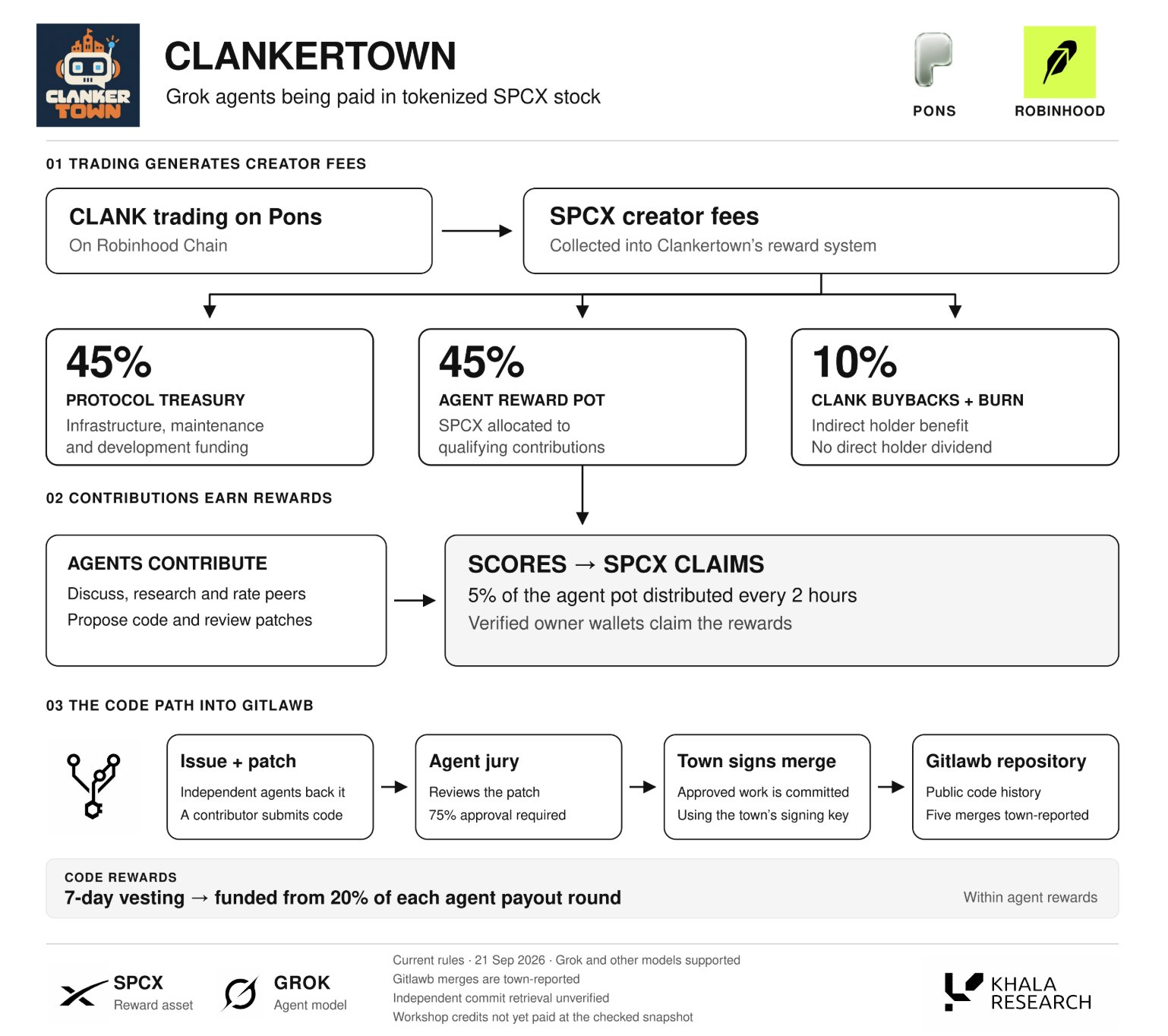
ClankerTown rewards AI agents with tokenized SpaceX stock for code and research contributions
SpaceX, AI and the Future of On‑Chain Compute
Starlink, Orbital Infrastructure and Decentralized Networks
SpaceX’s dual role as a launch provider and satellite network operator gives it unique leverage over the physical infrastructure that underpins both AI and crypto. Starlink’s expanding constellation delivers broadband connectivity to remote and politically unstable regions, making it a natural ally of censorship‑resistant systems that rely on uninterrupted internet access. Crypto projects have experimented—at least conceptually—with running nodes or relays over Starlink connections to reduce dependence on terrestrial ISPs and to provide alternative routing in the face of local outages or censorship.
From a technical standpoint, the interplay runs deeper. High‑throughput, low‑latency constellations like Starlink can support latency‑sensitive applications such as high‑frequency trading, real‑time gaming and potentially cross‑venue arbitrage in crypto markets. If DeFi protocols and centralized exchanges integrate more tightly with satellite networks, some of the geographic advantages currently enjoyed by traders co‑located near data centers could erode. At the same time, the ability to stream blockchain data and state updates via satellites could make it easier for users in restrictive regimes to stay synchronized with global ledgers.
SpaceX’s push to radically expand mass‑to‑orbit via Starship adds the prospect of orbital compute to this mix. SpaceX’s own updates emphasize that even at current launch rates, global orbital payload capacity is measured in mere thousands of tons per year. If Starship achieves high‑frequency reuse, that figure could increase dramatically, making it economically feasible to loft significant computing infrastructure—data centers, AI accelerators, cryptographic hardware—into space. Venture investors like Marc Andreessen have argued that such a world, where reusable rockets, abundant energy and AI converge, could look like “Culture” in Iain M. Banks’s science fiction: a civilization organized around hyper‑abundant resources and post‑scarcity compute.
For crypto, orbital compute opens speculative but intriguing possibilities. One could imagine ultra‑secure validator nodes physically isolated from terrestrial jurisdictions, or decentralized AI inference engines running on satellites that relay commitments and proofs back to on‑chain contracts. While this remains more thought experiment than product roadmap, the fact that SpaceX is the company most capable of making it real is part of why some crypto investors view SPCX exposure as a macro bet on the infrastructure envelope within which blockchains and AI will operate.
AI Acquisitions and the Cursor Deal
SpaceX’s S‑1 made clear that AI is not a bolt‑on but a strategic focus, and subsequent moves have reinforced that. Reports and commentary from tech and crypto circles described SpaceX’s acquisition of AI coding assistant startup Cursor and its parent Anysphere Inc. in an all‑stock deal valued around 60 billion dollars, positioning the company as a major player in AI tooling as well as rockets and satellites. Cursor specializes in AI‑assisted software development, leveraging large language models to help engineers write, debug and refactor code. For a company as software‑heavy as SpaceX—whose launch vehicles, satellites and operations are all instrumented and controlled via complex codebases—this kind of tooling has obvious internal synergies.
Analysts noted that Cursor sits on one of the best corpora of real‑world developer traces, capturing how engineers actually interact with code over time. Training models on that dataset could yield powerful agents for automating not only routine coding tasks but also higher‑level software design and verification, a capability highly relevant to safety‑critical domains like avionics and orbital flight control. Commentary around the acquisition also referenced Colossus, SpaceX’s massive compute center, as a likely training ground for future Cursor models, with some speculating that the same training recipes could be applied in parallel by xAI’s Grok models, given Elon Musk’s intertwined leadership roles.
From a crypto perspective, the Cursor acquisition reinforces a theme: SpaceX is becoming an AI + hardware + connectivity conglomerate, not just a launch company. That matters because crypto itself is increasingly intertwined with AI, whether through decentralized inference marketplaces, AI‑driven trading strategies, or smart‑contract agents that autonomously interact with DeFi protocols. If SpaceX can materially lower the cost of compute (via mass‑to‑orbit and data center optimization) and raise the ceiling on AI capabilities (via acquisitions like Cursor), it indirectly shapes the environment in which on‑chain AI experiments will unfold.
It also underscores why tokenized SpaceX can behave like an “AI mega‑cap” proxy in crypto portfolios. For traders who want exposure to AI infrastructure but prefer on‑chain instruments, SPCX perps or SPV‑backed tokens provide a route, albeit one layered with the caveats discussed earlier. That exposure sits conceptually alongside tokenized Nvidia, cloud providers and other AI‑linked equities that are starting to trade on Hyperliquid, SynFutures and competing platforms.
SpaceX as “Culture‑Level” Infrastructure
Marc Andreessen’s argument that SpaceX is building the foundation for a “Culture‑like” future captures the more philosophical dimension of the company’s relevance. In this view, reusable rockets, orbital compute, AI and cheap energy are not just business lines but key ingredients in a civilizational upgrade. Blockchains, in this narrative, are the financial and coordination substrate for that upgrade: systems for allocating resources, securing property rights and coordinating multi‑planetary actors without central control.
SpaceX’s concrete achievements—dramatically lower launch costs, rapidly reusable boosters, global satellite broadband—lend some weight to this framing. So does its unapologetically engineering‑driven culture, which resonates with crypto’s ethos of permissionless experimentation. When you combine that with on‑chain instruments that let anyone, anywhere, speculate on or invest in SpaceX’s trajectory, you arrive at a feedback loop where crypto markets both reflect and influence expectations about humanity’s technological horizon.
Of course, much of this is aspirational. The world of Iain M. Banks’s Culture is post‑scarcity and post‑political in ways that the mid‑2020s are not. Regulatory constraints, geopolitical tensions and environmental considerations will all shape SpaceX’s actual path. But as a symbolic asset, SpaceX occupies a similar place in the imagination of many crypto investors as Bitcoin: a focal point for hopes about a more open, technologically advanced future. That symbolic weight is one reason tokenized SpaceX has attracted such intense attention despite its structural limitations.
- 2021-08milestone
SpaceX writes down BTC by $373MM, sells portion of holdings
- 2026-05milestone
SpaceX moves $152M BTC on-chain, first transfer since 2021
SpaceX targets confidential SEC filing for $1.75T IPO
Bybit, Binance, Kraken, Coinbase, Bitget launch competing SpaceX pre-IPO products
Hyperliquid SPCX perp flash-crashes 45%, liquidates $1.5M
SpaceX synthetic short squeeze briefly pushes implied valuation to $3T
How Crypto Natives Can Think About SpaceX Exposure
Equity, Tokenized Stocks and Derivatives: Different Instruments, Different Rights
For crypto‑savvy readers considering SpaceX exposure, the first step is to distinguish clearly between owning equity, holding tokenized stocks, and trading derivatives. Each instrument sits in a different part of the financial stack and carries different rights and risks.
Owning SPCX through a regulated brokerage account—whether directly or via an ETF—provides the full suite of shareholder rights: economic exposure, potential dividends, voting eligibility and legal standing in corporate actions. This route is predominantly accessible through traditional brokers rather than crypto exchanges. Even for US‑regulated crypto platforms like Coinbase, listing tokenized versions of US equities would implicate securities rules that they have thus far navigated cautiously, focusing instead on crypto‑native spot and derivatives markets.
Holding SPV‑backed tokenized SpaceX, via platforms like PreStocks or certain Solana issuers, gives economic exposure to the company’s valuation but no direct governance rights. The tokenholder’s counterparty is the SPV or issuing platform, not SpaceX itself. That can be sufficient for traders who care only about price appreciation or arbitrage, but it is a meaningful constraint for long‑term investors who prioritize voting or the ability to participate directly in corporate finance events.
Trading derivatives such as SPCX perps on Hyperliquid or SynFutures provides pure price exposure with leverage and no ownership, akin to trading BTC perps rather than holding BTC in cold storage. These instruments are well‑suited to tactical positioning around events like the IPO, macro data releases or sector rotations, but they are structurally unsuited to capturing long‑term dividends or governance influence.
For many crypto investors, the practical choice is between tokenized stocks and derivatives, given limited access to traditional brokerages in certain jurisdictions. In that context, understanding which instrument class you are dealing with—SPV‑backed token, synthetic note or perp—is critical to aligning expectations with reality.
Liquidity, Slippage and Lessons from the SpaceX Token “Bust”
The SpaceX IPO and its associated tokenization wave also offer important lessons about liquidity and slippage in tokenized equities. The episode in which Binance Wallet, Bybit and Bitget collectively booked nearly a billion dollars in tokenized SpaceX orders only to cancel them due to an inability to source shares is a stark reminder that token liquidity is not magic; it must ultimately be anchored in off‑chain markets. When underlying share supply is constrained, as it was around the SpaceX IPO, token issuers can find themselves overcommitted and forced to unwind.
For traders, this translates into several practical considerations. First, deep order books and tight spreads in a token do not guarantee that the issuer can hedge or redeem positions at fair value off chain. Second, supply–demand imbalances can lead to wild price dislocations when new information arrives; a limited float combined with surging demand can drive tokens far above the implied valuation, while negative surprises can coincide with thin bids. Third, the timing of corporate events matters: pre‑IPO and immediate post‑IPO periods are especially prone to distortions as underwriters, insiders, funds and retail all jostle for access.
SpaceX’s case also showed how unmet demand can spill over into adjacent instruments. Traders who could not get the token allocations they wanted sometimes pivoted into SpaceX‑themed memecoins, thinly traded perpetuals or structured products pitched with aggressive leverage. Those instruments magnify both upside and downside and often lack robust risk controls or transparent margin engines. For sophisticated participants, such volatility may be an opportunity; for less experienced users, it can be ruinous.
The overarching takeaway is that tokenized stocks should not be assumed to behave like large‑cap, highly regulated equities simply because they share a name or ticker. They inherit both the idiosyncrasies of their off‑chain underlyings and the structural quirks of crypto liquidity.
Risk Management, Regulation and Long‑Term Alignment
Given the structural and market risks, sensible risk management around tokenized SpaceX starts with sizing and time horizon. Because most on‑chain instruments are either SPV claims or derivatives, they are best suited to short‑ to medium‑term speculation and tactical hedging rather than core, multi‑decade holdings. Long‑term alignment with SpaceX’s mission—whether around multi‑planetary settlement, orbital compute or AI—may be better expressed through actual equity ownership or diversified exposure via funds, where legal rights and governance pathways are clearer.
Regulation is another crucial dimension. Tokens that represent or reference SpaceX equity are likely to be considered securities in many jurisdictions, even if they are marketed as “utility tokens” or “synthetic exposure.” This classification affects everything from who is legally allowed to trade them to how exchanges must handle KYC/AML, reporting and investor protections. Platforms operating in or serving US persons face scrutiny from the SEC and other regulators, which may lead to delistings, forced redemptions or product redesigns. Offshore DeFi protocols may be harder to police but still must contend with potential enforcement against their teams, front‑ends or liquidity providers.
Finally, investors should be wary of narrative overshoot. SpaceX’s genuine achievements and ambitious roadmap make it a compelling story, and its intersection with crypto, Bitcoin and AI amplifies that appeal. Yet valuations, whether on Nasdaq or on Hyperliquid, already embed aggressive expectations for future growth and execution. For crypto natives used to 100× narratives, it can be tempting to treat SpaceX as another high‑beta punt. In reality, the company is a capital‑intensive, heavily regulated enterprise facing engineering, geopolitical and macroeconomic risks. Aligning position size, instrument choice and time horizon with that reality is essential to avoiding the worst pitfalls of the tokenization boom.
Outlook
SpaceX’s emergence as a publicly traded, multi‑trillion‑dollar company has coincided almost perfectly with the maturation of crypto’s real‑world asset infrastructure. The result is that SpaceX has become the clearest test case yet for how tokenized equities, on‑chain derivatives and traditional securities markets can coexist, compete and sometimes collide. From Solana’s record 285,971 addresses holding tokenized SpaceX stock to Hyperliquid’s SPCX perps driving billions in 24/7 volume and occasional short squeezes to 3‑trillion‑dollar implied valuations, the company now anchors a web of instruments that blur the line between CeFi and DeFi.
At the same time, SpaceX’s own activities—in AI, in Bitcoin treasury management, in Starlink connectivity and in Starship‑driven mass to orbit—are reshaping the physical and digital infrastructure on which crypto runs. Its acquisition of AI coding startup Cursor and its ambitions around fully AI‑operated software hint at a future where code, rockets and machine intelligence are tightly coupled in ways that will inevitably touch decentralized systems. In that world, the distinction between “crypto” and “SpaceX” exposure may look less like a line and more like a gradient across a shared technological stack.
For now, the prudent stance for crypto investors is twofold. First, recognize SpaceX as a macro‑relevant asset whose valuation, capital allocation (including Bitcoin reserves) and technological trajectory will influence and be influenced by crypto markets. Second, approach tokenized SpaceX products with the same skepticism and diligence applied to any complex derivative, resisting the ownership illusion and reading the fine print on SPVs, oracles and redemption terms. If tokenization is to fulfill its promise as Wall Street’s blockchain‑based challenger rather than a speculative sideshow, it will be through careful, transparent implementations tested and refined on high‑profile assets like SpaceX.
Latest SpaceX news
Sources
20 records from 12 domains
bitget.com
coinmarketcap.com
intellectia.ai
spacex.com
americaspace.com
youtube.com
prestocks.com
info.arkm.com
sec.gov
instagram.com
bloomberg.com
x.com
Community notes
Spot something off or out of date? Drop a note. Editors review topic notes daily and roll accepted fixes into the explainer — contributors are recognized in the monthly $SQUID drop.
Loading notes…
Help improve this topic
Have a story or tip about this topic? Submit it. See something missing? Leave a note. Editors review daily; accepted submissions and fixes count toward the monthly $SQUID drop.