
IPOs turn private ownership into public equity. Crypto extends price discovery and access around that transition, but perpetuals, tokenized shares, and SPV interests carry very different ownership, liquidity, and counterparty risks.
+42 sources across the wider coverage universe
 Aerospace and defense supplier Arxis targets up to $1.06B in US IPO, aiming to capitalize on rising demand for electronic and mechanical components across global defense markets2026-04
 Amazon-backed X-energy targets up to $800M IPO as nuclear startup rides AI-driven power demand, with plans to supply 5GW of energy by 20392026-04
 Bitget opens tokenized pre-IPO trading with SpaceX as first asset on new IPO Prime platform2026-04
 Naver Financial targets immediate IPO after closing $10.3B Dunamu-Upbit acquisition2026-04
 CXMT, Asia's biggest IPO of 2026, puts crypto shadow market to the test2026-07
 SpaceX holds 8,285 BTC worth $603M steady as xAI costs flip $8B profit to nearly $5B loss ahead of IPO2026-04
An Initial Public Offering (IPO) is the process by which a private company sells shares to the public on a regulated stock exchange for the first time, converting private ownership into publicly tradeable equity.
For most of financial history, IPOs were walled gardens—accessible mainly to institutional investors and the wealthy. That boundary is becoming more permeable. The crypto industry has built parallel infrastructure for pre-IPO price discovery, tokenized share exposure, and synthetic equity products. Some of those products widen access; others merely make it easier to speculate on a price. Understanding the difference matters more than the shared IPO label.
What an IPO Is and How It Works
When a private company decides to go public, it hires investment banks as underwriters. These banks conduct due diligence, help set an initial share price through bookbuilding—the process of soliciting demand from institutional investors—and arrange for shares to list on an exchange, typically the NYSE or Nasdaq in the United States.
The company files a registration statement, usually an S-1 in the US, with the Securities and Exchange Commission. That document discloses financial results, risk factors, ownership information, and the business model. After SEC review, shares are priced and allotted, usually to institutional clients first. Retail investors commonly gain access only once open-market trading begins, potentially after an initial price increase has already transferred part of the upside to the investors who received the offering allocation.
Key terms:
- Underwriter: The investment bank managing the share sale, due diligence, pricing, and distribution.
- Lock-up period: A post-IPO restriction, often lasting 90–180 days, that prevents specified insiders from immediately selling.
- Bookbuilding: The pre-IPO process of measuring institutional demand to help set the offering price.
- S-1: The SEC registration document through which a prospective US public company discloses material information.
IPO proceeds can go to the company through a primary offering, providing new capital, or to existing shareholders through a secondary offering. Many transactions combine both. That distinction tells investors whether the offering principally finances future operations, provides liquidity to existing owners, or does some of each.

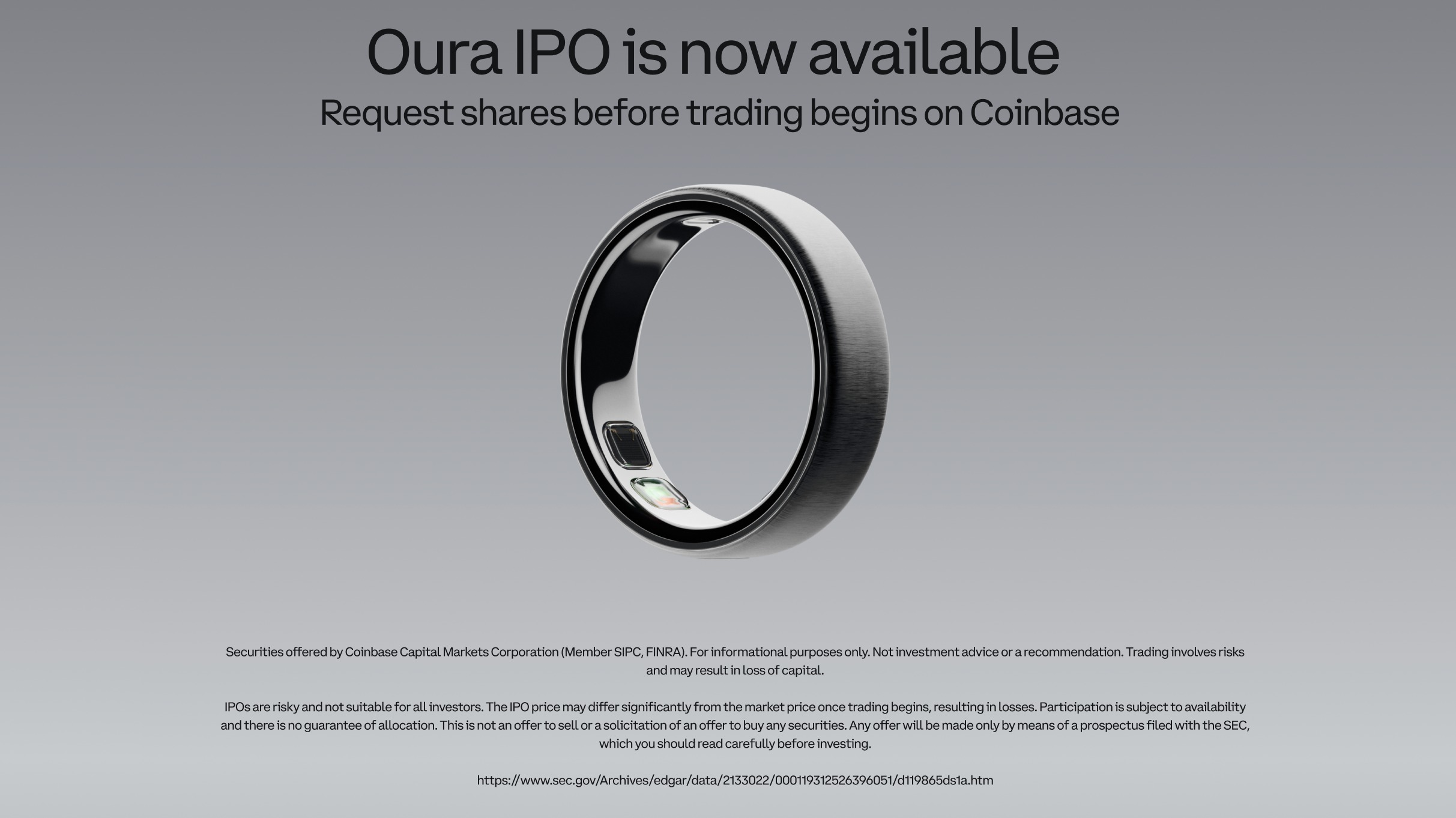
Coinbase launches IPO access, first offering is Oura Ring, open until September 29
Why Companies Go Public
Going public gives a company access to large pools of capital, creates liquidity for early investors and employees, and raises its profile. It also imposes continuing costs: audited reporting, quarterly disclosure, shareholder scrutiny, and exposure to public-market volatility.
For venture-backed technology and crypto companies, an IPO can become the principal exit mechanism for investors who have held illiquid stakes for years. The alternatives are an acquisition or remaining private, sometimes for decades. Staying private gives founders more insulation from quarterly expectations, but it can leave employees and early investors dependent on irregular secondary sales for liquidity.
The trade-off therefore runs both ways. Public markets offer capital and liquidity at scale, but they also expose management to earnings pressure, activist shareholders, and continuous repricing. Large private rounds postpone those pressures without eliminating the eventual need to reconcile private valuations with public-market demand.
Readers click IPO stories not for the listing mechanics but for the credibility audit — whether the entity filing deserves public-market trust given its conflicts of interest, regulatory entanglements, or unsustainable unit economics.
The Pre-IPO Market: Where Crypto Enters
Before a company lists, its shares can trade through specialist secondary platforms, employee transactions, and Special Purpose Vehicles, or SPVs. Platforms such as Forge Global operate regulated secondary-market infrastructure, although access commonly depends on investor eligibility, available supply, and identity verification.
Crypto-native products change the distribution layer. Retail demand for private companies—including prominent AI businesses and SpaceX—has encouraged the creation of tokenized wrappers and synthetic markets. These instruments can make price exposure easier to acquire, but accessibility should not be confused with ownership. A contract that references a private-company valuation may be economically useful without conveying voting rights, dividends, information rights, or a claim on actual shares.
Some investors have also used stablecoins to acquire pre-IPO exposure across borders and around conventional payment constraints. That behavior demonstrates the strength of demand, but it also concentrates risk in the wrapper, issuer, custodian, and settlement process. Crypto can shorten the path to a trade without shortening the legal path to the underlying equity.
SpaceX: A Stress Test for Crypto Infrastructure
SpaceX's 2026 public listing became a major test for crypto-native IPO infrastructure. Its valuation quickly exceeded $2.5 trillion, placing the equity event on a scale large enough to draw both institutional allocation demand and substantial synthetic trading.
Hyperliquid's HIP-3 protocol became a prominent venue for pre-IPO price discovery. Before the listing, SPCX perpetual contracts let traders take leveraged positions on the expected IPO price. Trading volume on the SPCX perpetual reached approximately $1.4 billion on IPO day and roughly $3.1 billion across the nine-day period surrounding the listing.
That activity reclassifies the product correctly: it was a prediction and risk-transfer market, not an equity distribution system. Its value lay in producing a continuously traded price before and around the listing. Its cost was basis risk—the possibility that the contract's price or settlement mechanics would diverge from the economic experience of holding the shares.
Tokenized stocks presented a different problem. Platforms introduced SPCXon tokens on Solana, Ethereum, and BNB Chain, with Ondo Global Markets tokenizing SpaceX on BNB Chain shortly after launch and crossing $1 million in volume within an hour. The rapid activity showed demand for fractional, crypto-native access.
The supply chain underneath those products proved less elastic. Binance, Bybit, and Bitget cancelled SpaceX IPO allocation programs after the available shares fell short, with users promised refunds. The result exposed the decisive distinction: tokenizing a claim is technically straightforward, but sourcing enough legally transferable equity to honor that claim is not.
A holder of a tokenized stock commonly owns a derivative or a contractual claim backed by a custodian's position. If the custodian cannot obtain the shares, the token cannot deliver the same economic and legal package as brokerage-held equity. The token is an instrument layered over ownership; it does not manufacture ownership when the underlying allocation is unavailable.
Gemini stock down 80% from IPO as buyers weigh its costly-to-replicate licenses

What Tokenized Stocks Offer—and What They Do Not
Pre-IPO crypto products fall into several categories whose similar interfaces conceal different rights.
Perpetual futures are cash-settled synthetic contracts tracking an expected or observed price. Traders receive leveraged price exposure but never own shares. Their relative virtue is clarity: a perpetual is openly a derivative. Their cost is liquidation, funding-rate, basis, and venue risk.
Tokenized shares represent claims associated with underlying shares held by a custodian. When the legal structure is sound and the custodian possesses sufficient assets, the token can provide fractional access and faster transfer. When backing is unavailable, poorly disclosed, or undercapitalized, the structure becomes a claim on a promise rather than a dependable substitute for equity.
SPV interests give investors an interest in a vehicle that owns shares. This can create a more direct legal connection to the equity, but access may be limited to accredited investors, minimum investments may be high, and transfers can be restricted. An SPV interest also may not provide the same rights as holding shares directly.
Pre-IPO perpetual markets settle against an IPO price or subsequent trading reference. They provide directional exposure without an equity claim. Analysis by Arrakis Finance of competing SpaceX markets argued that decentralized perpetual venues contributed a meaningful price signal before traditional bookbuilding concluded. That establishes a potential role in price discovery; it does not turn derivative traders into shareholders.
The practical test is simple: ask what happens if the referenced company never lists, the custodian cannot source shares, the venue becomes insolvent, or the token trades away from the underlying price. The answer identifies the product more reliably than its marketing name.
- 01Circle IPO business model fragility
Multiple high-click stories dissected Circle's S-1 revealing 99% revenue tied to interest rates, $908M paid to Coinbase, and incoming competition from JPMorgan, PayPal, and Meta — making readers question whether the USDC issuer can hold its valuation through a rate cut cycle.
- 02Bullish CoinDesk reputation laundering
The top-clicked story framed Bullish's IPO as a credibility operation using a purchased media outlet to rehabilitate its EOS-era history, hitting the nerve of financial conflict of interest corrupting the information environment around a listing.
- 03Regulatory and political interference
The SEC's last-minute delay of Exodus Wallet's NYSE listing and Kraken's IPO freeze showed readers that political discretion, not market readiness, is the real gating factor for crypto public offerings.
- 04Onchain tokenized IPO access
Stories about Ondo Finance's Global Listing, Jupiter's PreStocks limit-order platform, and Bankless's Canton Network equity offering drew readers curious about bypassing traditional IPO access gatekeepers entirely.
- 05Exchange IPO race and political capital
Gemini's IPO filing revealing mounting losses alongside the Winklevoss twins' Trump-orbit positioning showed that political alignment has become as load-bearing as financial metrics for crypto firms seeking public listings.
- 06Non-crypto companies disclosing Bitcoin pre-IPO
Figma's $70M Bitcoin ETF holding and SpaceX's 8,285 BTC treasury appearing in IPO filings signaled to readers that Bitcoin balance-sheet exposure is becoming a mainstream pre-listing data point.
Crypto Companies Moving Toward Public Markets
Coinbase's April 2021 direct listing on Nasdaq was a landmark for the industry. It gave public-market investors a regulated vehicle for exposure to a major US crypto exchange and subjected Coinbase to SEC reporting obligations. A direct listing differs from a conventional underwritten IPO, but it still converts private equity into publicly traded shares.
Kraken followed a less direct path, discussing and deferring public-market plans across multiple cycles while remaining private. The broader pattern is instructive: crypto companies face the familiar trade-off between liquidity and scrutiny, with additional complications from securities law, money-transmission requirements, and changing rules for digital assets.
Other exchanges illustrate how preparation can precede a listing by years. Bithumb targets 2028 IPO as exchange shifts to K-IFRS and tightens internal controls, according to the exchange's notice. Accounting standards and controls are not ceremonial preliminaries. They are part of the operating machinery required to make a private enterprise legible to public investors.
Plans and completed listings should remain separate categories. An intended year indicates direction and preparation, not certainty that market conditions, regulatory review, or the company's readiness will permit an offering on that schedule.
Prediction Markets and the IPO Thesis
Kalshi has reportedly held early discussions about a potential IPO after substantial growth in revenue and private valuation. Preliminary talks are not bookbuilding, an approved registration statement, or a completed allocation. They show that prediction markets can contemplate the same path from private financing to public ownership as exchanges and other fintech businesses.
The category is especially relevant to crypto because prediction markets share the event-driven trading culture associated with platforms such as Polymarket and Hyperliquid. Yet their relationships with traditional finance can be contradictory. JPMorgan cut Polymarket’s banking services in late 2025 but still seeks role in potential IPO, according to the Financial Times. The episode reclassifies the bank-platform relationship as commercial and conditional rather than simply adversarial: a financial institution can reject one form of exposure while pursuing another role governed by different risks and incentives.
A public prediction-market company would not give shareholders direct ownership of the contracts traded by its customers. It would give them exposure to the operator's revenues, costs, regulatory position, and competitive prospects. That distinction mirrors the difference between owning an exchange and owning the assets traded on it.

Coinbase opens IPO access to US retail investors, starting with Oura
AI Companies and the Pre-IPO Frenzy
The AI investment boom has produced intense demand for exposure to companies such as OpenAI, Anthropic, xAI, and Perplexity. Legitimate private shares remain scarce relative to retail demand, encouraging investors to consider SPVs, secondary platforms, tokenized wrappers, and perpetual futures.
Each step away from direct equity adds another dependency. An SPV introduces vehicle governance and transfer restrictions. A tokenized wrapper introduces an issuer and custodian. A perpetual adds leverage, funding, and settlement risk while removing the equity claim entirely. These products are not necessarily defective; they solve different problems. Trouble begins when price exposure is presented as though it carries the rights of ownership.
Institutional investors can often pursue direct allocations through conventional channels while keeping crypto exposure in separate vehicles. Retail participants routed through wrappers and derivatives receive a structurally different package. The relevant comparison is therefore not simply who can trade, but what each participant owns after the trade settles.
- 2025-01regulatory
Circle submits confidential IPO filing to SEC
- 2025-04milestone
Circle enlists JPMorgan and Citi as lead underwriters
- 2025-05regulatory
Circle files public S-1, discloses $908M Coinbase stake acquisition
- 2025-06regulatory
SEC issues last-minute delay blocking Exodus Wallet NYSE listing
- 2025-07milestone
Gemini files for $433M IPO, reveals wider losses in S-1
- 2025-10governance
Kraken parent Payward freezes multibillion-dollar IPO citing market conditions
- 2026-02launch
Bullish upsizes IPO to 30M shares at $32-33, lists on NYSE as BLSH
- 2026-04launch
Ondo Finance launches Global Listing for tokenized U.S. IPO stocks across Ethereum, Solana, and BNB Chain
Regulatory and Structural Considerations
IPO-adjacent crypto products operate in contested regulatory territory. In the United States, a tokenized stock may constitute a securities offering requiring registration or an exemption. Rules and permitted structures vary outside the US, and regulatory permission in one jurisdiction does not automatically travel with the token to another.
Four risks deserve particular attention:
1. Counterparty risk: Who holds the underlying asset, and what claim does the investor have if that party cannot deliver?
2. Regulatory risk: Is the instrument permitted in the investor's jurisdiction, and can enforcement interrupt trading or redemption?
3. Liquidity risk: Can the position be exited without a large discount, and does its price track the referenced equity?
4. Allocation and lock-up risk: Does the issuer possess transferable shares, and are those shares restricted when settlement is due?
These questions turn an abstract warning into an observable test. Investors can inspect custody disclosures, settlement rules, eligibility restrictions, redemption mechanics, and the treatment of cancelled or delayed listings. A familiar ticker or token interface answers none of them.
Outlook
The IPO remains the primary mechanism by which private-company value becomes broadly accessible as regulated public equity. Crypto is changing the infrastructure around that transition more quickly than it is changing the legal meaning of ownership.
Decentralized perpetual markets can contribute price discovery and risk transfer around major listings. Tokenized-stock platforms can improve transferability and fractional access when the underlying shares and legal structure are real. Regulated secondary markets can connect eligible buyers with existing holders before an IPO. Each model creates access, but each creates a different kind of access.
The convergence point—a regulated, liquid on-chain market with dependable equity backing and clear investor rights—remains a work in progress. The SpaceX listing showed both sides of the trade-off: crypto markets could absorb enormous speculative demand and generate a public price signal, while token programs still failed when actual share supply did not match that demand.
For a crypto-native investor, the essential question is not whether a pre-IPO product is innovative. It is what the instrument legally and economically delivers. If custody, settlement, liquidity, and investor rights can be made as legible as the token itself, on-chain pre-IPO markets can become durable financial infrastructure. If they cannot, the products will remain useful mainly as speculation around an ownership event occurring somewhere else.
Latest IPO news
Sources
2 records from 2 domains
Community notes
Spot something off or out of date? Drop a note. Editors review topic notes daily and roll accepted fixes into the explainer — contributors are recognized in the monthly $SQUID drop.
Loading notes…
Help improve this topic
Have a story or tip about this topic? Submit it. See something missing? Leave a note. Editors review daily; accepted submissions and fixes count toward the monthly $SQUID drop.