
Tesla is an AI, autonomy, and energy company that manufactures EVs — now accessible on-chain via tokenized equity platforms — with its bull case riding on FSD robotaxi economics and custom AI chip development.
+10 sources across the wider coverage universe
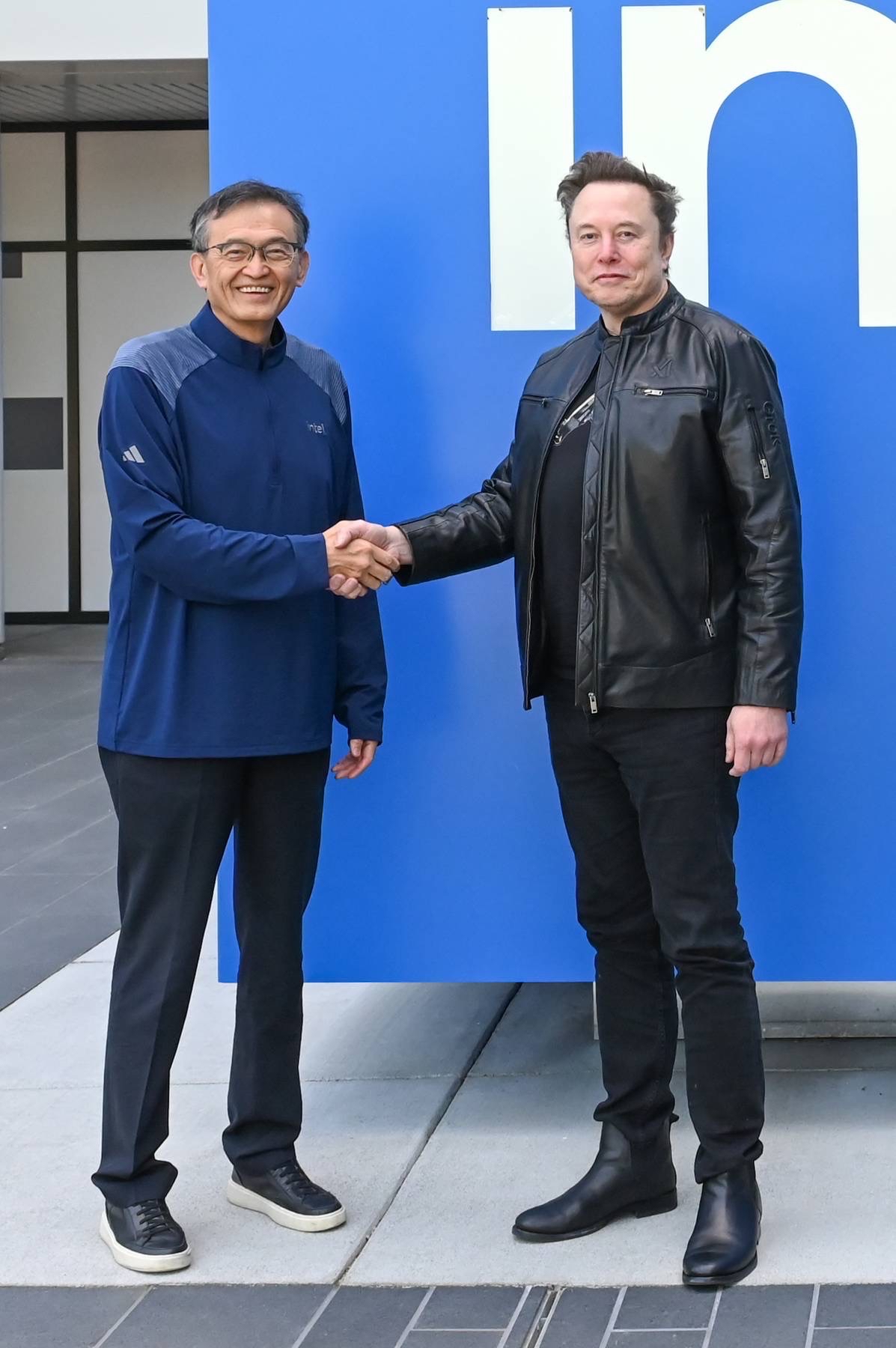 Intel partners with Elon Musk's SpaceX, xAI, and Tesla on Terafab to scale chip production toward 1TW/year of compute, targeting massive AI and robotics acceleration2026-04
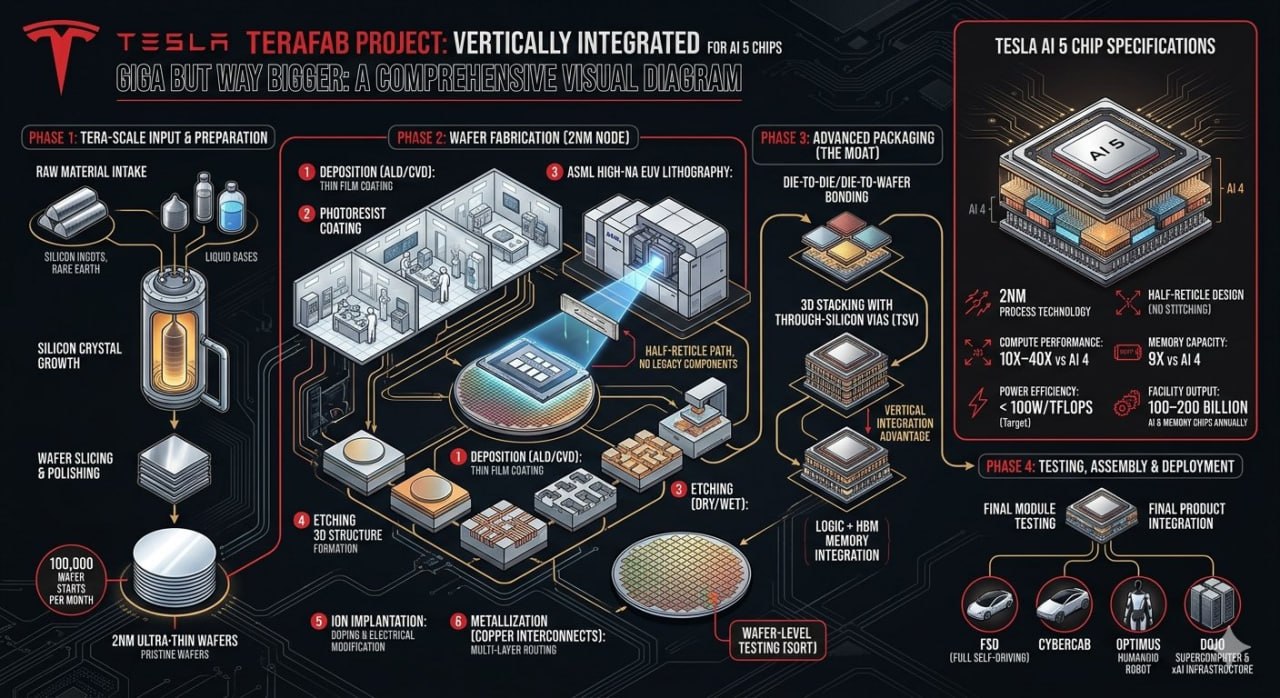 Tesla, xAI and SpaceX chart a course for Terafab, a new venture in galactic infrastructure towards becoming a galactic civilization.2026-03
 Public firms now hold over 1M BTC as Strategy, Tesla, Block and Metaplanet embrace Bitcoin treasury strategies to hedge inflation and attract investors2026-06
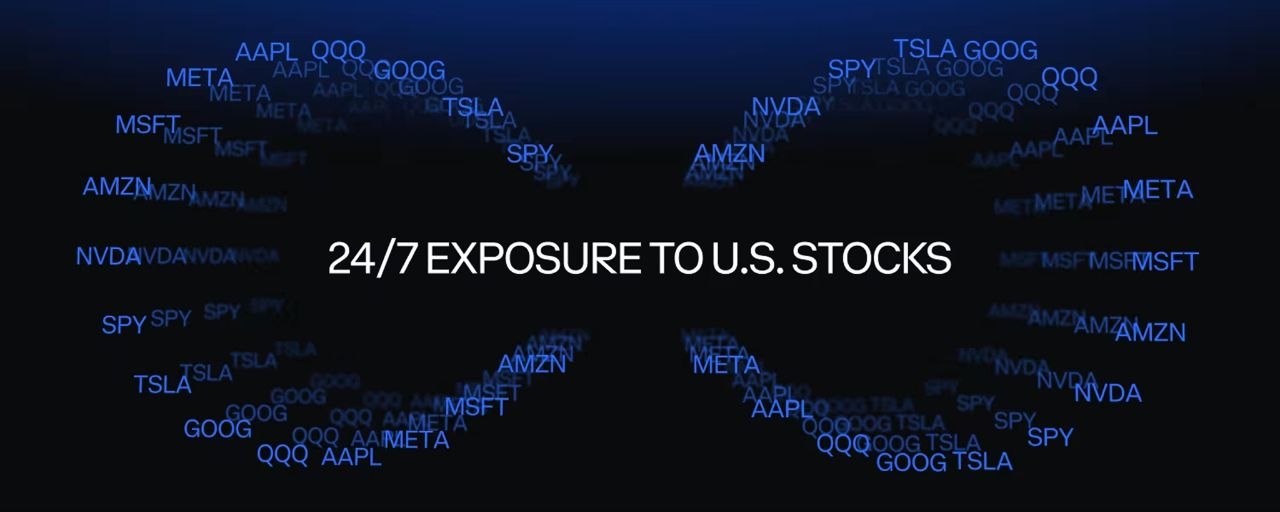 Coinbase launches stock perpetual futures for non-U.S. users, offering 24/7 leveraged exposure to equities like Apple, Nvidia and Tesla with USDC settlement2026-03
 Tokenized equities could unlock a share of the ~$130T global stock market, letting crypto users trade stocks like Tesla, Inc. or NVIDIA Corporation directly onchain2026-03
 Tesla’s Optimus robot paired with solar energy may evolve into self-replicating system in space, marking potential breakthrough in autonomous manufacturing2026-03
Tesla sits at the intersection of electric vehicles, artificial intelligence, robotics, and—increasingly—on-chain financial infrastructure, making it one of the most consequential companies for crypto-native investors to understand.
What Tesla Actually Is (and Isn't)
Most people file Tesla under "car company." That framing has been wrong for years. Tesla (NASDAQ: TSLA) is better described as an AI and energy company that manufactures vehicles as its primary revenue vehicle—pun intended. The distinction matters because it explains why the stock trades at multiples that defy conventional automotive valuation, and why it keeps appearing in crypto-adjacent conversations about tokenized equities, autonomous AI systems, and Elon Musk's broader technology empire.
Founded in 2003 and taken public in 2010 at a valuation that represents roughly 0.1% of where it trades today, Tesla's trajectory has been one of the most dramatic wealth-creation events in modern market history—and also one of the most volatile.

Intel partners with Elon Musk's SpaceX, xAI, and Tesla on Terafab to scale chip production toward 1TW/year of compute, targeting massive AI and robotics acceleration
Elon Musk: The Variable That Breaks Every Model
No analysis of Tesla is complete without addressing its CEO. Elon Musk controls Tesla's strategic direction, its public perception, its relationship with regulators, and—through overlapping ventures—its supply chain. His other companies include SpaceX (launch vehicles and Starlink internet), xAI (large language models), and X (formerly Twitter). Each of these creates both synergies and conflicts of interest.
The synergy angle: Tesla's AI chip development, its autonomous driving stack, and its humanoid robot program (Optimus) all draw from a shared talent pool and research culture that Musk curates across his companies. When Musk posts that Tesla's AI6 chip "might set a record for most usable intelligence from a wafer when factoring in yield," that claim sits within a broader competitive context against Nvidia's data-center dominance—a race that directly intersects with crypto mining infrastructure and AI inference costs.
The conflict angle is harder to ignore. A 2025 analysis found that SpaceX purchased 1,279 Cybertrucks in Q4 2025, which propped up Tesla's quarterly delivery numbers while masking what analysts described as a 51% underlying demand decline. That kind of related-party transaction raises legitimate accounting questions and underscores why Tesla's financials require more scrutiny than a typical large-cap.
Readers engage Tesla content not as an EV story but as a crypto-adjacent asset play — clicks cluster around Bitcoin treasury holdings, tokenized equity protocols, and macro BTC/Tesla price correlation, revealing an audience that treats TSLA as a de facto on-chain instrument.
The AI and Autonomy Bet
Tesla's bull thesis, stripped to its core, is an autonomy bet. The company has spent over a decade gathering real-world driving data from its fleet—now in the millions of vehicles—and using that data to train neural networks for Full Self-Driving (FSD).
FSD version 14.3.4 is currently in active rollout. Tesla's camera-only approach (no lidar) remains controversial among autonomy researchers, but the company argues that human drivers navigate using vision alone, so sufficiently capable vision AI should generalize better than sensor-fusion approaches. Recent developments include camera-vision systems capable of preemptively deploying airbags based on predicted collision trajectories—a capability that cuts both ways: it demonstrates real-time inference sophistication, but also raises liability questions if the prediction system misfires.
The commercial endpoint for FSD is the robotaxi network. Tesla has launched robotaxi service in Dallas and Houston, making it an operational competitor—not just a promise—to Waymo's commercial deployments. The economics of autonomous ride-hailing, if they work at scale, would represent a revenue stream orders of magnitude larger than vehicle sales margins.
Tesla's Position in the AI Hardware Race
Nvidia dominates AI accelerator supply chains. Tesla is trying to reduce its dependence on that supply chain by designing its own inference chips in-house. The AI6 chip mentioned in internal engineering communications represents the latest generation of this effort.
This matters for crypto audiences for a specific reason: the same silicon scarcity that drove GPU prices during crypto mining booms now governs AI training capacity. Companies that can design custom silicon—Tesla, Apple, Google, Amazon—gain structural cost advantages over those buying from Nvidia at market rates. If Tesla's in-house chip program succeeds, it changes the unit economics of every AI-dependent product line: FSD inference, Optimus robot control, energy grid optimization.
Apple provides a useful comparison. When Apple transitioned its Mac lineup to its own M-series chips, it unlocked performance-per-watt advantages that competitors couldn't match with off-the-shelf solutions. Tesla is attempting a similar vertical integration in automotive and robotics AI.
Coinbase lists tokenized stocks for Amazon, Microsoft, Strategy, SanDisk, SpaceX, and Tesla on Base
Tesla as an On-Chain Asset
This is where Tesla becomes directly relevant to crypto-native audiences. Tesla's equity is now accessible through multiple on-chain venues without going through a traditional brokerage.
Tokenized equity platforms have moved from concept to live product. Binance's bStocks program offers 1:1-backed tokenized U.S. securities—including Tesla—tradeable 24/7 on BNB Chain through PancakeSwap. OKX, in partnership with Ondo Finance, has listed 263 tokenized U.S. equities for eligible users, with Tesla among them, accessible directly from existing crypto trading accounts without a separate wallet or cross-chain operation. Uniswap has tokenized shares of Tesla, SpaceX, Apple, and Nvidia available on-chain. Platforms like Tria offer leveraged Tesla exposure fully on-chain alongside Nvidia, Google, and Amazon.
The self-custody angle is a genuine differentiator. Projects like Based (via tradexyz) allow users to hold tokenized Tesla, Apple, Microsoft, and Amazon positions in fully self-custodial wallets on iOS, Android, and web—meaning the position exists on-chain under the user's own keys, not in a custodial account subject to exchange counterparty risk.
This represents a structural shift in how retail crypto participants can express macro views. Instead of swapping into stablecoins to wait out market volatility, a trader can rotate directly into tokenized TSLA or tokenized NVDA without off-ramping to a bank account. The 24/7 trading availability is particularly relevant for crypto audiences accustomed to markets that never close—traditional equities have fixed trading hours; tokenized versions do not.
OKX has also announced plans to offer Pre-IPO perpetual contracts for private companies including SpaceX, OpenAI, and Anthropic—providing price exposure without equity ownership, a structure familiar to crypto derivatives traders.
- 01Tokenized Tesla stock on-chain
Multiple platforms launching 24/7 tokenized TSLA exposure (Kraken, Coinbase perpetuals, xStocks) signals readers tracking whether crypto rails can replace traditional equity access.
- 02Tesla Bitcoin treasury exposure
Tesla's Q4 BTC profits and $184M digital-asset balance sheet position it as a proxy Bitcoin holding, attracting readers hunting collateral and treasury yield angles.
- 03TSLA-BTC macro correlation
The DeepSeek-triggered rout that simultaneously crushed BTC 6% and TSLA demonstrated to readers that risk-off moves now treat crypto and Tesla as the same trade.
- 04Musk political risk to TSLA
Warren SEC probe letters, Trump-Musk spending-bill feud, and government contract threats created sharp single-day drawdowns readers followed as live governance risk.
- 05Tesla stock as DeFi collateral
Robert Leshner's thesis that borrowing against TSLA to buy real-world assets is 'the future of DeFi' reframed Tesla shares as programmable collateral, pulling in tokenization-focused readers.
- 06Terafab AI chip infrastructure
The Tesla/xAI/SpaceX joint chip venture toward 1TW/year compute attracted readers who see physical AI infrastructure as the next narrative after software-layer crypto-AI plays.
The Vehicle Product Line
Tesla's current hardware lineup spans several categories:
Consumer EVs: Model 3 (sedan), Model Y (crossover), Model S (performance sedan), Model X (SUV), Cybertruck (stainless steel body, claimed 500-mile range, 14,000-pound tow capacity). The Cybertruck's polarizing design has translated into mixed sales results; it occupies a segment with few direct competitors but has faced questions about real-world range under towing conditions.
Commercial: The Tesla Semi is in limited production. It faces infrastructure headwinds—charging networks for Class 8 trucks remain sparse, and fleet maintenance at scale presents operational challenges that Tesla's service network wasn't originally designed to handle.
Upcoming: The Rivian R2's imminent launch represents a direct competitive threat to the Model Y, historically Tesla's highest-volume vehicle. Rivian has positioned the R2 as a more accessible crossover, and early specification comparisons suggest it will compete on range and charging speed in the $40,000–$50,000 price band where Model Y volume lives.
Risks: What Could Break the Thesis
Demand erosion: The Q4 2025 SpaceX Cybertruck purchase that masked delivery declines is a warning sign. Tesla's brand has become politically associated with Musk's public persona in ways that appear to be deterring some buyers in key markets. European and Chinese sales have faced headwinds that don't resolve easily.
Regulatory and safety risk: FSD is under ongoing scrutiny from the National Highway Traffic Safety Administration (NHTSA). Any high-profile autonomous incident could trigger regulatory intervention that delays or restricts the robotaxi program—the single largest pillar of the bull case.
Environmental and resource risk: Tesla's physics-first lithium battery redesign program has drawn scrutiny in Texas, where the manufacturing footprint intersects with ongoing drought conditions and water resource pressures. As ESG considerations affect institutional capital allocation, environmental permitting and water-use conflicts represent a non-trivial operational risk.
Concentration risk: Musk's attention and governance are spread across Tesla, SpaceX, xAI, and X. Any serious crisis at one venture competes for resources and attention across the others. SpaceX's independence from Tesla as an entity means Tesla shareholders have no direct claim on Starlink's economics.
Tokenization-specific risks: On-chain Tesla exposure through tokenized equity platforms carries its own risk layer. Counterparty risk (the issuer of the token), smart contract risk, regulatory risk (tokenized securities face evolving legal frameworks across jurisdictions), and liquidity risk in less-established venues all apply. Holding bTSLA on PancakeSwap is not the same as holding TSLA in a regulated brokerage account, even if the price tracks 1:1 under normal conditions.

Ondo enables 24/7 minting and redemption for 20+ stocks, including Nvidia, Tesla, Apple and SpaceX
SpaceX, AI, and the Musk Ecosystem Play
Tesla cannot be fully understood in isolation. Musk has floated the idea of merging SpaceX and Tesla, and analysis of what that would mean for Bitcoin holdings—SpaceX holds BTC on its balance sheet—has circulated in crypto media. No merger is imminent, but the hypothetical illustrates how interconnected these entities are in practice.
The practical overlap: Tesla Diners (now operating in Los Angeles with Austin and Palo Alto announced) double as Supercharger destinations with entertainment infrastructure, a customer retention tool that extends the Tesla brand ecosystem beyond the vehicle. Optimus robots, if deployed commercially, would generate revenue streams across both Tesla and potentially SpaceX's manufacturing needs. The AI talent pipeline Musk maintains across xAI and Tesla gives the company access to frontier model research that pure automotive companies cannot match.
- 2025-01milestone
DeepSeek AI shock drags BTC -6% and TSLA simultaneously
- 2025-01regulatory
Senator Warren sends first SEC letter on Musk board independence
- 2025-02milestone
Tesla Q4 Bitcoin profits reported; BTC-as-collateral thesis surfaces
- 2025-03launch
Terafab joint venture (Tesla, xAI, SpaceX) announced targeting 1TW compute
- 2025-03milestone
TSLA shares plunge ~14% — worst day in five years amid X outage and brand fallout
- 2025-04milestone
European Tesla EV sales fall 49% YoY as brand damage accelerates
- 2025-05milestone
xStocks tokenized TSLA expands to Tron after surpassing $500M on-chain volume
- 2025-06launch
Tesla launches robotaxi service in Austin
Markets Context
Tesla sits in the S&P 500 and is one of the most heavily traded equities globally. It also appears in most major ETFs tracking technology or clean energy themes. For crypto traders, this means Tesla price action often correlates with broader risk-on/risk-off sentiment—when the Nasdaq sells off, TSLA typically amplifies the move in both directions.
The on-chain tokenized equity layer adds a new dynamic: crypto liquidity events can now flow into Tesla exposure without touching traditional rails, potentially creating new arbitrage and correlation patterns between crypto market cycles and tokenized equity pricing.
Outlook
Tesla's trajectory over the next three to five years hinges almost entirely on autonomy. If robotaxi economics work at scale and FSD generalizes to unsupervised operation across diverse geographies, the company's addressable market transforms from "EV manufacturer" to "AI mobility platform"—a categorically different valuation frame. If autonomy stalls under regulatory pressure, competitive encroachment, or technical limitations, the vehicle business alone cannot justify current multiples.
For crypto-native participants, the more immediate question is whether tokenized Tesla exposure matures into a reliable, liquid, and legally sound product. The infrastructure is moving fast—multiple platforms now offer on-chain TSLA in 2026—but the regulatory framework for tokenized securities remains unsettled in most jurisdictions. Watch both the FSD rollout velocity and the regulatory posture toward on-chain equity products as the leading indicators that will determine how this story resolves.
Latest Tesla news
Intel partners with Elon Musk's SpaceX, xAI, and Tesla on Terafab to scale chip production toward 1TW/year of compute, targeting massive AI and robotics accelerationCoinbase lists tokenized stocks for Amazon, Microsoft, Strategy, SanDisk, SpaceX, and Tesla on BaseOndo enables 24/7 minting and redemption for 20+ stocks, including Nvidia, Tesla, Apple and SpaceXTesla, xAI and SpaceX chart a course for Terafab, a new venture in galactic infrastructure towards becoming a galactic civilization.Public firms now hold over 1M BTC as Strategy, Tesla, Block and Metaplanet embrace Bitcoin treasury strategies to hedge inflation and attract investorsCoinbase launches stock perpetual futures for non-U.S. users, offering 24/7 leveraged exposure to equities like Apple, Nvidia and Tesla with USDC settlementCommunity notes
Spot something off or out of date? Drop a note. Editors review topic notes daily and roll accepted fixes into the explainer — contributors are recognized in the monthly $SQUID drop.
Loading notes…
Help improve this topic
Have a story or tip about this topic? Submit it. See something missing? Leave a note. Editors review daily; accepted submissions and fixes count toward the monthly $SQUID drop.