
In-depth explainer on TON/The Open Network and its Gram token, covering Telegram integration, Gram’s rebrand from Toncoin, staking and validators, USDT-on-TON payments, DeFi and TAC cross-chain, plus market and regulatory outlook.
+82 sources across the wider coverage universe
 TON activates Catchain 2.0, cutting finality to 1 second and block times to 400ms2026-04
 TON taps Swiss-licensed SCRYPT to open institutional USDT rails for banks and fintechs2026-04
 Telegram and TON gain momentum as leading stack for AI agents after months of rapid updates, positioning messaging-native infrastructure at the center of next-gen autonomous applications2026-04
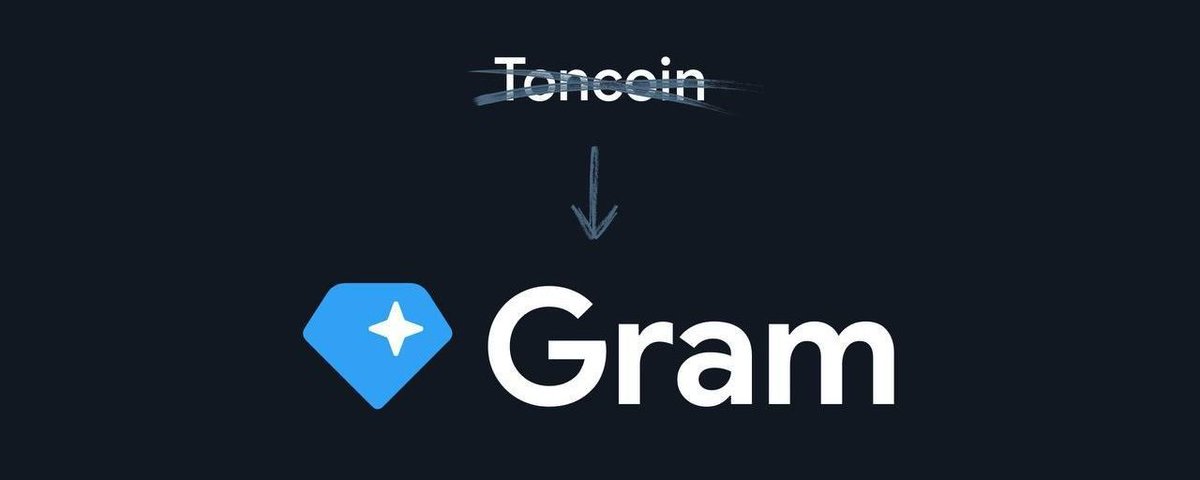 TON community approves Toncoin rename to Gram with 81.22% support; GRAM ticker takes effect June 152026-06
 Telegram’s TON Wallet inside Telegram is adding DeFi “vaults” so users can earn onchain yield on Bitcoin, Ethereum and USDT by routing funds into third-party strategies, shifting the app from pure self-custody to a DeFi gateway.2026-02
 Durov cuts TON transaction fees 6x to ~$0.0005 within a week, with most transactions set to become feeless2026-04
TON, Gram, and The Open Network: An Evergreen Explainer
The Open Network (TON) is a high-throughput, proof-of-stake layer‑1 blockchain originally conceived by messaging giant Telegram and now developed by the independent TON ecosystem, with its native token recently rebranded from Toncoin (ticker: TON) to Gram (ticker: GRAM) while the network name “TON” remains unchanged. Deeply integrated into the Telegram app via built‑in self‑custodial wallets and mini apps, TON aims to turn chat-based user flows into a global crypto payments and Web3 platform, with USDT stablecoin transfers, in‑app purchases, and staking at its core.
What Is TON?
TON sits at the intersection of a consumer social network and a modern layer‑1 blockchain. At the protocol level it is a scalable, sharded, proof‑of‑stake network designed to handle millions of transactions per second through a combination of a masterchain, multiple workchains, and dynamically splitting shardchains. At the user level it is best known as “the Telegram blockchain,” because its infrastructure is tightly integrated into Telegram’s messaging app, which counted roughly 950 million monthly active users in 2024. This combination of technical design and distribution gives TON an unusual profile compared to other smart‑contract platforms.
The native cryptocurrency of The Open Network is now called Gram and trades under the ticker GRAM, following a community-approved rebrand from Toncoin (TON) completed in June 2026. Gram functions as the gas token that pays for transactions, a staking asset that secures the network, and a unit of account and collateral within the emerging TON DeFi ecosystem. At the same time, much of the transactional volume on TON today is denominated not in Gram but in dollar-pegged stablecoins, particularly USDT issued natively on the chain. In practice, this means that for many end users TON appears less as a speculative asset and more as a settlement layer for stablecoin payments running through Telegram.
Understanding TON therefore requires tracking two overlapping narratives. One is the technical story of an ambitious sharded blockchain designed for extreme throughput and low fees. The other is a platform story about Telegram’s attempt to weave crypto payments, digital commerce, and Web3 apps directly into a global messaging network. The reintroduction of the Gram brand, the rapid expansion of staking, and the growing importance of USDT-on-TON all fit into this dual identity.
Origins: From Telegram’s ICO To A Community‑Run Network
The TON project began in the late 2010s as an internal Telegram initiative to build a blockchain capable of handling global-scale messaging and payment use cases. The original white paper referred to the native token as Gram, and Telegram raised around 1.7 billion dollars from private investors in 2018 to fund development. However, the United States Securities and Exchange Commission (SEC) brought an enforcement action against Telegram over this token sale, arguing that the Gram distribution constituted an unregistered securities offering. Telegram ultimately settled with the SEC, agreed to return unused investor funds, and halted its direct involvement in launching the token.
Crucially, the underlying codebase for TON was open sourced. After Telegram stepped back, members of the open‑source community picked up the project, maintained the code, stabilized the network, and gradually established what is now known as the TON ecosystem. A 2021 open request from community contributors documented how, since early 2021, volunteers had worked to restore, maintain, and further develop the network, emphasizing that the chain’s survival depended on a decentralized technical and governance effort rather than on Telegram alone. Over time this work coalesced into the independent TON Foundation and a broader ecosystem of validators, developers, and infrastructure providers.
In this community‑run era, the token circulating on the main network was called Toncoin, using the ticker TON. The Gram brand, which had been associated with the original Telegram-led ICO, was deliberately abandoned because of the regulatory baggage attached to it. Toncoin became the de facto gas and staking token, and for several years the project’s public materials and exchange listings used Toncoin/Toncoin (TON) rather than Gram. The network itself, however, kept the name “The Open Network” or TON.
The Return To Gram Branding
In 2026 the project’s branding made a full circle. The TON community held a vote via the TON Vote platform on whether to rename the native token back to Gram, returning to the branding of the original 2018 white paper while leaving the chain name “TON” intact. With 81.22 percent of participants voting in favor, the proposal passed, and it was announced that as of 12:00 UTC on June 15, 2026, Toncoin would officially be renamed to Gram, with the ticker changing from TON to GRAM.
The ecosystem, including exchanges and custodians, shifted accordingly. KuCoin, for example, announced that it had completed the rename of Toncoin to Gram and that trading would resume under the new GRAM ticker on June 15, 2026. Other major platforms, including Binance, stated that they would support the rebranding of Toncoin (TON) to Gram (GRAM), helping ensure that spot and derivatives markets reflected the new ticker consistently across venues. In parallel, Telegram founder Pavel Durov publicly framed the move as TON “returning to its roots,” and ecosystem press described the change as aligning the network with a more explicitly “Telegram‑native currency” identity.
This rebrand is important for readers because it means that older materials, exchange listings, and analytic dashboards may still refer to the token as Toncoin or use the ticker TON, while newer ones will show Gram/GRAM. Functionally they refer to the same asset on the same network. To avoid confusion, this explainer uses “Gram” for the token unless discussing historical stages where “Toncoin” was the prevailing term.

TON activates Catchain 2.0, cutting finality to 1 second and block times to 400ms
Inflation just 6x'd from 0.6% to 3.6% annually to fund this — 400ms blocks mean 6x more block production and 6x more token issuance per year. Stakers eat well short-term, non-stakers get diluted until the network hits a new equilibrium. Sub-second finality is competitive with Solana and Sui but no longer a differentiator, so whether this actually matters depends on Telegram Mini Apps generating enough tx volume to absorb the increased issuance rather than just accelerating sell pressure.
Core Technology And Architecture
Beneath the Telegram-facing user experience, TON is a purpose-built, highly scalable blockchain architecture. Its design centers on three main ideas: a multi‑chain structure with a masterchain and multiple workchains, dynamic sharding of those workchains into shardchains, and a proof‑of‑stake consensus mechanism with Byzantine Fault Tolerance (BFT) properties. Together, these components aim to deliver sub‑second finality and extremely low transaction fees, making the network suitable for consumer‑scale payments and microtransactions.
Masterchain, Workchains, And Infinite Sharding
TON’s base design is unusual in that it is explicitly multi‑chain from the start, rather than relying primarily on rollups or external sidechains. The architecture defines a single masterchain that stores global protocol configuration, validator stakes, and references to blocks produced by other chains in the ecosystem. On top of this masterchain, the protocol allows up to \(2^{60}\) distinct workchains, each representing its own blockchain that can have its own rules, virtual machine, and even native asset.
Within each workchain, TON implements what its documentation calls the infinite sharding paradigm. In this model, each workchain can be split into multiple shardchains that process disjoint subsets of account addresses. When the transaction load in a particular shard exceeds a threshold, the network can automatically split that shard into two and redistribute accounts between them, thereby increasing parallel throughput. When load falls, shards can be merged to reduce overhead, enabling the system to flex capacity up and down as needed.
The sharding scheme is designed so that each shardchain has up to 240 neighboring shardchains, and the maximum number of hops between any two shardchains within the same workchain is 15. This bounded “distance” allows routing of messages and value transfers across shards without unbounded latency growth as the system scales. Importantly, all these chains—masterchain, workchains, and shardchains—are part of a single logical network composable at the protocol level, which differentiates TON’s scaling approach from some other architectures that rely heavily on independent, externally bridged sidechains.
Consensus: Proof‑Of‑Stake With BFT
TON uses a proof‑of‑stake (PoS) consensus in which validators lock up Gram to participate in block production and earn rewards, while delegators can stake through validators to share in those rewards. The consensus mechanism incorporates a Byzantine Fault Tolerant design, meaning the network remains secure and consistent as long as a supermajority of validators (by stake) follow the protocol, even if a minority act maliciously or go offline.
In practice, validator sets are selected periodically, and validators produce blocks for specific shardchains under a schedule that ensures fairness and decentralization of block production across the stake distribution. Finality on TON is fast; official materials describe sub‑second finality under normal conditions. Recent performance improvements have pushed realized finality toward the neighborhood of 0.6 seconds according to ecosystem reports, though exact figures vary by measurement methodology and network conditions. The combination of BFT consensus and rapid finality is meant to support payments and interactive applications where users expect near‑instant confirmation.
The design also emphasizes low transaction fees. Ton.org highlights “nearly zero fees” as a core property, aiming to make microtransactions economically viable and to reduce friction for use cases such as tipping, small in‑app purchases, and high‑frequency game actions. From a security perspective, this creates a tension: very low fees can reduce the protocol’s revenue to pay validators, which must be balanced through inflationary issuance and staking rewards. TON’s economic parameters, including reward rates and inflation, have therefore been actively adjusted over time as developers seek to reconcile low fees with an adequate security budget.
The TON Virtual Machine (TVM) And Smart Contracts
Smart contracts on TON run in the TON Virtual Machine (TVM), a stack‑based virtual machine tailored to the network’s sharded architecture. The TVM is invoked whenever a message is sent to an account that contains smart contract code, much like the Ethereum Virtual Machine executes code when a transaction targets a contract address. TVM instructions operate primarily on a stack, with deterministic gas accounting used to cap execution costs and prevent denial‑of‑service attacks.
Historically, TON smart contracts were written in low‑level languages like FunC, which compile down to TVM bytecode. To make development more accessible, the ecosystem has introduced higher-level languages such as Tact, a “fresh programming language for TON Blockchain” designed to emphasize efficiency and ease of development. Tact is marketed as suitable for complex smart contracts and seeks to offer a more modern developer experience compared to writing directly in FunC or assembly-like TVM code.
This multi‑language toolchain allows developers to build a range of applications including decentralized exchanges, NFT collections, on‑chain games, and infrastructure protocols that support the broader Telegram mini‑app economy. The presence of a dedicated TVM also means that TON can evolve its contract semantics and opcodes independently, though this can complicate cross‑chain compatibility relative to EVM-based ecosystems. In practice, many TON projects rely on specialized SDKs, wallets, and bridges to connect users from other chains.
Scalability, Latency, And Real‑World Constraints
From a theoretical standpoint, TON’s multi‑layer sharding and PoS‑BFT consensus allow it to scale horizontally by adding more shards and validators as demand grows. The ability to dynamically split and merge shardchains is intended to avoid both underutilization and congestion, delivering high throughput without permanently fragmenting liquidity. Sub‑second finality aims to make the network competitive with centralized payment systems in terms of user-perceived speed.
In practice, real‑world performance depends on validator hardware, network conditions, and software implementations. Bottlenecks can occur not only in block production but also in state synchronization, cross‑shard message passing, and bridging to other ecosystems. The network’s complexity also increases the attack surface, especially around cross‑chain communication and smart contract security. Nonetheless, TON’s architecture places it squarely among high‑throughput, consumer‑oriented L1s that trade some design simplicity for potential scale.
TON readers are not betting on blockchain technology — they are betting on Telegram's billion-user distribution as a crypto onboarding funnel, which means every top-clicked story (Durov's arrest, network outage, SEC classification, exclusivity backlash) is actually a stress test of that single distribution thesis.
Tokenomics: From Toncoin To Gram
The economic design of TON revolves around the Gram token, which provides the primary incentive for validators, the unit of gas for transactions, and a key asset in TON DeFi. Readers should be aware that much of the existing literature still uses the name Toncoin and the ticker TON, particularly for historical data series and earlier exchange listings. Conceptually, however, Gram is a continuation of Toncoin rather than a new asset; the rebrand is one of identity and ticker, not of protocol-level token replacement.
Core Functions Of Gram
Gram has three main on‑chain functions in the TON economy. First, it pays for gas, meaning that every transaction or smart contract interaction on TON consumes gas priced in Gram. Gas fees aim to cover the computational and storage costs incurred by validators and to prevent spam. Fees are intentionally low to support retail usage. Second, Gram is staked by validators as collateral against misbehavior; validators lock tokens in staking contracts and earn rewards in return, while delegators can entrust their Gram to validators in exchange for a share of those rewards. Third, Gram serves as a unit of account and collateral in TON DeFi, where it can be supplied to lending protocols, paired in liquidity pools, or wrapped and bridged to other networks.
Off-chain, Gram is integrated into Telegram’s monetization flows. Telegram introduced Telegram Stars, an in‑app off-chain currency for digital purchases, and uses assets such as Gram to settle creator earnings and ad revenue payouts behind the scenes. While Stars themselves are not minted on TON, the use of Gram as a settlement asset means that Telegram’s internal digital economy is indirectly linked to the TON blockchain.
Staking Rewards, Inflation, And Yield
Staking is the backbone of TON’s security model. Validators stake Gram to participate in consensus and receive protocol rewards, composed of a mix of block issuance (inflation) and a share of transaction fees. Telegram’s founder has publicly highlighted that TON offers some of the highest annual staking rewards among the fifty largest cryptocurrencies, framing this as a key driver of investor interest. At one point, ecosystem discussions referenced staking yields on the order of the high teens (for example, around 18.8 percent annualized), though actual realized yields vary by validator, commission structure, and network conditions.
High staking rewards imply a nontrivial inflation rate unless they are almost entirely funded from transaction fees. TON’s commitment to low fees shifts more of the security budget toward inflationary issuance, and ecosystem coverage has noted episodes where inflation increased as fees were cut to support user adoption. In one widely discussed period, fee reductions and reward adjustments were associated with an inflation rate in the mid-single-digit percentage range, which sparked debate about long‑term token supply growth and staking sustainability. While precise parameters change over time, the general trade‑off is that higher reward rates incentivize staking and bolster security, but also increase the dilution borne by non-staking holders.
From an investor perspective, this makes staking almost a baseline expectation for Gram holders who intend to hold for any meaningful period. Those who keep tokens idle rather than staking or deploying them in DeFi are effectively accepting dilution relative to those who earn staking yields. At the same time, staking introduces lockup or unbonding periods and smart contract risk, particularly when done through third‑party services.
The Gram Rebrand: Process And Market Impact
The renaming of Toncoin to Gram carries both symbolic and practical implications. At the symbolic level, it marks a deliberate return to the network’s original identity as envisioned in Telegram’s first TON white paper, while signaling that the chain has matured beyond the legal troubles that led to the initial abandonment of the Gram brand. This change was not imposed from above; it emerged through a community voting process on TON Vote, where over four‑fifths of participants supported the proposal.
At the practical level, the rebrand has required a coordinated migration across wallets, exchanges, data providers, and smart contracts. KuCoin’s announcement that it had completed the rename and resumed trading under GRAM on June 15, 2026, is one example of how centralized exchanges executed the switch. Binance likewise communicated support for the Toncoin to Gram rebrand, assisting users through ticker and name changes in spot and margin markets. Korean exchanges and regional platforms issued their own notices to update deposit, withdrawal, and display fields from TON/Toncoin to GRAM/Gram, sometimes pausing deposits and withdrawals briefly during the transition.
Derivatives markets also had to adapt. Coinbase, which had previously listed a Toncoin perpetual futures product (TON-PERP), announced that it would suspend trading for that product around June 17, 2026. The exchange stated that any remaining open TON-PERP positions would be settled automatically at the time of suspension, using a final settlement price calculated as the average index price over the sixty minutes prior to closure. According to subsequent coverage, the final settlement price for TON-PERP was 1.623 USDC, crystallizing profits and losses for traders and effectively winding down that specific derivatives exposure as the ecosystem realigned around the new GRAM ticker.
The suspension of a single perpetual futures product does not necessarily signal a negative fundamental view of the asset on Coinbase’s part; exchanges routinely adjust derivative offerings in response to liquidity, regulatory, and operational considerations. However, it underscores that rebrands can have complex downstream effects, especially when derivative contracts, margin requirements, and risk systems reference ticker symbols. For market participants, the key takeaway is to track both token name and contract specifications carefully, particularly during transition periods when TON and GRAM labels may coexist.
Gram As Gas Versus Medium Of Exchange
Although Gram is central to staking and protocol operations, much of the day‑to‑day transactional activity on TON involves stablecoins. Ecosystem analyses indicate that the single largest economic activity on TON today is USDT-on-TON transfers, not Gram-denominated payments. In this environment, Gram functions primarily as a gas token and collateral asset, while dollar‑pegged stablecoins serve as the primary medium of exchange for users making payments, trading, or moving money across borders.
This pattern mirrors a broader trend in crypto, where stablecoins have increasingly taken over the role of transactional currency, while native L1 tokens serve as base-layer security and fee assets. TRM Labs’ Global Crypto Adoption Index, for example, notes that USD stablecoins processed hundreds of billions of dollars in retail transaction volume over the past two years across virtual asset service providers. TON’s integration of USDT directly into Telegram chat flows aligns with this trend, positioning Gram as the infrastructure token that underpins a stablecoin-led payments system rather than as a payment currency for everyday users.
Staking, Validators, And Security
The security and decentralization of TON depends on its validator set and staking dynamics. As of recent ecosystem reporting, TON has grown to roughly 400 validators spread across six continents, a figure that developers frame as evidence of broad geographic and institutional dispersion. Unlike some smaller PoS networks where a handful of entities dominate control, TON’s validator expansion has been accompanied by strategic moves from Telegram itself, which has become the single largest validator while arguing that this can coexist with, and even strengthen, decentralization.
Validator Topology And Telegram’s Role
Validators on TON are responsible for producing blocks, validating transactions, and participating in BFT consensus. Each validator stakes a significant amount of Gram, either self‑owned or delegated, and is subject to protocol-level incentives that reward honest participation and penalize misbehavior. The presence of around 400 validators globally means that consensus is not concentrated in a single jurisdiction or operator group, at least at the level of validator count.
Telegram’s role as the largest single validator has raised questions about centralization, given the company’s critical importance to the TON user funnel and its historical leadership in the project. Pavel Durov has argued that Telegram’s validator position actually strengthens decentralization, because it enables other major players, such as exchanges and custodians, to join the validator pool without individually accruing a disproportionate share of power. In this framing, Telegram’s large stake acts as an anchor that allows additional institutional validators to enter without pushing any one of them above critical thresholds, while the overall set of hundreds of validators ensures resilience.
From a security perspective, what matters is not only the number of validators but also the distribution of stake among them, the quality of their operational setups, and the governance processes that determine protocol changes. TON’s public narrative emphasizes broad validator participation and the use of community voting platforms such as TON Vote to coordinate decisions like the Gram rebrand. However, as with many PoS networks where a few large entities control significant stake, there remains an ongoing debate about how much effective power is concentrated in a small group of custodial platforms and core ecosystem contributors.
Staking Mechanics And User Participation
For most users, participating in TON’s security model means staking Gram through validators rather than running a validator node themselves. Staking can be done via self‑custodial wallets integrated into Telegram, web wallets, or exchange-hosted services, each with different trade‑offs. The built‑in wallet, now branded as DeFi Account, allows users to hold and manage Gram directly on the TON blockchain while keeping control of their private keys. This wallet can also interface with staking contracts and DeFi protocols, enabling users to delegate stake or deposit into liquid staking solutions that issue derivative tokens like tsTON.
The high headline staking yields, which ecosystem communications have highlighted as among the highest for large‑cap cryptoassets, create strong incentives for Gram holders to stake. This produces a security benefit, since a higher fraction of supply staked increases the cost of attacking the network. At the same time, derivative products and liquid staking tokens introduce additional layers of smart contract and liquidity risk. The temporary issues faced by cross‑chain systems involving staked TON derivatives, such as the TAC CCL incident where funds in USDT, BLUM, and tsTON required restoration following sequencer-level problems, illustrate how staking can become entangled with bridging and DeFi risks in complex ways.
Security Assumptions And Attack Surfaces
TON’s BFT consensus ensures that as long as less than a third of the validator stake is controlled by malicious actors, the network can reach agreement safely. However, if a coordinated attack controls or corrupts a sufficiently large stake share, finality guarantees could be compromised. This vulnerability is not unique to TON; it is inherent in PoS designs. What differs is how each network structures slashing, unbonding periods, and validator rotation to deter attacks and facilitate recovery.
The network’s sharded architecture also creates additional attack surfaces. Cross‑shard communication and state synchronization are complex, and bugs in these mechanisms can lead to inconsistent views of the ledger or opportunities for double spending if not handled correctly. The TON team’s emphasis on formal methods, careful TVM design, and conservative updates is partly a response to these challenges, but the risk cannot be eliminated entirely. Similarly, cross‑chain bridges linking TON to other ecosystems, including TAC’s CCL and bridges that wrap Gram for use on EVM chains, are frequent targets for exploits across the industry.
Overall, TON’s security posture reflects the trade‑offs of a high‑performance PoS network. The combination of a relatively large validator set, robust staking participation, and BFT consensus provides a strong foundation, but the network’s complexity, the prominence of a single large application platform (Telegram), and the growing importance of cross‑chain infrastructure require constant vigilance.
TON taps Swiss-licensed SCRYPT to open institutional USDT rails for banks and fintechs
TON, Telegram, And The User Experience
What differentiates TON from many other L1s is not only its technical design but also its tight integration into a mass‑market messaging app. Telegram’s decision to support a built‑in self‑custodial wallet that runs on TON, coupled with the rise of Telegram mini apps and Web3 games, has turned chat interfaces into the primary entry point for many users’ first on‑chain interactions.
Telegram Wallet / DeFi Account
Telegram’s wallet product, accessible through the Wallet bot and the attachment menu in chats, serves as a DeFi Account that is self‑custodial. Self‑custody here means that users’ wallets exist on the TON blockchain itself, with cryptographic keys controlling funds, rather than being held in a centralized ledger inside Telegram’s infrastructure. Users can create a wallet, back up their recovery phrase, send and receive assets, and interact with TON dApps without leaving the messaging environment.
The wallet supports Gram (formerly Toncoin), USDT-on-TON, and other ecosystem tokens, as well as NFT collectibles and in some cases liquid staking derivatives. For new users, the onboarding flow is significantly more familiar than downloading a separate browser extension or mobile wallet: they interact with bots, inline buttons, and mini apps using the same UX patterns they already know from chats. This approach has been a key driver of TON adoption, especially in regions where Telegram is widely used and where traditional banking access is limited.
Mini Apps, Games, And Earn‑To‑Play Experiences
On top of this wallet infrastructure, Telegram has encouraged the development of mini apps and games that run inside chats or as standalone Telegram experiences. Many of these are built on TON or integrate TON assets as rewards, currencies, or NFTs. Users can tap to play, complete tasks, or participate in social campaigns and earn small amounts of Gram or other tokens as part of “tap‑to‑earn” and “task‑to‑earn” dynamics.
From a crypto adoption standpoint, this model turns speculative token exposure into a byproduct of entertainment and social interaction. Instead of signing up to an exchange to buy a token, users may first encounter Gram by receiving it from a friend, winning it in a game, or completing a mini‑app quest. Because the wallet is built into Telegram, these rewards are immediately liquid within the chat ecosystem: users can send them to others, stake them, or swap them in in‑app interfaces without leaving Telegram.
Telegram Stars And In‑App Purchases
Telegram’s Stars system adds another layer. Stars are an in‑app unit used for digital purchases such as premium features or in‑app items in mini apps. They are not themselves a blockchain asset, but they function as an accounting unit within Telegram’s centralized infrastructure. Crucially, Telegram allows developers and creators who earn Stars to cash out their earnings in crypto, with Gram among the supported settlement assets. This means that even if end users never touch Gram directly, a portion of the economic activity generated inside Telegram’s mini‑app ecosystem can flow onto the TON blockchain as developers convert their earnings.
This model sits somewhere between a traditional platform currency and a Web3 token economy. Users transact in Stars at the UI level, while Gram and other blockchain assets serve as settlement currencies in the background. The design avoids some of the UX friction associated with requiring every user to maintain an on‑chain balance, while still leveraging TON as an infrastructure layer.
USDT On TON And Chat‑Native Stablecoin Payments
The integration of USDT on TON has accelerated the shift from Gram-denominated payments to stablecoin-based transfers. Tether announced in April 2024 that it was launching both its dollar-pegged USDT stablecoin and its gold-pegged XAUT token on The Open Network, explicitly positioning this as a way to strengthen ties with Telegram’s Web3 ecosystem and enable seamless value transfer within it. By 2024, USDT-on-TON’s supply had crossed the one‑billion-dollar mark, making it one of the network’s dominant assets by on‑chain usage.
Within Telegram, USDT can be sent and received much like messages or media: users can enter an amount, select a contact or group, and confirm the transfer, with the underlying transaction executed on TON. For users in countries with volatile local currencies or limited banking access, this offers a way to hold and move dollar-denominated value using an app they already use for communication. For merchants and creators, accepting USDT-on-TON payments via Telegram offers global reach without requiring customers to interact with traditional payment rails.
At the broader industry level, this aligns with a macro trend in which stablecoins are increasingly used for cross‑border payments, remittances, and on‑chain commerce. TRM Labs documents hundreds of billions of dollars in stablecoin flows through retail virtual asset service providers over recent years, reflecting their growing importance in everyday crypto use. TON’s competitive advantage lies in making these flows chat‑native: the payment primitive is embedded inside conversations, bots, and mini apps, rather than existing only in separate DeFi interfaces.
- 01Telegram gaming user explosion↗
Hamster Kombat crossing 100 million users made TON's user-acquisition story suddenly credible at scale, pulling readers who had dismissed TON as speculative.
- 02DeFi TVL surge legitimacy↗
A 118% monthly TVL surge to $600M invited readers to judge whether growth was organic or incentive-driven — the core question for any fast-rising chain.
- 03Durov arrest ecosystem shock↗
Pavel Durov's arrest collapsed the assumption that Telegram's regulatory exposure was someone else's problem, forcing readers to re-price TON's single-point-of-failure risk.
- 04native Bitcoin bridge rollout↗
Two separate Bitcoin bridge stories (Telegram's BTC bridge and tgBTC) drew clicks because BTC liquidity is the credibility signal for any L1 serious about DeFi.
- 05Telegram exclusivity controversy↗
Barring non-TON chains from Telegram mini-apps read as a monopoly play, drawing readers concerned about developer lock-in and ecosystem concentration risk.
- 06SEC securities classification
TON appearing on CoinGecko's list of 48 SEC-flagged tokens put regulatory overhang on an asset already tied to a founder under arrest in France.
DeFi, Stablecoins, And Cross‑Chain Bridges
TON’s DeFi ecosystem is smaller than those of Ethereum or some other high‑TVL chains, but it has been expanding in tandem with Telegram’s user‑driven growth and the launch of key primitives like USDT-on-TON. Analytics platforms such as DeFiLlama track TON among hundreds of blockchains by metrics like total value locked (TVL), fees, and protocol count, where it appears as a mid‑tier but rising network rather than a top‑three DeFi giant. The orientation of TON DeFi is notably payments‑centric and stablecoin‑centric, reflecting the network’s consumer focus.
TON DeFi Today
Core DeFi components on TON typically include decentralized exchanges, automated market makers, lending markets, and staking derivatives. Gram acts as a base asset and collateral, while USDT and other stablecoins often dominate trading pairs and lending demand. Because gas fees on TON are low, DeFi interactions can be inexpensive, which is attractive for small traders and experimental strategies. However, liquidity depth and market efficiency still lag behind older ecosystems, meaning that large trades may incur higher slippage and that some asset pairs are thinly traded.
A distinctive aspect of TON DeFi is its close coupling to Telegram mini apps. Many mini apps and bots incorporate DeFi operations behind simple interfaces, allowing users to swap tokens, provide liquidity, or deposit into yield strategies without interacting with raw DeFi protocols. This can simplify UX but also adds layers of custodial and smart contract risk, depending on how these apps custody user assets and route orders.
Stablecoin Rails And Macro Adoption
As noted, stablecoins—particularly USDT-on-TON—are central to TON’s DeFi and payment flows. Tether’s decision to support TON explicitly cited the goal of enabling “seamless value transfer” and increasing liquidity and activity within the network. By offering USDT and XAUT natively, TON becomes part of a multi‑chain stablecoin fabric in which the same Tether-issued assets circulate across Ethereum, Tron, Solana, and now TON, among others. This multi‑chain presence enables arbitrage, cross‑chain migration of liquidity, and redundancy in case any single chain experiences issues.
At the same time, stablecoins are increasingly in the sights of regulators, especially in the United States and Europe. The evolution of stablecoin-specific legislation, as well as broader digital asset regulatory frameworks like the U.S. “Clarity Act” advanced by the Senate Banking Committee in May 2026, will affect how platforms that support assets like USDT-on-TON can operate in key markets. For TON, whose user base is global and whose core application is a messaging app rather than a financial institution, regulatory expectations will likely center on how custodial ramps, off‑ramps, and licensed intermediaries handle compliance rather than on the base protocol itself.
Cross‑Chain Connectivity And TAC CCL
Cross‑chain connectivity is another pillar of TON’s evolving DeFi landscape. To integrate with the wider crypto economy, TON relies on bridges and cross‑chain liquidity systems that allow assets like Gram, USDT, or staked derivatives to move between TON and other networks. One such initiative involves TAC and its cross‑chain liquidity (CCL) system, which supports transactions between TON and TAC and potentially other chains.
The TAC CCL infrastructure experienced a security or reliability incident that led operators to temporarily pause cross‑chain transactions while sequencer-level patches were developed and audited. During this period, some funds in assets including USDT, BLUM, and tsTON were missing or frozen pending investigation. Project communications later reported that patched sequencer software had been independently reviewed by auditors and TON ecosystem partners, that cross‑chain operations between TON and TAC had resumed, and that restoration of missing funds was underway or completed. The episode illustrates both the appetite for cross‑chain composability in the TON ecosystem and the associated risks.
The broader history of cross‑chain exploits across the crypto industry shows that bridges are frequent points of failure. TON’s long‑term success in DeFi will depend not just on the robustness of its base layer, but also on the security of the bridges and cross‑chain systems that connect it to other networks. For users, this underscores the importance of understanding whether they are interacting with native assets on TON or wrapped assets that rely on intermediary contracts and off‑chain components.
Market Structure, Trading, And Regulation
TON/Gram trades on a wide array of centralized exchanges and decentralized venues. Its market structure reflects both its status as a top‑tier L1 token and its close association with Telegram. Liquidity is concentrated on major exchanges, with derivatives offerings that include perpetual futures, options, and structured products, although availability varies by jurisdiction and platform.
Centralized Exchange Listings
Toncoin, and now Gram, has been listed on major centralized exchanges including Binance, Bybit, OKX, MEXC, KuCoin, and, in many jurisdictions, Binance’s regional platforms. Coinbase added support for Toncoin in August 2024, expanding TON’s reach into the U.S. user base. These listings have been important for liquidity, price discovery, and providing fiat on‑ramps for users whose first exposure to TON is through trading rather than through Telegram.
With the rebrand to Gram, exchanges have had to update trading pairs, tickers, and in some cases internal risk systems. KuCoin’s announcement that trading services would resume under GRAM after completing the rename is emblematic of the operational steps involved, including updating order books, APIs, and custodial systems. Binance’s support for the rebrand further smooths the transition, ensuring that users can find the asset under a consistent ticker across multiple platforms. Regional exchanges in Korea and other markets have issued notices about temporarily suspending deposits and withdrawals of Toncoin (TON) during the migration, followed by relisting under Gram (GRAM).
Derivatives: Perpetual Futures And Options
Derivatives markets have become a significant venue for TON price discovery and speculation. Perpetual futures products like TON-PERP allow traders to take leveraged long or short positions on the token’s price without holding the underlying, while options products give traders more granular exposure to volatility. For instance, derivatives platforms have documented short‑term strategies such as a trader entering a five‑minute classic option put on TON and realizing substantial profit as the price moved below a specific strike level, highlighting the asset’s intraday volatility.
Coinbase’s handling of the Toncoin perpetual future illustrates how rebrands and risk considerations can interact. The exchange announced in advance that it would suspend trading for the Toncoin perpetual futures product (TON-PERP) on June 17 around 21:00 UTC and that any remaining positions would be automatically settled at suspension. The settlement price, calculated as the average index price over the prior sixty minutes, was later reported as 1.623 USDC. By closing out the product cleanly, Coinbase reduced operational complexity around the ticker change and mitigated potential confusion among traders. Whether a new GRAM-denominated perpetual product will be offered in the future remains an open question.
For traders, the existence of derivatives magnifies both opportunities and risks. Leverage can amplify gains or losses, and liquidations can occur rapidly if prices move against heavily margined positions. The example of a large “whale” position—such as an approximately 5.39 million dollar long position opened at a price near 1.97 with a liquidation threshold around 0.944—illustrates the size and leverage some market participants deploy, which can exacerbate volatility when positions are forced to unwind.
Regulatory Context
TON’s regulatory story is shaped by its origin in Telegram’s abandoned Gram ICO and its current status as a community-run network with deep ties to a centralized messaging platform. The SEC’s action against Telegram’s original Gram sale underscored the agency’s view that large token offerings to U.S. investors require registration or a valid exemption, especially when conducted by centralized entities. That enforcement episode led Telegram to distance itself formally from the token launch, which was then picked up by the open‑source community.
Today, the key regulatory questions relate less to the base TON protocol and more to the applications, on‑ and off‑ramps, and financial products built on top of it. Exchanges listing Gram must comply with local securities, derivatives, and AML rules. Payment service providers that use USDT-on-TON rails to facilitate cross‑border transfers or merchant payments must integrate KYC and monitoring. Telegram itself, while integrating wallets and ads monetization that touch TON, must navigate differing national rules around digital assets, in‑app purchases, and data privacy.
Globally, regulators are moving toward more explicit crypto frameworks. The advancement of the U.S. “Clarity Act” by the Senate Banking Committee in May 2026 is one example of attempts to delineate permissible activities for digital assets platforms, although details and final outcomes remain in flux. For TON, whose core use case is a messaging app with significant presence in Europe, Asia, and the Middle East, the evolution of EU MiCA implementation, Asian licensing regimes, and sanctions enforcement will likely have as much practical impact as U.S. federal law.

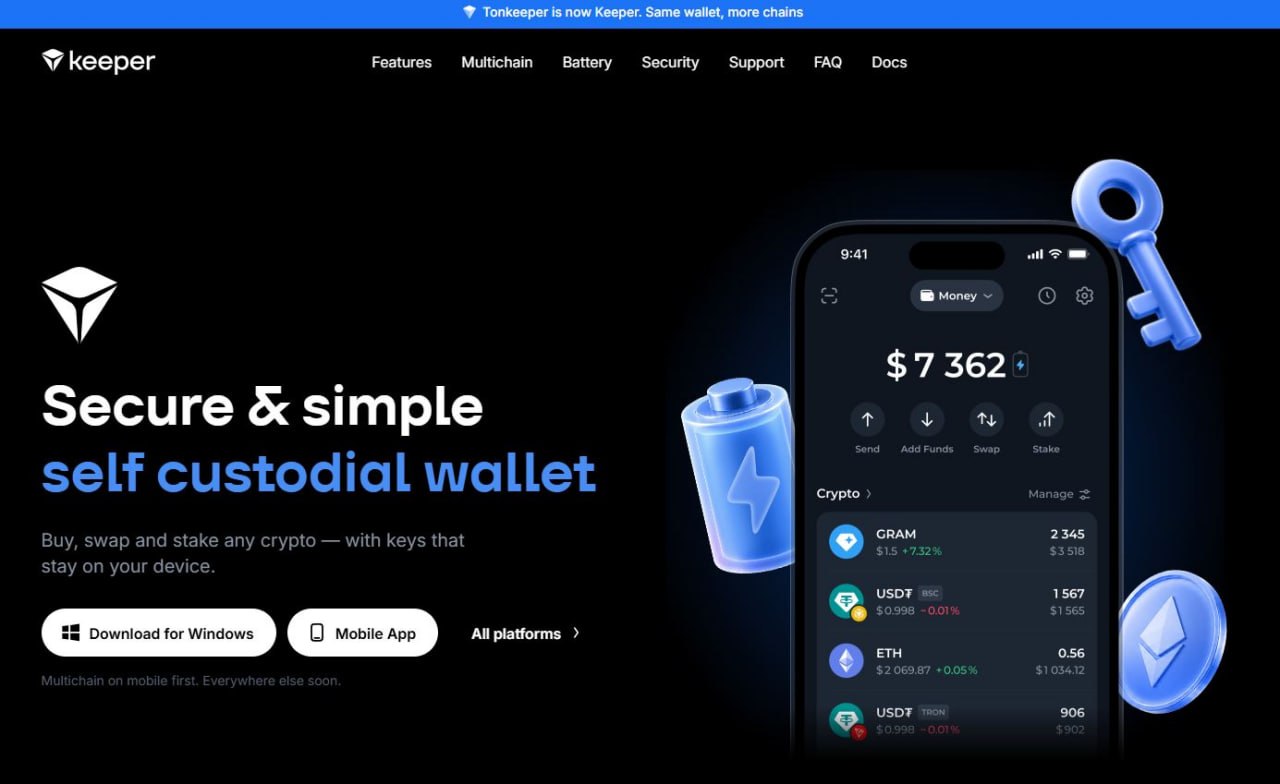
Tonkeeper rebrands as Keeper and expands beyond TON to support seven networks, including Bitcoin, Ethereum and more
Risks, Critiques, And Comparisons
Like any major crypto project, TON faces a mix of technical, economic, and governance risks. Its unusual combination of a consumer messaging platform and a complex sharded blockchain has attracted both enthusiasm and skepticism. Understanding these risk factors is essential for anyone considering building on, using, or investing in TON.
Technical Complexity And Attack Surface
TON’s architecture, with its masterchain, multiple potential workchains, and dynamically splitting shardchains, is technically sophisticated. This sophistication enables scalability but also increases the potential for implementation bugs, misconfigurations, or unforeseen interactions between components. The TVM adds another layer of complexity, as smart contracts must be carefully audited to avoid vulnerabilities.
Cross‑chain connectivity further expands the attack surface. Incidents like the TAC CCL outage and fund restoration effort, while ultimately resolved, highlight how issues in sequencers, bridges, or cross‑chain liquidity systems can disrupt user funds even if the base TON chain remains intact. More broadly, the history of crypto is replete with bridge exploits, making risk‑aware usage of wrapped assets and cross‑chain protocols crucial.
Economic Risks: Inflation, Rewards, And Stablecoin Dependence
High staking rewards, while attractive, are not free. They represent a transfer from future holders and non‑stakers to current stakers via inflation. In periods when TON reduces fees to promote adoption, the share of validator revenue coming from newly minted tokens rises, increasing inflation and potential long‑term dilution for holders. If rewards remain substantially higher than organic fee revenue for extended periods, questions arise about the sustainability of the security budget and the eventual equilibrium between staking yield and token price.
Another economic risk lies in the network’s dependence on stablecoins like USDT for actual transaction volume. If most user activity occurs in USDT while Gram is primarily a gas and staking token, then Gram’s value proposition becomes more infrastructural and less directly tied to everyday payments. This is not necessarily negative, but it means that Gram’s price may be driven more by investor expectations about TON’s long‑term role in the crypto stack than by direct transactional demand for Gram itself. Regulatory shifts affecting stablecoins or Tether specifically could also have outsized effects on on‑chain activity.
Governance And Centralization Concerns
Although TON has hundreds of validators, stake distribution and ecosystem control remain focal points of debate. Telegram’s role as the largest validator and the primary UX gateway gives it significant de facto influence over the network, even if formal control is decentralized. Changes to Telegram’s business strategy, leadership, or regulatory environment could have knock‑on effects for TON’s adoption and narrative.
Community‑driven processes like the TON Vote that approved the Gram rebrand with 81.22 percent support show that the ecosystem can coordinate collective decisions. However, turnout, stake concentration among large holders, and the influence of major service providers shape how representative such votes truly are. As TON matures, the robustness of its governance mechanisms—both on‑chain and off‑chain—will be tested by more contentious issues than branding.
Comparisons With Other High‑Throughput L1s
In the broader landscape, TON is often compared to other high‑throughput L1s—particularly those that emphasize fast finality, low fees, and consumer applications. Its main differentiator is Telegram integration: whereas other chains rely on wallets and dApps that users must seek out, TON is effectively embedded in an app that hundreds of millions already use. This gives TON a unique distribution advantage but also binds its fate more tightly to a single corporate platform than is typical for, say, Ethereum.
From a technical perspective, TON’s infinite sharding and TVM set it apart from EVM-compatible chains and from monolithic high‑performance chains. This may prove advantageous for scaling but can slow down the onboarding of developers accustomed to the EVM toolchain. The emergence of Tact and better SDKs is partly an attempt to bridge this gap. Over time, TON’s competitive positioning will depend not only on raw throughput but also on how rich and reliable its developer ecosystem becomes and how compelling its Telegram-native applications are relative to rivals.
Hamster Kombat surpasses 100M users on TON
Pavel Durov arrested in France
TON TVL reaches $600M, up 118% in one month
- 2024-09exploit
TON six-hour network outage; Binance and Bybit suspend deposits
Tether USDT and XAUT launch on TON blockchain
Telegram bars non-TON blockchains from mini-apps and games
Toncoin Bridge officially shut down
TAC mainnet launches; Curve DEX goes live on Telegram via TON mini-app
Conclusion
The Open Network occupies a distinctive niche in the crypto ecosystem. It is simultaneously a technically ambitious sharded PoS blockchain and the de facto Web3 backend for a global messaging platform. Its native token, now again called Gram after a community-approved rebrand from Toncoin, powers gas payments, staking, and DeFi activity on-chain while serving as a settlement asset behind Telegram’s Stars-based in‑app economy. For users who interact with TON through Telegram, the experience is often framed not as “using a blockchain” but as sending money, playing games, or managing digital assets inside a familiar chat app.
Technically, TON’s architecture—centered on a masterchain, multiple potential workchains, and dynamically scalable shardchains—positions it as a high‑throughput network built for consumer-scale payments and microtransactions. Its BFT proof‑of‑stake consensus and fast finality support payment and DeFi use cases that require near‑instant confirmation, while the TON Virtual Machine and higher-level languages like Tact enable a growing application layer. At the same time, the network’s complexity, reliance on cross‑chain infrastructure, and ambitious scaling goals pose nontrivial engineering and security challenges.
Economically, the story of Gram is one of evolving identity and function. The reintroduction of the Gram name reconnects the network to its original branding, but in a context where the token’s primary roles are as gas, staking collateral, and DeFi asset rather than as the main unit of day‑to‑day payments. High staking rewards make participation in security attractive but raise questions about long‑term inflation and sustainability. Stablecoin usage, especially USDT-on-TON, dominates transactional volume, aligning TON with the broader industry shift toward stablecoin-led payments while also exposing it to stablecoin-specific regulatory and counterparty risks.
From a market structure perspective, Gram enjoys broad centralized exchange support and active derivatives markets, though products like Coinbase’s TON-PERP perpetual futures may be adjusted or retired as ticker changes and regulatory considerations evolve. The presence of large leveraged traders and high‑yield staking products underscores both the opportunities and risks for speculators. Meanwhile, validator expansion to around 400 nodes across six continents and Telegram’s role as the largest validator frame ongoing debates about decentralization, governance, and the interplay between corporate platforms and decentralized networks.
Ultimately, TON’s trajectory will be shaped by three interlocking factors. The first is user adoption: whether Telegram users embrace on‑chain features enough to justify the network’s scale and to cement TON as a default stablecoin and payments rail for chat-based commerce. The second is developer momentum: whether builders choose TON as a primary home for mini apps, games, and DeFi protocols and whether tooling like Tact and the TVM ecosystem can compete with EVM-centric alternatives. The third is regulatory clarity: how regulators treat messaging-app-integrated wallets, stablecoin rails, and community-run L1s, and whether upcoming legislation offers enough certainty for major enterprises and institutions to engage with TON at scale.
For now, TON stands as one of the more intriguing experiments in merging social networks, payments, and programmable money. Its success is far from guaranteed, but its combination of a massive installed user base, a technically ambitious L1, and a reenergized Gram brand ensures that it will remain a key project to watch in the evolving Web3 landscape.
Outlook
Looking ahead, TON’s prospects hinge on whether it can convert its structural advantages into durable, mainstream usage. The immediate roadmap revolves around consolidating the Gram rebrand across all infrastructure, continuing to expand validator participation without compromising security, and deepening the integration of USDT and other stablecoins into Telegram-native payment flows. As cross‑chain systems like TAC’s CCL come back online with audited patches, the ecosystem will also seek to restore confidence in bridges and staking derivatives, which are critical for connecting TON to the wider crypto economy.
If Telegram’s mini apps, games, and Stars-driven monetization succeed in making crypto feel like a seamless part of chat-based life, TON could emerge as one of the primary payment backbones for a new generation of digital commerce. Conversely, if regulatory headwinds intensify, if key bridges falter, or if alternative L1s capture the bulk of consumer developer mindshare, TON may find itself primarily a niche high‑throughput chain powering a subset of Telegram features. The most likely path sits somewhere in between: TON and Gram becoming a significant, if not exclusive, infrastructure layer for Telegram’s financial and Web3 features, with a DeFi and developer ecosystem that grows in step with, but does not entirely redefine, the broader crypto landscape.
For investors, builders, and users, the key will be to track not just token price and staking yields, but also real indicators of utility: growth in USDT-on-TON transfers, adoption of Telegram-integrated dApps, evolution of governance via TON Vote, and the network’s positioning in global stablecoin and DeFi analytics. These metrics will ultimately tell whether TON has fulfilled its ambition to be not only “the Telegram blockchain,” but also a core piece of the world’s crypto payments infrastructure.
Latest TON news
TON activates Catchain 2.0, cutting finality to 1 second and block times to 400msTON taps Swiss-licensed SCRYPT to open institutional USDT rails for banks and fintechsTonkeeper rebrands as Keeper and expands beyond TON to support seven networks, including Bitcoin, Ethereum and moreTelegram and TON gain momentum as leading stack for AI agents after months of rapid updates, positioning messaging-native infrastructure at the center of next-gen autonomous applications Keeper Wallet adds multichain DeFi trading powered by MoonPay Trade, enabling one-tap swaps across TON, TRON, Ethereum, Bitcoin and moreTON community approves Toncoin rename to Gram with 81.22% support; GRAM ticker takes effect June 15
Sources
20 records from 14 domains
ton.org
bitcoinfoundation.org
drpc.org
facebook.com
binance.com
wallet.tg
x.com
github.com
eco.com
docs.ton.org
tact-lang.org
documents1.worldbank.org
defillama.com
trmlabs.com
Community notes
Spot something off or out of date? Drop a note. Editors review topic notes daily and roll accepted fixes into the explainer — contributors are recognized in the monthly $SQUID drop.
Loading notes…
Help improve this topic
Have a story or tip about this topic? Submit it. See something missing? Leave a note. Editors review daily; accepted submissions and fixes count toward the monthly $SQUID drop.