
A privately held web3 studio best known for creating the **Bored Ape Yacht Club** NFT collection, Yuga Labs has become a bellwether for how intellectual property, token communities, and metaverse ambitions intersect on Ethereum. Through high-profile acquisitions, legal battles, governance experiments, and security inte
- x.com4
- theblock.co4
- coindesk.com2
- businessoffashion.com1
- dappradar.com1
- nodefoundation.com1
- forum.apecoin.com1
+7 sources across the wider coverage universe
 Yuga Labs names new CEO as co-founder Greg Solano transitions to chairman role2026-04
 Yuga Labs settles BAYC trademark lawsuit with Ryder Ripps, ending four-year copycat NFT fight2026-04
 Yuga Labs rescues 68 NFTs from Flooring Protocol exploit, including 29 BAYC and 2 CryptoPunks2026-06
 Yuga Labs invests millions in developing its Otherside gamified metaverse world, targeting Bored Ape Yacht Club community members2023-07
 Yuga Labs cuts jobs as part of restructuring, CEO Greg Solano says the company “lost its way”2024-04
- Yuga Labs and Magic Eden team up to debut Ethereum NFT marketplace committed to enforcing creator royalties2023-11
Yuga Labs: An Evergreen Explainer for Crypto and DeFi Readers
A privately held web3 studio best known for creating the Bored Ape Yacht Club NFT collection, Yuga Labs has become a bellwether for how intellectual property, token communities, and metaverse ambitions intersect on Ethereum. Through high-profile acquisitions, legal battles, governance experiments, and security interventions, the company now sits at the center of many of the defining debates in NFTs, DeFi-style composability, and on-chain culture.
From its 2021 launch of Bored Ape Yacht Club during the NFT bull market to its later acquisition of CryptoPunks and Meebits, the development of the Otherside metaverse, and an evolving stance on governance and royalties, Yuga Labs has repeatedly shaped market norms rather than simply following them. The firm’s valuation, reported at around 4 billion U.S. dollars in 2022, was driven by over a billion dollars in Bored Ape-related sales, alongside the consolidation of several “blue-chip” collections under a single corporate umbrella. More recently, Yuga has engaged deeply with creator royalties, partnered with Solana-native marketplace Magic Eden on a royalty-enforcing Ethereum marketplace, and intervened to rescue NFTs from a third-party protocol exploit, underscoring how NFT brands inherit many of the same security and economic complexities that define DeFi. At the same time, leadership changes, job cuts, and controversies around in-person events and DAO governance show that Yuga’s trajectory is neither linear nor guaranteed, but instead offers a case study in the growing pains of web3-native companies operating at global scale.
Origins and Identity of Yuga Labs
Founding context and Ethereum-native roots
Yuga Labs emerged in 2021 as a small, pseudonymous team building on Ethereum, framing itself less as a traditional tech startup and more as a culture studio rooted in NFT-native identity. Its breakout collection, Bored Ape Yacht Club (BAYC), launched in April 2021 on Ethereum using the ERC‑721 standard, at a time when the NFT market was rapidly expanding from early experiments such as CryptoPunks into mainstream awareness. The initial Bored Ape mint price was 0.08 ether, around 190 U.S. dollars at the time, and the 10,000-piece collection sold out in roughly twelve hours, an early signal that demand for profile-picture (PFP) NFTs tied to social identity and club-like access was intensifying. BAYC’s success quickly transformed Yuga from an experimental project team into a focal point for a new wave of NFT-native entrepreneurship, attracting attention from both crypto-native investors and venture capital firms.
BAYC’s underlying technical design reflects the standardization and composability that have made Ethereum the dominant platform for NFTs and much of DeFi. Each Bored Ape token is an ERC‑721 non-fungible token representing what one legal scholar might call “a unique unit of data recorded in a blockchain, which permanently records its provenance or sales history”. This token standard, inter-operable across wallets, marketplaces, and DeFi protocols, meant that Apes could flow into lending platforms, liquidity pools, and fractionalization schemes much like ether or ERC‑20 tokens, even as their value was driven by social status and cultural narratives rather than cash flow or protocol fees. That composability, as later events like the Flooring Protocol exploit would show, is both a strength and a risk for NFT brands that become deeply enmeshed in the broader Ethereum ecosystem.
Corporate mission: culture, IP, and “club” identity
From the outset, Yuga Labs framed BAYC less as a static art drop and more as the anchor for a long-term “club” and brand strategy. The collection’s lore situates the Apes as degenerate crypto traders in a near-future world who have “aped in” early, become wealthy, and now spend their time in a slightly dystopian yacht club. Owners of a Bored Ape NFT receive more than a tokenized image: they gain access to a private online club, exclusive in-person events, and the right to participate in an evolving narrative around the brand. Yuga supplemented this with on-chain experiences such as THE BATHROOM, a shared digital “graffiti” board accessible only to token holders, reinforcing the idea that BAYC was a social coordination layer as much as a collectible series.
Public statements from Yuga leadership further underscore this positioning. In discussing the future of the club, a Yuga Labs executive described the company’s work as guided by three pillars: “IRL” (in real life), “Storytelling,” and “Style,” emphasizing that meetups, experiences, and fashion would be as central as smart contracts to the BAYC experience. Rather than treating NFTs simply as financialized digital art, Yuga has consistently presented itself as a hybrid of entertainment studio, lifestyle brand, and technology company. This hybrid identity, which straddles consumer culture and crypto infrastructure, is one reason why Yuga’s strategic choices reverberate across both NFT markets and the broader DeFi and Ethereum ecosystems.
Position in the NFT and Ethereum landscape
Within a year of BAYC’s launch, Yuga Labs had become synonymous with “blue-chip” NFTs and served as a benchmark for the wider market. During the 2021–2022 cycle, individual Bored Apes sold for prices measured in millions of dollars, with at least one piece reportedly auctioned for more than 24 million U.S. dollars, while aggregate sales across the BAYC collection surpassed one billion dollars. These cash flows, combined with subsequent collections and token launches, helped support a 2022 valuation of Yuga Labs around 4 billion dollars, backed in part by investors that included major venture firms and the now-defunct crypto exchange FTX. The company’s rapid ascent echoed the trajectory of DeFi protocols like MakerDAO in earlier cycles, where on-chain network effects translated into outsized valuations, but in Yuga’s case the collateral was brand equity and narrative rather than collateralized debt positions.
As the market cycle turned, Yuga’s position also made it a proxy for the fortunes of NFTs at large. By April 2024, the floor prices of Bored Ape NFTs had fallen by approximately 90 percent from their peaks in 2022, mirroring the broader drawdown in NFT trading volumes and speculative fervor. Yet even in a downturn, BAYC remained one of the most recognized assets in crypto culture, with Apes used as avatars by celebrities, funds, and anonymous traders alike. In a similar way that MakerDAO’s DAI has become a reference point for stablecoins and on-chain credit markets, Yuga’s collections continue to function as a benchmark for the cultural and financial health of the NFT segment of the Ethereum economy.

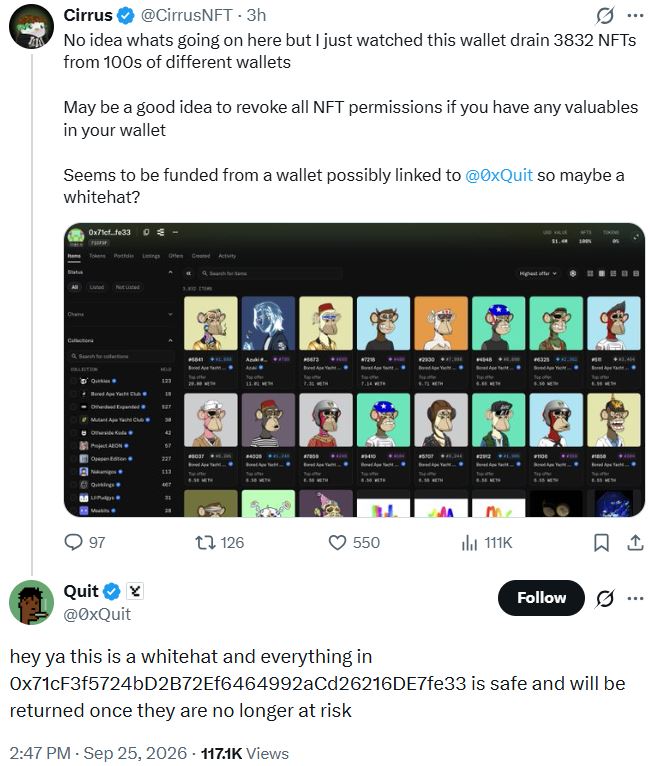
Wallet drains 3,832 NFTs via Magic Eden contract; Yuga Labs VP suggests white-hat rescue
Flagship Collections: Bored Apes, Mutants, and the Kennel Club
Bored Ape Yacht Club: design, supply, and mechanics
Bored Ape Yacht Club is structurally simple yet culturally dense. The collection consists of 10,000 unique NFT images of cartoon apes generated algorithmically from a set of 172 distinct visual traits, including different fur colors, clothing, hats, and backgrounds. Each Ape is thus both one-of-one and part of a recognizable visual system, allowing holders to express individuality while signaling affiliation with the broader BAYC brand. This blend of standardization and variation, familiar from generative art and PFP collections, has proven particularly effective in social media contexts where avatars need to be instantly recognizable at small sizes.
From a technical perspective, each Ape is an ERC‑721 token minted on Ethereum, with metadata pointing to its associated image and trait set. The use of ERC‑721 means that Apes can be traded on any marketplace that supports the standard, deposited into custodial and non-custodial wallets, and integrated into DeFi protocols that accept NFTs as collateral. The initial mint in April 2021 was open to the public at a fixed price of 0.08 ETH per token, and demand grew quickly as crypto-native influencers and early adopters began to showcase their Apes on social media. Within approximately twelve hours, the full collection had sold out, leaving the secondary market on platforms like OpenSea to determine subsequent price discovery. That rapid sell-out, combined with intense secondary trading, invited comparison to initial DeFi yield-farming seasons, where early participants captured outsized upside.
Membership, perks, and IP rights
What distinguished BAYC from the many other PFP collections that launched around the same time was not only aesthetic but also the promise of ongoing membership, perks, and intellectual property rights. Holders are granted access to an online “club,” gated by token ownership, where they can interact with other members, participate in community decisions, and receive airdrops or allowlists for future Yuga drops. Access to THE BATHROOM, a token-gated drawing board where each wallet can place pixels at intervals, was one early example of this membership utility, while later expansions included in-person events under the ApeFest brand. These features made BAYC feel less like a static collectible set and more like a membership pass to an evolving social network.
Crucially, Yuga Labs adopted a comparatively permissive stance toward intellectual property, explicitly signaling that BAYC token holders enjoyed broad commercialization rights over their specific Apes. In practice, this meant that owners could license their Ape’s likeness for use in merchandise, music videos, restaurants, or other media projects, subject to some general constraints. This approach contrasted sharply with collections like CryptoPunks under their original creator Larva Labs, where IP rights were more tightly controlled and licensing options limited. By empowering holders to build derivative brands around their characters, Yuga effectively decentralized some aspects of BAYC’s cultural production, even as the core trademarks and logos remained under corporate control. The approach mirrors, in a cultural context, the way protocols such as MakerDAO allow permissionless composability on top of their contracts while retaining governance over core parameters.
Market performance and the NFT boom-and-bust
BAYC’s secondary market performance became emblematic of both the heights and fragility of the NFT boom. During the 2021–2022 bull run, floor prices for Bored Apes rose from under one ether to dozens and eventually hundreds of ether, with rare traits commanding multi-million-dollar valuations in marquee auctions and private sales. Auction houses such as Sotheby’s and Christie's began to feature Apes in curated NFT sales, further blurring boundaries between traditional art markets and on-chain collecting. As Yuga expanded the universe with related collections like Mutant Ape Yacht Club (MAYC) and Bored Ape Kennel Club (BAKC), the total sales volume across the broader “Ape ecosystem” climbed into the billions of dollars, strengthening Yuga’s negotiating position with investors and partners.
However, as macro conditions tightened and speculative interest cooled, NFT trading volumes declined sharply. By April 2024, according to market reports and data aggregated by researchers, Bored Ape floor prices were down roughly 90 percent from their all-time highs, with similar drawdowns across most PFP collections. This revaluation exposed the extent to which BAYC’s peak pricing had been fueled by leverage, token incentives, and celebrity promotion rather than purely by sustained cultural demand. It also forced Yuga to pivot from monetizing primary drops and secondary royalties in a bull market to building more durable revenue streams and use cases that could support the brand through extended downcycles, much as DeFi protocols like MakerDAO have had to adapt to changing lending and staking environments.
Derivative collections and ecosystem expansion
To grow the ecosystem beyond the original 10,000 Apes, Yuga released derivative collections that both rewarded existing holders and brought new participants into the fold. Mutant Ape Yacht Club introduced a much larger collection of “mutated” Apes, created via serum airdrops to BAYC holders and public sales, while Bored Ape Kennel Club offered companion dog NFTs that could be claimed for free by Ape owners during a limited window. Sales of these secondary collections generated hundreds of millions of dollars in additional volume; one estimate placed MAYC sales around 670 million dollars and BAKC sales around 173 million, indicating strong demand for exposure to the Ape brand at different price points.
These expansions created a stratified ecosystem in which original BAYC tokens functioned as the highest-status assets, Mutant Apes provided a mid-tier entry point, and Kennel Club or other derivatives offered more affordable access. The structure parallels DeFi protocols where governance tokens confer deeper rights while LP tokens or vault receipts provide narrower exposure. For Yuga, this stacked model increased the total addressable market for its brand without diluting the scarcity or prestige of the original BAYC series. It also laid the groundwork for future integrated experiences, such as the Otherside metaverse, where different classes of NFTs might confer distinct roles or capabilities.
Readers clicked Yuga Labs stories not for NFT hype but to track a specific corporate arc: a company that captured billions in cultural capital, then visibly stumbled through executive admissions of failure, governance fights, and IP divestments — making it a case study in Web3 institutional decay.
Expanding the Universe: CryptoPunks, Meebits, and Otherside
Acquiring CryptoPunks and Meebits: consolidating blue chips
In 2022, Yuga Labs took the unprecedented step of acquiring the intellectual property rights to CryptoPunks and Meebits, two influential NFT collections created by Larva Labs. The deal included the purchase of 423 CryptoPunks and 1,711 Meebits from Larva Labs, alongside control over the IP associated with the collections, although the exact financial terms were not publicly disclosed. CryptoPunks, often regarded as one of the earliest and most culturally significant PFP collections, had accumulated an estimated 2.2 billion dollars in total sales by that point, while Meebits had recorded approximately 248 million dollars in sales. By bringing these brands under its corporate umbrella, Yuga effectively consolidated several of the most valuable and historically important NFT projects in the space.
This consolidation had both symbolic and practical implications. Symbolically, it signaled that Yuga did not see itself solely as the “Bored Ape company” but as a broader steward of NFT culture, willing to absorb legacy projects and reshape their licensing and development trajectories. Practically, the acquisition gave Yuga a portfolio of distinct visual and cultural assets that could be activated in different ways across games, metaverse experiences, and merchandising lines. It also raised questions familiar from traditional entertainment and tech industries: whether concentration of IP in a small number of corporate entities would stifle experimentation or, conversely, provide the resources needed to maintain and expand beloved franchises.
IP rights: from Larva Labs to Yuga’s commercial-use model
One of the most immediate changes Yuga announced following the CryptoPunks and Meebits acquisition concerned intellectual property licensing. Under Larva Labs, Punks had been governed by relatively restrictive licensing terms that limited what individual holders could do with the images associated with their tokens. Yuga, by contrast, stated that it would grant CryptoPunks and Meebits owners “the same commercial rights that BAYC and MAYC owners enjoy,” effectively aligning the collections with BAYC’s more liberal IP model. This meant that Punk and Meebit holders, like Ape holders, could commercialize their specific characters in media, merchandising, and other ventures, subject to overarching brand guidelines.
This shift was widely interpreted as a victory for the “token holder rights” ethos within the NFT community, which argues that ownership without meaningful utility or licensing rights undermines the potential of NFTs as programmable IP primitives. By moving Punks and Meebits toward a more decentralized commercialization model, Yuga positioned itself as a counterpoint to more restrictive licensing regimes, even as it maintained corporate control of trademarks and strategic direction. In DeFi terms, one might analogize this to protocols that open-source their core contracts and encourage permissionless integrations while still retaining governance tokens and upgrade authority. The challenge, in both domains, is to balance open participation with the need for coherent brand and protocol evolution.
Otherside: a gamified, interoperable metaverse
Beyond consolidating existing PFP collections, Yuga Labs has invested heavily in building Otherside, a “gamified, interoperable metaverse” designed to serve as a virtual playground for a variety of NFT communities. Marketed as a “metaRPG,” Otherside aims to blend mechanics from massively multiplayer online role-playing games (MMORPGs) with web3-enabled virtual worlds in which players own the underlying land and assets. In this model, NFTs such as Bored Apes, Mutant Apes, and potentially third-party collections can become playable characters or confer in-game abilities, while virtual land parcels, known as Otherdeeds, function as tokenized real estate and resource-holding plots.
The first 100,000 Otherdeeds were made available on April 30, 2022, in one of the largest and most closely watched virtual land sales in web3. Purchases were conducted through smart contracts on Ethereum, with ApeCoin used as a currency in some phases, illustrating Yuga’s intent to knit together its various products—PFPs, fungible tokens, and metaverse experiences—into a unified economic system. Otherside’s design explicitly emphasizes interoperability, promising that NFTs from different collections will be able to enter the world as avatars or artifacts, a vision that resonates with broader web3 aspirations around composable identity and asset portability. However, realizing this vision at scale involves not only technical challenges around rendering, networking, and cross-project integrations, but also governance questions about which collections are “whitelisted” for deeper integration and on what terms.
Fashion, luxury, and the Gucci partnership
Yuga’s metaverse ambitions have attracted interest from major brands seeking to explore digital fashion and collectibles. One of the most notable collaborations is the multi-year partnership between Yuga Labs and luxury fashion house Gucci, announced through the “Otherside Relics by Gucci” initiative. As part of this partnership, Gucci and Yuga plan to “explore the intersection between fashion and entertainment in the Metaverse,” with Gucci designing digital items and narratives that tie into the Otherside world and potentially to physical products. This collaboration positions Otherside not just as a game or social hub but as a platform for branded experiences that could blend virtual and real-world exclusivity.
The Gucci partnership reflects a broader trend in which high-end fashion and consumer brands experiment with NFTs as a medium for storytelling, loyalty, and limited-edition drops. By aligning itself with a heritage fashion house rather than solely with crypto-native partners, Yuga signals a desire to bridge web3 culture with established luxury markets and to test how digital ownership can complement or extend physical ownership. For Gucci, the collaboration offers a laboratory for understanding how younger, crypto-savvy audiences engage with luxury in virtual environments, and whether NFTs on Ethereum can function as status symbols in the same way as physical handbags or apparel. The partnership’s success or failure will likely inform how other brands navigate similar collaborations, including on alternative chains such as Solana, where NFT communities have also attracted interest from consumer-facing companies.
Infinite Node Foundation and the next phase of CryptoPunks IP
In a later development, the intellectual property associated with CryptoPunks moved again, this time from Yuga Labs to a nonprofit entity, the Infinite Node Foundation (NODE). Public statements from NODE co-founder Micky Malka describe the organization as a nonprofit steward of the CryptoPunks IP, acquired from Yuga Labs with the goal of managing the brand as a kind of cultural public good rather than as a purely corporate asset. Alongside co-founder Becky, Malka has emphasized that NODE’s mission is to support the long-term cultural significance and accessibility of CryptoPunks, rather than to exploit the brand for maximum short-term profit.
This transition illustrates an emerging pattern in web3 where cultural artifacts and protocols sometimes move from corporate ownership to nonprofit or community trust structures once they reach a certain level of maturity or historical importance. It parallels, in a loose sense, discussions in DeFi about transitioning protocol ownership or revenue streams to DAOs or foundations, as seen in MakerDAO’s complex governance evolution. For Yuga, transferring the CryptoPunks IP to Infinite Node can be seen as both a strategic and reputational move: it reduces the burden of stewarding a historically significant but culturally distinct collection, while showcasing willingness to prioritize what some community members view as a more neutral custodian for a piece of NFT history. The handoff raises important questions about how IP governance, community expectations, and economic incentives intersect in the long-term management of iconic on-chain assets.
Tokenomics, ApeCoin, and Governance Experiments
ApeCoin as an ecosystem token
While Yuga Labs itself did not issue ApeCoin (APE), the fungible token is deeply intertwined with the Bored Ape ecosystem and Yuga’s broader strategy. ApeCoin was launched by an independent entity, ApeCoin DAO, with allocations to BAYC and MAYC holders, Yuga Labs, and other stakeholders, and it serves as both a governance and utility token for projects in the “Ape ecosystem.” In practice, APE has been used for purposes such as purchasing Otherside land during specific sale phases, providing incentives for ecosystem projects, and serving as a governance token in the DAO that oversees its treasury and certain strategic decisions. This design loosely parallels governance tokens in DeFi protocols like Maker’s MKR, although the underlying assets and objectives—cultural IP versus collateralized debt positions—differ significantly.
The coexistence of a private company (Yuga Labs), a token-governed community (ApeCoin DAO), and a broad constellation of third-party builders has created a layered governance landscape whose contours are still evolving. Yuga retains control over its trademarks and core IP, while ApeCoin DAO governs the use of a substantial token treasury intended to benefit the ecosystem as a whole. This separation was initially framed as a way to decentralize aspects of decision-making and to reduce regulatory risk for Yuga by distancing the company from direct control over the token. Over time, however, tensions have emerged regarding the effectiveness, accountability, and direction of DAO governance in a brand-driven ecosystem.
ApeCoin DAO’s treasury and MakerDAO comparisons
ApeCoin DAO controls a significant treasury denominated in APE tokens, designed to fund grants, sponsorships, and ecosystem initiatives. One proposal filed with the DAO noted that the DAO held approximately 169 million APE tokens, valued at over 168 million U.S. dollars at contemporary market prices, underscoring the scale of on-chain capital at stake. The DAO’s governance process, centered on Ape Improvement Proposals (AIPs), allows token holders to vote on funding allocations, structural changes, and collaborations. This process has enabled community-driven initiatives but has also attracted criticism for low voter participation, potential token concentration among large holders, and the challenge of coordinating complex strategic decisions via open governance.
Comparisons to DeFi governance experiments are instructive. MakerDAO, for instance, has spent years iterating on governance structures, including the introduction of core units, elected delegates, and, more recently, an “Endgame” plan seeking to balance decentralization with efficient decision-making. ApeCoin DAO operates in a different domain—culture and gaming rather than lending and stablecoins—but faces analogous questions: how to prevent governance capture, how to ensure specialized expertise informs decisions, and how to align long-term strategy with token-holder incentives that may be short term and speculative. Unlike MakerDAO, which anchors a critical piece of DeFi infrastructure in the form of DAI, ApeCoin DAO presides over a more discretionary and brand-dependent set of activities, making its legitimacy particularly sensitive to perceptions of alignment with Yuga and the wider Ape community.
Proposal to sunset ApeCoin DAO and launch ApeCo
In this context, a major governance inflection point emerged when Yuga-associated leadership proposed to effectively replace ApeCoin DAO with a new governing body, ApeCo. A proposal filed as an AIP on June 5 outlined a plan to “sunset” the DAO and transfer key assets—including treasury funds, intellectual property rights, smart contracts, and administrative operations—to a newly formed corporate entity led by Yuga. The envisioned transition would see ApeCo assume full responsibility for managing the grant program, directing the development of ApeChain, and overseeing key brand initiatives associated with the Bored Ape Yacht Club ecosystem. In essence, the proposal would consolidate decision-making and execution under a more traditional corporate structure, albeit one that would presumably maintain some mechanisms for community input.
The proposal’s sponsor was identified as Yuga Labs CEO Greg Solano, underscoring the degree to which Yuga’s leadership remained intertwined with the governance of the ApeCoin ecosystem. Supporters of the move argued that DAO governance had proved unwieldy, slow, and prone to misalignment, and that a focused corporate entity could more effectively deploy capital and drive coherent strategy. Critics, by contrast, viewed the proposal as a step toward centralization that risked disenfranchising token holders and undermining the ethos of decentralization that had initially been emphasized around ApeCoin. The debate echoes similar disputes in DeFi when protocol teams have sought to reclaim or re-concentrate control, highlighting an unresolved tension in web3 between the efficiencies of corporate governance and the legitimacy conferred by token-based decentralization.
Decentralization, control, and the Ethereum–Solana context
The ApeCo proposal also sits against a broader backdrop of differing governance and ecosystem cultures across chains like Ethereum and Solana. Ethereum’s emphasis on credible neutrality, open-source development, and composable infrastructure has fostered a rich ecosystem of DAOs, DeFi protocols, and NFT projects that experiment with various governance models. Solana, while also home to DAOs and NFT communities, has often emphasized performance, low fees, and consumer-scale applications, with different trade-offs in terms of decentralization and governance. Yuga’s choice to anchor its ecosystem on Ethereum—and to engage deeply with DAO structures and debates—is thus not merely technical but philosophical.
At the same time, the gravitational pull of large brands like Yuga inevitably shapes norms around what “decentralization” means in practice. If a leading NFT ecosystem can propose dissolving its nominally independent DAO in favor of a company-led entity, that may embolden other projects to re-centralize, just as MakerDAO’s gradual professionalization has influenced expectations for DeFi governance. Conversely, resistance to such moves could strengthen calls for more robust and accountable DAO frameworks. For practitioners and observers across both Ethereum and Solana ecosystems, the ApeCoin DAO versus ApeCo debate offers a live test case of how web3 communities negotiate power, efficiency, and values in the face of large, valuable treasuries and complex brand assets.
- 01Otherside metaverse ambition↗
The multi-million-dollar bet on a gamified metaverse for BAYC holders was Yuga's most forward-looking pitch, drawing readers curious whether an NFT brand could become a games company.
- 02Restructuring and decline narrative↗
CEO Greg Solano publicly admitting the company 'lost its way' alongside layoffs gave readers a rare moment of executive candor about NFT-era overexpansion.
- 03Creator royalties enforcement fight↗
The Magic Eden Ethereum marketplace partnership positioned Yuga as a royalties defender, touching the industry-wide tension between creator economics and zero-fee trading.
- 04Ryder Ripps IP legal battle↗
The multi-year lawsuit over copycat NFTs — culminating in a court-ordered $1.6M judgment and eventual settlement — drew readers tracking whether NFT copyright claims had real legal teeth.
- 05Ethereum staking infrastructure criticism
A Yuga VP publicly quitting solo staking over Ethereum's incentive design signaled insider disillusionment with the chain underpinning BAYC's entire value proposition.
- 06DAO governance and asset control shift↗
Greg Solano's proposal to dissolve ApeCoin DAO and replace it with ApeCo — moving $168M in assets — read as a founder reclaiming control from a decentralized structure that wasn't working.
Business Model, Revenue Streams, and Royalty Debates
Primary sales, secondary royalties, and venture capital
Yuga Labs’ business model has evolved over time but rests on three primary pillars: primary sales of NFTs and virtual land, royalties from secondary market trading, and strategic partnerships and investments. The initial sale of 10,000 Bored Apes at 0.08 ETH each generated a modest but meaningful inflow of capital that funded further development and marketing. Subsequent primary drops, including Mutant Apes, Kennel Club companions, and Otherdeeds for Otherside, produced far larger revenues as Yuga’s brand recognition and demand grew. Additionally, Yuga has earned a share of secondary market transactions through creator royalties encoded in marketplace agreements and, in some cases, enforced at the smart contract level.
These on-chain cash flows, combined with the skyrocketing valuations of BAYC and related collections during the NFT boom, attracted the attention of venture capital investors, culminating in a major funding round in 2022 that valued Yuga at approximately 4 billion dollars. That valuation was supported not only by Bored Ape Yacht Club’s sales—estimated to surpass 1.1 billion dollars—but also by the performance of Mutant Ape Yacht Club, Bored Ape Kennel Club, CryptoPunks, and Meebits, which collectively accounted for billions more in trading volume. The infusion of venture capital enabled Yuga to scale its team, invest in ambitious projects like Otherside, pursue acquisitions, and weather subsequent market downturns. It also introduced the familiar tension between long-term community alignment and the expectations of equity investors seeking returns within conventional time horizons.
Creator royalties and the Magic Eden partnership
One of the most contentious issues in the NFT market over the past several years has been the status of creator royalties on secondary sales. As new marketplaces emerged and sought to compete on price, some allowed or even encouraged traders to bypass optional royalty payments, eroding a key revenue stream for creators and NFT studios. In response, Yuga Labs, alongside other stakeholders, began exploring ways to harden royalty enforcement at the protocol level rather than relying solely on marketplace norms or social pressure. This culminated in a high-profile partnership with Magic Eden, a multi-chain NFT marketplace originally rooted in the Solana ecosystem, to develop a new Ethereum-based marketplace dedicated to enforcing creator royalties.
According to public descriptions, the Yuga–Magic Eden marketplace is designed so that royalties, typically ranging between 2.5 percent and 10 percent of the sale price, are enforced on every NFT trade conducted through the platform. Magic Eden has implemented a new smart contract architecture intended to enforce royalties on all trades, not only within its own marketplace but also in any external marketplace that adopts the same contract standard. The vision is that new NFT projects can mint directly with this contract, thereby baking royalty enforcement into their tokens from the outset, while other marketplaces could integrate the system to maintain access to those collections. For Yuga, this initiative represents both a defense of its business model and an attempt to shape the broader NFT infrastructure toward more creator-friendly norms.
The partnership is notable in part because Magic Eden’s roots are on Solana, a chain whose NFT ecosystem has gone through its own intense debates over royalties and marketplace incentives. By collaborating with a Solana-native marketplace on Ethereum-based infrastructure, Yuga underscores the increasingly cross-chain nature of NFT liquidity and marketplaces. It also highlights how business and technical decisions around royalties intersect with deeper questions about the sustainability of creator economies: without enforceable recurring revenue, studios like Yuga might be pushed toward more extractive primary sales or alternative monetization models that could misalign incentives between creators and collectors.
Implications for creators, collectors, and NFT market structure
The outcome of the royalties debate, and of experiments like the Yuga–Magic Eden marketplace, will have significant implications for both creators and collectors across chains. For creators, enforceable royalties promise a more predictable revenue stream that can support ongoing development, community management, and experimentation, similar to protocol fees in DeFi. For collectors, however, royalties represent a transaction cost that may reduce trading frequency or arbitrage opportunities, particularly for high-volume traders. The balance between these interests will shape market microstructure and may determine whether NFT markets evolve toward something closer to traditional art markets, where galleries and artists share in secondary sales, or toward more purely financialized markets with minimal frictions.
In this sense, Yuga’s stance parallels some of the debates around protocol fee switches and revenue sharing in DeFi platforms. Just as MakerDAO and other protocols have grappled with how much value to return to token holders versus retaining for protocol resilience, NFT ecosystems must decide how much ongoing compensation creators receive versus minimizing costs for traders. Yuga’s decision to actively champion royalty enforcement rather than simply adapting to market pressure signals a belief that long-term brand-building requires sustainable creator revenue, even at some cost to short-term liquidity. Whether this view becomes dominant on Ethereum, Solana, or other chains remains an open question, but the company’s scale ensures that its choices will influence where and how NFT liquidity aggregates.
Technology Stack, Security, and the Flooring Protocol Exploit
Ethereum, ERC‑721, and NFT composability
At the technical level, Yuga Labs’ core products are deeply embedded in the Ethereum stack. Bored Apes, Mutant Apes, Kennel Club tokens, and Otherside’s Otherdeeds are all structured as ERC‑721 NFTs, leveraging Ethereum’s security model and ecosystem of tooling. The ERC‑721 standard defines a set of functions and events that allow NFTs to be minted, transferred, and queried in a consistent way, enabling wallets, marketplaces, and smart contracts to interact with them without custom integrations. This standardization is part of what makes NFTs “composable”: other protocols can accept Apes or Otherdeeds as collateral, fractionalize them into fungible ERC‑20 tokens, or bundle them into portfolio products without needing permission from Yuga.
This composability, celebrated as a hallmark of web3 innovation, also introduces new vectors of risk. When NFTs are locked into third-party smart contracts—whether for lending, liquidity provision, or yield strategies—their security becomes contingent on the correctness of those contracts as well as on Ethereum’s base-layer security. Just as DeFi lending protocols can be exploited via smart contract bugs or oracle manipulations, NFT-specific protocols can suffer exploits that put high-value tokens at risk. For a company like Yuga, whose brand is tied to the perceived safety and prestige of its collections, third-party vulnerabilities become reputational issues even when Yuga’s own contracts function as intended.
Flooring Protocol and systemic risk to blue-chip NFTs
This dynamic was vividly illustrated in an exploit involving Flooring Protocol, a third-party platform that allowed users to deposit high-value NFTs into on-chain pools. Although specific technical details of the vulnerability are beyond the scope of the public summaries, reports indicate that an exploit was discovered that left NFTs in certain Flooring Protocol pools vulnerable to theft or unauthorized withdrawal. Because the affected pools contained so-called “blue-chip” NFTs, including Bored Apes and CryptoPunks, the exploit posed not only financial risk to individual depositors but also potential reputational damage to the brands associated with those tokens.
In many ways, the Flooring Protocol incident echoed the structure of DeFi exploits in which composability and permissionless integration allow risk to propagate across protocols. Just as an error in a yield aggregator can compromise assets deposited into underlying lending markets, a flaw in an NFT pooling contract can suddenly endanger multiple high-value collections. The incident underscored that NFT owners who seek to unlock liquidity by entering DeFi-like protocols are effectively transforming their NFTs into yield-bearing assets with associated smart contract risks. For Yuga Labs, whose tokens are frequently used as collateral or liquidity sources in such schemes, the question becomes whether and how the company should intervene when third-party infrastructure threatens the safety of its ecosystem.
Yuga’s white-hat rescue of 68 NFTs
In response to the Flooring Protocol exploit, Yuga Labs took an unusually hands-on approach by organizing a white-hat rescue operation. Using its GrailsOTC trading desk, the company executed a series of transactions to pull 68 high-value NFTs out of vulnerable Flooring Protocol pools, reportedly ahead of would-be attackers and before the assets could be drained. The rescued NFTs included 29 Bored Ape Yacht Club tokens and at least two CryptoPunks, among other blue-chip assets, with a combined estimated value exceeding 500,000 U.S. dollars at the time of the operation. Once secured, the tokens were held in Yuga-controlled wallets, with the expectation that they would be returned to their rightful owners or otherwise handled in accordance with community expectations.
Reports from The Defiant, Decrypt, and other outlets emphasized that the rescue was proactive and executed under “white-hat” ethics, meaning Yuga sought to prevent theft rather than exploit the vulnerability for profit. The operation showcased both the advantages and controversies of having a powerful corporate actor embedded in an ostensibly decentralized ecosystem. On one hand, Yuga’s resources, expertise, and speed allowed it to coordinate a response that individual NFT holders might have struggled to achieve, similar to how core DeFi teams sometimes lead mitigation efforts during protocol crises. On the other hand, the episode raised questions about the informal power Yuga wields over the fate of assets that, in principle, are permissionless and independent once minted.
Security lessons for NFTs and DeFi-style composability
The Flooring Protocol incident and Yuga’s response highlight several key lessons for security and risk management in NFT and DeFi ecosystems. First, the episode underscores that composability is a double-edged sword: while it enables sophisticated financial products and liquidity strategies, it also creates coupling between protocols that can transmit shocks and exploits across what appear to be distinct systems. Second, the incident illustrates the emergence of “systemically important” NFT collections whose security issues can have outsized cultural and financial impact, similar to how large stablecoins or lending protocols are viewed as critical infrastructure within DeFi.
Third, the rescue raises normative questions about the appropriate role of corporate NFT issuers in responding to third-party contract vulnerabilities. Some argue that Yuga’s intervention reflects responsible stewardship of its brands and community, analogous to how software vendors issue patches for vulnerabilities in widely used products. Others worry that such interventions could set expectations that issuers will always “bail out” holders affected by external exploits, potentially encouraging risk-taking or moral hazard. These debates parallel those in DeFi around protocol responsibility for user losses stemming from composability and the limits of “code is law” as a guiding principle.
Finally, the incident connects to broader questions about Ethereum’s security model and incentive structure. A Yuga executive’s public comments about solo staking and Ethereum’s incentive design, though not directly tied to the exploit, reflect a growing concern that base-layer centralization or misaligned incentives could indirectly affect the security of assets like NFTs that rely on Ethereum for settlement. As NFTs become integrated into lending markets, derivatives, and cross-chain bridges, their risk profile increasingly resembles that of DeFi assets, making security practices and governance just as critical as artwork and storytelling.
Bored Ape Yacht Club launches
Yuga Labs acquires CryptoPunks and Meebits IP from Larva Labs
Otherside metaverse land sale ('The Other Side') raises ~$300M
ApeFest Hong Kong: UV lighting causes attendee injuries
Yuga Labs layoffs; CEO Greg Solano says company 'lost its way'
Court orders Ryder Ripps and Jeremy Cahen to pay $1.6M in copyright damages
NODE Foundation acquires CryptoPunks IP from Yuga Labs
Greg Solano proposes dissolving ApeCoin DAO, replacing with ApeCo
Legal Strategy, IP, and Brand Stewardship
Commercialization rights and Yuga’s IP philosophy
Yuga Labs’ approach to intellectual property has been one of its most distinctive and influential contributions to NFT culture. By clearly stating that Bored Ape Yacht Club holders have broad commercialization rights over their individual Apes, Yuga enabled a proliferation of derivative projects, from streetwear brands and food products to music acts and media franchises based on specific Apes owned by community members. This model treats each NFT not only as a collectible or membership pass but also as a micro-licensing bundle, empowering holders to build their own micro-brands under the larger BAYC umbrella. It is a marked departure from traditional entertainment IP regimes, where studios often retain tight control over character usage.
The company extended this philosophy to CryptoPunks and Meebits after acquiring their IP, promising to grant holders IP rights comparable to those enjoyed by BAYC and MAYC owners. This move was particularly significant for CryptoPunks, whose original licensing under Larva Labs had been more restrictive and had sparked community debates about the meaning of NFT ownership. By aligning Punks and Meebits with its commercial-use model, Yuga positioned itself as a champion of token-holder IP rights, while also reinforcing its role as the central orchestrator of these brands’ overarching narratives and visual identity. In practice, this hybrid model—centralized brand stewardship combined with decentralized micro-licensing—has become a reference point for other NFT projects crafting their own licensing frameworks.
The Ryder Ripps RR/BAYC litigation and its implications
Yuga’s permissive licensing stance has not prevented it from vigorously defending its core trademarks and brand identity when it believes they are being misused. The most notable example is the long-running legal dispute with artist Ryder Ripps and collaborators over the RR/BAYC collection, which Yuga alleged was a deliberate attempt to confuse consumers and capitalize on BAYC’s brand by selling near-identical images linked to different NFTs. The case raised complex questions at the intersection of copyright, trademark, and free expression, with Ripps’ team arguing that the project was an artistic commentary and thus protected speech, while Yuga contended it was a form of misleading counterfeit.
In U.S. federal court proceedings, judges largely sided with Yuga’s arguments, finding that the RR/BAYC collection infringed on Yuga’s trademarks and engaged in false designation of origin. The court rejected the claim that simply pointing to different token contracts and metadata was sufficient to avoid confusion, emphasizing that consumers could reasonably believe RR/BAYC NFTs were affiliated with or endorsed by Yuga. The decisions suggested that, at least under current U.S. law, trademark protections apply to NFT collections similarly to how they apply to physical goods and traditional digital products. While the parties ultimately reached a settlement that ended the litigation, the case established important precedents for how courts may treat copycat NFT projects and “appropriation art” in a blockchain context.
For NFT creators and collectors, the RR/BAYC saga underscores that tokenization does not magically circumvent IP law. Owning an NFT does not necessarily confer the right to create derivative collections that use similar names, logos, or images in ways that might confuse consumers about origin or affiliation. At the same time, the case leaves open questions about the scope of permissible commentary, parody, and criticism using on-chain assets, issues that will likely be tested in future disputes. For Yuga, the legal victory reinforced its brand protection posture and signaled to would-be copycats that it is willing to invest substantial resources in litigation, even as it continues to encourage derivative works that respect its trademarks and licensing terms.
CryptoPunks IP and the Infinite Node Foundation
As noted earlier, Yuga Labs’ stewardship of CryptoPunks was relatively brief, culminating in the transfer of the collection’s IP to the Infinite Node Foundation (NODE). NODE, described as a nonprofit entity co-founded by entrepreneur Micky Malka and a partner identified as Becky, acquired the CryptoPunks IP from Yuga with the stated goal of serving as a neutral and mission-driven custodian. Public commentary from NODE’s founders suggests a focus on preserving CryptoPunks’ cultural significance, fostering public engagement, and potentially supporting educational or archival initiatives centered on the collection.
This handover reflects a nuanced approach to IP that recognizes the distinct identity and historical weight of CryptoPunks relative to Yuga’s in-house brands. Whereas Bored Apes originated as a Yuga-native project with close integration into the company’s metaverse and token strategies, CryptoPunks emerged years earlier as a kind of proto-NFT experiment, later embraced by a wide spectrum of collectors and artists. By transferring Punks’ IP to a nonprofit, Yuga signaled an understanding that not all iconic NFT collections need or benefit from centralized corporate ownership. The move also alleviated potential conflicts between Yuga’s commercial objectives and community expectations around the stewardship of what many regard as a digital cultural artifact.
Regulatory and copyright questions for NFTs
Yuga’s IP strategies and legal battles sit within a broader, evolving regulatory landscape for NFTs. Questions persist about whether and when NFTs might be treated as securities, how consumer protection laws apply to NFT marketplaces and brands, and how existing copyright and trademark frameworks map onto tokenized assets. While the RR/BAYC case provided some guidance on trademark issues, many other questions remain unsettled, including the enforceability of on-chain licensing terms, the status of NFTs used as fractionalized investment vehicles, and the obligations of issuers when tokens are used in DeFi-like structures.
Yuga’s activities touch many of these areas. The company has issued or promoted NFTs that function as access passes, collectible art, and in-game assets; it has engaged in token-linked governance debates via ApeCoin; and its IP is frequently used as collateral in lending and liquidity protocols. This complexity means that Yuga’s legal strategies—and any regulatory scrutiny it might attract—could have ripple effects across the NFT and DeFi sectors. As governments and courts continue to grapple with tokenized assets, Yuga’s choices around licensing, enforcement, and governance will likely serve as case studies for policymakers and legal scholars seeking to understand how web3-native IP and communities function in practice.
Culture, Community, and Controversies
Club culture and social signaling
Part of what propelled Yuga Labs to prominence is the strength of the social and cultural identity that coalesced around Bored Ape Yacht Club. Owning an Ape quickly became a status symbol in crypto circles, signaling both financial success and early participation in a defining NFT movement. This status-driven dynamic, amplified by celebrity endorsements and media coverage, turned BAYC into a kind of digital “yacht club” in which token-gated Discord servers, exclusive merchandise, and event invitations functioned as tangible manifestations of on-chain membership. The effect resembles private investment clubs or social networks, but with membership keyed to ownership of a specific set of NFTs rather than to fiat wealth or personal connections.
Yuga intentionally nurtured this club-like atmosphere through lore, visuals, and ongoing engagement. The “bored” expression and casual attire of Apes reflect a tongue-in-cheek attitude toward wealth and speculation, while the dingy, graffiti-covered environments depicted in BAYC imagery evoke a countercultural backdrop for what is, in economic terms, a high-end luxury asset. Token-gated digital experiences like THE BATHROOM reinforced the sense of communal participation, allowing members to co-create visual artifacts even if their artistic contributions were humorous or irreverent. Over time, the BAYC community developed its own norms, slang, and hierarchies, mirroring the sociological dynamics of offline clubs and online fandoms.
ApeFest and the Hong Kong UVA incident
One of the most visible ways Yuga extended BAYC’s club culture into the physical world was through ApeFest, a series of in-person events and parties for Ape holders and guests. These gatherings, held in locations including New York and Hong Kong, featured live music, branded installations, and networking opportunities for NFT enthusiasts, blending elements of music festivals, industry conferences, and private parties. While ApeFest helped solidify community bonds and generate social media buzz, it also highlighted the practical and reputational risks that come with hosting large-scale physical events.
At ApeFest 2023 in Hong Kong, these risks were brought into sharp focus when at least 22 attendees reportedly experienced eye pain, vision problems, or skin irritation following the event. Subsequent investigations by Yuga Labs, conducted in collaboration with Jack Morton Worldwide—the global brand experience agency that produced ApeFest 2023—determined that UVA-emitting lights installed in one corner of the event were likely the cause of the reported issues. Yuga described the reports as “deeply concerning” and undertook a thorough review of inventory records, material logs, and specifications for lighting and paint, as well as interviews with contractors and on-site inspections. The conclusion that improper UVA lighting was likely responsible underscored the importance of rigorous safety protocols in event production, particularly when experimental or visually intense lighting is involved.
The incident drew criticism and concern from community members and observers, some of whom questioned Yuga’s oversight of vendors and risk management practices. For a brand whose value is tightly intertwined with community goodwill and public perception, such incidents can have outsized impact, even if they stem from contractor errors rather than deliberate negligence. The Hong Kong episode thus serves as a reminder that as NFT-native brands move into physical spaces—whether through events, retail pop-ups, or collaborations—their responsibilities increasingly resemble those of traditional entertainment and hospitality companies, with attendant legal and reputational stakes.
Market downturn, restructuring, and “lost its way”
The broader NFT market downturn and internal strategic challenges have also shaped Yuga’s community relations. As noted earlier, Bored Ape floor prices fell dramatically from their highs, eroding not only paper wealth but also some holders’ sense of BAYC as an unassailable status symbol. Against this backdrop, Yuga Labs announced in 2023 that it was eliminating a number of roles as part of a company-wide restructuring aimed at refocusing on core initiatives. In communications about the restructuring, Yuga leadership acknowledged that the company had grown rapidly and, in the words of co-founder and executive Greg Solano, had at times “lost its way,” indicating a recognition that expansion into too many initiatives had diluted focus.
The job cuts came roughly 18 months after Yuga closed a 450 million dollar seed round, highlighting how quickly market conditions had shifted and how challenging it can be to align headcount and spending with cyclical revenues. Yuga emphasized that it would offer severance packages and employment assistance to affected employees, but the restructuring nonetheless signaled a more cautious and disciplined approach going forward. For community members, these changes were a double-edged sword: on one hand, a leaner, more focused Yuga might execute more effectively on key projects like Otherside; on the other hand, visible retrenchment could erode confidence among those accustomed to relentless growth narratives.
Narrative pillars: IRL, storytelling, and style
In the wake of these challenges, Yuga has sought to articulate a clearer strategic narrative for its brand and community. A notable articulation came in the form of social media commentary from leadership emphasizing three guiding pillars for the club’s future: IRL experiences, Storytelling, and Style. The “IRL” pillar underscores continued investment in physical events, meetups, and touchpoints, despite the setbacks of incidents like ApeFest Hong Kong, reflecting a belief that on-chain communities benefit from face-to-face interaction. “Storytelling” points to narrative expansions through comics, animations, games, and other media that deepen the lore of Bored Apes and related collections, moving beyond static images toward richer fictional universes.
“Style,” finally, captures both the fashion-forward aesthetic of BAYC and the potential for collaborations with apparel, accessories, and lifestyle brands, as exemplified by the Gucci partnership around Otherside. By staking out these pillars, Yuga implicitly acknowledges that the future of the brand cannot rest solely on token prices or speculative volume but must be anchored in cultural relevance and creative output. For a crypto news audience, this shift is notable because it aligns Yuga more closely with entertainment and fashion companies that live or die by their ability to generate compelling IP, rather than with purely financial protocols. At the same time, Yuga’s continued involvement in governance debates, security interventions, and royalty infrastructure ensures that its trajectory remains deeply entangled with the evolution of DeFi and Ethereum.
BAYC floor prices collapsed from their 2022 peaks alongside the broader NFT market downturn, directly undercutting Yuga's revenue model and forcing the restructuring.
The proposal to replace ApeCoin DAO with a founder-controlled ApeCo entity reveals that decentralized governance of core assets was effectively nominal from the start.
Yuga successfully defended its BAYC trademarks and secured a $1.6M damages award against Ryder Ripps, but multi-year litigation cost demonstrated NFT IP enforcement remains expensive and slow.
The Flooring Protocol exploit required Yuga to execute a whitehat rescue of 68 high-value NFTs including 29 BAYC, exposing how third-party DeFi integrations create recovery obligations for the brand.
Multiple hospitalizations from UV exposure at ApeFest Hong Kong and the subsequent sale of CryptoPunks IP compounded a pattern of brand-damaging incidents that eroded community trust.
Corporate Strategy, Leadership, and Workforce
Fundraising, valuation, and strategic ambitions
The scale of Yuga Labs’ fundraising and valuation has given it both opportunities and obligations uncommon among NFT-native companies. The roughly 450 million dollar seed round closed in 2022, led by major venture capital firms, valued Yuga at approximately 4 billion dollars, a level more typical of late-stage tech companies than of startups built around a two-year-old NFT collection. This valuation was premised not only on historical sales and royalties but also on expectations that Yuga would successfully build out Otherside, expand its IP across media formats, and potentially become a central player in whatever form the “metaverse” ultimately takes.
Such expectations require Yuga to operate on multiple fronts simultaneously: game development, community management, legal compliance, IP licensing, and infrastructure partnerships. The company’s strategic investments—such as acquiring CryptoPunks and Meebits, launching Otherside, partnering with Gucci, and collaborating with Magic Eden—reflect an attempt to leverage its capital base to entrench itself as a long-term cultural and technical platform. Yet large valuations also create pressure to deliver growth and profitability, particularly once initial NFT boom revenues subside. Yuga’s subsequent restructuring and renewed focus on core initiatives can be interpreted as a response to this tension, seeking to align operating costs and strategic bets with a more sober assessment of market conditions.
Leadership changes and governance signaling
Yuga’s leadership structure has evolved alongside its strategic shifts. The company was initially founded by pseudonymous figures who later revealed their identities, including Greg “Garga” Solano and Wylie “Gordon Goner” Aronow, with additional executive talent brought in as the company scaled. Over time, Yuga has experimented with different configurations of executive and board leadership, reflecting both internal dynamics and the need to signal stability and competence to investors and the market. For example, a widely noted personnel move saw industry veteran Michael Figge appointed as CEO of Yuga Labs, with co-founder Greg Solano transitioning to the role of board chairman. Market reactions were immediate; one data point indicated that ApeCoin (APE) surged by over 80 percent on the day the leadership change was announced, suggesting that investors viewed the new leadership configuration positively.
In another context, however, Greg Solano was also identified as serving as Yuga Labs CEO when he filed the proposal to sunset ApeCoin DAO and launch ApeCo, highlighting the fluidity of titles and roles over time. These shifts illustrate how leadership changes at Yuga are often intertwined with broader strategic moves, such as governance restructuring or metaverse development, rather than being purely internal HR matters. For token holders and community members, executive appointments and transitions are not merely corporate news but signals about how aggressively Yuga will pursue centralization, partnerships, and new product lines. In this sense, Yuga’s leadership dynamics resemble those of large DeFi protocols where the identities and track records of core contributors can significantly influence market sentiment.
Workforce restructuring and focus on core initiatives
As discussed earlier, Yuga Labs’ workforce has not been immune to the volatility of the NFT market and the challenges of scaling a multi-faceted web3 company. The 2023 decision to cut jobs as part of a restructuring was framed by Yuga as a necessary step to refocus on core initiatives that would drive long-term value, particularly Otherside and key brand partnerships. The company emphasized that affected employees would receive severance packages and employment assistance, aligning with conventional tech-industry practices while also acknowledging the human impact of strategic decisions.
For observers, the restructuring provided a reality check relative to the exuberant narratives of 2021–2022, when it was easy to imagine NFT brands growing unabated as long as markets remained frothy. Instead, Yuga’s experience mirrors that of many high-growth startups that must recalibrate when macro conditions shift, even if their underlying products retain cultural relevance. From a DeFi perspective, one might compare this to protocols that dramatically scaled incentives and grants during bull markets and then had to retrench and optimize for sustainability once token prices and yields declined. Yuga’s choices thus offer insight into how NFT-native companies manage the transition from speculative mania to more mature, albeit still uncertain, operating environments.
Partnership strategy: Gucci, Magic Eden, and beyond
Partnerships have been a core component of Yuga’s strategy to extend its reach beyond the immediate crypto-native audience. The Gucci collaboration, focused on Otherside Relics and broader explorations of fashion in the metaverse, aligns Yuga with a globally recognized luxury brand and offers opportunities for cross-promotion and co-branded experiences. The Magic Eden partnership, by contrast, is more infrastructural, centering on the creation of an Ethereum NFT marketplace that enforces creator royalties at the smart contract level. Taken together, these partnerships illustrate Yuga’s intent to operate simultaneously in the realms of consumer culture and technical infrastructure.
For Gucci, Yuga provides access to a highly engaged, digitally native community and a living laboratory for experimenting with digital collectibles, virtual fashion, and hybrid physical-digital experiences. For Magic Eden, collaborating with Yuga on Ethereum offers an opportunity to deepen its presence beyond Solana and to position itself as a champion of creator-friendly marketplace design. Yuga, in turn, benefits from Gucci’s cultural cachet and Magic Eden’s expertise in marketplace dynamics across chains. These relationships also highlight a key difference between Yuga and many DeFi protocols: whereas DeFi collaborations often revolve around composable contracts and token swaps, Yuga’s partnerships frequently involve complex IP, branding, and experiential design considerations that must satisfy both crypto-native and mainstream stakeholders.
Yuga Labs in the Broader Web3 and DeFi Landscape
NFTs as financial primitives and DeFi integration
Yuga Labs’ ecosystem sits at the intersection of cultural IP and financial infrastructure, making it an instructive case study for understanding NFTs as financial primitives. Bored Apes, Mutant Apes, and Otherdeeds are frequently used as collateral in lending protocols, fractionalized into ERC‑20 tokens, or packaged into NFT indices, blurring the lines between collecting and investing. In some cases, these assets have been integrated into DeFi protocols that also support stablecoins like MakerDAO’s DAI, enabling complex strategies where users borrow against NFTs to leverage into other positions or earn yield. This integration brings NFTs squarely into the orbit of DeFi risk management, oracle design, and liquidity provisioning.
From a structural perspective, NFTs differ from fungible tokens in important ways, including heterogeneous valuations, lower liquidity, and more idiosyncratic risk. Yet the success of Yuga’s collections, particularly BAYC, has motivated the development of specialized NFT lending markets and pricing oracles capable of handling these complexities. The Flooring Protocol exploit and Yuga’s rescue operation underscore that as NFTs become embedded in DeFi-style architectures, their risk profile begins to resemble that of other on-chain assets exposed to smart contract vulnerabilities, oracle failures, and systemic shocks. For DeFi practitioners accustomed to thinking in terms of collateral factors and liquidation cascades, the spread of Apes and Otherdeeds into lending markets introduces new dimensions of illiquidity and valuation uncertainty.
Cross-chain ecosystems: Ethereum, Solana, and beyond
While Yuga Labs’ flagship collections are firmly rooted on Ethereum, the company’s partnerships and the broader NFT landscape span multiple chains, including Solana. Magic Eden’s origins as a Solana marketplace and its later expansion to Ethereum and other chains exemplify this cross-chain dynamic. Solana’s NFT ecosystem has cultivated its own blue-chip collections, market microstructures, and community norms, often emphasizing fast, low-cost transactions and high-frequency trading relative to Ethereum’s more expensive but arguably more secure environment. Yuga’s decision to work with a Solana-native marketplace on an Ethereum-focused royalty-enforcement project demonstrates how expertise and innovations can flow across chains even when specific collections remain chain-bound.
This cross-chain interplay has implications for how NFT brands think about liquidity, user acquisition, and technical design. Some projects have experimented with bridging NFTs across chains or issuing parallel collections on multiple chains, though doing so raises challenging questions about provenance, scarcity, and user confusion. Yuga has, to date, largely avoided fragmenting its flagship collections across chains, instead focusing on Ethereum and exploring other environments, such as Bitcoin’s Ordinals, through separate projects. Nonetheless, the proliferation of NFT ecosystems on Solana, Polygon, and other networks means that Yuga must compete not only with Ethereum-native rivals but also with culturally significant brands elsewhere. How it navigates this increasingly multi-chain landscape—whether through partnerships, interoperability standards, or cautious chain-specific strategies—will shape its relevance in a web3 world that is decidedly not monolithic.
Mainstream adoption, regulation, and long-term sustainability
Finally, Yuga Labs’ trajectory raises broader questions about the long-term sustainability of NFT-driven brands and their potential role in mainstream adoption of web3. On one hand, BAYC and related collections have introduced millions of people to the concept of NFTs, wallet ownership, and on-chain communities, in some cases more effectively than abstract explanations of DeFi or layer-1 infrastructure could. High-profile partnerships with brands like Gucci and the visibility of Apes in media and entertainment suggest that NFTs can serve as a culturally resonant entry point to the broader crypto ecosystem. On the other hand, the volatility of NFT prices, controversies around speculative behavior, and high-profile incidents like the ApeFest Hong Kong UVA injuries and copycat litigation complicate the narrative and may deter some mainstream participants.
Regulatory developments will further shape the environment in which Yuga and similar companies operate. Issues such as consumer protection in NFT sales, the classification of certain tokens as securities or commodities, and tax treatment of digital collectibles all bear on user behavior and corporate strategy. Yuga’s experiments with DAO governance, metaverse economies, and IP licensing offer rich material for regulators and policymakers trying to understand how web3-native organizations function in practice. Whether Yuga ultimately resembles more a Disney-like IP powerhouse, a hybrid tech and entertainment company, or something closer to a protocol-governed network remains an open question, one that depends as much on external regulatory choices and market evolution as on internal decisions.
Outlook
Looking ahead, Yuga Labs faces a complex mixture of opportunities and challenges that will test both its creative vision and its operational resilience. On the opportunity side, Otherside remains a potentially transformative project if Yuga can deliver a compelling, interoperable metaverse that attracts sustained user engagement and third-party development. The Gucci partnership
Latest Yuga Labs news
Sources
17 records from 13 domains
en.wikipedia.org
x.com
makemepulse.com
otherside.xyz
ocula.com
gucci.com
lex.substack.com
scmp.com
unchainedcrypto.com
thedefiant.io
cryptoslate.com
instagram.com
coinstats.app
Community notes
Spot something off or out of date? Drop a note. Editors review topic notes daily and roll accepted fixes into the explainer — contributors are recognized in the monthly $SQUID drop.
Loading notes…
Help improve this topic
Have a story or tip about this topic? Submit it. See something missing? Leave a note. Editors review daily; accepted submissions and fixes count toward the monthly $SQUID drop.