
Deep dive explainer on how art works in crypto today, covering NFTs, Tezos, AI, marketplaces like SuperRare, prediction markets, payments, environmental issues, and how artists and collectors can navigate web3’s evolving cultural infrastructure.
+104 sources across the wider coverage universe
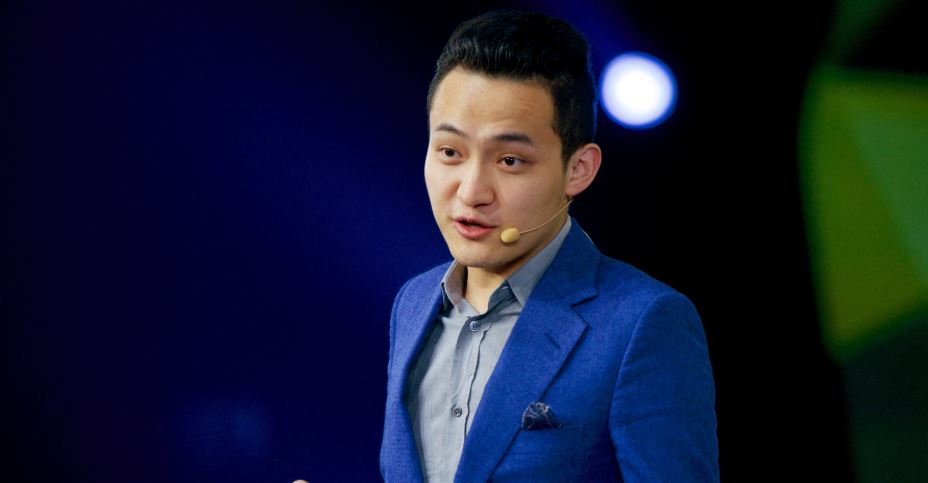 Eric Trump mocks Justin Sun's $1B World Liberty lawsuit, compares TRON founder to $6M banana art buyer2026-04
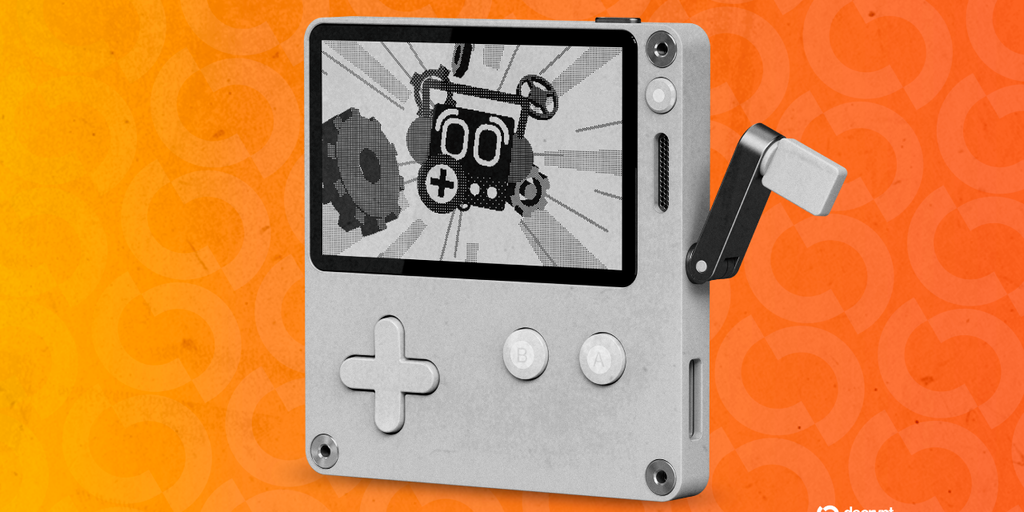 Playdate maker Panic bans generative AI art, music, and writing from its Catalog storefront, while allowing coding tools like GitHub Copilot with disclosure2026-04
 "Art That Outlives Museums: When Network Becomes the Medium" - a guest article by Natalie Stone for Ethereum2026-01
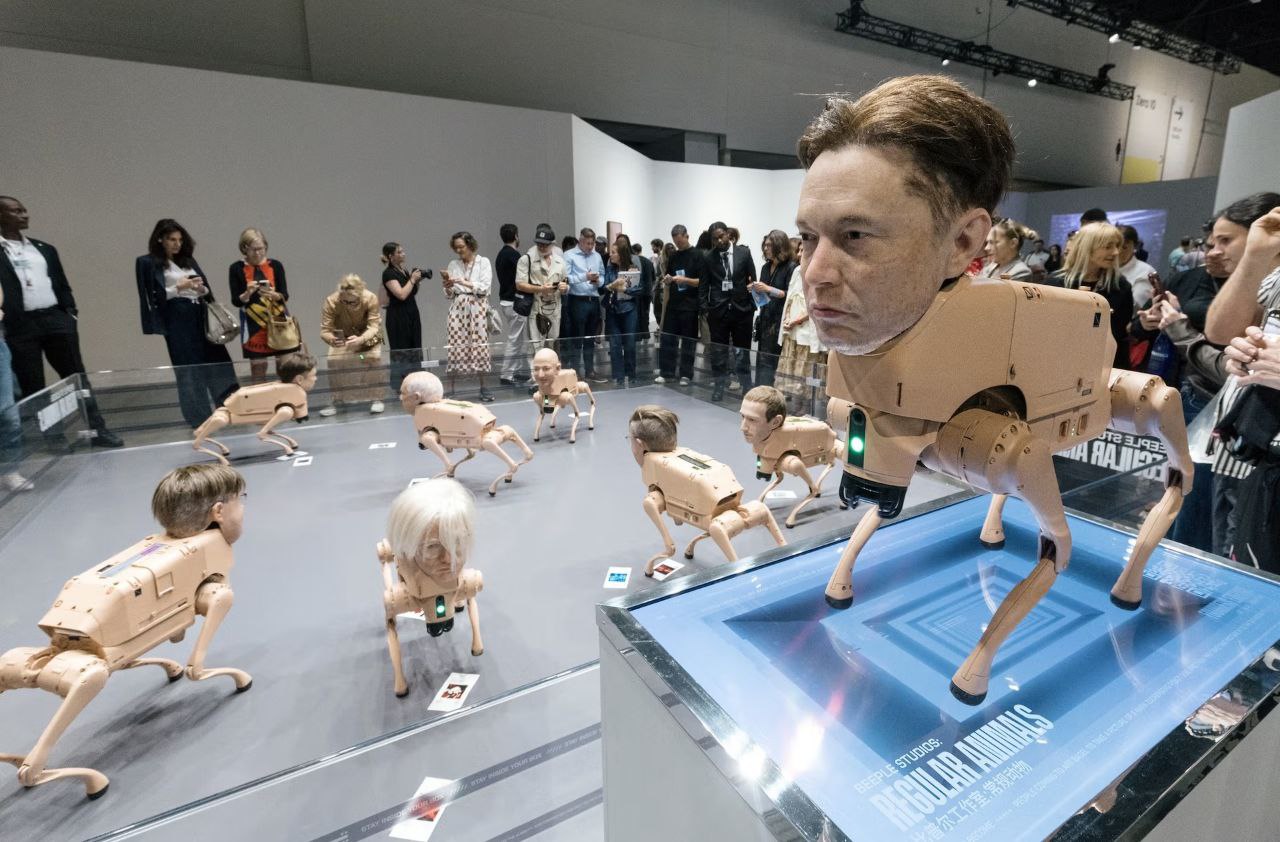 Who let the dogs out?
Beeple unveils “Regular Animals” at Art Basel—robot dogs with Elon Musk, Mark Zuckerberg, Jeff Bezos, and Beeple heads that roam, take photos, and poop printed artworks linked to free NFTs.2025-12
Who let the dogs out?
Beeple unveils “Regular Animals” at Art Basel—robot dogs with Elon Musk, Mark Zuckerberg, Jeff Bezos, and Beeple heads that roam, take photos, and poop printed artworks linked to free NFTs.2025-12 Enron abandons ‘performance art’ and just dumps a memecoin2025-02
 New York MoMA adds tokenized artworks to its permanent collection, embracing blockchain and AI technology. The museum's acquisition of NFTs signals a new era in digital art.2023-11
Art in Crypto: How Blockchains, NFTs, and AI Are Rewriting the Art World
In crypto, art refers not just to images and objects but to systems of code, tokens, markets, and communities that turn digital creativity into verifiable, tradable, and programmable cultural assets. It is the intersection of aesthetic practice with blockchains, NFTs, AI, and new market infrastructures that let artists launch work globally and collectors participate in real time.
From Paintings to Protocols: What “Art” Means in Web3
Art has always been more than the physical materials from which it is made. A painting is not simply pigment on canvas but a combination of intention, context, authorship, and the evolving stories told about it. In crypto, that logic persists, but the substrate changes: instead of canvas and stretcher bars, the fundamental material is data inscribed on a blockchain. A digital image, video, or interactive piece can be copied infinitely, yet a token on a blockchain can designate a particular instance as the original or canonical version in the eyes of collectors, much as a signed certificate or gallery provenance once did for analog works. The file remains endlessly reproducible, but the non-fungible token becomes the scarce object of ownership.
This distinction between the media file and the token that represents it is foundational to understanding web3 art. The artwork may live on a decentralized storage network, on a traditional server, or directly in a smart contract, but the token is what carries the unique identifier, provenance trail, and often the terms of how that work can be sold or licensed. In traditional markets, these functions were handled by paperwork, archives, and institutional memory; now they are increasingly encoded in software. For artists, that shift opens up the possibility of designing how their work circulates as carefully as they design the imagery or interaction itself. For collectors, it means the record of ownership is globally visible, transparent, and composable with other crypto infrastructure.
The term crypto art emerged to describe art that is closely bound to blockchain culture, whether through subject matter, medium, or market. Some crypto art explicitly references memes, tokens, or onchain data; other work is “crypto” primarily because it is minted, traded, and archived on a chain. This is distinct from digital art in the broader sense, which encompasses decades of practice in video, net art, software art, and CGI that may or may not involve tokens. Digital art existed long before NFTs, but tokenization has given many digital artists new routes to sustainability and visibility, and it has introduced collecting norms to audiences that previously might not have purchased art at all.
Data from the Art Basel and UBS Survey of Global Collecting suggests that this shift is not a passing fad but a structural change. Digital art has rapidly climbed the spending rankings among high-net-worth collectors, coming in third after painting and sculpture. The same survey reports that more than half of major collectors purchased a digital artwork in 2024 or 2025, and that the share of digital art in their collections jumped from 3% to 13% over that period. These figures reflect a convergence of art and crypto, in which digital works—regardless of whether they are NFTs, onchain generative pieces, or video installations backed by tokens—are no longer peripheral experiments but a core part of how contemporary collections are built.
At the same time, art in crypto is not limited to static images or collectibles. Artists increasingly treat blockchains themselves as a creative material, embedding logic, randomness, governance rights, or even financial primitives into their works. Institutions and curators have begun to recognize this expanded field: programs such as the Museum of the Moving Image’s commissions that explore blockchain as a creative material, including works like TO BE PERCEIVED, AGAINST EVIL, explicitly frame onchain behavior as part of the artwork over time. In this context, art is both the visible output and the invisible system of contracts, oracles, communities, and incentives that shape how that output behaves.
Defining Art Beyond the File
The friction between the infinitely copyable nature of digital media and the scarcity logic of art markets has often been presented as a paradox. Blockchains resolve this not by limiting the flow of images but by shifting the object of value from the image itself to a verifiable claim about it. As one popular explainer puts it, the NFT is the “fancy digital token” that says, in effect, “this is the original” of a digital work; the image can be copied, but the token cannot. Ownership in this sense is less about excluding others from seeing the work than about establishing a socially recognized link between a wallet address and a specific edition or instance.
This reframing has several implications. First, it decouples the experiential aspect of art from the property aspect. A work might be displayed simultaneously on a public LED wall in a city square, in a virtual gallery, and in a collector’s home screen while remaining anchored to a single token that determines who can resell or license it. Exhibitions like Quayola’s En plein air, presented as an outdoor installation in Basel as part of an ongoing partnership between HEK and the Tezos Foundation, crystallize this model by pairing a public-facing installation with blockchain-based editions that collectors can acquire. The art exists both “in the world” and “onchain,” with each layer reinforcing the other.
Second, treating the token as a core artistic component invites artists to experiment with how it behaves over time. Rather than seeing the blockchain merely as a registry, artists can program their works to respond to ownership changes, market conditions, or other onchain signals. SuperRare’s Liquid Editions framework is one example: here the artwork is packaged as an ERC-20 token with a fixed supply and dynamic market mechanics, and the artwork itself can respond to onchain activity such as buying and selling. In such cases, the visual or sonic output is just one facet; the evolving distribution and trading pattern becomes part of the piece.
Finally, the token-centric view foregrounds questions of governance and control. Who can modify metadata, upgrade contracts, or alter royalty settings? How are collectors informed of changes? Traditional art histories rarely had to consider contract mutability, but in crypto art these issues directly affect how works endure. When an Ethereum-based marketplace like Foundation shuts down permanently after a failed acquisition, artists and collectors confront the reality that while tokens remain onchain, the social and technical interfaces around them can disappear. That discontinuity becomes, in a way, part of the work’s history.
Crypto Art, NFT Art, and Digital Art: Overlapping but Distinct
Because the terms are frequently conflated, it is useful to separate crypto art, NFT art, and digital art conceptually, even though in practice they overlap. Digital art is the broadest category: it includes any artistic practice that uses digital tools or media, whether or not it involves blockchains. A video installation in a museum, a browser-based artwork, or a CGI-rendered sculpture can all be digital art without ever touching a token.
NFT art is more specific. It refers to works that are represented and traded using non-fungible tokens, typically on public blockchains like Ethereum or Tezos. The key feature is the use of a unique token ID to track ownership and provenance. An NFT artwork might be a still image, animation, generative script, or even a physical object that is accompanied by a digital token. Platforms such as SuperRare operate as curated NFT art galleries and auction houses, specializing in one-of-one works that emphasize artistic merit and provenance. In this context, the NFT is both a certificate and a portal to a broader ecosystem of collectors, curators, and secondary markets.
Crypto art sits at the intersection of these two, but with an emphasis on the cultural and conceptual dimensions of crypto. A purely aesthetic landscape image minted as an NFT might be considered NFT art but not necessarily “crypto art” in the narrower sense. By contrast, a generative piece that pulls live price feeds from decentralized exchanges, or a conceptual work that visualizes liquidity flows or governance votes, is more clearly grounded in crypto-specific themes. Exhibitions and commissions that explicitly frame blockchain as a creative material, such as the MoMI × Tezos program, tend to foreground this kind of crypto-native experimentation.
The mainstreaming of digital art collections, documented by Art Basel and UBS, cuts across these categories. Many collectors who buy digital works may not think of themselves as “crypto art” enthusiasts, yet they participate in token-based markets when acquisitions are minted in NFT formats. Conversely, some deeply crypto-native artists deliberately work outside formal NFT platforms, publishing open-source code or onchain experiments that resist monetization. For a crypto news audience, it is crucial to keep these nuances in view: the technology is not synonymous with a single aesthetic or market niche, but rather a toolkit that different artistic communities adopt in different ways.

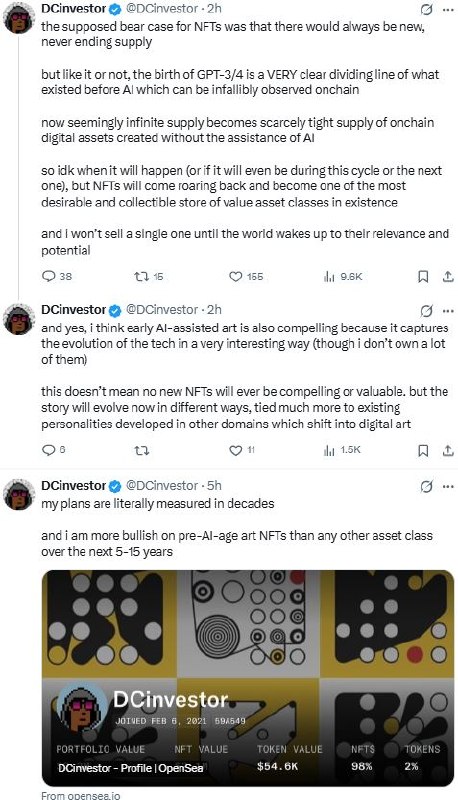
DCinvestor says pre-AI art NFTs will outperform other assets over the next 5-15 years
How NFTs Turn Digital Works into Collectible Assets
Non-fungible tokens are the main mechanism by which crypto art becomes a tradable asset rather than a mere digital file. The core idea is straightforward: a blockchain ledger assigns a unique identifier to each token and tracks which wallet controls it over time. Because this ledger is publicly verifiable and resistant to tampering, it can serve as a canonical record of who owns which edition of a work. This transforms digital art into something that collectors can buy, sell, and pledge as collateral using the same infrastructure that handles other crypto assets.
Under the hood, most art NFTs conform to token standards, such as ERC-721 or ERC-1155 on Ethereum, or equivalent standards on other chains. These standards define how tokens can be transferred, queried, and interacted with by wallets and marketplaces. When an artist “mints” a piece, they invoke a smart contract that issues a new token to their address and links it to metadata describing the work, often including a URI pointing to the media file itself. The minting transaction is recorded onchain, creating a timestamped record of the token’s creation. Collectors can then purchase the token, either directly from the artist or via a marketplace, with each transaction extending the provenance chain.
In many cases, the media file is stored off-chain, on services like IPFS or Arweave, with the token referencing its location. Some artists choose to store the entire artwork’s code and outputs directly onchain, ensuring that the piece can be reconstructed purely from blockchain data but at the cost of higher gas fees and greater technical constraints. The decision between onchain and off-chain storage has both aesthetic and conservation implications: an onchain generative script is virtually inseparable from the chain that hosts it, whereas an off-chain video may remain accessible even if the original NFT marketplace disappears, as long as the storage network persists.
The Mechanics of Non-Fungible Tokens
The term “non-fungible” simply means that each token is unique and not directly interchangeable with others. Where one ETH is functionally identical to any other ETH, one token representing a particular artwork is not substitutable for one representing another, even if they are priced similarly. This makes NFTs well-suited for art, where the market is built around distinctions between individual works or editions rather than homogeneous units.
From a user’s perspective, buying an NFT art piece is conceptually similar to buying any other crypto asset. A collector connects a wallet, approves a transaction, and pays a specified amount of cryptocurrency plus gas fees for processing. Once confirmed, the token is transferred to their address, and most platforms will update their interface to show that the artwork is now “owned” by that wallet. Underneath, the smart contract records the transfer, and any future moves will append new entries to this ledger.
One important nuance is that ownership of the NFT does not automatically confer full intellectual property rights over the underlying art. In most cases, the artist retains copyright and grants the token holder certain rights, such as display, resale, or limited commercial use, through separate license terms. These terms might be embedded in the metadata, linked from the platform’s listing page, or simply implied by the norms of the community. For sophisticated collectors, understanding the precise scope of these rights is as important as evaluating the aesthetics or provenance.
Another key mechanism is programmable royalties. Many NFT contracts include logic that allocates a percentage of each secondary sale back to the original creator. For example, an artist might set a 10% royalty, so that if a piece initially sells for \$10 and later resells for \$1,000, the artist automatically receives \$100 from that resale. This model contrasts with traditional art markets, where artists typically earn only from the initial sale, leaving them disconnected from the upside of later price appreciation. The promise of ongoing royalties has been a major driver of NFT adoption among digital artists, although enforcement has become increasingly contested as some marketplaces try to circumvent royalty mechanisms to attract low-fee trading.
Marketplaces, Galleries, and Launch Formats
NFT art markets consist of a patchwork of platforms, each with its own curation standards, contract architectures, and community cultures. On the high end, curated venues position themselves as digital analogues of blue-chip galleries. SuperRare, for instance, has operated since 2018 as a “premier digital art gallery and auction house,” focusing on original, single-edition works by vetted artists and emphasizing provenance and exhibition histories. The platform offers timed auctions, reserve-price mechanics, and editorial programming, framing NFTs not as speculative chips but as entries in a digital art canon.
Other platforms opt for a more open model, allowing nearly anyone to mint and list works. This approach lowers barriers but also floods the market with material of varying quality, making discovery a challenge. Some open platforms have struggled to find sustainable business models. Foundation, once a visible Ethereum NFT marketplace, announced it was shutting down permanently after a failed acquisition by digital art display company BlackDove. The closure underscores the platform risk inherent in relying on centralized services, even in ostensibly decentralized ecosystems. While tokens and media may persist, social graphs, auction histories, and interface-specific features can vanish.
On Tezos, a different ecosystem of art platforms and community-driven initiatives has grown around the chain’s low transaction costs and energy-efficient consensus. The “Art on Tezos” community collaborates with institutions such as HEK Basel and the Tezos Foundation to stage exhibitions and screenings that pair onchain editions with physical and virtual displays. Projects like Quayola’s En plein air and programs like Open Worlds: An Afternoon of Digital Art Encounters in Lisbon illustrate how Tezos-based art can inhabit outdoor spaces, festival screens, and museum walls while remaining anchored in a shared infrastructure of smart contracts.
The launch formats on these platforms vary widely. Some artists favor “one-of-one” works sold via auction or fixed price; others issue small editions to make pieces more accessible. SuperRare’s introduction of Liquid Editions adds another dimension: here, editions are not discrete ERC-721 tokens but ERC-20 artwork tokens with a fixed supply and dynamic pricing mechanisms. The “Value Discovery” Liquid Edition, for example, is described as a dynamic, interconnected piece of digital art whose behavior is linked to how collectors trade the underlying tokens. This effectively turns editions into miniature markets, inviting collectors to participate in the work not just by holding a single token but by contributing to its liquidity and distribution.
Launch Strategies: Drops, Editions, and Systems
For artists entering crypto markets, launch strategy is as much an artistic decision as a commercial one. A “drop” might consist of a single iconic piece, a series of related works, or an ongoing stream of generative outputs tied to an algorithm. Decisions about edition size, pricing, reserve thresholds, and auction timing all shape how collectors perceive scarcity and value. Limited editions can create a sense of exclusivity, while open editions—where minting is allowed for a fixed time window—emphasize participation and community.
System-based formats like Liquid Editions push this further by embedding market behavior into the work’s concept. Because these ERC-20 artworks use dynamic market mechanics and can respond to onchain activity such as buying or selling, the line between the artwork and the marketplace begins to blur. Artists can design pieces that change visually as liquidity crosses certain thresholds, or that unlock new layers when held by particular wallets or DAOs. From a collector’s standpoint, acquiring such works is closer to joining a protocol than to buying a static object.
Choosing a launch format also entails navigating the realities of gas fees and transaction congestion. When minting on networks where demand spikes, artists may pay significant gas to deploy contracts and issue tokens. Some respond by batching mints or using L2 solutions; others gravitate toward chains like Tezos or Avalanche, where fees are typically lower and more predictable. These technical constraints influence aesthetic decisions: an artist experimenting with real-time generative scripts might prefer a network with fast finality, while someone issuing a small number of large video files may prioritize storage options over transaction speed.
The integration of fiat on-ramps further complicates launch design. Many newer platforms now allow artists to list works in stablecoins like USDC, while enabling collectors to pay via debit cards or Apple Pay/Google Pay at checkout. Under the hood, the payment processor acquires the requisite crypto and executes the onchain transaction, but from the user’s perspective the experience resembles a familiar e-commerce flow. For creators, this broadens the potential collector base beyond crypto-native users and makes launch planning more akin to a global product release than a niche token drop.
Royalties, Secondary Markets, and Creator Economies
One of the most cited benefits of NFTs for artists is the possibility of ongoing royalties on secondary sales. Smart contracts can be written so that a specified percentage of each resale is automatically sent to the creator’s address. In theory, this aligns incentives: artists benefit when collectors successfully place works and grow their markets, and collectors can promote artists knowing that future success supports continued production. The example often given is a piece that sells for a modest sum early in an artist’s career and later commands a high price; under traditional systems, the artist would see none of that upside, whereas with NFT royalties they receive a share each time ownership changes.
In practice, royalty enforcement depends on marketplace behavior. Some platforms honor onchain royalty instructions; others treat royalties as optional tips or ignore them entirely to attract high-volume traders seeking lower fees. The resulting “royalty wars” have led to fragmented standards, with some artists migrating to chains or platforms that take a harder line on enforcement. Experiments with protocol-level royalty enforcement, where contracts restrict transfers unless a royalty is paid, trade off liquidity against creator compensation.
Secondary markets also extend beyond standard NFT venues. Community-specific marketplaces, such as the Bored Ape Yacht Club’s peer-to-peer platform for apparel, collectibles, art, and “weird one-offs from the Club,” allow holders to buy and sell items using ecosystem tokens like APE on dedicated networks such as ApeChain. These custom markets can incorporate club-specific logic, including gated access, reputation systems, or bundled sales, blurring the distinction between art, merchandise, and membership assets.
As creator economies mature, artists are experimenting with novel revenue structures. Some issue governance tokens that allow collectors to vote on future series or exhibition decisions. Others share a portion of their royalties with early supporters or with DAOs that fund new commissions. The availability of granular onchain data, including volume, holder concentration, and price history, enables creators and collectors to analyze their markets in near real time. However, this same transparency can compress attention cycles, with markets rapidly rewarding or punishing perceived momentum, making it critical for artists to build resilient communities rather than relying solely on speculative flows.
Leviathan readers click 'art' stories at both extremes — institutional legitimacy (MoMA tokenizing its permanent collection) and satirical exposure (Enron's 'performance art' memecoin, LIBRA as the 'art of the rug pull') — revealing the real pull is whether 'art' framing in crypto signals genuine cultural capital or elaborate cover for a dump.
Chains, Platforms, and Communities: Where Crypto Art Lives
Although Ethereum remains the most visible home for NFT art, the broader crypto art ecosystem spans multiple blockchains and layers, each with distinctive trade-offs. Factors such as transaction cost, energy profile, developer tooling, and community culture all shape how art practices evolve on a given network. For a crypto-literate audience, evaluating these dimensions is as important as evaluating aesthetics, since they influence both the experience of collecting and the long-term resilience of works.
Art platforms increasingly position themselves not just as marketplaces but as cultural ecosystems tied to particular chains. On Ethereum, projects like SuperRare, Art Blocks, and a wide range of independent contracts showcase the possibilities of complex smart contracts and deep liquidity. On Tezos, a tightly knit scene emphasizes experimentation, affordability, and institutional partnerships. On Avalanche and other EVM-compatible chains, art intersects with gaming, DeFi, and AI infrastructure, reflecting more hybrid use cases. Each environment defines different norms around curation, pricing, and community governance.
For artists and collectors, these differences translate into practical choices. A creator may find that their work and audience align more naturally with a Tezos-based festival program that prioritizes low-cost experimentation, or with an Ethereum-based curated platform that targets high net-worth collectors. A collector may choose to focus on onchain generative art that lives entirely in Ethereum smart contracts, or on multimedia works backed by Tezos exhibitions in physical institutions. Understanding these ecosystems helps participants navigate opportunities and risks.
Ethereum and the Rise of the NFT Art Market
Ethereum’s programmable smart contracts provided the foundation on which the modern NFT art market was built. Early experiments with tokenized art leveraged standards like ERC-721 to encode unique digital collectibles, paving the way for more artist-driven platforms. As tooling matured, artists gained access to minting interfaces that abstracted away low-level contract code, while collectors could use familiar wallets to participate in auctions or fixed-price sales. The combination of a large developer base, deep liquidity, and composable DeFi infrastructure made Ethereum a natural hub for art as an asset.
SuperRare is emblematic of this trajectory. Launched in 2018, it has positioned itself as a “premier digital art gallery and auction house” that elevates digital art into cultural history. The platform vets artists, curates exhibitions, and offers features like reserve auctions to create scarcity and narrative around individual works. Smart contracts handle the issuance and transfer of tokens, while the platform layer surfaces editorial content and social features that contextualize pieces. For collectors, this environment approximates the experience of working with a traditional gallery but with the added transparency and programmability of onchain assets.
Ethereum’s success has also brought challenges. Transaction fees can be volatile, making minting or collecting prohibitively expensive at peak times. This has driven some artists to explore L2 networks and sidechains that offer lower costs and faster confirmations while maintaining ties to Ethereum’s security model. It has also led to the segmentation of markets: high-value, low-volume works may remain on mainnet, while edition-heavy or experimental series migrate to more cost-effective layers. The complexity of bridging assets between these layers can itself become a subject for artistic exploration, as creators turn the flows of tokens and data into generative material.
Despite the emergence of alternatives, Ethereum’s role as a reference point persists. Many cross-chain platforms settle high-value transactions or escrow contracts on Ethereum, even if content distribution or community engagement occurs elsewhere. This makes Ethereum’s cultural conventions—such as the emphasis on provenance, OG status, and contract-level innovation—highly influential across the broader crypto art field.
Tezos: An Energy-Efficient Art Ecosystem
Tezos occupies a distinct position in the crypto art landscape, particularly for artists and institutions concerned with environmental impacts and accessibility. Operating on a proof-of-stake consensus model, Tezos’s energy consumption per transaction is significantly lower than proof-of-work chains, a characteristic that has been highlighted in debates over NFTs’ environmental footprint. Low transaction costs make it viable to mint and collect works at lower price points, encouraging experimentation outside blue-chip markets.
The “Art on Tezos” ecosystem illustrates how technical features can support a vibrant cultural scene. Partnerships between the Tezos Foundation and institutions like HEK Basel have resulted in ongoing programs that bridge onchain art with physical exhibitions. Quayola’s En plein air installation, presented during Art Basel week as an outdoor exhibition, exemplifies this synthesis of digital landscapes, large-scale public display, and tokenized editions. Visitors encounter the work in situ, while collectors participate via blockchain-backed releases tied to the same project.
Beyond Basel, Tezos art initiatives have extended to festivals, open calls, and museum collaborations. Programs such as “Open Worlds: An Afternoon of Digital Art Encounters” in Lisbon showcase curated selections of works on large LED screens, often with dedicated minting opportunities for participating artists. The Museum of the Moving Image’s “TO BE PERCEIVED, AGAINST EVIL” commission on the Schlosser Media Wall likewise foregrounds blockchain as a creative material, with a process image of the work available for collection. These initiatives position Tezos not just as a ledger but as a networked exhibition space, where the same piece can traverse physical, virtual, and onchain contexts.
For many artists, Tezos’s community culture is as important as its technical profile. The ecosystem has attracted a mix of emerging and established creators drawn by its emphasis on experimentation and the relative ease of onboarding. The absence of high gas fees reduces the pressure to treat every mint as a major financial event, allowing for iterative practices and micro-editions. Collectors, in turn, can build broad-based collections without the capital intensity required on some Ethereum platforms. The result is an environment where art can function both as a speculative asset and as a medium of everyday expression.
Onchain Art Beyond Ethereum and Tezos
While Ethereum and Tezos are prominent anchors, the geography of crypto art extends across many networks. Avalanche, for instance, has positioned itself as a high-throughput, low-latency platform where institutional payments, gaming, onchain art, and AI infrastructure coexist. Ecosystem reports highlight how onchain art fits into a broader strategy of supporting diverse use cases, from DeFi to entertainment, with subnets and specialized chains catering to particular communities. For artists, this can mean opportunities to integrate their work into games, metaverse environments, or AI-driven experiences that live entirely on Avalanche-based infrastructure.
Other chains and infrastructure projects aim to solve specific bottlenecks in the art stack. Payment-focused initiatives like x402, backed by payment networks, cloud platforms, developer tools, and crypto-native teams, are building “the next payment layer for the internet,” which can support collaborative art experiences and seamless purchase flows. By abstracting away wallet complexity and integrating traditional payment rails, such systems lower friction for both creators and collectors, especially in contexts where art is part of broader interactive or educational programs.
Layered architectures further complicate the picture. Some artists deploy contracts on L2 networks anchored to Ethereum for security but tailored for high-volume minting or interactive onchain logic. Others use sidechains associated with specific communities, such as club-branded chains for PFP projects, where art, merchandise, and membership assets share liquidity and governance. The Bored Ape Yacht Club’s peer-to-peer marketplace on ApeChain, where users buy and sell apparel, collectibles, and art using the APE token, reflects this trend toward vertically integrated ecosystems that blend art with lifestyle branding.
For collectors, the proliferation of chains raises questions about interoperability, provenance tracking across networks, and the practicalities of managing multi-chain portfolios. Cross-chain bridges, custodial services, and indexers play increasingly important roles in presenting a unified view of an art collection that may, under the hood, be scattered across heterogeneous ledger technologies. Over time, standards for cross-chain provenance and metadata portability are likely to become as critical as token standards themselves.
Curators, Institutions, and Festivals
One of the clearest signs that digital and crypto art have moved beyond niche status is the degree of engagement from established cultural institutions. Art Basel has devoted significant editorial coverage to the transformation of the NFT and digital art markets, analyzing how art-related NFT sales have evolved and how collectors’ tastes are shifting as the broader crypto market rallies and matures. Its reporting highlights that while sales of art-related NFTs in early 2024 were slightly down versus the same period in 2023, digital art more broadly has gained ground in collections and spending priorities.
Museums and media arts centers are increasingly treating blockchain-based practices as a legitimate field of inquiry. HEK Basel’s multi-year partnership with the Tezos Foundation, encompassing outdoor installations, screenings, and online exhibitions, positions blockchain not as a gimmick but as a platform for sustained artistic engagement. The Museum of the Moving Image’s commissions, including works like TO BE PERCEIVED, AGAINST EVIL that explore perception, evil, and digital mediation through the lens of blockchain, similarly demonstrate institutional willingness to commission and display onchain-inflected art.
Festivals and conferences play a complementary role, acting as launchpads for new works and contexts where crypto art intersects with broader cultural and technological debates. Events like NFC Lisbon, which feature curated screening programs under themes such as “Cycles” on large LED screens, offer artists exposure to live audiences while connecting them to onchain communities. Web3-focused summits and gatherings often integrate art installations, NFT galleries, and AI-driven experiences into their programs, underscoring art’s role in making abstract technical concepts tangible.
These developments feed back into collector behavior. According to Art Basel and UBS’s collector survey, digital art has become the third-highest category by spending among high-net-worth respondents, with over half purchasing a digital artwork in recent years. Institutional validation, combined with more sophisticated curation and criticism, helps differentiate long-term artistic value from short-lived speculative cycles. For a crypto news audience, tracking how festivals, museums, and biennials integrate onchain work provides a useful barometer of where the field is headed.
AI, Generative Systems, and the Boundaries of Authorship
AI and generative systems occupy a central, and contested, place in contemporary crypto art. Generative art, in which artists write algorithms that produce visual or sonic outputs, predates blockchain by decades. What is new is the confluence of onchain deployment, tokenized ownership, and large-scale generative AI models trained on vast datasets. This combination raises questions about authorship, originality, and ethical training practices, and it forces platforms and communities to articulate where they draw the line between acceptable assistance and unacceptable substitution.
From an artistic standpoint, there is continuity between code-based generative art and some uses of AI. Artists who deploy algorithms onchain, for instance through generative NFT collections or programmable art systems, treat code as a primary medium. SuperRare’s Liquid Editions explicitly frames digital artists as working with systems—“time, code, networks, participation, memory, and change”—and offers a native collecting format for such system-based works. In this view, the artwork is not just a static image but an evolving relationship between parameters, collectors, and network conditions.
Generative AI introduces a different paradigm, allowing artists (and non-artists) to produce complex imagery, audio, or text from natural-language prompts. When combined with NFTs, this enables vast production at low marginal cost, raising fears of market saturation and diminishing the premium on human craft. It also triggers debates about whether outputs generated by models trained on copyrighted material can themselves be considered original, or whether monetizing such outputs perpetuates unlicensed appropriation.
From Algorithmic Art to Generative AI
Historically, generative art has been grounded in explicit coding: artists define rules, randomness, and structure, then allow algorithms to execute and produce results within certain constraints. In the NFT context, this practice found a natural fit on programmable blockchains, where artists could deploy their generative scripts directly into smart contracts, ensuring that each token minted corresponds to a unique execution of the shared algorithm. Collectors value both the individual outputs and the elegance or conceptual rigor of the underlying code.
Liquid Editions sits within this lineage by treating ERC-20 tokens themselves as part of a generative system. A Liquid Edition artwork can change in response to onchain activity, such as buying, selling, or holding patterns, making the market a co-author of the piece. The artist defines how the system responds—perhaps adjusting color palettes based on holder diversity or revealing new layers as certain volume thresholds are reached—while collectors collectively determine which states are realized through their behavior. In such works, authorship is distributed across artist, code, and community.
Generative AI operates differently. Instead of writing bespoke algorithms, creators interact with pre-trained models through prompts and parameter adjustments. The model’s internal representations of style and content, learned from large corpora, play a major role in determining outputs. When these outputs are tokenized as NFTs, questions arise: is the artist the prompting human, the model developer, the rights holders of the training data, or some combination? How should credit and compensation be allocated? These issues are still unresolved in many jurisdictions, and different NFT platforms have adopted divergent policies.
Platform Policies and Market Preferences
Some platforms and ecosystems have responded to AI-generated art by imposing clear boundaries. Panic, the company behind the handheld Playdate game console, announced that its official Playdate Catalog would “no longer accept titles that use ‘Generative AI’ for art, audio, music, text, or dialog,” while allowing developers to use AI assistance for coding with proper disclosure. The policy explicitly bans the use of large language models like ChatGPT or Google Gemini, image generators such as Stable Diffusion, and audio generators like MuseNet and Suno in content submitted to the Catalog. Previously approved games that incorporated generative AI are allowed to remain but must include a disclosure specifying how AI was used.
While Playdate is a gaming platform rather than an NFT gallery, its stance reflects a broader discomfort with opaque AI-generated content in creative ecosystems. Some NFT platforms have similarly introduced tagging requirements for AI art, or created separate categories so that collectors can choose to support or avoid AI-heavy works. Others embrace AI art as a natural extension of digital practice, focusing instead on the quality and distinctiveness of the outputs rather than the tools used.
Market preferences are still evolving. Certain collectors actively seek human-made or code-native generative art that can be audited and run locally, viewing these works as more durable and conceptually rigorous. Others are drawn to the rapid innovation and novel aesthetics made possible by AI tools, particularly when combined with onchain interactivity. For institutions, the key concerns often center on transparency, provenance, and rights: they want to know how a work was made, what datasets were involved, and whether displaying or collecting it exposes them to ethical or legal challenges.
Ownership, Copyright, and Training Data
Legal frameworks around AI-generated art remain in flux, with significant implications for NFT markets. In some jurisdictions, authorities have suggested that works created entirely by non-human processes may not qualify for copyright protection. If a purely AI-generated image has no human author in the eyes of the law, then tokenizing it as an NFT does not automatically create enforceable IP rights; the tokenized asset may be more akin to a claim over a unique instance of an unprotected work. This uncertainty complicates licensing, enforcement, and valuation.
A related issue concerns the training data used to build generative models. Many models have been trained on large datasets scraped from the internet, which likely include copyrighted artworks used without explicit permission. Critics argue that monetizing outputs derived from such models amounts to unlicensed exploitation of artists’ labor. Supporters counter that training is akin to human learning and that outputs are transformative. Regardless of where one stands, the potential for litigation affects how collectors and platforms assess the risk of buying or hosting AI-generated NFTs.
For crypto art, these questions intersect with the permanence of onchain records. Once an AI-generated piece is minted and traded, its provenance is immutable; if later found to infringe on someone's rights, remediation may require blacklisting contracts, removing marketplace listings, or relying on social consensus to devalue the token. Platforms that enforce disclosure, like Playdate’s requirement to specify the extent of AI use for coding assistance, may offer a template for NFT venues seeking to balance innovation with accountability.
AI as Collaborative Medium
Despite these challenges, many artists view AI not as a threat but as a collaborator. They use models as sketch generators, texture creators, or narrative engines, then refine outputs through human editing, curation, and onchain integration. Collaborative projects, such as those supported by initiatives like the AI OPC collaborative learning camps and payment infrastructures like x402, explore how groups of humans and AI systems can co-create large-scale artworks or data-driven installations. In these contexts, AI is one tool among many, situated within a broader practice that includes code, performance, and community engagement.
On chains like Avalanche, where ecosystem reports highlight the presence of both onchain art and AI infrastructure, artists can directly tie AI models to smart contracts, creating pieces that update in response to live inputs or that allow collectors to influence generative parameters through token holdings. Such works move beyond the static prompt-output model of early AI art into more genuinely interactive systems. From a collector’s perspective, owning a token may confer not only display rights but also some degree of control over an evolving AI-driven process.
As these practices mature, the boundary between “AI art” and “non-AI art” is likely to become less meaningful than the distinction between transparent, ethically grounded workflows and opaque, minimally authored output. For crypto art specifically, where transparency and verifiability are baked into the technical substrate, there is an opportunity to encode AI-related provenance—such as training data sources, model versions, and human intervention steps—into metadata. Doing so could make AI-inflected works more legible and trustworthy to collectors, curators, and regulators alike.
- 01Meme coins as performance art cover
Enron and LIBRA launchers both used artistic or theatrical framing to deflect scrutiny, and readers clicked hard on the irony of 'performance art' as rug-pull camouflage.
- 02Museum institutional NFT adoption↗
MoMA adding tokenized works to its permanent collection signals mainstream legitimacy, a milestone readers hungry for institutional validation found compelling.
- 03NFT market crash and platform revival↗
A 93% volume collapse to $197M in 2024 set the context, making fxHash 2.0's Ethereum launch and bonding-curve graduation mechanics feel like a genuine revival bet.
- 04MiCA regulatory threat to MEV
The warning that MiCA Article 92 could classify MEV extraction as market manipulation alarmed DeFi participants who had not expected trading mechanics to face criminal-law scrutiny.
- 05Celebrity art-world spectacle and mockery
Justin Sun eating a $6M Maurizio Cattelan banana and Eric Trump's public mockery of the lawsuit turned the story into appointment entertainment that crossed crypto and mainstream art audiences.
- 06AI-generated art legitimacy and platform bans↗
Panic banning generative AI art from its Catalog storefront — while allowing AI coding tools — crystallised the emerging split between AI as creative output versus AI as development aid.
Markets, Auctions, and New Ways to Price Art
Crypto has not only created new kinds of art objects; it has also introduced new mechanisms for pricing and speculation. NFTs make it possible to trade unique digital assets using the same infrastructure as fungible tokens, while DeFi primitives enable collateralization, fractionalization, and automated market-making for art. At the same time, traditional auction houses and financial platforms are experimenting with ways to integrate art and crypto markets, from accepting cryptocurrency bids to launching prediction markets tied to auction outcomes.
Understanding these market innovations requires looking beyond headline-grabbing sales to the underlying mechanisms. Primary sales, secondary trading, liquidity pools, and derivative instruments all play roles in how value is discovered and redistributed. For artists and collectors, the challenge is to navigate this complexity without losing sight of the intrinsic motivations that drive art creation and collecting in the first place.
Primary Sales, Auctions, and Floor Prices
Primary sales remain the main avenue through which revenue flows directly to artists. These can take the form of fixed-price listings, Dutch auctions where prices descend over time until purchased, or reserve auctions where bidding begins once a minimum threshold is met. Platforms like SuperRare provide structured auction formats tailored to one-of-one digital artworks, allowing artists to set reserve prices and time limits that balance price discovery with scarcity and urgency. Smart contracts handle bid escrow and settlement, reducing counterparty risk and ensuring transparent outcomes.
Secondary markets introduce different dynamics. On open marketplaces, NFTs tied to particular collections or artists develop “floor prices”—the lowest price at which any token in the set is listed. Floor prices serve as shorthand for market sentiment, with rising floors often interpreted as signs of momentum. However, thin liquidity and wash trading can distort these signals, making it important for participants to analyze volume, bid-ask spreads, and holder distribution rather than relying solely on headline figures.
Art NFTs occupy a spectrum between purely aesthetic objects and quasi-financial instruments. Some collectors approach them with the same mindset as traditional art patrons, focusing on the work’s cultural significance, the artist’s trajectory, and curatorial reception. Others treat NFTs as speculative assets, flipping works rapidly to capture short-term gains. The coexistence of these mindsets creates volatility: markets can swing from exuberance to retrenchment as macro crypto conditions and narrative cycles shift.
Art NFTs as an Asset Class
Data-driven analyses suggest that digital and NFT art have found a durable, if volatile, place in collectors’ portfolios. Art Basel’s reporting on the NFT market notes that sales of art-related NFTs from January to June 2024 were slightly lower than in the same period of 2023, despite a broader rally in crypto asset prices. This decoupling indicates a maturation process, where art markets are no longer simply riding the coattails of token bull cycles but are subject to their own supply-demand dynamics and curatorial filters.
At the same time, digital art as a whole has advanced in collector priority. The Art Basel and UBS Survey of Global Collecting 2025 found that digital art ranked third in total spending among 3,100 high-net-worth respondents, behind only painting and sculpture. More than half of these collectors reported purchasing at least one digital artwork in 2024 or 2025, and the share of digital works in their collections rose from 3% in 2024 to 13% in 2025. These figures encompass both tokenized and non-tokenized digital art, but they underscore a growing comfort with intangible, screen-based works as serious collection targets.
From a portfolio perspective, art NFTs introduce unique characteristics. They are illiquid compared with major fungible tokens, often with sparse order books and long holding periods between trades. Valuations can be highly idiosyncratic, hinging on artist reputation, narrative, and curatorial endorsement rather than purely on metrics like cash flows or utility. For some collectors, this idiosyncrasy is a feature rather than a bug, offering diversification and exposure to cultural capital. For others, it poses risk and requires careful selection.
Prediction Markets and Art Auctions
One of the more novel developments at the intersection of art and crypto markets is the emergence of regulated prediction markets tied to traditional art auctions. The platform Kalshi, a CFTC-regulated prediction market in the United States, has launched contracts that allow users to trade on the outcomes of art auctions at major houses such as Christie’s, Sotheby’s, and Phillips. In this setup, users buy “yes” or “no” shares linked to specific event outcomes, such as whether a Jackson Pollock painting will sell for more than \$100 million. Prices for these shares fluctuate based on supply and demand, effectively representing the crowd’s probability estimate that the event will occur.
Kalshi’s expansion into art auctions includes markets not only for individual lots but also for aggregate sales volumes at particular events. For example, users can trade on whether total sales at a given Sotheby’s contemporary art evening sale will exceed a preset threshold. These instruments allow speculators and art market observers to hedge or express views on auction performance without directly buying or selling the artworks themselves. They also generate real-time, market-based estimates of expected outcomes, which can be compared with pre-sale estimates from auction houses.
The introduction of such markets has prompted regulatory and ethical scrutiny. Critics worry that turning art auctions into bettable events could incentivize manipulative behavior or erode the perceived dignity of the art market. Supporters argue that prediction markets aggregate dispersed information and improve price discovery. For crypto art participants, these developments are a reminder that financialization is not unique to NFTs; even traditional art markets are being reimagined through probabilistic, tradable claims.
Payments, Stablecoins, and Fiat On-Ramps
Payment infrastructure is a crucial, if often overlooked, part of the crypto art experience. Early NFT markets required collectors to hold specific cryptocurrencies and pay gas costs directly, creating steep learning curves for newcomers. Over time, platforms have integrated stablecoins such as USDC as pricing and settlement media, making it easier to denominate art in units that approximate fiat currency. This stabilizes price references and simplifies accounting for both creators and collectors.
More recently, many marketplaces have introduced direct fiat on-ramps, allowing users to pay for NFTs using debit or credit cards, Apple Pay, or Google Pay, while settling transactions onchain. Artists can list works in USDC, and at checkout collectors choose whether to pay with crypto or with traditional payment methods, with the platform handling conversion and delivery. This model brings crypto-native art into alignment with broader e-commerce norms, reducing friction for mainstream buyers who may be comfortable with digital goods but not yet with wallets and gas fees.
Projects like x402, which aims to serve as a next-generation payment layer backed by payment networks, cloud platforms, developer infrastructure, and crypto-native teams, illustrate how payment and art infrastructures are converging. By offering “human-proof” extensions and collaborative tools, such systems can support multi-user art experiences where payments, access control, and creative contributions are all handled through a unified onchain back end. For artists, this enables new business models based on subscriptions, microtransactions, or pay-per-interaction engagements.
Stablecoins also play a role in cross-border patronage. Collectors can support artists regardless of geography without navigating traditional banking constraints, while artists can price work in stable units insulated from the volatility of native chain tokens. However, this convenience comes with its own dependencies on centralized issuers, KYC processes, and regulatory frameworks, which can shape who participates and under what conditions.
Platform Risk and Market Cycles
As with any digital platform-dependent field, crypto art is subject to platform risk. The shutdown of Foundation, an Ethereum-based NFT marketplace, after a failed acquisition deal with digital art display company BlackDove, is a case in point. While the underlying NFTs and media files remain onchain or in decentralized storage, the loss of the platform means loss of its interface, community features, and specific market mechanisms. Artists who relied on Foundation’s branding and traffic must adapt, while collectors may find it harder to resell works or access contextual information such as original descriptions or exhibition histories.
Platform consolidation and churn are likely to continue as markets mature. Some platforms will succeed in building sustainable fee models, curatorial identities, and community loyalty; others will merge, pivot, or disappear. Community-run or protocol-native marketplaces, such as BAYC’s peer-to-peer market on ApeChain, represent one response to this volatility. By controlling their own trading venues, communities can reduce dependence on third-party platforms and tailor features to their specific needs, whether that involves bundling merch with art, gating access by token ownership, or integrating DAO governance.
Market cycles amplify these structural risks. Bull phases can attract speculative capital, driving rapid expansion in platform count and trading volume but also encouraging unsustainable practices. Bear phases expose weak models and force projects to prove long-term value. Throughout these cycles, the underlying technologies—blockchains, token standards, storage systems—tend to persist, while surface-level platforms come and go. For participants, the challenge is to distinguish between the enduring “rails” on which art can travel and the transient venues through which it is momentarily displayed or traded.
Environmental and Ethical Questions Around Crypto Art
The environmental impact of crypto has become one of the most visible critiques of NFT art, especially during periods when energy-intensive proof-of-work networks dominate. NFTs contribute to greenhouse gas emissions and climate change through the energy used by the blockchains on which they are created, exchanged, and stored. This impact varies widely depending on the consensus mechanism and network design, but for many audiences the association between NFTs and carbon-intensive mining remains a concern.
At the same time, digital and crypto art complicate traditional assumptions about environmental footprint. Physical art production involves materials, shipping, climate-controlled storage, and travel for exhibitions, all of which carry emissions. Digital art replaces some of these with data center use and device energy consumption while introducing new blockchain-related costs. Ethical discussions must therefore weigh not only the marginal energy of a given NFT transaction but also the broader system in which art is produced, circulated, and consumed.
Energy Use, Proof-of-Stake, and Green Narratives
Blockchains differ dramatically in their energy profiles. Under proof-of-work, miners compete to solve computationally intensive puzzles, consuming significant electricity as they secure the network. Under proof-of-stake and related consensus mechanisms, validators are chosen based on staked assets rather than computational work, drastically reducing energy requirements per transaction. As a result, NFTs on proof-of-stake networks like Tezos have a much smaller environmental footprint than similar activities on proof-of-work chains.
Investopedia’s overview of NFTs and the environment emphasizes that, regardless of mechanism, blockchains do use energy, and that NFTs contribute to emissions through their production and exchange. However, it also notes that shifts to more energy-efficient consensus models, along with initiatives to offset emissions or use renewable energy sources, can mitigate impact. Many art-centric chains and platforms have highlighted their environmental credentials, positioning themselves as “green” alternatives. Tezos’s proof-of-stake design has been a key selling point in attracting artists and institutions sensitive to environmental critiques.
For a crypto art audience, the nuance lies in understanding both absolute and relative impacts. A single NFT mint on a proof-of-stake chain may have negligible marginal energy cost, but a high-volume mintfest or a generative drop with thousands of pieces still carries cumulative usage. At the same time, replacing physical shipping of limited editions with digital distribution may produce net reductions. Evaluating these trade-offs requires transparent data and careful lifecycle analysis rather than simplistic narratives.
Cultural Capital, Speculation, and Access
Ethical debates around crypto art extend beyond energy use to questions of cultural capital, speculation, and access. Critics argue that NFTs primarily serve speculative interests, turning art into chips in a casino-like market where prices bear little relation to aesthetic or cultural value. Proponents counter that art markets have always involved speculation and that NFTs open doors for creators historically excluded from institutional gatekeeping.
In practice, crypto art markets contain both exclusionary and democratizing tendencies. On one hand, iconic collections and blue-chip artists can achieve price levels that put their work out of reach for everyday collectors, replicating the stratification of traditional art markets. On the other hand, the ability to issue editions, fractionalize ownership, or create system-based works like Liquid Editions allows artists to engage many more participants at lower individual entry prices. Community-driven experiments with patronage DAOs, shared vaults, and social tokens further diversify access paths.
Access is also shaped by technical literacy and regulatory environment. While card-based on-ramps and user-friendly custodial wallets lower barriers, they often require KYC and are limited by jurisdiction. Artists and collectors in regions with restrictive financial systems may find that peer-to-peer crypto rails provide more autonomy but also expose them to volatility and legal uncertainty. Cultural capital in crypto art thus accrues not only to those with money but also to those with network knowledge and technological fluency.
Moderation, Harassment, and Community Health
As art communities move into crypto-native platforms, they inherit the challenges of online social networks: harassment, plagiarism, hate speech, and misinformation. The pseudonymous nature of many participants can both protect vulnerable artists and enable bad actors. AI tools complicate these dynamics by lowering the cost of generating manipulative or harmful content.
Moderation in decentralized environments is not straightforward. Centralized platforms can ban users or remove listings but may face backlash for perceived censorship. Protocol-level moderation tools—such as blocklists that frontends can choose to respect or ignore—offer some flexibility but require coordination. For art communities, maintaining healthy discourse and protecting marginalized creators is as crucial as innovating in technical and market structures. The choices platforms make about AI content, royalties, and discovery algorithms all feed into the broader ethical climate of crypto art.
NFT annual trading volume hits $197M — 93% below 2021 peak
- 2025-01exploit
Enron brand relaunches as memecoin, frames dump as 'performance art'
- 2025-02exploit
LIBRA memecoin rug pull; Rekt declares it redefines 'art of the rug pull'
- 2025-03milestone
Justin Sun purchases and publicly eats Maurizio Cattelan's $6M Comedian banana
Panic bans generative AI art, music, and writing from Playdate Catalog storefront
OpenSea launches SEA token; pledges $1M reserve and 50% of platform fees into prize vault
- 2025-10launch
fxHash 2.0 launches with Ethereum/EVM support and bonding-curve graduation mechanics
MoMA acquires tokenized artworks for permanent collection, signalling institutional NFT endorsement
How Artists and Collectors Can Navigate Crypto Art
Given the complexity of technologies, markets, and cultural norms involved, entering the crypto art space can feel daunting. Yet the core principles that guide good decision-making are recognizable from both traditional art and crypto investing: clarity of purpose, due diligence, and a long-term view. Artists must balance experimentation with sustainable practices, while collectors must differentiate between short-lived hype and enduring work.
There is no single blueprint for success. Different practices and goals call for different tools, chains, and communities. What follows is not a checklist but a set of considerations that can help participants orient themselves in a rapidly evolving ecosystem.
For Artists: Finding Your Niche and Identity
For creators, the temptation to chase trends—whether PFP collections, AI prompts, or the latest generative contract type—is strong. However, sustainable trajectories tend to emerge when artists build from a clear sense of their own interests and strengths. Finding a niche and identity means identifying what you uniquely bring to the intersection of art and crypto, whether that is deep conceptual engagement with onchain systems, distinctive visual language, or long-term collaborative projects.
Workflows may involve a mix of onchain and off-chain tools. An artist might prototype pieces using traditional digital software, then translate select works into NFTs for specific platforms aligned with their audience. Participation in open calls, such as those organized by Tezos-related festivals or institutions, can provide both exposure and feedback. At the same time, building a direct relationship with collectors through social channels, newsletters, or IRL events remains crucial. Tokens can facilitate these relationships but do not replace them.
Practical considerations include understanding the costs and permanence implications of different chains, choosing marketplaces or self-deployed contracts, and deciding on edition sizes and pricing strategies. Royalties must be set with an awareness of how different platforms enforce them. Documentation—process notes, statements about AI use or training data, explanations of onchain logic—can add substantial value, especially as institutions and sophisticated collectors increasingly scrutinize provenance beyond transactional history.
For Collectors: Due Diligence and Discovery
Collectors entering crypto art markets face a firehose of information and offerings. Due diligence starts with basic checks: verifying that a work is minted from the artist’s authentic address or verified contract, confirming that media is securely stored, and understanding whether rights and royalties are clearly defined. Examining a work’s transaction history onchain can reveal patterns of wash trading or unusual activity, while community chatter can provide context about an artist’s reputation and practice.
Discovery tools range from curated platforms like SuperRare to community channels around chains like Tezos, Avalanche, and others. Physical and virtual exhibitions, such as museum programs or festival screenings, often highlight artists whose work has already passed some curatorial filter. Attending these events, whether in person or through virtual tours and talks, can help collectors develop informed tastes rather than relying solely on social media hype or floor-price movements.
Financially, collectors should treat art NFTs as illiquid, high-risk assets and size positions accordingly. Diversification across artists, mediums, and chains can mitigate idiosyncratic risk, but it cannot eliminate systemic market volatility. Understanding that some purchases may be primarily patronage, with limited resale prospects, can clarify expectations and reduce later frustration. For those interested in the more speculative side, tools such as analytics dashboards, pricing indexes, and even prediction markets tied to traditional auctions can complement—but not replace—artistic judgment.
Legal, Tax, and Security Basics
Regardless of artistic or financial goals, crypto security and compliance fundamentals are non-negotiable. Self-custody of valuable NFTs requires secure wallet practices, including hardware wallets, careful seed phrase storage, and awareness of phishing risks. Approving contract interactions only from trusted platforms and revoking unnecessary approvals can prevent token theft. For high-value collectors, multisig setups and custodial solutions may be appropriate.
On the legal and tax fronts, NFT transactions can trigger taxable events, and classification of NFTs for tax purposes may vary by jurisdiction. Consultation with professionals familiar with both crypto and art is advisable. Intellectual property considerations, especially for generative AI or collaborative works, should be addressed upfront through clear licensing and documentation. As regulators increasingly focus on crypto markets, including NFTs, practices that prioritize transparency and compliance will likely fare better over time.
Outlook
Crypto has already reshaped the art landscape, but its full impact is still unfolding. Digital art is no longer a marginal curiosity; it ranks alongside painting and sculpture in collector spending, and more than half of major collectors now include digital works in their portfolios. NFT markets have moved beyond their initial speculative frenzy into a more complex phase where curated platforms, institutional collaborations, and experimental systems like Liquid Editions coexist with meme-driven collections and DeFi-inflected trading.
Looking ahead, several vectors seem poised to define the next chapter. First, the integration of AI and generative systems will continue to challenge notions of authorship, originality, and rights, prompting platforms to refine disclosure policies and technical provenance tools. Second, cross-chain interoperability and payment infrastructures like x402 will make art experiences more seamless across networks and devices, bringing in broader audiences without requiring deep technical knowledge. Third, the expansion of prediction markets and other financial instruments around art auctions signals a deeper entanglement of art with probabilistic, data-driven finance, raising both opportunities for price discovery and concerns about over-financialization.
At the same time, environmental and ethical considerations will remain central. The adoption of energy-efficient consensus mechanisms, such as proof-of-stake, and the rise of chains like Tezos for art will help address carbon concerns, but debates over training data, cultural equity, and access will persist. For artists and collectors, thriving in this environment will mean embracing the strengths of crypto—transparency, programmability, global reach—while maintaining a critical, human-centered perspective on what art is for. If crypto’s impact truly extends beyond finance into education, art, and entertainment, then the art being made onchain today is not just another asset class; it is part of a broader redefinition of cultural infrastructure for the digital age.
Latest Art news
Sources
20 records from 13 domains
youtube.com
instagram.com
help.superrare.com
thedefiant.io
boredapeyachtclub.com
engadget.com
nansen.ai
x.com
superrare.com
news.artnet.com
x402.org
artbasel.com
investopedia.com
Community notes
Spot something off or out of date? Drop a note. Editors review topic notes daily and roll accepted fixes into the explainer — contributors are recognized in the monthly $SQUID drop.
Loading notes…
Help improve this topic
Have a story or tip about this topic? Submit it. See something missing? Leave a note. Editors review daily; accepted submissions and fixes count toward the monthly $SQUID drop.