
A corporate Bitcoin treasury holds BTC as a primary reserve asset instead of cash. This explainer covers how the model works, who pioneered it, who has copied it, and where it fails.
+16 sources across the wider coverage universe
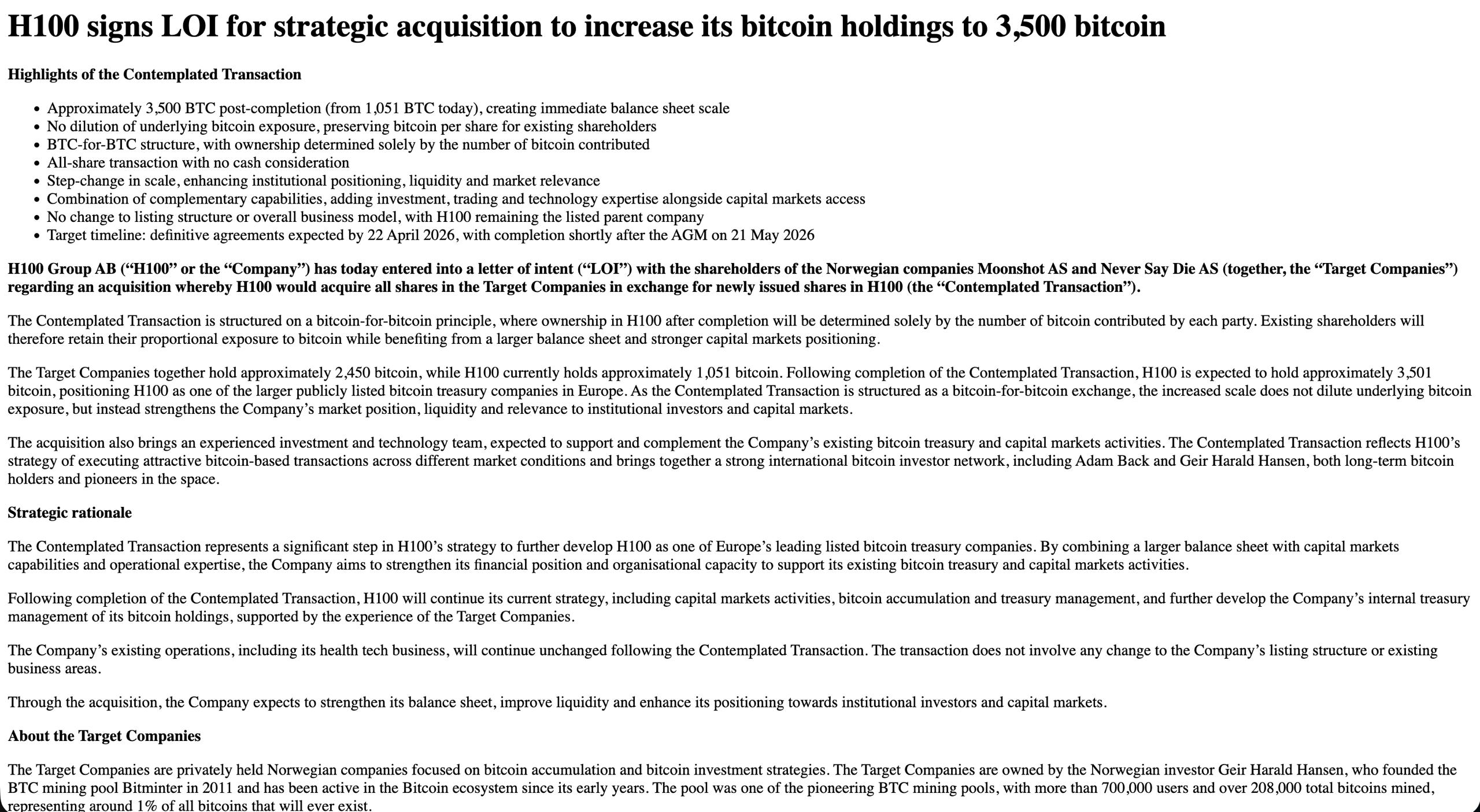 H100 Group signs LOI to acquire Norwegian bitcoin firms, tripling treasury to 3,500 BTC2026-03
 TD Cowen trims Strategy to $350, initiates buy on four Bitcoin treasury firms with $140K BTC thesis2026-04
 Bitcoin Japan plans a $60M raise with EVO Fund, allocating $4.1M for its first Bitcoin purchase despite adopting a BTC treasury strategy and still holding zero BTC2026-07
 Strategy is repurchasing $1.5B in 0% convertible notes as Michael Saylor’s bitcoin treasury giant moves to reduce debt and gradually shift toward equity financing2026-05
 Pantera Capital urges Satsuma to liquidate 646 BTC ($50M) and return cash to shareholders as DAT-linked stock collapses 99%, signaling deep crisis in bitcoin treasury strategy2026-04
 Strive buys 32 BTC at $63,911 average, raising its treasury to 19,032 bitcoin2026-06
A corporate Bitcoin treasury is cash or liquid reserves held partly or entirely in Bitcoin rather than traditional currencies or short-term government bonds, treating BTC as a primary reserve asset rather than a speculative trade.
What a Bitcoin Treasury Actually Is
When a company converts a portion of its balance sheet into Bitcoin, it is making a deliberate treasury management decision: replacing dollars, euros, or money-market instruments with a fixed-supply digital asset. The reasoning, at its most direct, is that fiat cash loses purchasing power over time while Bitcoin's 21-million-coin hard cap theoretically protects against dilution.
The mechanics matter. A treasury allocation can be funded through retained cash, equity issuances, convertible notes, or — in the case of newer entrants — purpose-built capital raises where the investment thesis is Bitcoin exposure itself. The asset is held on the company's balance sheet and marked to fair value under accounting rules updated by the Financial Accounting Standards Board (FASB) in late 2023, which now require companies to report Bitcoin at current market prices rather than impaired historical cost — a change that removed one of the main accounting disincentives to holding BTC.

Strive buys 1,355 BTC, lifting holdings to 26,355 BTC as it targets overtaking MARA and reaching second-largest treasury by year-end

How Strategy Built the Template
No company has shaped this space more than Strategy (formerly MicroStrategy), the business intelligence software firm led by executive chairman Michael Saylor. Starting in August 2020, Saylor made the case that Bitcoin was superior to cash as a treasury reserve, and began converting the company's idle cash into BTC. What began as a hedge against dollar inflation became a defining corporate identity: Strategy now holds well over 500,000 BTC, making it by far the largest public Bitcoin treasury in the world.
Strategy's method evolved over time. It issued convertible notes — debt instruments that pay low interest and convert to equity if the share price reaches a target — to raise billions for additional Bitcoin purchases. It also ran equity offerings. The implicit arbitrage was that Strategy's shares traded at a premium to its Bitcoin net asset value (NAV), meaning it could sell equity at a premium and deploy those proceeds into BTC, a process Saylor framed as "Bitcoin yield" — measuring BTC-per-diluted-share growth over time.
Saylor has also introduced a metric called CEBE BPS (Convertible Equity Backed by Enterprise Bitcoin per Share) as what he describes as a conservative risk metric for evaluating Bitcoin treasury firms, arguing traditional valuation frameworks do not capture the model's dynamics.
Strategy's approach has not been without critics. Analyst downgrades and price target reductions — TD Cowen trimmed its target to $350, for example, while initiating coverage on several smaller treasury firms — reflect ongoing debate about appropriate valuation frameworks. Samson Mow, another prominent Bitcoin advocate, has publicly warned about the risks of Strategy needing to sell Bitcoin if market conditions deteriorate and debt obligations become difficult to service.
Readers click Bitcoin treasury stories not to celebrate adoption but to stress-test the model — the highest engagement clusters around macro threats, debt-funded accumulation risk, and government rejection, revealing that the audience is actively auditing whether corporate BTC treasuries are a durable strategy or a leveraged bet dressed up as treasury management.
The Wave of Corporate Imitators
Strategy's share price performance between 2020 and 2024 prompted a wave of imitators. The logic was appealing on paper: gain Bitcoin exposure through a listed stock without holding the asset directly, potentially with leverage embedded through the convertible-note structure.
Metaplanet, a Japanese hotel-turned-investment company, became one of the most prominent examples outside the United States. The firm added 5,075 BTC in the first quarter of 2026 alone and became the third-largest public Bitcoin treasury globally. Its aggressive accumulation — the company reached over 7,300 BTC with roughly 90,000 mining machines and a 52.4% gross margin just eight months after its Nasdaq debut — made it a case study in how quickly a company can reorient around a Bitcoin treasury strategy.
By August 2026 Metaplanet was funding that accumulation from two new directions at once. On August 13 it completed the inaugural issuance of "BitBonds" — ¥200 million (about $1.3 million) in three-year notes carrying 4.0–4.3% coupons, sold through its own Metaplanet Securities subsidiary. The notes are unsecured: no Bitcoin backs them, so bondholders carry Metaplanet's credit risk rather than a claim on its treasury. Five days later the company went further, agreeing to contribute 2,100 BTC (about $132 million) for roughly 95.7% of Nasdaq-listed Super League, which will be renamed Superplanet and become its dedicated US treasury vehicle once the deal closes in the fourth quarter of 2026. "We've built one of the world's largest Bitcoin treasuries from Japan," said chief executive Simon Gerovich. "Superplanet is how we build in America, the deepest capital market in the world." Between the two moves, Metaplanet now has a debt-funded lever alongside the equity issuance that built its original position, plus a second listed vehicle raising capital in a different currency and market entirely.
Twenty One Capital, backed by Tether and SoftBank, pursued a different route: building a Bitcoin treasury firm from the ground up as a pure-play vehicle. Tether subsequently moved to acquire majority ownership, buying out SoftBank's stake, before Tether Investments proposed a merger to accelerate the strategy further. The structure illustrates how Bitcoin treasury companies can become acquisition targets or consolidation vehicles in their own right.
By August 2026 the pure-play thesis was already straining under a quarter that marked its treasury sharply lower, and Twenty One had just swapped founding CEO Jack Mallers — who stepped back to run his separate payments company, Strike — for Raphael Zagury. Zagury's diagnosis doubled as an indictment of the pure-treasury model itself: the stock traded well below the Bitcoin backing it rather than at the premium the structure depends on, and in his words, "that gap could be viewed as a misallocation of capital; we share that view." His answer was to stop being only a Bitcoin balance sheet — layering governance changes, acquired operating businesses, capital-markets work, M&A, and Bitcoin-backed lending on top of the treasury, with Berkshire Hathaway as the explicit template, because, as he put it, "if Twenty One is going to be worth owning, it must become more than a Bitcoin treasury." The company, in other words, now argues its own survival depends on becoming something other than a treasury.
Capital B raised $17.8 million specifically to build a Bitcoin treasury, framing growth in BTC accumulation as its primary KPI.
Strategy's Shift Away From "Never Sell"
For years, a defining characteristic of the serious Bitcoin treasury playbook was the "never sell" commitment — the idea that BTC was held permanently and would never be liquidated regardless of price. Strategy broke from this approach in early 2026, selling a portion of its holdings. The move was framed as balance-sheet management — the company retired approximately $1.5 billion in convertible debt — but it represented a meaningful departure from the ideological purity that had defined the model. It also validated critics who had argued that leveraged Bitcoin treasury structures contain embedded sell pressure when debt comes due.
Where the Model Breaks Down
The failures in this space are as instructive as the successes.
Sequans Communications, an IoT chipmaker, abandoned its Bitcoin treasury strategy after less than a year, selling nearly 80% of its holdings to pay down debt and exiting with only 658 BTC remaining before announcing it would sell those too to refocus on its core semiconductor business. The episode illustrates a structural tension: operating companies with real liabilities, payroll, and capital expenditure needs cannot maintain Bitcoin exposure through extended drawdowns the way a purpose-built holding vehicle might.
Nakamoto, another Bitcoin treasury firm, found itself seeking a reverse stock split to meet Nasdaq's minimum price requirements as its shares declined — a sign that the premium-to-NAV thesis requires favorable market conditions to hold together.
Multiple other firms have quietly shut down their Bitcoin treasury strategies, unable to sustain the model when BTC prices fell and the equity premium disappeared.
The founder of BSTR, a Bitcoin treasury firm, put it bluntly: the space still has its share of "carnival barkers" — companies adopting the Bitcoin treasury label as a reflexive market narrative rather than a genuine capital allocation decision.
- 01Debt-funded BTC accumulation skepticism
The Ponzi-echo and bubble-popped framings drew readers suspicious that equity/debt issuance to buy BTC is structurally fragile, not innovative.
- 02State and sovereign reserve battles
US states racing to establish Bitcoin reserves while the UK and US Treasury Secretary explicitly rejected them created a high-tension regulatory contrast readers tracked closely.
- 03MicroStrategy copycat firm proliferation
A wave of small-cap and NASDAQ-listed companies adopting the Strategy template — often via SPACs, mergers, or IPOs — raised questions about who survives a drawdown.
- 04Macro risk and BTC price correction
Arthur Hayes's $70K bearish call anchored reader anxiety that the entire treasury thesis depends on a price floor that macro conditions could remove.
- 05Regulatory and tax treatment
The CAMT unrealized-gains exposure and SEC actions showed readers that accounting and tax policy could impose billion-dollar penalties on treasury holders without a sale.
- 06Asia Bitcoin treasury expansion
Metaplanet, Sora Ventures, and Bakkt's Japan moves signaled that the treasury playbook was going multinational, with Asia-specific capital structures like zero-interest bonds.
Political and Macro Context
The Bitcoin treasury trend has intersected with broader political narratives, particularly in the United States. During the Trump administration's second term, Bitcoin received a more favorable regulatory posture than in prior years, and discussion of a U.S. strategic Bitcoin reserve — holding BTC at the federal level — became mainstream enough to influence corporate decision-making. If a government were to hold Bitcoin as a reserve asset, the reasoning went, the legitimacy of corporate treasury holdings would be further cemented.
In Europe, the playbook is developing differently. Speakers at Paris Blockchain Week 2026 were explicit that European Bitcoin treasury strategies would not simply copy Strategy's heavily leveraged, convert-note-funded structure, citing different regulatory environments, investor bases, and risk tolerances. Former UK politician Nigel Farage and former Chancellor Kwasi Kwarteng have been associated with a Bitcoin treasury vehicle in Britain, though details remain limited.
How Bitcoin Treasury Firms Are Valued
Valuing a Bitcoin treasury company is not straightforward. The most common framework is NAV (net asset value) — total BTC holdings at market price, minus liabilities. When a company trades at a premium to NAV, the premium is meant to reflect the value of management's capital-raising ability, the optionality of future BTC accumulation, and the convenience yield for investors who want leveraged Bitcoin exposure in an equity wrapper.
The premium, however, is circular: it only holds as long as new capital can be raised at a premium to NAV to buy more Bitcoin, which requires the stock to keep outperforming. When Bitcoin prices fall or investor sentiment shifts, the premium collapses, leaving the company with leverage and no obvious path to de-risk.
Twenty One Capital is the live counter-example to that mechanism. By August 2026 it traded at 0.7x its enterprise mNAV — a discount, not a premium — while its income statement showed a related but distinct symptom: a $413.5 million second-quarter net loss, mostly the accounting mark on its 43,514 BTC treasury as Bitcoin's price fell. The two figures measure different things — mNAV is what the market pays for a dollar of the company's Bitcoin, the net loss is an accounting result on Bitcoin it already owns — but together they show the flywheel running backward. A company trading below its Bitcoin value can no longer issue equity at a premium to buy more BTC; it can only dilute existing holders to raise cash at all, the opposite of the loop that built Strategy's position.
FASB's fair-value accounting change helped on the income statement side — companies can now report unrealized gains rather than only impairments — but it introduced new income volatility that some institutional investors find uncomfortable.
The Role of Derivatives and Structured Products
A secondary ecosystem has developed around Bitcoin treasury stocks. Options markets on Strategy shares are among the most actively traded in the U.S. equity market. This created a feedback loop: high implied volatility on the stock enabled Strategy to sell covered call-style products (notably its "STRK" and "STRF" preferred securities) to generate income, which in turn funded Bitcoin purchases. The model is sophisticated and opaque enough that retail investors buying Strategy shares may not fully understand the layered risks involved.
- 2020-08milestone
MicroStrategy makes first corporate Bitcoin treasury purchase
- 2024-01regulatory
US Spot Bitcoin ETFs approved, accelerating institutional BTC demand
- 2025-02milestone
MicroStrategy rebrands to Strategy, doubling down on BTC treasury identity
- 2025-03regulatory
US states begin introducing strategic Bitcoin reserve legislation
- 2025-04regulatory
Treasury signals CAMT rule easing for firms holding unrealized BTC gains
- 2025-05milestone
Metaplanet expands BTC treasury via zero-interest yen bonds in Japan
- 2025-06governance
UK Treasury formally rules out national Bitcoin reserve
- 2025-06regulatory
Treasury Secretary Bessent states US will not purchase Bitcoin for reserves
DigiDollar and Emerging Alternatives
Some in the industry have proposed that the Bitcoin treasury "boom" is unwinding as stablecoin alternatives — denominated models sometimes called "DigiDollar" strategies — offer corporations a middle path. Rather than holding volatile BTC, a company might hold dollar-denominated digital assets that preserve capital while maintaining exposure to crypto market infrastructure. Whether this represents a genuine shift or a temporary narrative remains to be seen, but it underscores that the Bitcoin treasury model is not the only option for companies seeking crypto balance-sheet exposure.
Risks Every Holder Should Understand
Price volatility is the most obvious risk. Bitcoin has experienced drawdowns exceeding 80% from peak to trough in prior cycles. A company with significant BTC on its balance sheet can see its reported net assets fluctuate dramatically in a single quarter.
Leverage amplification is less obvious. Companies that borrowed to buy Bitcoin face margin calls or debt refinancing risk if prices fall far enough. The convertible-note structure means dilution is the alternative to cash repayment — both outcomes are painful in a bear market.
Liquidity mismatch affects operating companies most acutely. A business with quarterly payroll, supplier payments, and capital expenditure cannot sit on illiquid BTC when cash is needed. Purpose-built holding companies are structurally better suited to weather drawdowns.
Regulatory uncertainty remains a factor, particularly for companies operating across jurisdictions with different tax treatment of digital assets and different disclosure requirements.
Custody risk — the technical and operational risk of securely holding large quantities of Bitcoin — is non-trivial, though institutional custodians have improved significantly since 2020.
Outlook
The Bitcoin treasury model has proven durable enough to survive multiple market cycles and to expand beyond the United States into Japan, Europe, and elsewhere. The failures of Sequans and other operating companies suggest the model works best when capital structure is designed from the ground up around BTC accumulation — not bolted onto an existing business with existing liabilities.
Institutional pressure from FASB's fair-value rules, improving custody infrastructure, and increasing political legitimacy in key markets are all structural tailwinds. But the premium-to-NAV dynamic remains the model's Achilles heel: when that premium compresses, the capital-raising flywheel stalls. The companies that survive the next cycle will likely be those that built durable balance sheets, avoided excessive leverage, and held Bitcoin through drawdowns without being forced to sell.
Whether Bitcoin treasury strategies represent genuine financial innovation or a sophisticated bull-market arbitrage that disappears when conditions reverse remains an open question — one the market will answer in time.
Latest Bitcoin Treasury news
Sources
3 records from 3 domains
theblock.co
ir.superleague.com
tftc.io
Community notes
Spot something off or out of date? Drop a note. Editors review topic notes daily and roll accepted fixes into the explainer — contributors are recognized in the monthly $SQUID drop.
Loading notes…
Help improve this topic
Have a story or tip about this topic? Submit it. See something missing? Leave a note. Editors review daily; accepted submissions and fixes count toward the monthly $SQUID drop.