
Deep dive on CoW (COW): the MEV-aware DeFi stack behind CoW Swap, CoW Protocol, CoW AMM and CoW DAO, covering architecture, token governance, liquidity design, integrations, risk, and long-term outlook for traders, LPs and builders.
+14 sources across the wider coverage universe
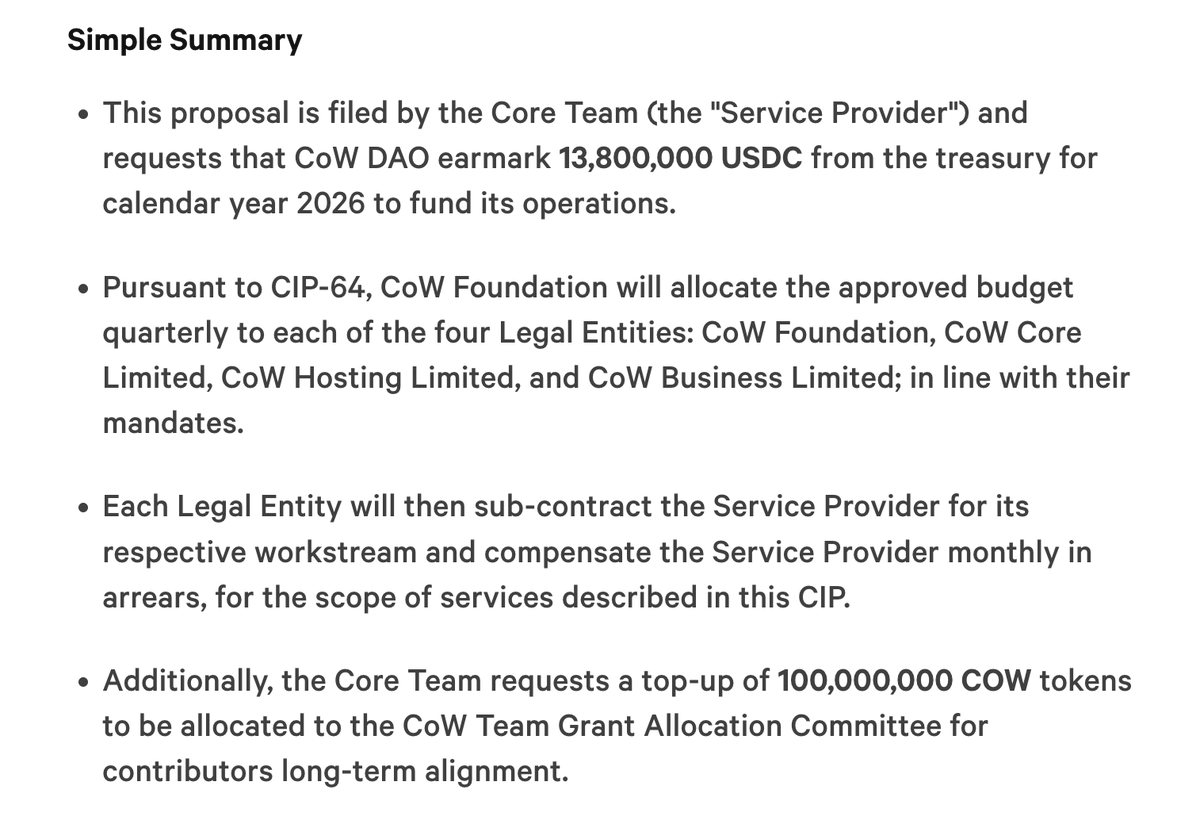 The CoW core team requests 13.8M in $USDC for 2026 operations, plus an additional 100MM $COW tokens vested over four years2025-12
 Safe{Wallet} now has native swaps – powered by CoW Swap!2024-05
 CoW Swap's core team floats proposal for six-month fee experiment, testing revenue generation for CoW Protocol2023-11
 CoW Swap finally deploys on an L2 😅 Starting today, users can hear their favorite Mooo sound when trading on Arbitrum One! h2024-06
 Fairblock and Anagram collaborate to introduce FairyCoW Swap, delivering encrypted order protection on CoW Swap.2024-05
 CoW Swap leaps to 26% market share—more than doubling in a year—and is poised to dethrone 1inch as the DEX aggregator king amid nearly $5B in monthly volume.2025-02
Understanding CoW (COW): MEV‑Aware DeFi, DEX Aggregation, and DAO Governance
CoW is the governance token of CoW DAO, the decentralized community behind CoW Protocol, CoW Swap, MEV Blocker, and CoW AMM—an ecosystem of Ethereum-based tools designed to make on-chain trading safer, more efficient, and less vulnerable to miner extractable value (MEV) and liquidity value loss. At its core, the project combines an intent-based trading protocol, a powerful DEX aggregator, and a novel MEV‑capturing automated market maker, all governed by COW token holders through an increasingly structured decentralized governance process.
CoW in Context: DeFi, DEX Aggregators, and MEV
To understand why CoW and the broader CoW ecosystem matter, it helps to start with the problems they are trying to solve. Decentralized exchanges (DEXs) such as Uniswap and Balancer pioneered non-custodial trading using automated market makers (AMMs), allowing users to swap tokens directly from their wallets without relying on centralized intermediaries. However, this model introduced new challenges, including fragmented liquidity across many pools and chains, and exposure to MEV—value extracted by block producers, searchers, and other sophisticated actors who can reorder or manipulate transactions in the mempool. As DeFi matured, DEX aggregators emerged to route trades across multiple venues for better pricing and deeper liquidity, but many of these systems still left users vulnerable to frontrunning, sandwich attacks, and other MEV strategies.
CoW Protocol positions itself at the intersection of these trends by rethinking how users express trades and how those trades get executed on-chain. Instead of having each trader submit a raw transaction directly to a DEX pool, CoW introduces an intent-based model where users sign off-chain messages describing what they want to achieve, and specialized actors called solvers compete to satisfy those intents as efficiently and safely as possible. This approach enables batch auctions, peer-to-peer matching between users with opposing orders, and uniform clearing prices that can reduce slippage and MEV leakage relative to simple point-in-time swaps on a single AMM.
CoW Swap is the primary user-facing DEX aggregator built on top of CoW Protocol, routing orders through the protocol’s solver network while also drawing liquidity from a wide range of underlying DEXs and even other aggregators. The project’s broader suite includes MEV Blocker, a transaction protection tool that routes orders away from public mempools to avoid common MEV attacks, and CoW AMM, a new AMM design that aims to capture MEV for liquidity providers rather than letting it flow to external arbitrageurs. Governance of this expanding product family is coordinated through CoW DAO, with COW token holders proposing and voting on changes via the CoW Forum and Snapshot voting space.
From a market-structure perspective, CoW stands out because it reframes on-chain trading not as isolated swaps, but as a competition among solvers to deliver the best aggregate outcome for all users in a batch. The name “CoW” reflects the concept of coincidence of wants, whereby traders with complementary needs can be matched directly without routing everything through pools, potentially saving gas and reducing price impact. For a crypto news or research audience, CoW is therefore best viewed not just as another governance token, but as the coordination asset for a distinct, MEV-aware DEX stack that has already begun to influence how wallets, lending protocols, and liquidity platforms structure their swap flows.

The CoW core team requests 13.8M in $USDC for 2026 operations, plus an additional 100MM $COW tokens vested over four years

"@tranvictor WoW CoW team is asking 14M USDC + 20M worth of token (at current price) for 2026 operation. (Given the fact that they just enabled flatfee). Kyber needs just a very small portion of that and we are not worse in term of volume."
Origins and Governance of CoW DAO
CoW DAO originated around the development of CoW Protocol and CoW Swap, which were built to address mounting concerns about MEV and user protection on Ethereum. The DAO describes its mission as building “the most user-protective products in DeFi,” with a focus on open-source, permissionless infrastructure that anyone can integrate. Rather than a single product, CoW DAO oversees an ecosystem that includes the protocol layer, front-end interfaces, and auxiliary tooling such as MEV Blocker and CoW AMM, as well as educational resources geared toward making DeFi concepts more accessible.
Membership in CoW DAO is permissionless and based on holding the COW token, which functions as the primary governance asset. Token holders are encouraged to participate in what the community informally calls the “CoWmunity” through multiple channels, including the CoW DAO Forum for long-form governance discussions, a public Discord server for more informal coordination, and a Snapshot space for off-chain token-weighted voting. This design mirrors broader DAO governance patterns in DeFi, but with a strong emphasis on active contributor roles, including specialized delegates, solver operators, and working groups focused on areas like protocol research, ecosystem partnerships, and grants.
Formally, CoW DAO’s governance is organized around CoW Improvement Proposals (CIPs), which are numbered proposals that define specific protocol, treasury, or governance changes. Community members draft CIPs and first present them on the public forum for discussion and refinement. Once a proposal is mature, it can go to Snapshot for a token-weighted vote, with voting power based on a combination of COW and vote-escrowed COW (vCOW) held or delegated to a given address. This layering allows passive token holders to delegate their votes to more active participants, and it enables the DAO to separate governance from on-chain execution, minimizing gas costs while still respecting tokenholder preferences.
The DAO’s governance structure has continued to evolve as the ecosystem grew. One notable development has been the introduction of a delegate council, a group of COW holders who apply to serve as recognized delegates, subject to specific requirements such as self-delegating a minimum of 10,000 COW tokens and capping their effective voting power to avoid over-centralization. Candidates are screened by a Grants sub-DAO, which assesses their expertise, contributions, and alignment with CoW’s mission before they become part of the council. This structure aims to professionalize governance without abandoning the open, token-based ethos, and it responds to a broader DeFi trend where large protocols increasingly rely on dedicated delegates to manage complex technical and economic decisions.
Treasury management and operational funding are also mediated through governance. CoW DAO controls a combination of native COW tokens and other assets, often including stablecoins such as USDC, and periodically votes on multi-year operating budgets and compensation structures for core development teams. These proposals typically blend stablecoin funding—used to pay ongoing operational costs—with time-vested COW token allocations that align contributors with the long-term value of the protocol. By denominating budget requests partly in USDC and partly in COW, the DAO can balance stability with upside, but it also exposes governance to debates about dilution, token emissions, and capital efficiency that are common across DeFi treasuries.
In parallel, CoW DAO has used CIPs to shape more technical aspects of the protocol’s decentralization, such as the rules governing solver participation and bonding requirements. Proposals like CIP-44, which targets reduced bonding requirements for solvers while maintaining a secure environment, demonstrate how governance decisions can directly influence network structure and competition among solver operators. In this way, CoW DAO is not only making high-level strategic decisions but is also actively tuning the protocol’s market microstructure.
Readers' click pattern reveals that CoW's appeal is primarily as a B2B liquidity infrastructure layer — the Safe{Wallet} integration drew nearly 4x more clicks than any other story — meaning adoption risk is concentrated in a handful of high-stakes integrator relationships rather than direct user growth.
Architecture of CoW Protocol: Intents, Batch Auctions, and Solvers
The most distinctive aspect of CoW Protocol is its intent-based architecture, which decouples what users want to do from how those trades are actually executed on-chain. In traditional DEX interactions, a user signs and submits a transaction that directly invokes a contract, specifying the exact path and parameters of the swap. By contrast, CoW users sign an “intent to trade”—a structured message that defines the tokens, amounts, constraints, and validity period, but leaves route selection and execution details to external solvers. The signed intent is not immediately broadcast to the blockchain; instead, it is sent to the protocol’s off-chain infrastructure, where solvers collect multiple intents into batches and compete to find the best way to satisfy them.
This design enables batch auctions, where many orders are cleared together at a uniform price, rather than each transaction being executed sequentially at potentially different prices. By solving for the optimal settlement of all intents in a batch, solvers can identify opportunities for peer-to-peer matching—where one trader’s sell order directly satisfies another’s buy order—as well as optimized routes through external DEXs and aggregators. When users’ intents line up, the protocol experiences a “coincidence of wants,” allowing trades to be matched internally without necessarily touching AMM pools, which can reduce gas consumption and minimize price impact.
A typical batch auction in CoW Protocol involves several steps handled by solvers. First, solvers collect recent user intents and construct candidate settlement plans that map which trades can be matched directly, which need to be routed via DEX pools, and what on-chain transactions would implement the plan. They then submit these candidate solutions to a competition run by the protocol, which selects the one that maximizes defined objective criteria, such as total surplus created for users or adherence to certain fairness constraints. The winning solver is responsible for submitting the on-chain transaction and gets compensated from the surplus or dedicated rewards, while the batch clears all user orders at a uniform clearing price that respects users’ minimum or maximum acceptable prices.
A key benefit of this architecture is its potential to mitigate MEV. Because user intents are handled off-chain and aggregated into batch auctions, they are not exposed as individual, easily exploitable transactions in the public mempool. The protocol’s design and the use of private orderflow routing can substantially reduce opportunities for classic MEV attacks such as sandwiching, in which an attacker inserts trades before and after a victim’s transaction to capture price impact. In addition, the uniform clearing price and shared surplus distribution model aim to keep price improvements and arbitrage-like gains within the protocol, returning value either to users or to protocol stakeholders such as solvers and liquidity providers, rather than leaking it to external arbitrage bots.
Another important component is delegated trade execution, which refers to the fact that solvers execute trades on behalf of users within the constraints of their signed intents. Users do not need to decide which DEX or bridge to use, nor do they have to manage route complexity or worry about getting a worse price because they chose the wrong venue. Instead, they specify what they are willing to pay or accept, and solvers handle the complexity of finding the best path across multiple DEXs, aggregators, and potentially different chains. Delegated execution can improve UX and efficiency, but it also introduces governance and security questions about how solvers are selected, how they are incentivized, and how to prevent malicious or incompetent behavior.
To address these concerns, CoW Protocol operates a bonding and competition framework for solvers. Solvers typically must post significant collateral and adhere to rules enforced by the protocol, with governance proposals like CIP-44 exploring ways to reduce bonding thresholds to encourage more participants without sacrificing security. The protocol’s roadmap also includes efforts to make solver participation more decentralized and multi-chain friendly, as reflected in discussions about deploying CoW Protocol to various Layer 2 networks and adjusting the solver infrastructure to handle cross-domain settlement. Alongside these on-chain mechanisms, CoW’s MEV Blocker RPC endpoint plays a complementary role by providing a route for users and integrated wallets to submit transactions that bypass the public mempool and share a portion of any captured MEV back to users rather than to miners or validators.
Overall, the CoW architecture shifts power from transaction originators and mempool adversaries to a more structured solver ecosystem overseen by the DAO. This approach resembles a competitive “auction of auctions,” where solvers vie to produce the most efficient aggregate settlement, and governance continually tunes the rules of that competition. For traders and liquidity providers, understanding this architecture is crucial because it explains why CoW Swap prices can differ from those on single DEX venues, why surplus is sometimes returned to users, and how MEV is internalized or redistributed within the system.
The COW Token: Governance, Incentives, and Value Drivers
The COW token sits at the center of this ecosystem as the primary governance asset of CoW DAO and a key element in the incentive structure that coordinates solvers, developers, and the broader community. From a design standpoint, COW is an Ethereum-based token that grants holders the right to propose and vote on CIPs, influence treasury allocation, and shape high-level protocol strategy. Although day-to-day trading on CoW Swap does not require COW—users can swap tokens like ETH, USDC, or DAI directly through the UI—the token’s governance role indirectly affects every aspect of the protocol, from fee policies and liquidity incentives to decisions about which chains to support and how MEV revenue is shared.
CoW DAO’s governance documentation emphasizes that the protocol’s rules are to be “owned, developed, and enforced by the CoWmunity,” with COW holders acting as the final decision-making body. In practice, voting power is calculated based on a combination of COW and vCOW, a vote-escrowed derivative that likely reflects longer-term commitments or staking arrangements. This structure allows the DAO to weigh the voices of more committed participants more heavily, while still allowing flexible token ownership. Governance votes take place on Snapshot, where token balances are snapshotted at a specific block, and votes are cast off-chain with cryptographic signatures, avoiding gas costs while maintaining a verifiable record of community preferences.
Beyond pure governance rights, COW also functions as an incentive and bonding asset in the solver ecosystem. Proposals like CIP-44 and connected forum discussions outline how solvers can be required to post COW, alongside other assets such as yield-bearing stablecoins or ETH, as part of their bond. In CIP-44’s proposed framework, solvers might post a minimal initial deposit, including a specified amount of COW, and then have a portion of their rewards automatically directed toward increasing their bond until a target deposit is reached. This design ties solver behavior to the value of COW and provides a mechanism for the DAO to punish misbehavior or poor performance by slashing bonds, thus aligning solver incentives with protocol security.
At the same time, governance has debated how best to distribute COW rewards to solvers and other actors. CIP-68, for instance, focuses on simplifying logistics by distributing all solver COW rewards on Ethereum mainnet, even as the protocol scales to multiple chains. The rationale is that concentrating rewards on a single chain can support healthier markets for the token, making it easier for solvers to manage their positions and for the DAO to monitor reward flows. Proposals of this kind show how closely intertwined token economics and protocol mechanics are: decisions about where and how COW rewards are paid can impact liquidity, price stability, and the attractiveness of running solver infrastructure.
The DAO also uses COW for internal alignment and contributor compensation. Longer-term operating proposals have combined stablecoin requests, often denominated in assets like USDC, with time-vested COW allocations to core teams and service providers. This dual-asset structure recognizes that contributors need stable funding for salaries and expenses, while also ensuring they share in the upside if CoW’s products gain market share and drive demand for COW as a governance asset. However, it also raises standard tokenomics questions: aggressive issuance or large grants can dilute existing holders, while overly conservative emissions might limit the DAO’s ability to attract and retain talent and critical infrastructure providers.
Indirectly, the token’s value is tied to the success of CoW’s products in attracting volume and embedding themselves into the DeFi stack. As CoW Swap routes more trading activity through its solver network, as CoW AMM accumulates liquidity, and as integrated protocols like Aave and wallets like Safe rely on CoW Protocol for swaps, the governance stakes become more consequential, potentially increasing demand for COW from participants who want influence over parameters like fee rebates, revenue sharing, and product expansion. At the same time, this creates a feedback loop: concentrated governance power could distort protocol decisions toward short-term token price gains, while a more distributed and mission-aligned holder base might prioritize user protection and long-term adoption over immediate token appreciation.
For investors and users analyzing COW, it is therefore important to view the token not just as a speculative asset, but as a claim on governance over a complex set of markets: the batch auction mechanism, MEV protection infrastructure, and an emerging AMM design that actively competes with external arbitrageurs. The degree to which token incentives, bonding, and rewards remain aligned with user welfare and protocol integrity will be a central determinant of CoW’s long-run sustainability.

CoW Swap’s new cross-chain swap feature finally ditches separate bridges, high fees, and security risks that have cost users billions.

This is actually very big
CoW Swap: User Experience, Order Types, and MEV Protection
CoW Swap is the primary interface through which everyday users and many integrations access CoW Protocol’s functionality. It operates as a DEX aggregator that sources liquidity from a broad set of decentralized exchanges and other aggregators, while also leveraging CoW’s batch auction and solver infrastructure to combine peer-to-peer matching with smart routing. When a user initiates a swap through the CoW Swap UI, they are not sending a transaction directly to a specific AMM; instead, they are creating an off-chain order—an intent—that solvers can fulfill by finding the best available combination of liquidity sources and matching opportunities.
The CoW Swap interface is designed to be familiar to users of other DEXs and aggregators, with panels for selecting a “sell” token and a “buy” token, entering amounts, and reviewing estimated returns and gas fees. However, under the hood, the system is different. Because orders are signed off-chain and settled later, users can access advanced order types that would be cumbersome or expensive to implement as on-chain transactions. CoW Swap supports market-style swaps, limit orders, and time-weighted average price (TWAP) orders, among others, all expressed as intents and processed through the same solver network.
Limit orders on CoW Swap allow users to specify a precise price at which they are willing to buy or sell a token, along with parameters such as order duration and whether the order can be partially filled. Rather than placing a transaction that sits in a DEX contract’s on-chain orderbook, the user signs an off-chain limit order that is stored by the protocol until market prices reach the specified level and a solver can include the order in a batch auction. If conditions are never met, the order simply expires; if it is still active but the user changes their mind, they can usually cancel it off-chain without paying gas, since the cancellation consists of updating the off-chain view of valid intents. This makes limit strategies substantially more gas-efficient than on-chain limit orders, which typically require separate transactions to place and cancel.
TWAP orders offer another layer of sophistication by allowing users to spread a large trade over a chosen time interval, smoothing out execution and reducing market impact. Through CoW Swap’s interface, traders can specify the overall size of their position and the time window over which they want it executed. The protocol then decomposes this into smaller chunks that solvers execute over time, aiming to approximate a time-weighted average price while still benefiting from batch auctions and aggregated liquidity. This feature can be particularly valuable for large trades in less liquid tokens, or for strategies that seek to minimize signaling risk by avoiding a single large on-chain transaction.
CoW Swap’s value proposition is closely tied to MEV protection. By design, orders submitted through the platform are not broadcast into the public mempool in a straightforward way; instead, they are processed as signed messages and eventually included in a solver’s batch auction transaction. In combination with MEV Blocker—a dedicated transaction protection tool that routes orderflow through a network of block builders and searchers who commit to sharing MEV rebates with users—this significantly reduces the likelihood of common MEV exploits such as frontrunning and sandwiching. The protocol’s documentation and educational materials emphasize that delegated execution, coincidence of wants, and uniform clearing prices together help “keep you safe from MEV,” even though no system can eliminate all forms of extractable value.
Integrations amplify CoW Swap’s reach and impact. Safe{Wallet}, for instance, uses CoW Protocol under the hood to power native swaps inside its multisig wallet interface, allowing users to exchange tokens without leaving the Safe environment. When a Safe user initiates a swap, the interface uses CoW’s batch auction system for execution, benefiting from the same aggregated liquidity and MEV protections available on the standalone CoW Swap site. Similarly, Aave has integrated CoW Swap into its swap widget on networks like Ethereum, Arbitrum, Base, and Gnosis, aiming to offer better pricing and built-in MEV protection for its lending protocol users. These integrations suggest that a growing share of DeFi swaps may be routed through CoW’s solver network, even when users do not directly interact with CoW-branded interfaces.
CoW Swap has also expanded across multiple chains and scaling solutions. Initially focused on Ethereum mainnet and Gnosis Chain, the protocol later launched on networks such as Arbitrum and Polygon, with official communications highlighting that CoW Swap is now available across major EVM environments including Ethereum, Gnosis, Arbitrum, Base, Avalanche, and Polygon. Each new deployment extends the reach of the solver network and offers users a consistent experience across chains, although governance and technical discussions have highlighted significant challenges in fully decentralizing solver infrastructure and reward distribution across multiple domains. This multi-chain footprint is increasingly important as users seek lower fees and faster confirmations while still desiring robust MEV protection.
Finally, CoW Swap’s user education efforts are notable. CoW DAO has launched a learning hub targeting foundational DeFi topics, explaining concepts such as DAOs, DEXs, loans, and liquidity provisioning in accessible terms. Alongside more product-specific guides on limit orders, TWAP strategies, and MEV, this educational push helps demystify the protocol’s more advanced features and lowers the barrier to entry for new users who might otherwise find intent-based trading and batch auctions opaque. For a news audience, this underscores CoW’s dual focus on technical sophistication and usability.
- 01major wallet and protocol integrations↗
Safe{Wallet}'s native CoW Swap integration (991 clicks), plus Aave and Infinex partnerships, show readers tracking CoW as embedded DeFi infrastructure rather than a standalone destination.
- 02fee switch and protocol revenue↗
The fee experiment proposal and fee switch activation against $33B in cumulative trading volume drew readers tracking whether CoW can finally capture value from its dominant order flow.
- 03LVR-resistant CoW AMM design↗
The Balancer/CoW AMM collaboration and its graduation from beta generated sustained interest as a structural solution to loss-versus-rebalancing that all AMM liquidity providers face.
- 04L2 and cross-chain expansion↗
CoW Swap's belated Arbitrum deployment and the launch of native cross-chain swaps resonated with readers aware that mainnet-only aggregation caps addressable volume.
- 05MEV attack surface versus protection claims↗
The disclosed multi-block MEV attack, the surplus shifting bug, and FairyCoW's encrypted order flow show readers stress-testing whether CoW's core MEV-protection promise holds under adversarial conditions.
- 06DEX aggregator market share race↗
The 26% market share milestone framing CoW as poised to overtake 1inch gave readers a competitive narrative to track for token positioning.
CoW AMM and Liquidity Design: Capturing MEV for LPs
While CoW Protocol’s batch auctions and CoW Swap’s aggregator are primarily focused on traders, CoW AMM targets the other side of the market: liquidity providers (LPs) who supply capital to pools and, in traditional AMMs, often suffer from loss-versus-rebalancing (LVR) and other forms of value leakage. In standard constant function AMMs, external arbitrageurs capture most of the gains from price discrepancies between the pool and the broader market, effectively extracting value from LPs over time. Research cited by CoW suggests that LVR can cost LPs on the order of 5–7% of their liquidity on average, depending on the asset pair and market conditions.
CoW AMM aims to invert this dynamic by integrating more deeply with CoW Protocol’s solver ecosystem and MEV-aware infrastructure. Instead of passively allowing arbitrageurs to rebalance the pool whenever prices move, CoW AMM is designed so that solvers can internalize rebalancing as part of the batch auction process, capturing the associated value for LPs or for the protocol, rather than leaving it to external agents. This is possible because solvers, in the course of constructing optimal settlements for user intents, can identify when a CoW AMM pool is out of sync with external prices and incorporate a rebalancing trade into their settlement plan at a price that reflects the current market, not just the AMM’s invariant.
The design is closely associated with a new class of AMM structures that CoW has described as the first MEV-capturing AMM, now deployed through a collaboration with Balancer. CoW AMM pools exist on Balancer’s infrastructure, meaning LPs can deposit liquidity through Balancer’s familiar UI and benefit from its incentive mechanisms, while the CoW side of the integration contributes its MEV defense and surplus-capturing capabilities. This combination gives LPs exposure to a more advanced AMM design without having to learn a new interface or contract system, which is important for adoption given the conservatism of many large LPs.
From a liquidity management perspective, CoW AMM potentially changes the calculus for LPs choosing where to deploy capital. In conventional AMMs, LPs must weigh trading fees against LVR and impermanent loss, often resulting in outcomes where realized returns are lower than headline APRs would suggest. By actively capturing MEV and arbitrage opportunities, CoW AMM seeks to increase net returns for LPs while also contributing to more efficient price discovery within the CoW ecosystem. If successful, this could attract deeper liquidity, particularly in popular pairs such as stablecoins like USDC against ETH or other major assets, which in turn improves execution quality for CoW Swap users.
However, the interaction between CoW AMM, solvers, and users is complex and still evolving. An incident acknowledged by the CoW team involved surplus shifting, where surplus that would ordinarily have accrued to traders was instead redirected in a way that benefited LPs on CoW AMM. In that case, the protocol reported that a trader on CoW Swap was negatively impacted while liquidity providers on CoW AMM were positively, but unfairly, affected, highlighting how subtle incentive misalignments can create edge cases where the system departs from its user-protection ethos. The team’s response and subsequent governance discussions underscore the importance of transparent monitoring and parameter tuning when introducing new AMM designs that share complex interactions with solver behavior.
The collaboration with Balancer is also noteworthy from a governance standpoint. Balancer brings its own DAO, token, and governance processes, which must interoperate with CoW DAO’s decisions regarding CoW AMM parameters, incentives, and integration depth. Joint initiatives, such as aligning incentives to make LVR-resistant AMMs a new dominant design in DeFi, require cross-DAO coordination and careful design of joint incentives. For COW holders, this adds an additional layer of governance responsibility: decisions about CoW AMM do not occur in a vacuum but in a larger ecosystem where Balancer stakeholders also have a say.
In the long run, CoW AMM can be seen as an attempt to bring LPs into the same MEV-aware framework that CoW Swap offers to traders. By structurally reducing value leakage and sharing surplus more equitably, CoW AMM seeks to create a healthier two-sided market, where both traders and LPs benefit from MEV being internalized within the protocol rather than extracted by outsiders. Whether this model becomes dominant will depend on empirical performance, LP adoption, and the ability of CoW DAO and Balancer to iterate on the design as new MEV strategies and market conditions emerge.
Risk, MEV, and Ongoing Research in the CoW Ecosystem
Despite its emphasis on safety, CoW’s ecosystem operates in the inherently adversarial environment of public blockchains, where MEV, smart contract risk, and evolving attack vectors remain constant concerns. MEV is particularly salient because it is not a single vulnerability but a class of behaviors arising from the ability of block producers and searchers to reorder, include, or exclude transactions for profit. CoW’s batch auctions, intent-based architecture, and MEV Blocker RPC are all attempts to reduce the surface area for MEV, but they cannot eliminate all forms of extractable value.
For example, while batch auctions and private routing can mitigate classic single-block sandwich attacks, multi-block MEV and long-range strategies may still impact users. In public communications, CoW DAO has acknowledged instances where trades on CoW Protocol appeared to fall victim to multi-block MEV attacks, prompting investigation and discussion about further hardening the system. These episodes highlight that MEV evolves as protocols change, and that defenses must continually adapt. MEV Blocker addresses some forms of exploitation by routing orderflow through participants who commit to returning a share of MEV to users, but it still relies on off-chain agreements and reputational mechanisms, which require ongoing monitoring.
On the smart contract and protocol side, risks include bugs in settlement logic, flaws in solver competition mechanisms, and misconfigurations in AMM parameters, any of which could result in losses for users or LPs. The surplus-shifting incident involving CoW AMM demonstrates how complex interactions between solvers and liquidity pools can produce unexpected outcomes, even when the underlying contracts behave as coded. When surplus is misallocated—even unintentionally—it can undermine trust in the protocol’s fairness guarantees, prompting calls for more transparent analytics, better auditing of solver behavior, and tighter constraints within the batch auction mechanism.
Governance itself introduces another dimension of risk. As control over key parameters, treasury assets, and protocol upgrades rests with COW token holders and their delegates, the system is exposed to potential governance capture, low voter participation, and misaligned incentives. Proposals governing solver bonding requirements, reward distribution, affiliate programs, or large USDC-denominated budgets can all materially affect the protocol’s economics, and if decided by a small subset of holders, they could tilt the system away from its user-protective ethos. The introduction of a delegate council and delegation programs is meant to improve decision quality and broaden participation, but it also concentrates influence among recognized delegates, making their incentives and accountability structures critical.
Cross-chain expansion and emerging cross-chain swap capabilities add yet another layer of complexity. Deploying CoW Protocol to Layer 2 networks and additional EVM chains involves challenges such as maintaining consistent solver incentives, avoiding fragmented reward markets, and ensuring that MEV protection is effective across different execution environments. Governance discussions have highlighted the difficulty of designing a solver system that remains decentralized and secure when settlement spans multiple chains, especially if solvers must manage bonds and rewards in several domains. Furthermore, cross-chain swaps—whether implemented through intent-based routing or via bridges—expose users to bridge risk, liquidity fragmentation, and more complex forms of MEV that exploit differences between chains.
Regulatory and reputational risks also intersect with CoW’s design choices. As MEV and orderflow monetization practices attract more scrutiny, protocols that route large volumes of private transaction orderflow or share MEV revenues must navigate evolving norms and potential legal questions. At the same time, CoW’s emphasis on user protection and open-source transparency may place it in a relatively favorable position compared with more opaque actors, provided it continues to communicate clearly and respond proactively to incidents. Educational initiatives, such as the CoW learning hub and detailed documentation on intents, orders, and MEV, contribute to this transparency by helping users understand both the benefits and limitations of the protocol’s defenses.
In sum, CoW’s approach to risk is characterized by ongoing experimentation: batch auctions, MEV Blocker, CoW AMM, and solver bonding rules are all live mechanisms that must continually evolve in the face of an adaptive adversarial environment. For analysts and users, tracking governance proposals, incident reports, and research outputs from CoW DAO is essential to understanding how the protocol’s risk profile changes over time.

A cow shares reflections on what’s valuable and most cherished

Ecosystem, Integrations, and Multi‑Chain Expansion
The CoW ecosystem extends beyond its core contracts and front-end interface, increasingly functioning as infrastructure for other protocols, wallets, and applications. Integrations with major DeFi platforms exemplify this trend. Aave Labs partnered with CoW Swap to upgrade Aave’s swap widget, integrating CoW Protocol’s solver-based routing to deliver better pricing, deeper liquidity, and built-in MEV protection across networks like Ethereum, Arbitrum, Base, and Gnosis. For Aave users, this means that actions such as rebalancing collateral positions or swapping borrowed assets are routed through CoW’s batch auctions, even if they never visit the CoW Swap website directly.
Similarly, Safe{Wallet} incorporates CoW Protocol for native swaps within its multisig interface. Safe users can initiate token exchanges from within the wallet, with the UI presenting estimated returns and gas costs, while CoW handles execution through batch auctions. This integration is particularly important because many DAOs and institutions rely on Safe for treasury management, meaning that a significant amount of DeFi treasury rebalancing may already be benefiting from CoW’s MEV-aware execution. As more treasury managers incorporate MEV considerations into their operating procedures, this kind of integration could become a key differentiator.
On the network side, CoW has progressively expanded to multiple EVM-compatible environments. After initial deployments on Ethereum mainnet and Gnosis Chain, CoW Swap launched on Layer 2 networks such as Arbitrum and optimistic rollups, and later announced a deployment on Polygon, bringing CoW Protocol’s model to a chain known for low fees and a large retail user base. Official communications emphasize that with Polygon support, CoW Swap is available across all major EVM environments, including Ethereum, Gnosis, Arbitrum, Base, Avalanche, and Polygon, though the exact set of supported networks may evolve over time. Multi-chain deployments increase reach but also require careful coordination of governance, rewards, and solver operations, as highlighted in technical discussions about the path to Layer 2 deployments.
These technical threads converge in CoW DAO’s governance over solver incentives and reward distribution. CIP-68 provides a window into how the DAO is grappling with multi-chain logistics by proposing that all solver COW rewards be distributed on Ethereum mainnet, even as activity spans multiple chains. By simplifying reward logistics and concentrating liquidity in a single COW market, the proposal aims to maintain healthy token markets and reduce operational complexity for solvers. Meanwhile, CIP-44 addresses how to lower the barrier to entry for new solvers in a multi-chain setting by reducing bonding requirements and allowing rewards and refunds to grow bonds over time, thereby fostering a more decentralized and competitive solver ecosystem.
CoW’s ecosystem also includes educational and community initiatives. The learning hub promoted by CoW DAO provides explanations of DeFi building blocks, including DEXs, DAOs, loans, and liquidity provision, positioning CoW as not just a trading tool but also a resource for onboarding new users into decentralized finance. This educational layer complements more advanced documentation on intents, governance, and developer integration points, helping the project appeal simultaneously to retail traders, advanced DeFi users, and engineers building on top of CoW Protocol’s APIs.
As the ecosystem grows, network effects become increasingly important. Each new integration—whether with a lending protocol like Aave, a wallet like Safe, or a centralized front-end like Infinex—brings additional orderflow into CoW’s solver network, potentially improving batch auction efficiency and deepening liquidity access for all participants. In turn, higher throughput can justify more sophisticated solver strategies and support a richer landscape of MEV-protected order types, from large TWAP trades to complex multi-leg swaps. For COW token holders, this growth translates into more consequential governance decisions, as the parameters they set for fees, reward distribution, and AMM integration affect a broad range of downstream applications and users.
CoW Swap (Gnosis Protocol v2) public beta launch
CowDAO formed; COW token launched via airdrop
TWAP orders launched on CoW Swap
CoW AMM launched in collaboration with Balancer to address LVR
Multi-block MEV attack on CoW Protocol trades disclosed by core team
Fee switch activated; CoW begins capturing revenue on $33B cumulative volume
CoW Swap deploys on Arbitrum One, its first L2
Safe{Wallet} integrates native swaps powered by CoW Swap
Participating in CoW DAO and Using CoW Products
Participation in the CoW ecosystem can take several forms, ranging from simple trading activities on CoW Swap to active governance and professional solver operations. For most users, the entry point is trading via CoW Swap, where they can connect a wallet such as MetaMask, Safe, or another Web3 wallet and initiate token swaps. When a user chooses a token pair—say, selling ETH for USDC—the interface displays an estimated output, gas costs, and information about price impact. Behind the scenes, the user is asked to sign an off-chain message representing their intent to trade, rather than an on-chain transaction, and this signed intent is then picked up by solvers who compete to execute the trade within the user’s specified conditions.
Advanced users may leverage limit orders and TWAP orders for more fine-grained control. To place a limit order, a trader selects the tokens and amounts, then specifies the minimum price they are willing to accept if selling, or the maximum price they will pay if buying. They can choose how long the order should remain valid, from minutes to many months, and whether the order can be partially filled or must be filled entirely in one batch. Once the order is signed off-chain, it becomes part of the set of intents that solvers monitor, and if market conditions intersect with the specified price, a solver can include the order in a batch auction for settlement. If the price is never reached, the order simply expires.
TWAP orders follow a similar pattern but add a temporal dimension. A user decides how much of a token they wish to buy or sell and over what time horizon they want the order executed. CoW Swap decomposes this large intent into smaller chunks, and solvers attempt to execute those chunks across multiple batches over the chosen period, resulting in an overall execution price that approximates the time-weighted average of market prices during that interval. This is especially useful for institutional participants, DAO treasuries, or large traders who need to manage slippage and market impact carefully.
On the governance side, users become CoW DAO participants by acquiring COW tokens, which can be purchased on exchanges or earned through contributions, grants, or participation in protocol incentive programs. Holding COW grants access to governance rights, including posting and discussing CIPs on the CoW Forum and voting on proposals via the Snapshot space. Active participants often introduce themselves in governance channels, build a track record of contributions, and may apply to become recognized delegates under the DAO’s delegate council program, which requires self-delegation of a minimum COW stake and adherence to voting power caps.
Governance proposals can cover a wide range of topics, such as modifying solver bonding parameters, adjusting CoW AMM incentives, launching educational initiatives, or approving budgets denominated in USDC and COW for core teams and ecosystem development. Over time, the DAO has also explored mechanisms like affiliate frameworks and delegation programs to increase participation and align incentives for community members who help drive adoption. These proposals reflect a broader pattern in DeFi governance, where protocols move beyond simple parameter tweaks toward more sophisticated programs that shape distribution, marketing, and ecosystem growth strategies.
More specialized participants may operate as solvers, running infrastructure that ingests user intents, constructs optimal settlement plans, and competes in batch auction competitions. Becoming a solver requires technical capabilities, significant bonding capital—often including both COW and stable assets—and a deep understanding of DeFi markets, DEX routing, and MEV dynamics. Successful solvers are compensated through surplus and rewards, but they are also subject to governance-defined rules that can include slashing for misbehavior, routing requirements such as submitting solutions via MEV Blocker RPC, and constraints on how surplus is shared between users, LPs, and the protocol.
In all these roles, education and transparency are crucial. CoW’s documentation on intents, orders, and governance, along with its DeFi learning hub, provides the conceptual foundation for users to understand how their actions fit into the larger protocol. For a crypto news audience, this makes CoW an instructive example of how advanced protocol design, MEV awareness, and DAO governance come together to create a complex but increasingly user-friendly DeFi system.
Competitive Positioning and Strategic Scenarios
Within the increasingly crowded landscape of DEX aggregators and MEV-aware protocols, CoW occupies a distinct niche defined by its combination of intent-based architecture, batch auctions, and MEV-capturing AMM design. Traditional aggregators such as 1inch, Matcha, and ParaSwap primarily focus on routing “raw” user transactions across multiple DEXs to find the best price at a given moment, often leaving MEV defenses to external services or private RPC providers. By contrast, CoW integrates MEV-aware mechanisms directly into its core protocol, with solvers competing not only on routing efficiency but also on how effectively they can internalize and redistribute MEV.
This difference can be conceptualized by comparing two execution paradigms. In the transaction-centric paradigm, each user’s trade is an independent unit that must be executed as specified, typically via a direct AMM call, and aggregators simply optimize path selection across pools. In the intent-centric paradigm exemplified by CoW, users describe desired outcomes, and solvers have the flexibility to match orders peer-to-peer, rebalance AMMs, and leverage cross-venue opportunities within a batch auction that clears all orders at a uniform price. The latter opens the door to more sophisticated optimizations and MEV internalization but requires greater trust in solver selection, governance, and protocol design.
CoW’s collaboration with Balancer on CoW AMM further differentiates it from other MEV-aware projects by extending MEV capture beyond traders to LPs. Some MEV-focused initiatives, such as private mempools or builder-relay systems, primarily address user-facing transactional MEV without substantially altering AMM mechanics. CoW’s approach is more holistic, targeting both sides of the market: traders via batch auctions and private routing, and LPs via MEV-capturing AMM designs. If successful, this could make CoW infrastructure attractive to a wide range of DeFi participants, from aggregators and wallets to professional LPs and DAOs managing treasuries.
Partnerships are another differentiator. Integrations with protocols like Aave and wallets like Safe embed CoW’s infrastructure deep into the DeFi stack, making it a default routing layer for swaps within popular applications. As more platforms adopt CoW for swap execution, the protocol benefits from growing network effects: more orderflow improves the efficiency of batch auctions and the robustness of solver competitions, which in turn can lead to better prices and stronger MEV protection, further attracting integrations. This virtuous cycle could position CoW as a central piece of on-chain trading infrastructure, rather than just another front-end DEX.
However, CoW also faces challenges. Competing aggregators and MEV solutions may adopt similar techniques, such as private transaction relays, batch auctions, or integrated MEV capture, eroding CoW’s differentiation over time. Governance complexity poses another strategic risk: as the protocol grows more influential and cross-chain, COW token governance must manage an expanding set of trade-offs involving liquidity incentives, solver rules, AMM parameters, cross-chain reward logistics, and treasury deployment. Missteps in any of these domains could open opportunities for leaner or more focused competitors.
From a token perspective, COW’s value is tightly coupled to the protocol’s ability to sustain adoption and maintain a credible commitment to user protection and fairness. If the DAO consistently aligns surplus distribution, MEV capture, and treasury management with long-term ecosystem growth, COW could serve as a durable coordination asset for a broad range of stakeholders, including traders, LPs, and integrated protocols. Conversely, if governance drifts toward short-term tokenholder profit maximization at the expense of user welfare or protocol security, the ecosystem could face reputational and competitive headwinds.
For analysts, tracking CIPs, governance participation, incident responses, and integration announcements provides insight into which of these strategic scenarios is unfolding. CoW’s trajectory will likely depend not only on its technical innovations but also on how effectively COW token holders exercise their governance responsibilities in a rapidly evolving DeFi environment.
The surplus shifting bug — where solver behavior silently harmed traders while benefiting CoW AMM LPs — demonstrated that intent-settlement logic creates non-obvious economic attack surfaces even absent a direct contract exploit.
A live multi-block MEV attack on CoW Protocol trades was confirmed by the core team, directly undercutting the protocol's primary user value proposition of MEV protection.
The solver network is dominated by a small set of professional solvers backed by bonding pools; CIP-44 reduced bonding requirements to widen participation, but solver concentration risk persists.
CoW DAO operates on-chain with active CIP voting and a delegate program, but the core team's request for 13.8M USDC plus 100M COW tokens vested over four years signals that operational control remains substantially centralized.
As a non-custodial intent-based aggregator, CoW faces lower direct regulatory exposure than centralized venues, though broad DeFi regulatory risk applies across jurisdictions.
With approximately 26% DEX aggregator market share and nearly $5B in monthly volume at time of reporting, near-term liquidity depth risk is low, though volume is materially dependent on continued integrator partnerships.
Conclusion
CoW and the COW token represent a comprehensive attempt to redesign on-chain trading around an intent-based, MEV-aware, and DAO-governed architecture. At the protocol level, CoW replaces direct user transactions with signed intents that solvers aggregate into batch auctions, using coincidence of wants and uniform clearing prices to improve execution quality and internalize surplus. At the product level, CoW Swap provides a DEX aggregator experience that abstracts away routing complexity while giving users access to advanced order types such as limit and TWAP orders, all underpinned by MEV protection mechanisms like MEV Blocker.
On the liquidity side, CoW AMM extends MEV-aware design to LPs, aiming to reduce loss-versus-rebalancing by capturing arbitrage value within the protocol, particularly through a collaboration with Balancer that makes these pools accessible via familiar interfaces and incentive systems. Governance through CoW DAO, powered by the COW token, orchestrates this ecosystem, with CIPs, delegate programs, and multi-asset treasury management guiding decisions on solver bonding, reward distribution, cross-chain deployments, and educational initiatives.
The project’s emphasis on user protection and open-source infrastructure has led to deep integrations with major DeFi platforms and wallets, including Aave and Safe, as well as expansion across key EVM chains such as Ethereum, Gnosis, Arbitrum, Base, Avalanche, and Polygon. At the same time, incidents around surplus allocation, evolving MEV threats, and the complexity of multi-chain governance underscore that CoW operates in a challenging, adversarial environment and must continually iterate on its mechanisms and parameters.
Ultimately, CoW’s significance lies in how it reframes on-chain trading as a coordinated competition among solvers under DAO governance, rather than a series of isolated swaps exposed to mempool adversaries. For traders, LPs, and integrated protocols, understanding CoW’s architecture, governance model, and risk profile is essential to assessing its role in the future of decentralized finance.
Outlook
Looking forward, CoW’s trajectory will likely hinge on three intertwined dynamics: the evolution of MEV and intent-based protocols, the maturation of DAO governance, and the consolidation of cross-chain trading infrastructure. As more orderflow migrates from public mempools to private, MEV-aware systems, CoW’s batch auction and MEV Blocker stack could become a standard layer for DeFi swaps, particularly if integrations with major wallets and protocols continue to expand. At the same time, competing projects may adopt similar techniques, making governance, transparency, and user trust key differentiators.
DAO governance around COW will face growing pressure as the protocol’s economic footprint widens. Decisions about solver incentives, AMM parameters, cross-chain reward logistics, and treasury strategies—often involving large USDC budgets and significant COW allocations—will shape both protocol sustainability and tokenholder value. The success of delegate councils, affiliate frameworks, and education-focused initiatives will be critical to maintaining an informed, engaged governance community capable of steering the protocol through increasingly complex trade-offs.
From a market-structure perspective, CoW’s experiments with MEV-capturing AMMs and solver-based batch auctions may influence how future DEXs and aggregators are built, particularly if empirical performance shows persistent improvements in LP outcomes and user execution quality. If CoW can continue iterating on its mechanisms, respond transparently to incidents, and align its governance with its user-protective mission, it is well positioned to remain a central actor in the next phase of DeFi’s evolution, where MEV-awareness, cross-chain interoperability, and sophisticated DAO coordination become baseline expectations rather than differentiating features.
Latest COW news
The CoW core team requests 13.8M in $USDC for 2026 operations, plus an additional 100MM $COW tokens vested over four yearsCoW Swap’s new cross-chain swap feature finally ditches separate bridges, high fees, and security risks that have cost users billions.A cow shares reflections on what’s valuable and most cherished CoW Swap is now live on Polygon
 CoW protocol unveils FCBAs, redefining On-Chain Trading with a smarter, faster, fairer DEX standard
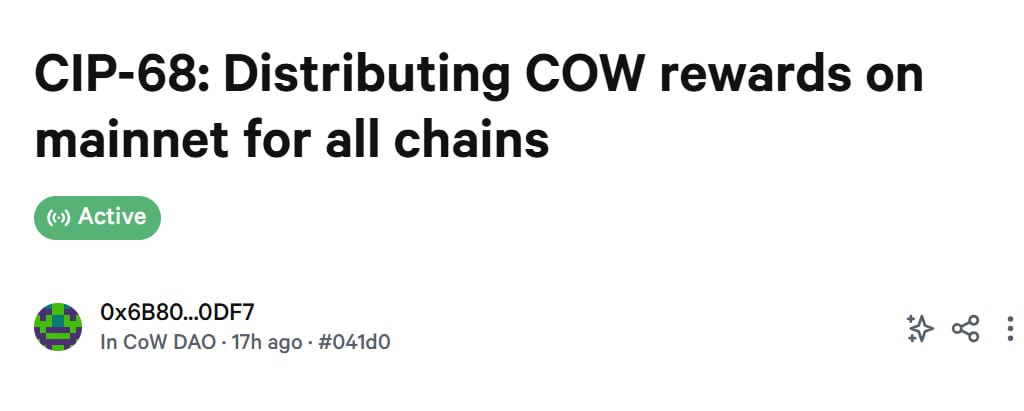 CIP-68 on CoW DAO - a proposal for distribution of all solver $COW rewards on mainnet, on order to simplify logistics and ensure healthy markets.Active now -
Sources
20 records from 10 domains
cow.fi
swap.cow.fi
binance.com
docs.cow.fi
x.com
tradingview.com
forum.cow.fi
dune.com
aave.com
help.safe.global
Community notes
Spot something off or out of date? Drop a note. Editors review topic notes daily and roll accepted fixes into the explainer — contributors are recognized in the monthly $SQUID drop.
Loading notes…
Help improve this topic
Have a story or tip about this topic? Submit it. See something missing? Leave a note. Editors review daily; accepted submissions and fixes count toward the monthly $SQUID drop.