
Decentralized AI distributes model training and inference across open networks rather than corporate data centers, using token incentives to coordinate compute — with Bittensor, Gensyn, and BitTorrent's BTTInferGrid among the leading examples.
Decentralized AI refers to the development, training, and deployment of artificial intelligence systems across distributed networks — rather than inside proprietary data centers controlled by a single company — so that no single entity holds a monopoly over AI access, governance, or compute.
Why Centralization Is the Default Problem
The modern AI industry has consolidated rapidly. A small number of corporations — operating large, proprietary model stacks trained on privately curated data — now supply most of the world's AI inference capacity. This structure creates dependencies that are both technical and political. When a government compels a centralized AI provider to restrict access, suspend a model, or alter its outputs, every downstream user is affected simultaneously and with no recourse.
This structural fragility surfaced concretely when discussion of potential regulatory pressure on Anthropic, the company behind Claude, prompted analysts at Grayscale to argue the episode "makes a strong case for decentralized AI." The argument is straightforward: centralized AI models are single points of failure for anyone who depends on them, whether that dependency is commercial, journalistic, or scientific. Permissionless alternatives that no single government or corporation can unilaterally shut down represent a qualitatively different reliability guarantee.
Decentralized AI is the technical and economic attempt to build those alternatives.
The decentralized AI project Aethir demonstrated how a Google protocol for agent communication can be used in conjunction with the x402 payment standard.
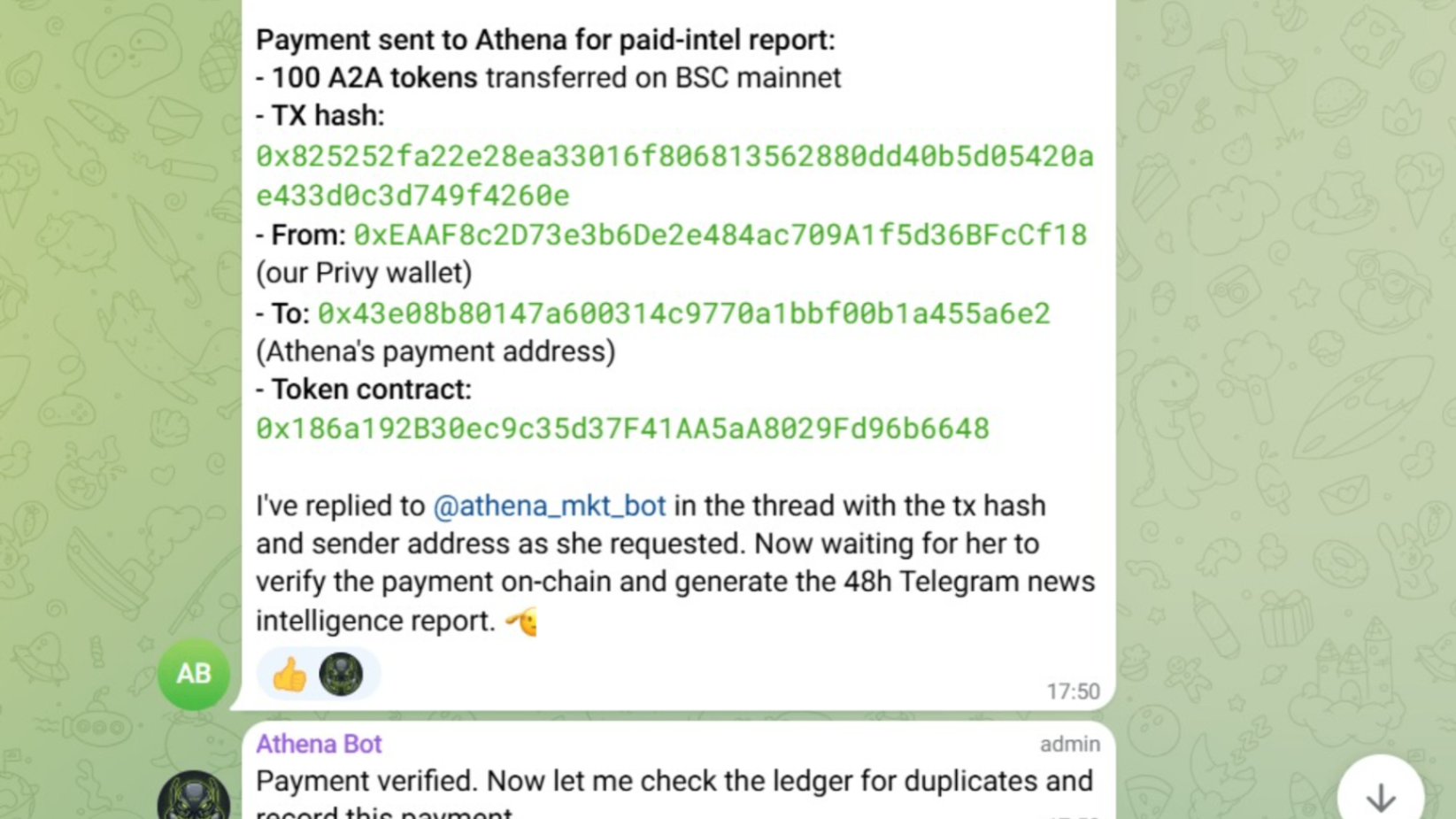

Aethir’s own write-up confirms the pilot used a standard BSC token transfer, not the x402 A2A extension. It proved wallet automation and tx-hash gating, not x402’s payment-required, payment-submitted, and payment-completed flow. That gap matters: a May 2026 paper reproduced five x402 attacks on Base Sepolia and live endpoints, including paid-but-denied outcomes (arXiv:2605.11781).
How Decentralized AI Networks Work
At their core, decentralized AI systems replace the centralized data center with a protocol — a set of rules enforced by a blockchain or a cryptographic coordination layer — that routes AI work across many independent participants.
Compute supply networks aggregate GPU resources from operators worldwide who are compensated in tokens for processing inference or training tasks. Gensyn, for example, describes itself as a decentralized AI compute network designed to connect distributed GPU resources globally; Upbit's listing of its token in mid-2026 signals growing exchange-level validation of this model. Akash Network takes a similar permissionless approach to GPU supply, explicitly describing open access as its design principle. c0mpute's "Shard" product targets one of the hardest unsolved problems in this space: running very large models (up to 744 billion parameters) across distributed GPUs at latency that is actually usable for inference — a capability previously reserved for colocated data center clusters.
Model marketplaces and subnet architectures add a layer above raw compute. Bittensor (ticker: TAO) is the most widely cited example. It operates as an open-source, permissionless network where validators score the outputs of AI model providers (called "miners") within specialized topic areas called subnets. Token rewards flow to participants who produce the most useful AI outputs as judged by the network, rather than to a company's shareholders. TAO's inclusion in the Russell Microcap Index via TAO Synergies marks an early moment of institutional acknowledgment for this model. YumaGroup's expanded work as a guide into Bittensor's ecosystem reflects the growing infrastructure building up around it.
0G (Zero Gravity) represents a related infrastructure layer: a decentralized data availability and storage network oriented specifically toward AI use cases, providing verifiable data provenance for AI training pipelines — a problem that centralized providers handle opaquely behind proprietary walls.
Inference Is the Current Frontier
Training large models is expensive and slow; for most production use cases, inference — actually querying a trained model — is where cost and latency are felt. This is why much of 2025–2026 activity has focused on decentralized inference specifically.
BitTorrent's evolution is instructive here. Once known exclusively as a peer-to-peer file-sharing protocol and later a Binance Launchpad alumnus, BitTorrent has completed the sunset of its BTTC bridge and pivoted explicitly toward AI inference through BTTInferGrid — a decentralized inference grid that puts the legacy peer-to-peer architecture in service of routing AI computation rather than file chunks. Justin Sun framed this as a natural evolution: the same properties that made BitTorrent resistant to centralized censorship of file distribution apply to AI model access.
c0mpute's Shard takes the technical problem of distributed inference most seriously. Running a single very large model requires coordinating memory and computation across machines that are geographically separated, with network latency at each hop. Shard claims to have solved the coordination problem in a way that keeps end-to-end inference latency competitive with centralized providers — a meaningful engineering claim, if verified at scale.
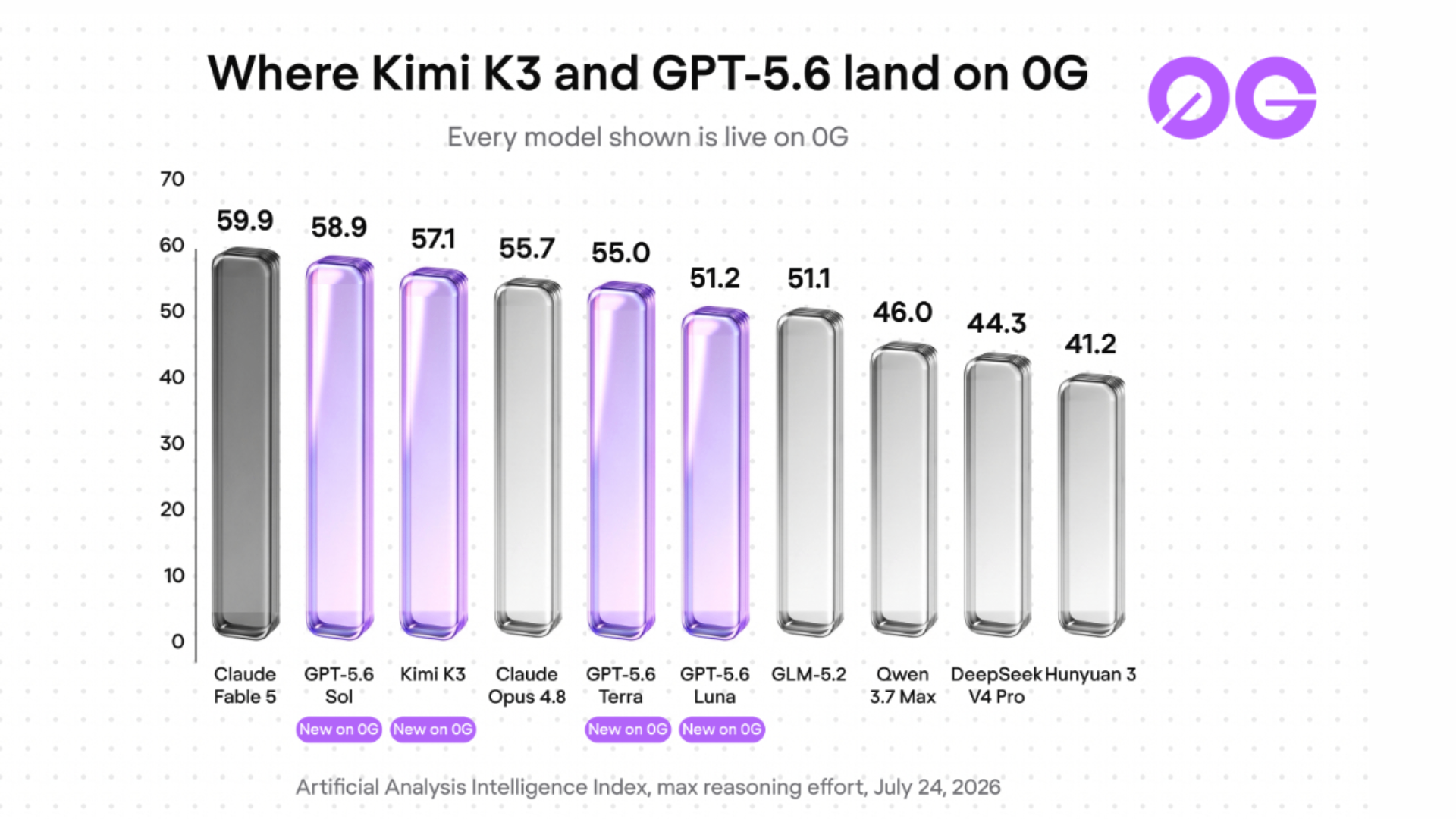
0G added Moonshot's Kimi K3 to its decentralized AI routing network, exposing the Chinese frontier model through a hardware-attested path despite mounting scrutiny from Washington
AI Agents and the Decentralized Stack
The emergence of AI agents — AI systems that take multi-step autonomous actions, call external tools, and execute transactions — raises the stakes for infrastructure ownership considerably. An agent that can book hotels, execute trades, or send money on a user's behalf needs an underlying platform that users can actually trust.
Anthropic's Claude now supports agentic hotel booking and payment flows over Base blockchain via the x402 payment protocol, demonstrating that frontier AI agents are already operating on crypto rails. Claude Opus 4.8 extended this trajectory with "stronger long-running agentic coding and workflow abilities," signaling that autonomous, multi-step AI tasks are moving from research to production.
The decentralized AI ecosystem is building parallel infrastructure for agents. Moonbeam and GLMR's announced migration from Polkadot to Base is explicitly framed as enabling a "decentralized AI agent communication" protocol — the Moonbeam Protocol — suggesting that blockchain networks are positioning themselves as coordination layers for AI agents rather than just token issuance platforms. Bella's partnership with RATGPT to build a decentralized AI agent platform for tokenized creation and trading is another instance of this pattern: AI agents as first-class economic actors operating through decentralized infrastructure.
OlaXBT takes the agent concept into portfolio management, describing a "decentralized AI trading layer" powered by swarms of specialist AI agents with hybrid data intelligence — an architecture that distributes investment decision-making across an agent fleet rather than centralizing it in a single model or a single firm.
For agents, a specific technical concern has emerged around verifiability. Cysic ZK has argued — and researchers have echoed — that for autonomous AI agents, cryptographic verifiability of outputs matters more than shaving milliseconds off latency. If an agent is making consequential decisions, the ability to prove that a specific model produced a specific output under specific inputs is more important than speed. Zero-knowledge proofs applied to AI inference represent an open research area with significant production implications.
Token Mechanics and Economic Incentives
Decentralized AI networks rely on token-based incentive systems to coordinate behavior that would otherwise require corporate hierarchy. The mechanics vary by project but share common structures.
In Bittensor's subnet model, miners compete to produce the best AI outputs within a domain (image generation, language modeling, financial prediction, and so on), and validators — who stake TAO tokens — score those outputs. Token emissions flow to high-performing miners and accurate validators. The system attempts to make "produce good AI work" economically equivalent to "earn money," without a central employer deciding what "good" means.
Gensyn's model centers on verifiable compute: GPU operators earn tokens for provably completing AI workloads, with cryptographic receipts preventing false claims of work done. The listing on Upbit — South Korea's largest crypto exchange by domestic volume — reflects the market's assessment that verifiable compute has reached sufficient maturity to warrant liquid trading.
The broader pattern is that token design in decentralized AI networks must solve a harder version of the standard crypto incentive problem: not just "did you hold a block," but "did your AI output actually help someone?"

Decentralized AI project Nous Research in talks to raise $75M at $1.5B valuation: report

Institutional and Regulatory Context
The decentralized AI argument gains urgency from regulatory developments. Several jurisdictions have moved to require AI companies to provide government access to model outputs, training data, or operational controls. For centralized providers, compliance is straightforward to compel. For a protocol running across thousands of independent nodes in multiple jurisdictions, the same coercion is technically and legally far more difficult to execute.
This asymmetry is not lost on institutional allocators. The argument that centralized AI represents a regulatory concentration risk — and that decentralized alternatives provide a form of jurisdictional diversification — is now being made explicitly in research from firms like Grayscale. Whether that risk manifests in ways that drive meaningful capital toward decentralized alternatives remains an open empirical question.
At the same time, decentralized AI networks face their own regulatory uncertainty. Token classifications, compute export controls, and liability for AI outputs generated on permissionless networks all represent unresolved legal questions in most jurisdictions.
Technical Limitations Remain Real
Honest accounting of the space requires acknowledging what decentralized AI cannot yet do as well as its centralized counterparts.
Model quality: The largest and most capable models — GPT-4-class and above — are trained by organizations with billions in compute budgets and proprietary datasets. Decentralized networks have not yet produced comparable frontier models, though they have produced useful specialized models within particular domains.
Latency: Routing inference across geographically distributed, independently operated nodes introduces coordination overhead. c0mpute's Shard is one attempt to solve this; it is not yet a solved problem at scale.
Developer experience: Building on a decentralized AI network requires navigating token mechanics, subnet selection, and protocol-specific APIs. The tooling is improving but remains significantly more complex than calling a centralized API.
Data availability: Training high-quality models requires large, well-curated datasets. Decentralized data markets (including 0G's data availability layer) address part of this, but data curation quality at centralized providers is currently difficult to replicate in a permissionless setting.
Outlook
The structural argument for decentralized AI — that concentrating intelligence infrastructure in a few corporations or regulatory jurisdictions creates systemic fragility — is likely to grow stronger as AI becomes more economically and politically significant, not weaker. The regulatory pressures that prompted the Grayscale analysis are early; they will intensify.
The technical trajectory is one of narrowing gaps. Distributed inference speeds are improving. Token incentive models are being refined through live production experience on networks like Bittensor. AI agents operating on blockchain rails — booking, trading, and coordinating autonomously — are moving from demos to deployment. The 2026 cohort of infrastructure projects (Gensyn, c0mpute, 0G, BTTInferGrid) represents a more technically specific generation than the first wave of "blockchain plus AI" announcements.
Whether decentralized AI produces models that can compete with frontier centralized systems at the capability frontier is the defining unanswered question. For now, the realistic case is not that it replaces centralized AI but that it provides a meaningful alternative — particularly for applications where censorship resistance, jurisdictional independence, or verifiable provenance matter more than raw performance.
Latest Decentralized AI news
The decentralized AI project Aethir demonstrated how a Google protocol for agent communication can be used in conjunction with the x402 payment standard.0G added Moonshot's Kimi K3 to its decentralized AI routing network, exposing the Chinese frontier model through a hardware-attested path despite mounting scrutiny from WashingtonDecentralized AI project Nous Research in talks to raise $75M at $1.5B valuation: report TAO Synergies to join Russell Microcap Index as a key public link to decentralized AI
 Justin Sun says BitTorrent completes BTTC bridge sunset, shifts focus to decentralized AI
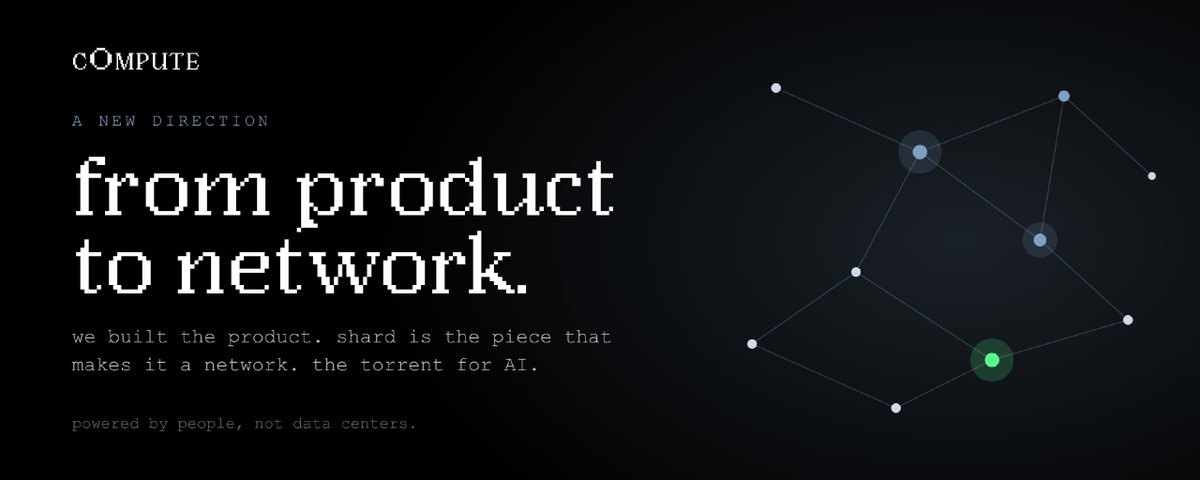 c0mpute says it has solved decentralized AI’s speed problem with Shard, enabling 744B-parameter models to run across distributed GPUs at usable inference speeds
Community notes
Spot something off or out of date? Drop a note. Editors review topic notes daily and roll accepted fixes into the explainer — contributors are recognized in the monthly $SQUID drop.
Loading notes…
Help improve this topic
Have a story or tip about this topic? Submit it. See something missing? Leave a note. Editors review daily; accepted submissions and fixes count toward the monthly $SQUID drop.