
In‑depth explainer on Dune, the on‑chain data platform powering crypto dashboards, stablecoin and DeFi analytics, ETF and hack forensics, and AI‑driven research across 100+ chains, plus its risks, limitations, and future outlook.
+4 sources across the wider coverage universe
 Dune cuts 25% of staff as CEO Fredrik Haga says AI tools now automate crypto dashboard creation and institutional data workflows2026-05
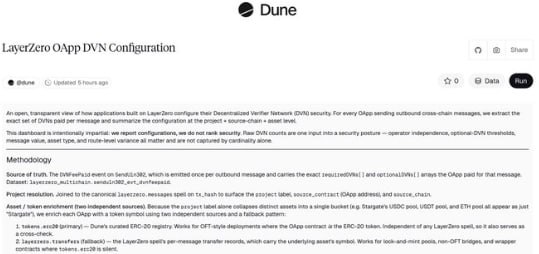 Dune maps DVN security across 2,665 LayerZero OApps post‑KelpDAO hack, revealing nearly half still run a risky 1‑of‑1 configuration despite growing calls for stronger multi‑verifier setups.2026-04
 Dune data confirms “Pendle Effect” as PT/YT markets drive token demand surges, boosting holders, supply, and capital inflows via yield tokenization and DeFi composability2026-05
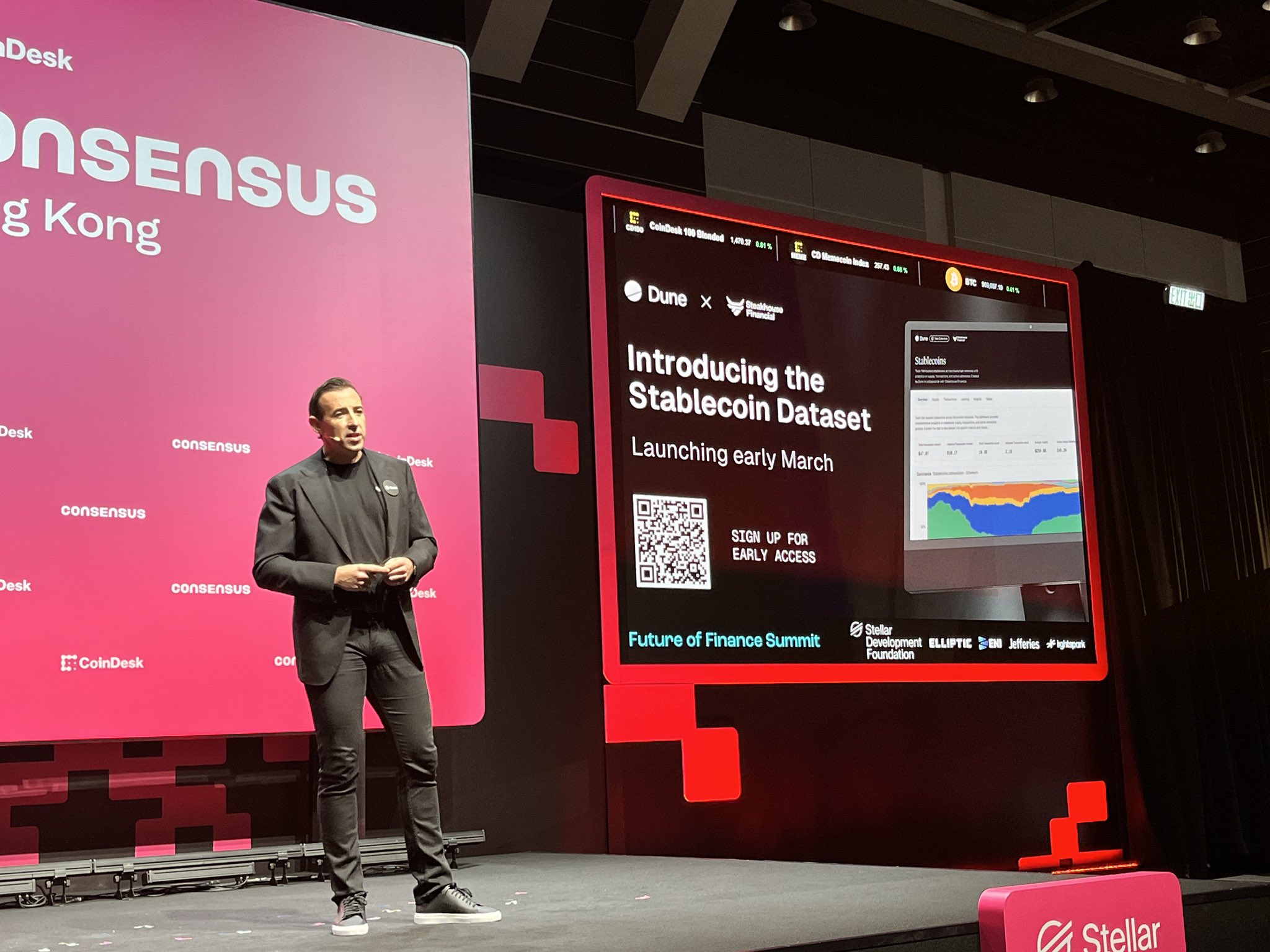 Non-USD stablecoins hit $1.2B supply and $300B+ in transfers across 200+ tokens, per first Visa-Dune stablecoin report2026-03
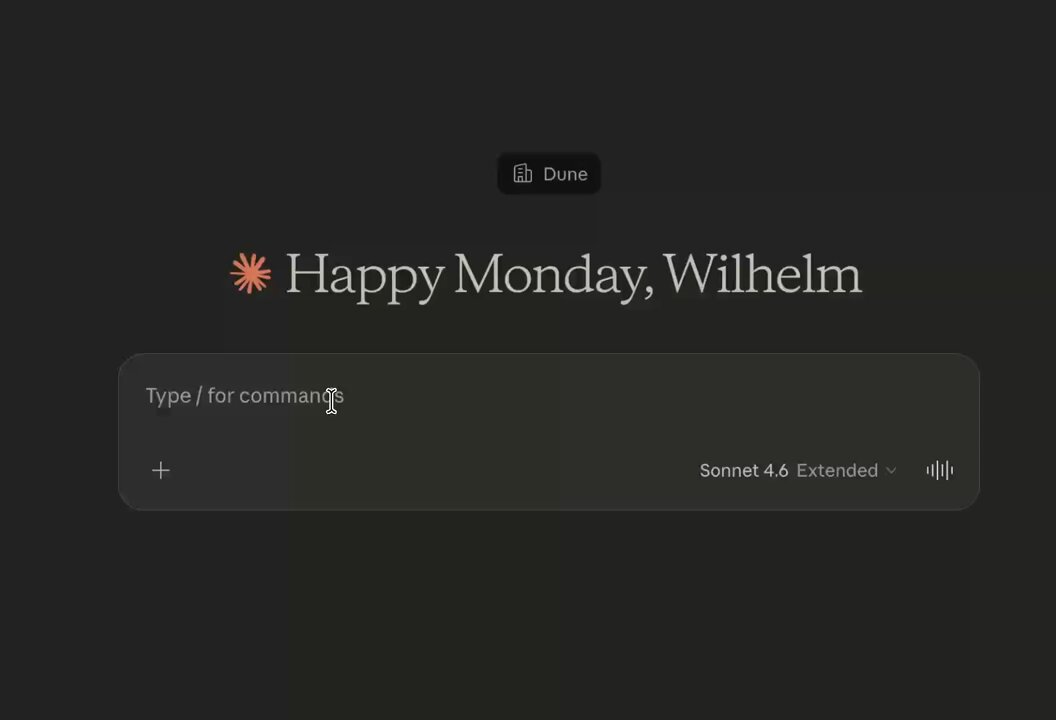 Dune launches Dune MCP, a new integration that lets users plug its crypto data platform directly into leading AI tools like Claude, ChatGPT, and Cursor to search tables, write queries, and build charts from a single prompt2026-03
 Balancer + Dune (Full report available): the largest analysis of LBP performance to date!2026-02
Dune: The On‑Chain Data Platform Powering Crypto Analytics
An on‑chain analytics platform, Dune (often still called Dune Analytics) aggregates, decodes, and organizes blockchain data from more than one hundred networks so that analysts, protocols, and institutions can query it with SQL, build interactive dashboards, and feed it into trading and research workflows. By turning low‑level transaction data into human‑readable tables and visualizations, Dune has become a de facto public data layer for much of crypto, underpinning work on stablecoins, markets, Ethereum, security incidents, and the broader convergence of TradFi and digital assets.
What Dune Is And Why It Matters
At its core, Dune is an on‑chain data platform: a service that ingests raw blockchain data, normalizes and decodes it, and exposes it through a query and visualization environment that behaves like a familiar business‑intelligence stack. Rather than requiring every team to run their own nodes, build bespoke ETL pipelines, and maintain protocol decoders, Dune centralizes that heavy lifting and lets users focus on analysis, dashboards, and downstream products. The platform is explicitly designed for crypto, which means its schemas, labels, and curated datasets are tuned to the patterns of DeFi, stablecoins, NFTs, prediction markets, and security‑sensitive infrastructure rather than generic web traffic or enterprise logs.
Originally known as “Dune Analytics,” the product gained traction as a community‑driven site where power users wrote SQL queries to analyze early DeFi protocols and shared dashboards openly, allowing anyone to fork and adapt them. Over time it has evolved into what the company now markets as an “onchain data platform for enterprise teams,” emphasizing uses by funds, protocols, and larger institutions alongside the grassroots analyst community. This dual identity is important in crypto’s information environment: while exchanges and trading firms often keep their internal data proprietary, Dune has become a widely used public reference that traders, researchers, journalists, and regulators can all look at when they want a neutral view of on‑chain activity.
Dune describes itself as “the all‑in‑one crypto data platform” that lets users query with SQL, stream data through APIs and its DataShare product, and publish interactive dashboards across more than one hundred blockchains. That “all‑in‑one” framing reflects how the platform tries to span the full analytics stack: storage, query engine, schema design, visualizations, scheduled refreshes, and now an AI layer that can write SQL and build charts from natural language prompts via the Dune MCP Server. For a crypto audience, this makes Dune a kind of Bloomberg terminal for on‑chain data, albeit one that is partially crowdsourced and pointed at public ledgers rather than private order books.
From the perspective of the wider ecosystem, Dune matters because it standardizes how crypto is measured. When analysts quote figures for stablecoin transfer volumes, DeFi TVL on a new L2, or ETF deposit flows, those numbers often originate from Dune dashboards or from research projects that use Dune as one of their primary data sources. This gives the platform outsized influence in how market narratives are framed: which assets appear large or small, which chains look like they are gaining traction, and how serious a security incident appears when plotted across time and counterparties.

Dune cuts 25% of staff as CEO Fredrik Haga says AI tools now automate crypto dashboard creation and institutional data workflows

Nansen cut 30% in 2023 and the cheap/free analyst crowd kept moving to Dune; now the same pressure is climbing up the stack. Dune’s 346 stablecoin SQL models across 38 chains and MCP access tell you where margin survives: curated labels, normalized transfers, freshness, and warehouse pipes into Snowflake/BigQuery, not one-off dashboards. If AI turns dashboard building into a commodity, the next fight is whether Dune can charge institutions for provenance and uptime without hollowing out the public wizard economy that made the data useful in the first place.
How Dune Works: Data, SQL, And Dashboards
Raw, decoded, and curated datasets
Dune’s value proposition rests on its data catalog, which is organized into raw, decoded, and curated datasets spanning more than one hundred blockchains. Raw data consists of low‑level entities such as blocks, transactions, logs, and traces, ingested directly from node infrastructure and indexed into queryable tables with minimal interpretation. This layer is closest to what you would see if you ran your own node and looked at RPC responses or block files, but it is normalized for consistency and performance across chains.
Decoded datasets sit one level up the stack and apply ABI information and protocol‑specific parsers to transactions and logs so that smart‑contract interactions become human‑readable, labeled events and function calls. Instead of a topic hash and a blob of hex, an analyst can query explicit fields such as “amount_in,” “amount_out,” “token0,” or “recipient” for a given DEX swap, or “collateral_asset” and “liquidation_amount” for a lending protocol event. This is especially important for ecosystems like Ethereum where a large share of economic activity happens in contract code rather than in simple balance transfers.
Curated datasets go further by aggregating and labeling data according to specific analytical needs. These include protocol‑level tables that calculate key metrics, wallet intelligence datasets that classify addresses by behavior, and thematic tables that combine activity across multiple protocols, such as stablecoin flows or prediction market positions. For example, Dune’s “Prediction Markets” dashboard and underlying data bring together positions, fees, and resolution information for venues including Polymarket and Kalshi, making it possible to compare liquidity and outcomes across different platforms in a unified schema. Similarly, curated stablecoin datasets aggregate token contracts and normalize metadata across dozens of chains, enabling cross‑asset, cross‑network views of supply and transfer activity that would be difficult to construct from raw logs alone.
A simplified way to think about these layers is summarized below.
| Dataset layer | Description | Typical crypto use case |
|---|---|---|
| Raw | Blocks, transactions, logs, traces with minimal interpretation. | Low‑level forensics, custom protocol decoders, validation of decoded data. |
| Decoded | Contract calls and events parsed into named fields using ABIs. | DeFi trading analysis, protocol‑specific KPIs, wallet interaction histories. |
| Curated | Aggregated, labeled, theme‑specific tables across protocols and chains. | Stablecoin market structure, prediction markets, cross‑chain user behavior. |
Because all three layers are exposed through the same SQL interface, teams can flexibly move between them: relying on curated tables for quick insight, then dropping into decoded or raw data when they need to verify assumptions or explore new protocols that are not yet fully abstracted.
Querying with SQL and performance considerations
Dune’s user interface is built around SQL queries that run against its warehouse, which behaves like a traditional relational database from the analyst’s point of view. Users can write queries directly in the web app, referencing tables from the data catalog, and immediately inspect the results, visualize them, and embed them into dashboard tiles. This design has made SQL literacy a valuable skill in the crypto research community, with many influential dashboards maintained by pseudonymous analysts who specialize in writing complex join and window‑function logic to derive new metrics.
The platform exposes typical relational primitives, but it also encourages performance‑oriented patterns that matter particularly for large blockchains. For example, documentation for Dune integrations on Sei, an EVM‑compatible chain, emphasizes the importance of limiting queries using date ranges, filtering on indexed columns such as block dates and addresses, and using aggregations at appropriate granularities to avoid scanning unnecessary data. Example queries in those docs show analysts grouping by weekly acquisition cohorts, filtering by successful transactions, and adding function‑signature filters when tracking specific in‑game actions or contract methods. These patterns generalize across chains: on Ethereum, a naive full‑history scan that ignores indexes or dates can be expensive, whereas a query restricted to specific tokens, contracts, or time windows is far more efficient.
Crucially, Dune queries can be parameterized and scheduled, making them suitable for both exploratory work and production reporting. A team might build a single parametrized query for DEX liquidity and then reuse it across dozens of dashboards or automated reports by changing only the token or chain parameters, rather than maintaining separate SQL scripts for each case. When combined with curated datasets, this makes it possible to maintain relatively complex analytics infrastructure with a small team, which is one reason why funds and DeFi protocols have gravitated toward Dune instead of building their own bespoke warehouses for everything.
Dashboards, visualization, and sharing
On top of its query engine, Dune provides a dashboarding layer where query outputs can be surfaced as charts, tables, and key performance indicator tiles. Dashboards can be public or private, can contain multiple visualizations derived from different queries, and support basic interactivity such as filtering by time range, token, or protocol where the underlying SQL has been written to accept parameters. For many crypto teams, these dashboards function as living reports: product managers track weekly active addresses, risk teams monitor liquidations and collateral distributions, and traders follow real‑time DEX volumes or ETF flows without having to inspect raw data.
The platform’s ethos of open sharing has made certain dashboards quasi‑canonical in the industry. For example, a widely used Dune dashboard tracks on‑chain deposits and withdrawals of addresses identified as custodians for Ethereum ETFs, giving a transparent view of flows into and out of ETF‑related wallets. Rather than relying solely on issuer press releases or TradFi filings, analysts can watch real‑time on‑chain movements that correspond to ETF creations, redemptions, and rebalancing. Similar dashboards exist for stablecoin flows, lending protocol health, and tokenized yield markets, often becoming reference points in market commentary and research threads.
Dune recently complemented dashboards with a refreshed API and DataShare capabilities, along with updated subscription plans and a new free tier, which allow users to pull query results directly into their own tools and applications. While the exact limits and tiers evolve over time, the general direction is clear: Dune is positioning itself not just as a web UI, but as a backend data service that developers can integrate into trading systems, research notebooks, and internal BI tools without scraping dashboards or manually exporting CSV files.
APIs, clients, and programmatic access
Programmatic access is increasingly central to how Dune is used in professional crypto workflows. The platform’s API supports querying pre‑saved queries and, in higher‑tier plans, executing parametrized queries directly, returning results in machine‑readable formats suitable for Python, R, or JavaScript environments. This allows quantitative researchers and data engineers to treat Dune as a managed warehouse and focus on modeling and visualization in tools they already use, such as Jupyter notebooks or internal dashboards.
Community‑maintained client libraries have emerged to streamline this process. A researcher at Paradigm, for example, has released a Python client that aims to be the “fastest and easiest” way to export data from Dune into local analysis environments, wrapping authentication, pagination, and query execution in a high‑level interface. In practice, this means an analyst can write a Dune query once, save it, and then embed it in reproducible research code that fetches fresh data on demand, blending on‑chain metrics with off‑chain indicators, order‑book data, or macroeconomic series.
Over time, this combination of dashboards and APIs has moved Dune closer to a hybrid model: part public analytics site, part institutional data infrastructure. For crypto markets that move around the clock and across chains, having a single source that provides both visual narratives and raw data feeds is increasingly valuable, especially for teams that do not want to operate and maintain their own full‑stack data pipelines.
The Dune MCP AI layer
The most recent architectural pillar is Dune’s MCP Server, which implements the Model Context Protocol so that compatible AI agents can connect directly to the full Dune data warehouse. According to Dune’s own announcement, the MCP server lets AI tools such as Claude, Cursor, and certain ChatGPT‑based environments search the data catalog, write SQL queries, run them, and even build charts from a single prompt. A promotional demo shows a conversational agent analyzing users and activity with curated and decoded datasets across major protocols, then returning both numerical summaries and visualizations.
In practice, this turns Dune into a kind of autonomous analyst backend: instead of a human writing SQL, the AI model receives a natural language instruction (“show weekly active stablecoin wallets on Ethereum and Solana”), inspects Dune’s schemas, drafts a query, executes it, and converts the result into a chart to embed back into the conversation. This has potentially profound implications for who can use on‑chain data. Teams that previously lacked SQL expertise—or relied on a small group of specialists—can now experiment with dashboards and analyses via chat interfaces, lowering the barrier to entry for non‑technical stakeholders.
It is worth noting that MCP support still depends on client implementation and rollout. Community discussions around MCP have highlighted that not all ChatGPT interfaces currently expose MCP integration, particularly some desktop clients. Nonetheless, the architectural direction is clear: Dune is betting that AI‑mediated analytics will be a core part of how crypto data is consumed, and it is restructuring both its technical stack and its workforce accordingly.
Leviathan readers click Dune not for exploration but for settlement — every top headline uses a Dune dashboard as an external audit receipt to confirm a contested claim (ETF inflows are real, a hack's scope is verified, stablecoin growth is quantified), revealing that the platform's primary reader value is as an on-chain fact-checker, not a general analytics tool.
Multi‑Chain Coverage: From Ethereum To Flow And New L2s
Ethereum and the EVM ecosystem
Dune’s earliest and deepest coverage is in the Ethereum ecosystem, where the majority of DeFi and NFT experimentation has historically taken place. Ethereum mainnet, major L2s, and EVM‑compatible sidechains provide rich transaction histories and complex smart‑contract interactions that are well‑suited to Dune’s decoded and curated datasets. Decentralized exchanges, lending protocols, liquid staking tokens, and NFT marketplaces all emit events that can be parsed into granular tables, making it possible to measure everything from swap routing patterns to NFT wash trading.
As the EVM universe has expanded, Dune has followed. It now indexes a range of Ethereum L2s and EVM‑compatible networks, creating a unified query plane for what is effectively a multi‑chain execution environment. A recent example is Etherlink, an EVM‑compatible L2 that integrated with Dune so that its on‑chain activity is fully indexed and accessible via Dune’s SQL interface. With this integration, developers, traders, and researchers can inspect every transaction, block, and market interaction on Etherlink in real time, applying the same queries and dashboards they use for other EVM chains.
Another case is RISE, an Ethereum L2 designed for high‑performance decentralized finance, which is now live on mainnet and fully integrated with Dune. Because RISE is engineered for high throughput—advertising six‑figure transactions‑per‑second capacity—traditional block explorers alone are insufficient for understanding its DeFi landscape. Dune’s integration allows users to slice that activity by protocol, asset, and user cohort, supporting both trading strategies and stress tests of the network’s liquidity and stability.
Flow and app‑specific L1s
Dune’s expansion is not limited to EVM chains. It has also integrated Flow, a Layer 1 blockchain designed for mass‑market applications such as games and consumer NFTs, which uses its own Cadence smart‑contract language alongside an EVM layer. The Flow integration indexes on‑chain activity across both Flow EVM and native Cadence contracts, transforming raw transactions and contract deployments into analytics‑ready tables that capture DeFi usage, user growth, and real‑world adoption patterns.
This move is notable because Flow has faced persistent questions about scalability, user retention, and the depth of its on‑chain economy compared with more DeFi‑centric chains. By bringing Flow into the same analytical environment as Ethereum and its L2s, Dune makes it easier to compare actual usage across ecosystems rather than relying on marketing claims or isolated metrics. Analysts can, for instance, measure how many unique wallets interact with Flow‑based games or NFT collections over time, compare those cohorts to equivalent metrics on Ethereum or Polygon, and see whether Flow’s narrative of “mass‑market apps” is borne out in the data.
Dune has applied a similar approach to other app‑focused chains. The Sei documentation for Dune integration, for example, frames the platform as an invaluable tool for game developers who want to track player acquisition, in‑game actions, retention cohorts, and monetization on‑chain using SQL queries and dashboards. With consistent schemas and best‑practice guidance—such as always including date filters, filtering on indexed columns first, and carefully defining what counts as a “user”—Dune essentially provides a shared analytical grammar for very different chains and application types.
Stablecoins as a multi‑chain stress test
Perhaps the clearest illustration of Dune’s multi‑chain reach is its role in stablecoin analytics. A joint report by Dune and Artemis on the state of stablecoins in 2025 found that aggregate stablecoin supply had reached roughly 214 billion dollars, with estimated yearly transfers around 35 trillion dollars, roughly double the annual volume of Visa’s card network at the time. The report highlighted how centralized exchanges (CEXs) held the largest share of stablecoin liquidity, while decentralized finance protocols—including DEXs, lending protocols, and yield strategies—accounted for the majority of transfer volume. It also showed that active stablecoin wallets had grown by more than half in the prior year, from roughly 19.6 million to over 30 million, underscoring how widespread stablecoin usage had become across chains.
More recent Dune‑based analyses suggest that this trend has only intensified. Internal dashboards and research using Dune data show more than 200 trackable stablecoins across 37 chains, with an aggregate market capitalization exceeding 320 billion dollars and monthly transfer volumes that topped 10 trillion dollars in January 2026, the highest level since the spring 2022 market peak. Within those flows, decentralized exchanges account for more than half of the value transferred, while centralized exchanges still hold on the order of 80 billion dollars of stablecoin balances, making them crucial liquidity hubs for both crypto‑native and fiat‑on‑ramp activity.
However, work by McKinsey using Artemis analytics—drawing on similar on‑chain data sources—illustrates why raw Dune stablecoin volumes must be interpreted cautiously. When the analysts attempted to isolate “true” payments—stablecoin transfers that correspond to end‑user transactions rather than internal exchange reshuffling or DeFi loop activity—they estimated annual stablecoin payment volume in 2025 at around 390 billion dollars, or roughly 0.02 percent of global payment volume. In other words, the trillions of dollars of stablecoin transfers captured in Dune’s dashboards reflect a mixture of trading, collateral shuffling, bridging, and internal treasury moves, alongside emerging real‑economy payments. For stablecoins, Dune excels at measuring where and how tokens move, but domain expertise is required to interpret which flows represent genuine economic usage.
Prediction markets and the TradFi–crypto boundary
Another emerging area where Dune’s multi‑chain datasets matter is prediction markets and the broader convergence of TradFi and crypto markets. Dune has curated prediction‑market data across platforms such as Polymarket and Kalshi, unifying shares, resolution prices, and fee structures into a common schema. This makes it easier to study how prediction markets react to macro events, regulatory decisions, or corporate actions across both on‑chain and regulated venues.
For instance, where traditional exchanges might list binary options or structured products tied to political outcomes, on‑chain markets like Polymarket host user‑created markets on everything from election results to economic indicators, with liquidity pools that can be analyzed in detail via Dune. At the same time, regulated platforms such as Kalshi operate under CFTC oversight but can have their key metrics, such as open interest and fee patterns, folded into Dune dashboards alongside purely on‑chain protocols. Research produced with Dune has explored how these markets price risk around major events and how liquidity and participation compare to more conventional derivatives, contributing to debates on whether prediction markets provide superior forecasting or are primarily speculative.
Dune data has also been used to analyze TradFi–crypto convergence in more direct ways. One high‑profile example comes from Binance Wallet’s SpaceX IPO subscription, where Dune dashboards showed that around 557 million dollars in funds were committed by roughly 27,700 on‑chain addresses, with the vast majority of participants contributing relatively small tickets in the twenty‑thousand‑dollar‑and‑under range. That pattern suggested broad retail interest in tokenized access to a marquee private‑market deal, even if ultimate ownership of the underlying equity remained tightly intermediated. Combined with dashboards for Ethereum ETF flows and tokenized Treasury products, these use cases illustrate how Dune is becoming a lens on the gradual financialization of crypto rails by traditional financial products and issuers.

Dune maps DVN security across 2,665 LayerZero OApps post‑KelpDAO hack, revealing nearly half still run a risky 1‑of‑1 configuration despite growing calls for stronger multi‑verifier setups.
Security, Hacks, And Risk Monitoring
Why on‑chain data matters for incident response
Crypto markets are uniquely transparent: when a security incident or exploit occurs, the entire sequence of transactions is recorded on‑chain. The challenge is not observing that something happened, but reconstructing a coherent narrative from thousands of addresses and contract calls. Dune’s structured datasets and visualization tools make it a natural environment for post‑mortem analysis of hacks and for proactive monitoring of vulnerable infrastructure.
In the aftermath of major incidents, analysts frequently turn to Dune to trace stolen funds, identify related wallets, and monitor attempts to launder assets through mixers or cross‑chain bridges. Because Dune’s decoded and curated tables already parse common DeFi primitives, constructing a trace can be as simple as filtering for transfers relating to a particular exploit contract or following token movements from the victim protocol’s address to exchanges and other endpoints. Once the relevant queries are written, they can be turned into dashboards that update in real time, serving both as investigative tools and as public transparency reports.
Visualizing hacks: the case of wallet and bridge exploits
A widely cited example of Dune’s role in incident visualization is the Atomic Wallet hack, where a dashboard built by security researcher Taylor Monahan mapped the flow of stolen funds across chains and services. By using Dune’s multi‑chain data and decoded transfers, the dashboard showed how the attacker consolidated funds, routed them through bridges, and attempted to cash out via exchanges, providing a clear visual narrative for users, media, and investigators trying to understand the scale and mechanics of the exploit.
Similar dashboards have been constructed for bridge‑related incidents, where attackers exploit vulnerabilities in cross‑chain messaging or validation to mint unbacked tokens or reroute assets. In such cases, Dune’s ability to join data across multiple chains is crucial: an exploit might begin on an Ethereum smart contract, manifest as unbacked tokens on a destination chain, and then spread through secondary lending and DEX positions. With curated data on bridges, DEXs, and lending protocols, an analyst can reconstruct the full contagion path, highlighting which protocols and user cohorts are affected and how much value is at risk at each step.
Mapping DVN security and infrastructure risk
Dune has also been used to study infrastructure risk beyond direct hacks. Following the KelpDAO incident, where questions arose about the security assumptions of LayerZero’s cross‑chain messaging architecture, researchers used Dune to map Decentralized Verifier Network (DVN) configurations across thousands of LayerZero‑enabled applications. A widely circulated Dune dashboard cataloged around 2,665 so‑called “OApps” and found that nearly half still operated with a risky 1‑of‑1 verifier configuration, meaning that a single verifier failure or compromise could put the application at risk.
By aggregating DVN setups into a single view, the dashboard turned what would otherwise be obscure configuration details into an actionable risk landscape. Protocol teams, auditors, and users could see at a glance which applications had upgraded to stronger multi‑verifier configurations and which remained exposed, adding pressure on laggards to harden their setups. This is an example of how Dune’s curated datasets and community dashboards can indirectly improve security, not by preventing vulnerabilities but by making them legible and reputationally costly to ignore.
Risk dashboards for protocols and institutions
Beyond incident‑specific work, many protocols and institutional players use Dune for ongoing risk monitoring. DeFi protocols maintain dashboards tracking collateral distributions, liquidation thresholds, exposure to particular assets, and the health of insurance funds, often drawing from both raw and curated datasets. Centralized exchanges and custodians build internal dashboards that monitor stablecoin inflows and outflows, concentration of counterparty exposure, and unusual activity patterns across their on‑chain wallets.
In stablecoin markets, Dune dashboards that track yields across different tokens and chains are used by treasuries and DAOs to allocate reserves, but they also reveal where risk is pooling in the system. For instance, a dashboard that ranks stablecoin yields by protocol and chain can highlight when unusually high yields are driven by thin liquidity, mercenary incentives, or repeated rehypothecation within the same ecosystem—a pattern that has historically preceded instability. By making such patterns visible, Dune becomes part of the risk‑management apparatus, even though it does not perform custody or protocol‑level security itself.
- 01ETF inflow real-time tracking↗
Readers wanted live, verifiable proof that institutional ETH ETF demand was materializing — hildobby's dashboard became the go-to audit trail for a high-stakes market debate.
- 02Hack forensics and visualization
The Atomic Wallet hack dashboard by Taylor Monahan demonstrated that on-chain data can reconstruct an exploit's full blast radius, pulling readers seeking accountability rather than just breach headlines.
- 03Stablecoin market intelligence↗
Multiple high-click headlines used Dune to surface non-obvious stablecoin facts — non-USD supply crossing $1.2B, $10T January transfer volumes, 200+ tokens across 37 chains — giving readers data points that reframed scale.
- 04Developer tooling and API access
Paradigm's Python client and Dune's updated API tier drew clicks from builders wanting programmatic access to on-chain data without bespoke infrastructure.
- 05AI integration replacing SQL analysts↗
Dune MCP's launch and the 25% layoff announcement landed close together, framing a single story about AI automating the dashboard-creation workflow that Dune built its user base around.
- 06DeFi protocol security and tokenomics audits
Dashboards mapping LayerZero DVN risk, veAERO lock concentration, Balancer LBP performance, and the Pendle yield-tokenization effect attracted readers using Dune data to stress-test specific protocol designs.
Community Dashboards, Research, And Governance
Open dashboards as a public good
One of Dune’s defining features is its culture of open dashboards and public queries. Many of the most influential dashboards in crypto are built by independent analysts who are not paid by protocols or institutions but share their work openly, sometimes monetizing indirectly via grants or reputation. Dune’s interface encourages this by making queries forkable: any user can copy an existing query, adapt it to new tokens or chains, and build new dashboards on top.
This has created a kind of public data commons. Dune dashboards for key DeFi protocols often provide better transparency than the protocols’ own official sites, especially when it comes to granular usage metrics, cohort analyses, or nuanced tokenomics effects. For instance, a Dune dashboard examining the “Pendle Effect” showed how principal and yield token markets on Pendle drove surges in demand for underlying tokens, boosting holder counts, circulating supply, and capital inflows via yield tokenization and DeFi composability. By making those dynamics visible, the dashboard influenced how traders and governance participants understood Pendle’s impact on the broader ecosystem.
Tokenomics, governance, and DAO decision‑making
Dune is particularly influential in the domain of tokenomics and governance, where on‑chain metrics often determine the success of incentive programs and protocol upgrades. A prominent example is the Aerodrome protocol on Base, where a Dune dashboard and accompanying analysis thread examined the distribution and lock behavior of veAERO governance tokens. The data showed that nearly all veAERO supply was locked for the maximum duration, a pattern with significant implications for voting power concentration, liquidity incentives, and long‑term protocol control.
Such dashboards are not merely descriptive. They are frequently cited in governance forums and proposal discussions, where participants debate the merits of changing reward schedules, adjusting emissions, or modifying lock‑up mechanics. Because the underlying queries are public, other community members can verify the analysis, extend it, or challenge assumptions, leading to more informed and transparent decision‑making. In effect, Dune acts as a shared measurement layer for DAO politics.
Deep‑dive research: Balancer LBPs and stablecoins
Beyond short dashboards and threads, Dune underpins more formal research products. A collaboration between Balancer and Dune resulted in one of the largest analyses of Liquidity Bootstrapping Pools (LBPs) to date, using Dune data to study price discovery, liquidity dynamics, and participant behavior across many LBP launches. The study helped teams understand how different parameter choices—such as starting prices, weight schedules, and duration—affected outcomes, and provided empirical grounding for best‑practice recommendations for token launches that aim to avoid extreme volatility or manipulation.
Similarly, the Dune‑Artemis “State of Stablecoins 2025” report used Dune’s multi‑chain curated datasets as a foundation for a comprehensive view of stablecoin supply, velocity, user growth, and chain‑by‑chain adoption. It complemented other work, such as the Visa‑Dune report on non‑USD stablecoins, which found that these non‑dollar tokens had reached roughly 1.2 billion dollars in supply and more than 300 billion dollars in transfers across over 200 tokens, even though they remained a small fraction of the overall market. Together, these efforts illustrate Dune’s role not just as a dashboarding tool but as a core empirical resource for academic‑style research on crypto markets.
Education and onboarding
Dune has also invested in educational content to help bring new analysts into the ecosystem. Beginner‑oriented resources describe it as an “all‑in‑one crypto data platform” and walk users through querying with SQL, streaming data via APIs and DataShare, and publishing interactive dashboards across more than one hundred blockchains. Chain‑specific documentation, like the Sei developer guide, provides concrete SQL examples tailored to particular use cases such as game analytics or DeFi metrics, while emphasizing general best practices like date filtering and index awareness.
For the crypto community, these materials lower the barrier to entry for serious data work. Instead of needing a background in data engineering, a motivated analyst can learn enough SQL and Dune’s schema conventions to begin producing useful insights and dashboards, contributing to a virtuous cycle where more public analysis attracts more users and, in turn, more data‑driven discourse around protocols, stablecoins, and markets.
Dune data confirms “Pendle Effect” as PT/YT markets drive token demand surges, boosting holders, supply, and capital inflows via yield tokenization and DeFi composability
AI, Automation, And The Changing Role Of Crypto Data Teams
From manual SQL to AI‑assisted analysis
For much of its history, Dune catered primarily to SQL‑literate power users. Protocols and funds often hired specialist data engineers or analysts whose primary job was to write and maintain complex queries, build dashboards, and act as internal interpreters of on‑chain data. This labor model mirrored traditional finance and enterprise BI, where dedicated analytics teams support decision‑makers by translating questions into data workflows.
The introduction of the Dune MCP Server and AI‑agent integrations represents a potential shift in that model. With MCP, Dune exposes its data catalog and query engine to AI models that can understand natural language instructions, convert them into SQL, execute the queries, and present the results as charts or summaries. In principle, this allows product managers, traders, or even governance participants with no SQL knowledge to obtain non‑trivial analyses by simply conversing with a chatbot, at least for well‑covered datasets where the schemas and metrics are well understood.
This development parallels broader trends in the BI world, where AI‑driven tools are increasingly able to build dashboards, forecast metrics, and suggest visualizations automatically. A typical pattern in those platforms is that users upload a dataset, ask natural‑language questions, and receive interactive dashboards with theming, global filters, and cross‑filtering behavior configured automatically. Dune’s MCP integration is essentially the crypto‑specific analog: the data is already there, and AI becomes the front‑end query author and dashboard builder.
Workforce restructuring and Dune’s layoffs
Dune itself has explicitly linked this AI shift to changes in its own workforce. In 2026, the company cut roughly 25 percent of its staff in a restructuring that CEO Fredrik Haga attributed directly to the capabilities of Dune MCP. In public comments, Haga argued that teams and agents can now build dashboards and workflows on Dune without needing to know SQL, reducing the need for in‑house specialist roles focused solely on query and dashboard construction. This echoed a broader pattern across the tech and fintech sectors, where firms from payments processors to blockchain foundations have cited AI automation as a factor in significant headcount reductions.
The move was controversial within the data and crypto communities, both as an indicator of how quickly AI is being operationalized and as a signal about the future of analytics careers. On the one hand, automation of rote query‑writing could free human analysts to focus on domain expertise, modeling, and strategic interpretation. On the other, it risks devaluing mid‑level roles that historically served as entry points into deeper quantitative work, potentially concentrating expertise and control in smaller, more senior teams.
Implications for analysts, funds, and protocols
For crypto‑native organizations that depend on Dune, the rise of AI‑assisted analytics has mixed implications. Funds and trading firms stand to benefit from faster iteration: if AI can draft reasonable baseline queries and dashboards, human quants can spend more time refining edge cases, integrating off‑chain data, and testing hypotheses. Protocol teams may be able to empower product and community managers to self‑serve analytics questions that previously required the data team’s time.
However, there are also new risks. AI‑generated SQL can be brittle or misleading if the underlying schemas are poorly understood or if the model overfits to spurious correlations. Because on‑chain data is full of edge cases—airdrop farming, MEV activity, wash trading, exploit patterns—analyses that look plausible at a glance may fail under scrutiny when they encounter adversarial behavior. This makes human oversight and domain knowledge more important, not less, particularly when the outputs are used to inform governance decisions, risk limits, or public communications.
From a market‑structure perspective, the combination of Dune’s curated datasets and AI interfaces could democratize access to high‑quality analytics, narrowing the informational advantage that sophisticated players enjoy over retail users or smaller funds. At the same time, it may incentivize larger institutions to move more of their proprietary data into environments that can be queried by AI agents, further blurring the line between public and private analytics. In all cases, Dune sits at the nexus of these developments, both as a beneficiary of AI and as a company forced to adapt its products, business model, and staffing to an AI‑rich environment.
- 2023-06milestone
Atomic Wallet hack dashboard published by Taylor Monahan
- 2023-10launch
Paradigm releases cryo Python client for Dune data export
Hildobby ETH ETF inflow dashboard goes live post-spot ETF launch
Dune and Artemis publish State of Stablecoins 2025 report
- 2025-03milestone
First Visa-Dune stablecoin report: non-USD supply hits $1.2B, $300B+ transfers
Dune data records $10T stablecoin transfer volume — highest since April 2022
Dune MCP launched, enabling AI tools (Claude, ChatGPT, Cursor) to query on-chain data directly
Dune cuts 25% of staff, citing AI automation of dashboard and workflow creation
Limitations, Caveats, And Best Practices
Volume versus utility: reading Dune metrics critically
One of the most important caveats in using Dune is that not all volume is equal. As the stablecoin example shows, on‑chain transfer volumes can reach tens of trillions of dollars annually, but a large share of that activity reflects internal exchange movements, DeFi loops, and arbitrage rather than genuine end‑user payments. The McKinsey analysis that estimated around 390 billion dollars in “true” stablecoin payments in 2025—just 0.02 percent of global payments—underscores how raw Dune volumes can significantly overstate real‑economy adoption if interpreted naively.
Similar issues arise in DeFi and NFT markets. A DEX may show high nominal volumes on Dune dashboards, but if most of that volume is generated by wash traders chasing incentive programs or by bots arbitraging between pools, the effective liquidity available to organic users may be far lower than the numbers suggest. NFT marketplaces, too, have seen inflated volumes due to wash trading and loan‑driven cycling of assets, which can give a misleading impression of genuine demand if not properly filtered. Analysts using Dune must therefore combine quantitative metrics with qualitative understanding of protocol mechanics and incentive design.
Data coverage, indexing, and schema evolution
Dune’s data catalog is broad but not omniscient. While it covers more than one hundred blockchains with raw, decoded, and curated datasets, coverage of individual protocols can vary, particularly for newer or more experimental projects. Some contracts may be ingested only as raw logs until decoders are written and curated tables are designed, meaning that analysis of those protocols requires more manual effort and may lack the convenience of standardized metrics.
Moreover, schemas evolve. As protocols upgrade or add new features, Dune’s decoded and curated tables may change structure, potentially breaking existing queries or altering the meaning of historical metrics if not handled carefully. Versioning and documentation mitigate some of this risk, but analysts must still be vigilant about relying on metrics whose definitions may have shifted over time.
Indexing lag is another consideration. While Dune aims for near real‑time coverage, there can be delays in ingesting and decoding activity on some chains, especially during periods of congestion or when network changes require pipeline adjustments. For high‑frequency trading or risk‑critical use cases, this means Dune data should be complemented with direct node access or specialized infrastructure rather than treated as a definitive, low‑latency source of truth.
Privacy and ethical considerations
Because Dune builds on inherently transparent blockchains, it participates in a delicate balance between insight and privacy. Most public dashboards analyze activity at the address or protocol level without explicitly deanonymizing individuals, but in principle, combining on‑chain data with off‑chain information could lead to intrusive profiling. As Dune and similar platforms make it easier to perform wallet intelligence and cohort analysis, the line between legitimate market research and privacy‑eroding surveillance can blur.
Crypto’s pseudonymous norms compound this tension. Many users rely on the difficulty of linking addresses to identities in practice, even though all transactions are public in theory. As Dune’s curated and AI‑accessible datasets make address‑level behavior more legible, there is growing debate about the ethics of wallet labeling, the responsibilities of analysts, and the potential need for norms or guidelines around what kinds of aggregations and inferences are acceptable in public dashboards versus private research.
Practical guidance for responsible use
Despite these caveats, Dune remains one of the most powerful tools available for understanding on‑chain behavior—provided it is used responsibly. Documentation and beginner guides emphasize best practices that also serve as guardrails against misuse or misinterpretation. These include scoping queries with clear date ranges, filtering on indexed columns like block date and address for performance and relevance, and aligning analytical definitions with protocol realities rather than arbitrary thresholds.
For new users, a pragmatic path is to start with well‑regarded curated dashboards—for example, stablecoin overviews, leading DEX and lending protocol dashboards, or trusted ETF and tokenomics views—and inspect the underlying queries to understand how experienced analysts define key metrics. From there, users can adapt those queries to new contexts, gradually moving down the stack into decoded and raw data as their understanding deepens. Combining this bottom‑up learning with top‑down domain context about crypto markets, stablecoins, Ethereum, and security practices yields analyses that are both technically grounded and economically meaningful.
Outlook
Dune sits at a crossroads in the evolution of crypto data. On one axis, it is expanding horizontally across chains and asset classes, integrating networks like Flow, Etherlink, RISE, and Sei alongside its deep coverage of Ethereum and EVM ecosystems. This multi‑chain reach enables genuinely comparative research on where real activity is happening, whether in stablecoins, DeFi, NFTs, gaming, or emerging prediction markets. On another axis, it is pushing vertically into AI‑mediated analytics through its MCP Server, reshaping both its product and its internal organization around the idea that natural‑language interaction with on‑chain data will become standard.
For crypto markets, this trajectory suggests that on‑chain transparency will only become more powerful and more accessible. Stablecoin reports, ETF flow dashboards, tokenomics analyses, and exploit forensics built on Dune will continue to inform how traders, protocols, regulators, and the public understand the health and risks of the crypto ecosystem. At the same time, the very ease of generating charts and narratives raises the bar for critical literacy: distinguishing between meaningful signals and AI‑generated noise will be an ongoing challenge.
If crypto continues to integrate with traditional finance—through tokenized securities, on‑chain prediction markets for macro events, and regulated stablecoin payment rails—platforms like Dune will become crucial infrastructure for both sides of the divide. They will provide the shared empirical substrate on which debates about regulation, systemic risk, and innovation are conducted. The degree to which Dune can maintain methodological transparency, manage AI responsibly, and steward its community of open‑data contributors will go a long way toward determining whether that substrate supports genuine insight or merely amplifies the latest narrative cycle.
Latest Dune news
Dune cuts 25% of staff as CEO Fredrik Haga says AI tools now automate crypto dashboard creation and institutional data workflowsDune maps DVN security across 2,665 LayerZero OApps post‑KelpDAO hack, revealing nearly half still run a risky 1‑of‑1 configuration despite growing calls for stronger multi‑verifier setups.Dune data confirms “Pendle Effect” as PT/YT markets drive token demand surges, boosting holders, supply, and capital inflows via yield tokenization and DeFi composabilityNon-USD stablecoins hit $1.2B supply and $300B+ in transfers across 200+ tokens, per first Visa-Dune stablecoin reportDune launches Dune MCP, a new integration that lets users plug its crypto data platform directly into leading AI tools like Claude, ChatGPT, and Cursor to search tables, write queries, and build charts from a single promptBalancer + Dune (Full report available): the largest analysis of LBP performance to date!Sources
18 records from 11 domains
dune.com
community.openai.com
crowdfundinsider.com
- crowdfundinsider.com· 2026 / 06 / 286400-dune-analytics-integrates-flow-an-l1-blockchain-for-mass-marke…
- crowdfundinsider.com· 2026 / 05 / 280707-ethereum-virtual-machine-compatible-l2-etherlink-integrates-wi…
- crowdfundinsider.com· 2026 / 05 / 277744-ethereum-l2-rise-now-live-on-mainnet-on-dune-analytics
crypto.news
altcoinbuzz.io
mckinsey.com
x.com
docs.sei.io
docs.dune.com
alchemy.com
youtube.com
Community notes
Spot something off or out of date? Drop a note. Editors review topic notes daily and roll accepted fixes into the explainer — contributors are recognized in the monthly $SQUID drop.
Loading notes…
Help improve this topic
Have a story or tip about this topic? Submit it. See something missing? Leave a note. Editors review daily; accepted submissions and fixes count toward the monthly $SQUID drop.