
Explainer on what “hacker” means in crypto today, covering black-, white- and gray-hat roles, DeFi and bridge exploits, DPRK campaigns, AI-augmented attacks, malware and scams, plus practical security lessons for users, builders and institutions.
+12 sources across the wider coverage universe
 CertiK CEO warns AI is giving DeFi hackers an edge as attackers automate exploits, target supply chains, and overwhelm defenders across an increasingly vulnerable crypto ecosystem2026-05
 Whitehat hacker returns $190K out for $209K to Renegade protocol after exploiting flawed Arbitrum dark pool contract, keeping 10% bounty to avoid legal action2026-05
 OneKey's Yishi on KelpDAO hack: 10-15% hacker bounty, LayerZero fund, Aave backstop — don't cut WETH depositors2026-04
 Researchers uncover how hackers used over 34 fake npm, PyPI and Rust packages in “TrapDoor” attack targeting Solana, Sui and Aptos developers to steal wallets and cloud credentials2026-05
 Chainalysis signs KNPA deal to train Korean police after DPRK hackers stole over $2B in 20252026-06
 Cardano wallet provider SecondFi will shut down after hackers stole $2.4M in ADA by exploiting a transaction-signing flaw that exposed users' private keys2026-07
Hacker in Crypto: Meaning, Methods, and Modern Threats
A hacker in crypto is an individual or group that uses technical or social engineering skills to gain an advantage over digital systems managing cryptocurrencies and blockchains, whether for malicious theft, legitimate security research, or something in between. In the digital asset ecosystem, hackers now range from idealistic white hats and protocol auditors to financially motivated cybercriminals and state-sponsored teams that routinely move hundreds of millions of dollars in Bitcoin, ETH, stablecoins, and other tokens across borders.
Origins and Meaning of “Hacker” in a Crypto Context
The word hacker predates Bitcoin by decades, emerging in computing subcultures to describe people who “hacked” clever solutions together or pushed hardware and software beyond intended limits. Over time, mainstream usage shifted toward describing anyone who breaks into computer systems, with motives ranging from harmless curiosity to outright cybercrime. In the context of cryptocurrencies, that older sense of deep technical tinkering survives in open-source communities and security research, but it co-exists with a harsher reality: hackers are now among the most powerful market actors, capable of causing multibillion-dollar losses, triggering market crashes, or rescuing stranded funds through sophisticated interventions. This duality makes “hacker” a loaded term in crypto, encompassing both existential threat and indispensable security skillset at once.
Modern cybersecurity definitions focus on unauthorized access as the core of hacking, and this framing maps neatly onto the crypto stack. Cisco, for example, defines a hacker as someone who breaches defenses to gain unauthorized access to devices or networks, taking advantage of technical vulnerabilities or weak security practices. Splunk distinguishes between different hacker “hats” based on intent and authorization, separating criminals from ethical security professionals and ambiguous gray-hat actors. In crypto, that spectrum extends from ransomware operators and DeFi exploiters to auditors and white-hat rescuers who actively break systems under contract or in order to prevent greater harm.
The rise of cryptocurrencies intensified the stakes of hacking by making digital assets both programmable and instantly transferable. In traditional finance, getting away with theft at scale often required insider access, elaborate money-mule networks, or slow offshoring schemes. On-chain, a single private key or misconfigured smart contract can unlock hundreds of millions of dollars in ETH or USDC in minutes, and blockchain settlement makes those transfers irreversible in practice. This direct linkage between code and capital transformed hackers from peripheral threats into central protagonists of crypto’s story, shaping everything from protocol design and regulation to public perception of the industry.
Culturally, hackers occupy a mythic place within crypto, reflecting both the cypherpunk ideal of individuals subverting centralized systems and a darker archetype of shadowy figures emptying bridges and exchanges. Early in Bitcoin’s history, technically sophisticated users who understood the protocol and its security model accumulated large positions when coins were extremely cheap, in some cases becoming multimillionaires as prices rose. FinanceFeeds notes that several such early adopters effectively leveraged their hacking and security backgrounds to understand and trust Bitcoin before the broader market could, demonstrating the positive side of technical “hacker” expertise. At the same time, notorious incidents such as the 2011 Mt. Gox flash crash—where a compromised auditor account dumped Bitcoin from around 17.50 dollars to 0.01 dollars in minutes—cemented the idea that a single hacker could destabilize an entire market.

North Korean hackers move tens of millions through Hyperliquid as US officials weigh onshoring the platform


Deadly set of hackers that needs to be stopped. One just don't want to cross paths with them
Types of Hackers and Their Motives in Crypto
Within cybersecurity, hackers are often classified by “hat color” to capture their intentions and legal status, and this taxonomy is especially useful in the crypto ecosystem. Black-hat hackers are those who exploit systems illegally for personal gain, often stealing assets, installing malware, or extorting victims. White-hat hackers, or ethical hackers, use similar techniques with permission or with the explicit purpose of hardening systems and protecting users, typically operating under contracts, bug bounty programs, or community mandates. Gray-hat hackers straddle these categories, probing systems without authorization but sometimes disclosing vulnerabilities, negotiating bounties, or even returning funds after an exploit. In crypto, one must add a further category: state-sponsored or advanced persistent threat (APT) groups that use blockchain exploits and infrastructure compromises as tools of national strategy.
A simple way to frame these roles in the digital asset world is to compare their authorization, intent, and typical on-chain behavior:
| Hacker type | Intent and legality | Typical crypto activities | Illustrative example |
|---|---|---|---|
| Black hat | Illegal, profit-driven, no authorization | Exchange hacks, DeFi exploits, ransomware, cryptojacking, wallet drains | North Korean TraderTraitor group stealing funds from Bybit and DeFi bridges |
| White hat | Authorized or benevolent, focused on defense | Penetration testing, audits, rescue of trapped funds, responsible disclosure | Pseudonymous hacker recovering locked ETH from a faulty ICO contract and returning it to users |
| Gray hat | Unauthorized access but sometimes benevolent outcomes | Unsolicited exploits followed by negotiation, partial fund returns, public disclosures | Exploiters who demand a “bounty” after draining funds, offering to return most of the loot |
| State-sponsored/APT | Geopolitical or sanctions-evasion motives, highly resourced | Large-scale exchange and bridge hacks, spear-phishing of devs, laundering via mixers | Lazarus Group’s KelpDAO bridge exploit and other DPRK-linked operations |
Black-hat hackers dominate headlines because their activities cause direct losses. They may deploy ransomware, steal customer databases, plant cryptojacking malware that silently mines coins on compromised devices, or exploit vulnerabilities in smart contracts to drain DeFi protocols. The U.S. Federal Trade Commission (FTC) emphasizes that scammers increasingly demand payment in cryptocurrency, exploiting the irreversibility of crypto transfers and the difficulty of recovering funds once they leave a victim’s wallet. In DeFi, black-hat actors have learned to chain on-chain exploits, cross-chain bridges, and off-chain access—such as compromised admin keys or servers—into multi-stage operations that can drain hundreds of millions of dollars and then launder it through mixers and cross-chain swaps.
White-hat hackers, by contrast, are increasingly formalized in crypto through bug bounties, auditing firms, and organized “war games” where security researchers stress-test protocols before or after launch. Ethical hackers are legally permitted to break into systems under defined scopes to find flaws so they can be fixed before adversaries exploit them. This ethos carries over into on-chain rescue missions: a pseudonymous white hat recently recovered roughly two million dollars’ worth of ETH trapped in an old initial coin offering (ICO) smart contract due to a bug, then moved the funds to a safe address for later return. In another example from the options protocol Thetanuts Finance, a white-hat actor reportedly replicated the same exploit that had been used to steal about 105,000 dollars from legacy vaults, but did so only to secure the remaining funds and coordinate remediation with the project team.
Gray-hat behavior in crypto is controversial because it often involves unauthorized access or contract exploitation followed by post hoc negotiation. Such actors may argue that without their intervention the funds would have been taken by more malicious parties, but regulators and courts in many jurisdictions still treat the initial intrusion as unlawful. Some high-profile DeFi incidents have featured negotiators who demand that projects “pay a bounty” or promise no law enforcement referrals in exchange for the return of a portion of stolen tokens. This gray zone both reflects and exacerbates the lack of clear legal pathways for urgent on-chain rescue and creates incentives for quasi-extortion under the guise of security testing.
State-sponsored hacking groups—most notably those linked to the Democratic People’s Republic of Korea (DPRK)—represent a distinct category because their operations are highly organized, politically directed, and often focused on bypassing economic sanctions. Chainalysis estimates that North Korean hackers stole about 2.02 billion dollars in cryptocurrency during 2025, a 51 percent increase from the previous year, bringing their all-time haul to roughly 6.75 billion dollars. These teams specialize in hitting centralized exchanges, cross-chain bridges, and DeFi protocols, frequently using spear-phishing to compromise high-privilege accounts before exfiltrating funds in ETH, Bitcoin, and various tokens. Their activities blur the line between “cybercrime” and “cyberwarfare,” making them a strategic concern for governments as well as for crypto projects.
Readers do not click hacks for the exploit mechanics — they click for the aftermath drama: on-chain negotiations, dormant wallets suddenly moving, hackers getting caught or outsmarted, and the question of whether stolen funds ever come back.
How Hackers Attack Crypto Systems
Centralized Exchange Hacks and Key Compromise
Exchanges are natural targets for hackers because they centralize large pools of digital assets behind authentication and key-management systems. The Mt. Gox flash crash in June 2011 remains an early, formative example: a hacker obtained credentials for an auditor’s account and used that privileged access to dump large quantities of Bitcoin on the exchange, causing the price to plunge from roughly 17.50 dollars to 0.01 dollars in minutes before the exchange halted trading and rolled back transactions. Although Bitcoin itself continued operating normally, the incident demonstrated that trust in centralized custodians could be as fragile as a single compromised password.
More than a decade later, similar attack patterns persist at far larger scales. In a public service announcement, the FBI’s Internet Crime Complaint Center (IC3) attributed a roughly 1.5 billion dollar theft from the Bybit cryptocurrency exchange in February 2025 to North Korean actors associated with the TraderTraitor campaign. This group had previously been linked to targeted phishing of employees in crypto and financial firms, often impersonating recruiters or investment partners to gain access to internal systems. Once inside, such hackers seek hot wallet keys, API credentials, and emergency controls, which can allow them to transfer assets in BTC, ETH, USDC, and other tokens to external addresses beyond the exchange’s immediate control.
These incidents underscore how, even in a world of decentralized blockchains, centralized operational practices remain a dominant source of risk. Security firms like Cisco emphasize that hackers routinely exploit technical weaknesses—such as unpatched software or misconfigured firewalls—as well as social engineering weaknesses like phishing and credential reuse. Exchanges must therefore maintain robust identity and access management policies, segmented key storage architectures, and continuous monitoring to prevent and detect anomalous withdrawals. When those controls fail or are bypassed, users can lose funds they never directly controlled, often with limited recourse beyond partial reimbursements or protracted legal processes.
DeFi Exploits on Ethereum and Beyond
If centralized exchanges invite “traditional” hacking against web servers and private keys, decentralized finance opens an entirely new attack surface in the form of composable smart contracts. On Ethereum and other programmable chains, tokens such as ETH, USDC, and governance assets are controlled by on-chain logic that is immutable once deployed, which means any bug or overlooked edge case can become a permanent vulnerability. Security firm Halborn’s 2025 report on the top 100 DeFi hacks notes that off-chain incidents—such as compromised admin keys and backend systems—now account for 56.5 percent of attacks and 80.5 percent of funds lost, but on-chain contract flaws remain a critical vector.
Common DeFi exploits include reentrancy attacks, price oracle manipulation, flash-loan abuse, and logic errors in lending and options protocols. These attacks often play out in seconds, with hackers using flash loans to borrow large amounts of capital, manipulate prices, trigger liquidations or faulty accounting, and then repay the loan while pocketing profits. Attackers have grown increasingly sophisticated in chaining smart contracts across multiple protocols, sometimes moving through complex paths spanning Ethereum mainnet, layer-2 networks, and alternative chains. Once exploits succeed, tokens are often swapped into ETH or stablecoins and routed through mixers and cross-chain bridges to obfuscate flows.
Bridge and cross-chain messaging infrastructure have emerged as especially lucrative targets. Chainalysis describes how attackers linked to North Korea’s Lazarus Group stole around 292 million dollars’ worth of rsETH from KelpDAO’s LayerZero bridge in April 2026 by forging a cross-chain message, allowing them to drain the bridging adapter. This class of vulnerability exploits the assumptions that one chain makes about events on another, and minor misconfigurations or logic errors in validation can unlock enormous pools of liquidity. Guardarian’s review of crypto hacks in May and June 2026 reports that one of the largest cases of the period was a private-key-driven attack on Humanity Protocol, reflecting how operational security failures and DeFi logic bugs now frequently intersect.
Wallets, Keys, and Phishing in a Self-Custody World
Although smart contracts attract attention, many of the most consequential crypto hacks still start with simple credential theft or malware. In the Humanity Protocol incident, for example, Quantstamp’s postmortem indicates that attackers gained remote access to a director’s device through a phishing attack, copied wallet data and private keys, then used that access to upgrade an Ethereum token contract and mint approximately 141.18 million H tokens. On BNB Smart Chain, attackers similarly took control of a proxy admin contract and minted additional tokens, which they then dumped for ETH and BNB. This pattern illustrates how compromising a single high-privilege user can give hackers effective control over supposedly decentralized token supplies.
The FTC warns that scammers frequently use fake investment platforms, romance scams, and blackmail to induce victims to send cryptocurrency, often promising guaranteed returns or threatening to release compromising information unless paid. They emphasize that legitimate businesses and government agencies do not demand payment in cryptocurrency and that any such demand should be treated as a red flag. Once a victim sends coins to a scam address, there is usually no mechanism for reversal, and recovery efforts depend on law enforcement, chain-analytics firms, and sometimes cooperation from exchanges if the funds touch KYC’d accounts.
Phishing remains one of the most common ways to compromise wallets and admin keys. Attackers may clone the website of a major DeFi protocol or exchange, use homograph domains, or send direct messages on social platforms pretending to be support staff or partners. They exploit users’ unfamiliarity with how wallet signatures work, tricking them into approving malicious smart contracts that grant unlimited token allowances or transfer ownership of NFTs and governance tokens. In institutional settings, such as trading firms or protocols, phishing can be tailored to executives, developers, or signers of multisig wallets, as seen in TraderTraitor campaigns and the Humanity Protocol case.
Malware, Cryptojacking, and the Gaming Attack Surface
Beyond phishing, malware remains a powerful tool for hackers seeking crypto credentials. Kaspersky’s Securelist team recently uncovered a campaign in which attackers embedded malware into user-generated “application wallpapers” distributed through Steam’s Workshop for the popular live-wallpaper app Wallpaper Engine. These wallpapers contained executables, malicious DLLs, and scripts, sometimes hidden inside password-protected archives whose passwords were stored in accompanying configuration files. When users applied these wallpapers, the malware installed backdoors such as the DarkKomet remote-access trojan and modified system libraries to hunt for Steam credentials, enabling account hijacking.
The same campaign also used the compromised machines to deploy a variety of malware families, including infostealers, botnet loaders, ransomware, and crypto miners. In some cases, users might only notice that their computer suddenly slowed down due to a hidden mining process consuming CPU and GPU resources. Fortinet defines such activity as cryptojacking, describing it as a type of malicious cryptomining that embeds itself in devices and quietly uses their resources to mine cryptocurrency, effectively giving attackers “free money” at the victim’s expense. Cryptojacking scripts can be delivered through malicious email links, drive-by downloads on websites, or bundled inside seemingly benign applications, as in the Wallpaper Engine example.
These campaigns highlight how the broader software and gaming ecosystems intersect with crypto risk. Many gamers now hold crypto assets, trade NFTs, or interact with Web3 games, and their machines often store wallets or seed phrases. Malware that initially targets their gaming accounts can easily be extended to scan for wallet files, browser extensions, or clipboard contents that resemble seed phrases or private keys. Once a hacker has such data, they can drain wallets directly on-chain, converting stolen assets into liquid tokens and moving them through mixers or cross-chain bridges.
Supply-Chain Attacks and Developer-Focused Exploits
As crypto infrastructure becomes more complex, attackers have increasingly targeted the software supply chain and developer environments. Security experts warn that hackers are distributing malicious packages through ecosystems like npm, PyPI, and Rust’s crates.io, embedding backdoors and wallet-stealing functionality into libraries that Web3 developers might unwittingly import into their projects. Once integrated, these packages can exfiltrate environment variables, cloud credentials, or private keys, allowing attackers to compromise build systems or sign malicious releases under trusted names.
CertiK’s CEO, Ronghui Gu, has cautioned that AI is giving DeFi hackers an operational edge by helping them automate vulnerability discovery, generate exploit code, and scale spear-phishing and supply-chain attacks across a growing number of protocols. A separate analysis on “crypto’s next billion-dollar hacker” suggests that advanced AI models can already help attackers move at near superhuman speed, reviewing codebases, designing exploit strategies, and orchestrating complex on-chain transactions faster than human defenders can react. When combined with poisoned packages or backdoored libraries, such capabilities make it possible to compromise wallets or cloud systems en masse, especially among smaller teams that lack dedicated security staff.
This trend extends beyond DeFi into the broader AI and open-source tooling world. Recent incidents have shown that even AI model distribution infrastructure can be abused, with hackers inserting malware into seemingly legitimate software downloads to gain footholds on developer machines. Once inside, attackers can target the high-value secrets that underpin crypto operations: seed phrases, SSH keys for validators, and credentials for NFT marketplaces, RPC providers, or liquidity pools. Because many of these tools are installed via trust-based workflows—such as pip install or npm install—users may have few visual cues that anything is amiss until funds or access rights are gone.
North Korean Hackers and the Geopolitics of Crypto Attacks
Few actors illustrate the convergence of hacking, crypto, and geopolitics as starkly as North Korea-linked groups such as Lazarus and TraderTraitor. Chainalysis’s 2025 theft report notes that North Korean hackers stole about 2.02 billion dollars in cryptocurrency in 2025 alone, representing 51 percent year-over-year growth and bringing their total haul since 2016 to roughly 6.75 billion dollars. These operations focus heavily on DeFi protocols, cross-chain bridges, and centralized exchanges, reflecting both the liquidity available in these venues and the comparative difficulty of seizing or freezing assets once they leave regulated platforms. Funds are typically laundered through mixers, over-the-counter brokers, and cross-chain swaps to evade detection and sanctions.
The KelpDAO bridge hack illustrates the technical sophistication of these campaigns. Chainalysis attributes an April 2026 exploit of KelpDAO’s LayerZero-based bridge to Lazarus-linked actors, describing how they forged a cross-chain message that tricked the protocol’s bridging adapter into releasing approximately 116,500 rsETH, worth around 292 million dollars at the time. The attackers then executed a series of on-chain transactions to move and swap the stolen rsETH, while also using infrastructure that matched previously observed DPRK-linked patterns. Subsequent reporting indicated that much of the unfreezable portion of these funds—roughly 220 million dollars—was laundered, closing most practical recovery avenues.
Similarly, the TraderTraitor campaign has been tied to both DeFi and centralized exchange incidents. The FBI’s IC3 office explicitly attributed the roughly 1.5 billion dollar Bybit theft to DPRK actors in this cluster, warning that they use social engineering, fake job offers, and malware-laced tools to compromise employees at crypto firms. In many cases, such campaigns involve highly targeted spear-phishing emails and LinkedIn messages, malicious documents, or trojanized trading and wallet software that appear legitimate but contain hidden payloads. Once an internal machine is compromised, the attackers pivot laterally to locate hot wallet keys, admin credentials, or multi-signature participants, positioning themselves to exfiltrate large volumes of digital assets with minimal external visibility.
Humanity Protocol’s H token exploit shows how these techniques extend to project leadership. According to Quantstamp’s analysis, which has been cited in coverage of the incident, attackers obtained remote access to a director’s device via a phishing attack, copied wallet data and private keys, and then used these credentials to upgrade the Ethereum token contract and mint 141.18 million H tokens. On BNB Smart Chain, they took over a ProxyAdmin contract and minted additional tokens, then sold those H holdings for ETH and BNB, ultimately realizing more than 30 million dollars in value before liquidity dried up. Quantstamp noted that the tooling and certificate-signing patterns resembled DPRK-linked intrusions, suggesting a continuity of tradecraft across ostensibly separate targets.
In response, governments and private firms are ramping up collaboration. Chainalysis announced an agreement with the Korean National Police Agency (KNPA) to train officers and enhance on-chain tracing capabilities after DPRK hackers stole over two billion dollars in crypto in 2025. Such efforts build on broader law enforcement guidance encouraging victims and intermediaries to report incidents to agencies including the FTC, the Commodity Futures Trading Commission (CFTC), the Securities and Exchange Commission (SEC), and the IC3 portal. These channels are critical for aggregating intelligence, identifying patterns across seemingly unrelated incidents, and coordinating sanctions designations or asset freezes where possible.
The geopolitical implications are significant. Crypto gives sanctioned states a way to acquire and move value outside traditional banking rails, which raises concerns not just about investor protection but also about nuclear proliferation and regional security. For DeFi projects, the involvement of state actors means that their threat model is no longer limited to anonymous hackers looking for a quick payday; they must consider adversaries with dedicated teams, custom zero-day exploits, and strategic incentives to undermine the credibility of blockchain infrastructure. For institutions considering on-chain finance—such as large banks exploring tokenized deposits or securities—this landscape reinforces the perception that blockchain-based systems come bundled with high-stakes cyber risk, especially in a world of AI-augmented offensive capabilities.
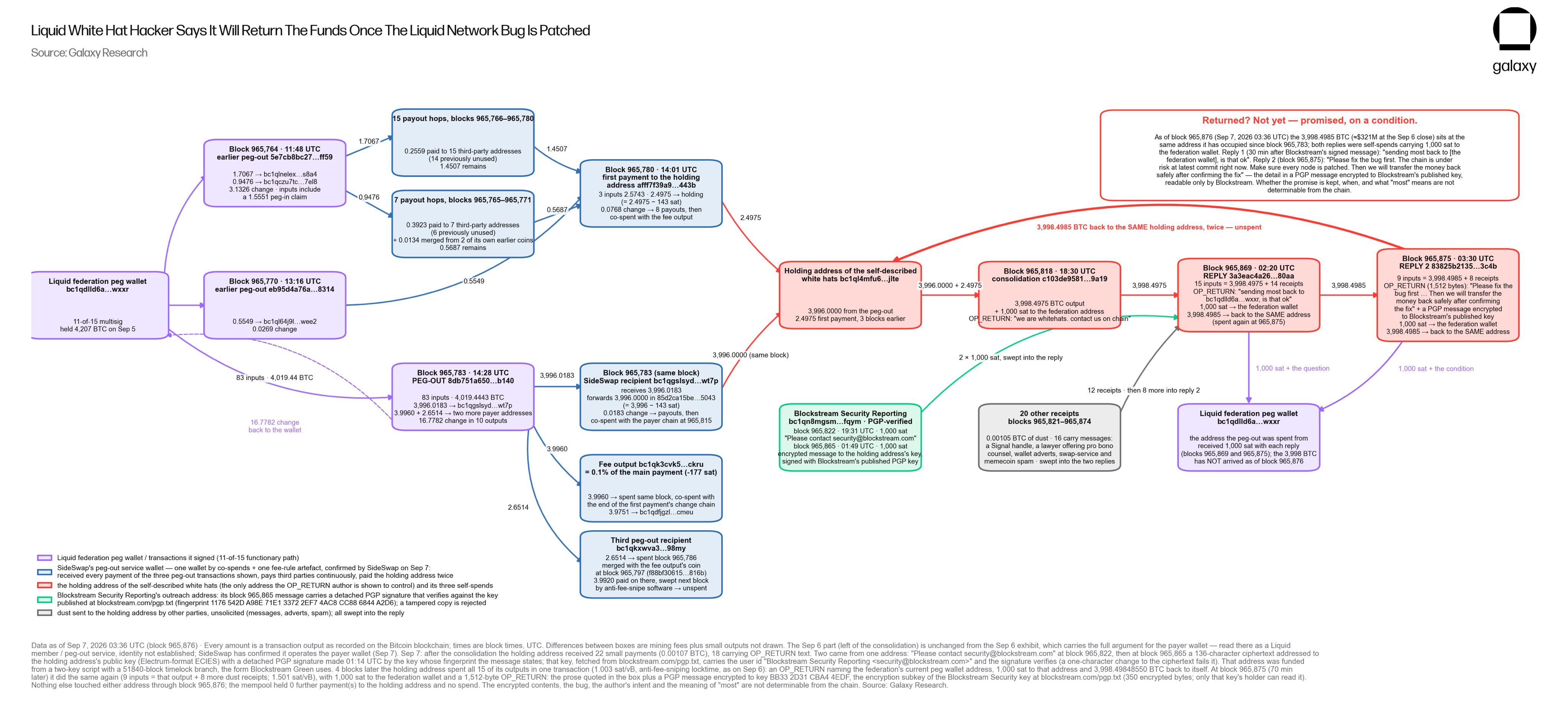
Liquid Network’s purported white-hat hacker returns 3,400 BTC after Blockstream confirms bridge nodes were patched, while roughly 600 BTC remains with the attacker

AI and the Changing Nature of Hackers
Artificial intelligence is reshaping both how hackers operate and how defenders respond. On the offensive side, advanced AI models can help attackers analyze vast codebases, identify subtle vulnerabilities, and generate exploit proofs-of-concept far more quickly than manual review alone. Crypto security experts have warned that AI is giving DeFi hackers an edge by enabling them to automate exploit discovery, optimize attack sequences, and even simulate the economic impact of potential attacks before deploying them on mainnet. With models capable of writing and debugging intricate smart contract interactions, a single hacker can now orchestrate multi-step exploits that would previously have required a team.
A report on the prospect of crypto’s “next billion-dollar hacker” argues that the newest AI models allow users to move at “superhuman speed,” effectively compressing the timelines for reconnaissance, exploit development, and execution. Attackers can feed AI systems decompiled contract code, historical transaction graphs, or configuration files and receive high-level summaries of potential weaknesses, complete with sample transactions or scripts to test them. When coupled with on-chain simulation environments and flash-loan liquidity, this capability transforms the attack surface, making it plausible that a determined actor could scan a large portion of DeFi for exploitable edge cases and weaponize them in rapid succession.
AI also amplifies social engineering. Phishing emails and direct messages can now be highly personalized and grammatically flawless, incorporating contextual details scraped from public profiles and previous communications. Deepfake voice and video tools enable more convincing impersonation of executives, support agents, or protocol founders, potentially tricking signers into approving malicious multisig transactions or revealing sensitive data. While these risks affect all sectors, crypto’s culture of fast-moving governance and informal communication on platforms like Discord and Telegram may make communities particularly vulnerable.
Defenders, however, are not powerless. Chain-analytics firms and security companies are increasingly using machine learning and AI to detect anomalous on-chain patterns, cluster addresses associated with known threat actors, and flag suspicious transactions in near real-time. Chainalysis, for instance, has built tools that can trace funds through mixers and cross-chain hops, helping identify and attribute major hacks like those carried out by Lazarus. Exchanges and DeFi protocols can integrate such intelligence into automated risk-scoring systems, freezing or flagging deposits linked to known hacks or high-risk services, though this raises complex questions about decentralization and censorship.
Auditing and code analysis are also benefiting from AI. Security firms are experimenting with AI-assisted review of smart contracts to catch common vulnerabilities and even suggest patches before deployment. Ethical hackers can use AI to generate more comprehensive tests and to model how a protocol behaves under extreme market conditions or adversarial scenarios. At the same time, prominent security researchers, including well-known iPhone and Sony hackers, have warned that AI coding agents may be a “disaster waiting to happen” if developers rely on them naively without understanding the code they produce. The risk is that AI may generate insecure patterns that propagate widely, creating monocultures of vulnerability that black-hat hackers can later exploit at scale.
The net effect is an accelerating arms race. As AI capabilities diffuse, the barriers to entry for sophisticated hacking—and for sophisticated defense—will both fall. For the crypto ecosystem, which already operates at the intersection of open-source software, pseudonymous users, and high-value assets, this dynamic heightens the need for robust security culture, continuous education, and layered defenses that assume some components will inevitably fail.
- 01On-chain bounty negotiations
Headlines showing protocols publicly offering hackers 10% bounties on-chain — and hackers actually returning funds — created a tense, serialized narrative readers followed like a heist thriller.
- 02Dormant wallet reactivations
FTX and Poloniex hackers moving funds after months of silence gave readers a live forensic chase, reviving the original crime with new stakes.
- 03North Korea state-sponsored hackers↗
The DPRK angle reframes crypto theft as geopolitical warfare — a 6,000-person cyber army, fake job applicants, and billion-dollar nation-state funding made the threat feel systemic rather than criminal.
- 04Hacker identity exposure and arrests
Stories where hackers were unmasked — Gurevich caught fleeing under a false name, ZKLend's hacker phished by a fake Tornado Cash site — delivered the accountability payoff readers crave.
- 05Theft trend and scale statistics↗
The two-thirds decline in 2023 theft gave readers a rare signal that defenses were working, making the billion-dollar residual loss feel both alarming and hopeful.
- 06Supply-chain and novel attack vectors↗
Headlines covering EIP-7702 wallet drains, invisible-Unicode malware in GitHub packages, and ThorChain laundering showed readers that attack surfaces were expanding beyond smart contracts into developer tooling and protocol upgrades.
White-Hat Hackers, Ethics, and Incentives in Crypto
Ethical hacking is the practice of applying hacking techniques for benevolent purposes, with the authorization of system owners or in alignment with clearly articulated defense objectives. Cisco notes that ethical hackers are often hired by businesses and governments to find vulnerabilities before malicious actors do, using penetration testing and other tactics to probe for weaknesses that can then be patched. In crypto, where open-source code and composability make it difficult to fully control how a protocol is used, white-hat hackers play an essential role in stress-testing designs and preventing catastrophic exploits.
Bug bounty programs are a primary mechanism for integrating white hats into protocol security. Instead of waiting for adversarial hackers to discover and weaponize vulnerabilities, projects offer financial rewards to researchers who responsibly disclose bugs, often through structured platforms or dedicated bounty portals. This approach acknowledges that the same skills used to break systems can also protect them, and it seeks to align financial incentives with positive outcomes. However, bounty amounts must be competitive with the potential upside of exploiting a vulnerability directly; otherwise, researchers may be tempted to cross into gray-hat territory.
The boundary between white and gray is particularly visible in “rescue” operations. The pseudonymous hacker who recovered about two million dollars’ worth of ETH from a faulty 2016 ICO contract did so by taking advantage of a bug that would have otherwise kept the funds permanently locked. They then transferred the tokens to a secure address and contacted the affected parties to coordinate return, embodying a strong white-hat ethic. By contrast, some DeFi incidents involve exploiters who unilaterally drain pools and then approach project teams with demands framed as bounties, offering to return a portion of the loot in exchange for immunity or public acknowledgment. From a legal perspective, the initial unauthorized access often remains problematic regardless of later negotiations.
Community-led responses can formalize parts of this process. In the THORChain ecosystem, for example, node operators approved a recovery plan that included a dedicated hacker bounty following previous security incidents, setting clear terms under which future exploiters could be rewarded for returning funds. While this does not eliminate risk, it provides a structured path for ethical or semi-ethical outcomes when unknown parties discover critical flaws. Similarly, some DAOs have begun drafting explicit policies describing how they will treat exploiters who return funds quickly, documenting expected percentages and cooperation with law enforcement.
Auditors and security consultancies occupy an important structural position in this ecosystem. Halborn’s analysis of the top 100 DeFi hacks serves not only as a retrospective but also as a guide to common design pitfalls, highlighting how certain patterns—such as unchecked upgradeability, insecure oracles, and insufficient access controls—recur across protocols. By turning incident data into structured knowledge, these firms help white-hat hackers and developers focus their efforts on the most likely sources of catastrophic failure. Meanwhile, on-chain monitoring tools can alert white-hat responders when suspicious patterns emerge, allowing them to front-run exploits by temporarily draining vulnerable contracts to safe addresses before attackers do, as apparently occurred in the ThetanutsFi legacy vaults incident.
Legal frameworks have not fully caught up with these realities. While ethical hacking is recognized in many jurisdictions, its boundaries are usually defined by explicit authorization and contracts. Crypto’s permissionless nature complicates this, because interacting with smart contracts is, in a narrow sense, always “authorized” by the code, even if it violates user expectations or economic intent. Regulators and courts may nonetheless view certain exploit-based profit-taking as theft or fraud, especially when it involves deception, unauthorized server access, or harm to unsophisticated users. As a result, white-hat hackers and protocols alike must carefully document scopes of work, disclosure processes, and rescue operations to avoid unintentionally straying into legally ambiguous territory.
How Users and Builders Can Reduce Hacker Risk
Although the threat landscape is complex, a large share of successful hacks and scams exploit basic security lapses rather than novel zero-day vulnerabilities. For individual users, fundamental hygiene remains the best defense. The FTC stresses that cryptocurrency payments are typically not reversible, so users should be skeptical of any demand to pay in crypto, especially when framed as urgent, guaranteed, or tied to supposed government or business orders. They emphasize that only scammers guarantee profits, promise “free money,” or demand that you pay in cryptocurrency to secure a job or protect your funds. Avoiding unsolicited links in emails, texts, or social media messages, even from familiar-looking accounts, reduces exposure to phishing that can lead to wallet compromise.
Users should also understand how wallet permissions work. Many DeFi hacks at the individual level involve malicious smart contracts that request broad token allowances, allowing the contract to move funds long after a user has forgotten about an initial interaction. Regularly reviewing and revoking token approvals, using well-maintained wallet software, and relying on hardware wallets for significant holdings can materially reduce risk. Malware, like the Wallpaper Engine-based campaigns discovered by Kaspersky, further underscores the importance of downloading software, especially executable content, only from trusted sources and being wary of user-generated content that can run arbitrary code.
For DeFi teams and DAOs, the security burden is considerably higher. Halborn’s data showing that off-chain incidents account for over half of attacks and a vast majority of funds lost underscores how operational security and key management are now as important as contracts themselves. Protocols must adopt strong practices around multisig governance, separation of duties, and device hygiene for signers, recognizing that a compromised laptop or phone belonging to a director or developer can undermine all on-chain logic, as the Humanity Protocol incident demonstrates. Privileged roles in upgradeable contracts should be narrowly scoped and, where possible, controlled by multi-party arrangements with clear incident response playbooks.
Supply-chain risk also demands attention. Teams should pin dependencies, monitor advisories for npm, PyPI, and Rust packages, and avoid integrating unvetted libraries into wallet, bridge, or contract tooling. Build systems and continuous integration pipelines should be isolated from production wallet infrastructure, and sensitive keys should never be stored in the same environments used for regular development work. With AI increasing the scale and sophistication of supply-chain attacks, defense-in-depth and redundancy become crucial, especially for systems that manage large volumes of ETH, USDC, and other liquid assets.
Centralized exchanges, custodians, and institutional players face their own set of expectations. Incidents like Mt. Gox, Bybit, and other large-scale exchange hacks reinforce the need for hardware security modules, robust hot–cold wallet segregation, and continuous penetration testing by external firms. Enterprises should treat blockchain infrastructure as critical financial market plumbing, aligning security budgets and risk management with that reality. At the same time, they can leverage AI and analytics to monitor transaction flows, integrating signals from firms like Chainalysis to detect and block deposits from known hacker-controlled addresses before funds enter their internal pools.
Across all these layers—users, builders, exchanges, and regulators—the most effective mitigation is a culture that treats security as a continuous process rather than a one-time checklist. Hackers adapt, tools evolve, and new protocols introduce novel failure modes. Staying up to date on the latest attack types and security technologies, as Cisco recommends, is not a luxury but a necessity for anyone deeply involved in crypto. Community education, transparent postmortems, and responsible reporting from security researchers and journalists can together help ensure that each hack, however painful, results in a stronger ecosystem rather than a repeatable blueprint for the next attacker.
Liquid Network hackers offer to return most of 4,000 BTC once a critical bug is patched, telling Blockstream to ensure every node is updated first
Cultural Myths, Market Impact, and the Hacker Archetype
Beyond technical and legal dimensions, hackers play an outsized role in the narratives that surround crypto. Early Bitcoin history is peppered with stories of privacy activists, cypherpunks, and technically adept libertarians who recognized the significance of decentralized digital money before mainstream finance did. FinanceFeeds notes that many of the “hackers who became Bitcoin millionaires” did so not by stealing funds but by understanding the protocol and mining or accumulating coins when they were cheap, leveraging their background in cryptography, networking, and security to build conviction in a system many dismissed as a toy. These stories contribute to a romanticized image of the hacker as a visionary outsider, capable of seeing value where others see noise.
However, the same archetype also fuels anxiety. News of large heists—whether from exchanges, DeFi protocols, or cross-chain bridges—feeds a perception that crypto is an inherently insecure casino, vulnerable to any sufficiently clever attacker. The Mt. Gox flash crash remains a vivid example: the sight of Bitcoin briefly trading for a cent, even if due to a single compromised account, suggested that markets built on centralized exchanges could be fragile and thinly defended. More recent multi-hundred-million-dollar exploits, especially those linked to state actors, reinforce the notion that holding digital assets exposes users and institutions alike to adversaries beyond the reach of conventional law enforcement.
In this environment, individual hackers sometimes become quasi-celebrities, with on-chain sleuths tracking their every move. Coverage has highlighted, for instance, how the hacker behind the Pando Rings incident reportedly used 10 million DAI to buy over 6,200 ETH during a market dip and later sold for a profit, drawing attention not just to their technical prowess but also to their trading acumen. Similarly, the Humanity and KelpDAO hackers’ wallets have been monitored in real time as they dump tokens, swap into ETH or stablecoins, and attempt to launder funds across chains. This spectatorship can blur moral lines, sometimes treating hacks like high-stakes games rather than crimes with real victims.
Yet hackers have also catalyzed positive change. Each major exploit tends to trigger a wave of audits, protocol upgrades, and community education, raising the baseline of security. Institutions exploring blockchain-based systems are forced to grapple seriously with cyber risk, bolstering their broader security posture as they evaluate whether and how to integrate tokenized assets or settle trades on-chain. Even regulatory agencies and law enforcement, initially skeptical of crypto’s pseudonymity, have discovered that transparent ledgers, combined with chain analytics and cooperation from exchanges, can make it possible to trace and sometimes recover stolen funds that would have vanished in the traditional shadow banking system.
In this sense, the hacker in crypto is both antagonist and reluctant teacher. Their attacks expose weaknesses not just in code but in governance, incentives, and human behavior. Whether the industry ultimately benefits from this painful feedback loop depends on how seriously builders, users, and regulators take the lessons, and whether white-hat expertise and defensive tooling can keep pace with black- and state-hat innovation.
- 2022-08exploit
LastPass infrastructure breached; vault data stolen
- 2022-11exploit
FTX collapse; exchange funds drained by unidentified hacker
Euler Finance hacked for ~$197M; hacker later returns funds after on-chain messages
Poloniex and KyberNetwork hacked; combined losses exceed $130M
- 2024-07exploit
WazirX hacked for ~$230M; Lazarus Group attributed; stolen tokens sold on-chain immediately
- 2024-11regulatory
Alexander Gurevich arrested in Israel attempting to flee under false identity for 2022 Nomad bridge exploit
- 2025-02exploit
ZKLend hacker phished for 2,930 ETH via counterfeit Tornado Cash site while attempting to launder proceeds
- 2025-05exploit
Ethereum Pectra upgrade's EIP-7702 exploited to drain wallets via malicious delegate contracts
Outlook
Looking ahead, hackers will remain central to the story of crypto, shaping how markets evolve, how protocols are designed, and whether institutions feel comfortable building on public blockchains. The trend lines are clear: more value is moving on-chain, more critical infrastructure is being tokenized, and more sophisticated actors—from state-sponsored groups like Lazarus to AI-augmented freelance hackers—are targeting that value. With AI accelerating the speed and scale of both offense and defense, the balance between black hats and white hats will likely hinge on how quickly the ecosystem can mainstream robust security practices, from formal verification and rigorous audits to hardened key management and continuous monitoring.
For users and builders, the practical implication is that security can never be an afterthought. In a world where a compromised director’s laptop can lead to tens of millions of dollars in minted tokens, or a misconfigured bridge can leak hundreds of millions in ETH-denominated assets overnight, operational discipline matters as much as clever contract design. At the same time, ongoing collaboration between crypto-native security firms, law enforcement agencies, and analytics providers offers a path toward gradually reducing the payoff of major hacks by increasing the likelihood of attribution, sanctions, and partial fund recovery. The hacker will not disappear from crypto’s narrative, but with enough collective effort, their role may shift from existential threat toward manageable, if ever-evolving, risk.
Conclusion
The term hacker in crypto encompasses a wide spectrum of actors, from idealistic security researchers and early adopters with deep technical insight to ruthless cybercriminals and state-backed teams using DeFi exploits as instruments of national policy. What unites them is an ability to perceive and exploit the gap between how systems are supposed to work and how they actually behave under real-world conditions. Whether through phishing and malware, smart contract logic flaws, cross-chain messaging bugs, or AI-enhanced supply-chain attacks, hackers continually probe the fault lines of a rapidly evolving, highly financialized technological landscape.
For the crypto ecosystem, the challenge is not to eliminate hacking—a utopian and unrealistic goal—but to shape its incentives and impact. Strengthening bug bounty programs, embedding ethical hacking into development lifecycles, and normalizing postmortems that transparently dissect failures can tilt the balance toward white-hat contributions. Simultaneously, rigorous operational security, careful key management, and AI-assisted monitoring are necessary to withstand increasingly sophisticated black-hat and state-sponsored campaigns targeting exchanges, bridges, and protocols. Ultimately, whether crypto matures into trustworthy financial infrastructure or remains a patchwork of precarious experiments will depend in large part on how well the community learns from its hackers—celebrated, feared, and everything in between.
Latest Hacker news
North Korean hackers move tens of millions through Hyperliquid as US officials weigh onshoring the platformLiquid Network’s purported white-hat hacker returns 3,400 BTC after Blockstream confirms bridge nodes were patched, while roughly 600 BTC remains with the attackerLiquid Network hackers offer to return most of 4,000 BTC once a critical bug is patched, telling Blockstream to ensure every node is updated firstCertiK CEO warns AI is giving DeFi hackers an edge as attackers automate exploits, target supply chains, and overwhelm defenders across an increasingly vulnerable crypto ecosystemWhitehat hacker returns $190K out for $209K to Renegade protocol after exploiting flawed Arbitrum dark pool contract, keeping 10% bounty to avoid legal actionOneKey's Yishi on KelpDAO hack: 10-15% hacker bounty, LayerZero fund, Aave backstop — don't cut WETH depositorsSources
20 records from 16 domains
fortinet.com
halborn.com
ic3.gov
x.com
youtube.com
longbridge.com
facebook.com
tradingview.com
cryptonews.net
chainalysis.com
splunk.com
cisco.com
financefeeds.com
consumer.ftc.gov
guardarian.com
securelist.com
Community notes
Spot something off or out of date? Drop a note. Editors review topic notes daily and roll accepted fixes into the explainer — contributors are recognized in the monthly $SQUID drop.
Loading notes…
Help improve this topic
Have a story or tip about this topic? Submit it. See something missing? Leave a note. Editors review daily; accepted submissions and fixes count toward the monthly $SQUID drop.