
MetaMask is Consensys's self-custodial Ethereum wallet with 30M+ monthly active users, offering swaps, a Mastercard debit card, an AI agent wallet, and native DeFi tools across EVM chains.
+15 sources across the wider coverage universe
 Polygon activates ERC-7715, enabling builders to request scoped permissions via MetaMask and unlock advanced agent-driven dApp interactions across its ecosystem2026-04
 MetaMask flags rise of AI-driven crypto attacks, from fake Google security pages to malware hitting 850+ extensions, exposing growing risks in automated fraud2026-04
 Societe Generale-FORGE brings bank-backed, MiCA-compliant USD stablecoin to MetaMask2026-04
 Monad's Keone says Phantom's decision to remove the network is a step backward, recommending MetaMask, Backpack, Rabby, Rainbow, Infinex and Ambire2026-07
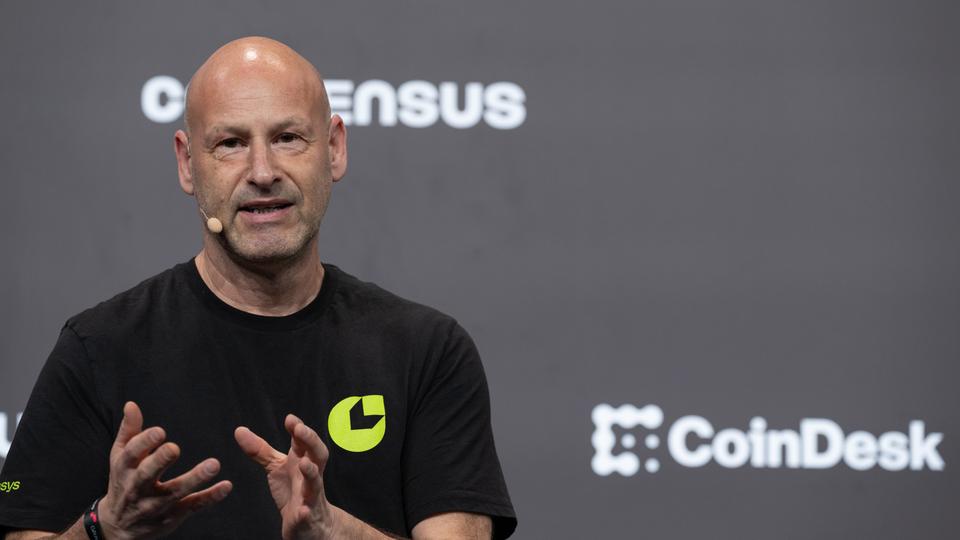 Consensys delays potential U.S. IPO until fall as $7B MetaMask parent waits out risk-off markets2026-05
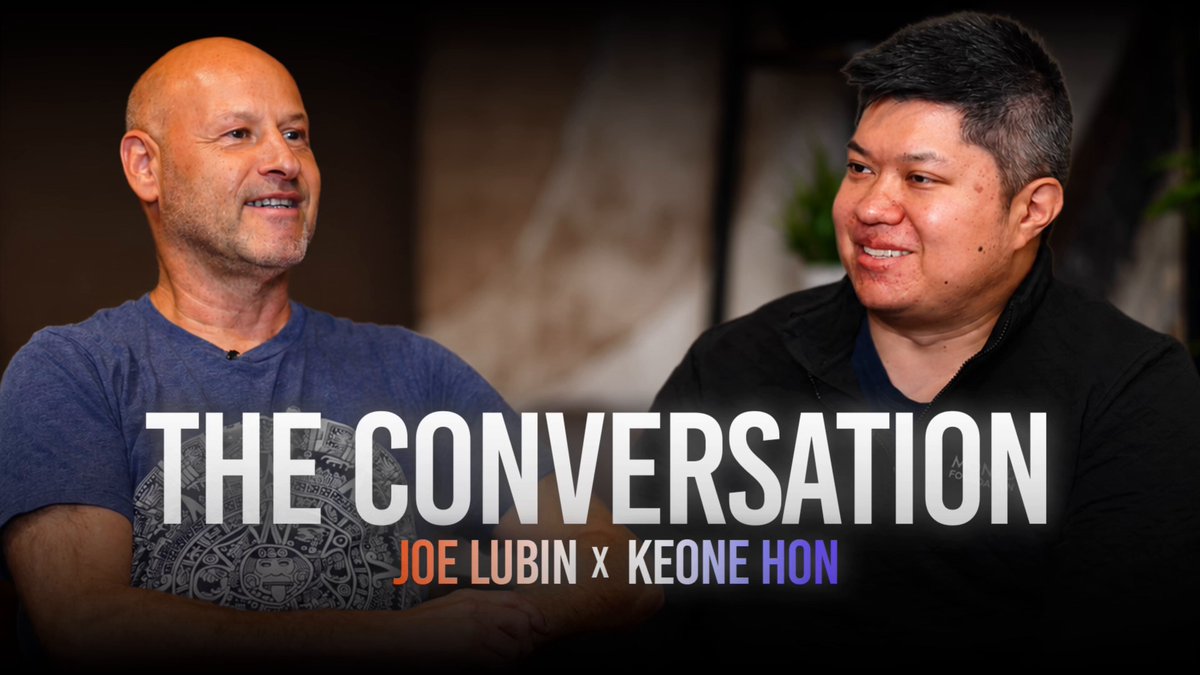 Ethereum co-founder Joseph Lubin and Monad's Keone Hon discuss AI-powered finance, stablecoin adoption, and MetaMask's new Money Account in a wide-ranging interview2026-07
The browser extension and mobile application that introduced millions of users to self-custodial Ethereum accounts, MetaMask has grown from a developer convenience tool into the de facto gateway for decentralized finance, NFTs, and on-chain identity.
What MetaMask Is
At its core, MetaMask is a non-custodial cryptocurrency wallet: it stores private keys locally on the user's device rather than on a company's server. That distinction matters because it means no third party can freeze, seize, or lose your funds on your behalf — the tradeoff being that losing your Secret Recovery Phrase means losing access permanently.
Developed and maintained by Consensys, the New York-based blockchain infrastructure company founded by Ethereum co-founder Joseph Lubin, MetaMask launched in 2016 as a Chrome extension that let developers interact with Ethereum smart contracts without running a full node. It has since expanded to Firefox, Brave, Edge, and iOS/Android, and grown to approximately 30 million monthly active users as of early 2026, with a reported total install base exceeding 100 million.
The wallet generates accounts from a 12-word Secret Recovery Phrase using the BIP-39 standard. Each phrase deterministically derives an unlimited number of Ethereum-compatible addresses, meaning one seed phrase manages multiple accounts across every EVM-compatible chain — Ethereum mainnet, Polygon, Arbitrum, Optimism, Base, BNB Chain, Avalanche, and others — without separate key management.

Polygon activates ERC-7715, enabling builders to request scoped permissions via MetaMask and unlock advanced agent-driven dApp interactions across its ecosystem

ERC-7715 scoped permissions for builders — this is the missing auth layer for agent-to-agent interactions. Right now every agent either has full access or none. Scoped permissions let you grant specific capabilities without blanket trust. Watch which protocols adopt this first.
The Consensys Connection
MetaMask is the primary consumer-facing product of Consensys, which is also behind the Infura RPC infrastructure, the Linea layer-2 network, and the Truffle/Hardhat developer tooling suite. The company raised $450 million in a Series D round in 2022 at a $7 billion post-money valuation, with JPMorgan and Goldman Sachs enlisted to lead a prospective IPO. That public listing has been repeatedly deferred: as of mid-2026, Consensys pushed the filing to at least fall 2026, citing risk-off market conditions (CoinDesk).
MetaMask's commercial importance to Consensys is substantial. Annual recurring revenue reportedly exceeds $150 million, driven primarily by the fee MetaMask charges on in-wallet token swaps and by staking services — both closely tied to Ethereum transaction volumes.
Readers engage with MetaMask not as a product to evaluate but as a personal financial vault to defend — security exploits and malware dominate the highest-clicked stories because a compromised MetaMask means total, irreversible loss, and that fear consistently outranks interest in every feature launch or mainstream payment integration.
How MetaMask Swaps Work
One of MetaMask's most-used features is its native token swap interface, which aggregates liquidity from multiple decentralized exchange routers and returns a best-execution quote without the user leaving the wallet. MetaMask charges a 0.875% service fee on each swap.
The routing intelligence behind that interface has become increasingly competitive. Recent data shows that Uniswap's API won approximately 52.4% of MetaMask's 554,000-plus Ethereum swap routing decisions, outperforming all other providers combined on execution quality and fill reliability. Separately, Uniswap powers around 31% of MetaMask swaps on Ethereum mainnet by volume — a share that reflects Uniswap's dominant liquidity depth across major trading pairs rather than any exclusive arrangement.
This aggregation model benefits users by abstracting routing complexity, but it also exposes a tension: MetaMask earns its swap fee regardless of which router fills the order, giving it an incentive to optimize for fee-generation as much as for user savings. Independent researchers periodically audit route quality to assess whether the platform consistently delivers best execution.
MetaMask Snaps: The Extension Layer
Launched to general availability in 2023, MetaMask Snaps is a permissioned plugin system that allows third-party developers to extend wallet functionality — adding support for non-EVM chains, custom transaction insights, notifications, and novel key management schemes — without MetaMask itself shipping the feature.
Snaps run in a sandboxed JavaScript environment with declared permissions (similar to mobile app permissions), and users must explicitly install and authorize each one. The framework has enabled integrations ranging from Bitcoin and Solana account support to institutional multi-party computation signing and gas-fee oracles.
A more recent development in the delegation layer is ERC-7710, a standard for semantic delegation that lets users grant scoped, revocable permissions to other addresses or automated agents. Intuition and MetaMask launched a $7,500 USDC bounty cohort in 2025 specifically targeting builders working on ERC-7710 implementations — a sign that on-chain permission primitives are becoming a product priority, not just a research proposal.
MetaMask flags rise of AI-driven crypto attacks, from fake Google security pages to malware hitting 850+ extensions, exposing growing risks in automated fraud

Torg Grabber compiled 334 unique samples in three months while scanning 850 extensions across 33 browser variants — that's a faster iteration cycle than most DeFi protocols ship features. Browser extensions bled $713M in 2025 alone, and now the attack surface is expanding in both directions: AI agents like OpenClaw are getting delegated wallet permissions for autonomous transactions while simultaneously being weaponized for autonomous exploitation (MetaMask's own December report showed AI agents draining $4.6M from test contracts and finding two novel zero-days). The irony of MetaMask partnering with CoinFello on hardware-isolated keys for AI agents in the same report where they document AI agents as the threat vector tells you exactly where this arms race is headed — wallet infra is being rebuilt around the assumption that the thing signing your transactions might also be the thing attacking them.
The MetaMask Card
In early 2026, MetaMask and Mastercard rolled out a self-custodial debit card across 49 US states (Vermont excluded), allowing users to spend USDC, USDT, or wrapped ETH directly from their MetaMask wallet at any of Mastercard's 150-million-plus merchant locations worldwide (CryptoTicker).
The card is processed by Monavate and is notable for its custody model: funds remain in the user's own wallet under their own seed phrase until the precise moment a transaction settles, rather than being pre-loaded onto a custodial card balance. Standard cardholders earn 1% cashback in mUSD, MetaMask's Ethereum-based stablecoin issued via Bridge, a Stripe-owned platform.
Aave has integrated directly with the MetaMask Card to enable yield-bearing mUSD spending via Mastercard — meaning balances can generate DeFi yield while sitting idle between purchases, a design that blurs the line between a savings account and a spending instrument.
Comparing the MetaMask Card to the Coinbase Card illustrates the custody tradeoff clearly: Coinbase's card draws from a custodial exchange balance and offers up to 4% cashback in select tokens, but users are spending from Coinbase's ledger rather than their own on-chain wallet. MetaMask's card prioritizes self-sovereignty; Coinbase's prioritizes rewards. Every MetaMask Card swipe is technically a crypto disposal and constitutes a taxable event under US rules — a friction point the product does not fully abstract away.
- 01wallet drain and malware targeting
Mark Cuban's $870K loss and back-to-back Mac and Windows malware campaigns made readers feel their own idle wallets were actively at risk, producing the two highest-engagement stories on the topic.
- 02MetaMask as mainstream payment rail
The Mastercard-backed MetaMask card, PayPal and Visa integrations, and Stripe fiat onramp collectively signaled that MetaMask is positioning itself as a real alternative to traditional payment infrastructure, pulling readers tracking crypto's crossover moment.
- 03SEC regulatory assault on Consensys
Dueling lawsuits between Consensys and the SEC over MetaMask staking put the wallet's core feature set and Ethereum's commodity classification at legal risk, drawing readers tracking crypto's survival in US markets.
- 04transaction routing and MEV control
MetaMask's Smart Transactions and its undisclosed third-party routing project raised concrete questions about whether the dominant wallet was quietly becoming a centralization chokepoint for Ethereum transaction flow.
- 05multi-chain and non-EVM expansion
Bitcoin integration, Snaps support for Cosmos and Solana, and Tezos connectivity signaled MetaMask's bid to own the wallet layer across every major blockchain ecosystem rather than remaining Ethereum-only.
- 06token rewards and Consensys ownership disputes
Planned MetaMask token launches promising $30M in Season 1 rewards, combined with a former-employee lawsuit alleging Consensys diverted MetaMask assets to a new entity, tied financial upside to unresolved governance questions about who controls the ecosystem.
AI Agent Wallet
The most significant product launch of MetaMask's recent roadmap is its Agent Wallet, which entered early access in 2025 with a public release targeted for summer. It is a self-custodial wallet designed specifically for AI agents to execute DeFi operations — swaps, perpetual positions, prediction markets, staking, and liquidity provision — across EVM chains, while every transaction passes through a mandatory security pipeline.
The security layer includes transaction simulation, threat scanning powered by Blockaid, and MEV protection. Transactions flagged as potentially malicious require human approval via two-factor authentication. Transactions deemed safe carry a $10,000 monthly protection guarantee against loss from malicious activity — a meaningful underwrite given the novel attack surface that autonomous agents introduce (MetaMask).
The underlying delegation model is built on MetaMask's Advanced Permissions system. Users define asset allowlists, amount caps, and time-window constraints for any agent session, and can revoke access at any time from the wallet interface without needing to interact with the agent framework directly. The wallet is compatible with OpenAI Codex, Claude Code, Cursor, Nous Research Hermes Agent, and OpenClaw, among other frameworks.
Two operating modes are available: Guard Mode, which enforces policy and approval workflows for cautious users, and Beast Mode, which streamlines automation for those comfortable with higher throughput. The launch positions MetaMask as infrastructure for the emerging category of agentic DeFi — where software agents, rather than humans, execute the majority of on-chain interactions.
Expanding the Product Surface: Perps, Prediction Markets, and Tokenized Assets
MetaMask has been broadening the financial products accessible directly within the wallet interface, progressively blurring the boundary between a key-management tool and a full trading front-end.
- MetaMask Perps introduced on-chain perpetual futures trading natively in the wallet, allowing leveraged long and short positions on major crypto assets without routing to a separate DEX front-end.
- MetaMask Prediction Markets added a native interface for binary event contracts, letting users take positions on crypto price outcomes and macro events.
- Ondo Global Markets integration extended the wallet's asset universe to include tokenized US stocks, ETFs, and commodities — a significant step toward bringing traditional finance instruments into a self-custodial wallet context.
These additions reflect a product strategy of capturing trading and yield activity within MetaMask rather than losing users to dedicated front-ends, thereby increasing the surface area for swap fees and other monetization.
Societe Generale-FORGE brings bank-backed, MiCA-compliant USD stablecoin to MetaMask
Security Architecture and Threat Reporting
MetaMask publishes monthly Crypto Security Reports — a practice it has maintained since at least mid-2024 through January 2026 and beyond — cataloguing phishing campaigns, approval-draining scams, and smart-contract exploits targeting its user base. The reports, produced with data from Blockaid, have documented rising sophistication in address-poisoning attacks and wallet-drainer kits distributed via fake DApp front-ends.
The wallet's primary security controls include:
- Blockaid transaction simulation: Flags potentially malicious transactions before the user signs, with an explanation of what permissions are being granted.
- Phishing detection: MetaMask maintains a blocklist of known malicious domains integrated into the extension.
- Hardware wallet support: Ledger and Trezor devices can be paired as signers, keeping private keys air-gapped even while the MetaMask interface is used for DApp interactions.
- Secret Recovery Phrase protection: The phrase is never transmitted to Consensys servers; it is encrypted locally using the user's chosen password.
Despite these controls, social engineering remains the primary threat vector. The overwhelming majority of reported fund losses involve users being deceived into voluntarily signing approval transactions — not exploits of MetaMask's code itself.
MetaMask has also backed the Open Transaction Layer, an industry initiative also supported by Robinhood and eToro, aimed at standardizing how transaction context is communicated across wallets and protocols to reduce the information asymmetry that makes approval-draining attacks effective.
- 2023-09exploit
Mark Cuban loses $870K in MetaMask drain after months of wallet inactivity
- 2023-09launch
MetaMask Snaps launches on mainnet, extending wallet to Cosmos, Solana, and Starknet
- 2024-04regulatory
Consensys sues SEC to preempt MetaMask enforcement, seeking ruling that ETH is not a security
- 2024-06regulatory
SEC sues Consensys, alleging MetaMask staking integrations are unregistered securities brokerage
- 2024-08exploit
Cthulhu macOS malware surfaces, specifically targeting MetaMask, Coinbase, and Binance wallet users
- 2025-03exploit
Microsoft discloses StilachiRAT Windows malware targeting MetaMask and 19 other wallet extensions
Multi-Chain and Cross-Chain Position
MetaMask defaults to Ethereum mainnet but supports any EVM-compatible network by adding custom RPC endpoints. The wallet auto-detects many popular networks (Polygon, Arbitrum, Optimism, Base, BNB Chain, Avalanche) and prompts users to add them on first interaction with a compatible DApp.
Bitcoin support arrived via a Snaps integration in 2023, allowing native BTC accounts to be derived from the same Secret Recovery Phrase as EVM accounts — a meaningful step given MetaMask's historical EVM exclusivity. The Linea network, Consensys's own zkEVM layer-2, receives first-party integration and is the chain used for MetaMask's Agent Wallet early access.
The wallet's Infura RPC backend, which handles node connections for the majority of MetaMask users, is a separate paid product within the Consensys stack. Critics have noted that reliance on a single RPC provider creates a centralization point and a potential privacy concern, since Infura can observe the IP addresses and transaction queries of MetaMask users. MetaMask has added support for custom RPCs and, in some regions, privacy-preserving alternatives to partially address this.
Token and Governance Speculation
MetaMask has no native governance token as of mid-2026. Consensys has referenced a prospective DAO and token structure in public roadmap documents, and the phrase "MetaMask token" surfaces periodically in community discussion, but no launch has been formally announced or scheduled. Any airdrop speculation should be treated with caution given the absence of confirmed plans.
Outlook
MetaMask's trajectory from developer tool to consumer finance platform is now largely complete in design, if not yet in adoption at scale. The Agent Wallet launch signals that Consensys is betting heavily on AI-driven DeFi as the next usage paradigm — a bet that requires solving the trust problem of autonomous key management, which the $10K protection guarantee and ERC-7710 delegation standards are explicitly designed to address.
The pending Consensys IPO, deferred to fall 2026, will test whether public markets assign durable value to a business whose revenue is tightly coupled to Ethereum transaction activity and crypto market cycles. If it proceeds, it would mark one of the more significant public listings in the crypto infrastructure space since Coinbase's 2021 direct listing — and a moment that would force a detailed public accounting of how many users actually pay for MetaMask's premium features versus using the free tier.
For users, the near-term calculus is straightforward: MetaMask remains the broadest, most battle-tested entry point into self-custodial Ethereum finance, with a security track record and developer ecosystem that no direct competitor has yet matched at comparable scale.
Latest MetaMask news
Polygon activates ERC-7715, enabling builders to request scoped permissions via MetaMask and unlock advanced agent-driven dApp interactions across its ecosystemMetaMask flags rise of AI-driven crypto attacks, from fake Google security pages to malware hitting 850+ extensions, exposing growing risks in automated fraudSociete Generale-FORGE brings bank-backed, MiCA-compliant USD stablecoin to MetaMask MetaMask adds NFL team prediction markets for the 2025 season
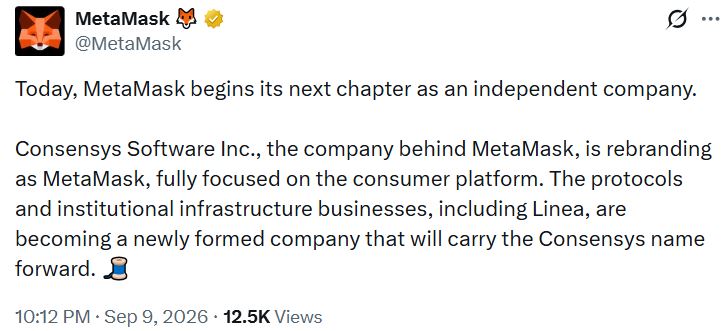 MetaMask splits from Consensys as standalone consumer company; protocols arm keeps Consensys nameConsensys delays potential U.S. IPO until fall as $7B MetaMask parent waits out risk-off markets
Community notes
Spot something off or out of date? Drop a note. Editors review topic notes daily and roll accepted fixes into the explainer — contributors are recognized in the monthly $SQUID drop.
Loading notes…
Help improve this topic
Have a story or tip about this topic? Submit it. See something missing? Leave a note. Editors review daily; accepted submissions and fixes count toward the monthly $SQUID drop.