
Deep dive on SharpLink, the Joe Lubin–backed Nasdaq firm building a massive Ethereum treasury. Explains its ETH‑only strategy, staking and Linea deployments, SBET stock dynamics, and how it fits into the broader corporate ETH treasury boom.
+9 sources across the wider coverage universe
 Ethereum's largest corporate backers launch Ethlabs, a new research hub backed by SharpLink, BitMine, and Consensys to accelerate protocol innovation beyond the Ethereum Foundation2026-06
 SharpLink resumes ETH buys with $7.85M purchase as ether sinks to 2026 low ahead of Russell inclusion2026-06
 TD Cowen cuts Strategy target to $350, calls Ethereum treasury firm SharpLink a buy at $162026-04
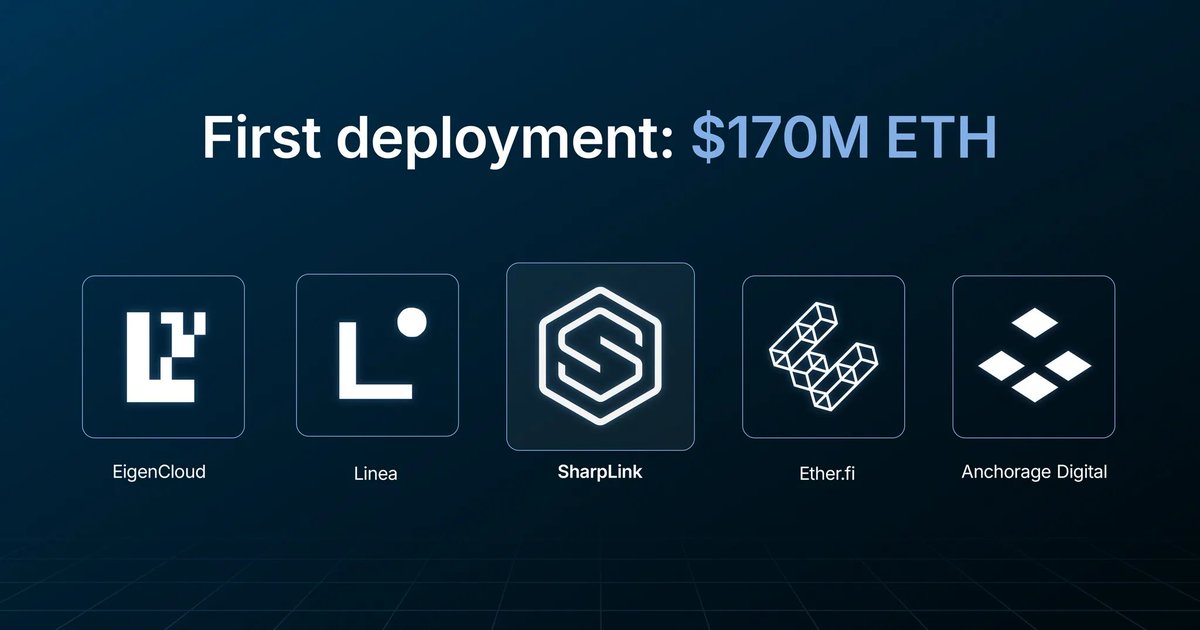 SharpLink Deploys $170M ETH on Linea in First-of-Its-Kind Institutional Strategy Combining Native Yield, Restaking Rewards, and Network Incentives.2026-01
 Publicly traded companies are rapidly accumulating Ethereum, with corporate ETH treasuries now holding over 5% of total supply. Leaders include BitMine, SharpLink, and Coinbase, signaling Ethereum’s growing role in institutional balance sheets.2025-12
 Linea reveals token plans, taps SharpLink and others for distribution2025-07
SharpLink: Inside Ethereum’s Leading Corporate Treasury
This Nasdaq-listed Ethereum treasury company acquires, stakes, and actively manages a rapidly growing ETH reserve on behalf of public‑market shareholders, positioning itself as a bridge between institutional finance and onchain yield. Backed by Ethereum co-founder Joe Lubin and led in part by former BlackRock executive Joseph Chalom, SharpLink’s strategy is to treat ETH as a productive “treasury asset” and to compound staking, restaking, and network rewards over time while operating under the disclosure and governance standards of a traditional listed company.
What SharpLink Is And Why It Matters
SharpLink is best understood as an Ethereum-first corporate treasury platform wrapped in a public company, rather than a conventional operating business whose balance sheet happens to hold some crypto. The company’s own materials describe it as an “institutional-grade Ethereum treasury platform” that combines native protocol rewards, ecosystem incentives, and institutional custody to create “a smarter, more productive access vehicle to ETH.” Instead of diversifying across many digital assets, SharpLink runs an ETH‑only core strategy, with the explicit objective of increasing ETH held per share over time through active treasury management and capital markets execution. That framing puts it in the same conceptual bucket as MicroStrategy’s Bitcoin strategy, but transplanted into the Ethereum ecosystem.
Corporate ETH holdings have become a meaningful macro variable for Ethereum. CoinGecko’s ETH treasuries tracker shows that dozens of institutions collectively hold millions of ETH, representing a non-trivial share of total circulating supply. Against that backdrop, SharpLink has moved from being a marginal player to one of the largest single corporate holders of ETH within just a few years, aided by substantial capital raises and aggressive accumulation programs. In July 2025, the company announced it had become the world’s largest corporate ETH holder with \(280{,}706\) ETH, a figure it continued to grow in subsequent months.
The firm’s strategy is not simply to passively sit on ETH reserves. SharpLink’s leadership emphasizes that Ethereum-native assets are productive in a way that traditional commodities and even Bitcoin are not, because ETH can be staked to secure the network and used across a broad DeFi and L2 ecosystem to earn additional yield. This thesis underpins the company’s decision to deploy the overwhelming majority of its ETH into staking, liquid staking, and restaking strategies, and to partner with infrastructure providers like ConsenSys, Linea, EtherFi, and EigenLayer‑aligned services to enhance returns without giving up institutional safeguards. For a growing class of investors who want exposure to ETH plus yield, but through a regulated equity wrapper, SharpLink has become a focal case study.
SharpLink is still formally known as SharpLink Gaming and trades on the Nasdaq under the ticker SBET, reflecting its pre‑crypto origins in gaming and sports betting technology. That legacy, however, now sits alongside a markedly different core business: operating what amounts to a publicly reported ETH macro fund. The company has supplemented its treasury disclosures with an “ETH dashboard” that shows total ETH holdings, cost basis, and related metrics, updated from internal records on a regular cadence to give markets near real‑time transparency into treasury performance. This convergence of onchain transparency and offchain reporting is part of what makes SharpLink significant: it is one of the first attempts to institutionalize a crypto‑native treasury strategy inside the traditional equity markets.

SharpLink CEO Joseph Chalom opposes Ethereum's EIP-8363, warning reduced staking rewards could weaken DeFi and erase ETH's yield advantage over Bitcoin
Origins: From Gaming To Ethereum Treasury
SharpLink’s story begins in the more familiar territory of online gaming and sports betting infrastructure. Under the SharpLink Gaming banner, the company originally focused on providing technology solutions and affiliate services to the iGaming and sports entertainment sectors, taking advantage of U.S. regulatory liberalization in online wagering. While that legacy business still exists in some form, it no longer defines the company’s strategic identity or investor narrative, which have pivoted decisively toward Ethereum treasury management. The persistence of “Gaming” in the corporate name and ticker is a reminder of that origin, but in practice the company has rebranded its mission around ETH.
The inflection point came when SharpLink attracted backing from Ethereum co-founder Joe Lubin and developed close alignment with ConsenSys, the software company behind MetaMask, Linea, and multiple pieces of Ethereum infrastructure. ConsenSys’ involvement is more than symbolic: SharpLink now positions itself as an ecosystem partner, explicitly tying its treasury strategy to Ethereum’s growth and to new L2 and DeFi primitives being developed in the ConsenSys orbit. Bankless coverage has described SharpLink as a “Joe Lubin-helmed Ethereum treasury firm,” underlining how deeply the company’s identity is now intertwined with the broader Ethereum ecosystem.
The corporate pivot was capital‑intensive. In a landmark deal, SharpLink announced the closing of a \$425 million private placement that would bankroll its transformation into a large‑scale Ethereum treasury operator. Galaxy Digital acted as a key partner in this transaction, and subsequent reporting framed the raise as capital “to build the Ethereum MicroStrategy,” a reference to Michael Saylor’s company that famously turned its balance sheet into a massive Bitcoin bet. Relative to SharpLink’s then‑modest equity market capitalization, this capital infusion was enormous, allowing it to rapidly scale its ETH holdings from tens of thousands to hundreds of thousands of coins.
As the treasury strategy took shape, SharpLink’s management began to explicitly articulate an ETH‑per‑share growth mandate. The company’s “About” materials emphasize that it “operates an ETH‑first treasury and capital platform that applies institutional‑grade infrastructure to an onchain asset, with a clear objective to grow ETH per share over time through active treasury management and disciplined capital markets execution.” That language marks a conceptual shift from seeing ETH merely as an investment on the balance sheet to viewing the entire corporate structure as a vehicle whose purpose is to aggregate ETH on behalf of shareholders, manage it productively, and report results under public markets’ standards of governance and accountability.
Leadership changes reinforced this shift. In July 2025, SharpLink brought in Joseph Chalom as Co‑Chief Executive Officer, highlighting his “over 20 years of institutional leadership at the intersection of” finance and innovation. Chalom previously spent decades at BlackRock, where he worked on strategic partnerships and digital asset initiatives, experience that maps directly onto SharpLink’s ambition to become an institutional‑grade gateway into Ethereum. His appointment signaled to markets that the company was serious about building credibility with large investors, not just retail traders drawn to the ETH narrative. Together with the firm’s crypto‑native co‑founders and Lubin’s backing, this created a hybrid leadership profile spanning Wall Street, crypto, and technology.
The reorientation toward Ethereum also changed how SharpLink engages with the industry. Executives now appear regularly on crypto‑native platforms, including podcasts and livestreams, to discuss topics like ETH as “the superior treasury asset,” the role of staking yields in corporate finance, and the trade‑offs between cypherpunk self‑sovereignty and institutional adoption. Public interviews with SharpLink’s CIO describe the firm as “the first digital asset treasury on the Ethereum ecosystem,” underscoring the ambition to be a prototype for a new corporate category rather than just another company with crypto exposure on its balance sheet. As the older gaming narrative recedes, SharpLink has become, in effect, a live experiment in how far a listed corporation can lean into Ethereum while still satisfying traditional market and regulatory constraints.
Readers click SharpLink's accumulation milestones not for the ETH amounts but to validate the MicroStrategy-for-Ethereum thesis in real time — each purchase, executive hire, and analyst rating is a data point on whether institutional credibility can survive a 91% stock crash while the treasury keeps growing.
ETH As A Treasury Asset: SharpLink’s Investment Thesis
What Is An Ethereum Treasury?
To understand SharpLink, it is useful to first define what an Ethereum treasury is. CoinGecko, which tracks onchain holdings of public companies and governments, describes Ethereum treasuries as “corporate strategies where companies hold ETH on their balance sheets as part of their financial reserves.” Instead of parking excess cash entirely in fiat instruments, these companies allocate a portion of reserves to ETH, treating it both as a long‑term strategic asset and, increasingly, as a yield‑bearing instrument thanks to Ethereum’s proof‑of‑stake design. As of the latest available data, CoinGecko reports that dozens of institutions together hold approximately millions of ETH, worth many billions of dollars, representing roughly \(6.32\%\) of total ETH supply. That concentration illustrates how corporate treasuries are emerging as a structural demand source for ETH.
SharpLink’s twist on the treasury concept is that the treasury is the business. Where a typical corporation might hold some ETH alongside other assets, SharpLink’s primary purpose is to raise capital, convert it into ETH, and manage that ETH to maximize long‑term value for shareholders. The company’s ETH dashboard, which reports holdings based on internal records updated weekly, functions like a quasi‑fund NAV disclosure, giving investors a transparent view of how much ETH per share the corporation controls. Over time, SharpLink aims not only to keep that ratio stable but to grow it, using staking yields, DeFi incentives, and disciplined financing to outpace dilution and corporate costs.
This model slots into a broader trend in digital assets: the rise of Digital Asset Treasury (DAT) companies whose equity is explicitly tied to the performance of a base crypto asset plus some strategy alpha. In Bitcoin, MicroStrategy is the canonical example. In Ethereum, firms like BitMine and SharpLink have become focal names, with analysts and banks now publishing dedicated research on Ethereum treasuries as an emerging asset class. CoinGecko’s tracking of ETH treasuries institutionalizes this trend by treating corporate ETH positions as a category on par with ETF holdings and government reserves, bringing them under the same statistical and analytical gaze.
Why ETH, Not Bitcoin Or Stablecoins?
SharpLink’s core thesis is that ETH is a superior treasury asset relative to alternatives like Bitcoin or stablecoins because it combines scarcity, programmability, and native yield. While Bitcoin is often framed as digital gold, it does not natively generate income and cannot be productively deployed across as rich an onchain economy. ETH, by contrast, can be staked to secure the Ethereum network, earning protocol rewards, and can be further used as collateral and liquidity across DeFi, rollups, and restaking protocols. That productivity gives corporate treasuries a path to generating returns on idle capital without fully exiting the base asset, a structure more analogous to holding dividend‑paying equity than static commodities.
Traditional bank research has increasingly echoed this view. Standard Chartered, for example, has published an “Ethereum Investor Guide” and has publicly highlighted Ethereum’s growing institutional adoption, including by major asset managers and banks. While that research is not specific to SharpLink, it supports the idea that institutional capital now sees ETH not only as a speculative asset but as core digital infrastructure with cash‑flow‑like properties via staking and fees. Stablecoins, meanwhile, are primarily useful for payments and settlement—roles Standard Chartered itself explores through its stablecoin solutions for cross‑border FX—but they typically do not offer the same upside exposure or native yield as ETH. For a treasury seeking both growth and income, ETH sits at a different point on the risk‑reward frontier.
SharpLink articulates this thesis in almost philosophical terms. Its materials argue that “Ethereum‑native assets behave differently than traditional financial instruments” because they “generate yield, reflect network usage, and operate within a live economic system,” whereas public markets are built on governance and accountability standards that historically have not applied to onchain systems. The company’s stated mission is to “bridge these two worlds” by bringing institutional‑grade risk management and disclosure to an ETH‑first treasury strategy, with the ultimate goal of compounding ETH per share over long horizons. Implicit in this vision is a belief that ETH itself will continue to accrue value as Ethereum’s economic activity and security needs grow, so that staking yields and incentives sit atop an appreciating base asset.
The comparison to Bitcoin treasuries clarifies the distinction. When a company like MicroStrategy buys BTC, it is effectively making a concentrated macro bet on digital scarcity and monetary debasement, but it cannot do much with the asset beyond holding it or using derivatives around it. Ethereum treasuries, by contrast, can plug directly into a programmable financial stack, from staking to restaking to DeFi liquidity provision, and can thereby harvest a stack of yields that potentially keep the corporate market NAV above \(1\) even in periods of price consolidation. This is precisely the dynamic that Standard Chartered’s digital assets team has highlighted when arguing that Ethereum treasury firms may have a higher probability of long‑term sustainability than pure BTC treasuries, given their ability to earn ongoing income on their core asset.
For SharpLink, this ETH‑centric thesis is not abstract. It shapes everything from how the company funds itself to how it allocates its balance sheet. Capital raised via equity or private placements is rapidly swapped into ETH, which is then staked or deployed into curated DeFi strategies, all while being held in institutional custody setups designed to satisfy regulators and auditors. That feedback loop—raise fiat, buy ETH, earn yield, report results, raise more capacity—is the economic engine of the business.
- 01ETH accumulation milestones↗
Every new purchase announcement — from 176K to 740K ETH — pulled readers tracking whether SharpLink could sustain its aggressive buying pace without diluting shareholders into oblivion.
- 02Stock crash vs treasury paradox↗
The 91% SBET share-price collapse while ETH holdings expanded exposed the structural tension between treasury NAV growth and equity dilution from ATM share issuance, which readers found more alarming than any hack.
- 03Linea staking deployment↗
SharpLink's decision to stake $170M ETH on Linea — combining native yield, restaking, and network incentives — marked the first time a public company treated L2 ecosystem incentives as a treasury strategy, not just a yield play.
- 04TradFi executive credibility signaling↗
Naming Joseph Chalom — 20-year BlackRock veteran — as Co-CEO was read as a legitimacy signal designed to reassure institutional investors nervous about the company's meme-stock volatility.
- 05ConsenSys ecosystem capture↗
ConsenSys leading the $425M private placement and Joe Lubin's board presence raised questions about whether SharpLink is an independent treasury firm or a distribution vehicle for the Ethereum Foundation's institutional agenda.
- 06Analyst and institutional buy ratings↗
TD Cowen buy ratings and Standard Chartered commentary on mNAV sustainability gave retail readers a framework for evaluating whether SBET's discount to ETH NAV was opportunity or value trap.
How SharpLink Accumulates ETH
Funding The Treasury: Capital Markets And Private Placements
The scale of SharpLink’s ETH holdings is only possible because the company has repeatedly tapped capital markets and private investors to fund its treasury strategy. The pivotal transaction was the \$425 million private placement that SharpLink announced in partnership with Galaxy Digital, which catapulted it into the top tier of corporate ETH holders almost overnight. This capital was explicitly earmarked for building out the firm’s Ethereum treasury platform, with Galaxy describing SharpLink’s ambition as becoming the largest publicly traded ETH holder globally. Commentary from Lex’s analysis framed the deal as a \$425 million “infusion to build out a financial demand investment” vehicle for ETH, echoing the MicroStrategy analogy.
Beyond private placements, SharpLink has relied heavily on at‑the‑market (ATM) equity offerings to raise incremental capital for ETH purchases. In a GlobeNewswire update, the company reported raising \$264.5 million in net proceeds through its ATM facility in a single week, alongside an update that its total ETH holdings had climbed above \(521{,}939\). Later communications and market commentary noted that SharpLink expanded its ATM authorization substantially, signaling that management was willing to continue issuing equity as long as it could channel proceeds into ETH at what it viewed as attractive prices. This is a classic capital‑formation tactic for asset‑accumulation vehicles, but its aggressive use has also raised questions about dilution and long‑term shareholder returns.
SharpLink’s funding mix also includes structured arrangements with trading firms and banks. OTC deals with Galaxy and other institutions have been used to acquire large blocks of ETH without materially impacting spot market liquidity, a strategy that aligns with how ETFs and institutional desks often manage flows. These deals allow SharpLink to rapidly scale its treasury when market conditions meet its internal criteria, while pricing and execution remain relatively discreet compared with directly buying on exchanges. In parallel, the company has cultivated relationships with custody providers like Anchorage Digital, integrating them not just for cold storage but as integral parts of more complex yield strategies, such as DeFi deployment that remains within a bank‑regulated custody perimeter.
This financing engine is ultimately what differentiates SharpLink from individual ETH whales or DAOs that accumulate ETH over time. As a public company, SharpLink has the ability to continuously tap equity markets, debt, and private placements to scale its treasury, and it is accountable to public shareholders for how effectively it converts that capital into ETH and yield. The strategy’s success therefore depends not only on ETH’s price path but on the company’s capital discipline—how much dilution it incurs, at what valuations, and with what timing relative to ETH’s cycles. Supportive analyst coverage, such as TD Cowen’s “Buy” rating on SBET with a double‑digit price target, reflects some confidence that the equity can capture this value creation, though other commentary has highlighted lingering fundamental concerns.
The Scale Of ETH Holdings
Because SharpLink is constantly in the market, its precise ETH balance changes frequently; but historical disclosures and media coverage highlight an unmistakable trend of rapid accumulation. Early in its treasury strategy, SharpLink was reported to have acquired around \(74{,}656\) ETH, valued at roughly \$213 million at the time, with about \(99.7\%\) of that stash deployed into staking strategies within months. That alone was enough for some analysts to dub SBET “Ethereum’s version of MicroStrategy,” underscoring how the company’s identity was already being recast as an ETH holding vehicle.
The numbers escalated quickly. By July 13, 2025, SharpLink announced that it had become the world’s largest corporate holder of Ethereum, with \(280{,}706\) ETH. Less than a month later, a GlobeNewswire update reported that the company’s treasury had grown to \(521{,}939\) ETH as of August 3, 2025, powered in part by that week’s \$264.5 million ATM raise. CoinGecko’s dedicated explainer on SharpLink later described the company as “the second‑largest corporate Ethereum holder,” citing total holdings of around \(740{,}760\) ETH, and other media coverage from Bankless highlighted that SharpLink’s ETH balance had surged to over \(837{,}000\) coins as its strategy matured. Even if the exact ranking shifts as new players emerge, these figures place SharpLink firmly among the top corporate ETH treasuries in the world.
It is important to recognize that all of these numbers are snapshots in time, not static facts. SharpLink’s own ETH dashboard, which is derived from internal company records and updated weekly (with common stock equivalents updated monthly), reflects the company’s effort to keep the market informed of ongoing changes in its holdings. Because ETH prices are volatile and the company is both raising capital and deploying ETH into staking and DeFi, the fiat value of its treasury and its ETH‑per‑share metrics can move significantly over short periods. For that reason, any specific ETH count should be understood as approximate and time‑bound rather than permanent.
What is more enduring is the pattern: a deliberate, sustained accumulation of ETH, backed by institutional capital and a corporate charter aligned with that goal. This pattern has attracted both admiration and criticism. Supporters view SharpLink as a high‑beta proxy for ETH with added yield and an institutional governance wrapper. Skeptics worry that the company is effectively a leveraged ETH trade, exposed not just to crypto price swings but also to equity market risk, funding conditions, and regulatory uncertainties. Both perspectives hinge on the same underlying fact: the concentration and growth of SharpLink’s ETH treasury.
Ethereum's largest corporate backers launch Ethlabs, a new research hub backed by SharpLink, BitMine, and Consensys to accelerate protocol innovation beyond the Ethereum Foundation
Putting ETH To Work: Staking, Restaking, And Linea
Native Staking And Liquid Staking As A First Step
From the outset of its treasury strategy, SharpLink’s leadership has emphasized that leaving ETH unstaked is a lost opportunity. In interviews, the company’s chief investment officer has described how the firm initially focused almost entirely on native staking and participation in a liquid staking protocol, effectively earning the standard Ethereum staking rate on the bulk of its holdings. Under Ethereum’s proof‑of‑stake consensus, validators who lock up ETH to secure the network earn issuance and priority fees, resulting in a yield that has generally fluctuated in the mid‑single‑digit percentage range, depending on network conditions. For a large corporate treasury, that is a meaningful income stream on top of any price appreciation.
SharpLink’s first phase therefore looked more like a classic staking‑as‑a‑service strategy than a complex DeFi operation. ETH was either staked directly or through curated liquid staking providers, with risk controls focused on validator performance, slashing protection, and custody security. This allowed the company to demonstrate to investors and regulators that it could earn yield in a relatively conservative way, using battle‑tested protocols and infrastructure, while building operational muscle in monitoring onchain positions and integrating staking flows into its treasury and accounting systems.
Even in this early phase, SharpLink was mindful of institutional constraints. Staked ETH and any associated derivative tokens were held through qualified custodians, most notably Anchorage Digital, which is a federally chartered crypto bank in the United States. By keeping staked positions within a bank‑regulated custody environment, SharpLink sought to address concerns that DeFi or staking activities might force it into uncharted legal or compliance territory. This approach set the stage for more sophisticated strategies by establishing a baseline, regulator‑friendly pattern: ETH is staked, yield is earned, all assets are held in qualified custody, and positions can be transparently reported to auditors and shareholders.
Over time, however, the company’s appetite for yield and its confidence in Ethereum’s infrastructure led it to expand beyond simple staking into more complex restaking and L2 yield strategies, particularly on Linea.
The Linea Strategy With ConsenSys, EtherFi, And EigenLayer‑Aligned Protocols
The next major evolution in SharpLink’s treasury deployment was its partnership with ConsenSys’ Linea network and protocols like EtherFi and EigenCloud, part of the broader EigenLayer restaking ecosystem. In a widely covered move, SharpLink announced plans to allocate up to \$200 million worth of ETH for deployment on Linea over a multi‑year commitment period, framing the strategy as a risk‑managed, first‑of‑its‑kind institutional approach that combines base staking yield, restaking rewards, and network incentives. Media coverage and subsequent commentary indicated that roughly \$170–\$200 million of this commitment has been actively deployed, making it one of the largest single institutional yield strategies in the Ethereum L2 ecosystem.
Linea is a zkEVM rollup built by ConsenSys, designed to offer Ethereum‑equivalent execution with lower fees and high throughput while settling back to mainnet for security. By deploying ETH and staked ETH derivatives on Linea, SharpLink can participate in incentive programs aimed at bootstrapping the L2’s ecosystem, including liquidity mining, validator or sequencer rewards, and governance token allocations once they launch. EtherFi and EigenCloud add another layer: they allow staked ETH to be restaked, meaning the same underlying ETH can simultaneously secure Ethereum and provide security to additional middleware or rollups, earning extra rewards for providing this shared security.
SharpLink’s CIO has described how the company spent months on due diligence before taking its “first step into DeFi” through this Linea‑EtherFi‑EigenCloud strategy, emphasizing that it is structured to remain within Anchorage Digital’s qualified custody perimeter. That means that, even though the underlying activities are DeFi‑like—restaking, providing liquidity, and participating in incentive programs—the legal and operational structure is more akin to a traditional segregated account managed by an institutional custodian. In effect, SharpLink and its partners have engineered a DeFi‑inside‑custody model, which could serve as a blueprint for other institutions that want to tap onchain yield without compromising compliance or control.
For SharpLink’s investors, the Linea strategy represents an attempt to stack multiple yield streams on top of the base ETH position. At the simplest level, the ETH is staked, earning the normal Ethereum validator rewards. On top of that, restaking through protocols like EtherFi and EigenCloud can earn additional rewards for contributing to the security of other networks or middleware. Finally, participation in Linea’s ecosystem, especially during its growth and token‑distribution phases, can generate network‑specific incentives, including potential allocations of the Linea token itself once distributed. If executed prudently, this layered approach could significantly increase the effective yield on SharpLink’s ETH treasury, though it also introduces more complexity and smart contract risk.
Risk Management, Custody, And Transparency
Complex yield strategies are only tolerable to public‑market investors if they are paired with robust risk management and transparency, and SharpLink has made these themes central to its pitch. On the risk side, the company repeatedly stresses its reliance on institutional‑grade partners: ConsenSys and Linea for infrastructure, EtherFi and EigenCloud for restaking, and Anchorage Digital for custody. By working with providers that have established compliance footprints and have undergone third‑party audits, SharpLink seeks to mitigate smart contract, operational, and counterparty risks to a degree acceptable for a listed company.
Custody is particularly crucial. In public interviews, SharpLink executives have highlighted that they structured their DeFi deployments in a way that allowed all assets and positions to remain under the control of Anchorage Digital, their qualified bank custodian. This arrangement is unusual; DeFi is typically associated with self‑custody wallets and direct onchain interactions. By moving these activities into a bank‑regulated custody framework, SharpLink effectively institutionalizes DeFi exposure, allowing it to present onchain yield strategies to auditors and regulators through a familiar custodial relationship while still reaping the economic benefits of DeFi protocols.
On the transparency side, SharpLink complements traditional SEC reporting with a more crypto‑native disclosure tool: its ETH dashboard. This dashboard, updated weekly based on internal records, reports total ETH holdings and related metrics, while common stock equivalents are updated monthly. Such near real‑time reporting goes beyond what is strictly required in traditional accounting standards but aligns with expectations in the crypto community, where onchain transparency is the norm. Combined with press releases that regularly update the market on major ETH accumulation milestones, staking deployment, and capital raises, this creates a hybrid transparency regime straddling GAAP reporting and blockchain‑era real‑time data.
Nevertheless, the complexity of these strategies—and the need to rely on multiple partners—means that SharpLink is exposed to non‑trivial operational and regulatory risks. Any major incident at a custodian, restaking protocol, or L2 could affect its treasury. Moreover, as regulators around the world grapple with how to classify staking, restaking, and DeFi activities, there is no guarantee that today’s structures will remain compliant tomorrow. SharpLink’s bet is that by working with high‑profile, well‑regulated partners and maintaining rigorous disclosure, it can stay ahead of regulatory expectations while continuing to push the frontier of what a corporate ETH treasury can do.
ConsenSys leads $425M private placement; ETH treasury strategy announced
Became largest publicly-traded ETH holder; 176,270 ETH at avg $2,626
SBET stock crashes 91% in two weeks amid ongoing ETH buying
Joseph Chalom (ex-BlackRock, 20 years) named Co-CEO of SharpLink
Holdings reach 205,634 ETH; ATM raises $64M in single week
Holdings reach 521,939 ETH; $264.5M raised via ATM in one week
$170M ETH deployed on Linea combining native yield and restaking rewards
ATM offering expanded from $1B to $6B via A.G.P. agreement
Governance, Leadership, And Institutional Narrative
From BlackRock To Ethereum: Joseph Chalom’s Role
Governance and leadership are critical to whether institutional investors trust an experiment as radical as SharpLink’s. The appointment of Joseph Chalom as Co‑CEO in July 2025 was a key step in this direction. SharpLink’s “About” page emphasizes that Chalom brings over two decades of institutional leadership experience, specifically at the intersection of finance, technology, and strategic partnerships. Although his previous roles are not detailed there, outside reporting has noted his long tenure at BlackRock, where he worked on key initiatives related to digital assets and strategic client solutions, giving him deep familiarity with how large asset managers think about risk, regulation, and product design.
Chalom’s presence helps reassure traditional investors that the company’s aggressive ETH strategy is being overseen by someone conversant in institutional risk frameworks and corporate governance, not just crypto‑native enthusiasm. His background suggests an ability to translate SharpLink’s onchain activities into narratives and metrics that resonate with pension funds, family offices, and bank research desks. It also signals that SharpLink is serious about building a durable corporate structure, not merely riding a temporary crypto bull market. In this sense, Chalom functions as a bridge figure, connecting SharpLink’s Ethereum‑native ambitions with Wall Street’s expectations.
Alongside Chalom, SharpLink’s leadership team includes founders and executives with deep roots in crypto and technology, complemented by investor relations professionals and advisors from traditional capital markets. GlobeNewswire releases list investor relations contacts with CFA credentials and firms specialized in IR, suggesting a deliberate effort to professionalize communications with the equity market. This blend of crypto domain expertise and public‑company discipline is central to the firm’s pitch that it can manage an ETH treasury at institutional scale while still satisfying the governance and accountability standards that regulators and index providers expect.
Joe Lubin, ConsenSys, And Ecosystem Alignment
If Chalom represents the bridge to traditional finance, Joe Lubin and ConsenSys represent SharpLink’s anchor within the Ethereum ecosystem. Bankless coverage has described SharpLink as a “Joe Lubin‑helmed Ethereum treasury firm,” implying that Lubin is not just a passive investor but a driving force behind the company’s strategy. Lubin, as a co‑founder of Ethereum and the founder of ConsenSys, has long championed Ethereum as the foundational infrastructure for programmable money and decentralized applications. His backing gives SharpLink unique alignment with Ethereum’s core development and L2 roadmap.
This alignment is visible in SharpLink’s partnerships. The company prominently notes its collaboration with ConsenSys, the builders behind MetaMask and Linea, as well as “the most trusted infrastructure providers and custodians across the Ethereum ecosystem,” framing these relationships as keys to accessing enhanced incentives and DeFi technologies. The Linea deployment strategy is the most concrete manifestation of this: SharpLink’s decision to commit up to \$200 million of ETH to Linea’s ecosystem, using EtherFi and EigenCloud for restaking, is closely intertwined with ConsenSys’ efforts to bootstrap Linea as a major Ethereum L2. That strategy not only benefits SharpLink’s treasury through yield and incentives; it also supports the growth of the very infrastructure that underpins its long‑term ETH thesis.
Beyond technical alignment, Lubin’s involvement reinforces SharpLink’s narrative that ETH is the core institutional digital asset around which a new generation of financial products and corporate treasuries will be built. In public commentary, SharpLink executives have described ETH as “the superior treasury asset” and “the world’s first true trust commodity”—productive, programmable, and deeply integrated into an expanding digital economy. That language resonates with Lubin’s long‑standing view of Ethereum as a generalized trust and settlement layer for all kinds of value transactions, not just a speculative crypto asset.
Industry Engagement And Thought Leadership
SharpLink’s leaders have not stayed confined to SEC filings and press releases; they are active participants in the broader debate over Ethereum’s future and the role of institutions in crypto. Company executives appear on shows like Bankless and other crypto media outlets to discuss topics such as ETH as money, self‑sovereignty, and the balance between cypherpunk values and mainstream adoption. This discourse is not purely theoretical. For example, Bankless episodes have debated whether the Ethereum Foundation should focus narrowly on preserving self‑sovereignty or more actively pursue product‑market fit and institutional integration, questions that directly impact the environment in which Ethereum treasuries like SharpLink operate.
SharpLink leadership also attends and speaks at industry conferences. At events like DAT Summit Hong Kong, SharpLink executives have joined panels on institutional yield, due diligence, and digital asset treasuries, sharing their experience of deploying large ETH positions in a risk‑managed way while navigating public‑company obligations. These appearances serve a dual purpose: they help SharpLink shape the conversation around institutional yield in Ethereum, and they position the company as a credible counterparty and thought partner for other institutions considering similar strategies.
The firm’s communications emphasize transparency and accountability, not only through the ETH dashboard but also through frequent updates on major treasury moves, such as large OTC ETH purchases or significant staking deployments. In interviews, SharpLink’s CIO has used vivid metaphors—such as describing “unstaked Ethereum adrift in calm seas” as a misuse of capital—to argue that productive deployment of ETH is not just an opportunity but an obligation for sophisticated treasuries. That kind of rhetoric is part of a broader attempt to reframe corporate cash management in a world where digital assets and onchain yield are increasingly available and institutionalized.
ATM offering expansion from $1B to $6B means SharpLink can continuously issue shares to buy ETH, creating permanent dilution pressure that caused a 91% stock drawdown even as ETH holdings grew.
ConsenSys as lead investor and primary ecosystem partner, Galaxy Digital as dominant OTC counterparty, and Joe Lubin's board seat concentrate control and counterparty risk in a tight set of Ethereum insiders.
Deploying $170M ETH on Linea with restaking via EigenLayer-adjacent infrastructure introduces layered slashing risk across multiple protocol layers that a traditional corporate treasury has no precedent for managing.
Acquiring hundreds of thousands of ETH primarily through OTC desks like Galaxy Digital limits price discovery and means exit liquidity in a stress scenario would require the same opaque bilateral market.
As a Nasdaq-listed company issuing billions in ATM equity to buy a single crypto asset and deploying it on DeFi protocols, SharpLink sits in an uncharted regulatory space between securities law and crypto market structure rules.
SharpLink's Linea staking strategy explicitly combines native yield, restaking rewards, and network incentives across multiple smart contract layers, each representing an unaudited or early-stage protocol surface.
Market Perception: SBET As “Ethereum’s MicroStrategy”
The MicroStrategy Analogy And Beyond
Since its large ETH purchases became public, SharpLink has frequently been labeled “Ethereum’s version of MicroStrategy.” The analogy is grounded in clear similarities. Like MicroStrategy, which redirected much of its corporate focus toward accumulating Bitcoin, SharpLink has pivoted from its original operating business to concentrate on building and managing a large treasury in a single crypto asset. Both companies use public equity markets as a levered conduit for investors to gain exposure to the underlying asset, often trading at premiums or discounts to the net asset value of their holdings based on market sentiment, capital raises, and perceptions of management.
However, there are also important differences. MicroStrategy’s BTC strategy is largely buy‑and‑hold, with some use of debt and derivatives but relatively little focus on native yield generation, since Bitcoin does not support staking at the protocol level. SharpLink’s ETH strategy, by contrast, is explicitly oriented around maximizing onchain yield via staking, restaking, and L2 incentives, in addition to directional exposure to ETH’s price. That means SBET’s value proposition is less about raw BTC‑like scarcity and more about the combination of ETH as programmable collateral and the yield opportunities that emerge in Ethereum’s financial ecosystem.
Analysts and market participants have responded to this hybrid profile with a mix of excitement and caution. TD Cowen, for example, has rated SharpLink a “Buy” with a target price far above some recent trading levels, positioning it as a high‑conviction play in the emerging Ethereum treasury space. At the same time, other commentary has pointed to “persistent fundamental concerns” that weigh on investor sentiment, including questions about the sustainability of dilution via ATM programs, the concentration of risk in a single volatile asset, and the execution risks inherent in complex DeFi strategies. These divergent views contribute to SBET’s volatility, as the market continually reprices both ETH itself and the quality of SharpLink’s strategy.
Trading Dynamics, NAV, And Tokenized Access
Because SharpLink is effectively a listed ETH holding vehicle with active yield strategies, its stock price often trades in relation to a market NAV (mNAV) metric that compares the value of its ETH holdings and other assets to its equity market capitalization. When SBET trades at a premium to mNAV, the company has more incentive to issue new shares via ATM offerings and deploy the proceeds into ETH, since each dollar raised buys more than a dollar of ETH exposure per share. When it trades at a discount, raising equity becomes more dilutive, and the market may be signaling skepticism about future value creation. This dynamic mirrors what has been observed in Bitcoin‑focused companies and ETFs, but with the added variable of yield and DeFi execution.
Crypto exchanges have further blurred the lines between traditional and digital markets by listing tokenized versions of SBET. Bybit, one of the world’s largest crypto exchanges, has listed SBET on its TradFi platform alongside other crypto‑exposed equities, giving crypto‑native traders an easier way to express views on SharpLink without going through a conventional brokerage. Media coverage of this listing highlighted SharpLink’s substantial ETH holdings—over \(74{,}656\) ETH at the time—and the fact that nearly all of it was deployed in staking strategies, reinforcing its status as an ETH‑centric treasury company. Tokenized access on exchanges like Bybit thus amplifies SBET’s reach and integrates it more fully into the crypto trading universe.
Market narratives around sustainability and yield also shape perception. Bank research, including from Standard Chartered’s digital assets team, has suggested that Ethereum treasury firms might have the “highest probability of being sustainable” among DAT companies, thanks to staking yields and pre‑approved strategies that help keep mNAV ratios above \(1\) even during price drawdowns. In this view, the ability to earn ongoing income on ETH differentiates SharpLink from more speculative plays that rely solely on price appreciation. However, this is not a guarantee; yield strategies can go wrong, and even well‑managed treasuries are subject to macro shocks, regulatory shifts, and liquidity crunches.
As a result, SBET often trades as a levered, actively managed ETH proxy, with its volatility reflecting not only ETH price moves but also changing expectations about SharpLink’s ability to safely capture onchain yield, scale its treasury without excessive dilution, and navigate the evolving regulatory landscape. For investors and traders who understand these dynamics, SBET offers a nuanced exposure that is neither a pure ETH spot bet nor a traditional growth stock, but something in between.

SharpLink resumes ETH buys with $7.85M purchase as ether sinks to 2026 low ahead of Russell inclusion
SharpLink In The Broader Ethereum Treasury And DAT Landscape
Comparison With Other Corporate ETH Holders
SharpLink is not alone in viewing ETH as a strategic treasury asset. CoinGecko’s Ethereum treasuries tracker lists dozens of public companies and governments that collectively hold around \(7{,}632{,}604\) ETH, worth over \$13 billion at the time of reporting, representing approximately \(6.32\%\) of Ethereum’s total supply. Among these, crypto‑native exchanges like Coinbase, mining and staking companies, and newer DAT vehicles like BitMine feature prominently. SharpLink’s rapid climb into the top ranks reflects both its aggressive capital deployment and the relative nascency of Ethereum treasuries as a structured corporate strategy.
Within this landscape, BitMine has emerged as a heavyweight, with commentary from bank analysts citing holdings in the low millions of ETH, more than double SharpLink’s reported \(837{,}000+\) ETH position in some snapshots. While specific figures fluctuate and new entrants appear, the broader pattern is clear: a small but growing cohort of specialized ETH treasuries now controls a material percentage of total ETH supply, and their decisions around staking, restaking, and L2 deployment have implications for Ethereum’s security and liquidity dynamics. SharpLink sits in this cohort as one of the more transparent and publicly debated examples, thanks to its Nasdaq listing and proactive communications.
CoinGecko’s explainer on SharpLink underscores this status by describing the company as the second‑largest corporate Ethereum holder at one point, with total holdings of around \(740{,}760\) ETH. That ranking can change as others accumulate or sell, but it frames SharpLink as a benchmark case for analyzing how corporate treasuries manage ETH exposure. SharpLink’s combination of aggressive accumulation, yield‑seeking deployment, and public‑company transparency makes it a logical reference point for analysts and policymakers studying the impact of corporate ETH holdings on the broader ecosystem.
Implications For Ethereum’s Monetary And Security Model
The rise of corporate ETH treasuries like SharpLink has implications beyond equity markets; it also affects Ethereum’s monetary and security model. ETH serves multiple roles in the ecosystem: it is the native gas token, the staking asset securing the network, and a key form of collateral and liquidity in DeFi. When large entities lock up significant amounts of ETH in staking and restaking, they increase the proportion of supply that is illiquid or semi‑liquid, potentially affecting market dynamics, price resilience, and the distribution of staking power.
On the positive side, having well‑capitalized, professionally managed treasuries stake large amounts of ETH can bolster Ethereum’s economic security. More ETH at stake generally means higher costs for potential attacks and more resilience against validator misbehavior. Entities like SharpLink, which stake through reputable providers and custodians, can provide stable, long‑term staking participation that is less likely to be withdrawn at the first sign of market turbulence. In this sense, corporate treasuries can function as anchors of staking demand, complementing decentralized and retail participation.
However, there are also concerns about centralization and systemic risk. If a significant share of staked ETH is controlled by a small number of corporate treasuries and their chosen custodians or staking providers, failures or coordinated decisions by those actors could have outsized impacts on network security and governance. For example, if regulatory pressure led a major custodian to censor certain transactions or withdraw from staking, that could ripple through to the corporations whose ETH they manage. Similarly, large treasuries participating in restaking protocols introduce new dependencies, as failures in those protocols could affect both the treasuries’ solvency and the security assumptions of the networks they help secure.
These tensions intersect with long‑running debates in the Ethereum community about the network’s mandate and values. Discussions on platforms like Bankless have highlighted concerns about whether Ethereum should prioritize cypherpunk self‑sovereignty and decentralization or embrace more explicit product‑market fit for institutions, including treasuries like SharpLink. The Ethereum Foundation’s evolving mandate and the growth of institutional L2s like Linea are part of this conversation. SharpLink’s existence and success thus act as a real‑world test of whether Ethereum can support large, yield‑seeking institutional treasuries without compromising its decentralization and censorship‑resistance goals.
From a monetary perspective, the accumulation of ETH by corporate treasuries reduces the freely circulating float available on exchanges, at least in the short to medium term. Combined with staking and restaking, this can contribute to structural supply tightness, particularly in bull markets when demand for ETH as gas, collateral, and speculative exposure all rise. While this dynamic can be bullish for ETH’s price, it also means that shocks—such as a major treasury unwinding positions—could have disproportionate effects on liquidity and volatility. SharpLink, as one of the largest and most visible ETH treasuries, is therefore not just a passenger in the Ethereum economy but a participant whose actions can influence the system it depends on.
Risk Factors And Critiques
Market And Funding Risks
No matter how sophisticated their strategies, Ethereum treasury firms like SharpLink remain fundamentally exposed to market risk. ETH is a volatile asset, subject to large drawdowns during bear markets and sharp rallies during bull markets. Because SharpLink’s balance sheet is heavily concentrated in ETH, the company’s book value and perceived solvency can fluctuate dramatically with ETH’s price. In severe downturns, the fiat value of its treasury could fall below the capital it raised, raising questions about sustainability and access to further funding. Equity investors in SBET are thus effectively taking leveraged exposure to ETH’s price path, with company‑specific factors layered on top.
Funding risk is closely related. SharpLink’s reliance on ATM equity offerings and private placements means that its capacity to grow or even maintain its ETH holdings depends on equity market conditions and investor appetite. When SBET trades at a premium to its ETH mNAV, issuing new shares to buy more ETH can create value; but when it trades at a discount, continued issuance becomes more dilutive and may be perceived as value‑destructive. Perplexity’s finance summary has noted periods where SharpLink’s stock fell sharply and approached 52‑week lows, with “persistent fundamental concerns” weighing on sentiment. In such environments, the company’s ability to raise new capital on favorable terms could be constrained, forcing it to slow or pause its accumulation strategy.
Interest rate and macro conditions also matter. In a world of higher risk‑free yields on traditional instruments, the relative attractiveness of ETH staking yields can diminish, especially given the higher volatility and regulatory uncertainty attached to digital assets. If institutional allocators decide that the risk‑adjusted returns of ETH treasuries are less compelling than other opportunities, capital flows into firms like SharpLink could slow, impacting both their equity valuations and their strategic flexibility.
Regulatory, Accounting, And Governance Risks
SharpLink operates at the intersection of securities regulation, banking, and crypto, a zone that is still evolving and sometimes contested. Questions about whether certain tokens or staking arrangements constitute securities, how to treat staking rewards under tax and accounting standards, and what risk controls are required for DeFi exposure all affect how regulators view Ethereum treasuries. While SharpLink has taken steps to mitigate these risks—using qualified custodians, working with reputable partners, and maintaining robust disclosures—there is no guarantee that future regulatory actions will leave its business model untouched.
Accounting treatment of digital assets and staking rewards remains a live issue. Depending on jurisdiction and audit interpretations, ETH may be classified in ways that lead to conservative recognition of gains and asymmetric treatment of impairments. Staking and restaking yields introduce further complexity, as they may be treated as income, capital gains, or something else, each with different tax and reporting consequences. SharpLink must navigate these rules while maintaining clear, investor‑friendly disclosures about ETH per share, yield, and risk, a non‑trivial task in a rapidly changing regulatory environment.
Governance risk is another consideration. As a public company with a concentrated strategic focus, SharpLink’s fortunes are heavily tied to the decisions of its leadership team and board. Strategic missteps—such as overly aggressive leverage, poor partner selection, or inadequate risk controls around DeFi deployments—could rapidly erode shareholder value. The dual role of some leaders as both ecosystem advocates and corporate executives can also create perception risks if the company appears to prioritize narrative and ecosystem alignment over shareholder protection. Robust governance structures, independent oversight, and clear incentive alignment are therefore essential to maintaining investor trust.
DeFi, Smart Contract, And Counterparty Risks
Finally, SharpLink’s pursuit of enhanced yield through staking, restaking, and DeFi exposes it to a spectrum of technical and counterparty risks that traditional treasuries do not face. Smart contract bugs, oracle failures, governance attacks on protocols, or unexpected behaviors in complex interactions between multiple protocols can all lead to loss of funds or temporary lock‑ups. While protocols like EtherFi and EigenCloud undergo audits and testing, no onchain system is entirely free of risk. SharpLink’s choice to concentrate large sums in such strategies magnifies the impact of any failure.
Counterparty risk extends to custodians and infrastructure providers. If a custodian like Anchorage Digital were to face operational issues, legal challenges, or cyberattacks, SharpLink’s access to its ETH and its ability to manage staking and DeFi positions could be impaired. Similarly, reliance on a specific L2 like Linea introduces execution and ecosystem risk: if Linea were to suffer a major exploit, face regulatory headwinds, or fail to attract sustainable usage beyond incentive programs, the expected yield and token rewards for SharpLink’s deployment might not materialize as planned. These risks are part and parcel of being an early institutional mover in new Ethereum infrastructure.
SharpLink attempts to mitigate these risks through diversification among partners, thorough due diligence, and careful structuring of its exposures. The company’s emphasis on being “risk‑managed” and its decision to keep even DeFi‑related activities within qualified custody frameworks are examples of this. Yet, for investors, it is crucial to recognize that the pursuit of higher yield necessarily carries higher risk. The key question is whether SharpLink’s governance, risk management, and ecosystem partnerships are robust enough to justify those risks in exchange for potentially superior long‑term ETH‑denominated returns.
Outlook
SharpLink sits at the frontier of an emerging corporate category: Ethereum‑native treasuries that treat ETH not merely as a speculative asset but as productive capital within a programmable, yield‑bearing financial system. Its rapid accumulation of ETH, deep partnerships with ConsenSys and other Ethereum infrastructure providers, and willingness to deploy large sums into staking and L2 strategies have made it both a bellwether and a test case. For crypto‑native observers, SharpLink offers a glimpse of how far institutional actors can go in embedding themselves in onchain economies; for traditional investors, it presents a novel, high‑beta vehicle for ETH exposure wrapped in the familiar packaging of a Nasdaq‑listed stock.
The future trajectory of SharpLink will depend on several intertwined factors. Ethereum’s own evolution—its scalability roadmap, L2 adoption, regulatory treatment, and competition from other smart contract platforms—will shape the opportunity set for ETH treasuries. The maturation of restaking, DeFi infrastructure, and institutional custody will determine how safely and efficiently SharpLink can continue to stack yields on top of its core ETH position. And macroeconomic conditions, from interest rates to risk appetite, will affect both ETH’s price and the equity market’s willingness to fund and value a specialized ETH treasury vehicle.
At the same time, the broader digital asset treasury (DAT) sector is becoming more crowded and sophisticated. Companies like BitMine, exchanges like Coinbase, and other dedicated ETH vehicles are accumulating their own treasuries, experimenting with different blends of staking, liquidity provision, and yield strategies. Regulators, banks, and research houses are paying closer attention, as evidenced by institutional reports on Ethereum treasuries and their sustainability. In that context, SharpLink will need to continue differentiating itself through transparent reporting, prudent risk management, and thoughtful participation in the Ethereum ecosystem, rather than relying solely on headline‑grabbing ETH purchases.
For now, SharpLink remains a high‑conviction bet on ETH’s centrality to the future of digital finance and on the idea that corporate treasuries can and should operate natively within that ecosystem. Its success or failure will offer valuable data points not just for shareholders but for the entire crypto industry, informing how other corporations structure their own digital asset reserves and how Ethereum integrates institutional capital at scale. For a crypto news audience navigating these shifts, SharpLink is likely to remain a key reference point when discussing the institutionalization of Ethereum and the evolving role of treasuries in the onchain economy.
Latest SharpLink news
SharpLink CEO Joseph Chalom opposes Ethereum's EIP-8363, warning reduced staking rewards could weaken DeFi and erase ETH's yield advantage over BitcoinEthereum's largest corporate backers launch Ethlabs, a new research hub backed by SharpLink, BitMine, and Consensys to accelerate protocol innovation beyond the Ethereum FoundationSharpLink resumes ETH buys with $7.85M purchase as ether sinks to 2026 low ahead of Russell inclusionTD Cowen cuts Strategy target to $350, calls Ethereum treasury firm SharpLink a buy at $16SharpLink Deploys $170M ETH on Linea in First-of-Its-Kind Institutional Strategy Combining Native Yield, Restaking Rewards, and Network Incentives.Publicly traded companies are rapidly accumulating Ethereum, with corporate ETH treasuries now holding over 5% of total supply. Leaders include BitMine, SharpLink, and Coinbase, signaling Ethereum’s growing role in institutional balance sheets.Sources
19 records from 14 domains
sharplink.com
lex.substack.com
nasdaq.com
coingecko.com
sc.com
datsummit.io
stocktitan.net
stocktwits.com
galaxy.com
globenewswire.com
bankless.com
youtube.com
facebook.com
perplexity.ai
Community notes
Spot something off or out of date? Drop a note. Editors review topic notes daily and roll accepted fixes into the explainer — contributors are recognized in the monthly $SQUID drop.
Loading notes…
Help improve this topic
Have a story or tip about this topic? Submit it. See something missing? Leave a note. Editors review daily; accepted submissions and fixes count toward the monthly $SQUID drop.