
BitMine Immersion Technologies (BMNR) is a NYSE‑listed Bitcoin and Ethereum firm that evolved into a major Ethereum treasury, using aggressive ETH accumulation, staking via MAVAN and a 9.5% preferred share to offer public‑market exposure to Ethereum‑backed yield.
+10 sources across the wider coverage universe
 BitMine buys 27,801 ETH in a week, lifting holdings to 5.77M ETH, 4.8% of supply2026-07
 Ethereum's largest corporate backers launch Ethlabs, a new research hub backed by SharpLink, BitMine, and Consensys to accelerate protocol innovation beyond the Ethereum Foundation2026-06
 Wallets likely tied to Tom Lee's BitMine receive 60,000 ETH from Kraken and BitGo2026-05
 Ethereum Foundation finalized the terms of a 10,000 ETH sale at an average price of $2,387 via OTC, to Tom Lee's Bitmine2026-04
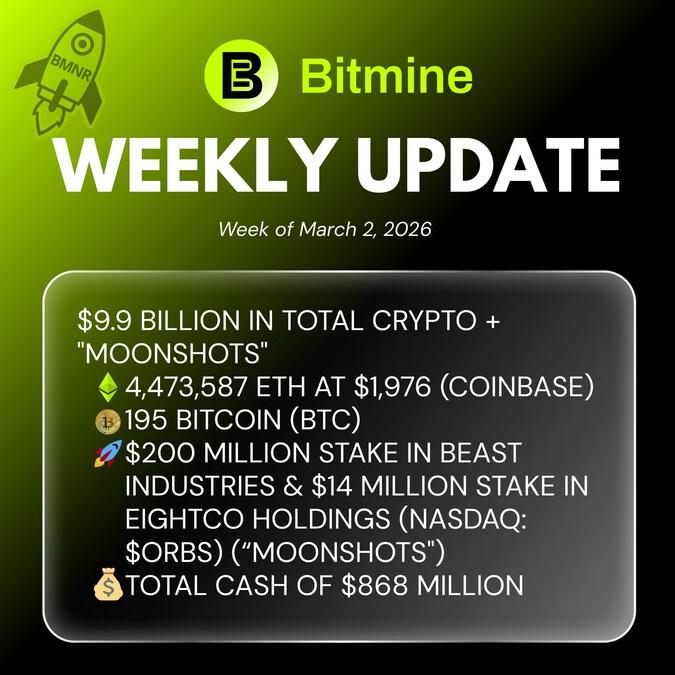 BitMine scoops another 50,928 ether at $1,976 apiece, pushing treasury to 4.47 million ETH and $9.9 billion in total assets2026-03
 Bitmine unveils MAVAN staking platform with 3.14M ETH and $300M projected annual yield, eyes world's largest validator title2026-03
BitMine: Inside The Ethereum‑Heavy Treasury Strategy Reshaping Corporate Crypto
BitMine Immersion Technologies, traded under the ticker BMNR, is a U.S.-based Bitcoin and Ethereum network company that has evolved from a niche immersion‑cooling Bitcoin miner into one of the largest Ethereum corporate treasuries in the world, holding more than \(5.3\) million ETH and positioning itself as an “Ethereum Treasury” vehicle for public‑market investors. Through aggressive ETH accumulation, large‑scale staking, and a high‑yield preferred share structure, BitMine has become a focal point in debates over how deeply corporations should embed crypto assets—especially Ethereum—into their balance sheets and business models.
BitMine At A Glance
BitMine Immersion Technologies, Inc. is headquartered in the United States and describes itself as a Bitcoin and Ethereum Network company that focuses on long‑term crypto accumulation rather than short‑term trading. In its regulatory filings around its uplisting to the NYSE American exchange, BitMine said it operated Bitcoin mining facilities in low‑cost energy regions such as Trinidad, Pecos (Texas), and Silverton (Texas), using immersion‑cooling technology to increase efficiency and hardware longevity. That operational footprint underpinned the company’s original identity as a Bitcoin miner, but over time its narrative has shifted toward treasury management and capital markets engineering around Ethereum. By mid‑2026, BitMine common stock had moved from NYSE American to the main New York Stock Exchange, enhancing its visibility among institutional investors seeking equity exposure to digital assets.
The company’s financial profile today is dominated far more by its crypto balance sheet than by its operating business. In March 2026, BitMine reported total crypto, cash, and “moonshot” equity holdings of approximately \(11.5\) billion U.S. dollars, backed primarily by 4.6 million ETH and a small Bitcoin position. By April, that figure had risen to roughly \(11.8\) billion with 4.87 million ETH; by late May, BitMine disclosed 5.39 million ETH—which it estimated as about \(4.47\%\) of the total circulating Ethereum supply of 120.7 million ETH—plus 203 BTC, strategic equity stakes, and hundreds of millions in cash. A subsequent update on June \(1\), \(2026\) indicated ETH holdings had reached approximately 5.42 million tokens with combined crypto and cash holdings of about \(11.6\) billion dollars, underscoring the pace and persistence of the accumulation strategy.
Management has leaned into this balance‑sheet story in its public messaging. In a March 2026 release, BitMine described its crypto trove as the number‑one Ethereum treasury holding globally and the number‑two overall corporate crypto treasury, behind only Strategy Inc. (traded on Nasdaq as MSTR), which has adopted Bitcoin as its primary treasury reserve asset. Strategy’s own investor relations materials present it as the first and largest “Bitcoin Treasury Company,” using proceeds from equity and debt financing, along with operational cash flows, to systematically accumulate BTC and offer investors a suite of securities providing different forms of Bitcoin exposure. BitMine explicitly positions itself as the Ethereum analogue to this model, seeking to become “the leading Ethereum Treasury company in the world” while still operating a Bitcoin mining business.
What sets BitMine apart from traditional miners and from Bitcoin‑only treasury firms is the way it is intertwining corporate finance with Ethereum’s native yield‑bearing features. Galaxy Digital’s research on “Ethereum as a Corporate Treasury Asset” argues that ETH offers a combination of programmability, staking yield, and broader DeFi integration that distinguishes it from Bitcoin, while also introducing additional complexity and risk. BitMine’s strategy appears designed to harness that feature set: it amasses ETH, stakes a large portion of its holdings on a proprietary validator infrastructure, and uses the resulting income stream to support a high‑yield preferred stock that trades on public markets. For equity investors, BitMine thus functions as a kind of Ethereum‑backed yield vehicle, but one whose fortunes are tightly linked to the volatility of the underlying asset and to the health of the Ethereum network itself.

BitMine buys 27,801 ETH in a week, lifting holdings to 5.77M ETH, 4.8% of supply
From Immersion Miner To Ethereum Whale
Origins In Bitcoin Mining
BitMine’s story begins not with Ethereum, but with hardware‑intensive participation in the Bitcoin network. In a June \(2025\) filing related to its uplisting to NYSE American, the company described itself as “a technology company focused on Bitcoin mining using immersion technology,” emphasizing operations in low‑cost energy regions in Trinidad and Texas. Immersion mining involves submerging ASIC rigs in dielectric coolant fluids, which can reduce wear, enable denser deployments, and improve energy efficiency relative to traditional air‑cooled setups. For a period, BitMine’s narrative looked similar to other publicly traded miners: deploy capital into hardware and infrastructure, secure cheap power, and monetize block rewards and transaction fees paid in BTC.
Alongside this physical mining footprint, the company also explored more financialized avenues of Bitcoin exposure. The same uplisting document referenced “Synthetic Bitcoin Mining,” whereby BitMine would participate in Bitcoin hashrate as a financial product, offer advisory services, and help other companies earn Bitcoin‑denominated revenues without themselves running mining operations. This dual approach—combining physical hashpower with financial structuring—foreshadowed BitMine’s later emphasis on pairing digital asset exposure with capital markets products targeted at institutional investors. However, in the early phase, Bitcoin remained the center of gravity.
The macro context surrounding this period included the broader institutionalization of Bitcoin, with miners going public, ETFs launching in major markets, and corporate treasuries beginning to experiment with BTC allocations. Strategy Inc., for instance, had already embarked on its now‑famous strategy of raising equity and debt capital to acquire and hold Bitcoin as its primary treasury reserve asset, pitching itself as a pure‑play proxy on BTC’s monetary properties. Within that ecosystem, BitMine’s initial differentiation lay mostly in its immersion‑mining focus and its exploration of hash‑based financial products, rather than in any radical treasury play.
The Pivot Toward Ethereum
The turning point came as BitMine began to reframe its identity from a Bitcoin miner to a “Bitcoin and Ethereum Network company” with a declared emphasis on accumulating crypto for long‑term investment. By early 2026, press releases consistently described BitMine not only as a miner but as a firm deploying its excess capital to become “the leading Ethereum Treasury company in the world,” guided by a philosophy it calls “the alchemy of \(5\%\).” In practice, this meant adopting ETH as the company’s primary treasury reserve asset and setting a goal of eventually holding around \(5\%\) of the total Ethereum supply.
The scale and cadence of ETH purchases accelerated markedly over late 2025 and into 2026. A March 2026 update disclosed that BitMine’s crypto and cash holdings totaled approximately \(11.5\) billion dollars, comprised largely of 4,595,562 ETH valued at \(2{,}185\) dollars each, 196 BTC, equity stakes in Beast Industries and Eightco Holdings, and \(1.2\) billion dollars in cash. Less than a month later, an April report showed ETH holdings had risen to 4,874,858 tokens at around \(2{,}206\) dollars, with 198 BTC and total crypto plus cash of \(11.8\) billion, and noted that BitMine had acquired 71,524 ETH in the prior week alone—its fastest weekly accumulation since December \(2025\). By May \(25\), 2026, the company reported 5,390,404 ETH at \(2{,}134\) dollars, along with 203 BTC, a \(200\) million dollar stake in Beast Industries, a \(95\) million dollar stake in Eightco, and \(444\) million dollars of cash, bringing total crypto, cash, and “moonshot” holdings to \(12.3\) billion dollars.
Throughout this period, BitMine’s communications repeatedly highlighted its progress toward the “alchemy of \(5\%\)” goal. The May update estimated that its 5.39 million ETH represented \(4.47\%\) of the 120.7 million ETH supply, and stated the company was about \(89\%\) of the way to its \(5\%\) target. A subsequent June release cited ETH holdings of approximately 5.42 million tokens and total crypto plus cash near \(11.6\) billion dollars, suggesting BitMine was continuing to add ETH, albeit with some week‑to‑week variation as it responded to market conditions. Crypto news coverage during this time underscored the scale of these moves, describing BitMine’s weekly ETH hauls as among the largest on record and tracking both accelerations and pauses in its buying as signals for broader Ethereum market sentiment.
Uplistings, Buybacks, And Market Recognition
While the ETH accumulation narrative was ramping up, BitMine was simultaneously climbing the ladder of U.S. equity exchanges and reshaping its capital allocation policies. In June \(2025\), the company announced that it expected its common shares to be approved for listing on the NYSE American stock exchange under the symbol BMNR, transitioning from the OTCQX market. This uplisting marked a step toward greater liquidity and institutional visibility but still placed the company on a mid‑tier venue relative to the main NYSE board.
By 2026, BitMine had taken the further step of uplisting from NYSE American to the New York Stock Exchange itself. Morningstar reported that BitMine would begin trading on the NYSE after the move, noting that the transition coincided with continued execution of its digital‑asset accumulation strategy and a growing ETH treasury. At the time of that article, BitMine said it held about 4.8 million ETH, representing nearly \(4\%\) of the token’s circulating supply, and total crypto holdings of around \(11.4\) billion dollars. The uplisting to the NYSE was accompanied by an expansion of the company’s share repurchase program from \(1\) billion to \(4\) billion dollars, signaling management’s willingness to use a portion of its capital—potentially stemming from both ETH appreciation and financing activities—to buy back common stock.
Leadership messaging around these capital moves came increasingly from Chairman Tom Lee, who has become the public face of BitMine’s Ethereum thesis. In commenting on the enlarged buyback program, Lee framed it as evidence of the company’s commitment to shareholders, even as it continued to allocate substantial resources toward ETH accumulation. Other interviews and research pieces have quoted Lee expressing an expectation of a coming “supercycle” for Ethereum and crypto, driven in part by Wall Street tokenization initiatives and the rise of artificial intelligence, with BitMine positioned as a levered beneficiary of that theme. The combined effect of uplistings, ETH purchases, and capital returns helped pull BitMine into major equity indices; recent Russell index composition updates have included BitMine in preliminary lists for large‑cap benchmarks, reflecting its swelling market capitalization and relevance for broader investors.
Readers click BitMine stories not for ETH macro analysis but to track credibility stacking in real time — the MrBeast deal, ARK's repeat buys, Founders Fund backing, and the Ethereum Foundation's own OTC sales to BitMine collectively signal that the legitimacy of the ETH corporate-treasury model is still being tested, not established.
The Ethereum Treasury Strategy
ETH As Primary Treasury Reserve And The “Alchemy Of 5\%”
BitMine’s strategic pivot is rooted in a bold and highly concentrated treasury philosophy: adopt Ethereum as the company’s primary reserve asset, accumulate it aggressively, and target ownership of roughly \(5\%\) of the total ETH supply. Press releases describing the company’s game plan repeatedly refer to this vision as the “alchemy of \(5\%\),” a phrase that captures management’s belief that owning a fixed, significant share of Ethereum’s capped supply can fundamentally alter the firm’s long‑term economics if ETH adoption and pricing follow a bullish trajectory. The approach echoes, but amplifies, the thesis adopted by Bitcoin‑forward treasuries like Strategy Inc., where the corporate entity becomes a vehicle for holding and capitalizing on the appreciation of a scarce digital asset.
The concept of using ETH as a corporate treasury asset has been gaining broader traction. Research from Galaxy Digital argues that Ethereum offers a differentiated profile compared with Bitcoin for corporate treasuries, thanks to its programmable nature, its role as the base asset for decentralized finance protocols, and the existence of native staking yields once ETH is locked into validator nodes. At the same time, Galaxy’s report underscores that Ethereum’s more complex technical roadmap, evolving fee mechanics, and potential regulatory ambiguities introduce risk factors that corporations must carefully manage. BitMine’s thesis effectively leans into the upside scenario of that analysis: if Ethereum continues to solidify its role as a settlement layer for tokenized assets and applications, then owning a large, actively staked ETH position could generate both capital gains and recurring yield.
Standard Chartered’s digital assets division has highlighted the rapid emergence of “Ethereum treasuries” as a distinct corporate category, estimating in a July research note that such companies had purchased roughly \(1\%\) of all ETH in circulation within just two months and could eventually hold as much as \(10\%\) of the total supply. The bank suggested that some public companies were beginning to favor ETH over BTC in their treasury strategies due to staking‑based yield, diversified use cases, and what it described as “regulatory arbitrage” advantages. In that dataset, ten publicly traded companies collectively held around 1,367,800 ETH, valued at about \(5.24\) billion dollars at then‑current prices, with BitMine identified as the largest holder at 566,700 ETH. Even though that figure is far below BitMine’s later multi‑million‑ETH disclosures, it illustrates the company’s early move into this space and the speed with which its holdings scaled.
By explicitly tying its brand to the \(5\%\) supply target, BitMine is not just making a balance‑sheet decision; it is wielding a marketing narrative aimed at both crypto‑native audiences and traditional investors. The idea of a single firm owning \(5\%\) of a major Layer‑1 asset’s supply raises obvious questions about concentration, governance influence, and systemic risk. From BitMine’s perspective, however, the ambition conveys conviction and a sense of scarcity: if corporate treasuries ultimately comprise up to \(10\%\) of ETH’s supply as Standard Chartered envisions, then BitMine alone would control roughly half of that cohort’s holdings. That framing helps explain why the company’s weekly ETH purchases, pauses, and staking updates have become regular fixtures in crypto news cycles.
Scale Of Holdings And Pace Of Accumulation
The quantitative arc of BitMine’s ETH accumulation through late 2025 and into 2026 is striking. In March \(2026\), the company reported holding 4,595,562 ETH at a reference price of \(2{,}185\) dollars, translating to an ETH position of just over \(10\) billion dollars and a share of approximately \(3.81\%\) of total supply. At that point, BitMine’s Bitcoin holdings were comparatively minor—196 BTC—underscoring the degree to which ETH had already become the dominant asset on its balance sheet. By April \(12\), the ETH stash had jumped to 4,874,858 tokens at \(2{,}206\) dollars each, lifting the implied ETH valuation and nudging BitMine’s supply share to roughly \(4.04\%\). Management emphasized that the company had acquired 71,524 ETH in the week leading up to that disclosure, describing it as the highest weekly pace of buying since December \(2025\).
The acceleration did not stop there. As of May \(25\), \(2026\), BitMine’s ETH position stood at 5,390,404 tokens at a reference price of \(2{,}134\) dollars, equating to roughly \(11.5\) billion dollars of ETH and a \(4.47\%\) share of the 120.7 million ETH supply. That update also noted a modest increase in BTC holdings (203 coins), a static \(200\) million dollar stake in Beast Industries, a somewhat larger stake in Eightco Holdings at \(95\) million dollars, and \(444\) million dollars of cash, bringing total crypto and cash holdings—including what BitMine calls “moonshots”—to \(12.3\) billion dollars. An early June communication from the company then cited ETH holdings of about 5.42 million tokens with total crypto and cash of \(11.6\) billion dollars, implying that either market prices had softened or that BitMine had made net use of cash and crypto in the intervening period.
Crypto market observers have treated these week‑to‑week shifts as a kind of real‑time macro signal. When BitMine executes one of its largest weekly buys, as it did with the 71,524 ETH haul recorded in April \(2026\), market commentary often frames the move as a vote of confidence in Ethereum’s near‑term prospects and a potential catalyst for price support, particularly if the company is sourcing coins from exchanges or OTC desks that would otherwise supply open markets. Conversely, episodes in which BitMine slows or temporarily pauses its ETH purchases—such as a week in May when tracker data indicated that it added no ETH while Strategy continued to accumulate BTC—have been interpreted as signs of greater caution from one of the network’s most visible corporate whales. News coverage has also noted periods where wallets believed to be linked to BitMine have received large transfers of ETH from custodians like Kraken and BitGo, suggesting that not all accumulation is executed directly via centralized exchange order books, but may include negotiated block trades and custodial movements designed to minimize market disruption.
Staking, Yield, And The MAVAN Platform
A core pillar of BitMine’s Ethereum strategy is staking—a process by which ETH holders lock their coins into validator nodes to help secure the network in exchange for protocol‑level rewards. In March \(2026\), BitMine announced the launch of MAVAN, short for “Made in America VAlidator Network,” a proprietary institutional‑grade Ethereum staking platform designed to serve as a dedicated staking infrastructure both for the company’s own holdings and for third‑party institutions. The MAVAN branding emphasizes a combination of U.S.‑based infrastructure, security, performance, and resiliency, with BitMine positioning the platform as a premium destination for institutions seeking to stake ETH without running their own validator operations.
At the time of the MAVAN launch, BitMine reported that it had already staked 3,142,643 ETH through the platform, using a reference price of \(2{,}148\) dollars per ETH to estimate the staked position at approximately \(6.8\) billion dollars. The company asserted that it had “staked more ETH than other entities in the world,” a claim that, if accurate, would make BitMine not only one of the largest ETH holders but also arguably the largest single staker on the network. In the same announcement, management stated that BitMine had staked 101,776 ETH in the preceding week and intended to continue adding scale over the coming weeks, with a target of staking nearly all of the company’s remaining unstaked ETH. That trajectory suggests that BitMine envisions its default state as a near‑fully staked treasury, subject only to liquidity and risk‑management constraints.
From a financial perspective, staking is central to BitMine’s ambition to convert ETH holdings into a yield‑bearing asset that can support its capital structure. Research on Ethereum as a corporate treasury asset emphasizes the potential for staking yields—often in the range of low‑ to mid‑single‑digit percentages annually—to supplement traditional income and to partially offset the volatility of ETH’s market price. BitMine’s own capital markets activities reinforce this logic: the company has issued a 9.50\% Series A Perpetual Preferred Stock, which pays a substantial cash dividend and, according to analysis from Simply Wall St, is at least partly funded by staking revenues generated from the MAVAN platform. By pooling ETH, running validators, and capturing both protocol rewards and, potentially, validator‑side MEV (maximal extractable value), BitMine aims to create a cash‑flow engine that can service a high‑yield preferred layer while still preserving upside from ETH price appreciation.
The staking push also brings BitMine into closer alignment with the Ethereum Foundation’s own treasury practices. In 2025, the Foundation published a detailed treasury policy outlining how it manages its ETH and non‑ETH assets, including diversification across fiat, stablecoins, and other instruments, and its intention to stake a portion of its ETH holdings while maintaining sufficient liquidity for grants and operations. The Foundation has subsequently engaged in periodic OTC sales of ETH—including at least three \(10{,}000\)‑ETH transactions to BitMine over a span of two months—designed to rebalance its treasury without incurring excessive market slippage. In effect, BitMine has become both a major staker and a significant counterparty to the network’s core steward, integrating deeply into the ecosystem’s financial plumbing.

Ethereum's largest corporate backers launch Ethlabs, a new research hub backed by SharpLink, BitMine, and Consensys to accelerate protocol innovation beyond the Ethereum Foundation
Funding And Capital Structure
Preferred Shares And An Ethereum‑Backed Yield Vehicle
To finance its ETH accumulation and staking infrastructure, BitMine has turned to the capital markets with a structure that blends characteristics of traditional income‑oriented securities and crypto‑backed vehicles. In a prospectus supplement filed with the U.S. Securities and Exchange Commission, the company detailed an offering of 3,000,000 shares of 9.50\% Series A Perpetual Preferred Stock. The preferred shares were issued at a par value (typically 25 dollars per share in such structures), implying gross proceeds in the vicinity of \(273.8\) million dollars, and were designed to trade on the NYSE alongside the common equity. The securities carry a fixed 9.50\% annual dividend rate, payable in regular installments, and are perpetual, meaning they have no fixed maturity date but can be redeemed by the issuer under certain conditions.
Analysis by Simply Wall St characterized this financing as a potential “game changer” for BitMine, arguing that the company used the proceeds from the preferred offering—along with other capital raises—to expand its Ethereum holdings to around 5.62 million ETH and to fund the MAVAN staking platform. The same commentary noted that BitMine had begun paying weekly cash dividends on the preferred shares, effectively setting up a rhythm of yield distribution that relies heavily on the cash flows generated by staking and other crypto‑related operations. By combining a substantial ETH treasury, institutional staking revenues, and a high‑yield preferred security, BitMine has essentially transformed itself into an Ethereum‑backed yield vehicle with a layered capital structure: common shareholders are exposed to the full volatility of ETH and the business, while preferred holders receive a pre‑specified income stream but sit ahead of common equity in the capital stack.
This model is unusual, though not entirely without precedent. Strategy Inc. has used a mix of convertible debt and equity issuance to finance its Bitcoin accumulation, but it has not structured a dedicated high‑yield preferred designed to be funded by protocol‑level income, in part because native Bitcoin yield opportunities are more limited and often require exposure to counterparty risk rather than protocol staking. BitMine’s use of Ethereum’s staking economics to underwrite a 9.50\% preferred offering effectively externalizes some of the network’s yield to traditional income investors, who may care less about ETH itself and more about the reliability of the dividend. That said, the sustainability of this model depends on factors such as staking yields, ETH price levels (which influence dollar‑denominated staking income), and BitMine’s operational efficiency in running validators at scale.
Share Repurchases And Equity Dynamics
In parallel with issuing preferred stock, BitMine has signaled a willingness to return capital to common equity holders through large‑scale share repurchases. Around the time of its uplisting to the New York Stock Exchange, the company announced that its board had expanded its share repurchase authorization from \(1\) billion to \(4\) billion dollars. Chairman Tom Lee framed the move as a demonstration of BitMine’s commitment to shareholders and as a way to capitalize on what management may view as a gap between the market valuation of BMNR shares and the underlying value of the company’s ETH and other assets. At a high level, if BitMine believes its stock trades at a discount to its net asset value, buying back shares can be accretive for remaining holders, particularly when funded by a mix of operating cash flows, financing proceeds, and, potentially, modest asset sales.
The interplay between ETH accumulation, preferred issuance, and buybacks is complex. On one hand, raising capital via preferred stock and then using a portion of that capital, or subsequent staking income, to repurchase common shares can concentrate ETH exposure per remaining share, effectively leveraging the balance sheet. On the other hand, if ETH prices fall sharply, the combination of a fixed dividend obligation to preferred holders and reduced treasury value can compress equity cushions, raise leverage ratios, and potentially constrain BitMine’s flexibility to continue buybacks or maintain its accumulation pace. These dynamics have been visible in the company’s financial results: in one recent quarter, BitMine reported a net loss of approximately \(3.82\) billion dollars, largely driven by an unrealized loss on its Ethereum holdings as ETH’s market price declined. Despite this accounting loss, the company indicated that it still held about 4.87 million ETH and continued to buy more, underscoring management’s long‑term conviction but also highlighting the volatility inherent in this capital structure.
Equity market responses to these moves have been mixed and often polarized. Simply Wall St observed that community fair value estimates for BitMine’s shares span a range from as low as a few cents to as high as \(130\) dollars, reflecting widely divergent expectations about ETH’s long‑term value, the sustainability of staking‑backed dividends, and the overall risk profile of BitMine’s strategy. Some investors appear to treat BMNR as a high‑beta proxy on Ethereum, with additional optionality from staking revenues and capital markets activity. Others focus on the downside scenarios, emphasizing concentration risk, potential regulatory scrutiny of staking and crypto‑backed securities, and the possibility that significant treasury losses could hamper the company’s ability to meet obligations to preferred holders and to fund operations.
OTC Deals, Counterparties, And Liquidity Management
Given the scale of its accumulation, BitMine cannot source all of its ETH via open market purchases on public exchanges without risking substantial slippage and signaling. Instead, the company appears to rely heavily on over‑the‑counter (OTC) deals and negotiated transfers with large holders and custodians. One notable relationship is with the Ethereum Foundation, which has periodically sold ETH to BitMine in block transactions. Reporting from Cointelegraph’s social channels indicated that the Foundation sold 10,000 ETH to BitMine in at least three OTC deals over a span of two months, each transaction worth on the order of \(20\)–\(23\) million dollars, and that these were part of a broader pattern of Foundation treasury rebalancing. These sales allow the Foundation to diversify and fund ecosystem development without exerting direct selling pressure on public markets, while providing BitMine with a reliable source of large ETH tranches.
In addition to OTC arrangements with the Ethereum Foundation, on‑chain analytics and news coverage have pointed to sizable inflows of ETH into wallets believed to be associated with BitMine from major exchanges and custodians such as Kraken and BitGo. These transfers often involve tens of thousands of ETH and may reflect either centralized exchange purchases that are later moved to self‑custody or private block trades intermediated by these platforms. Newsroom reports have also highlighted episodes where BitMine added roughly \(139\) million dollars’ worth of ETH ahead of the start of trading for its preferred shares, suggesting management timed certain large buys to coincide with capital raises or key corporate milestones.
Liquidity management in this context functions on multiple levels. BitMine must balance the desire to stake as much ETH as possible through MAVAN to maximize yield against the need to maintain sufficient liquid ETH or fiat reserves to cover preferred dividends, operational expenses, and potential share repurchases. It must also manage counterparty risk across its custodial relationships and OTC partners, ensuring that large transfers do not expose it to undue settlement or credit risk. Finally, the company must navigate the signaling effect of its own activity: because BitMine’s accumulation and staking moves are closely watched by traders, management may sometimes choose to slow or pause buying to avoid feeding speculative narratives or to create capacity for major block deals without contributing to short‑term market froth.
- 01MrBeast Beast Industries deal
The $200M investment in a YouTube creator's company was the single most-clicked angle, fusing institutional ETH treasury strategy with mainstream celebrity culture in a way no prior crypto-corp story had.
- 02ETH supply concentration race↗
Sequential headlines tracking BitMine crossing 3%, 4%, and 5% of total ETH supply drew readers monitoring how much of Ethereum one company can absorb before it becomes a systemic actor.
- 03Institutional validation signals↗
ARK Invest's repeat buys on down days and Standard Chartered's explicit sustainability endorsement gave readers third-party confirmation that the ETH treasury thesis has traction beyond Tom Lee.
- 04Ethereum Foundation OTC sales↗
Multiple tranches of the EF selling ETH directly to BitMine created narrative tension — readers wanted to know whether the Foundation was implicitly endorsing its own largest corporate accumulator.
- 05MAVAN staking yield model↗
The $300M projected annual yield and bid for world's largest validator status reframed BitMine as an income-generating infrastructure business, not just a leveraged ETH bet.
- 06$24.5B equity raise ambition↗
The scale of the capital program — targeting 5% of ETH supply via $24.5B in equity — pulled readers deciding whether this is a Strategy-for-ETH moment or an overleveraged accumulation scheme.
BitMine In The Ethereum And Corporate Treasury Ecosystem
Relationship To The Ethereum Foundation And Network Health
BitMine’s position as both a large ETH holder and a major staker inevitably shapes its relationship with the Ethereum Foundation and the broader community. The Foundation’s treasury policy emphasizes prudent risk management, diversification, and the need to ensure long‑term funding for ecosystem development, including grants, research, and public goods. It has made clear that while it holds a significant amount of ETH from the network’s early days, it periodically converts some of that ETH into fiat or other assets, often via OTC deals, to reduce volatility and secure funding. The recurring sales of \(10{,}000\) ETH blocks to BitMine exemplify how the Foundation seeks counterparties capable of absorbing large tranches without destabilizing markets.
From the network’s standpoint, having a large, sophisticated corporate actor willing to purchase ETH in size and stake it on professional infrastructure can be a double‑edged sword. On the positive side, BitMine’s staking activity helps secure the Ethereum blockchain by contributing substantial validator resources, enhancing decentralization relative to a hypothetical world where those coins remained unstaked or were concentrated in a few exchange‑run pools. BitMine’s MAVAN infrastructure, marketed as an institutional‑grade “Made in America” network, may also attract traditional financial institutions and enterprises that prefer to engage with U.S.‑based, regulated counterparties rather than anonymous or offshore staking providers. This could, in turn, deepen the pool of staked ETH and broaden the base of stakeholders with a direct economic interest in Ethereum’s stability.
On the other hand, the sheer scale of BitMine’s holdings and staking raises questions about concentration risk. If a single corporate entity were to control close to \(5\%\) of ETH’s total supply and stake nearly all of it on its own infrastructure, it could wield significant influence in protocol‑level voting mechanisms that rely on validator behavior, even though Ethereum’s governance is not strictly token‑weighted in the same way as some proof‑of‑stake networks. Furthermore, if BitMine were to encounter financial distress, regulatory sanctions, or operational failures, the sudden unavailability or forced liquidation of its ETH could have outsized effects on market liquidity, staking participation, and confidence in the network. These are not hypothetical concerns; they are part of the ongoing debate within the Ethereum community about how to balance the benefits of institutional participation with the ethos of decentralization.
Comparison With Strategy And Bitcoin Treasury Models
BitMine’s rise as an Ethereum treasury firm invites comparison with Strategy Inc., the pioneer of the Bitcoin corporate treasury play. Strategy’s investor materials describe a deliberate strategy of adopting Bitcoin as the primary treasury reserve asset, funding purchases through a combination of convertible debt, equity issuance, and operational cash flow, and providing investors with tailored securities for different risk‑return profiles. Its thesis is grounded in Bitcoin’s fixed supply, its role as digital gold, and its perceived insulation from monetary debasement, with less emphasis on protocol‑level yield or programmable use cases.
By contrast, BitMine’s ETH‑centric model layers additional complexity on top of the basic “digital asset on the balance sheet” idea. Ethereum’s supply is not strictly capped, and its monetary policy includes mechanisms like EIP‑1559 fee burning that create nuanced supply‑demand dynamics. ETH is also used extensively as collateral and gas for smart contracts, and can be staked for yield, introducing new dimensions of risk and opportunity. BitMine’s MAVAN platform and 9.50\% preferred offering explicitly seek to harness these properties by turning ETH into an income‑producing asset that supports a high‑yield security.
The following simplified table underscores some of the key differences between the two models, based on public disclosures and research:
| Dimension | BitMine (BMNR) | Strategy Inc. (MSTR) |
|---|---|---|
| Primary asset | Ethereum (ETH) as main treasury reserve asset | Bitcoin (BTC) as primary treasury reserve asset |
| Treasury scale | Over 5.3 million ETH, targeting \(5\%\) of total ETH supply | Hundreds of thousands of BTC accumulated over multiple years |
| Yield strategy | Protocol‑level staking yield via MAVAN; potential MEV income | No native staking; relies on price appreciation, limited yield options |
| Capital markets instruments | 9.50\% perpetual preferred shares; share repurchase program | Convertible debt, equity issuance; no high‑yield preferred focused on yield |
| Operating business | Bitcoin mining using immersion tech; staking infrastructure | Enterprise analytics software and services |
Both companies effectively function as proxies for their chosen assets, but BitMine’s model derives a greater portion of its economics from Ethereum’s “productive” characteristics, while also introducing more moving parts. The comparison also highlights broader sectoral trends: as digital‑asset treasuries proliferate, firms are experimenting with different combinations of asset choice, yield generation, financing structures, and operating businesses to align with their risk appetites and investor bases.
Position Among Ethereum Corporate Treasuries
Beyond its bilateral relationship with the Ethereum Foundation and its comparison to Strategy, BitMine sits within an emerging ecosystem of Ethereum‑heavy corporate treasuries. Data compiled by CoinGecko and referenced in Standard Chartered’s research note identified several public companies with meaningful ETH holdings, including Sharplink Gaming, Coinbase, Bit Digital, BTCS Inc., Bitcoin Group, GameSquare, KR1 plc, and Exodus Movement. At the time of that analysis, ten such companies held a combined 1,367,800 ETH, valued at about \(5.24\) billion dollars, with BitMine at 566,700 ETH and Sharplink at 438,200 ETH representing the two largest positions. Coinbase’s corporate treasury held around 137,300 ETH, while firms like Bit Digital, BTCS, and others maintained smaller but non‑trivial stakes.
These figures are now outdated relative to BitMine’s later disclosures, which show multi‑million‑ETH holdings, but they illustrate the early stages of a trend that Standard Chartered suggested could lead to corporate treasuries owning up to \(10\%\) of ETH’s total supply. In that projection, BitMine’s ambition to hold \(5\%\) of supply would make it not just a participant but a cornerstone of the corporate ETH holder cohort. Other companies listed in the CoinGecko dataset often use ETH in more modest ways—such as staking for additional yield, holding it as a long‑term investment, or integrating it into product offerings—without making it the centerpiece of a large treasury transformation. BitMine’s decision to build an entire brand and capital structure around ETH sets it apart.
As Ethereum’s role in tokenization, decentralized finance, and on‑chain infrastructure evolves, the presence of large corporate treasuries may influence market structure in subtle ways. For instance, companies like BitMine, Sharplink, and Coinbase can influence liquidity conditions by choosing when to accumulate or distribute ETH, how much to stake, and whether to lend tokens into DeFi or centralized lending markets. Their disclosures and earnings calls can also shape investor perceptions of Ethereum as an institutional asset, reinforcing or challenging narratives about its risk‑return profile relative to more traditional financial instruments and to Bitcoin.
Wallets likely tied to Tom Lee's BitMine receive 60,000 ETH from Kraken and BitGo
Risk Profile And Key Debates
Price Volatility And Accounting Impact
The most obvious risk embedded in BitMine’s strategy is Ethereum’s price volatility. Crypto assets remain highly speculative, and ETH has historically experienced sharp drawdowns during market downturns. Because accounting standards in many jurisdictions require companies to mark their digital asset holdings to market or recognize impairment when prices fall, treasury‑heavy firms can see large swings in reported net income that do not necessarily reflect any change in operational performance. BitMine’s own financials illustrate this dynamic: the company recently reported a quarterly net loss of approximately \(3.82\) billion dollars, driven primarily by an unrealized loss on its Ethereum holdings following a price drop. Despite the headline loss, BitMine indicated that it still held around 4.87 million ETH and continued to add to its position, underscoring the distinction between accounting outcomes and management’s economic view.
For equity and preferred investors, however, accounting losses cannot be entirely dismissed. They can affect leverage ratios, covenant calculations for any outstanding debt, investor sentiment, and, in some cases, regulatory or index‑inclusion criteria. A sustained period of low ETH prices would not only depress the market value of BitMine’s treasury but also reduce the dollar value of staking rewards, thereby pressuring the coverage of the 9.50\% preferred dividend. In extreme scenarios, where ETH prices fall and remain depressed for a prolonged period, BitMine might have to choose between slowing or suspending share repurchases, reducing capital expenditures on infrastructure, or rebalancing its treasury to maintain liquidity and solvency.
These concerns are not unique to BitMine; they are inherent to any corporate strategy that relies heavily on a volatile asset. Galaxy Digital’s research on Ethereum as a corporate treasury asset notes that while staking yields can help offset some volatility, they are unlikely to fully insulate firms from severe drawdowns, especially when ETH is a dominant portion of the balance sheet. The combination of mark‑to‑market swings and real economic impacts on cash flows demands robust risk management, including conservative leverage, scenario planning, and clear disclosure so that investors can understand the range of possible outcomes.
Concentration, Decentralization, And Staking Risk
BitMine’s pursuit of the “alchemy of \(5\%\)” raises a second category of risk: concentration at both the asset and network levels. From a portfolio perspective, the company is heavily concentrated in a single crypto asset, ETH, with only modest diversification into BTC, cash, and venture‑style equity stakes in companies like Beast Industries and Eightco Holdings. While this concentration is part of the strategic bet, it magnifies the impact of any ETH‑specific risk, whether technical (such as a serious protocol bug), competitive (such as a rival chain siphoning away activity), or regulatory (such as adverse classification or enforcement actions targeting staking). In a diversified corporate treasury context, such single‑asset risk would typically be mitigated; BitMine instead embraces it.
At the network level, BitMine’s large, heavily staked ETH holdings introduce questions about validator concentration and potential systemic impacts. The company’s MAVAN platform reportedly controls more staked ETH than any other individual entity, with over 3.1 million ETH committed as of March \(24\), \(2026\). While Ethereum’s design and social governance processes aim to resist capture by any single actor, having a major corporate validator operator controlling a sizable portion of the active set raises concerns among decentralization advocates. If MAVAN were to suffer a technical failure, such as misconfigurations that lead to slashable offenses, BitMine could lose a portion of its staked ETH, and the network could experience disruptions or temporarily reduced security.
Moreover, if regulators were to pressure a large U.S.‑based validator operator like BitMine to censor certain transactions or block interactions with sanctioned addresses, the company could find itself caught between compliance obligations and community expectations. Debates over transaction censorship following sanctions on specific smart contracts have already surfaced in Ethereum governance discussions, and the presence of large, regulated staking entities makes such debates more than theoretical. BitMine’s prominence ensures that any policy choices it makes in response to regulatory demands will be closely scrutinized, with implications for its reputation, its relationship with the community, and potentially the network’s censorship resistance.
Regulatory And Macro Considerations
Beyond asset and network‑level risks, BitMine operates in a shifting regulatory landscape for crypto assets, particularly around staking and yield‑bearing products. U.S. regulators have taken a close interest in staking‑as‑a‑service offerings, with debates over whether such arrangements constitute securities offerings, investment contracts, or other regulated activities. While Ethereum itself has often been described by regulators as a commodity, questions remain about the status of staking programs offered by intermediaries, especially when coupled with promised yields and marketed to the general public. BitMine’s MAVAN platform, which targets institutions, and its 9.50\% preferred stock, which is a registered security, sit at the intersection of these issues.
If regulators were to tighten rules around staking, classify certain validator operations as regulated activities, or impose new disclosure and compliance obligations, BitMine might face higher costs and constraints on its business model. Similarly, if future guidance were to interpret staking rewards or token‑based yield as interest or income subject to particular tax treatment, the economics of using staking to fund preferred dividends could shift. For now, BitMine appears to be operating within existing frameworks by registering its securities offerings and positioning MAVAN as an infrastructure service for sophisticated clients, but the regulatory trajectory remains uncertain.
Macro conditions also play a role. Interest rates, risk appetites, and capital market liquidity influence both the demand for high‑yield preferred stock and the attractiveness of crypto assets. In a high‑rate environment, a 9.50\% preferred may look less compelling relative to risk‑free yields or investment‑grade credit, potentially limiting BitMine’s ability to raise capital cheaply. Conversely, in a low‑rate or easing cycle, income‑hungry investors might find Ethereum‑backed yield structures more appealing. The interplay between macro cycles, ETH price dynamics, and BitMine’s funding costs is therefore an important, if sometimes underappreciated, layer of its risk profile.
Tom Lee joins BitMine as ETH treasury strategy is announced; stock surges ~300%
Ethereum Foundation publishes formal treasury and staking policy
Ethereum Foundation sells first 5,000 ETH tranche to BitMine via OTC at ~$2,043
- 2025-11milestone
Corporate digital-asset treasury inflows hit 2025 low; ETH treasuries record $37M net outflow despite BitMine accumulation
BitMine uplists to NYSE; buyback program expanded to $4B
$250M private placement closed, led by MOZAYYX, Founders Fund, and Pantera at $4.50/share
MAVAN staking platform launched; 3.14M ETH staked, $300M annual yield targeted
BitMine ETH holdings reach 5.42M tokens; total crypto and cash holdings $11.6B
Analytical Frameworks For Following BitMine
Reading BitMine’s Disclosures
For crypto‑savvy readers and traditional investors alike, tracking BitMine effectively requires attention to a blend of on‑chain data, corporate disclosures, and macro‑crypto research. The company’s press releases and SEC filings provide snapshots of its ETH and BTC holdings, their reference valuations, and the composition of its broader asset base, including cash and strategic equity stakes. These disclosures often include explicit calculations of the percentage of ETH supply BitMine controls and updates on its progress toward the \(5\%\) target. Comparing these figures across time allows observers to gauge the pace of accumulation, the impact of market prices, and the extent to which BitMine relies on external financing versus internally generated liquidity.
On‑chain analytics can complement these disclosures by tracing ETH flows into and out of addresses believed to be associated with BitMine and MAVAN. While attribution is imperfect and often inferred, large deposits into staking contracts, transfers from custodians, and clustering analyses can provide a real‑time sense of BitMine’s operational activity. Newsroom coverage frequently synthesizes such data, flagging episodes where the company executes unusually large purchases or slows its buying, and cross‑referencing them with exchange flows and price action. For readers following BitMine as a proxy for institutional ETH demand, these signals can be as informative as quarterly reports.
In addition, investors may want to examine BitMine’s financial statements for details on how it classifies and accounts for its digital assets, how it recognizes staking income, and how it funds dividends and buybacks. Nuances in accounting treatment—for instance, whether digital assets are recorded as intangible assets subject to impairment or marked to fair value—can materially affect reported earnings volatility and balance‑sheet metrics. Disclosures regarding risk management, such as hedging strategies, counterparty limits, and liquidity reserves, can also shed light on how BitMine prepares for adverse scenarios like extended ETH bear markets or regulatory shocks.
Linking ETH Cycles To BitMine’s Equity Story
Given the centrality of ETH to BitMine’s economics, it is natural to think of BMNR’s equity as a leveraged play on Ethereum’s price and adoption cycles. In bull markets, rising ETH prices can expand the value of BitMine’s treasury, enhance the dollar value of staking rewards, and improve the company’s perceived net asset value per share, potentially driving up BMNR’s stock price and facilitating capital raises at favorable terms. In such environments, BitMine may choose to accelerate ETH purchases, as it did during phases when it executed its largest weekly buys and added more than 71,000 ETH in a single week. Positive feedback loops can emerge if bullish sentiment toward Ethereum leads to inflows into BitMine’s preferred and common equity, which in turn fund additional accumulation.
In bear markets, the dynamics reverse. Falling ETH prices compress the value of BitMine’s treasury, reduce staking income in dollar terms, and generate accounting losses that can weigh on sentiment. If capital markets are less receptive to high‑yield preferred offerings or equity issuance during such periods, BitMine may have limited capacity to continue accumulating ETH or to sustain aggressive buybacks. Management commentary during drawdowns thus becomes a key indicator: statements about slowing ETH buys, managing risk, or prioritizing balance‑sheet strength can signal a shift from offense to defense, even if the long‑term thesis remains intact. Crypto news coverage has already chronicled episodes where Tom Lee has hinted that BitMine might moderate its ETH purchases as it approaches its \(5\%\) supply goal and in light of realized or unrealized losses.
For readers analyzing BitMine primarily as an ETH proxy, it may be useful to conceptualize BMNR’s valuation as a combination of mark‑to‑market treasury value, discounted cash flows from staking and operations, and an option‑like component reflecting management’s ability to raise capital and time the market. Tools from closed‑end fund analysis, such as tracking discounts or premiums to net asset value, might provide a rough heuristic, though BitMine’s capital structure and operating business differentiate it from a pure fund. Ultimately, the company’s fortunes will hinge on how Ethereum’s own adoption curve plays out, and on whether BitMine can maintain access to capital and operational excellence through multiple market cycles.
What BitMine Signals About Ethereum’s Institutional Adoption
Beyond its own balance sheet, BitMine serves as a barometer for Ethereum’s institutionalization. Its willingness to concentrate billions of dollars in ETH, stake a large portion of that supply, and structure a high‑yield preferred around staking income sends a public signal that at least one corporate management team views Ethereum not just as a speculative asset but as a foundational component of a treasury and yield strategy. This signal can influence other firms contemplating ETH allocations, especially when combined with research from banks like Standard Chartered and digital asset specialists like Galaxy Digital that articulate the case for ETH as a corporate asset.
The interplay between BitMine and the Ethereum Foundation’s treasury operations also highlights a maturing ecosystem where different types of entities—non‑profit stewards, for‑profit treasuries, exchanges, and institutional validators—coordinate via OTC deals, staking arrangements, and joint infrastructure efforts. The fact that the Foundation feels comfortable selling sizable ETH blocks to a public company like BitMine, rather than exclusively to trading firms or exchanges, reflects a degree of normalization of corporate crypto treasuries. Meanwhile, BitMine’s inclusion in large‑cap equity indices and its uplisting to premier exchanges such as the NYSE signal that mainstream capital markets are increasingly willing to host and benchmark crypto‑heavy business models.
At the same time, BitMine’s experience with volatility, accounting losses, and regulatory uncertainty serves as a cautionary tale. It underscores that while Ethereum’s programmability and yield capabilities are attractive, they come with complexities that require specialized expertise and robust governance structures. Other corporations considering ETH treasuries may study BitMine’s disclosures and market performance not only for inspiration but also for lessons on the importance of diversifying risk, managing leverage, and communicating transparently with investors about the unique features of digital assets.
A single ETH price correction already compressed BitMine's 3.63M-ETH treasury from ~$12B to ~$10.2B; share price is tightly coupled to ETH spot, amplifying drawdowns for equity holders.
Accumulating past 4% of total ETH supply means a forced liquidation scenario would be structurally disruptive to the broader market and validator set, creating tail risk that scales with holdings.
With 3.14M+ ETH staked via MAVAN targeting the world's largest validator title, a widespread client bug or coordinated slashing event could impair both yield and principal simultaneously.
Holdings exceeding 5M ETH far outpace daily on-chain liquidity; any meaningful unwind would require multi-party OTC negotiation, as evidenced by the Ethereum Foundation's own structured sales to BitMine.
As a NYSE-listed company earning staking yield on a multi-billion ETH treasury, BitMine faces evolving SEC disclosure requirements and unresolved classification questions around staked-asset income.
A $24.5B equity raise program combined with the $250M private placement at $4.50/share implies sustained share issuance that can structurally pressure existing shareholders even as ETH holdings grow.
Outlook
BitMine sits at the intersection of several powerful, but still evolving, trends: the institutionalization of crypto, the rise of Ethereum as a multifunctional asset, and the experimentation with new forms of yield‑bearing securities backed by digital treasuries. Its ambition to own approximately \(5\%\) of ETH’s total supply and to stake most of that on a proprietary validator network makes it an outsized player in both corporate crypto adoption and Ethereum’s network dynamics. Whether this strategy ultimately proves visionary or excessively risky will depend on factors that range from Ethereum’s technological roadmap and regulatory treatment to global macro conditions and BitMine’s own execution capabilities.
In the near to medium term, observers can expect BitMine to continue refining its balance between accumulation, staking, financing, and capital returns. As it nears its self‑imposed \(5\%\) supply threshold, management may shift emphasis from aggressive growth in ETH holdings toward optimizing capital structure, enhancing MAVAN’s role as an external staking platform, and deepening relationships with institutional clients and ecosystem partners such as the Ethereum Foundation. The company’s decision‑making around future preferred issuances, buybacks, and OTC deals will offer valuable clues about how it perceives risk and opportunity in different market environments.
Over the longer horizon, BitMine’s story will likely be read as a case study in corporate crypto strategy, regardless of outcome. If Ethereum fulfills bullish expectations and BitMine successfully navigates regulatory challenges and market cycles, it could stand as a prototype for a new class of publicly traded “protocol‑native treasuries” that combine balance‑sheet exposure, infrastructure operations, and financial engineering. If, conversely, Ethereum underperforms or regulatory and operational headwinds overpower the thesis, BitMine may be remembered as a cautionary example of over‑concentration and leverage in a young asset class. For now, it remains a central character in the unfolding narrative of how far, and how fast, corporations are willing to go in making crypto—especially ETH—a core part of their financial DNA.
Latest BitMine news
BitMine buys 27,801 ETH in a week, lifting holdings to 5.77M ETH, 4.8% of supplyEthereum's largest corporate backers launch Ethlabs, a new research hub backed by SharpLink, BitMine, and Consensys to accelerate protocol innovation beyond the Ethereum FoundationWallets likely tied to Tom Lee's BitMine receive 60,000 ETH from Kraken and BitGoEthereum Foundation finalized the terms of a 10,000 ETH sale at an average price of $2,387 via OTC, to Tom Lee's BitmineBitMine scoops another 50,928 ether at $1,976 apiece, pushing treasury to 4.47 million ETH and $9.9 billion in total assetsBitmine unveils MAVAN staking platform with 3.14M ETH and $300M projected annual yield, eyes world's largest validator titleSources
19 records from 14 domains
eqs-news.com
simplywall.st
prnewswire.com
- prnewswire.com· news-releases / bitmine-immersion-technologies-bmnr-announces-eth-holdings-reach-…
- prnewswire.com· news-releases / bitmine-immersion-technologies-bmnr-announces-eth-holdings-reach-…
- prnewswire.com· news-releases / bitmine-immersion-technologies-bmnr-announces-eth-holdings-reach-…
- prnewswire.com· news-releases / bitmine-immersion-technologies-bmnr-announces-launch-of-mavan-mad…
bitcoinfoundation.org
galaxy.com
strategy.com
blog.ethereum.org
webull.com
sec.gov
morningstar.com
facebook.com
x.com
coingecko.com
asksurf.ai
Community notes
Spot something off or out of date? Drop a note. Editors review topic notes daily and roll accepted fixes into the explainer — contributors are recognized in the monthly $SQUID drop.
Loading notes…
Help improve this topic
Have a story or tip about this topic? Submit it. See something missing? Leave a note. Editors review daily; accepted submissions and fixes count toward the monthly $SQUID drop.