
Tom Lee, Fundstrat co-founder and BitMine chairman, built one of crypto's largest corporate ETH treasuries—over 5.5M ETH—while maintaining bullish macro commentary on Ethereum through sharp 2026 drawdowns.
+7 sources across the wider coverage universe
 Tom Lee’s Bitmine uplists to NYSE, revealing 4.8M ETH holdings and expanding share buyback program to $4B in a major crypto-linked corporate treasury move2026-04
 Fundstrat’s Tom Lee says surging oil prices are Ethereum’s biggest macro headwind, with ETH facing record inverse correlation against crude markets2026-05
 Wallets likely tied to Tom Lee's BitMine receive 60,000 ETH from Kraken and BitGo2026-05
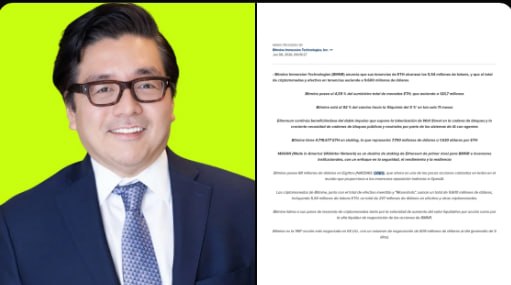 Bitmine added 127,000 ether for $207 million, bringing its treasury to 5.54 million ETH (4.59% of circulating supply) and nearing its "Alchemy of 5%" target, while Chairman Tom Lee declared the crypto selloff "superficial" and argued ETH prices shouldn't be pressured despite the 30% drop from April highs.2026-06
 Ethereum Foundation researcher Abbas Khan pens article: "Tom Lee's ETH Thesis is [REDACTED]"2025-12
 Ethereum Foundation finalized the terms of a 10,000 ETH sale at an average price of $2,387 via OTC, to Tom Lee's Bitmine2026-04
Tom Lee is a Wall Street veteran and co-founder of Fundstrat Global Advisors who became one of crypto's most prominent institutional bulls, best known for early and repeatedly bullish calls on Bitcoin and, more recently, for building one of the largest corporate Ethereum treasury positions on record through his role as chairman of BitMine Immersion Technologies.
Who Is Tom Lee?
Before crypto, Tom Lee spent more than two decades as a sell-side equity strategist, most notably as J.P. Morgan's chief equity strategist. In 2014, he co-founded Fundstrat Global Advisors, an independent research firm that advises institutional investors on macro strategy, equities, and digital assets.
Fundstrat's research became a go-to for crypto market participants because Lee was willing to make specific, time-bounded price forecasts for Bitcoin at a time when few credentialed Wall Street analysts would. Some calls proved prescient; others missed their targets by wide margins. What distinguished Lee from many commentators was his willingness to anchor his predictions to on-chain data, mining economics, and institutional fund-flow analysis rather than purely narrative-driven argument.
Lee's public profile—regular appearances on CNBC, Bloomberg TV, and Fox Business—made him a recognizable face during both the 2017 and 2020-21 bull cycles. His view, consistently held, is that Bitcoin and Ethereum represent durable monetary infrastructure rather than speculative assets, and that institutional adoption would eventually anchor their value through cycles.

Bitmine buys 27,562 ETH, bringing its holdings to over 4.9% of Ethereum supply as Tom Lee calls a crypto bull market

The BitMine Ethereum Treasury Strategy
The most consequential development in Lee's crypto career came through his involvement with BitMine Immersion Technologies (ticker: BMNR), where he serves as chairman. Beginning in early 2026, BitMine pivoted from its original bitcoin mining focus to an aggressive Ethereum accumulation strategy modeled loosely on Michael Saylor's MicroStrategy approach to Bitcoin.
The numbers scaled quickly. BitMine's on-chain wallets received tranches of ETH from custodians including Kraken and BitGo, with individual purchases ranging from $41 million to $139 million in a single disclosed transaction. By mid-2026, the firm had accumulated approximately 5.54 million ETH—representing roughly 4.59% of Ethereum's circulating supply—at a cost basis exceeding $12 billion at acquisition prices.
Lee publicly articulated a specific target: what he called the "Alchemy of 5%", referring to the goal of controlling 5% of all circulating Ether. The thesis is that a single institutional holder at that scale would exert structural influence on ETH's available float, potentially amplifying price movements during demand surges.
To finance the accumulation, BitMine announced a preferred stock offering carrying a 9.5% dividend, targeting $300 million in gross proceeds. The preferred shares provide an income layer for investors who want ETH exposure through an equity wrapper with yield.
Readers are drawn not to BitMine's ETH accumulation scale itself, but to the credibility contest around Tom Lee's thesis — the two pieces attacking or defending his ETH framework outperformed every buy-announcement headline combined, revealing that the real story is whether a MicroStrategy-for-ETH playbook can survive intellectual scrutiny.
Macro Commentary: Oil, Chips, and Ethereum's Headwinds
Lee wears two hats simultaneously—corporate strategist at BitMine and macro commentator at Fundstrat—and his public statements in 2026 have addressed both.
On Ethereum's price weakness, Lee pointed to an unexpected macro correlation: rising oil prices. In a notable departure from standard crypto narratives, he argued that ETH faces a record inverse correlation against crude oil markets—when energy costs rise, network transaction economics deteriorate and institutional risk appetite for energy-intensive infrastructure shifts. He described surging oil as "rough seas for ETH" even while maintaining that tokenization and AI-driven on-chain use cases chart a long-term course through 2026 and beyond.
On equities, Lee argued in a June 2026 CNBC interview that a sell-off in semiconductor stocks was "primarily driven by positioning ahead of the SpaceX IPO" rather than fundamental deterioration—an interpretation that points to his broader analytical method of attributing short-term price moves to mechanical positioning rather than structural change.
He also flagged a macro tailwind for equities more broadly: a wave of large IPOs that he estimated could add 5–6% of S&P 500 supply, with family offices and pension funds likely stepping in as natural buyers of new float. This analysis, while equity-centric, carries implications for crypto markets because institutional liquidity flows across asset classes.
Holding Through Losses: Paper Losses and the "Superficial Selloff" Argument
The ETH accumulation strategy was not without turbulence. When Ethereum fell roughly 30% from April 2026 highs, BitMine's treasury lost an estimated $7–10 billion in paper value within days—one of the largest single-entity unrealized losses in crypto history for a corporate treasury. Lee's Ethereum portfolio was reported to have shed $7.35 billion amid a particularly sharp bearish stretch.
Lee's public response was consistent with his prior commentary on Bitcoin drawdowns: he characterized the selloff as "superficial" and argued that ETH prices shouldn't be pressured by the macro environment as much as the market implied. He drew a specific historical analogy, describing Ethereum's technical setup as comparable to the S&P 500 after the 1987 crash—a period of sharp, fear-driven dislocation that ultimately resolved into a multi-year bull market. At the time of the comparison, ETH was trading approximately 22% below its $2,241 realized price—the average cost basis of on-chain holders.
The broader context for these losses included a simultaneous drawdown in Michael Saylor's Bitcoin position, which was reported to be down approximately $12.5 billion in paper value over the same period, putting combined unrealized losses among crypto's biggest corporate bulls near $22.5 billion at the trough.
Lee pushed back explicitly on selling behavior he observed among larger holders, calling current selling "classic market bottom behavior" and insisting that "the thesis for Bitcoin and Ethereum is absolutely not broken—they are the future of money."
Russell 3000 Inclusion and Index-Driven Liquidity
A separate catalyst Lee flagged for BitMine shareholders is potential inclusion in the Russell 3000 index, a broad benchmark covering small- and mid-cap U.S. equities. Russell reconstitution typically occurs annually, and companies that clear market-cap and liquidity thresholds are added automatically.
Index inclusion matters for a company like BitMine because passive funds tracking the Russell 3000—representing trillions in assets under management—would be required to purchase BMNR shares as a matter of portfolio construction, not discretionary conviction. Lee outlined this as a structural tailwind: forced buying from index funds creates demand that is independent of sentiment toward Ethereum itself.
This dynamic is not unique to BitMine. MicroStrategy's own inclusion in the Nasdaq-100 in late 2024 was widely cited as a liquidity accelerant for MSTR shares. Lee appears to be positioning BitMine along a similar path.
- 01ETH thesis credibility war
Competing takes from Abbas Khan and Andrew Kang directly attacking Tom Lee's ETH framework generated more clicks than any single price-target or buy announcement, signaling readers want to know if the bull case holds up.
- 02Tom Lee $60K ETH price target
The specific, extreme price forecast drove strong standalone engagement as readers evaluated whether a 20-30x call was analysis or hype.
- 03BitMine ETH supply capture
The explicit '5% of circulating supply' target framed accumulation as a governance and scarcity play, not just a treasury trade, pulling in readers tracking supply concentration.
- 04MrBeast BitMine crossover
A $200M bridge between the largest YouTube creator and an Ethereum treasury company represented a pop-culture legitimacy signal readers found novel and attention-worthy.
- 05Ethereum Foundation OTC sales
The EF selling ETH directly to BitMine via OTC raised questions about the foundation's own conviction and its relationship to a concentrated buyer.
- 06BitMine paper losses and macro pressure
Coverage of $10B+ unrealized losses and oil-price inverse correlation tested whether the treasury playbook was resilient or reckless under real market stress.
Preferred Stock, Retail Access, and Yield Engineering
The preferred share mechanism BitMine deployed in 2026 deserves closer examination, because it represents a financial structure increasingly used by crypto-native treasury companies.
Common equity in an ETH treasury vehicle gives investors leveraged directional exposure—if ETH rises, the stock typically outperforms the underlying asset; if ETH falls, the losses are amplified. Preferred stock with a fixed 9.5% dividend carves out a different tranche: investors receive yield regardless of ETH's price direction, with principal at risk only in a severe insolvency scenario.
This structure allows BitMine to raise capital from yield-seeking investors—pension funds, income-oriented retail accounts, conservative family offices—who want some crypto adjacency but cannot hold spot Ether or justify holding common shares in a highly volatile treasury vehicle. The tradeoff is ongoing dividend expense that must be serviced, creating a cash flow obligation that could become strained in a prolonged bear market.
Lee's framing of the offering emphasized the yield-plus-ETH-optionality angle: investors get income while also having exposure to the long-term ETH thesis.
Ethereum as a Strategic Reserve Asset: The Core Thesis
Underlying all of BitMine's activity is a specific claim that Lee has articulated repeatedly: that Ethereum is sufficiently mature to serve as a corporate treasury reserve asset, analogous to how Saylor positioned Bitcoin for MicroStrategy.
The argument rests on several pillars:
- Supply scarcity dynamics: post-Merge proof-of-stake reduced ETH issuance substantially; EIP-1559 burns a portion of transaction fees, creating deflationary pressure at high network utilization.
- Institutional infrastructure: regulated custodians, ETH futures markets, and the approval of spot ETH ETFs in the U.S. provide the risk management toolkit that treasury officers require.
- Network utility: unlike Bitcoin, Ethereum hosts a substantial share of DeFi, NFT, stablecoin settlement, and emerging tokenized real-world asset activity, which in theory creates demand for ETH as the native gas asset.
- Ethereum Foundation alignment: the ETF Foundation's continued stewardship of core protocol development, combined with the roadmap toward further scalability upgrades (Pectra, Fusaka), reinforces the network's durability argument.
Critics of the strategy argue that Ethereum's multi-asset competitive landscape—with alternative Layer 1 chains and Layer 2 networks capturing transaction volume—introduces risks that Bitcoin's single-asset narrative does not face. Lee has generally acknowledged competition without conceding the core thesis.
Relationship With Fundstrat's Research Arm
It is worth noting the structural relationship between Lee's role at BitMine and his continued work at Fundstrat. Fundstrat publishes institutional research, including bullish ETH price targets, while Lee simultaneously chairs a company accumulating ETH. This dual role creates an inherent conflict of interest that sophisticated market participants should account for when evaluating Fundstrat's Ethereum analysis.
Lee has not been evasive about the overlap—his public statements often blend Fundstrat macro commentary with BitMine corporate positioning—but the distinction between independent research and principal advocacy matters for how his forecasts should be weighted.
- 2026-03launch
Tom Lee joins BitMine; stock surges ~300%
- 2026-04milestone
Ethereum Foundation sells 10,000 ETH to BitMine OTC at avg $2,387
- 2026-05milestone
BitMine uplists to NYSE; discloses 4.8M ETH, $4B buyback
- 2026-05milestone
BitMine announces $20B additional equity raise targeting 5% ETH supply
- 2026-06governance
ETH drops 25% in 10 days; BitMine unrealized loss exceeds $10B
- 2026-06milestone
BitMine invests $200M in MrBeast's Beast Industries
- 2026-06milestone
BitMine reaches 5.54M ETH (4.59% of circulating supply)
- 2026-06milestone
Ethereum Foundation sells additional 5,000 ETH to BitMine for $10M OTC
Slowing the Pace: Nearing the Target
By mid-2026, Lee was signaling that BitMine's pace of ETH purchases would slow as the firm approached its 5% circulating supply target. He described the deceleration as a natural consequence of nearing the goal rather than a loss of conviction—noting that once the "Alchemy of 5%" threshold is reached, the strategic rationale for additional aggressive buying diminishes.
He also acknowledged the risk environment: a combination of macro headwinds (oil prices, IPO-related liquidity shifts), paper losses on existing holdings, and the operational cost of servicing preferred dividends all counsel some caution at the margin.
The slowing pace was framed by Lee as a maturation of the strategy—from aggressive accumulation to stewardship of a large, illiquid treasury position.
Outlook
Tom Lee's trajectory in crypto has moved from analyst-commentator to direct principal, a shift that concentrates both upside and reputational risk in a single asset. The BitMine experiment is, in effect, a live test of whether the MicroStrategy playbook—leverage the capital markets to accumulate a scarce digital asset at scale—translates from Bitcoin to Ethereum.
If Ethereum's long-term value proposition holds and the network continues to attract institutional development activity, BitMine's position could generate extraordinary returns for shareholders who held through the drawdowns. If ETH faces structural challenges—from competition, regulatory pressure, or a sustained macro environment unfavorable to risk assets—the losses embedded in a 5.5-million-ETH treasury become existential for the company.
For crypto market observers, Lee's dual role as macro commentator and ETH whale makes him one of the more consequential individual actors in Ethereum's price discovery—a status that is itself a novel feature of the current institutional phase of the crypto market.
Latest Tom Lee news
Community notes
Spot something off or out of date? Drop a note. Editors review topic notes daily and roll accepted fixes into the explainer — contributors are recognized in the monthly $SQUID drop.
Loading notes…
Help improve this topic
Have a story or tip about this topic? Submit it. See something missing? Leave a note. Editors review daily; accepted submissions and fixes count toward the monthly $SQUID drop.