
Plume is an RWA-focused blockchain that tokenizes real-world assets into onchain vaults, using a Bermuda licence, SEC transfer-agent status, and partners like Bybit, ether.fi, PIMCO and WisdomTree to bring regulated yield onchain.
+9 sources across the wider coverage universe
 Plume and FalconX roll out FALX, opening institutional onchain access to overcollateralized structured credit yields2026-06
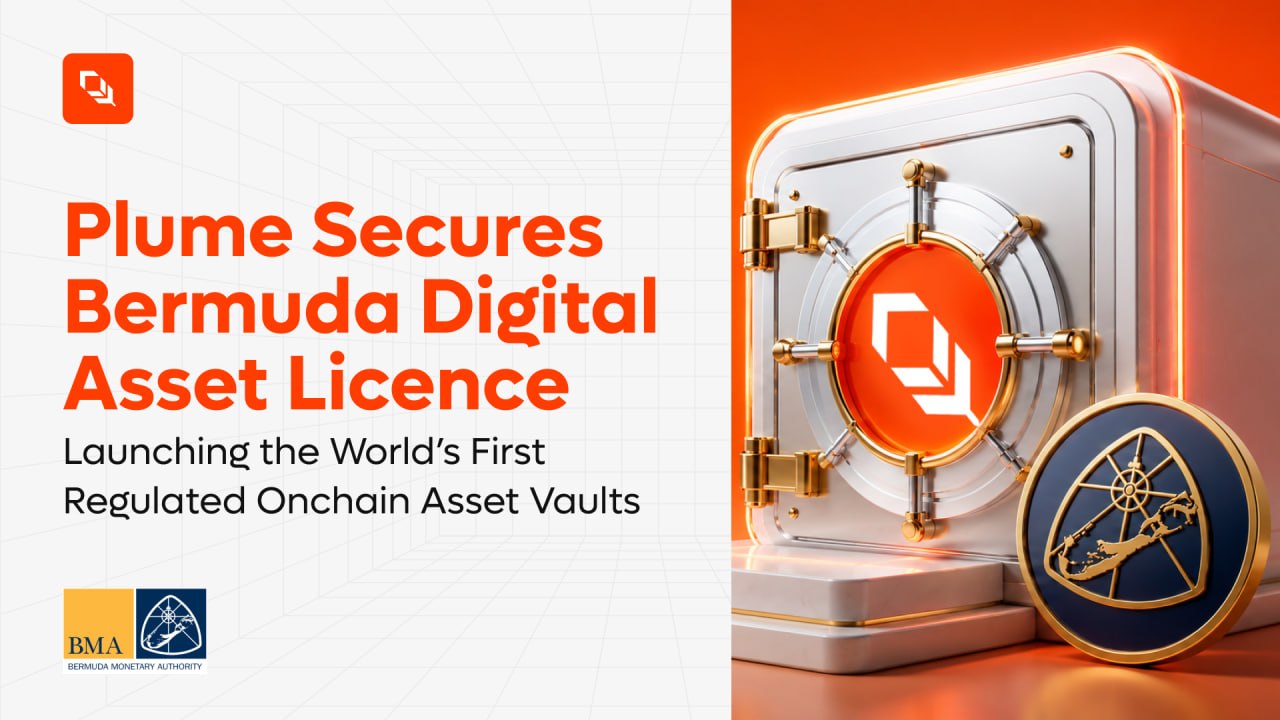 Plume secures Bermuda Digital Asset Licence launching the world's first regulated vaults.2026-05
 Plume brings nOPAL to Avalanche, offering onchain exposure to Brazilian credit card receivables2026-07
 Plume brings PIMCO and CMBI-backed fixed income vaults to millions of Bybit users2026-06
 EtherFi and Plume to offer onchain yield through Nest Vault powered by Superstate’s USCC.2026-03
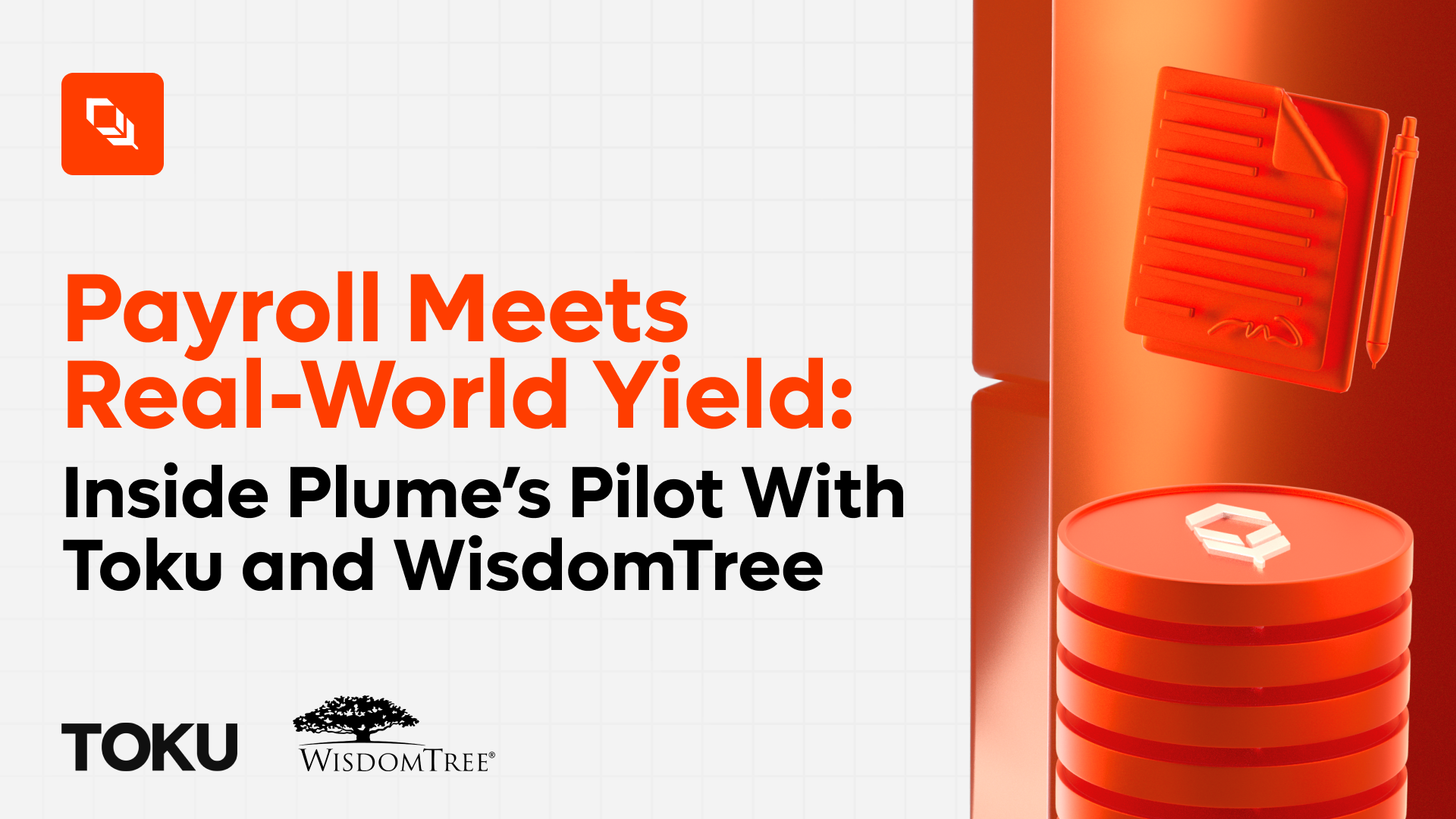 Plume pilots tokenized payroll with Toku and WisdomTree, converting employee wages into yield-bearing WTGXX shares2026-03
What Plume Is
Plume is a public, EVM-compatible blockchain purpose-built for tokenizing real-world assets (RWAs) and connecting them to decentralized finance—a category its backers call "RWAfi." The network launched its mainnet in mid-2025 and has since positioned itself less as a general-purpose chain and more as compliance-aware financial infrastructure, pairing onchain settlement with traditional regulatory wrappers (Plume, Eco).
What "Real-World Assets" Means Here
A real-world asset, in crypto terms, is a claim on something that exists off-chain—U.S. Treasuries, money market fund shares, corporate bonds, private credit, mortgage-backed securities, or commodities—represented as a token on a blockchain. Tokenization aims to make these instruments easier to move, divide, and settle, and to make their yield accessible inside DeFi applications rather than only through banks and brokerages.
The appeal is structural. Traditional fixed-income products generate yield from interest payments and credit spreads; onchain crypto yield has historically depended on trading fees, lending demand, and token emissions that can evaporate. Tokenized RWAs let a wallet hold an asset whose return comes from a regulated security in the background while the user interacts with a stablecoin or token on the front end. Plume's pitch is that it provides the rails—issuance, compliance screening, and distribution—for that handoff.

Plume launches nPRIME vault offering yield from Figure's $30 billion home equity lending market
Architecture and the Compliance Layer
Plume describes itself as a full-stack RWA chain: an EVM environment where tokenization, trading, and DeFi composability are native rather than bolted on. The differentiator is regulatory plumbing baked into the protocol. Plume has built screening at the sequencer level so that compliance checks (such as sanctions and AML controls) can be enforced as part of transaction processing, and it has pursued legal registrations that most chains never touch.
Two registrations stand out. In October 2025, Plume became one of the first blockchain-native entities registered with the U.S. Securities and Exchange Commission as a transfer agent—through its Kimber Transfer Agency—which lets it maintain shareholder records, process ownership changes, and interface with the DTCC for tokenized securities (CoinMarketCap). Separately, Plume's Bermuda subsidiary obtained a digital asset business licence (detailed below) to operate regulated vaults. Together these give Plume an unusual claim: that the legal entity behind the tokens, not just the code, is supervised.
Readers engage with Plume almost exclusively when a recognizable TradFi or DeFi institution (Goldfinch, PIMCO, WisdomTree, Apollo, EtherFi) lends its name to a yield product — the RWA Academy educational content received near-zero clicks, exposing that credibility-by-association, not category education, is what converts Leviathan readers.
Vaults: The Core Product
Most of Plume's recent activity centers on vaults. In Plume's design, a vault works like a tokenized fund: users deposit assets, receive proportional shares, accrue yield as the underlying portfolio earns, and redeem at net asset value (NAV). The mechanics resemble an exchange-traded fund, but the share accounting and redemption logic run on smart contracts instead of a fund administrator and custodian (Plume blog).
This vault primitive is what partners plug into. Rather than each issuer building its own tokenization stack, they allocate capital or distribute access through Plume vaults, and the yield-bearing share token can then move across DeFi—into lending markets, collateral positions, or other vaults—subject to the compliance controls embedded in the token.
The Bermuda Licence and "Regulated Vaults"
In mid-2026, Plume's Bermuda subsidiary—Kimber Digital Assets Bermuda ISAC Ltd. (KDAB)—received a Class M Digital Asset Business Licence from the Bermuda Monetary Authority (BMA) under the Digital Asset Business Act 2018, after an earlier conditional approval (The Block, Crypto Briefing). Plume characterizes KDAB as the first regulated onchain vault manager.
The legal structure matters for understanding the marketing language. Each KDAB vault operates as its own incorporated segregated account under Bermuda's Incorporated Segregated Accounts Act 2019, which provides statutory ring-fencing, separate legal personality, and bankruptcy remoteness—meaning, in principle, that one vault's failure should not contaminate another or the parent. KDAB runs an AML and anti-terrorist-financing programme supervised by the BMA, with transaction monitoring and freeze-and-seize capability embedded at the vault-token level, regardless of which blockchain the token is later bridged to (Crypto Briefing).
The same Bermuda framework (DABA) has been chosen by firms including Circle, Coinbase, and Kraken, which is part of why Plume leans on it rhetorically. For readers, the practical takeaway is that "regulated onchain vault" describes a specific arrangement—a supervised Bermuda entity issuing segregated, freezable share tokens—not a blanket guarantee of safety or principal protection.
Distribution: Reaching Where the Stablecoins Already Sit
Plume's recent strategy has been to meet capital where it already is rather than ask users to migrate. Two deals illustrate the approach.
Bybit. Plume partnered with the exchange Bybit to launch fixed-income vaults that let users put idle stablecoins to work without leaving their exchange accounts. The vaults route exposure to products managed by traditional asset managers—including a PIMCO fixed-income strategy and a CMB International (CMBI) fund—spanning mortgage-backed securities, high-yield corporate bonds, and Asia-Pacific investment-grade bonds (Bankless Times, crypto.news). Plume frames the opportunity around the large pool of stablecoins—by its own estimate tens of billions of dollars—that sits dormant on centralized exchanges earning nothing.
Ether.fi. The liquid restaking protocol ether.fi—one of the larger non-custodial yield platforms—allocated $100 million to a Plume RWA vault accessible directly inside ether.fi's app (The Block, PR Newswire). The capital came partly from ether.fi's liquidity-provider base and partly from its existing liquid ETH, USD, and BTC products. The vault's underlying exposures reportedly include an overcollateralized credit pool, a AAA-rated collateralized loan obligation (CLO), and a total-bond-market ETF. The deal is notable because it brings RWA yield to crypto-native users who were previously chasing onchain leverage and token incentives—a sign of demand shifting toward cash-flow-backed returns.
Other distribution and product partners have appeared in the same period, including derivatives venue GRVT launching tokenized yield products on Plume and a strategic tie-up with Orochi Network (CryptoRank).
- 01Real yield vs volatile APY
Goldfinch's promise of stable 5% private-credit returns framed against the failure mode of token-incentive APYs gave readers a concrete, skepticism-satisfying contrast they could act on.
- 02CTO death, founder grief
The passing of cofounder Eugene Shen was the second-highest clicked story, showing Leviathan readers follow the human layer of crypto projects alongside the financial one.
- 03Institutional vault products
EtherFi's Nest Vault via Superstate USCC and PIMCO/CMBI-backed fixed income on Bybit gave readers familiar TradFi brand names attached to onchain yield, making the products feel credible and accessible.
- 04Regulatory milestone licensing
Bermuda's Digital Asset Licence positioned Plume as the first regulated vault operator, which clicked because it answered the compliance question that institutional and retail readers both carry about RWA platforms.
- 05Tokenized payroll pilots
Converting employee wages into WisdomTree WTGXX shares represented a concrete, non-speculative use case that made tokenization tangible beyond trading.
- 06DeFi protocol integration + hack recovery
Curve going live on Plume and Plume's team assisting recovery of 857 pxETH in the yETH hack together showed readers the network is plugged into live DeFi risk, not just TradFi wrappers.
Payroll and the "Institutions Are Already Here" Thesis
Beyond investment vaults, Plume has piloted tokenized payroll. Working with employment-platform Toku and asset manager WisdomTree, Plume ran a pilot letting eligible employees receive a portion of their wages in shares of WisdomTree's tokenized money market fund, WTGXX—turning salary into a yield-bearing, regulated instrument. The experiment is small but illustrative of Plume's framing that tokenization becomes infrastructure only when it slots into familiar financial workflows like getting paid.
The WisdomTree relationship reflects a broader pattern: rather than asking large institutions to "come onchain," Plume emphasizes integrating with managers and platforms that already serve them. WisdomTree, PIMCO exposure via Bybit, and CMBI funds are the kind of established names that lend the network credibility with cautious allocators.
Token and Ecosystem
Plume's native token, PLUME, is used within the ecosystem for network activity and incentives; live price and market-capitalization data are tracked on public aggregators (CoinMarketCap). As with any RWA infrastructure token, it is worth separating the token's market behavior from the activity in the vaults: vault yield derives from the underlying securities, not from the token, and token price reflects speculative demand for the network rather than a claim on vault assets. Plume has also run growth mechanics such as trading tournaments and ambassador programs (including a Korea-focused push) to build usage, and has invested in education through its "RWA Academy" explainers on treasuries, money market funds, and bonds.
Regulatory and Policy Posture
Plume has been unusually visible on the policy side. Its general counsel testified before a U.S. congressional hearing on the future of tokenization and capital markets, arguing that tokenized securities could integrate into existing markets through targeted regulatory updates rather than wholesale rewrites. The company has also sponsored legal and regulatory events tied to Bermuda's digital-asset framework and pursued licenses in additional jurisdictions, including an Abu Dhabi Global Market registration and Korean institutional access via a local stablecoin integration (BeInCrypto).
This posture cuts both ways. Engaging regulators directly is a genuine differentiator in a sector where many projects avoid securities questions entirely. But aggressive expansion into markets like Korea also raises the prospect of regulatory friction, and the licenses Plume holds are jurisdiction-specific—a Bermuda licence and an SEC transfer-agent registration do not automatically clear the product everywhere it is distributed.
- 2024-11launch
Plume Genesis mainnet launch
- 2025-01milestone
Goldfinch real-yield partnership announced
- 2025-02launch
EtherFi Nest Vault via Superstate USCC goes live
- 2025-03regulatory
Bermuda Digital Asset Licence secured
- 2025-04exploit
Plume assists yETH hack recovery with Dinero
- 2025-05milestone
Tokenized payroll pilot launched with Toku and WisdomTree
- 2025-06launch
Curve Finance deploys on Plume
- 2025-06governance
Cofounder and CTO Eugene Shen passes away
Risks and Open Questions
Several caveats are worth keeping in mind. First, tokenized fixed income carries the credit, interest-rate, and liquidity risk of the underlying securities; the wrapper does not remove the chance of loss, and redemption "at NAV" assumes the vault can liquidate its holdings in stressed markets. Second, the compliance features that make these vaults attractive to institutions—freeze-and-seize controls, screening, segregated accounts—also mean the tokens are permissioned and reversible in ways that pure DeFi assets are not. Third, much of Plume's growth is partnership-driven; headline allocation figures like ether.fi's $100 million describe committed capital, not necessarily sustained, deployed, or recurring revenue. Finally, the RWA sector is increasingly crowded, with established competitors pursuing the same tokenized-yield demand, so distribution and trust—not just technology—will likely determine outcomes.
Outlook
Plume's near-term trajectory hinges on whether its regulatory-first model converts into durable capital rather than one-off allocations. The combination of a Bermuda vault licence, an SEC transfer-agent registration, and distribution through venues where stablecoins already sit (Bybit, ether.fi) gives it a coherent story for moving institutional yield onchain. The harder tests will be retention—whether idle stablecoins stay deployed once incentives fade—and regulatory consistency across the many jurisdictions it is entering. If tokenized RWAs continue their broader 2026 expansion, Plume is positioned as one of the more compliance-forward contenders; if the sector cools, the network's heavy investment in licensing and partnerships could prove either a moat or an expensive overhang.
Latest Plume news
Community notes
Spot something off or out of date? Drop a note. Editors review topic notes daily and roll accepted fixes into the explainer — contributors are recognized in the monthly $SQUID drop.
Loading notes…
Help improve this topic
Have a story or tip about this topic? Submit it. See something missing? Leave a note. Editors review daily; accepted submissions and fixes count toward the monthly $SQUID drop.