
Deep dive into Resolv’s USR stablecoin, RLP insurance layer, March 2026 exploit, Fluid’s $21M bad‑debt cleanup, and Vault Street RWA relaunch, with a focus on stablecoin design, DeFi contagion, and post‑hack recovery.
+20 sources across the wider coverage universe
 Resolv exploit ripples through Morpho ecosystem, hitting Gauntlet, MEV Capital, and Steakhouse USDC vaults2026-03
 Resolv allocates 9% of RESOLV supply to security incident recovery, shifts focus to Vault Street2026-07
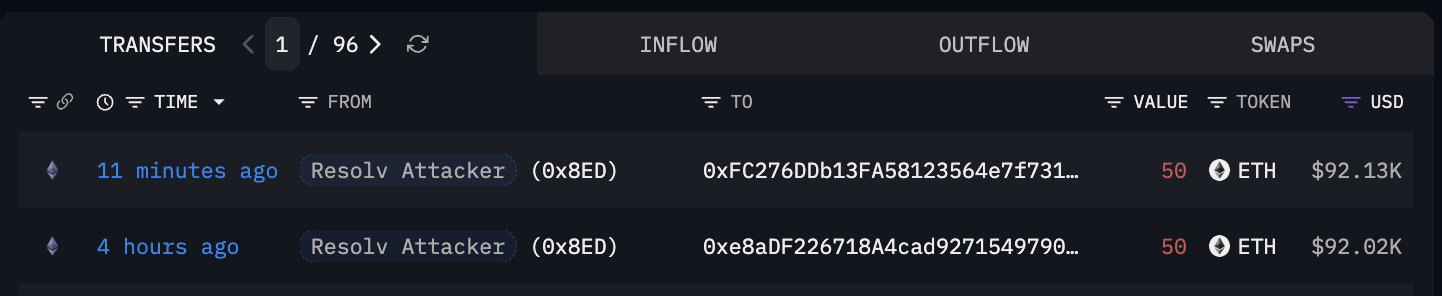 Resolv Labs attacker sends another $184K in ETH toward mixers, still holds $19.2M2026-07
 Researcher finds fluid treasury covered Resolv bad debt using internal credit line, not funds earmarked for users2026-05
 Fluid uses $8M DEX Lite credit line before DAO vote, shifting Resolv cleanup risk to USDC and USDT suppliers2026-05
 Chainalysis traces Resolv's $25M exploit to compromised AWS key that minted 80M unbacked USR2026-03
Resolv: A DeFi Stablecoin, Yield, and Risk Management Case Study
Resolv is a decentralized finance protocol built around a collateral‑backed stable asset called USR, an insurance layer token RLP, and the RESOLV governance token, aiming to offer stable on‑chain yield while intermediating risk between depositors and more sophisticated liquidity providers. In March 2026, a critical exploit of Resolv’s signing infrastructure enabled an attacker to mint roughly 80 million unbacked USR and extract about 23–25 million dollars in value, turning the project into a defining example of both DeFi fragility and structured recovery after a major hack.
Resolv in the Landscape of Stablecoins and Yield Protocols
To understand Resolv’s role in DeFi, it helps to situate it within the broader evolution of stablecoins and yield‑bearing protocols. Stablecoins are cryptoassets designed to track the value of an external reference, most commonly the U.S. dollar, using a variety of mechanisms ranging from fully backed reserves to algorithmic stabilization schemes. Resolv’s USR belongs squarely in the collateral‑backed camp: the design aims to maintain a dollar peg by holding a portfolio of underlying assets while letting users treat USR as a stable, fungible unit across DeFi lending, trading, and yield strategies. Where Resolv differs from many first‑generation stablecoins is the explicit layering of an insurance tranche, RLP, beneath USR, so that different user groups can choose more conservative or more leveraged exposures to protocol risk.
From a product‑positioning standpoint, Resolv markets itself as “the financial layer for stable returns,” signaling that the goal is not only stability of principal but also predictable, relatively low‑volatility income streams. This places it closer to on‑chain equivalents of fixed‑income or credit strategies than to purely transactional stablecoins used primarily for payments or exchange settlement. The collateral pool is structured to earn yield, often by allocating into other DeFi protocols and increasingly into tokenized real‑world assets, while USR and RLP provide the capital structure through which that yield and risk are distributed. The RESOLV token, in turn, sits above both as a governance and incentive asset tethered to the protocol’s long‑term economics.
This design reflects a broader trend in DeFi toward packaging complex yield strategies into accessible, abstracted layers. Instead of individual users directly managing collateral allocations, liquidity provisioning, and risk controls, they hold a single token such as USR and rely on the protocol’s architecture and governance to manage the underlying positions. Resolv’s later launch of “Vault Street,” an institutional‑focused real‑world asset (RWA) product suite led by the primeUSD strategy, underscores that ambition by targeting professional investors who want leveraged exposure to U.S. Treasury yields through stablecoins. The result is a protocol that aims to bridge the gap between conservative, dollar‑pegged assets and higher‑yielding but more complex credit and RWA strategies.
At the same time, Resolv’s trajectory shows how tightly intertwined DeFi protocols have become. USR was widely integrated into lending platforms, including Fluid, and used as collateral across multiple chains and strategies before the March 2026 exploit. The sudden failure of one of the system’s core assumptions—that USR supply could only be minted against properly authorized collateral—reverberated quickly through that network, turning Resolv from a quiet yield engine into the epicenter of a broader liquidity and risk management stress test for DeFi.
Resolv exploit ripples through Morpho ecosystem, hitting Gauntlet, MEV Capital, and Steakhouse USDC vaults
Best quote I heard today: DeFi is a house of cards Remove 1 card → the entire floor collapses
Core Architecture: USR, RLP and the RESOLV Token
USR: The Upper‑Layer Collateral‑Backed Stable Asset
USR is Resolv’s flagship stable asset, designed to function as an “upper layer” token pegged to the U.S. dollar and backed by a collateral pool managed by the protocol. In normal conditions, users interact with USR much like they would with other collateral‑backed stablecoins: they can mint USR by depositing approved collateral, use it as a medium of exchange and as collateral on external lending platforms, and redeem it for underlying assets through protocol mechanisms and integrations. The expectation embedded in this design is that USR will trade close to one dollar, with the collateral pool and redemption mechanisms anchoring the peg.
The collateral backing USR is not static cash in a vault; instead, it is typically deployed into on‑chain and, increasingly, real‑world yield‑bearing strategies. Resolv’s recovery framework and RWA roadmap describe USR as the stable surface of a stack of more complex exposures, including structures that aim to earn U.S. Treasury yields via tokenized instruments. During normal operation, this allows USR holders to benefit indirectly from sophisticated allocation strategies without needing to manage those positions themselves. The protocol’s role becomes that of an asset‑liability manager, responsible for matching USR redemptions and peg stability with the liquidity and risk profile of the underlying portfolio.
The March 2026 exploit made painfully clear, however, that even a well‑structured collateral pool cannot protect a stablecoin if its minting logic and signing infrastructure are compromised. In Resolv’s case, the attacker was able to mint approximately 80 million USR with only a fraction of the required collateral, turning the usual relationship between USR supply and backing on its head. While Resolv has emphasized that the underlying collateral pool remained intact and that the exploit was isolated to issuance mechanics, the incident shows that a stablecoin’s effective security is only as strong as every link in the chain governing minting, redemption, and accounting.
RLP: Insurance and Risk‑Absorbing Layer
Beneath USR sits RLP, a token that functions as an “insurance layer” designed to absorb losses before they reach USR holders. In economic terms, RLP can be viewed as a junior tranche in the protocol’s capital structure: RLP providers supply liquidity and in return receive higher prospective yields, but they stand in front of USR holders in the loss waterfall if the collateral pool suffers impairments or if protocol design or operational failures generate deficits. The recovery plan explicitly frames RLP as the layer intended to bear a substantial part of the damage from the March exploit, with RLP holders projected to receive a partial recovery of 60% or more, some of it in RESOLV tokens rather than in full cash equivalents.
This structure is meant to align incentives and create a buffer for USR users, particularly those who treat USR as a low‑risk quasi‑cash position. In theory, if the protocol experiences limited losses—for example, due to a counterparty default or modest under‑collateralization—those losses should be absorbed by RLP holders, preserving the peg and redeemability of USR. The exploit put this design under extreme stress, because the unauthorized minting of USR dramatically inflated supply and routed value out of the system via decentralized exchanges. Yet, because the underlying collateral remained largely intact, Resolv could frame RLP as the primary shock absorber while designing a differentiated compensation scheme for USR and RLP users.
RLP also illustrates the trade‑off between yield and risk that sits at the heart of many DeFi protocols. Higher yields are often generated by taking on more complex or concentrated exposures, whether through leverage, long‑dated assets, or counterparties whose risk is difficult to model. By explicitly labeling RLP as the insurance and risk‑bearing tranche, Resolv tries to make that trade‑off legible, but the exploit showed that even sophisticated users can be surprised by how losses manifest in tail events. For external integrators, the lesson is that supporting USR without fully accounting for the dynamics of RLP and the broader capital structure can create hidden systemic exposures when something goes wrong.
RESOLV: Governance and Value Accrual
The RESOLV token is the protocol’s governance and incentive asset, connecting the economic performance of Resolv’s products to community decision‑making and treasury management. Resolv’s Q1 2026 report stresses that the core functionality of RESOLV remains unchanged after the exploit and that its value is still directly tied to the protocol’s products and revenue. In practice, this means that RESOLV holders are expected to participate in governance around collateral strategy, risk parameters, recovery frameworks, and treasury actions, while also potentially benefiting from value accrual mechanisms as Resolv generates fees and yield spreads.
The exploit and subsequent recovery have tested this governance model in ways that would have been hard to simulate in advance. For example, the need to coordinate with external protocols such as Fluid on loss‑sharing arrangements created a complex negotiation between Resolv’s responsibilities as issuer of USR and the interests of RESOLV holders in preserving long‑term protocol health. The recovery plan for RLP, including partial compensation in RESOLV tokens, effectively uses governance token issuance as part of the recapitalization mechanism, diluting existing holders while attempting to align affected users with the protocol’s future upside. This is a common pattern in DeFi post‑mortems, where governance tokens act as a flexible balance sheet of last resort.
RESOLV’s role is also evident in how the protocol has navigated front‑end downtime and operational constraints during the recovery period. Resolv’s Q1 report notes that while staking and unstaking through the Resolv app were temporarily paused during the incident, users could still access all operations directly via smart contracts, and the token’s core functionality remained intact pending a relaunch of the interface. Coverage of the quarter highlights that Resolv generated around 722,000 dollars in Q1 revenue, even as weekly fee levels were modest and the staking front‑end remained offline during parts of the post‑exploit period. For an investor or analyst, these dynamics—how quickly governance responds, how transparent treasury actions are, and how protocol revenues hold up under stress—are central to evaluating the long‑term prospects of RESOLV.
Collateral, Integrations and Yield Sources
Resolv’s collateral pool and its integrations with external protocols are the engines that drive yield generation and systemic risk alike. Pre‑exploit, USR was widely used on DeFi lending platforms, with Fluid alone reporting about 100 million dollars in USR exposure across its markets, primarily via positions where USR or wrapped variants were supplied as collateral against stablecoin borrows in USDC and USDT. These positions effectively turned Resolv’s stable asset into leverage fuel for participants seeking to borrow other stablecoins or speculate on relative yields, amplifying the importance of USR’s peg and minting controls.
The collateral backing USR is deployed across a range of strategies, including lending to other protocols and, increasingly, tokenized real‑world assets through the Vault Street product suite. Vault Street’s flagship product, primeUSD, is designed as a leveraged U.S. Treasury yield strategy accessible to professional institutional investors via stablecoins. Users deposit stablecoins, and the strategy aims to combine on‑chain infrastructure with traditional structured finance expertise to provide enhanced yield relative to holding unlevered Treasury exposure. In turn, these allocations feed back into Resolv’s balance sheet, influencing both the revenue potential and liquidity profile of the collateral pool backing USR and RLP.
The exploit forced Resolv and its partners to rethink concentration risk and integration dependencies. After the attack, several protocols, including Fluid, paused USR‑related markets and moved to reduce or unwind their exposure. Some real‑world asset platforms, such as Midas, temporarily halted instant redemptions for affected strategies while they assessed and resolved their USR positions, eventually reporting full redemption or negligible exposure in certain vaults. These steps underscored that Resolv was not operating in isolation but rather as part of a tightly coupled network of capital flows, where issues in one protocol can rapidly propagate via collateral relationships and shared liquidity pools.
Readers clicked the Resolv exploit not for the hack mechanics but for the liability chain: who backstops unbacked stablecoins, which protocols absorb losses, and whether informal bailouts shift risk to uninvolved users — the Fluid internal credit line controversy drew nearly as much engagement as the exploit itself.
The March 22, 2026 Exploit
Timeline of the Attack
In the early hours of March 22, 2026 (UTC), attackers exploited a vulnerability in Resolv’s minting flow to generate tens of millions of unbacked USR and convert that into real value within minutes. According to post‑mortems and independent analyses, the exploit centered on a broken or subverted function in the USR mint pipeline, often described as a completeSwap() or analogous flow, which allowed the attacker to bypass normal collateral checks. Starting with roughly 100,000 dollars in USDC, the attacker was able to trigger the faulty minting logic repeatedly, creating approximately 80 million USR that were not matched by corresponding additions to the collateral pool.
Once the unbacked USR had been minted, the attacker moved quickly to dump it through decentralized exchange liquidity, swapping USR for other assets such as ETH and more established stablecoins. The speed of the attack was a critical factor: within a short window, the attacker managed to extract roughly 23–25 million dollars in real value, limited mainly by the depth of available liquidity and the slippage incurred as USR began to depeg. Chainalysis and other on‑chain analytics firms tracked the attacker’s wallets and flows, documenting the conversion of the illicitly minted USR into ETH and other tokens and the subsequent attempts to obfuscate or move those funds.
As USR flooded DEX pools and its price collapsed, Resolv responded by pausing all protocol functions to stop further damage and minting. The team confirmed the incident publicly, stating that the exploit affected USR issuance mechanics rather than the underlying collateral pool, which they said remained fully intact. In practical terms, however, USR holders and integrated protocols faced an immediate crisis of confidence: the outstanding supply of USR now consisted of a mixture of legitimately minted and illicitly minted tokens, and the market price had diverged sharply from the intended one‑dollar peg.
Root Cause: Compromised Signing Infrastructure
Subsequent analysis by Resolv and external firms traced the exploit to a compromise of off‑chain signing infrastructure rather than a straightforward on‑chain logic bug. Resolv’s official post‑mortem and coverage from blockchain forensics firms describe a scenario in which an attacker gained access to a key or credential involved in authorizing or generating signatures for the minting pipeline. Reporting linked this compromise to an exposed contractor credential on GitHub, suggesting that an attacker was able to abuse trusted development or operational access to subvert the minting process. In effect, the problem was not simply a flawed smart contract, but a breakdown in the operational security of the human and infrastructure systems that support the contracts.
This distinction matters because many DeFi users and protocols focus their risk assessments on on‑chain code audits and formal verification, while underweighting the attack surface created by off‑chain signers, relayers, and key management systems. Resolv’s experience demonstrates that a protocol can have formally audited core contracts yet still be vulnerable if a privileged signing key or off‑chain component can be hijacked. S&P Global’s broader analysis of DeFi hacks emphasizes precisely this point, highlighting operational security, access controls, and concentration limits as key pillars of a robust risk management framework. In Resolv’s case, the exploited key appears to have allowed the attacker to craft or approve transactions that the smart contracts treated as legitimate, bypassing the usual constraints on USR minting.
Resolv’s post‑incident communications stress that their security assumptions around signing infrastructure proved insufficient and that they intend to harden these layers going forward. The incident has sparked wider debate in DeFi about the appropriate use of hardware security modules, multi‑party computation (MPC), threshold signatures, and stricter separation of duties for contractors and external contributors. For protocols that rely heavily on off‑chain components—whether for price feeds, order routing, or transaction batching—the Resolv exploit stands as a cautionary tale that those systems must be treated as first‑class security concerns, not mere implementation details.
Market Impact: USR Depeg and Liquidity Stress
The immediate market impact of the exploit was a severe depeg of USR as the attacker dumped newly minted tokens into DEX pools and other holders rushed to exit positions. Prices for USR fell far below one dollar, reflecting both the sudden oversupply of the token and uncertainty about how much of the outstanding supply would ultimately be honored or redeemed by Resolv. Legitimate holders who had minted or acquired USR before the exploit saw their positions marked down sharply, even though the collateral backing pre‑exploit USR remained in place. For traders tempted to buy discounted USR after the exploit, the absence of a clear recovery framework created high risk, since it was unclear whether such tokens would be compensated at or near par.
The depeg propagated into lending and liquidity protocols where USR and its wrapped variants were used as collateral. Fluid, one of the most heavily exposed platforms, reported around 100 million dollars of USR exposure at the time of the incident, mainly in positions where users had deposited USR and borrowed USDC or USDT against it. When USR’s price collapsed, these positions became severely under‑collateralized, creating approximately 21 million dollars in bad debt—shortfalls where the value of collateral fell below the value of outstanding borrows. Other protocols, including Aave, Venus, Inverse Finance, Lista DAO, and various RWA vaults, moved quickly to pause USR‑related markets, unwind positions, or reassure users that their exposure was limited.
Resolv and its partners have since emphasized that the collateral backing pre‑exploit USR remained intact and that the exploit did not drain the core asset pool, which is vital for designing a recovery path. However, the market’s initial reaction underscores how difficult it is for users and protocols to distinguish between “good” and “bad” tokens in real time and how quickly confidence can evaporate in stablecoins during tail events. The presence of both legitimate and illicit USR in circulation created a contaminated asset pool, complicating the task of designing fair and enforceable redemption and compensation schemes.
Immediate Response: Pausing the Protocol and User Communications
Resolv’s first line of defense after detecting the exploit was to halt protocol operations, including minting, redemption, and staking flows, in order to prevent further unauthorized activity and supply inflation. The team issued a public statement confirming the incident, emphasizing that the collateral pool remained fully intact and that no underlying assets had been lost, and pledging to investigate the breach in collaboration with security partners. This message aimed to reassure users that the problem was contained to USR issuance mechanics rather than representing a full‑blown collapse of reserves.
In the days following the exploit, Resolv pursued a multi‑pronged communications and mitigation strategy. On‑chain analytics firms such as PeckShield and others were engaged to track the attacker’s wallets, and Resolv extended a public “white hat” offer, dangling a bounty if the attacker returned the bulk of the stolen funds. The team also issued a 72‑hour ultimatum warning that failure to return funds would result in heightened efforts to freeze or blacklist the stolen assets and intensify law‑enforcement engagement. Although the attacker did not publicly comply, these steps framed the narrative and signaled that Resolv was actively pursuing recovery rather than passively accepting the loss.
At the same time, Resolv warned users to avoid trading USR during the immediate aftermath because the market was polluted with illicitly minted tokens, and any transactions could complicate subsequent recovery and liquidation efforts. The protocol highlighted that buying discounted USR on secondary markets could expose traders to significant losses if those tokens were later excluded from compensation schemes or treated differently from pre‑exploit holdings. This warning illustrates the tension between DeFi’s permissionless markets—where anyone can trade at any price—and the need to enforce fair and targeted recovery measures when supply has been compromised by an exploit.

Resolv allocates 9% of RESOLV supply to security incident recovery, shifts focus to Vault Street
Resolv spent Q2 cleaning up its March 22 security incident, allocating 9% of the RESOLV supply to recoveries, with 70% of that tranche going to affected RLP holders. Its next bet is Vault Street: primeUSD uses leveraged investment-grade RWAs on Aave Horizon, targeting 5–8% net APY, while JAAA exposure ramps from 10% toward a 30% cap. RESOLV staking reopened in late May and averaged roughly 20% APR.
Contagion Effects: Fluid and the DeFi Lending Ecosystem
How Fluid Was Exposed to USR
Fluid, a DeFi lending platform that routes liquidity across multiple chains and strategies, emerged as one of the most affected external protocols in the wake of the Resolv exploit. Prior to the incident, Fluid supported USR and its wrapped variants as collateral assets in its lending markets, allowing users to deposit USR and borrow other stablecoins such as USDC and USDT. This integration effectively treated USR as a dollar‑equivalent asset, trusting Resolv’s collateral backing and peg stability. As a result, when the exploit occurred and USR depegged, Fluid’s risk engine was suddenly exposed to rapid and severe collateral deterioration.
According to Fluid’s post‑mortem, the platform had about 100 million dollars in USR exposure when the depeg hit. Much of this exposure existed in positions where USR served as collateral for loans of other stablecoins, meaning that the value of the collateral was directly tied to the USR peg. Once USR’s price plummeted, many of these positions became under‑collateralized, and liquidation mechanisms struggled to keep up in a market where USR liquidity was collapsing and prices were falling faster than positions could be unwound. This dynamic is a textbook example of how composability and collateral reuse, which enable capital efficiency in DeFi, can also magnify the impact of a failure in a single protocol or asset.
Fluid’s contracts themselves were not exploited; the platform has stressed that its smart contract logic, oracles, and pricing architecture remained intact throughout the incident. Instead, the damage was a downstream consequence of counterparty risk: Fluid treated USR as a reliable collateral asset, and when that assumption was invalidated by Resolv’s exploit, Fluid absorbed the resulting credit losses. This distinction is critical for both users and protocol designers, because it underscores that integration risk—who you accept as collateral and under what limits—is just as important as internal code security in a composable DeFi ecosystem.
Creation and Cleanup of $21 Million in Bad Debt
The immediate financial consequence of USR’s collapse within Fluid was the creation of approximately 21 million dollars in bad debt. Bad debt in a lending protocol arises when the value of seized collateral from liquidated positions is insufficient to cover the outstanding loans, leaving a deficit on the protocol’s balance sheet. In Fluid’s case, the rapid depeg of USR meant that by the time positions were liquidated, the USR collateral fetched far less than expected, and the protocol was left with a substantial shortfall against deposits of USDC, USDT, and other assets.
Fluid’s response was notable for its speed and for the controversial use of an internal credit line. Rather than waiting for a formal governance vote to authorize treasury spending, the Fluid team used a pre‑approved DEX Lite credit line to draw roughly 8 million dollars’ worth of USDC and USDT directly from the protocol’s shared liquidity layer. These funds were used to sweep up and consolidate thousands of scattered bad‑debt positions into a single address, effectively socializing and centralizing the loss at the protocol level while protecting individual depositors from immediate impact. The move did not involve external spending; instead, it was framed as internal accounting, shifting assets within the system to close the deficit in user markets.
Subsequently, Fluid’s governance posted a comprehensive proposal outlining how the bad debt would be fully repaid and how the credit line would be settled. The plan split the roughly 21 million dollar loss into three components: about 9.7 million dollars to be covered by Resolv as the issuer of the failed asset, around 8.2 million dollars from Fluid’s governance treasury, and approximately 1.5 million dollars from the Fluid core team, to be reimbursed from future protocol revenue. In total, roughly 19.3 million dollars of the bad debt were repaid up front, with the team fronting its portion in cash and the protocol committing to replenish the treasury over time. This coordinated recapitalization allowed Fluid to restore solvency, maintain user confidence, and continue operations without haircutting user deposits.
Governance, Credit Lines and User Protection
Fluid’s use of an internal credit line prior to a formal governance vote sparked debate within DeFi circles about emergency powers, transparency, and the boundaries of “code is law.” On one hand, the rapid deployment of the DEX Lite credit line likely prevented a more chaotic unwinding of bad debt and protected depositors from immediate losses or market panic. The team argued that the credit line was pre‑approved and that the draw was a matter of internal accounting, not an extraction of new value from the system. On the other hand, governance critics noted that the on‑chain vote to ratify repayment from the treasury came only after the funds had already been moved, raising questions about whether this inverted the usual order of token‑holder consent.
Subsequent analysis clarified that the treasury’s 8.2 million dollar contribution did not come at the expense of user funds earmarked for other purposes, but rather from assets held in a DeFi Smart Account controlled by governance. The proposal outlined the transfer of various treasury positions, including iETHv2 deposit tokens and other DeFi assets, to a multisig controlled by the team, which would liquidate them to repay the credit line. This sequence showcased the pragmatic tension between strictly decentralized governance and the need for swift executive action during crises. For users, the key outcome was that no depositor funds were haircut; the losses were borne by Resolv, the Fluid treasury, and the Fluid team, preserving the integrity of user balances.
The episode also highlighted the importance of clear communication from both Resolv and Fluid about who would ultimately bear the cost of the exploit. Fluid emphasized that its own smart contracts were not compromised and that the incident stemmed entirely from exposure to Resolv’s USR. Resolv, for its part, publicly committed to covering pre‑exploit USR positions on Fluid and other platforms as part of its recovery program, with reports indicating that around 70 million dollars of USR‑related debt on Fluid’s BNB and Plasma chains had already been repaid within days of the attack. This coordination helped contain contagion risk and served as a practical demonstration of how DeFi protocols can work together to manage shared crises.
Lessons for Risk Isolation and Noncustodial Design
The Resolv–Fluid episode has quickly become a reference point in discussions about risk isolation and noncustodial design in DeFi. Commentators have noted that for DeFi to serve as durable financial infrastructure, protocols must minimize unnecessary coupling and implement architectures that compartmentalize failures rather than allowing them to cascade. The combination of Resolv’s exploit and separate incidents such as the Kelp DAO exploit, which triggered liquidity stress across other lending markets, underscores how composability can create hidden channels for contagion when risk is not carefully segmented.
One approach gaining traction is the use of isolated lending markets, where each collateral type and market is ring‑fenced such that losses in one pool cannot easily spill over into others. The “Morpho effect” discourse and broader conversations about noncustodial risk‑isolation designs draw directly from the lessons of Resolv and similar incidents, suggesting that firebreaks are needed to prevent a single asset’s failure from compromising an entire platform’s solvency. In this context, Fluid’s ability to absorb a 21 million dollar shock without haircutting user deposits and while keeping its core contracts uncompromised is viewed as evidence that thoughtful protocol design and treasury management can materially mitigate contagion risk, even when exposures are large.
From an integrator’s perspective, the experience suggests that accepting novel stablecoins as collateral requires not only due diligence on reserves but also an assessment of minting controls, operational security, and issuer behavior under stress. Protocol‑to‑protocol relationships in DeFi increasingly resemble credit relationships in traditional finance, with lenders like Fluid effectively extending credit lines against the promise of stable assets like USR. The Resolv exploit demonstrates that when those promises fail, the ability of issuers and lenders to coordinate on loss sharing and recovery is crucial to preventing broader systemic instability.
- 01Morpho ecosystem contagion↗
The single highest-clicked story was not the exploit itself but its downstream hit on Gauntlet, MEV Capital, and Steakhouse USDC vaults — readers track DeFi liability chains, not isolated incidents.
- 02Compromised credential attribution↗
Readers wanted to know how 80M unbacked USR got minted — Chainalysis tracing the breach to a contractor GitHub credential and then an AWS signing key gave the story a concrete, accountable villain.
- 03Fluid bad debt backstop↗
Whether the Fluid core team used a $8M DEX Lite credit line before a DAO vote — effectively shifting cleanup risk to USDC and USDT suppliers — became its own controversy distinct from the original hack.
- 04Token airdrop mechanics
Multiple registration-deadline headlines (May 16 and May 25 cutoffs) generated consistent mid-tier clicks, showing a distinct reader cohort tracking eligibility windows around the RESOLV TGE.
- 05Post-exploit recovery roadmap↗
Readers followed the structured three-month recovery program for USR, RLP, and LP holders alongside the Q1 revenue report, tracking whether Resolv could re-establish operational credibility.
Resolv’s Recovery Framework and Vault Street Relaunch
Multi‑Phase Recovery for USR, RLP and LPs
Following the exploit, the Resolv Foundation announced a multi‑phase recovery plan designed to restore value to affected users, clean up the contaminated USR supply, and reposition the protocol for a relaunch. A central element of the plan is a three‑month compensation program that treats different user cohorts according to their risk profiles and the timing of their exposure. Under the framework described in official announcements, USR and wstUSR held before the attack are eligible to be exchanged one‑to‑one for USDC, reflecting the fact that the collateral backing pre‑exploit USR remained intact. By contrast, USR acquired after the attack—often bought at steep discounts on secondary markets—is slated to be redeemed at a rate of one USR to 0.5 USDC, recognizing both the speculative nature of post‑exploit purchases and the need to avoid over‑compensating opportunistic buyers.
RLP holders are expected to receive a recovery rate of at least 60%, with a portion of this compensation delivered in RESOLV tokens rather than in full cash equivalents. This aligns with RLP’s role as the insurance layer designed to absorb losses before they reach USR holders. Liquidity providers and other integrators are also folded into the recovery plan through tailored arrangements, such as Resolv’s commitment to cover pre‑exploit USR positions on platforms like Fluid. The official compensation window is scheduled to remain open for three months, giving affected users time to submit claims and align their positions with the recovery framework.
The structure of this plan reflects several competing objectives. First, it aims to make pre‑exploit USR holders whole or close to whole, since their tokens were legitimately minted against collateral and were not part of the fraudulent issuance. Second, it attempts to balance fairness with practical market realities for post‑exploit USR buyers, who assumed clear risk in acquiring a compromised asset but still play a role in stabilizing secondary markets. Third, it leverages RESOLV token issuance and RLP’s junior status to socialize losses across risk‑seeking participants rather than imposing them on the most conservative users. Taken together, the framework is an attempt to translate Resolv’s theoretical capital structure—upper‑layer USR, lower‑layer RLP, and governance via RESOLV—into concrete loss‑sharing terms after a real stress event.
Progress to Date: Redemptions and Debt Repayment
Early progress updates suggest that the recovery plan has made significant headway in reducing outstanding liabilities and restoring confidence. Within days of announcing the first phase of recovery, Resolv reported that over 90% of allowlisted pre‑exploit USR wallets had redeemed their holdings, amounting to more than 77 million dollars of USR redeemed for USDC. This rapid uptake indicates both the scale of legitimate USR holdings and the willingness of users to exit their positions at par under the recovery plan. It also helps to reduce future uncertainty by shrinking the pool of outstanding pre‑exploit USR that needs to be tracked and compensated.
On the integration side, Fluid confirmed that approximately 70 million dollars of USR‑related debt on its BNB and Plasma deployments had been repaid, reflecting Resolv’s commitment to cover pre‑incident USR positions on that platform. Governance proposals have been advanced to transfer remaining positions to a team‑controlled multisig for final settlement with Resolv, further simplifying the residual exposure and ensuring that compensation flows through clear and auditable channels. Other affected platforms, including RWA vault providers like Midas and risk‑management firms such as Gauntlet, have reported either full redemption of USR positions or limited exposure, and are actively working on their own user compensation plans.
Meanwhile, Resolv’s internal metrics indicate that the protocol continues to generate revenue despite the disruption. The foundation’s Q1 2026 report notes that Resolv produced around 722,000 dollars in revenue during the quarter, even as weekly fees remained modest and the staking front‑end was temporarily offline for parts of the post‑exploit period. Users could still interact with staking and other functions directly via smart contracts, preserving core functionality albeit with a higher technical bar. These figures suggest that while the exploit inflicted severe reputational and operational damage, Resolv retained a viable economic base from which to pursue recovery and relaunch plans.
Vault Street and primeUSD: Institutional RWA Strategy
In parallel with the recovery program, Resolv has launched “Vault Street,” a new business line focused on distributing tokenized real‑world assets and structured yield products to institutional and professional investors. Vault Street is designed to leverage the protocol’s underlying infrastructure and structured finance expertise to offer RWA‑backed strategies that integrate directly with on‑chain stablecoin markets. Its first flagship product, primeUSD, is described as a leveraged U.S. Treasury yield strategy that allows users to deploy stablecoins into a structured vehicle targeting enhanced yield from government debt.
The launch of Vault Street serves both strategic and narrative purposes. Strategically, it provides Resolv with an additional revenue stream and a clearer value proposition to institutional players who may be less interested in retail‑focused stablecoins but are keen to access yield on high‑quality traditional assets via crypto rails. By focusing on Treasuries and similar instruments, primeUSD and related products can tap into a large and relatively conservative investor base, while using leverage and structured payouts to increase returns compared to unlevered holdings. Narratively, Vault Street is positioned as a “new chapter” for Resolv, marking a transition from the initial era of protocol launch and subsequent crisis to a more mature phase centered on institutional‑grade infrastructure.
From a risk perspective, the move into RWAs and structured credit adds both diversification and complexity. Tokenized Treasury strategies can offer more predictable cash flows and lower credit risk than many DeFi‑native yield sources, but they introduce custodial, regulatory, and counterparty risks associated with off‑chain asset managers and banking partners. The success of Vault Street will depend on Resolv’s ability to manage these relationships, maintain transparent reporting on asset backing and leverage, and integrate RWA positions cleanly into the overall collateral structure that supports USR and RLP. For observers analyzing Resolv’s post‑exploit trajectory, Vault Street is a key initiative to watch, both as a potential growth engine and as an additional layer of operational and regulatory complexity.
Operational Changes, Security Upgrades and Transparency
Resolv’s public communications following the exploit emphasize a commitment to strengthening security architecture and enhancing transparency around risk management. Hardening off‑chain signing infrastructure is a top priority, with likely moves toward more robust key management practices, stricter access controls for contractors, and possibly the adoption of multi‑party or threshold signing schemes. The protocol has also indicated that it will review and refine its collateral allocation and concentration limits, drawing lessons from how exposures to a single stablecoin (USR) can propagate through integrators like Fluid and beyond.
Transparency around revenue, collateral composition, and recovery progress has been enhanced through detailed quarterly reports and post‑mortem publications. The Q1 2026 report, for example, does not shy away from describing the quarter as challenging, noting both the shift in market conditions affecting yield generation and the added complexity introduced by the March 22 security incident. It outlines pragmatic decisions around capital allocation and priorities, including temporary pauses of certain front‑end functions and adjustments to product roadmaps. This level of disclosure is increasingly expected of DeFi protocols that aim to attract institutional capital and withstand scrutiny from ratings agencies and regulators.
Finally, Resolv has sought to signal continuity and stability in its tokenomics by affirming that the core functionality of the RESOLV token remains directly tied to the protocol and its products and will continue in the same capacity as the protocol is relaunched. Staking and unstaking functions have been restored, and rewards resumed as of late May, although the platform continues to navigate the balance between moving quickly on new initiatives like Vault Street and ensuring that existing security and risk management improvements are fully implemented. For a crypto‑savvy audience, the interplay between these technical, economic, and governance adjustments is central to assessing whether Resolv’s post‑exploit path is credible.
Resolv Labs attacker sends another $184K in ETH toward mixers, still holds $19.2M
Risk Management, Hacks and Operational Security in DeFi
Off‑Chain Signing, Keys and Contractor Risk
The Resolv exploit underscores a reality that is sometimes underappreciated in DeFi risk discourse: many critical operations depend on off‑chain infrastructure that is not fully transparent to users or even integrators. In this case, a compromised signing key or credential associated with a contractor appears to have allowed an attacker to manipulate minting flows and bypass on‑chain safeguards. This is not an isolated pattern; several high‑profile DeFi and bridge hacks over the past years have also stemmed from weaknesses in key management, access control, and off‑chain governance processes rather than from purely on‑chain logic flaws.
For protocols, the lesson is that security must be treated as a holistic discipline encompassing both code and operations. Best practices include minimizing the number of privileged keys, using hardware security modules or secure enclaves, adopting multi‑party computation or threshold signatures for critical operations, and enforcing strict policies for contractor access and credential management. Code audits and formal verification remain essential, but they are insufficient if a single compromised credential can override the protections those audits verify. Resolv’s commitment to upgrading its signing infrastructure and access controls is a step in this direction, but the broader DeFi ecosystem will be judged on whether it collectively internalizes these lessons.
Contractor risk is a particularly thorny issue, because many DeFi projects rely on external developers, security firms, or infrastructure providers, often with overlapping roles and blurred boundaries. The alleged compromise of a contractor’s GitHub credential in the Resolv case highlights how a single weak link in this extended supply chain can create an entry point for attackers. Protocols may need to rethink how they manage third‑party contributions, including stricter review processes, compartmentalization of access, and clearer lines of accountability. Users and integrators, in turn, should demand clearer disclosures about who controls critical keys and what operational safeguards are in place.
Stablecoin Design, Collateral Pools and Depeg Scenarios
Resolv’s experience also feeds into the ongoing debate about stablecoin design and the resilience of different collateral models under stress. Collateral‑backed stablecoins like USR are often seen as safer than algorithmic or under‑collateralized designs, particularly when backed by high‑quality assets such as cash, Treasuries, or blue‑chip crypto. However, the exploit shows that even well‑backed stablecoins can suffer severe depegs if the mechanisms that enforce the link between supply and collateral are compromised. From a risk perspective, this suggests that evaluating a stablecoin requires scrutinizing not only its reserves but also its issuance, redemption, and governance pathways.
Depeg scenarios create complex challenges for protocols and integrators. When a stablecoin falls below its peg, the immediate question is whether the depeg reflects a genuine shortfall in backing or a temporary disruption due to liquidity imbalances or operational issues. In Resolv’s case, the collateral pool remained intact, but the presence of illicitly minted USR meant that not all tokens in circulation had a legitimate claim on those reserves. Designing recovery schemes that prioritize pre‑exploit holders without creating perverse incentives for post‑exploit speculation requires careful calibration, as evidenced by the differentiated redemption rates in Resolv’s plan.
For integrators like Fluid and others, the Resolv depeg highlights the need for robust collateral management frameworks that account for tail risks. These may include stricter collateral factors for newer or more complex stablecoins, dynamic risk parameters that can tighten in response to on‑chain signals of stress, and built‑in mechanisms to pause markets or restrict borrowing when a collateral asset deviates materially from its peg. Some protocols are exploring isolated markets where each collateral asset is siloed, reducing the risk that a single depeg event can compromise the entire platform. The Resolv case will likely inform the calibration of these mechanisms across the DeFi ecosystem.
Systemic Risk: Resolv, KelpDAO and Cross‑Protocol Contagion
The Resolv hack was not the only DeFi exploit in early 2026, and its effects must be understood alongside other incidents such as the Kelp DAO exploit and vulnerabilities affecting trading and derivative platforms. Kelp DAO’s exploit, for example, triggered liquidity stress across lending markets by affecting cross‑chain liquid staking positions, exposing weaknesses in how protocols handle collateral that spans multiple networks and bridges. Collectively, such incidents have contributed to periods of significant total value locked (TVL) drawdowns across DeFi, reflecting both direct losses from hacks and precautionary withdrawals by risk‑averse users.
From a systemic perspective, these events highlight how composability—the ability of protocols to build on top of each other—creates both innovation and interconnected fragility. Assets like USR or liquid staking tokens from Kelp DAO can be used as collateral, liquidity, or building blocks in numerous protocols simultaneously. When the underlying asset fails, the resulting stress radiates through lending markets, AMMs, structured products, and RWA vaults, often in ways that are difficult to predict ex ante. Risk isolation architectures, conservative collateral policies, and adaptive circuit‑breaker mechanisms are increasingly seen as essential firebreaks that can prevent localized incidents from becoming systemic crises.
In this context, Resolv and Fluid’s handling of the exploit and bad debt cleanup has been cited as evidence that DeFi can exhibit resilience when protocols move quickly and coordinate effectively. The fact that Fluid remained solvent without haircutting user deposits, and that Resolv was able to fund substantial portions of the recovery for integrators, suggests that robust treasuries and well‑designed capital structures can absorb shocks. However, the underlying reality remains that trust in individual protocols and assets is fragile, and each major incident resets user and institutional risk appetites.
Regulatory and Ratings Perspectives on DeFi Operational Risk
Traditional financial analysts and ratings agencies have taken note of episodes like Resolv’s exploit as they assess the risk profiles of DeFi protocols and digital assets more broadly. S&P Global’s digital assets brief on DeFi hacks emphasizes that operational security—including smart contract management, key control, and risk governance—is a critical determinant of creditworthiness and systemic stability. The report highlights the need for protocols to calibrate concentration limits, manage individual asset risks, and integrate robust operational safeguards if they aim to attract institutional capital or interface with traditional finance at scale.
From a regulatory standpoint, incidents involving compromised keys and off‑chain infrastructure reinforce concerns about governance transparency and accountability in decentralized systems. Policymakers may view the Resolv exploit as an example of how opaque operational practices can undermine assurances about reserve backing and peg stability, even in collateral‑rich stablecoin designs. At the same time, the speed and transparency of post‑mortems, the use of on‑chain governance to ratify recovery measures, and the willingness of protocols like Resolv and Fluid to absorb losses rather than impose them on end users may be seen as positive indicators of maturation.
For crypto‑native observers, the takeaway is that DeFi is increasingly being evaluated by standards similar to those applied to traditional financial institutions. Demonstrable risk management, clear governance processes, and robust operational security are no longer optional add‑ons; they are central to a protocol’s ability to sustain trust, attract capital, and survive adverse events. Resolv’s journey—from a stablecoin and yield protocol to the victim of a major exploit and then to a test case for structured recovery and institutional RWA integration—encapsulates many of these evolving expectations.
March 22 exploit: compromised contractor GitHub credential exposes AWS signing key; 80M unbacked USR minted, $25M in losses
Fluid automated ceilings trigger, USR markets paused; Fluid core team secures personal loans to cover 100% of bad debt
Chainalysis publishes attribution trace linking exploit to compromised AWS key
Resolv burns 57% of illicitly minted USR; Resolv postmortem published
Resolv publishes 2026 roadmap and three-month USR/RLP/LP recovery program; launches Vault Street with primeUSD institutional RWA product
- 2026-05milestone
RESOLV airdrop registration window opens; mandatory registration deadline May 16, genesis event deadline May 25
Resolv Foundation Q1 2026 report: $722K revenue, weekly fees under $10K, staking frontend still offline during recovery
How to Evaluate Resolv Going Forward
Key Metrics: Peg Stability, Collateralization and Revenue
For analysts and sophisticated users assessing Resolv’s prospects after the exploit, several metrics stand out as particularly important. Peg stability for USR is an obvious starting point: the degree to which USR trades close to one dollar in liquid markets over time reflects both the market’s confidence in the collateral backing and the effectiveness of redemption mechanisms and risk management. Tracking the residual presence of illicitly minted USR, the progress of token burns, and the uptake of redemption and compensation programs is critical to understanding whether the supply overhang has been fully resolved.
Collateralization ratios and collateral composition are equally important. Evaluating what share of collateral is held in on‑chain assets versus off‑chain RWAs, the liquidity profile of those assets, and the degree of leverage in structures like primeUSD can provide insight into the robustness of Resolv’s balance sheet. Analysts may also look at concentration risk—for example, the proportion of collateral in a single stablecoin, yield protocol, or RWA issuer—as a gauge of vulnerability to idiosyncratic shocks. Resolv’s quarterly reports and on‑chain data are key information sources for this assessment.
Revenue and cost metrics provide another lens on the protocol’s health. Resolv’s Q1 2026 revenue of approximately 722,000 dollars, generated in a quarter marked by both challenging market conditions and the March exploit, suggests that the protocol retains a meaningful economic base. However, the sustainability of this revenue, the cost of recovery and recapitalization measures, and the dilution effects of compensating users with RESOLV tokens all factor into an assessment of long‑term value. Observers should track how quickly revenues grow or recover as Vault Street ramps, as well as how much of that revenue is needed to cover prior losses versus funding new development and risk‑management investments.
Integration Footprint and Counterparty Risk
Resolv’s integration footprint—where USR, RLP, and RESOLV are supported across DeFi—is both a competitive strength and a risk channel. The Fluid experience shows that deep integration into lending markets can drive adoption and utility but also creates substantial counterparty risk when things go wrong. Evaluating Resolv going forward requires mapping its relationships with major lending platforms, AMMs, RWA vaults, and institutional partners, and assessing how those partners manage their own risk related to USR and RLP.
Protocols that paused USR markets during the crisis and have since resumed them may have updated their risk frameworks, including more conservative collateral factors, stricter oracle configurations, or explicit caps on exposure to Resolv assets. Institutional partners in Vault Street and primeUSD will apply their own due diligence standards, which may involve legal agreements, off‑chain audits, and ongoing monitoring of operational and regulatory risks. How Resolv navigates these relationships—balancing growth with prudent counterparty risk management—will be central to its long‑term viability.
Governance Quality and Community Response
The quality of Resolv’s governance, including the responsiveness and transparency of the Resolv Foundation and broader community, is another critical dimension of evaluation. The post‑exploit period has already provided a stress test: governance needed to approve recovery frameworks, treasury allocations, and new strategic initiatives like Vault Street while under intense scrutiny. The ability to push through complex compensation schemes and coordinate with external protocols such as Fluid indicates a functional governance process, but the longer‑term question is whether governance can proactively strengthen risk management and strategic planning rather than reacting only after crises.
Observers should pay attention to how governance handles trade‑offs between compensating existing users and preserving resources for future growth, as well as how it structures incentives for RLP providers and RESOLV holders in the wake of losses. The use of RESOLV token issuance as part of the compensation package for RLP holders, for instance, may align interests between affected users and the protocol’s future success, but it also dilutes existing token holders and could be perceived as socializing losses across the community. The tone and depth of governance discussions, the participation of security experts and risk professionals, and the transparency of treasury actions will all inform assessments of governance quality.
Comparing USR to Other Collateral‑Backed Stablecoins
Finally, evaluating Resolv requires situating USR in the broader landscape of collateral‑backed stablecoins. Compared to venerable issuers with large off‑chain reserves and regulatory oversight, USR operates in a more experimental domain, integrating tightly with DeFi and RWA strategies and employing a multi‑layer capital structure via RLP and RESOLV. This can offer attractive yields and more direct on‑chain composability but comes with higher operational and integration risk, as the March exploit demonstrated.
When comparing USR to other stablecoins, analysts might consider factors such as reserve transparency, regulatory posture, reliance on off‑chain versus on‑chain assets, governance decentralization, and the track record of handling stress events. Resolv’s exploit is a significant mark against its early track record, but its structured recovery plan, willingness to absorb losses, and push into institutional‑grade RWA products may mitigate some concerns if executed effectively. For users and protocols deciding whether to hold or integrate USR in the future, the calculus will hinge on whether they believe Resolv’s security upgrades, governance reforms, and business model evolve sufficiently to offset the memory of the March 2026 incident.
The March 2026 exploit was not a smart-contract bug but a compromised contractor GitHub credential that exposed an AWS signing key, enabling unauthorized minting of 80M USR — a purely operational failure.
A single off-chain signing key controlled the ability to mint unbacked stablecoins, meaning no on-chain governance or multisig threshold prevented the $25M loss.
USR depegged sharply post-exploit and exposure propagated through Morpho vaults (Gauntlet, MEV Capital, Steakhouse USDC), Fluid lending markets, and briefly threatened Aave liquidity providers.
Fluid's automated borrowing ceilings triggered correctly and paused USR markets, limiting on-chain smart-contract damage — the vulnerability was off-chain credential management, not contract logic.
The Fluid core team deployed an $8M DEX Lite credit line before a DAO vote to cover bad debt, raising questions about whether informal treasury actions bypass user-earmarked funds and governance norms.
USR's 74% depeg reinforces regulatory scrutiny of algorithmic and partially-backed stablecoins; the incident surfaced in S&P Global coverage of DeFi operational-security risks at a time when US stablecoin legislation remains unresolved.
Outlook
Resolv’s story to date is a microcosm of DeFi’s broader narrative: ambitious financial engineering and rapid innovation alongside profound lessons in operational risk and inter‑protocol contagion. The March 22 exploit exposed serious weaknesses in signing infrastructure and risk management, but it also triggered a coordinated response that saw Resolv, Fluid, and other partners absorb substantial losses, protect user deposits, and design a structured path to recovery. The launch of Vault Street and primeUSD suggests that Resolv still aspires to play a meaningful role in the emerging on‑chain RWA and yield‑distribution ecosystem, particularly for institutional investors.
Whether Resolv ultimately succeeds will depend on its ability to fully clean up the USR supply, complete compensation programs for USR, RLP, and LP users, and demonstrate that hardened security and governance practices can prevent similar incidents in the future. For the wider DeFi space, Resolv remains an important case study in how protocols handle stablecoin depegs, cross‑platform bad debt, and complex recovery negotiations. As institutional and regulatory scrutiny increase, the standards set by incidents like the Resolv exploit and its aftermath will shape expectations for how DeFi protocols design their capital structures, manage operational risk, and respond when their assumptions fail.
Latest Resolv news
Resolv exploit ripples through Morpho ecosystem, hitting Gauntlet, MEV Capital, and Steakhouse USDC vaultsResolv allocates 9% of RESOLV supply to security incident recovery, shifts focus to Vault StreetResolv Labs attacker sends another $184K in ETH toward mixers, still holds $19.2MResearcher finds fluid treasury covered Resolv bad debt using internal credit line, not funds earmarked for usersFluid uses $8M DEX Lite credit line before DAO vote, shifting Resolv cleanup risk to USDC and USDT suppliersChainalysis traces Resolv's $25M exploit to compromised AWS key that minted 80M unbacked USRSources
17 records from 14 domains
chainalysis.com
resolv.xyz
samhsa.gov
defiprime.com
mexc.fm
app.rwa.xyz
x.com
panewslab.com
spglobal.com
bingx.com
cardencex.io
indianaexchange.com
binance.com
cryptorank.io
Community notes
Spot something off or out of date? Drop a note. Editors review topic notes daily and roll accepted fixes into the explainer — contributors are recognized in the monthly $SQUID drop.
Loading notes…
Help improve this topic
Have a story or tip about this topic? Submit it. See something missing? Leave a note. Editors review daily; accepted submissions and fixes count toward the monthly $SQUID drop.