
Venus Protocol is BNB Chain's leading decentralized money market, offering lending, borrowing, unified liquidity via Flux, tokenized stock collateral, and on-chain trading — with XVS governance and a multi-layer oracle safety system.
+4 sources across the wider coverage universe
 Venus's multi-layer oracle defense: How your DeFi Assets stay protected2026-04
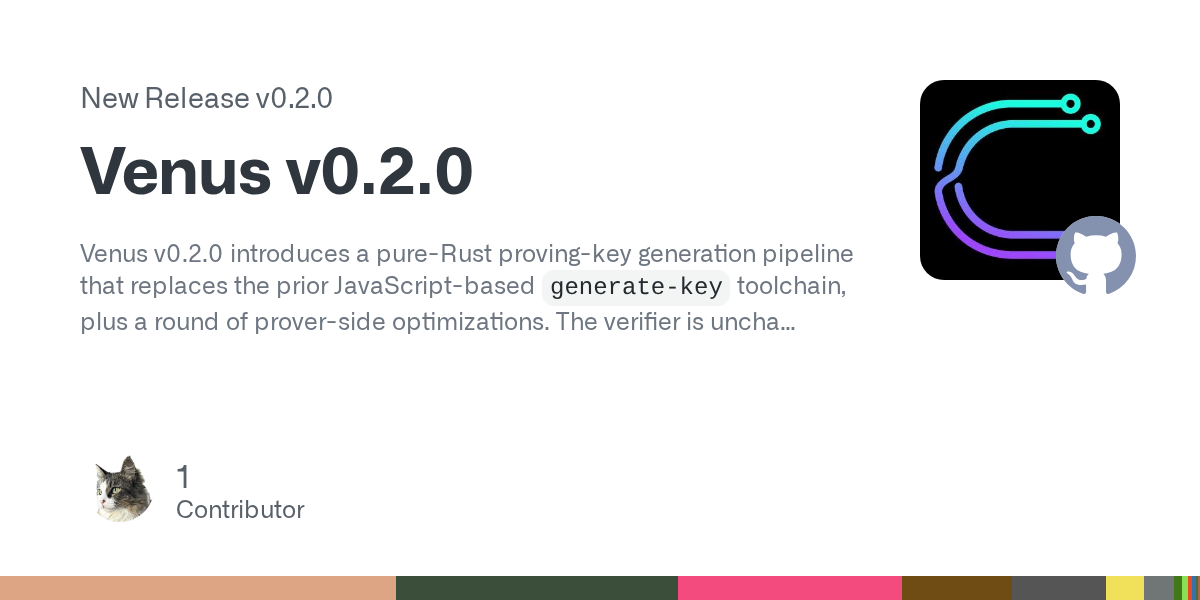 Cysic Venus v0.2.0 ships Rust proving-key setup with 3x faster key generation2026-05
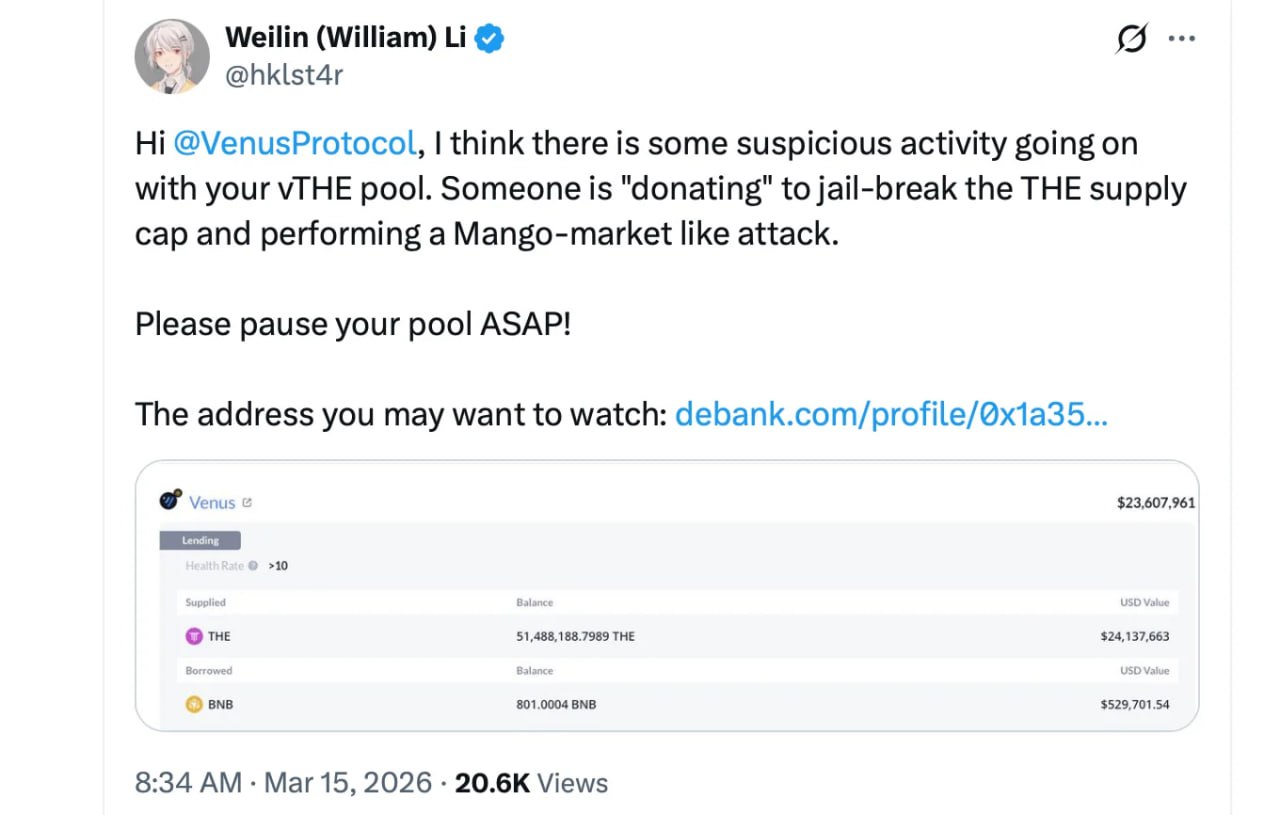 Suspected $3.7M exploit hits Venus Protocol after attacker uses illiquid token as collateral.2026-03
 Venus Protocol partners with Fluid to launch Venus Flux, a unified liquidity layer on BNB Chain enabling lend, borrow, swap from one pool.2026-02
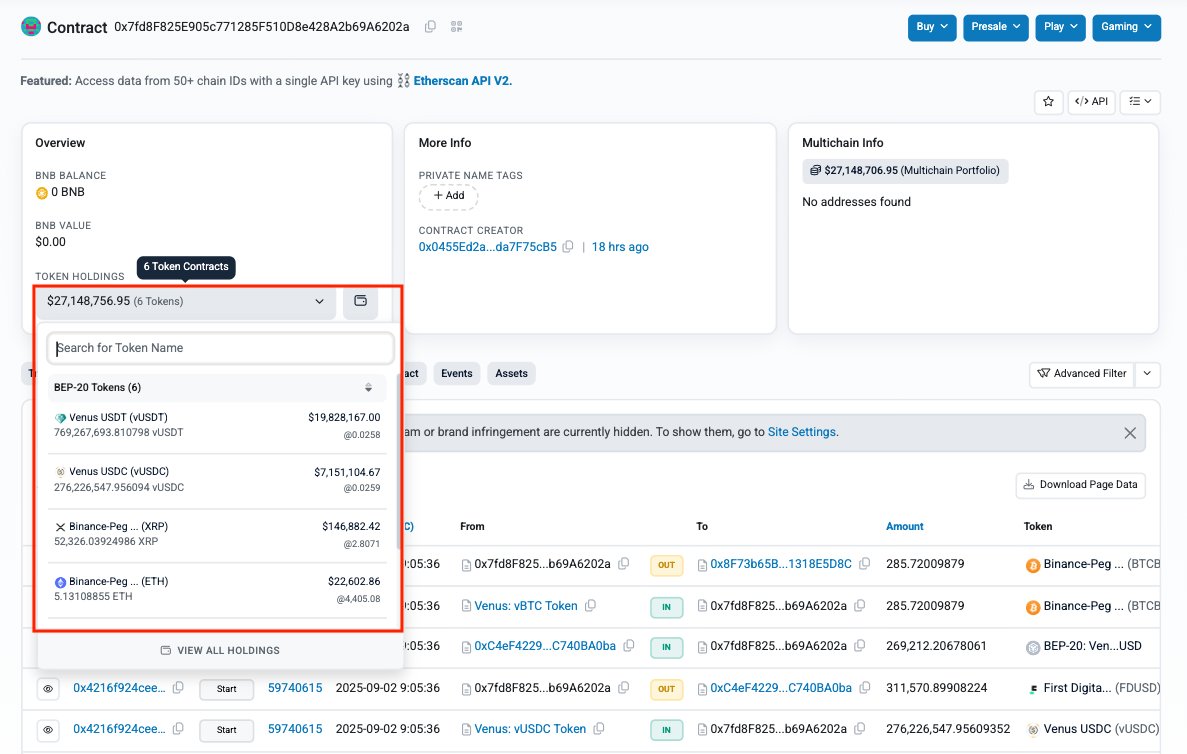 A user of VenusProtocol has been drained ~$27M in crypto after falling for a phishing scam.
The victim approved a malicious transaction, granting token approval to the attacker's address (0x7fd8...202a) for asset transfer.2025-09
A user of VenusProtocol has been drained ~$27M in crypto after falling for a phishing scam.
The victim approved a malicious transaction, granting token approval to the attacker's address (0x7fd8...202a) for asset transfer.2025-09 Venus Protocol is back online after a user lost $27M in a phishing scam. The protocol wasn’t breached; it paused services, then recovered the stolen funds through forced liquidation with community approval. Withdrawals and liquidations have now fully resumed.2025-09
Venus Protocol is a decentralized money market and lending platform native to BNB Chain, enabling users to supply assets as collateral, borrow against them, and earn yield — all without a central intermediary.
What Venus Does
At its core, Venus operates as an algorithmic lending market. Suppliers deposit assets into liquidity pools; borrowers draw against those pools by posting collateral worth more than their loan. Interest rates adjust automatically based on utilization: high demand drives rates up, attracting more supply and cooling borrowing. The native governance token, XVS (Venus), gives holders the right to vote on protocol parameters including interest rate models, collateral factors, and reserve ratios.
The protocol launched on BNB Chain (originally Binance Smart Chain) in late 2020, at a time when Ethereum gas costs were making Compound and Aave inaccessible for smaller participants. BNB Chain's low fees and compatibility with the EVM let Venus replicate the core money-market architecture at a fraction of the transaction cost.

Venus's multi-layer oracle defense: How your DeFi Assets stay protected
The Core Pool and Isolated Pools
Venus historically ran a single, shared liquidity pool — the Core Pool — where every asset shared the same risk bucket. A bad debt event in one market could, in theory, erode reserves across the entire protocol. To manage this, the team later introduced isolated pools: ring-fenced lending markets where a distressed asset could not contaminate unrelated collateral.
As of mid-2025, isolated pools on Venus have been sunset. The team paused all isolated pool activity and directed users to migrate positions back to the Core Pool or withdraw entirely. Withdrawals and repayments remain open; no funds are locked. The consolidation signals a strategic choice to concentrate liquidity and risk management in the Core Pool rather than fragment it across many smaller pools.
Readers click Venus exploits not for the attack mechanics but for the resolution moment — who absorbs the loss, whether governance steps in to force a liquidation, and whether funds actually come back — treating protocol incident response as the real product test.
Collateral Expansion: From Crypto to Tokenized Stocks
One of the most consequential recent developments is the integration of bStocks — tokenized stock positions — as collateral in the Venus Core Pool. This marks the first time tokenized equities have been usable as on-chain collateral on Venus, letting holders of tokenized representations of public company shares borrow against those positions without liquidating their stock exposure.
The mechanics mirror standard Venus collateral: the tokenized stock is deposited, a collateral factor is assigned (lower than for stablecoins, reflecting equity volatility), and the user can borrow up to that percentage of the collateral's value. If the position falls below the liquidation threshold, liquidators can step in, repurchase the collateral at a discount, and repay the debt.
Connecting equities to on-chain credit markets expands the addressable market for Venus well beyond crypto-native assets — a significant step toward the "everything is collateral" vision that some DeFi designers have pursued since Maker's early days with real-world assets.
Venus Flux: Unified Liquidity
Venus Flux is a unified liquidity layer built on BNB Chain that collapses what were previously three separate activities — lending yield, DEX fees, and borrowing power — into a single deposit position. A user depositing into Flux earns lending interest on their idle capital, simultaneously provides liquidity to trading pairs (capturing swap fees), and retains the ability to borrow against the same deposit without splitting funds.
The practical impact is capital efficiency. In a traditional DeFi stack, a user might put 50% of an asset into a lending protocol and 50% into a DEX LP position, earning both yields but forfeiting borrowing capacity on the LP portion and LP fees on the lending portion. Flux unifies these into one position.
The Flux Agent, available through the INFINIT interface, automates this: one deposit triggers the protocol to allocate across yield sources automatically, removing the need for manual rebalancing.
Venus Trade: Relative-Performance On-Chain Trading
Venus Trade is a newer on-chain trading product that takes a different approach to leverage than perpetual futures exchanges. Rather than holding a directional position funded by a funding rate, Venus Trade lets users go long one asset and short another — a relative-performance structure. Rankings among participants are based on percentage return (% PnL) rather than absolute profit.
The protocol itself frames this as a risk distinction from perp exchanges: there are no funding rates eating into positions over time, and the leverage model differs. That said, any leveraged trading carries liquidation risk, and the product is early. The launch included a $5,000 USDT prize pool arena to bootstrap activity.

Cysic Venus v0.2.0 ships Rust proving-key setup with 3x faster key generation
The Fixed-Term Vault
Venus Protocol introduced a Fixed-Term Vault — an ERC-4626 compliant on-chain product that offers fixed-duration participation windows, similar to a certificate of deposit in traditional finance. Users lock capital for a defined period and receive a predetermined yield, rather than floating with the variable rates of the Core Pool.
The ERC-4626 standard (the "tokenized vault" standard from Ethereum's EIP process) means the vault position itself is a transferable token, preserving some liquidity even during the lock period. This structure appeals to treasury managers and protocol-owned liquidity operators who want yield predictability over rate-chasing.
- 01illiquid collateral oracle exploit
The $3.7M THE token attack showed that accepting low-liquidity tokens as collateral creates a price-manipulation vector even with supply caps, pulling readers focused on structural lending risk.
- 02Venus Flux unified liquidity launch
The Fluid partnership and single-pool lend/borrow/swap architecture on BNB Chain attracted readers curious whether unified liquidity layers can displace siloed money markets.
- 03phishing victim forced liquidation
A $27M approval-based phishing drain followed by community-approved forced liquidation to recover funds compressed the full arc of DeFi incident governance into one story.
- 04oracle multi-layer defense
Venus's published breakdown of how its oracle stack resists price manipulation drew readers benchmarking what separates protocols that survive collateral attacks from those that don't.
- 05BNB Bridge exploiter liquidation
Watching the BNB bridge hacker get liquidated on the very protocol they used created a satisfying accountability narrative that transcended the technical details.
- 06Venus zkVM proving speed
Cysic's unrelated 'Venus' graph-based zkVM drew niche ZK infrastructure readers, revealing audience bleed between the DeFi brand and ZK research circles.
Oracle Infrastructure and Risk Management
Money markets live and die by their price feeds. Venus runs what it calls a Resilient Oracle system: a multi-layer validation framework with primary oracles (on-chain sources like Chainlink and Pyth) and fallback oracles that activate if a primary source fails validation checks. The system is designed to reject price feeds that are stale, manipulated, or outside expected bounds before those prices can affect liquidation thresholds.
This architecture matters because oracle manipulation has been a recurring attack vector across DeFi. By validating across multiple sources and maintaining fallback paths, Venus reduces the blast radius of a single oracle failure.
Despite this, Venus has faced stress events. The protocol relied on fallback oracles and risk funds to absorb bad-debt situations, and observers have noted that concerns about bad debt management remain. The risk funds — financed by a portion of protocol reserves — act as a backstop when liquidations fail to cover outstanding debt.
Security Incidents and Collateral Pauses
Venus's history includes collateral pauses triggered by external exploits. A notable example: a vulnerability in the Hyperbridge gateway allowed unauthorized minting of DOT tokens on Ethereum. Venus responded by pausing DOT supply and borrowing, setting the DOT collateral factor to zero, and removing the DOT market from the Binance Wallet loan list. Repayments and withdrawals remained open, protecting existing depositors.
The incident illustrates a challenge for any money market that accepts bridged or cross-chain assets: Venus's own oracle and collateral logic may be sound, but a weakness in an underlying bridge or token contract can force defensive pauses that disrupt users.
Similarly, Venus Flux faced scrutiny after concerns emerged around USR depeg risk and supply cap bypass vulnerabilities. The team suspended the USR market on Flux and raised questions about whether the separation between the Flux product and the Core Pool provides adequate protection. These episodes underscore the importance of the isolated-pool concept — and raise questions about what the Core Pool consolidation means for containing future contagion.
Stablecoin and Asset Ecosystem
USDC is a core asset across Venus markets, serving as both a borrowable stablecoin and a collateral option. BNB, the native token of BNB Chain, is deeply integrated — it functions as collateral, and BNB Chain's ecosystem relationships (notably with PancakeSwap) bring liquidity partners and users into Venus's orbit.
The PancakeSwap connection is more than incidental: Venus Flux draws on PancakeSwap liquidity, and the two protocols have co-promoted ecosystem initiatives. When PancakeSwap runs incentive programs, Venus-native liquidity can flow across.
Stablecoins more broadly are central to Venus's lending activity. USDC, USDT, and protocol-native stablecoins all appear in Core Pool markets. The protocol previously listed USD1 and XAUM (a gold-backed token) as collateral assets but paused these along with USDe, sUSDe, SolvBTC, and xSolvBTC — all in a defensive posture following market stress events in 2024–2025. Repayments and withdrawals for those assets remain accessible.

Suspected $3.7M exploit hits Venus Protocol after attacker uses illiquid token as collateral.
Governance and Venus Prime
XVS holders govern the protocol through on-chain proposals. Changes to collateral factors, interest rate parameters, new market listings, and treasury allocations all pass through governance. The voting structure aims to decentralize protocol control over time, though — as with most DeFi governance — participation rates and token concentration remain practical constraints.
Venus Prime is the protocol's loyalty and rewards program for high-engagement users, offering boosted yields to participants who hold a minimum XVS balance and meet activity thresholds. The program has undergone revisions; the team has signaled updates to Prime's mechanics as part of ongoing product development.
- 2022-10exploit
BNB Bridge exploiter liquidated for $30M on Venus lending market
- 2024-11exploit
Venus Protocol suffers $3.7M exploit via THE token illiquid collateral manipulation
- 2025-01exploit
User drained $27M via phishing approval; protocol pauses and recovers funds through forced liquidation
- 2025-03exploit
Thena THE token exploit leaves Venus with $2M bad debt
- 2025-12launch
Venus Flux launches on BNB Chain with $1M incentives via Fluid partnership
- 2026-01governance
Venus Flux USR markets anchored during depeg; funds protected
- 2026-04milestone
Venus Q1 2026 Recap: new products, infrastructure, and partner assets launched
Fees, Revenue, and Reserve Mechanics
Venus accrues revenue through the reserve factor — a percentage of interest paid by borrowers that flows into protocol reserves rather than to suppliers. These reserves serve multiple functions: they fund the risk fund (bad-debt backstop), support the Venus Prime rewards program, and can be directed by governance to other protocol needs.
The reserve factor varies by asset and is set via governance. Higher-risk or lower-liquidity assets typically carry higher reserve factors to build a proportionally larger safety buffer.
Ecosystem Position
Venus occupies a specific niche: it is the largest money market protocol native to BNB Chain by most TVL measures, competing indirectly with Aave and Compound on EVM chains while benefiting from BNB Chain's lower-fee environment and the Binance ecosystem's distribution. The bStocks integration and Venus Trade product push the protocol toward a broader financial platform rather than a pure lending market.
The partnership surface with Pendle (which launched a fixed-rate vault on Venus Core) and the INFINIT integration for Flux automation suggest a strategy of composing with other DeFi protocols rather than building every feature in-house.
Outlook
Venus is navigating the transition from its original single-pool design toward a more layered architecture: a consolidated Core Pool for blue-chip assets, Flux for unified liquidity, Trade for leveraged relative-performance strategies, and the Fixed-Term Vault for fixed-duration yield. Each layer adds product surface area but also complexity and potential failure modes.
The tokenized stock collateral integration is a meaningful frontier — if demand materializes and the bStock infrastructure proves reliable, it could establish Venus as the default on-chain credit facility for holders of tokenized traditional assets on BNB Chain. The caution around bridged assets and stablecoin depegs suggests the team has grown more conservative in its risk tolerance, which may limit upside velocity but improves the probability of avoiding a catastrophic bad-debt event.
For users, Venus remains a mature DeFi protocol with an established track record, active governance, and a broadening product set — alongside the attendant risks of smart contract vulnerabilities, oracle failures, and collateral volatility that accompany any on-chain money market.
Latest Venus news
Venus's multi-layer oracle defense: How your DeFi Assets stay protectedCysic Venus v0.2.0 ships Rust proving-key setup with 3x faster key generationSuspected $3.7M exploit hits Venus Protocol after attacker uses illiquid token as collateral.Venus Protocol partners with Fluid to launch Venus Flux, a unified liquidity layer on BNB Chain enabling lend, borrow, swap from one pool.Venus Protocol is back online after a user lost $27M in a phishing scam. The protocol wasn’t breached; it paused services, then recovered the stolen funds through forced liquidation with community approval. Withdrawals and liquidations have now fully resumed.A user of VenusProtocol has been drained ~$27M in crypto after falling for a phishing scam.
The victim approved a malicious transaction, granting token approval to the attacker's address (0x7fd8...202a) for asset transfer.Community notes
Spot something off or out of date? Drop a note. Editors review topic notes daily and roll accepted fixes into the explainer — contributors are recognized in the monthly $SQUID drop.
Loading notes…
Help improve this topic
Have a story or tip about this topic? Submit it. See something missing? Leave a note. Editors review daily; accepted submissions and fixes count toward the monthly $SQUID drop.