
Explainer on crypto restaking: how staked ETH is reused to secure new protocols, the roles of EigenLayer, Symbiotic and LRTs, yield and shared-security upside, plus leverage, bridge and slashing risks and the cautious but growing institutional adoption.
+7 sources across the wider coverage universe
 "5 Teams, 1 Mission: The Institutional Restaking Stack Explained - The Cap Room #1
"DeFi Dave, who will be on a livestream at 5 PM UTC with DAdvisoor, is as we've said starting two new shows - and one of them is the new inhouse Cap podcast, "The Cap Room"!
Enjoy this special first episode, with 5 guests - from EtherFi, Symbiotic, FalconX, M11 Credit, and of course - Cap!2026-03
"5 Teams, 1 Mission: The Institutional Restaking Stack Explained - The Cap Room #1
"DeFi Dave, who will be on a livestream at 5 PM UTC with DAdvisoor, is as we've said starting two new shows - and one of them is the new inhouse Cap podcast, "The Cap Room"!
Enjoy this special first episode, with 5 guests - from EtherFi, Symbiotic, FalconX, M11 Credit, and of course - Cap!2026-03 Etherfi Closes Institutional Restaking Agreement at Cap2026-02
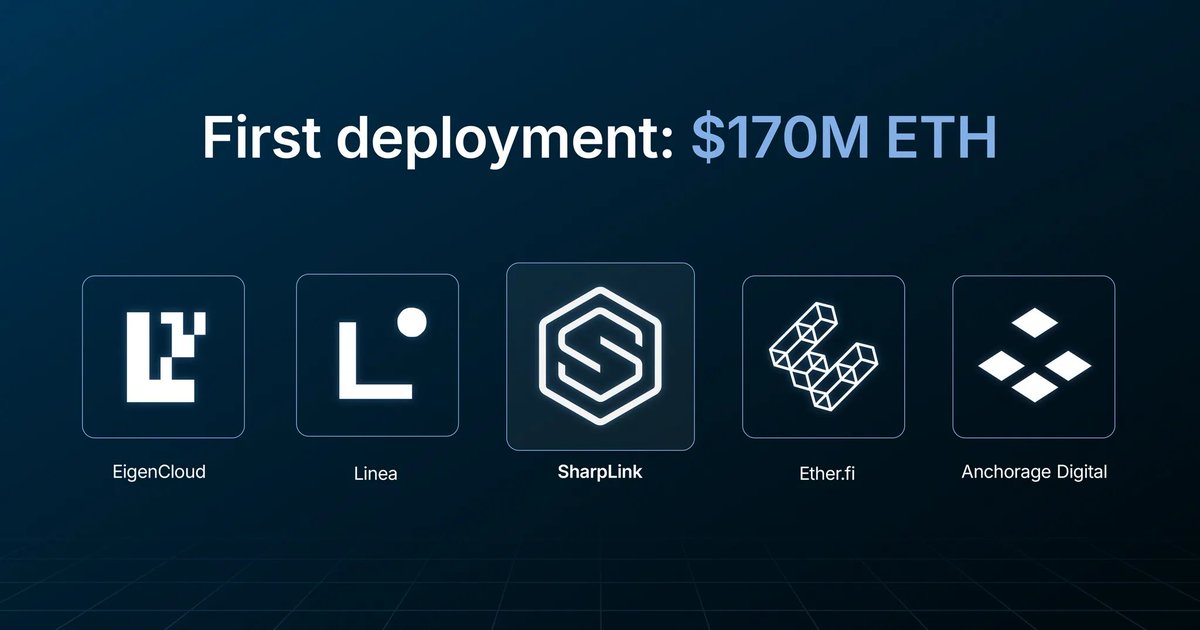 SharpLink Deploys $170M ETH on Linea in First-of-Its-Kind Institutional Strategy Combining Native Yield, Restaking Rewards, and Network Incentives.2026-01
 Introducing Nektar's first LRT Vaults: stUSD Restaking Vault, dlcBTC Bitcoin Staking Pool, and Re7 Nektar ETH Vault, Offering innovative restaking opportunities in partnership with leading DeFi Teams.2024-06
 Karak — now valued at $1bn — challenges EigenLayer in restaking sector2024-04
 EigenLayer exodus triggers wider decline in restaking sector as TVL drops across major protocols.2024-07
Restaking in Crypto: How Ethereum’s New Security Primitive Works
In crypto, restaking refers to reusing already staked assets—most notably staked ETH—to secure additional protocols or services, earning extra yield on top of base staking rewards while extending the underlying network’s trust to new applications. In practice, restaking systems such as EigenLayer, Symbiotic and their liquid restaking token (LRT) ecosystems aim to turn Ethereum’s proof‑of‑stake security into a reusable, programmable resource for DeFi, infrastructure, and even other blockchains.
From Staking to Restaking: Setting the Stage
To understand why restaking matters, it is essential to start with plain‑vanilla staking. In a proof‑of‑stake (PoS) blockchain such as Ethereum, validators lock up native tokens as collateral to participate in consensus and validate transactions, earning rewards for honest behavior and risking slashing if they attack or misbehave. Staking replaces the energy‑intensive puzzle‑solving of proof‑of‑work mining with a capital‑based security model, where economic stake stands in for hardware and electricity. Networks typically select validators in proportion to their stake, reward them with newly issued tokens and protocol fees, and enforce penalties through slashing and ejections for double‑signing, extended downtime, or other consensus violations. This design provides strong security guarantees as long as a sufficiently large share of stake is controlled by honest participants, and it has become the dominant paradigm for new smart‑contract platforms.
For individual holders, staking is both a security contribution and a yield‑generating activity. By delegating or running validators, token holders earn a protocol‑level return, which for ETH has generally trended in the low single digits on an annualized basis as the staking ratio has climbed and fee revenue has normalized. The result is a new kind of “onchain yield curve” in which staking returns compete with lending, liquidity provision, and other DeFi strategies for capital. As more ETH gets staked—recent market data show staking participation approaching a third of the supply—base yields naturally compress, motivating builders and traders to search for ways to “stack” additional income streams on top. Restaking emerges directly from this dynamic: it is a mechanism for extracting more economic value from the same escrowed collateral.
Staking also gave rise to an earlier innovation that paved the way for restaking: liquid staking. Protocols like Lido, Rocket Pool, and others allow users to deposit ETH, have it staked on their behalf, and receive a liquid staking token (LST) such as stETH or rETH that tracks the underlying plus accrued rewards. These LSTs can be traded, used as collateral, or deployed in DeFi while the underlying ETH remains staked, neatly solving the opportunity cost of locking capital in validators. Lido’s stETH, for example, has become one of the largest assets in DeFi, and Lido’s leadership has emphasized that the core value proposition of liquid staking is precisely this liquidity and composability. Restaking takes the same logic one step further, asking not only how to make staked assets tradable, but how to reuse the security they represent.

"5 Teams, 1 Mission: The Institutional Restaking Stack Explained - The Cap Room #1 "DeFi Dave, who will be on a livestream at 5 PM UTC with DAdvisoor, is as we've said starting two new shows - and one of them is the new inhouse Cap podcast, "The Cap Room"! Enjoy this special first episode, with 5 guests - from EtherFi, Symbiotic, FalconX, M11 Credit, and of course - Cap!
What Is Restaking?
At its core, restaking is a mechanism that allows already staked tokens, or tokens derived from them, to be pledged as security for additional protocols beyond the base chain. EigenLayer, which helped popularize the concept, describes itself as a “generalizable” programmable trust layer built on Ethereum, where staked ETH can be “re‑hypothecated” to secure so‑called Actively Validated Services (AVSs). Instead of each new middleware service, oracle network, rollup, or bridge bootstrapping its own validator set and token, these projects can tap into Ethereum’s existing economic security by recruiting restakers who opt in to additional slashing conditions. In exchange, restakers can earn extra rewards on top of their normal staking yield, either directly from the AVSs or through protocol‑level incentives. This creates a new market where security is bought and sold as a service, with restakers as suppliers and emerging protocols as demanders.
Restaking can occur in two main forms: native restaking and liquid restaking. In native restaking, Ethereum validators who already have 32 ETH staked in the beacon chain register their validators with a restaking protocol’s smart contracts, agree to additional slashing terms, and thereby allow their staked ETH to secure AVSs. Their consensus keys are reused to sign attestations or proofs for those services, and misbehavior can result in slashing not only within the restaking protocol but also on the underlying Ethereum stake. This deep coupling between AVS performance and base‑layer security is the source of restaking’s power and its risk. Liquid restaking, by contrast, uses derivatives: users deposit ETH or liquid staking tokens such as stETH into a restaking protocol, which then manages the validator operations and AVS participation, issuing an LRT that represents the claim on this restaked position.
This LRT structure is particularly important in practice because it enables non‑validator users to participate in restaking via a familiar DeFi interface. Protocols such as Renzo, YieldNest, Puffer Finance and others allow users to deposit ETH or LSTs and receive reward‑bearing LRTs like ezETH or ynLSDe that accrue both staking and restaking rewards over time. Renzo, for example, issues ezETH to depositors and automatically allocates the underlying assets to EigenLayer strategies, with the token’s value increasing as rewards compound. YieldNest’s design similarly aims to capture restaking yield through specialized derivatives that can be used across DeFi while the protocol handles validator and AVS interactions under the hood. This structure abstracts away the operational complexity of validator management and AVS selection, at the cost of additional smart‑contract and governance risk concentrated in the LRT issuer.
A key conceptual distinction between staking and restaking lies in where slashing risk originates. In simple staking, the only slashing conditions are those of the base chain: double‑signing, equivocation, and similar consensus faults. In restaking, the same underlying collateral is now subject to slashing for failures in multiple protocols simultaneously, since validators or restaking pools can be penalized for misbehavior relating to each AVS they support. This creates correlated risk, where a bug in an AVS, a misconfigured operator, or a malicious attack could trigger slashing across many restakers, potentially affecting a meaningful fraction of staked ETH. Research from teams such as the Cardano Foundation, IOG, and Gauntlet has emphasized precisely these compounding risks and the need for careful incentive design when extending validator responsibilities through restaking overlays.
Despite these concerns, restaking is attractive because it transforms Ethereum’s proof‑of‑stake security into a modular, reusable primitive. Instead of every protocol reinventing a token and validator set, restaking lets builders plug into a common security pool, potentially reducing fragmentation and raising the economic cost of attacks on smaller systems. Symbiotic, another shared‑security project, explicitly positions itself as a thin coordination layer that networks can use to design their own restaking rules with flexible collateral and validator configurations. In this sense, restaking can be viewed as the next step in the evolution of staking: from single‑protocol security to a marketplace where economic trust can be programmatically allocated across a stack of services.
Restaking readers concentrated on Introducing Nektar's first LRT Vaults: stUSD Restaking Vault, dlcBTC Bitcoin Staking Pool, and Re7 Nektar ETH Vault, Offering innovative restaking opportunities in partnership with leading DeFi Teams..
Core Mechanisms: Native Restaking, Liquid Restaking, and LRTs
Mechanically, native restaking begins at the level of the Ethereum validator. A validator that controls 32 ETH and runs consensus and execution clients can opt into a protocol like EigenLayer by registering its validator keys through a set of smart contracts. This registration declares that the validator is willing to accept extra slashing conditions associated with one or more AVSs, which may require signing additional messages, producing proofs, or performing off‑chain computations. The protocol typically tracks the validator’s AVS commitments and defines how slashing evidence from those services propagates back to the underlying stake. If an operator fails or acts maliciously, they can lose not just their AVS rewards but a portion of their beacon‑chain ETH, aligning incentives across all layers. Native restaking thus offers the highest security integration but requires direct validator participation, which is operationally demanding.
Liquid restaking protocols abstract this complexity for end users but introduce their own layers of design decisions. When a user deposits ETH or LSTs into Renzo, for instance, the protocol stakes or restakes those assets on EigenLayer and allocates them across AVSs based on an internal strategy, while issuing the user ezETH as a transferable, yield‑bearing claim. EzETH’s value increases as both base staking rewards and AVS rewards accrue, and the token can be used in DeFi as collateral, traded, or supplied to liquidity pools without interrupting the underlying restaking activity. YieldNest follows a comparable model with its ynLSDe product, designed specifically to capture restaking yield from Ethereum by combining liquid staking and restaking into a single derivative. Puffer’s pufETH similarly wraps restaked ETH into an LRT that institutions can hold under custody at Anchorage Digital, demonstrating how the same building blocks can serve different user segments.
From a technical standpoint, LRTs sit on top of existing LSTs or native staked ETH and add an additional accounting layer. Three Sigma’s analysis emphasizes that liquid restaking tokens represent restaked positions that are subject to the risks of every protocol they touch, creating compound exposure. Because a single restaked asset can secure multiple AVSs, and that asset can itself be used as collateral in lending markets, leverage can accumulate quickly in ways that are not always obvious to end users. The Bank for International Settlements has documented how DeFi leverage driven by collateralized borrowing can lead to systemic fragility, with average leverage levels around 1.4–1.9 and top users considerably higher, raising the share of debt close to liquidation when markets turn. Restaking‑derived leverage, where LRTs are rehypothecated through money markets, adds an additional dimension to this dynamic.
To anchor these distinctions, it is useful to compare the main models along a few practical axes. The following table sketches a simplified comparison of native staking, liquid staking, native restaking, and liquid restaking.
| Dimension | Native staking (ETH) | Liquid staking (LSTs) | Native restaking | Liquid restaking (LRTs) |
|---|---|---|---|---|
| Liquidity | Locked at validator level | Tradable derivative like stETH or rETH | Locked at validator level | Tradable restaked derivative like ezETH, pufETH, ynLSDe |
| Yield sources | Base staking rewards | Base staking rewards | Base + AVS rewards | Base + AVS rewards + DeFi strategies |
| User type | Validator operators | Any user | Validator operators | Any user |
| Slashing scope | Ethereum consensus only | Ethereum consensus only | Ethereum + AVS slashing | Ethereum + AVS + protocol‑level risks |
| Complexity | High operational load | Moderate (smart‑contract risk) | Very high (multi‑protocol) | High (stacked protocol risks) |
This comparison highlights that restaking does not simply increase yields; it also extends the slashing and smart‑contract risk perimeter. While native restaking has the most direct relationship with Ethereum consensus, liquid restaking makes that extended risk accessible and composable across DeFi. The sophistication of the strategies, and the difficulty of tracking all the interconnected exposures, is precisely what makes LRTs powerful for sophisticated users and concerning for regulators and risk managers.
- 01Novel LRT vault products↗
Readers responded most to concrete new products — Nektar's stUSD/dlcBTC/ETH vaults, Puffer's $135M first-day deposits, and Renzo's $17M raise — signalling appetite for yield-bearing primitives over abstract protocol mechanics.
- 02EigenLayer vs challengers↗
The emergence of Karak ($1B valuation) and Symbiotic ($2B TVL debut) directly threatening EigenLayer's dominance drove sustained reader interest in who would win the restaking infrastructure race.
- 03Airdrop yield harvesting
Multiple high-click headlines framed restaking protocols explicitly as airdrop vehicles, drawing readers seeking a structured playbook for accumulating pre-token points.
- 04Bitcoin restaking expansion↗
Babylon's BTC staking, Lombard's EigenLayer partnership, Swell's swBTC, and dlcBTC in the Nektar vault signalled a narrative shift from ETH-only restaking to a multi-asset model readers found compelling.
- 05Leveraged restaking systemic risk↗
Gearbox's 10x leveraged restaking mechanics and explicit comparisons to Terra and the 2008 financial crisis attracted readers alert to contagion risk inside the LRT stack.
- 06LRT TVL growth milestones↗
Readers tracked successive TVL records — $3.5B across LRT protocols, ETH staking hitting 27.95%, Puffer reaching $850M in under two weeks — as a proxy for sector momentum.
The Restaking Ecosystem: EigenLayer, Symbiotic, and Beyond
EigenLayer is the archetypal Ethereum restaking protocol. Architecturally, it consists of a set of smart contracts that accept deposits of native staked ETH or LSTs, track validator registrations, and manage opt‑in slashing conditions for AVSs. AVSs might include data availability layers, oracle networks, bridges, or specialized execution environments that require economically secured validation but do not wish to launch their own token or validator set. By outsourcing security to the pooled restaked ETH, these services can in theory achieve Ethereum‑grade economic guarantees more quickly and cheaply than via a standalone token system. EigenLayer markets this as “programmable trust,” where security is decomposed from execution and reassembled into bespoke configurations for each AVS. This vision has attracted substantial capital; by mid‑2025, Ethereum‑based restaking protocols led by EigenLayer and Symbiotic were estimated to secure on the order of tens of billions of dollars.
Symbiotic adopts a slightly different, more modular approach to shared security. Its team describes the protocol as a minimal coordination layer that allows network builders to define their own (re)staking parameters rather than enforcing a one‑size‑fits‑all model. In practice, Symbiotic supports a broad range of collateral types and enables projects to customize validator sets, slashing rules, and economic incentives using a common onchain framework. This flexibility has resonated with both DeFi builders and restaking‑native projects; Symbiotic has quickly accumulated hundreds of millions of dollars in TVL according to tracking platforms like DeFiLlama. Cap, an emerging stablecoin project, uses Symbiotic under the hood to create a “covered” model where restaked collateral backs yield‑bearing stablecoins, demonstrating how shared security can power novel financial instruments. Our newsroom has highlighted how Cap’s early flywheel—featuring institutional partners and LRT issuers such as Renzo—illustrates the convergence between restaking infrastructure and higher‑level financial products.
Around these core security layers, a constellation of liquid restaking protocols has emerged. Renzo, built atop EigenLayer, positions itself as both an LRT issuer and a professional strategy manager, allowing users to deposit ETH or LSTs, receive ezETH, and gain exposure to curated EigenLayer AVS allocations. The token is designed as a reward‑bearing asset that increases in value over time, and its design emphasizes DeFi interoperability so ezETH can serve as collateral or liquidity across protocols. YieldNest is similarly focused on “supercharged yield,” offering products like ynLSDe tailored to capture restaking rewards while emphasizing security and ease of use for non‑expert users. Manta Network, originally known for inflationary staking incentives, has pivoted towards a “Restaking Paradigm” that channels capital into higher‑yield restaking strategies, one example of how existing ecosystems are reorganizing around this new primitive.
Restaking is also expanding beyond Ethereum. Lombard, for example, has partnered with EigenLayer and the Eigen Foundation to introduce LBTC, a Bitcoin‑backed asset that can participate in EigenLayer’s restaking ecosystem. This arrangement combines Babylon’s Bitcoin staking infrastructure with Ethereum’s restaking stack, allowing LBTC holders to earn both base yield from Bitcoin staking and additional rewards through EigenLayer AVSs. In parallel, Babylon itself has attracted strategic investment to develop Bitcoin restaking solutions and support rollup and Layer‑2 innovation, indicating that Bitcoin‑secured restaking may become an important cross‑chain theme. Our newsroom has covered how Solana’s Jito, a major MEV‑aware staking protocol, plans to add restaking functionality, while Swell has introduced swBTC, a liquid restaking token backed by wrapped BTC on Ethereum, suggesting that both the Ethereum and non‑Ethereum ecosystems see restaking as a way to deepen capital efficiency and security sharing.
Etherfi Closes Institutional Restaking Agreement at Cap
TL;DR summary Ether.fi, FalconX, and M11 Credit have executed DeFi's first institutional restaking agreement via Cap Money. Ether.fi delegates weETH tokens to Cap's platform, built on Symbiotic, to underwrite private credit for M11 Credit through FalconX's Structured Credit Facility. This bridges restaking liquidity with institutional borrowing, offering restakers sustainable fixed yields from lending activities. However, it introduces slashing risks if borrowers default, signaling maturing DeFi integration with traditional finance.
Why Restaking Matters: Yield, Capital Efficiency, and Shared Security
Restaking’s rapid growth is best understood through the lens of onchain yield and capital efficiency. As Galaxy’s research on the “state of onchain yield” emphasizes, staking returns are just one component of a broader yield stack that includes lending, liquidity provision, and incentive programs. When base staking yields compress—an expected outcome as more ETH is staked and protocol revenues normalize—investors seeking higher returns naturally look for ways to layer additional yield sources without deploying fresh capital. Restaking provides precisely that: the ability to earn AVS rewards, points, and governance tokens on top of the base ETH staking yield, and then to further enhance returns by using LRTs as collateral in DeFi. This stacking effect has driven a surge of interest in LRTs, with total value in liquid restaking tokens climbing into the multi‑billion‑dollar range according to market trackers, even as observers warn of potential systemic risks reminiscent of pre‑crisis traditional finance leverage cycles.
From the perspective of protocol builders, restaking is attractive because it addresses a long‑standing bootstrapping problem. New networks, oracles, and data services need economic security to be trustworthy, but launching and maintaining a dedicated token and validator set is costly and often yields weak security until the system matures. Shared security via restaking allows these projects to “rent” a slice of Ethereum’s existing economic trust, raising the economic cost of attacks and aligning their incentives with those of ETH stakers. Symbiotic’s model, for example, enables rollups and DeFi protocols to design bespoke security modules that plug into a common restaked collateral pool, while retaining control over governance and parameterization. In this sense, restaking extends the concept of “security as a service” that has long existed informally in validator‑as‑a‑service businesses into a transparent, programmable onchain market.
Capital efficiency is another critical angle. In traditional PoS, each protocol’s security is siloed: a token staked on one network cannot simultaneously secure another, and funds staked for security cannot be used elsewhere. Restaking collapses these silos by allowing the same economic stake, or tokens derived from it, to act as collateral for multiple layers of the stack. A single ETH may be locked in the beacon chain, represented by an LST like stETH, restaked via a protocol such as EigenLayer, wrapped again into an LRT like ezETH, and then supplied as collateral in a lending market, all while securing AVSs and generating multiple yield streams. This is an extraordinary degree of capital reuse, unmatched in traditional finance, and it is both the source of restaking’s appeal and the reason risk experts frequently invoke analogies to structured credit products and rehypothecation‑driven leverage chains.
For DeFi users, restaking introduces new strategic choices about where to sit along the risk–return curve. A conservative ETH holder might simply stake through a provider like Lido, hold stETH, and avoid restaking entirely, a position some institutional players still prefer given the immaturity of restaking infrastructures. A more aggressive user might shift into an LRT that participates in restaking but retains broad DeFi composability, accepting additional smart‑contract, slashing, and liquidity risk in exchange for higher expected yield. Active traders and funds may go further, using LRTs as collateral to lever up their exposure or to farm incentives in protocols that integrate restaked assets, a pattern documented in onchain data studies of DeFi leverage. Restaking thus becomes another axis on which market participants express their risk appetite and macro views on Ethereum’s long‑term security model.
Finally, restaking has governance and ecosystem‑level implications. Because AVSs can pay in their own tokens or in ETH‑denominated fees, restakers become a new constituency with economic interests in a growing constellation of protocols. This may affect how governance tokens are distributed, how cross‑protocol governance alliances form, and how conflicts of interest are managed when AVSs compete for the same security budget. Shared security models like Symbiotic’s and EigenLayer’s effectively create meta‑governance layers where decisions about slashing standards, collateral eligibility, and operator requirements can influence dozens of downstream projects at once. The result is a more deeply interconnected DeFi landscape, where the line between staking, infrastructure, and application‑level risk is increasingly blurred.
EigenLayer mainnet restaking launch
LRT sector TVL surpasses $3.5B across Ether.fi, Renzo, Kelp, Puffer, Bedrock
- 2024-02milestone
Puffer Finance attracts $135M deposits on first day of launch
Symbiotic debuts with $2B TVL, positioning as permissionless EigenLayer rival
- 2024-09milestone
Solayer Solana restaking soft-launch hits $20M cap in 45 minutes
Anchorage Digital launches institutional LRT access via Puffer Finance integration
KelpDAO bridge exploit drains cross-chain LRT funds
Risks and Failure Modes: Restaking’s Dark Side
Alongside its promises, restaking introduces a complex risk surface that is only beginning to be mapped. One of the clearest illustrations of these dangers came from KelpDAO’s rsETH ecosystem, which suffered a roughly 292 million dollar exploit via its LayerZero bridge infrastructure. According to post‑mortems and blockchain analysis, attackers linked to North Korea’s Lazarus Group exploited a single‑signer configuration in KelpDAO’s “DVN” oracle module, enabling them to mint approximately 116,500 unbacked rsETH on a bridged chain. The attacker then used rsETH as collateral in Aave deployments on Ethereum and Arbitrum, borrowing large amounts of WETH and wstETH before the discrepancy in backing was detected, resulting in hundreds of millions of dollars in stolen value. Crucially, every individual transaction appeared valid at the protocol level, and the exploit hinged on cross‑chain invariant violations that were not caught in time. For a restaking ecosystem built on derivative tokens like rsETH, this episode underscored how bridge design and collateral integrity are existential concerns.
Risk analysts have drawn several lessons from the KelpDAO incident. Chainalysis, which tracked the exploit, emphasized that detection in such scenarios requires monitoring relationships between events across chains rather than single transactions, and that invariant‑based monitoring is critical for identifying cross‑chain mismatches early. Independent risk firms reviewing rsETH have recommended stronger decentralization of bridge signers, robust bug bounty programs, and clearer communication around collateralization and risk management processes. Our newsroom has reported that Llama Risk’s assessment of rsETH advised caution when using LRTs as collateral, noting the sector’s reliance on off‑chain services and centralization vectors, and warning that points‑driven demand can lead to rapid shifts in liquidity and potential depegs. While these critiques are specific to rsETH, the underlying themes—bridge security, oracle design, and the fragility of leveraged DeFi structures—apply broadly to restaking ecosystems.
Beyond protocol‑specific exploits, restaking raises systemic concerns about correlated slashing and leverage. The Cardano Foundation, IOG, and Gauntlet have collaborated on research examining validator incentives and restaking security, highlighting that when the same stake backs multiple protocols, failures can propagate in unexpected ways. For example, a bug in an AVS’s client software could cause many restaked validators to sign conflicting messages, triggering slashing not just within the AVS but on the underlying Ethereum stake, potentially affecting a large fraction of staked capital. If that stake is also represented by LSTs and LRTs used as collateral in DeFi, the resulting losses could cascade into liquidations, depegs, and liquidity crises. Studies by the Bank for International Settlements on DeFi leverage suggest that high borrower leverage undermines lending resilience, pushing more loans toward liquidation thresholds and amplifying market stress when prices move sharply. Restaking adds another layer to this leverage stack by enabling the same unit of collateral to anchor multiple risk exposures simultaneously.
Liquid restaking tokens in particular present a bundle of intertwined risks. Three Sigma’s comparison of LSTs and LRTs notes that, unlike simple liquid staking tokens, LRTs expose holders to the combined risks of all protocols they secure, including AVSs and the restaking issuers themselves. Any one of these components—EigenLayer, Symbiotic, an individual AVS, a bridge, or a DeFi protocol using the LRT as collateral—can fail or be exploited, potentially compromising the token’s value. Renzo’s ezETH, YieldNest’s ynLSDe, Puffer’s pufETH, and similar tokens all must manage not only validator performance and AVS risk, but also liquidity, peg stability, and governance in an environment where incentives may encourage aggressive yield‑seeking behavior. Galaxy’s work on onchain yield underscores that strategies with higher nominal returns often involve hidden tail risks and complex dependencies that are difficult for non‑expert users to fully evaluate. In a restaking context, those hidden risks may be bound up in slashing conditions or cross‑chain mechanisms that are not easily observable from token price alone.
Bridge and cross‑chain risks are particularly salient given restaking’s aspirations to connect multiple ecosystems. The KelpDAO exploit demonstrated that a single misconfigured or centralized component, such as a one‑of‑one signer in a DVN module, can compromise the integrity of an entire restaking token when that token is used across chains. Chainalysis has argued that security teams must treat cross‑chain bridges as critical infrastructure, with multi‑layered monitoring and robust, decentralized validator sets. As more projects explore Bitcoin restaking via protocols like Babylon and Lombard, or introduce restaked BTC tokens like swBTC, the intersection between Bitcoin’s relatively conservative security culture and Ethereum’s more experimental LRT environment will demand careful design and risk communication. The same is true for Solana’s planned restaking integrations via Jito: connecting a high‑throughput chain with its own validator economics to external restaking services will require alignment on slashing, governance, and liability for failures.
Finally, there is the socio‑economic dimension of restaking risk. Points programs, airdrop speculation, and aggressive marketing can attract capital into complex restaking strategies faster than governance and risk management frameworks mature. Our newsroom has documented how TVL in LRTs surged into the tens of billions as ETH staking yields compressed, with some observers likening the buildup of collateral and liquidity risks to structured finance products before the 2008 crisis. Risk assessments like Llama Risk’s rsETH report have emphasized that LRTs remain a less mature asset class, heavily reliant on off‑chain coordination and centralized teams, and that users should be cautious about assuming these instruments behave like traditional money‑market funds or ETFs. In this environment, transparency around AVS selection, slashing rules, and protocol dependencies is essential for building durable trust.
The April 2026 KelpDAO bridge exploit demonstrated that cross-chain LRT infrastructure introduces novel attack surfaces beyond the core restaking contracts themselves.
A single operator set failure on EigenLayer or Symbiotic can trigger simultaneous slashing across every AVS (Actively Validated Service) that operator secures, amplifying losses for all depositors stacked on that operator.
With an estimated $2.3B in LRT collateral deployed as leverage, a sustained LRT depeg during market stress could force cascading liquidations across lending protocols that accept LRTs as collateral.
EigenLayer's operator set is concentrated among a small number of professional node operators, meaning a coordinated failure or regulatory action against those operators could impair security for dozens of AVSs simultaneously.
Restaking tokens that accrue yield and are tradeable on secondary markets may attract securities classification in major jurisdictions, a risk compounded by the lack of any clear legal framework for AVS reward flows.
As ETH staking yields compress toward 3%, restaking protocols must continuously source new AVS demand to sustain advertised APYs, creating a structural incentive to onboard riskier or less-vetted AVSs.
Institutional Restaking: From Puffer to Anchorage and Cap
While early restaking activity has been dominated by retail DeFi users and crypto‑native funds, institutional adoption is emerging as a distinct theme. Anchorage Digital, a US‑regulated crypto bank, has partnered with Puffer Finance to offer institutional clients access to Ethereum liquid restaking via pufETH directly within Anchorage’s qualified custody environment. Under this arrangement, institutions can stake their ETH through Anchorage, receive pufETH credited to their custody accounts, and earn combined rewards from Ethereum validation and restaking while retaining on‑platform liquidity. Puffer’s protocol is designed to reduce operational hazards and broaden validator participation, and the integration aims to wrap these innovations in a compliance and security framework suitable for large allocators. Anchorage emphasizes that clients can benefit from advanced onchain yield opportunities without managing validator operations or taking on new counterparty exposures across multiple providers, consolidating staking, restaking, and governance processes under a single institutional‑grade roof.
Anchorage has also expanded its restaking offerings by integrating ether.fi, a non‑custodial protocol that supports staking, restaking, and DeFi deployment of ETH and LSTs. Through this integration, institutional clients can mint or acquire select liquid staking tokens and restake them via ether.fi from within Anchorage’s platform, again keeping assets in secure custody while accessing restaking yields. Ether.fi is widely used by both individual investors and institutions to manage validator operations and optimize staking strategies, and Anchorage positions its integration as a “trusted path” to restaking that aligns with regulatory and operational requirements. Taken together, these partnerships show how the institutional “restaking stack” is forming: specialized protocol teams like Puffer and ether.fi provide the onchain infrastructure, while custodians like Anchorage furnish the compliance, governance, and auditability layers that traditional finance participants demand.
At the same time, some major staking providers remain cautious about restaking. In public commentary, Lido’s head of institutional relations has noted that while liquid staking is increasingly integrated into institutional products, restaking is still viewed as too immature for many of Lido’s traditional clients. He has pointed to regulatory uncertainty and the complexity of stacking multiple slashing conditions as key reasons institutions are moving deliberately, even as they explore integrations with protocols like EigenLayer. This caution underscores an important point: whereas staking has now been recognized by some regulators as a relatively standard protocol activity, restaking’s novel risk profile and cross‑protocol entanglements mean it has not yet achieved the same level of comfort among conservative allocators.
Stablecoin and structured‑product experiments further illustrate institutional interest in restaking as a yield source. The Covered Agent Protocol (Cap) introduces a stablecoin system where restaked collateral underwrites yield‑bearing stable assets, with risk‑management analyses from firms like Chaos Labs highlighting how restaking can support innovative designs while requiring robust caps and controls. Our newsroom has reported on “The Cap Room,” a podcast featuring teams from EtherFi, Symbiotic, FalconX, M11 Credit, and Cap discussing the “institutional restaking stack,” signaling that large market‑makers, credit funds, and protocol teams are collaborating on shared standards for restaking‑based products. Other institutional‑scale deployments, such as SharpLink’s strategy that combines native ETH yield, restaking rewards, and network incentives on a Layer‑2 like Linea, demonstrate how restaking is becoming one component of multi‑layer yield optimization strategies targeted at sophisticated players.
All of this points to a bifurcated trajectory for restaking in institutional circles. On one side, regulated custodians and infrastructure providers are racing to integrate restaking in ways that satisfy compliance teams and risk committees, leveraging protocols like Puffer, ether.fi, EigenLayer, and Symbiotic. On the other, some of the largest liquid staking providers and traditional funds remain on the sidelines, citing immature risk frameworks and unclear regulatory guidance. The balance between these forces will likely determine how quickly restaking transitions from a DeFi‑native experiment to a mainstream component of institutional crypto portfolios.

SharpLink Deploys $170M ETH on Linea in First-of-Its-Kind Institutional Strategy Combining Native Yield, Restaking Rewards, and Network Incentives.

First of its kind, more of its kind Well, looking forward to the impact on yields here
How to Evaluate Restaking Opportunities
For crypto investors and builders trying to navigate the restaking landscape, a structured risk‑assessment framework is essential. The first layer is understanding the underlying staking exposure: what asset is being staked, on which network, and through what mechanism. ETH staking via Ethereum’s PoS consensus is relatively well‑understood, with clear slashing conditions and a robust client ecosystem. Bitcoin‑based restaking through solutions like Babylon and Lombard, or Solana restaking via Jito, involve different security models and maturity profiles, with distinct validator economics and governance structures. Users should assess whether the base‑layer staking setup itself is sound, including client diversity, decentralization of validators, and the track record of any middlemen such as staking providers or custodians. If the foundation is weak, restaking simply amplifies fragile security.
The second layer concerns the restaking protocol’s architecture and governance. EigenLayer, Symbiotic, and similar platforms define the rules by which AVSs plug into the shared security pool, including how slashing is triggered, how disputes are resolved, and how collateral is managed. Key questions include how decentralized operator sets are, whether AVS slashing conditions are transparently documented, and how upgrade authority is distributed among teams, DAOs, and token holders. Symbiotic’s emphasis on permissionless, customizable restaking underscores how much design space exists here: while flexibility can be a strength, it also means users must vet each configuration rather than assuming uniform security across the board. For protocols layering stablecoins or structured products on top of restaking, as in Cap’s case, independent risk audits such as those by Chaos Labs can provide valuable external scrutiny.
The third layer is the liquid restaking token or user‑facing product. LRTs like ezETH, pufETH, or ynLSDe encapsulate complex strategies behind a single token, and their design choices around rebasing versus reward‑bearing models, fee structures, and redemption mechanics matter greatly. Three Sigma’s analysis stresses that LRTs bundle multiple protocol risks, so users should examine what exactly backs the token, how it can be redeemed, and under what circumstances redemptions might be delayed or gated. Renzo, for example, positions ezETH as a reward‑bearing token whose value grows over time, but users must trust Renzo’s strategy management and EigenLayer integrations. Puffer and Anchorage’s pufETH offering aims to minimize operational risk and centralization from an institutional perspective, but end‑clients still need to understand how restaking exposure interacts with broader portfolio risk. YieldNest, marketing itself as “simple, secure, supercharged yield,” must similarly translate technical restaking complexity into understandable risk disclosures for users.
Finally, there is the DeFi integration layer, where LRTs and other restaked assets are used as collateral, liquidity, or governance tokens. Galaxy’s work on onchain yield and the BIS’s analysis of DeFi leverage both highlight that the most severe losses often occur when leveraged positions collide with liquidity crunches. When LRTs are widely used as collateral in lending markets, a sudden depeg or AVS‑related shock could force mass liquidations, driving down prices and precipitating a feedback loop. Users should be wary of strategies that rely heavily on borrowing against LRTs to lever up yield, particularly when those strategies are further entangled with incentive programs that may disappear once token distributions end. The KelpDAO rsETH exploit shows how a failure in the token’s backing—here, via a bridge vulnerability—can ripple through DeFi positions that appear, at face value, to be over‑collateralized. Evaluating restaking opportunities therefore means thinking not only about the yield, but about exit liquidity, collateral dependencies, and worst‑case unwind scenarios.
Restaking Across Chains: Ethereum, Bitcoin, Solana, and Beyond
Although Ethereum remains the primary hub for restaking, the concept is rapidly being adapted to other ecosystems. On Ethereum, the combination of a mature PoS base layer, dominant LSTs like stETH, and rich DeFi infrastructure makes it natural to experiment with shared security and LRT‑based yield strategies. EigenLayer and Symbiotic both leverage Ethereum’s economic weight and developer community, while Renzo, YieldNest, Puffer, and others build user‑facing abstractions on top. As ETH staking participation grows and liquid staking consolidates, restaking is increasingly seen as a way to extend Ethereum’s security model outward, whether to rollups, oracle networks, or other middleware.
Bitcoin’s emerging restaking ecosystem reflects a different starting point. Traditionally, Bitcoin has shunned active staking in favor of proof‑of‑work mining and conservative, non‑programmable security assumptions. Protocols like Babylon and Lombard seek to bridge that gap by introducing mechanisms through which BTC can earn yield and provide security to external systems, often by representing BTC as wrapped or synthetic assets on programmable chains. Lombard’s LBTC, for example, can participate in EigenLayer’s restaking ecosystem, allowing holders to earn base yield from Babylon’s Bitcoin staking as well as AVS rewards on Ethereum. This dual‑staking model suggests a future where Bitcoin’s capital base contributes to securing a broad array of multi‑chain services, though it also raises thorny questions about trust assumptions, bridge security, and the alignment of Bitcoin’s conservative ethos with more experimental restaking architectures.
On high‑performance chains like Solana, restaking is being integrated into existing validator and MEV‑aware staking systems. Jito, a leading Solana protocol that optimizes MEV capture and staking returns, has announced plans to add restaking capabilities, potentially allowing SOL stakeholders to secure additional services while earning extra yield. While detailed designs are still evolving, the dynamic validator set and fast block times on Solana imply that restaked services will need to carefully balance performance with slashing‑based security mechanisms. Similar experiments are underway on other chains and Layer‑2s, as teams explore how native staking and external restaking can be combined to bootstrap ecosystems with limited initial token distribution.
Across all these environments, a common pattern emerges: restaking serves as a bridge between base‑layer economic security and higher‑level services that need trust assumptions but do not want to, or cannot, launch their own standalone tokens. In Ethereum’s case, this bridge is built on top of LSTs and DeFi, while in Bitcoin’s, it often involves synthetic representations and cross‑chain bridges. In Solana and other high‑throughput chains, restaking must integrate with existing validator dynamics. As more chains experiment with these designs, interoperability and standardization will become more important. If a single restaked BTC token is used as collateral on Ethereum, Solana, and a rollup, then the security and governance of its issuing protocol become systemically important across multiple ecosystems simultaneously.
Outlook
Restaking has rapidly evolved from an abstract idea about “re‑hypothecating Ethereum security” into a concrete market structure involving billions of dollars in collateral, a growing roster of protocols, and a complex web of DeFi integrations. Its core promise is compelling: by allowing staked assets to secure multiple protocols at once, restaking increases capital efficiency, accelerates the bootstrapping of new networks, and opens novel yield opportunities for both retail and institutional participants. Flagship platforms like EigenLayer and Symbiotic, along with LRT issuers such as Renzo, YieldNest, and Puffer, have demonstrated that there is substantial demand for these products, and institutional partnerships with firms like Anchorage Digital suggest restaking is on the radar of more conservative allocators as well. At the same time, major players like Lido remain cautious, emphasizing that restaking’s risk profile and regulatory status are not yet as settled as those of simple liquid staking.
The risks, however, are equally real. Episodes like the KelpDAO rsETH exploit, as well as broader analyses from the Cardano Foundation, the BIS, and independent risk firms, highlight that restaking compounds existing DeFi challenges around leverage, smart‑contract risk, and cross‑chain security. When the same collateral secures multiple AVSs and underlies widely used LRTs, failures can propagate quickly and in non‑linear ways. The sector’s heavy reliance on bridges, oracles, and complex governance structures adds additional layers where human error or malicious actors can intervene. For restaking to become a durable component of the crypto financial system, builders will need to invest heavily in formal verification, invariant‑based monitoring, conservative collateral management, and transparent, robust governance—especially as institutions demand higher standards of risk management and compliance.
Looking ahead, the most likely trajectory is that restaking becomes a permanent, but more disciplined, part of the crypto landscape. On Ethereum, it may solidify into a standard “security marketplace” where AVSs compete for restaked collateral under well‑understood slashing frameworks, and where LRTs are treated not as risk‑free stable instruments but as structured products with clear disclosures. On Bitcoin and other chains, restaking experiments will continue to probe the balance between extending economic security and preserving base‑layer trust assumptions, with early products like LBTC in the EigenLayer ecosystem offering a preview. For users and institutions alike, the task is to approach restaking not as a free lunch but as a new frontier in programmable trust: powerful, flexible, and potentially transformative, but requiring the same rigor and skepticism that complex financial engineering has demanded in every other domain.
Latest Restaking news
"5 Teams, 1 Mission: The Institutional Restaking Stack Explained - The Cap Room #1
"DeFi Dave, who will be on a livestream at 5 PM UTC with DAdvisoor, is as we've said starting two new shows - and one of them is the new inhouse Cap podcast, "The Cap Room"!
Enjoy this special first episode, with 5 guests - from EtherFi, Symbiotic, FalconX, M11 Credit, and of course - Cap!Etherfi Closes Institutional Restaking Agreement at CapSharpLink Deploys $170M ETH on Linea in First-of-Its-Kind Institutional Strategy Combining Native Yield, Restaking Rewards, and Network Incentives. Cap's flywheel is now in motion 👏. The first major delegation on Cap's network was executed by RenzoProtocol, with ConcreteXYZ joining as the first operator. Powered by symbioticfi, sustainable restaking yield has become a reality 🧢
 @msobro shares thoughts on YieldNest, $YND and ‘shadiness’ around its recent TGE
 Chaos Labs endorses Cap as suitable for restakers due to its innovative model
Sources
18 records from 18 domains
fidelity.com
blockdaemon.com
threesigma.xyz
defillama.com
nansen.ai
chainalysis.com
crowdfundinsider.com
lombard.finance
yieldnest.finance
x.com
blog.symbiotic.fi
cardanofoundation.org
galaxy.com
anchorage.com
bis.org
youtube.com
governance.ether.fi
defiprime.com
Community notes
Spot something off or out of date? Drop a note. Editors review topic notes daily and roll accepted fixes into the explainer — contributors are recognized in the monthly $SQUID drop.
Loading notes…
Help improve this topic
Have a story or tip about this topic? Submit it. See something missing? Leave a note. Editors review daily; accepted submissions and fixes count toward the monthly $SQUID drop.