
SBI Holdings is Japan's most aggressive financial incumbent in crypto—building investment trusts, XRP and stablecoin rails, and consolidating exchanges as Japan reclassifies digital assets. Here's what SBI is building and why it matters.
+19 sources across the wider coverage universe
 Gumi and SBI to launch ¥3 billion Bitcoin and altcoin fund with Daiwa backing2026-07
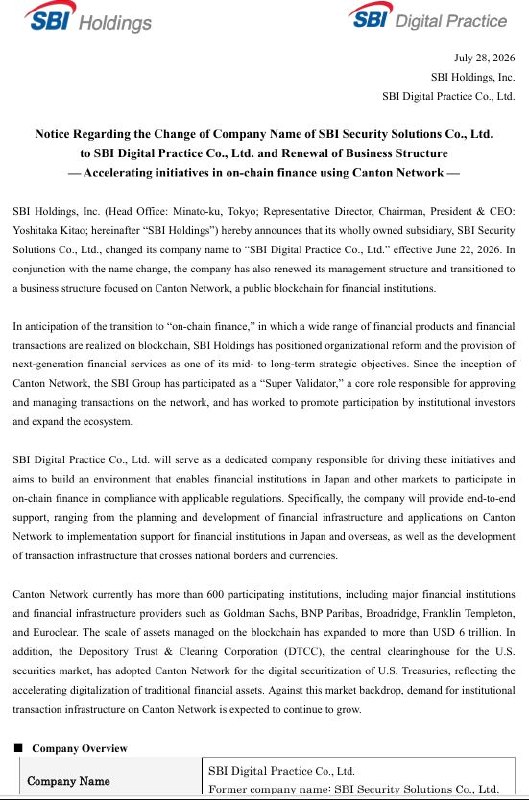 SBI rebrands security subsidiary as Digital Practice to build Canton Network financial infrastructure2026-07
 SBI-owned crypto market maker B2C2 explored sale talks with multiple potential buyers over the past 18 months, though valuation disagreements stalled deals2026-07
 Ondo and SBI plan tokenized Japanese equities with JPYSC settlement and collateral2026-07
 SBI Crypto winds down Bitcoin mining pool with roughly 2% of network hashrate by July 312026-07
 SBI Shinsei plans BTC, ETH, and XRP vouchers equal to 20% of yen deposit interest2026-06
SBI Holdings is one of Japan's largest financial-services groups and, through subsidiaries spanning brokerage, banking, asset management, and crypto exchanges, has become the most aggressive incumbent pushing digital assets into the country's mainstream financial system.
This page explains what SBI is, why a Tokyo-listed financial conglomerate matters so much to crypto markets, and how its 2025–2026 moves—from investment trusts to stablecoins to exchange consolidation—fit into Japan's broader regulatory reset.
What SBI Is
SBI Holdings, Inc. began life in 1999 as the internet-finance arm of SoftBank ("SBI" originally stood for Strategic Business Innovator / SoftBank Investment) before becoming fully independent. Today it is a sprawling financial group built around three pillars: financial services (online brokerage SBI Securities and SBI Shinsei Bank), asset management, and biotechnology/healthcare, with a fast-growing "Next" segment covering crypto and Web3.
Two attributes make SBI unusually important to digital-asset markets. First, scale and distribution: SBI Securities is one of Japan's largest online brokerages by account count, giving the group a direct retail channel that crypto-native firms lack. Second, a long-standing alliance with Ripple. SBI co-founded SBI Ripple Asia in 2016 and has been among the most prominent corporate backers of XRP and the XRP Ledger (XRPL), a relationship that colors much of how the group approaches tokenized payments and settlement.

SBI Shinsei Trust Bank and SBI VC Trade commit ¥1B to JPYSC, advancing stablecoin use cases through reserve asset management with Japanese Government Bonds
Japan's Regulatory Reset
SBI's recent activity cannot be separated from a structural change in Japanese law. In April 2026, Japan's cabinet approved an amendment to the Financial Instruments and Exchange Act (FIEA) that reclassifies cryptoassets—reportedly more than 100 tokens, including XRP—as financial instruments, moving them out of the Payment Services Act framework and into the same legal category as stocks and bonds (CoinDesk, BeInCrypto).
That reclassification is paired with a proposed tax change. Japan's 2026 tax-reform plan would cut the top rate on crypto gains from as high as 55% to a flat 20%, matching the rate on listed equities and investment trusts (CoinMarketCap Academy). The punitive tax regime has historically been a primary deterrent for mainstream Japanese savers, so aligning crypto with equities removes a major friction point. Together, the two changes open the door to regulated, exchange-traded crypto products sold through ordinary brokerage accounts—the precise distribution edge SBI already owns.
A term worth defining here: an investment trust (Japan's equivalent of a mutual fund or, in some formats, an ETF) is a pooled vehicle a broker can sell inside a standard securities account. For most retail investors, buying crypto exposure this way is simpler and more familiar than opening an account at a crypto exchange.
Readers click SBI stories not for crypto speculation but for institutional legitimacy signals — each headline validates that Japan's largest internet financial group is systematically converting traditional finance rails (trust banks, megabank consortia, Saudi sovereign capital) into onchain infrastructure, making SBI the clearest proxy for state-sanctioned DeFi adoption in Asia.
The Investment-Trust Race
The headline development of 2026 is a coordinated brokerage push into crypto investment trusts. SBI Securities and Rakuten Securities both plan to offer crypto investment trusts once regulators finalize the rules, and—notably—are reportedly developing these products in-house rather than outsourcing them, according to Nikkei reporting (crypto.news, Bankless Times).
The significance is the company they keep. Of roughly 18 large brokerages surveyed, 11—including Nomura, Daiwa, and Mizuho—said they would consider entering the market, with broader launches widely framed around a 2028 horizon as the legal framework matures (Bitcoin.com News). When Japan's largest TradFi names line up behind a product category, it signals that crypto exposure is being normalized as a standard portfolio building block rather than a speculative sideshow.
SBI's own product roadmap reportedly extends beyond a single bitcoin fund to a dual Bitcoin-and-XRP ETF and a gold-crypto hybrid vehicle, both pending FSA approval (Crypto Times, 24/7 Wall St.). The group has signaled an internal ambition to manage on the order of several trillion yen in crypto-linked assets within a few years, underscoring that trusts are a strategic priority, not an experiment.
Exchange Consolidation
Alongside building products, SBI is consolidating the rails beneath them. The group already operates SBI VC Trade as its in-house regulated exchange and previously absorbed Bitpoint. In May 2026 it opened formal capital-and-business-alliance talks with Bitbank, one of Japan's largest crypto exchanges, with the stated aim of making it a consolidated subsidiary (BeInCrypto).
The logic is vertical integration: by owning the exchange, custody, asset-management, and brokerage layers, SBI can capture the full value chain from token settlement to retail distribution. For the wider market, consolidation cuts both ways—it concentrates liquidity and trust under regulated, well-capitalized operators, but it also reduces the number of independent venues in a maturing market.
SBI invests $270 million in Indonesian fintech Ajaib to expand yen stablecoin use in Southeast Asia

The Ripple and XRP Connection
No profile of SBI is complete without its Ripple relationship. The group's remittance arm, SBI Remit, uses Ripple infrastructure for cross-border payments and has reported milestone transaction volumes while steadily adding bank partners, including a recently reported alliance with Tottori Bank that lifted its partner count to 26 (24/7 Wall St.).
On the asset side, SBI VC Trade became an early regulated distributor of Ripple's dollar-backed stablecoin, RLUSD, in Japan (FinTech Magazine). SBI has also pursued XRP-linked products, including an XRP-inclusive ETF filing and shareholder-reward programs distributing XRP to qualifying investors (24/7 Wall St.). SBI Shinsei Bank has separately floated a plan to offer BTC, ETH, and XRP vouchers equal to a portion of yen deposit interest, a novel way of routing conventional banking yield into crypto exposure.
Because of this concentration, SBI is frequently cited in bullish XRP commentary. Readers should treat price-target narratives (such as claims tying SBI's strategy to specific XRP price breakouts) as market speculation, not as guidance from SBI itself.
- 01SBI global investment spree
The $100M startup fund and Saudi Aramco alliance signal SBI deploying capital at scale across the crypto stack, from seed to sovereign partnerships.
- 02JPY stablecoin infrastructure
JPYSC and Project Pax represent SBI's bid to anchor the yen onchain, directly challenging USD stablecoin dominance in Japan.
- 03XRP and onchain bond issuance
The 10-billion-yen onchain bond with XRP rewards is a concrete TradFi-to-DeFi bridge that retail investors can participate in, making abstract tokenization tangible.
- 04Japan crypto ETF pathway
SBI's expected leadership on Tokyo Stock Exchange crypto ETFs by 2028 positions it as the gateway for mainstream institutional allocation in Japan.
- 05Exchange consolidation play
Acquiring Bitbank after the Bitpoint merger signals SBI is consolidating Japan's retail crypto market under one regulated umbrella.
- 06RWA and tokenized securities
Strium L1 and the Startale joint venture show SBI building purpose-built blockchain infrastructure for regulated asset tokenization, not just investing in it.
Stablecoins and Onchain Settlement
SBI's stablecoin ambitions reach beyond distributing RLUSD. Its institutional liquidity provider B2C2—a crypto market-maker SBI controls—has moved to use public blockchains as settlement rails for institutional stablecoin transactions, reportedly adopting Solana as a primary settlement network ([context from newsroom coverage]). Using a high-throughput public chain for institutional settlement reflects a broader TradFi shift toward onchain infrastructure, though commentators have flagged the network-risk tradeoffs of routing institutional flows over a single chain.
SBI is also an active venture backer of stablecoin and onchain-finance infrastructure. It co-led a $51 million Series B (alongside Investcorp) into Fasset, a firm scaling stablecoin rails across emerging markets, and anchored a roughly $50 million investment into Startale, a Japan-focused onchain-finance startup, as part of a $63 million Series A ([newsroom coverage]). Through SBI Ripple Asia, the group has registered as a prepaid-payment-instrument issuer in Japan to support a tokenized payment platform on the XRP Ledger. Not every initiative advances smoothly—the SBI–Startale onchain push has reportedly encountered regulatory hurdles—illustrating that Japan's framework, while opening, still gates novel products carefully.
Tokenization, Fan Tokens, and Global Bets
SBI's crypto footprint also extends into consumer-facing tokenization. Through a joint venture with Chiliz (SBI Chiliz), the group signed a memorandum of understanding with football club Tokyo Verdy to explore Japan's first major club Fan Token, a Web3 fan-engagement product. SBI has additionally launched a Visa-branded crypto-rewards card in Japan that converts everyday spending into BTC, ETH, or XRP rewards (Genfinity).
On the corporate-venture side, SBI's reach is global. A roughly $100 million fund associated with SBI is aimed at giving Japanese firms access to Silicon Valley AI, fintech, and blockchain startups, and SBI has been name-checked alongside TradFi institutions such as State Street and DBS Bank in industry "innovator" recognitions—signaling how the broader market increasingly classifies SBI as a bridge between traditional finance and crypto.

Ondo and SBI plan tokenized Japanese equities with JPYSC settlement and collateral
Where Sony and USDC Fit
SBI is not building Japan's crypto on-ramp alone, and two other names recur in the same conversation. Sony, via its Sony Bank and the Soneium blockchain ecosystem, represents a parallel Japanese-conglomerate push into onchain finance; executives have publicly discussed Sony/SBI cooperation on tokenized trading and real-world-asset (RWA) initiatives, reflecting how Japan's incumbents are partnering as much as competing. USDC, Circle's dollar stablecoin, is the global benchmark against which Japan's regulated stablecoin distribution (including SBI's RLUSD work) is measured; Japan's framework permits banks and licensed intermediaries to distribute fiat-backed stablecoins, positioning SBI as a potential gateway for major dollar tokens into the domestic market.
- 2024-03milestone
SBI and Circle form Japan joint venture
- 2024-09milestone
SBI-backed B2C2 adopts Solana for institutional stablecoin settlement
- 2025-01milestone
Startale raises $63M Series A anchored by SBI $50M
- 2025-03launch
SBI and Startale launch Strium L1 for tokenized securities and RWAs
- 2025-04launch
SBI and Startale introduce JPYSC, Japan's first trust bank-backed JPY stablecoin
- 2025-06milestone
SBI moves to acquire Bitbank for ¥46.7B, lifting crypto custody to ¥1.1T
- 2025-08milestone
SBI and SBI Shinsei invest $50M in Circle following IPO
- 2026-01regulatory
Japan FSA signals 2028 crypto ETF approval; SBI and Nomura named likely leads
Risks and Open Questions
Several uncertainties shape SBI's trajectory. Product launches remain contingent on FSA approval and the final shape of the FIEA and tax reforms; timelines such as the 2028 framing for broader trust rollouts could shift. Concentration risk is real—SBI's tight alignment with Ripple/XRP means group fortunes are partly tied to a single token's regulatory and market fate. Settlement choices like B2C2's reliance on Solana introduce operational and network risk. And consolidation, while strengthening regulated operators, raises competition questions for Japan's exchange market.
Outlook
SBI has positioned itself at the intersection of three converging trends: Japan's regulatory normalization of crypto, the migration of TradFi distribution onchain, and the institutionalization of stablecoins and tokenized assets. If Japan's tax and FIEA reforms land as expected, SBI's combination of brokerage reach, exchange ownership, and Ripple-anchored payments infrastructure could make it the default conduit through which mainstream Japanese investors first touch digital assets. The key variables to watch are regulatory approvals for its trust and ETF products, the outcome of the Bitbank consolidation, and whether peers like Nomura and Daiwa follow SBI's lead—turning a single conglomerate's strategy into an industry standard.
Latest SBI news
SBI Shinsei Trust Bank and SBI VC Trade commit ¥1B to JPYSC, advancing stablecoin use cases through reserve asset management with Japanese Government BondsSBI invests $270 million in Indonesian fintech Ajaib to expand yen stablecoin use in Southeast AsiaOndo and SBI plan tokenized Japanese equities with JPYSC settlement and collateralSBI Crypto winds down Bitcoin mining pool with roughly 2% of network hashrate by July 31SBI-owned crypto market maker B2C2 explored sale talks with multiple potential buyers over the past 18 months, though valuation disagreements stalled dealsSBI Shinsei plans BTC, ETH, and XRP vouchers equal to 20% of yen deposit interestCommunity notes
Spot something off or out of date? Drop a note. Editors review topic notes daily and roll accepted fixes into the explainer — contributors are recognized in the monthly $SQUID drop.
Loading notes…
Help improve this topic
Have a story or tip about this topic? Submit it. See something missing? Leave a note. Editors review daily; accepted submissions and fixes count toward the monthly $SQUID drop.