
Deep dive explainer on Squid Pass, the NFT-based ad right powering Leviathan’s SQUID ecosystem, covering auctions, tokenomics, DeFi media context, DePIN, gold-backed stables and on-chain attention markets.
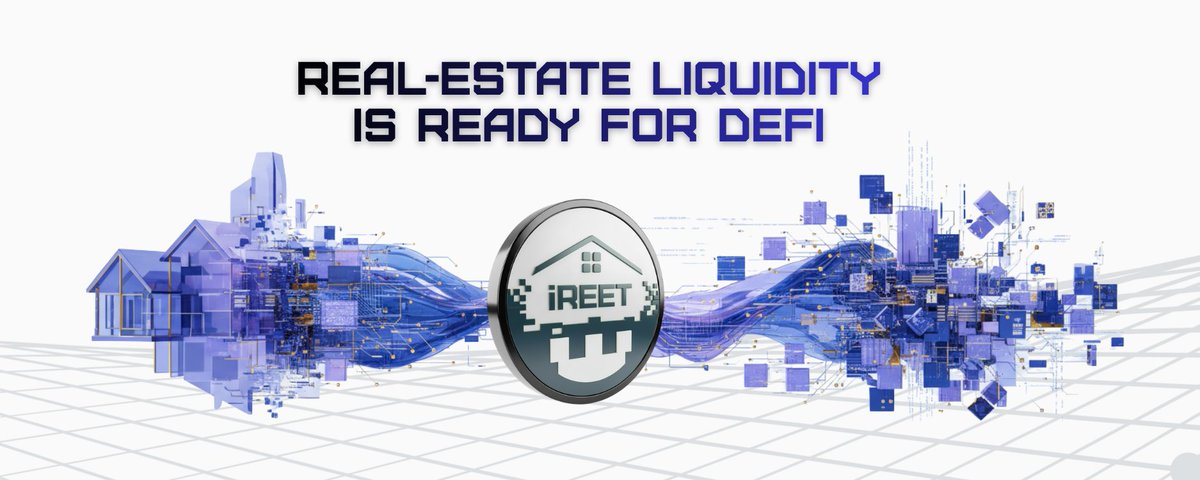 RAAC puts 16 rental properties onchain with $iREET launch, routing $34.5K/month in tenant income through Curve2026-04
 RAAC Mid-Month Yield Report is out👀2026-04
 RAAC opens $1.135M bond for tokenized real estate token $IREET, with 45-day lockup timed to RAACLend debut2026-04
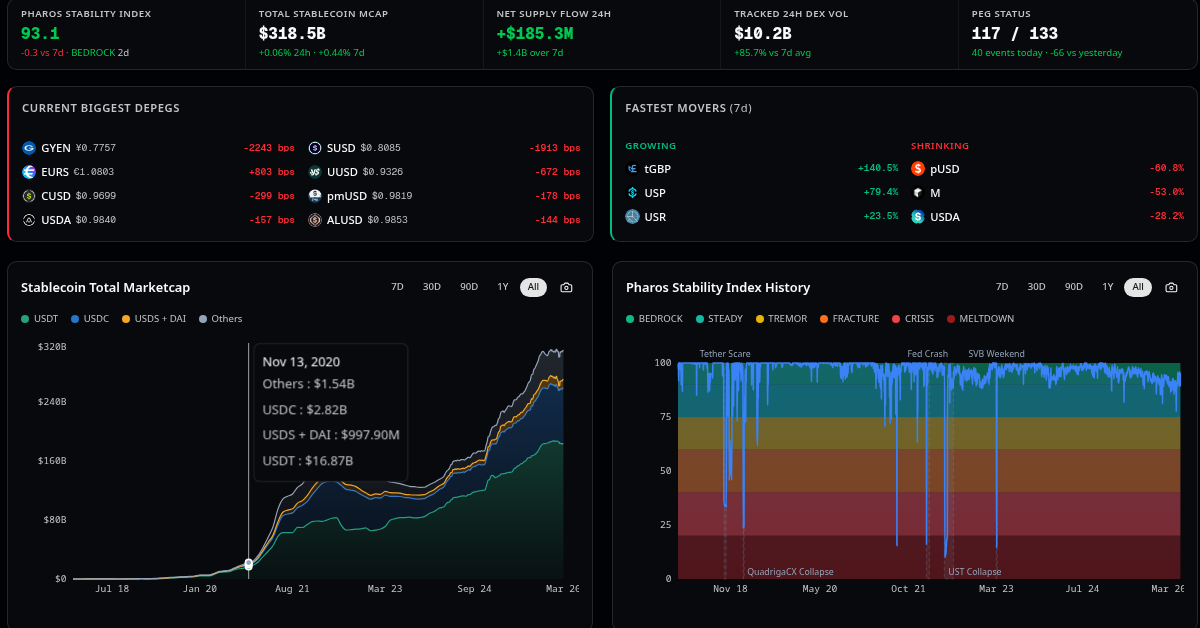 Every stablecoin carries risk. Pharos shows you exactly how much. Peg scores, safety grades, depeg alerts, yield data & on-chain liquidity for 145+ coins. Don't hold blind2026-03
 Tokenized Markets Are Fragmented.
SuperSwap Unifies Them.2026-03
Tokenized Markets Are Fragmented.
SuperSwap Unifies Them.2026-03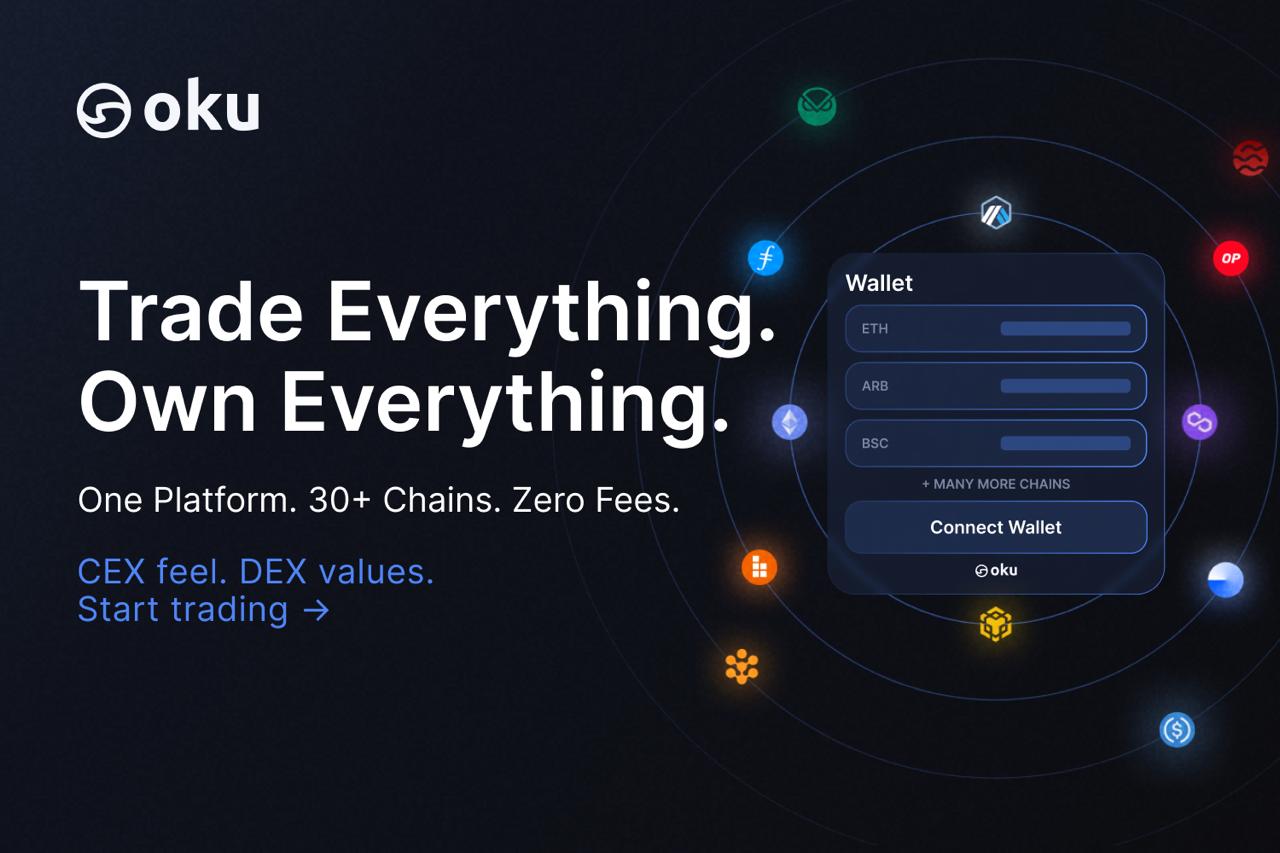 Professional grade trading with zero fees.
Now 10x faster after our latest upgrade.
If you're still settling for less, it's time to level up with oku.trade2026-03
Professional grade trading with zero fees.
Now 10x faster after our latest upgrade.
If you're still settling for less, it's time to level up with oku.trade2026-03
Squid Pass: Tokenized Advertising Rights In The Leviathan DeFi Ecosystem
A tokenized advertising credential, Squid Pass is an NFT-based access right that lets projects buy prominent media exposure across the Leviathan News ecosystem, paid for and allocated on-chain via auctions and SQUID incentives. Rather than treating ad inventory as off-chain contracts, Squid Pass turns attention into a programmable, composable asset that DeFi projects can bid for, trade, and incorporate into their broader treasury and growth strategies.
In practice, Squid Pass sits at the intersection of crypto media, DeFi token incentives, and on‑chain governance. It is issued and distributed through public auctions on Ethereum mainnet and centralized exchanges, with demand for passes linked to the visibility they confer on Leviathan News’ channels and partner outlets. The passes plug directly into the Leviathan Points token, SQUID, which functions as the reward and utility layer of the ecosystem and whose primary real-world use today is to unlock Squid Pass NFTs that allow advertising on Leviathan’s project channels. Around this nucleus, a wider constellation of tools and protocols has emerged: Squid DAO proposals coordinate periodic SQUID drops for contributors and participants, AI tools such as Squid Digest convert Leviathan’s coverage into actionable signals, and partners in the broader DeFi stack—from gold-backed stablecoin issuer RAAC to DePIN networks like AIOZ—compete for scarce attention through these tokenized ad rights. This explainer unpacks how Squid Pass works, how it relates to SQUID and Leviathan, and how it fits into a wider trend of turning media, marketing, and even research into transparent, on-chain markets for attention.
Defining Squid Pass In The Leviathan Ecosystem
At its core, Squid Pass is a non-fungible token that represents the right to a specific bundle of promotional benefits across the Leviathan News media network. In contrast to traditional ad buys negotiated off-chain between a project and a publisher, Squid Pass packages these rights into an NFT that can be auctioned, transferred, or held, with the details of issuance and ownership recorded on-chain. Leviathan’s own description of SQUID notes that the token’s primary utility is delivered through Squid Pass NFTs, which allow the holder to advertise on project channels, making the pass the main bridge between points-style rewards and tangible media exposure. This structure is deliberately simple: holders are not buying a security or a yield-bearing asset, but rather a time‑bounded right to reach Leviathan’s audience under transparent, predefined conditions.
The Leviathan brand itself spans daily news coverage, protocol deep dives, research partnerships, and community shows, so the value of Squid Pass is tightly linked to the reach and credibility of that media footprint. Leviathan already amplifies projects ranging from infrastructure providers such as Palliora—an infrastructure layer for private, verifiable compute at scale—to analytics and research shops like OAK Research, which offers long-form DeFi analysis and actionable data-driven insights. By tokenizing ad inventory, the Squid Pass model allows participants in this broader ecosystem to compete for exposure through an open, market-based process rather than relying solely on off-chain relationships or opaque ad pricing. For earlier-stage protocols, this can democratize access to visibility; for Leviathan, it aligns editorial, community, and revenue incentives with the SQUID token economy.
It is important to distinguish this crypto-native Squid Pass from unrelated products that share a similar name in gaming and entertainment. For instance, Fortnite’s community has seen a “Squid Game Tycoon VIP Pass,” where players unlock in-game progression benefits by entering a numeric code, but this concept is entirely separate from Leviathan’s on-chain advertising NFT and has no connection to SQUID or DeFi. Clarifying that distinction helps avoid confusion for newcomers who may encounter multiple “Squid” branded products across games, tokens, and NFTs. In the context of this explainer, Squid Pass refers exclusively to the NFT-based advertising instrument associated with Leviathan News and the Leviathan Points (SQUID) ecosystem.
From a design perspective, Squid Pass is best understood as a media primitive rather than a speculative collectible. The pass encodes service rights rather than pure scarcity, and its economic value is derived from the downstream marketing performance it can unlock for protocols that secure it in an auction. In that sense, Squid Pass occupies a different niche than art NFTs or gaming assets: the closest analogue in traditional finance would be tokenized ad credits or auctioned billboard slots, but here those rights are verifiable, transferable, and potentially integrable with other DeFi positions. Understanding how this works requires looking at both the technical and economic design underpinning the pass.
From Crypto Newsfeed To On‑Chain Media Primitive
Leviathan News did not emerge in a vacuum; it sits within a growing universe of on-chain trading, lending, and infrastructure protocols that increasingly compete not only for liquidity and users, but for narrative attention. Coverage spans tokenized real-world assets like RAAC’s gold-backed stablecoin pmUSD, which is fully collateralized by gold-reserve-backed securities from I-ON Digital Corp and pegged to one U.S. dollar, as well as RAAC’s tokenized real-estate bonds such as iREET. It also includes cross-chain trading venues, lending platforms, and infrastructure stacks like AIOZ Network’s DePIN-powered content distribution chain, which blends decentralized storage, streaming, and AI compute to serve media applications. In such an environment, the opportunity cost of being invisible can be higher than the cost of capital itself.
Tokenizing ad inventory via Squid Pass responds to this structural reality. Rather than Leviathan privately negotiating recurring sponsorships, a portion of its most visible inventory—such as pinned posts, Twitter/X threads, or newsletter placements—can be allocated to the winners of Squid Pass auctions. The rights conferred by the pass are finite but renew over time as new passes are minted for subsequent periods, creating a predictable supply of media attention that can be priced by the market. Because the underlying asset is media exposure rather than financial yield, the product remains conceptually aligned with advertising rather than being repackaged as a pseudo-security.
A second motivation for the Squid Pass model is community participation. SQUID, the Leviathan Points token, functions as a reward currency distributed across various community behaviors, including engagement with content, contributions to governance, or participation in DAO initiatives. By tying pass utility to SQUID and enabling points to be converted into or used alongside Squid Pass NFTs, Leviathan can reward its most engaged users with discounted or preferential access to advertising rights. This can be particularly valuable for grassroots or early-stage teams that are highly embedded in the ecosystem but lack large cash treasuries.
Squid Pass Versus Other “Squid” Brands
The crypto industry has seen multiple “Squid”-branded tokens and projects, some of which have been controversial or short-lived. Leviathan Points (SQUID) is distinct in both purpose and structure. LBank’s asset page describes SQUID as the reward foundation of the Leviathan ecosystem, emphasizing that its primary use is via Squid Pass NFTs that enable advertising on project channels, and noting that SQUID is positioned as the predecessor to SQUILL, a planned governance token. Price-tracking services such as Coinbase and CoinGecko list Leviathan Points under the ticker SQUID, recording a relatively modest market capitalization and low daily trading volume relative to major DeFi blue chips, underscoring its positioning as a community reward and utility token rather than a speculative mega-cap asset.
By explicitly anchoring SQUID’s main utility to Squid Pass, Leviathan diverges from purely speculative meme tokens that lack clear, measurable use cases. The token exists to grease the wheels of a specific set of media and advertising workflows, with value ultimately flowing toward the performance and scarcity of media slots rather than arbitrary narratives. This focus helps the project maintain a durable north star even as market conditions shift. It also provides a clear conceptual distinction from game-oriented “Squid” passes, such as the aforementioned Fortnite “Squid Game Tycoon VIP Pass,” which lives entirely within a proprietary game economy and does not interact with on-chain finance.

Flex, an upcoming choose-your-fixed-rate lending market, being built by our Leviathan News contributor johnnyonline, on his show "Vibe Building", explained in a simple way


Since I'm a dummy, let me learn 😅
Architecture: NFTs, Rights, And Incentive Design
Squid Pass is implemented as an NFT contract that binds together three critical elements: the issuance schedule of passes over time, the concrete benefits associated with each pass, and the on-chain record of ownership and redemption. Although implementation specifics can evolve, the basic architecture reflects how NFTs have matured from static images to programmable containers of rights. Where early NFT projects focused primarily on digital collectibles, Squid Pass exemplifies a class of NFTs where real-world or off-chain services are gated by ownership of a tokenized credential.
The rights embedded in a Squid Pass can include advertising placements across Leviathan’s channels, such as pinned posts on social platforms, newsletter features, or spots in special research series. Leviathan’s own communications around SQUID describe Squid Pass NFTs as permitting advertising within project channels, which suggests that the contract’s metadata must at least specify the scope and time window during which the holder can exercise those rights. This can be implemented either as one-off passes tied to specific campaigns or as longer-dated season passes that entitle the holder to recurring placement over a period. In either case, the value of the pass is grounded in Leviathan’s reach and the responsiveness of its audience to the content being promoted.
From an incentive-design standpoint, tying ad rights to NFTs introduces several beneficial properties compared with off-chain ad sales. First, ownership becomes composable: the pass can be transferred between wallets, potentially resold on secondary markets, or even held in multisig or DAO treasuries. Second, pricing can be discovered transparently through auctions, removing some of the opacity around how ad prices are set. Third, the pass can serve as an anchor for further experimentation, such as allowing protocols to collateralize their future visibility or to allocate passes to community members as part of a broader go-to-market strategy.
The fact that Squid Pass is tightly coupled to SQUID also matters. Leviathan Points function as the reward layer of the ecosystem, with periodic SQUID drops allocated via DAO proposals such as the February 2026 distribution that covered January’s activities. When these points can be routed into Squid Pass, either by purchasing passes directly or by participating in auctions where SQUID plays a role, the system creates a feedback loop: projects and individuals that meaningfully contribute to Leviathan’s success accumulate more SQUID, which improves their ability to secure future media exposure through passes. In this way, Squid Pass is as much an incentive design tool as it is an ad product.
Tokenizing Attention And Ad Inventory
In economic terms, Squid Pass tokenizes attention. Media outlets have always monetized attention by selling access to their audience to advertisers, but that access has usually been governed by bilateral contracts, rate cards, and long-term sponsorships. By contrast, Squid Pass wraps discrete units of exposure into NFTs and supplies them via auctions and programmatic allocation. The underlying resource being traded is still attention, but the form of the contract is now programmable, tradable, and subject to on-chain governance.
This tokenization is analogous to trends in other parts of DeFi. In credit markets, protocols like Ratehopper offer an autonomous refinancing layer that continuously monitors borrowing positions across lending platforms and optimizes refinancing, effectively tokenizing the right to lower interest rates and automating that process. In real-world asset markets, RAAC tokenizes gold and real estate into instruments like pmUSD and iREET, turning off-chain income streams and collateral into ERC‑20 tokens and bond primitives. Squid Pass applies the same principle to media: the scarce off-chain resource is reader attention, and it is converted into an on-chain asset that reflects the right to tap that resource under certain conditions.
One advantage of this approach is that it aligns the pricing of attention with market conditions. During periods when DeFi innovation is intense and projects compete fiercely for user mindshare—such as when new tokenized asset venues like SuperSwap launch to unify fragmented markets, or when leveraged tokens debut on venues like Hyperliquid—demand for ad slots can surge. Conversely, during quieter market phases, lower auction clearing prices for Squid Passes can offer cost-effective entry points for projects that are building during the downturn. The auction mechanism gives both buyers and the publisher a real-time signal about the marginal value of an incremental unit of attention.
Integration With Leviathan Points (SQUID)
SQUID, the Leviathan Points token, underpins much of the Squid Pass economy. According to LBank’s description, SQUID serves as the basic reward currency for the ecosystem, provides utility primarily through Squid Pass NFTs, and is intended as a precursor to SQUILL, a governance token slated for a future launch. Price trackers show SQUID trading at low absolute levels with modest daily volumes, with a circulating supply around tens of millions of tokens and a correspondingly small market capitalization, reinforcing its role as a community reward token rather than a large-cap DeFi asset.
A central design choice in the ecosystem is to keep most of SQUID’s concrete utility tied to Squid Pass. This avoids the trap of inventing artificial “token sinks” that do not correspond to real needs. When a protocol wants to advertise via Leviathan, it can participate in Squid Pass auctions that may accept a mix of assets such as WETH or crvUSD, but SQUID can also be used in ecosystem incentive programs, drops, or discounts associated with passes. For example, the February 2026 SQUID Drop described how auctions on Ethereum mainnet generated strong bidding demand, and encouraged community members to spread awareness of Squid Pass, suggesting an interplay between the token’s distribution and the visibility of the pass product itself.
In the longer term, the planned SQUILL governance token may absorb some of SQUID’s governance functions while leaving the latter as a more purely utility and reward token. This separation could mirror patterns elsewhere in DeFi, where one token manages protocol control and another functions as a points or loyalty asset. In any case, Squid Pass remains the key place where SQUID intersects with concrete economic output, namely the allocation of media exposure.
Readers click Squid Pass content not for token speculation but to discover which projects are willing to put real $SQUID on the line to reach a self-selected DeFi power-user audience — the auction winner reveal is the signal, not the ad copy itself.
Distribution: Auctions, Drops, And Secondary Markets
The primary mechanism for distributing Squid Pass appears to be auctions, held both on Ethereum mainnet and, in some cases, through centralized exchange infrastructure. Leviathan News hosted a live Squid Pass 2024 NFT auction on mainnet, where community members bid in real time for the first pass of the year. The auction format not only discovered the market price for the pass, but also served as a community event that deepened engagement, with commentary and live reactions as bids escalated before a winner emerged. This format exemplifies how auctions can be both market mechanisms and social rituals in crypto communities.
Gate, a centralized exchange, has also announced auctions for SQUID Pass, highlighting how CEXs are experimenting with hosting on-chain style NFT sales within their own interfaces. In a notice to users, Gate explained that a SQUID Pass auction would soon launch, that an early auction had been introduced, and that the bidding method had been updated in this iteration, signaling an evolving product design around how passes are sold. By offering auctions through a centralized exchange, Leviathan and its partners can reach users who may be more comfortable with centralized custody or who do not actively manage on-chain wallets, thus extending the reach of the Squid Pass concept beyond native DeFi power users.
On Ethereum mainnet, auctions for SQUID-related assets have been documented in governance updates and community posts. The February 2026 SQUID Drop summary references “Auction Stats” on mainnet and notes that bidding demand remained strong, underscoring sustained interest in ecosystem allocations even in volatile markets. While these auctions may distribute SQUID rather than passes directly, they contribute to the same incentive loop: tokens acquired through auctions can be deployed toward ecosystem activities, including future Squid Pass participation, and their pricing informs market expectations about the value of Leviathan-related rights.
Mainnet Auctions And Bidding Mechanics
Mainnet Squid Pass auctions typically accept payment in major DeFi assets such as wrapped Ether (WETH) or stablecoins like crvUSD, as indicated by Leviathan’s promotion of its first mainnet Squid Pass auction that supported bidding in WETH and crvUSD, with the promise of additional supported tokens in future events. These choices reflect the liquidity preferences of active DeFi users, who often hold their treasuries in base assets or widely used stablecoins rather than niche tokens. Settling auctions in blue-chip assets can also simplify the downstream accounting for both Leviathan and winning bidders.
From a mechanical standpoint, most NFT auctions follow either an English auction model, where bids ascend until no higher bids are placed, or a batch auction format, where multiple passes or slots are sold simultaneously at a uniform clearing price. The Leviathan Squid Pass 2024 auction was run as a live event, suggesting an ascending-bid format designed to encourage real-time competition for a single high-profile pass. As more passes are introduced—whether seasonal, thematic, or channel-specific—Leviathan could choose to expand into multi-unit auctions, where several passes are sold at once, potentially at different tiers of prominence.
The experience of running visible auctions also feeds back into the broader SQUID ecosystem. Auction results, such as closing prices and bid distributions, can be published to inform market participants about evolving valuations of Leviathan’s media inventory. Those metrics can, in turn, influence the design of future SQUID Drops, DAO proposals, or partnership packages. For example, if passes routinely clear at higher prices during periods when major DeFi launches cluster—such as when Curvance debuts lending on new L1s or when new gold-backed stablecoin strategies go live—Leviathan may adjust its issuance tempo to better match demand cycles.
CEX-Supported Auctions And Accessibility
The involvement of centralized exchanges like Gate in hosting SQUID Pass auctions points to a hybrid distribution model that blends on-chain and custodial rails. Gate’s announcement that a SQUID Pass auction would soon be launched, accompanied by references to “early auctions” and revised bidding methods, implies that the exchange sees value in offering curated, event-style NFT opportunities to its user base. For Leviathan and Squid Pass, this expands the potential buyer base to include users who primarily interact with crypto through CEX accounts rather than self-custodied wallets.
This dual-track approach raises interesting questions about custody, settlement, and utility delivery. On-chain, the Squid Pass NFT resides in a wallet that can directly sign messages or interact with Leviathan’s systems to claim advertising rights. In a CEX context, the pass may initially be held by the exchange on behalf of the user, requiring either withdrawal to a self-custodied address or an off-chain process where the exchange and Leviathan coordinate to map exchange account IDs to pass benefits. Over time, competition between on-chain and CEX distribution could influence where most of the liquidity and price discovery for Squid Pass resides.
Accessibility via exchanges also speaks to a broader theme of “DeFi marketing meets CeFi distribution.” The same audience that might trade gold-backed stablecoins like pmUSD on Curve or hold tokenized real-estate bonds like iREET in DeFi portfolios can be reached via Leviathan’s coverage and Squid Pass-enabled campaigns, while more exchange-centric traders can discover these assets via CEX-hosted auctions and listings. Squid Pass sits at the nexus of these two worlds, using NFT mechanics to bridge them.
SQUID Drops And Community Allocation
Beyond auctions, the SQUID ecosystem periodically allocates tokens through community-focused distributions governed by Squid DAO proposals. The February 2026 SQUID Drop proposal on Goverland describes a distribution covering January’s activities and refers readers to a detailed blog post for granular breakdowns of allocations. Although these drops primarily concern SQUID token distribution, they are integral to the Squid Pass story because they determine who in the community accumulates the points that can later be leveraged for media access.
These distributions often reward behaviors that increase the overall value of Leviathan’s ecosystem: producing research, building tools like Squid Digest, participating in governance, or contributing to protocol integrations. By funneling more SQUID toward those who build, the system increases the likelihood that future Squid Pass holders will be teams and individuals with a deep stake in the ecosystem’s success, rather than purely external speculators. That alignment of values can enhance the quality of the campaigns run through Squid Pass, as projects that earned their way into visibility are more likely to be substantive and long-term–oriented.
Secondary markets for SQUID and, potentially, Squid Pass NFTs add another dimension. SQUID tokens are tracked on services like Coinbase and CoinGecko, and traded on exchanges including LBank, giving them a liquid if modestly sized marketplace. Should Squid Pass NFTs themselves gain secondary liquidity, bidders who win an auction could, in principle, resell passes to other projects that value the specific time window or channel exposure more highly. This would further deepen the financialization of attention, but it would still be anchored in the real-world utility of media rights.
The SQUID Token: Points, Rewards, And Governance
To fully grasp Squid Pass, one must understand SQUID as the substrate on which the pass model is built. Leviathan Points, ticker SQUID, function as the ecosystem’s reward foundation, as emphasized in LBank’s description, which notes that SQUID’s utility is provided via Squid Pass NFTs and that SQUID is positioned as the precursor to a forthcoming governance token called SQUILL. This framing situates SQUID in the growing category of “points tokens,” which capture user engagement and contribution in a form that can later be redeemed for utility or governance.
Price and liquidity data from tracking sites illustrate SQUID’s scale. Coinbase’s price page for Leviathan Points reports a small market capitalization on the order of tens of thousands of dollars and a 24‑hour trading volume in the low thousands of dollars, reflecting a thinly traded token largely held by community participants rather than speculative whales. CoinGecko similarly records SQUID’s price and volume, estimating a circulating supply of roughly 25 million tokens and valuing the asset at a fraction of a single bitcoin in aggregate market cap. These figures imply that SQUID is not yet a major speculative instrument, which is consistent with its role as a utilitarian reward currency embedded in a specific media ecosystem.
Leviathan Points As Reward Layer
The reward function of SQUID is evident in DAO governance and distribution patterns. The February 2026 SQUID Drop proposal on Goverland outlines how SQUID is periodically distributed to community members, with the off-chain vote supporting a distribution that covered the prior month’s contributions. The accompanying Substack blog post (referenced in the proposal) offers a detailed breakdown of allocation categories, ranging from contributors to governance participants, though the snippet emphasizes that auction demand for SQUID remained strong throughout the period. This dual approach—combining earned distributions with auction-based sales—helps both decentralize the token supply and discover market prices.
In practical terms, SQUID functions as a point system that accrues to those who engage with Leviathan’s content, tools, and governance. For example, community developers have built Squid Digest, an AI-powered daily digest generator that fetches top crypto and tech headlines from Leviathan News’ API, processes them through language models, and publishes the results to Ghost CMS, with the project explicitly described as “built by SQUID pirates for the crypto seas.” Such tools enhance the value of Leviathan’s information flows and are likely candidates for SQUID rewards through DAO processes, illustrating how the token incentivizes ecosystem-level infrastructure.
Token Utility Via Squid Pass
The utility of SQUID crystallizes when it is linked to Squid Pass. LBank’s description makes explicit that SQUID’s utility is implemented via Squid Pass NFTs that allow advertising on Leviathan project channels, positioning the pass as the primary venue for token redemption. A project with a significant SQUID balance can decide whether to deploy those tokens in auctions to secure passes, to hold them as a bet on future SQUILL governance conversion, or to distribute them to community members as part of ambassador programs that may also involve Squid Pass usage.
The interplay between SQUID and Squid Pass can be viewed through the lens of “marketing mines.” Just as liquidity mining programs reward users with tokens for providing capital to DeFi protocols, Squid Pass, backed by SQUID rewards, incentivizes projects to invest in higher-quality content and long-term relationships. A protocol that wins a Squid Pass auction may choose to allocate a portion of its marketing budget not only to the auction but also to distributing SQUID to its own users, to encourage joint participation in Leviathan’s community and governance. This creates multi-layered network effects around content, capital, and participation.
Path Toward SQUILL Governance
The planned introduction of SQUILL as a governance token adds another axis to the ecosystem’s design. Although details may still be under discussion, the high-level vision appears to be a separation of powers: SQUID as the utility and reward layer, SQUILL as the formal governance instrument. This is reminiscent of structures in other DeFi protocols where governance tokens control protocol parameters, treasury allocations, and strategic direction, while separate tokens or points track usage, loyalty, or rewards.
In a mature version of this system, Squid Pass could be influenced by both tokens. SQUID balances might determine access to or discounts on passes, while SQUILL holders could vote on how many passes are issued per period, which channels they cover, and what eligibility criteria advertisers must meet. Governance decisions could also address whether certain categories of projects—such as those dealing with highly speculative memecoins or unvetted leverage platforms—are excluded or subject to enhanced scrutiny before they can acquire Squid Passes. In this way, SQUILL governance would help safeguard Leviathan’s editorial and reputational integrity even as ad rights are allocated via market mechanisms.

Leviathan News hosts first Squid Pass auction on mainnet. Bid now using WETH, crvUSD, with more tokens to come soon™️
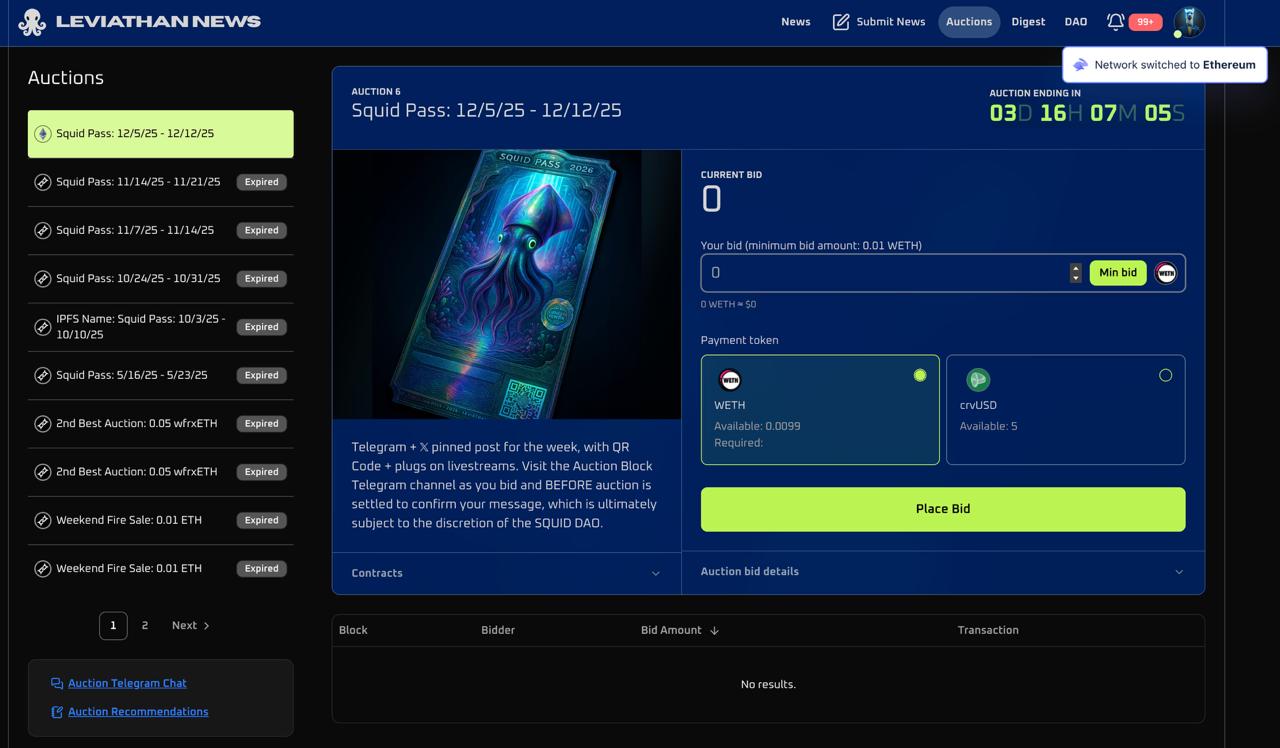

wen Squid
Squid Pass In A DeFi And DePIN Media Stack
Squid Pass does not exist in isolation; it functions within a layered stack of infrastructure, protocols, and analytics that collectively form the DeFi media and attention economy. At the base, networks like Ethereum provide settlement for NFTs and tokens. On top of that, DePIN systems such as AIOZ Network aim to decentralize core infrastructure for media distribution, including storage, streaming, and AI computation. Further up, DeFi protocols like RAAC’s pmUSD and iREET, lending markets like Curvance, and credit optimizers like Ratehopper power capital flows. At the apex sits media, research, and analytics—Leviathan, OAK Research, tools like Pharos for stablecoin risk assessment, and signal generators like Squid Digest.
In this architecture, Squid Pass is a coordination tool between capital and narrative. A project like RAAC can tokenize a gold-backed stablecoin with pmUSD, deploy it into Curve pools, and accumulate tens of millions of dollars in TVL while offering attractive yields to participants, as highlighted in recent coverage that notes pmUSD’s rapid growth and double-digit yield opportunities. Yet without sustained media coverage and education, many potential users may remain unaware of how the product works or how its risk profile compares to other stablecoins. By securing a Squid Pass, RAAC or similar issuers can sponsor deep dives, AMAs, or explanatory threads across Leviathan’s channels, ensuring that their complex products are understood by the right audience.
Content Distribution And Decentralized Infrastructure
AIOZ Network exemplifies the DePIN layer that underpins decentralized media. The platform positions itself as a blockchain-based network that revolutionizes content distribution through decentralized technology, leveraging a global network of distributed nodes to provide web3 storage, AI computation, and streaming services for dApps. In this model, rather than content being hosted and delivered from centralized servers, it is served by a decentralized physical infrastructure network, increasing resilience and potentially reducing costs. For media outlets like Leviathan and projects advertising through Squid Pass, DePIN infrastructure can serve as the backend for hosting videos, podcasts, or interactive dashboards.
The synergy between DePIN and tokenized media rights is subtle but powerful. If AIOZ or similar networks succeed in making decentralized media hosting more performant and cost-effective, Squid Pass campaigns could evolve from static banner placements into rich, multi-format experiences that live entirely on decentralized infrastructure. A Squid Pass holder could, for instance, host an educational series about its protocol on AIOZ-powered streaming, with the promotion and discovery layer orchestrated via Leviathan and paid for via Squid Pass auctions. This would move the entire lifecycle of advertising—from creative asset hosting to user acquisition tracking—closer to a fully on-chain, decentralized stack.
Case Study: AIOZ Network And DePIN For Web3 Media
AIOZ’s design choices illustrate why decentralization in media infrastructure matters for products like Squid Pass. By leveraging a DePIN architecture, AIOZ distributes tasks such as video transcoding, storage, and delivery across a global network of nodes, which are incentivized via the AIOZ token. This makes it harder for any single actor to censor or degrade content and could improve latency and reliability for users distributed across many geographies. For advertisers using Squid Pass, this means that their campaigns can be hosted in a censorship-resistant manner, aligning with the broader ethos of trustless and permissionless systems that underpins DeFi.
Decentralized infrastructure also interacts with cost structures. If DePIN networks can undercut centralized cloud pricing, the marginal cost of running rich media campaigns decreases, allowing projects to allocate a larger portion of their budget toward securing high-visibility Squid Passes rather than paying for hosting. In an environment where marketing budgets must be carefully balanced against protocol incentives, fees, and liquidity mining, such savings could be material. Over time, one could imagine Squid Pass evolving to explicitly favor campaigns that make use of decentralized hosting, further reinforcing the DePIN thesis.
Real-World Assets, Gold, And Stablecoin Coverage
Real-world asset protocols like RAAC are natural beneficiaries of Squid Pass–enabled media. RAAC’s pmUSD is positioned as a fully backed, gold-collateralized stablecoin pegged at one U.S. dollar, with backing provided by ION.au gold-reserve-backed securities from I-ON Digital Corp. RAAC has launched pmUSD bonds that allow participants to deposit USDT, USDC, or ETH to receive pmUSD after a lock-up period, signaling a hybrid between fixed-income and stablecoin issuance. The firm has also explored tokenizing real estate via iREET bonds backed by rental properties, with tweets highlighting multi-million dollar bond offerings for real estate-backed tokens. These products are complex, cross-cutting traditional finance and DeFi.
For such issuers, visibility is crucial. Squid Pass permits them to reach an audience already primed for nuanced discussions around yield, risk, and collateral quality, as evidenced by Leviathan’s coverage of tools like Pharos, which evaluates stablecoin risk via peg scores, safety grades, depeg alerts, and on-chain liquidity analytics. In addition, RAAC publishes yield reports, such as a May 2026 mid-month yield report detailing performance and market positioning, demonstrating an ongoing dialogue with investors about returns and risk. Through Squid Pass campaigns, RAAC can integrate these reports into broader narratives around portfolio construction, gold as a hedge, and the role of tokenized real-world assets in DeFi.
Squid Pass is also well suited to spotlight risk analytics platforms themselves. Pharos, for example, aims to quantify stablecoin risk, while tools like OAK Research provide long-form DeFi analyses and actionable signals. These services, which often monetize via subscriptions or institutional partnerships, derive value from a steady flow of informed users. By acquiring Squid Passes, they can ensure that their research and dashboards reach an audience that includes both individual DeFi participants and protocol teams, potentially creating virtuous cycles where better information leads to better capital allocation across everything from gold-backed stablecoins to leverage platforms.
Credit Markets, Leverage, And On-Chain Analytics
Beyond stablecoins and RWAs, Squid Pass intersects with a range of credit and leverage products that Leviathan covers. Ratehopper positions itself as a non-custodial, agentic system that automates refinancing and optimizes borrowing across autonomous debt markets, constantly monitoring positions and adjusting them to keep borrowing efficient. Lending platforms like Curvance, which recently launched with promises of higher capital efficiency, and upcoming fixed-rate markets like Flex, built by community contributors and explained via Leviathan’s “Vibe Building” show, all require sustained education if they are to avoid being used as pure speculative casinos.
Leveraged tokens launching on derivatives venues such as Hyperliquid, tokenized markets aggregators like SuperSwap that unify fragmented liquidity, and new trading frontends like oku.trade that promise zero-fee professional-grade trading, all vie for the attention of similar user segments. Squid Pass provides a structured way for these products to surface their key value propositions, with campaigns that can be tailored to emphasize unique features such as capital efficiency, compliance, or novel risk controls. Meanwhile, analytics around who clicks, trades, or follows up on Squid Pass–driven campaigns can feed back into both Leviathan’s editorial priorities and the advertisers’ understanding of their target audience.
- 01Weekly auction winner reveals↗
The highest-clicked content is consistently the winner announcement, treating Squid Pass as a weekly leaderboard where project credibility is staked publicly in $SQUID.
- 02AIOZ DePIN repeat campaigns↗
AIOZ ran multiple consecutive Squid Pass buys with an anti-centralization narrative, drawing repeat clicks as readers tracked whether the message evolved — a case study in auction-native brand building.
- 03DeFi yield product launches
Rings Protocol, yBOLD, and Bearn each used Squid Pass as a cold-launch surface for new yield products, and readers clicked to evaluate whether the yield numbers were real.
- 04Auction price vs. audience value↗
The framing of 'under $4 to reach $50MM in DeFi power users' made the cost-per-impression angle itself the news, pulling in clicks from projects evaluating the buy.
- 05RWA and stablecoin ad campaigns↗
RAAC's pmUSD and the Open Stablecoin Index used Squid Pass for protocol launches, signaling that RWA issuers see crypto-native ad rails as a credibility signal, not just reach.
- 06Community governance tie-in↗
The $SQUID bidding mechanism connects ad spend directly to DAO token utility, and readers engaged with the question of whether auction winners gain governance-adjacent influence.
Community, Governance, And Data: Building Around Squid Pass
An essential dimension of Squid Pass is its embedding in a broader community and governance landscape. Squid DAO, whose proposals are visible on governance platforms like Goverland, has a say in how SQUID is distributed and how the ecosystem evolves. The February 2026 SQUID Drop proposal, for instance, references detailed blog posts and encourages community input on allocation frameworks, underscoring that token distribution is not simply dictated by a central team. This participatory governance model extends to discussions about Squid Pass issuance, eligibility, and future functionality.
Leviathan’s community spans multiple platforms, including Twitter/X, Discord, and Telegram. While not all Leviathan-branded channels are explicitly crypto-related—some, such as a “Leviathan Manhwa” Telegram channel, focus on manhwa content and highlight the brand’s broader cultural footprint—the ecosystem at large reflects the multi-platform nature of crypto communities. In this context, Squid Pass can be seen as a cross-platform access right: a single on-chain credential that crystallizes into visibility across social channels, newsletters, and possibly Telegram announcements or AMAs, depending on how each campaign is structured.
Squid DAO And Governance Proposals
Governance over SQUID and Squid Pass is still evolving, but the existence of formal proposals and off-chain votes demonstrates a trajectory toward more decentralized decision-making. The February 2026 SQUID Drop proposal, for example, describes a distribution covering contributions in January and points readers to a Substack blog post for granular detail on categories and recipients. This combination of high-level on-chain voting and off-chain narrative explanation mirrors governance patterns in many DeFi protocols, where formal votes capture the final decision and accompanying essays provide context.
As Squid Pass becomes more central to how Leviathan monetizes its platform and coordinates ecosystem partners, governance will likely play a greater role in setting the rules of the game. Key governance questions include how many passes should be issued per period, whether certain passes should be reserved for community or non-profit initiatives, and what standards advertisers must meet to qualify. For instance, governance might decide to limit access for highly speculative products that do not meet basic transparency standards, such as having clearly documented tokenomics or audited smart contracts. These decisions will shape Squid Pass’s reputation and, by extension, its long-term economic value.
Newsletters, Research, And AI-Assisted Signals
Content pipelines around Leviathan extend beyond news articles to research partnerships and AI-enhanced tools. OAK Research, for instance, provides long-form analyses and data-driven DeFi insights, offering both free and premium content. Leviathan has highlighted OAK’s work and even promoted discount codes for OAK Premium, indicating an integrated ecosystem where media, research, and advertising intersect. Squid Pass campaigns can promote such research services, while the research itself informs readers’ understanding of projects that might be advertising through Squid Pass.
Squid Digest, the AI-powered daily digest generator, adds another layer of sophistication. By fetching top crypto and tech headlines from Leviathan’s API, processing them with large language models, and publishing them to Ghost CMS, Squid Digest turns the firehose of information into structured summaries and even trading signals. Described as a “living experiment in AI-assisted trading signal generation,” it provides one example of how AI tools can sit downstream of media but upstream of trading decisions. Advertisers using Squid Pass may find that their campaigns are not only seen directly but also indirectly influence AI-curated digests and signals, amplifying their reach.
Social Channels And Grassroots Discovery
Crypto communities are inherently social, and platforms like Telegram, Twitter/X, and Discord remain central to how narratives spread. Leviathan’s ecosystem taps into these channels both for content distribution and community building. Telegram channels with names like “Leviathan Manhwa” illustrate how branding can spill over into adjacent cultural spaces, attracting users who may later cross-pollinate into DeFi conversations. Twitter/X threads, Spaces, and cross-posts with partner protocols deepen engagement.
In this milieu, Squid Pass operates as a discovery accelerator. A project that secures a Squid Pass can coordinate a multi-pronged campaign: a written explainer on Leviathan’s site, a Twitter/X thread, an AMA or Spaces session, and mentions in AI-powered digest tools. The pass ensures that these touchpoints are scheduled and executed within a defined window, providing the advertiser with a predictable bundle of exposure. Over time, community members learn to recognize Squid Pass–backed campaigns as signals worth investigating, especially if governance and curation ensure that only projects meeting certain quality thresholds are allowed to advertise.
Economic Considerations: Pricing Attention On-Chain
The economics of Squid Pass revolve around a simple but profound question: how much is attention worth when priced on-chain? Traditional digital advertising markets answer this through opaque auctions run by centralized platforms, where advertisers bid on keywords, audiences, or placement slots. Squid Pass instead offers a more transparent and community-driven structure, where passes representing bundles of exposure are auctioned off in discrete events, and the resulting clearing prices can be observed by all.
Several factors influence the value of a Squid Pass. The first is the reach and engagement of Leviathan’s channels during the period covered by the pass. If Leviathan’s content is being widely shared, cited by other outlets, or integrated into tools like Squid Digest, the effective audience size and attention intensity increase, making passes more valuable. The second is the competitive landscape of advertisers: when multiple high-profile protocols—say, a new RAAC product, a major AIOZ update, and a cutting-edge leverage platform—are all launching around the same time, bidding pressure in Squid Pass auctions is likely to rise. Third, macro market conditions, such as bull versus bear cycles, influence how much of a protocol’s treasury it is willing to allocate to marketing versus liquidity incentives.
From the advertiser’s perspective, a Squid Pass outlay competes with other budget items such as liquidity mining, trading fee rebates, or user referral programs. A project building a gold-backed stablecoin like pmUSD must weigh whether spending on Squid Pass campaigns yields a higher return in terms of TVL and user trust than alternative strategies like offering higher yields or integrating with additional DeFi protocols. Similarly, a leverage platform or DEX aggregator like SuperSwap would compare the cost of securing a Squid Pass to sponsoring trading competitions, paying for influencer coverage, or investing in UI/UX improvements.
Valuing An Advertisement NFT
One way to conceptualize the value of a Squid Pass is to estimate the expected incremental cash flows generated by the campaign it enables. If a protocol can measure how many new users, deposits, or transactions result from a Squid Pass–backed campaign, and assign an expected net present value to those flows, it can derive an internal maximum bid. In practice, measuring such attribution is challenging, but frameworks from performance marketing can be adapted. Over time, empirical data from multiple Squid Pass campaigns across protocols will help refine these models.
The table below sketches a conceptual comparison between three different types of tokens or assets that might appear in Leviathan’s coverage and Squid Pass campaigns: SQUID, pmUSD, and AIOZ. The goal is not to fix exact valuations, which fluctuate, but to highlight their differing roles.
| Asset | Primary Function | Backing / Collateral | Core Utility In Ecosystem |
|---|---|---|---|
| SQUID (Leviathan Points) | Reward and utility token for Leviathan ecosystem | Not explicitly collateralized; issued via drops and auctions | Powers Squid Pass NFTs that allow advertising on project channels; precursor to SQUILL governance token |
| pmUSD (RAAC) | Gold-backed stablecoin pegged to 1 USD | Collateralized by ION.au gold-reserve-backed securities from I-ON Digital Corp | Acts as a stable medium of exchange and yield-bearing asset in DeFi; used in bonds and liquidity pools |
| AIOZ | Token of AIOZ Network DePIN | Backed by network demand for storage, streaming, and AI compute tasks | Incentivizes nodes in decentralized content distribution and AI infrastructure for web3 media |
This comparison underscores that Squid Pass sits at the junction of very different asset types: speculative-reward tokens like SQUID, collateral-backed stablecoins like pmUSD, and infrastructure tokens like AIOZ. Campaigns funded or advertised through Squid Pass must speak to audiences who allocate capital across this spectrum. The ability to price a Squid Pass appropriately therefore depends on understanding how these diverse assets compete and complement each other in portfolios.
Liquidity, Volatility, And Treasury Management
Treasury management adds another wrinkle to Squid Pass economics. Many protocols hold their treasuries in a mix of native tokens, blue-chip assets like ETH, and stablecoins. Tools like Ratehopper help optimize borrowing and refinancing, ensuring that treasuries can access leverage at competitive rates without constant manual intervention. Meanwhile, RAAC’s gold-backed pmUSD offers an alternative to dollar-only stables, giving treasuries exposure to tokenized gold with a stablecoin wrapper. In this landscape, deciding which asset to use for Squid Pass auctions becomes non-trivial.
If Squid Pass auctions accept multiple payment assets, protocols may choose to spend from their most volatile holdings to preserve stablecoin reserves, or conversely to deploy stablecoins if they consider their native token undervalued. Market volatility influences these decisions: in bull markets, spending a small percentage of a rapidly appreciating treasury on Squid Pass campaigns may be easier to justify than in bear markets, when every dollar of runway is precious. Governance around Squid Pass auctions could also decide to accept certain “preferred” assets, such as pmUSD or other blue-chip stablecoins, to support ecosystem partners and reduce exposure to volatile tokens.
Comparing With Alternative Marketing Approaches
Squid Pass exists alongside other marketing options. Protocols can pay for banner ads on crypto news sites, sponsor Twitter Spaces, partner with influencers, or rely on organic community evangelism. Each channel has different costs, attribution challenges, and reputational implications. Squid Pass differentiates itself by bundling multiple types of exposure within a single, verifiable NFT and by anchoring its allocation to transparent auctions rather than bespoke sales negotiations.
However, Squid Pass is not a panacea. It may not be the most efficient channel for hyper-targeted campaigns that require fine-grained control over audience segments or for protocols that prefer to operate in stealth. Its value is greatest for projects that want to signal legitimacy by associating with Leviathan’s brand and that can benefit from being embedded in editorial narratives, research reports, and AI-curated digests. For such projects, a Squid Pass campaign can be part of a multi-channel strategy that includes TVL incentives, referrals, and integrations with other protocols like SuperSwap, Curvance, or RAACLend.

Feel good using Resupply? That’s by design


TL;DR: Ionut Nechifor, Resupply’s UI/UX designer, crafted the protocol’s visual identity and the iconic hippo mascot. His philosophy blends clarity, usability, and emotional connection, turning complex DeFi mechanics into approachable, intuitive interfaces. Drawing on traditional sketching, vector graphics, and game-inspired aesthetics, he emphasizes simplicity, trust, and storytelling in design. Currently, he’s developing Forma, a modular UI kit for Web3 designers, aiming to streamline professional UI creation with optional AI-powered features.
Risks, Challenges, And Regulatory Dimensions
Like any innovation at the intersection of media and finance, Squid Pass carries risks and faces constraints. At the technical level, the smart contracts implementing Squid Pass must be audited and carefully designed to prevent vulnerabilities such as unauthorized minting, metadata manipulation, or logic bugs in auction settlement. Although NFTs are now a mature standard, each new contract and auction mechanism introduces potential attack surfaces. Leviathan and Squid DAO must therefore invest in security practices commensurate with the value passing through Squid Pass auctions.
Platform risk is another concern. Squid Pass derives almost all of its economic value from Leviathan’s continued operation and reputation. If Leviathan’s audience were to shrink or if the outlet were to lose credibility due to poor editorial choices or security incidents, the value of Squid Pass would correspondingly decline. This is akin to “key person risk” and “brand risk” in traditional media businesses, but tokenization amplifies the impact because it can create liquid markets where sentiment shifts quickly translate into price volatility. Governance via SQUILL may mitigate some centralized decision risk, but it cannot fully hedge against exogenous shocks.
Regulatory questions hover over the entire space. While Squid Pass is conceptually an advertising contract, regulators could scrutinize its structure to determine whether it functions in practice as an investment contract in certain jurisdictions. For example, if Squid Pass is widely traded on secondary markets and marketed primarily as an appreciating asset rather than an ad utility, regulators might argue that it should be treated as a security. Leviathan and Squid DAO will likely need to navigate disclosures, terms of use, and possibly KYC/AML requirements in some contexts, particularly if CEX partners like Gate list Squid Pass or associated tokens for wider retail participation.
Finally, advertising ethics and responsibility come into play. Even if Squid Pass is legally an ad product, Leviathan must decide what categories of projects to accept. Promoting high-risk instruments such as highly leveraged tokens, untested lending protocols, or opaque investment schemes could expose users to unacceptable risks. This is particularly salient in a DeFi landscape where every stablecoin carries some risk, as Pharos-style analytics emphasize, and where even gold-backed stablecoins require scrutiny of collateralization, governance, and legal frameworks. Striking a balance between open, market-based allocation of ad slots and editorial responsibility will be an ongoing governance challenge.
February 2026 SQUID drop distributed to holders
Squid Pass auction week of 3/7–3/14 goes live
omgcorn.eth (Yearn Finance) wins weekly Squid Pass slot
AIOZ publishes Squid Pass campaign performance report
Leviathan DAO governance proposal on leviathannews.eth Snapshot
Rings Protocol wins slot; 76% veUSD / 94% veETH yields promoted
How Squid Pass Might Evolve
Looking ahead, Squid Pass could evolve in several directions, reflecting broader shifts in DeFi, DePIN, and on-chain governance. One avenue is increased modularity. Instead of monolithic passes that cover multiple channels and a fixed time window, Leviathan could introduce granular passes for specific formats—such as newsletter-only, Twitter/X-only, or AI-digest-only campaigns—or for different audience segments, such as retail traders, institutional DeFi participants, or developers. These more specialized passes could be auctioned separately, allowing projects to tailor their bids to their precise marketing needs.
Another avenue is integration with cross-protocol incentives. Squid Pass could be combined with ecosystem reward programs, where a project that wins a pass also commits to providing a certain amount of liquidity, yield, or trading volume to partner protocols. For instance, a pmUSD Squid Pass campaign could be bundled with incentives to deepen pmUSD pools on Curve or SuperSwap, or a Ratehopper campaign could coincide with the launch of refinancing incentives on specific lending platforms. This would turn Squid Pass from a pure advertising right into a coordination device for multi-protocol launches.
Decentralized infrastructure and AI may also reshape how Squid Pass campaigns are delivered and measured. As DePIN networks like AIOZ mature, content associated with Squid Pass campaigns could be hosted and delivered entirely over decentralized networks, with real-time analytics collected in privacy-preserving ways. AI tools like Squid Digest could become more personalized, tailoring which Squid Pass–backed campaigns to highlight for different user profiles based on their on-chain behavior and wallet scoring, in line with broader trends where hundreds of millions of wallets are analyzed to unlock customized yield and access opportunities.
Finally, governance will determine how inclusive and resilient Squid Pass becomes. The transition from SQUID as a points and utility layer to SQUILL as a governance token offers an opportunity to enshrine principles such as neutrality, transparency, and user protection in smart contracts and DAO constitutions. Cooperation with other “trustless force” initiatives in the Ethereum ecosystem, including protocols like Curve, Liquity, and f(x), could further harden Squid Pass against capture or abuse, positioning it as a durable public good in the DeFi media landscape rather than a short-term monetization gimmick.
Outlook
Squid Pass represents an early but significant experiment in bringing the economics of attention fully on-chain. By wrapping advertising rights in an NFT, anchoring their distribution in transparent auctions, and tying their utility to a points-based reward token like SQUID, Leviathan and its community have created a new kind of media primitive—one that speaks the language of DeFi while addressing a perennial need for narrative discovery. The model dovetails with parallel trends in tokenized real-world assets, gold-backed stablecoins, DePIN infrastructure, and AI-assisted analytics, all of which rely on credible, well-distributed information to find product–market fit.
Whether Squid Pass becomes a widely imitated template or remains a niche instrument will depend on execution, governance, and the continued evolution of the broader crypto cycle. If Leviathan can maintain editorial integrity, secure robust infrastructure, and steward SQUID and SQUILL governance toward openness and responsibility, Squid Pass may offer a sustainable way to align the incentives of media, protocols, and users. Against a backdrop where tokenized markets remain fragmented, borrowing is automated by agentic systems, and decentralized networks increasingly power everyday infrastructure, a tokenized ad right like Squid Pass may end up being less an oddity and more an essential bridge between code, capital, and conversation.
Latest Squid Pass news
Flex, an upcoming choose-your-fixed-rate lending market, being built by our Leviathan News contributor johnnyonline, on his show "Vibe Building", explained in a simple wayLeviathan News hosts first Squid Pass auction on mainnet. Bid now using WETH, crvUSD, with more tokens to come soon™️Feel good using Resupply? That’s by design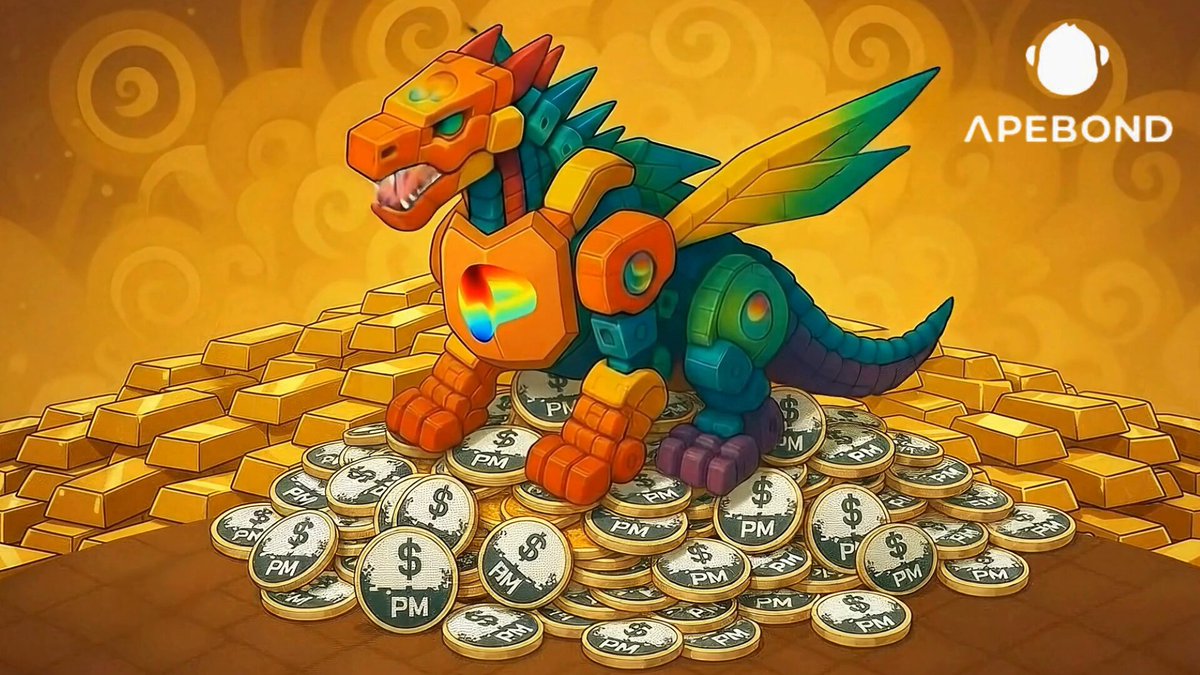 This Thursday December 18th, RAAC is officially launching its gold-backed stablecoin $pmUSD!
The launch is via a bond sale on Apebond, where $1M pmUSD will be available with a reward going from 2 to 5%!
This means: for every $1 USDT / USDC you deposit, you receive up to $1.05 pmUSD after the locking period. On top of that, this sale also marks the start of the RAAC points program, and participating in this sale will grant the biggest point multiplier of the program!
Finally, this sale is private for the RAAC Bots holder, the Llamas and the ApeBond premium users!
Follow RAAC on X for additional details!
This Thursday December 18th, RAAC is officially launching its gold-backed stablecoin $pmUSD!
The launch is via a bond sale on Apebond, where $1M pmUSD will be available with a reward going from 2 to 5%!
This means: for every $1 USDT / USDC you deposit, you receive up to $1.05 pmUSD after the locking period. On top of that, this sale also marks the start of the RAAC points program, and participating in this sale will grant the biggest point multiplier of the program!
Finally, this sale is private for the RAAC Bots holder, the Llamas and the ApeBond premium users!
Follow RAAC on X for additional details! A nice AIOZ Network write up by decrypt tells us why we need decentralization now and forever
 Curvance is live on Monad mainnet!
Deposit, borrow, and access leverage with capital efficiency up to 3x higher than legacy lending platforms.
Month one features over $750,000 in liquid incentives across supported vaults! Try the system and see how far lending mechanics can go when built for performance.
Curvance is live on Monad mainnet!
Deposit, borrow, and access leverage with capital efficiency up to 3x higher than legacy lending platforms.
Month one features over $750,000 in liquid incentives across supported vaults! Try the system and see how far lending mechanics can go when built for performance.Sources
19 records from 16 domains
gamerant.com
x.com
leviathannews.substack.com
github.com
coinbase.com
gate.com
t.me
aioz.network
pmusd.raac.io
youtube.com
lbank.com
coingecko.com
gl.app
blog.raac.io
docs.ratehopper.ai
coinmarketcap.com
Community notes
Spot something off or out of date? Drop a note. Editors review topic notes daily and roll accepted fixes into the explainer — contributors are recognized in the monthly $SQUID drop.
Loading notes…
Help improve this topic
Have a story or tip about this topic? Submit it. See something missing? Leave a note. Editors review daily; accepted submissions and fixes count toward the monthly $SQUID drop.