
A comprehensive guide to crypto auction mechanics — from exchange call auctions and token launches to NFT sales, gas fee markets, batch DEX designs, and security risks — covering how on-chain auctions allocate scarce assets fairly and efficiently.
+4 sources across the wider coverage universe
 Uniswap Auctions rolls out guide to Continuous Clearing Auctions, detailing bidding strategy, FDV pricing, and how users can adapt when prices move out of range mid-auction2026-04
 Cap token auction now live for registered users, with Uniswap Auctions guide explaining how to participate over the next 5 days2026-06
 Robinhood Chain integrates CCA and Uniswap Auctions, letting teams launch fully onchain token auctions, discover market prices, and bootstrap Uniswap v4 liquidity2026-07
 Uniswap lets teams launch CCA token auctions from web app on Ethereum, Base, Arbitrum, and Unichain2026-06
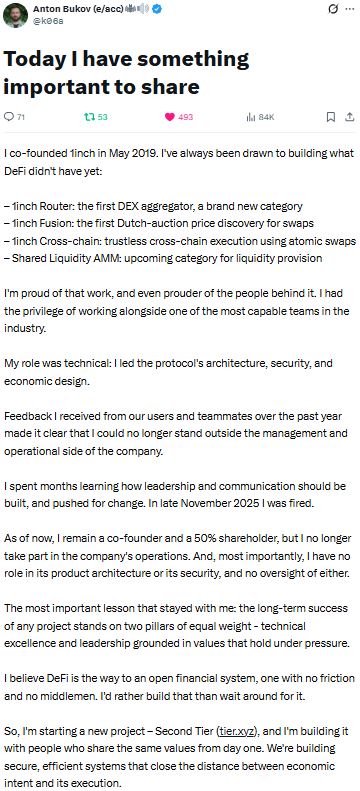 Anton Bukov, co-founder of 1inch, reflects on building the first DEX aggregator and Dutch-auction system, now launches new infrastructure startup Second Tier2026-07
 The best auction in town is open again!
Get the SQUID Pass for the week!
Bidding starts at 0.026 ETH.
Four and a half hours to go!
Bid here2026-04
The best auction in town is open again!
Get the SQUID Pass for the week!
Bidding starts at 0.026 ETH.
Four and a half hours to go!
Bid here2026-04
In crypto, an auction is a time-bounded, rules-governed mechanism for allocating a scarce asset — a token, a block slot, an NFT, or a fee parameter — to the highest-value bidder in a way that is transparent and, ideally, manipulation-resistant.
What Makes a Crypto Auction Different
Traditional auctions rely on an auctioneer as trusted intermediary. Crypto auctions can replace that trust with code: bids are submitted on-chain or to a verifiable off-chain system, settlement is deterministic, and the rules cannot be changed mid-auction by a single party.
That property matters enormously. In a conventional IPO or exchange listing, the price-discovery window is opaque. In a call auction on a centralized exchange — the format KuCoin used for the $BEAT listing, where order books opened at 07:00 UTC for ten minutes before trading unlocked at 08:00 — participants can see the indicative clearing price update in real time as limit orders arrive. Coinbase uses the same mechanism when onboarding new assets: pairs like CHECK-USD, META-USD, MEZO-USD, and KAIO-USD each enter an "auction mode" for a minimum of ten minutes, during which orders accumulate but no matches execute, giving the market a chance to find an equilibrium before the opening print.
The common thread is price discovery under controlled conditions — preventing a first-mover advantage from setting a price that everyone else has to chase.

Hut 8 wins Poolin bankruptcy auction for Texas data centers with $140 million bid

Token Launch Auctions
When a new protocol wants to distribute tokens without handing an advantage to bots or early insiders, it often turns to a structured launch auction.
Continuous Clearing Auctions, as explained in Uniswap's recently published guide, allow bidding over an extended window — in some cases five days or more. The clearing price is not fixed at the start; it adjusts as new orders arrive. Participants who bid above the eventual clearing price receive tokens; those below do not. This design reduces the gas-war dynamic that plagues fixed-price mints and gives later participants a fair shot. Uniswap Auctions also walks users through what happens when prices move out of range mid-auction — a scenario where an active bidding strategy, not passive limit setting, often produces better outcomes.
Cap token auctions follow a similar philosophy but set a hard ceiling on the number of tokens sold. Once the cap is reached, the auction closes regardless of elapsed time. The design creates urgency without allowing unlimited dilution.
The Dutch auction variant — familiar from Gnosis Protocol's early days — starts the price high and drops it on a schedule until demand absorbs the supply. It is theoretically optimal under certain information conditions, though in practice frontrunning and gas manipulation can distort outcomes unless the auction is run in a private mempool or uses commit-reveal schemes.
Leviathan readers click auction content not for mechanics or yield — they click because auctions expose the real price of influence: editorial control, pinned posts, and DeFi audience access are being discovered in public, and the gap between AMM price and auction clearing price is the actual news.
NFT Auctions
Non-fungible token auctions are among the most visible use cases in the space, and the mechanics have grown significantly more sophisticated since the early days of simple ascending-bid sales.
SuperRare recently rolled out an expanded marketplace that lets collectors filter live activity by new mints, sales, listings, ongoing auctions, and open bids — surfacing the real-time auction book in a way that mirrors what traders expect from an order-matched exchange. Physical-backed NFTs — editions that come with hand-signed prints or tangible assets — now appear as a dedicated category, reflecting a convergence between on-chain provenance and off-chain collectibles.
The NORML release, a series of eight 1/1 works auctioned alongside a Bidder's Edition, illustrates a newer format: pairing a token ($NORML) with auction participation rights, so collectors who hold the token influence how artwork is revealed over time. The auction is not purely a price mechanism; it is a governance layer over the creative release itself.
Squid Pass auctions, run weekly on the Leviathan platform, are a direct example of how media platforms are experimenting with NFT-gated access. Each Squid Pass grants the holder elevated rights within the Leviathan ecosystem — early access to content, participation in $SQUID token distributions, and priority access to community features. Auctions begin at a floor denominated in ETH (recently 0.026 ETH) and run for several hours with live bidding. Notifications are surfaced through the platform's Telegram channel, making the auction loop native to the messaging environment where Leviathan's community already lives. On-chain settlement means that pass ownership, bid history, and transfer rights are all auditable without relying on the platform as custodian.

Arbitrum rolls out priority gas auctions and fast feed for faster transactions.

Fee Auctions and Mechanism Design
One of the most technically interesting auction categories in DeFi does not sell an asset at all — it sells the right to set a parameter.
At ETHGlobal New York, a team called RiverSwap built on 1inch Aqua to address a chronic problem in automated market makers: static fees bleed liquidity providers to arbitrage bots whenever price moves happen off-chain faster than the pool can react. RiverSwap's solution is to auction the right to set the pool's fee at each block. Whoever wins the auction captures the fee; by paying up to win, they internalize the cost that would otherwise flow to arbitrageurs. Liquidity stays in wallets via Aqua's intent-based routing rather than sitting in pooled contracts, reducing the surface area for sandwich attacks.
Dual Frequency Batch Auctions, the mechanism behind Superluminal's upcoming perpetuals DEX, take a different cut at the same problem. Rather than continuous order matching, trades are collected into discrete batches and cleared simultaneously at a uniform clearing price. The "dual frequency" element refers to running two overlapping batch windows — one for large institutional flows, one for retail — so that both can interact without one systematically extracting from the other. Batch auctions at the settlement layer are already used in production by CoW Protocol and on Gnosis Chain; extending them to perpetuals markets is a meaningful architectural bet.
Gas Auctions, MEV, and Preconfirmations
Every Ethereum transaction participates in an informal auction. Since EIP-1559, the base fee is algorithmically determined, but the priority fee (tip) is discretionary and effectively buys ordering priority within a block. When block space is scarce, this degrades into a gas war — bots overbid on transactions where the profit opportunity justifies the cost.
The result is miner extractable value (MEV): the profit available to validators by reordering, inserting, or censoring transactions. Flashbots and its successors formalized MEV extraction into a structured market, running a sealed-bid auction where searchers submit bundles and block builders select the highest-paying combination.
ETHGas preconfirmations represent the next layer: commitments from validators to include a specific transaction in a future block before that block is built. A preconfirmation converts a probabilistic inclusion into something approaching a guarantee, which matters for latency-sensitive applications like trading, cross-chain bridges, and payment flows. The mechanism is itself an auction — validators price their commitment based on how much block space they expect to need and what the opportunity cost of the commitment is.
Bonnie Blue names newborn BetBolt after $1.2M donation wins naming auction. Bids from crypto fans topped out with crypto casino platform BeltBolt, at $1.2M after competing against names like Solana and Pump.

Auction Security: Lessons from the Clanker Sniper Incident
Auctions create concentrated moments of on-chain activity with clear financial stakes, which makes them attractive targets. The clanker v4 sniper auction incident — in which an attacker drained approximately 26 WETH from 41 sniper wallets in roughly 20 seconds — is instructive.
The attack did not compromise clanker's token deployment contracts or treasury. Instead, it exploited WETH approvals that sniper participants had granted in connection with the auction mechanics. Once those approvals were live, the attacker could pull funds without ever touching the core protocol. Clanker issued guidance that participants who had granted WETH approvals revoke them immediately.
The takeaway is structural: auction participation often requires granting token approvals, and those approvals persist unless explicitly revoked. A well-designed auction contract should scope approvals to the minimum necessary amount and expire them automatically at auction close. Users participating in any sniper, bid-escrow, or deposit-based auction should audit their active approvals with tools like Revoke.cash and revoke anything that outlives its auction.
- 01Squid Pass editorial control prize
Winning an auction grants control over a pinned post reaching $50M+ in DeFi assets under management, framing the auction not as advertising but as power purchase.
- 02SQUID token price discovery via auction
The headline showing 1 SQUID purchasing 1000x its AMM value in auction made readers confront that the token's effective market cap might be radically mispriced on secondary markets.
- 03Cheap DeFi advertising value floor
Multiple headlines framing the Squid Pass as the best-value advertising in DeFi drew clicks from projects weighing alternatives to Twitter/influencer spend.
- 04Whale vs. shrimp live bidding drama
The Waj Pass standoff between a SQUID whale and a shrimp created a real-time competitive narrative that pulled in readers as spectators.
- 05Protocol yield optimization auctions
Marinade's auction marketplace and the OpenStable rebalance auctions showed readers that Dutch and clearing-price auctions are becoming a yield-routing primitive, not just a fundraising format.
- 06Auction format experimentation across DeFi
Hyperliquid HIP-6, Harberger auctions on Hyperliquid staking, and Enso's Coinlist return signaled that auction design is an active frontier, attracting readers tracking mechanism innovation.
Governance and Treasury Auctions
Auctions also appear in protocol governance. When Polkadot ran its parachain slot model, projects bid DOT tokens in a candle auction format — an ascending-bid auction with a retroactively determined end time, designed to prevent last-second sniping. The randomized close meant bidders had to commit their best price throughout, rather than waiting for the final seconds.
As Polkadot has migrated to a coretime model that allocates block space more granularly, the parachain auction format has become largely obsolete. The Heima team recently proposed burning 16.5 million HEI tokens that had been reserved specifically for parachain auction bids — a recognition that the mechanism that justified the allocation no longer exists. Treasury tokens reserved for one auction format cannot simply be repurposed; the governance process around burning them is itself a form of community price discovery.
On the fundraising side, ETH auctions by established protocols have become a significant capital formation tool. Aztec Network moved 5,020 ETH — the proceeds from its auction fundraise — into Coinbase Custody, a choice that signals both the scale of the raise and the institutional-grade custody expectations that accompany it.
How Leviathan Uses Auctions
Within the Leviathan / Squid Bot ecosystem, auctions serve multiple functions beyond simple fundraising. The weekly Squid Pass auction is announced through the platform's Telegram bot, bids are placed on-chain, and the outcome is recorded on Leviathan's backend with matched_news linkage so that editorial content can be associated with specific auction cycles. The $SQUID token plays a supporting role: auction activity and pass ownership factor into the contributor leaderboard, creating an incentive loop between holding (or winning) passes and earning protocol rewards.
The platform's on-chain auction data is exposed through a public API, and auction results feed into the editorial side of the site — articles can be matched to the auction cycle during which they were published, giving the community a way to audit the relationship between content and token economics.
- 2023-02milestone
Taproot Wizards Dutch auction closes 50% above secondary price
- 2023-11governance
Polkadot governance votes to abandon parachain slot auctions
- 2024-01launch
Inaugural Leviathan auctions expire, netting 15,251 SQUID for treasury
- 2024-06launch
Leviathan hosts first Squid Pass auction on Fraxtal mainnet
- 2024-09launch
Marinade unveils auction marketplace to optimize liquid staking yields
- 2025-01milestone
Enso conducts first Coinlist auction in three years at TGE
- 2025-03governance
Hyperliquid HIP-6 adapts continuous clearing auctions to CLOB for token listings
- 2025-04launch
Stakedhype launches Harberger auction market for Hyperliquid perp market leases
Outlook
Auction mechanisms are proliferating across almost every layer of the crypto stack — token launches, NFT sales, block space, protocol governance, and fee parameters. The unifying pressure is the same: any time a scarce resource must be allocated to many competing parties, a well-designed auction produces a price that reflects genuine demand rather than who has the fastest bot.
The next wave of innovation is likely to focus on privacy-preserving auctions (using zero-knowledge proofs to hide bids until settlement), cross-chain clearing (single auctions that settle across multiple execution environments simultaneously), and tighter integration between auction mechanics and social or messaging layers — as Leviathan's Telegram-native Squid Pass auctions already demonstrate. The underlying bet is that auctions, when designed well, are fairer and more capital-efficient than first-come-first-served mints, centralized book-builds, or static AMM pricing.
Latest Auction news
Hut 8 wins Poolin bankruptcy auction for Texas data centers with $140 million bidArbitrum rolls out priority gas auctions and fast feed for faster transactions.Bonnie Blue names newborn BetBolt after $1.2M donation wins naming auction. Bids from crypto fans topped out with crypto casino platform BeltBolt, at $1.2M after competing against names like Solana and Pump.Community notes
Spot something off or out of date? Drop a note. Editors review topic notes daily and roll accepted fixes into the explainer — contributors are recognized in the monthly $SQUID drop.
Loading notes…
Help improve this topic
Have a story or tip about this topic? Submit it. See something missing? Leave a note. Editors review daily; accepted submissions and fixes count toward the monthly $SQUID drop.