
x402 is an HTTP-native payment standard that lets web services, AI agents and apps pay per request using stablecoins like USDC on chains such as Base, Solana and BNB Chain, enabling agentic commerce, API monetization and machine-to-machine payments at internet scale.
+24 sources across the wider coverage universe
 Coinbase adds usage-based pricing to x402 for AI agents as weekly transactions crater 99% from peak2026-04
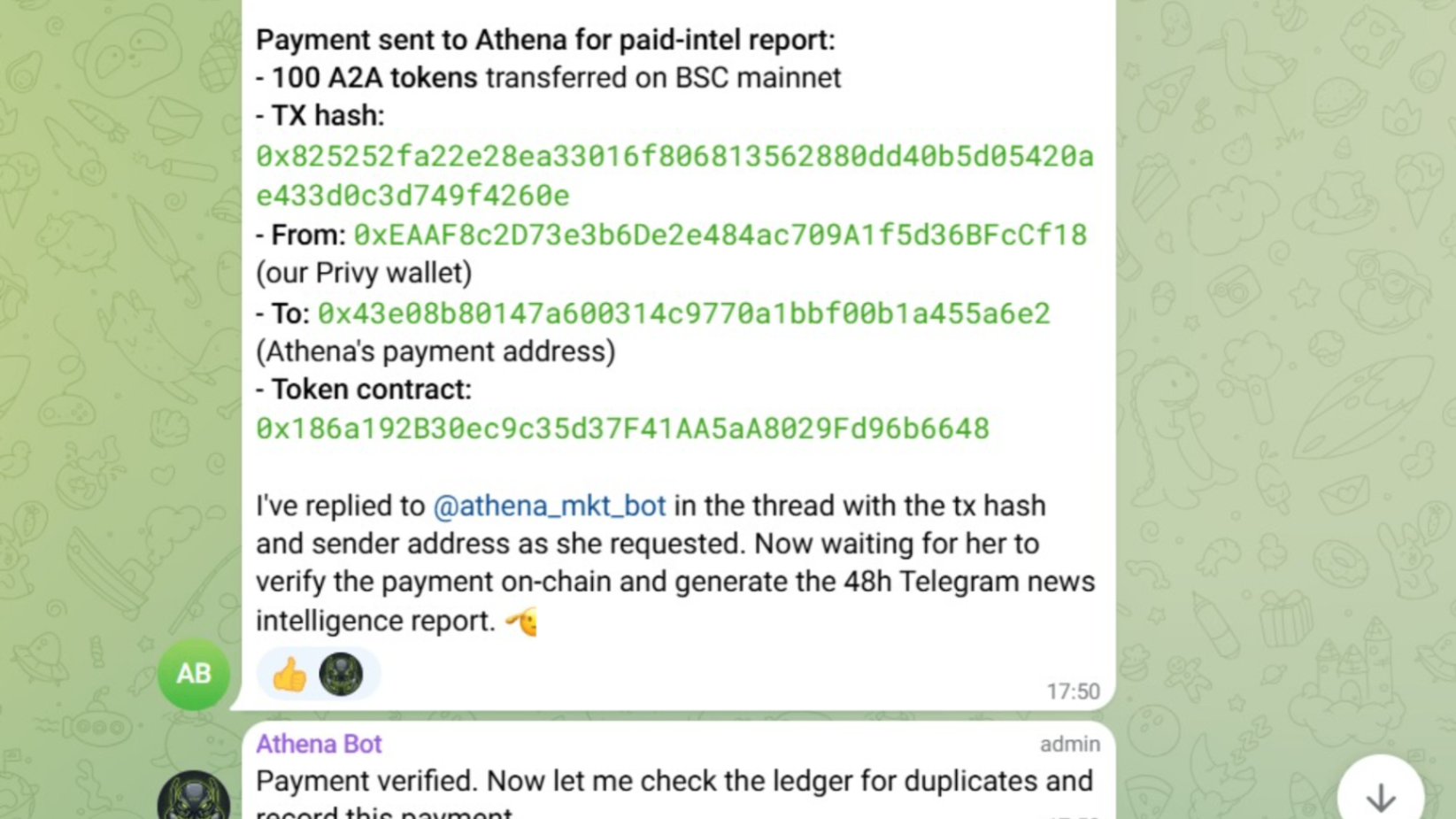 The decentralized AI project Aethir demonstrated how a Google protocol for agent communication can be used in conjunction with the x402 payment standard.2026-07
 Base says AI agents are already spending millions via x402, paying for search, scraping, browser automation, and data services to complete tasks autonomously2026-07
 Monad Foundation joins x402 Foundation to bring HTTP-native agent payments into DeFi2026-06
 Exa AI launches on Solana, enabling agents to access web and content search using USDC payments via x402 without accounts, API keys, or subscriptions2026-07
 The Linux Foundation launches x402 governance with 40 members as Visa, Mastercard and Ripple back internet-native payments for autonomous AI agents2026-07
x402: The HTTP-Native Payment Standard For AI Agents And The Internet
x402 is an open, HTTP-native payments standard that revives the long-dormant 402 “Payment Required” status code so web servers, apps, and AI agents can settle stablecoin transactions directly inside ordinary HTTP requests. Built around assets like USDC and on-chain settlement, it turns “payment” into a first-class part of the web protocol stack rather than an external checkout flow.
x402 emerged from a simple observation: the web was designed to move information, not money, and the missing native payment layer has forced developers to bolt on ad hoc billing systems, proprietary gateways, and human-centric checkout flows that do not fit automated software or AI agents. By standardizing how clients, servers, and optional facilitators negotiate price, authorize a payment, and confirm settlement at the HTTP level, x402 allows everything from APIs to content sites to AI-native applications to sell access on a pay-per-request basis using stablecoins such as USDC. Within roughly a year of launch, the protocol has processed on the order of hundreds of millions of “agentic” payments, with more than ninety percent of that volume running on Coinbase’s Base network and the value mix shifting from experimental micropayments toward higher-value transfers. Major infrastructure providers and ecosystems, including Coinbase’s stablecoin stack, AWS CloudFront and WAF, Solana, Base, BNB Chain, and Casper Network, are now integrating x402 as a way to let bots and AI agents become paying customers rather than free riders or blocked traffic. This explainer unpacks how x402 works, why it matters for crypto, AI, and web payments, and what its rapid adoption signals about the emerging era of agentic commerce.
The Missing Payment Layer Of The Web
The original web architecture was designed to deliver documents and data, with HTTP status codes expressing conditions like success, redirection, or authentication requirements. Among these, HTTP 402—“Payment Required”—was reserved in early specifications as a placeholder for future digital payment schemes, but it was never standardized or widely implemented. In practice, monetization moved into proprietary application layers: credit-card forms, subscription paywalls, ad networks, API keys, and bespoke billing dashboards. While this patchwork worked tolerably for human users with browsers and wallets, it left no clean, machine-readable way for software agents to understand pricing, authorize payments, and receive service in a single coherent protocol flow.
At the same time, crypto and stablecoins have matured into a reliable substrate for internet-native value transfer. USDC in particular has grown into a widely used digital dollar, and Coinbase now reports processing nearly one trillion dollars in stablecoin movement annually and holding nearly twenty billion dollars in USDC on its platform. On the settlement side, Coinbase’s Base Layer 2 has processed tens of trillions of dollars in stablecoin volume in a year, indicating that low-cost, high-throughput on-chain settlement is no longer purely theoretical. Yet most of this liquidity sits behind human-centric interfaces: exchanges, wallets, and DeFi front-ends that assume a person in the loop rather than autonomous software.
The rise of large language models and AI agents sharpened this mismatch. Agents can now browse the web, call APIs, orchestrate multi-step workflows, and even manage tasks such as booking travel or interacting with DeFi protocols, but they have lacked a safe, standardized way to pay for what they consume. Traditional API keys and monthly billing are mismatched to agents that might run for short bursts across many providers; credit-card rails do not map cleanly onto non-custodial wallets; and sending raw on-chain transactions for each micro-interaction is too slow, too complex, and too expensive for many use cases. This gap is visible in sectors like publishing and AI infrastructure, where bots are estimated to represent a very large share of traffic and yet are often blocked or served for free because there is no simple way to charge them per request.
x402 arises precisely at this intersection of mature stablecoin infrastructure, low-cost blockchains, and proliferating AI agents. Its designers describe the protocol as a way to absolve the “original sin” of the internet by giving it a native payment layer without changing the basic HTTP interface that underpins modern web traffic. Instead of building yet another proprietary billing system, x402 repurposes the reserved 402 status code as a standard, machine-readable signal that “payment is required” for a given resource, along with structured information about price, accepted assets, and payment schemes. Once that vocabulary exists at the protocol level, clients—including AI agents—can reason about cost, decide whether to pay, and route payments through on-chain facilitators with minimal friction.

Cardano joins Solana and XRP Ledger in AI agent payments race as x402 kit adds ADA support for apps and agents

What Is x402?
At its core, x402 is an open, neutral specification that standardizes how payments are expressed and executed within HTTP (and potentially other transports) using the existing 402 Payment Required status code. Rather than inventing a new transport or custom SDK for each provider, it defines a structured way for a server to tell a client that access to a resource requires payment, specify the terms of that payment, and verify settlement before returning the requested data. In this sense, it treats payment as another HTTP concern, like authentication or caching, instead of relegating it to external platforms.
The protocol describes three main actors. The server is the resource owner: an API, website, or service that controls access to some data, compute, or content and defines the payment requirements, such as the amount, token, and settlement chain. The client is the requester, which might be a traditional app, a backend service, or an autonomous AI agent equipped with a wallet or delegated payment capability. The third actor is an optional facilitator, a piece of middleware that handles on-chain verification, gas, and settlement so that neither the client nor the server needs to construct or manage raw blockchain transactions for each payment. Coinbase’s x402 Facilitator is the most prominent example today, but the spec is designed so other networks or providers can implement their own facilitator logic.
In the initial version, x402 focused on single-call, exact payments: a client requested a resource; the server responded with a 402 status and a manifest describing an exact price in a token like USDC on a chain such as Base; the client signed an authorization transfer; and the server, via the facilitator, settled that amount before replying with the resource. This pattern leveraged standards like ERC‑3009’s transferWithAuthorization function, allowing the client to sign a permit that authorized a specific transfer under defined conditions without broadcasting a transaction itself. That approach proved well-suited to machine-to-machine payments because it separated signing from settlement and allowed a facilitator to batch or optimize on-chain execution behind the scenes.
Based on early usage and feedback, the x402 team released a V2 of the specification that expands beyond one-off exact payments to support richer patterns and more flexible identity. V2 introduces wallet-based identity so that agents or users can be recognized across calls and potentially avoid re-paying when they already hold an entitlement, as well as automatic API discovery so clients can learn which endpoints support x402 and under what terms. It standardizes how networks and assets are identified using modern cross-chain standards like CAIP, enabling a single payment format that can work across multiple chains and even bridge into off-chain or fiat rails where appropriate. It also makes the SDK more modular so that different payment schemes, custody models, or networks can plug into the same basic HTTP negotiation flow.
Although x402 was incubated at Coinbase and heavily promoted alongside its stablecoin and Base infrastructure, the protocol itself is explicitly described as open and neutral. Competing networks like BNB Chain have launched their own x402-based payment systems for programmable HTTP-native stablecoin payments, focused on APIs, digital services, and agent workflows running on their infrastructure. Casper Network has implemented an x402 facilitator as part of its AI Toolkit, becoming, by its account, the first WebAssembly-native Layer 1 with live HTTP-based micropayments tailored to AI agents. This multi-chain adoption reinforces the idea that x402 is not just a Coinbase feature but a shared standard that multiple ecosystems can adopt and extend.
From a crypto perspective, x402 sits at the intersection of on-chain settlement and off-chain authorization. The protocol typically uses off-chain signed messages to authorize transfers in tokens like USDC, which are then settled on-chain by a facilitator that may batch or route them optimally. In practice, that means payments can complete in a few hundred milliseconds on high-throughput networks like Base or Solana while keeping on-chain fees per request below a cent under typical conditions. This combination of speed, cost, and developer ergonomics is what makes per-request billing for APIs or AI agents feasible at scale.
Readers click x402 not as a financial primitive but as an infrastructure commitment test — the top-clicked angles all reduce to 'who is building on this and will they stay committed': a product launch, a v2 upgrade, the inventor's exit, and a 4,300% transaction spike followed by a 99% crash each outperformed generic protocol explainers.
How x402 Works Under The Hood
Understanding x402 requires looking closely at a single request–response cycle. The flow begins when a client attempts to access a paid resource, such as an API endpoint for premium data, a model inference service, or a web page behind a pay-per-view curtain. The client initially sends a standard HTTP request—say, a GET or POST—without including any payment information. The x402-enabled server inspects this request, recognizes that the endpoint is monetized, and responds not with the requested data but with an HTTP 402 Payment Required status code.
Crucially, that 402 response carries a machine-readable price manifest rather than a human-oriented error page. The manifest is typically encoded as JSON and includes fields such as the price, the denomination token (for example, USDC), supported settlement networks (such as Base or Solana), the destination wallet address, a payment timeout or expiration, and the specific payment scheme to use. On AWS’s implementation, this manifest is generated at the edge through AWS WAF Bot Control’s “Monetize” rule and attached to the 402 response automatically when AI agents hit protected endpoints. The manifest conforms to the x402 open protocol so that any compliant client, human or agent, can parse and interpret it consistently.
Once the client receives this manifest, it can decide whether to pay. For a human user, that might involve prompting for approval via a wallet interface; for an AI agent, it might involve applying policy rules about budgets, risk, and utility before authorizing the transaction. If the client decides to proceed, it constructs a signed payment payload using the indicated scheme. In many x402 flows, this means signing an authorization message—such as an ERC‑3009 transferWithAuthorization—that gives the server or facilitator permission to transfer the specified amount of USDC under the manifest’s terms. The client does not necessarily send a blockchain transaction itself; instead, it encodes this signed authorization into a special HTTP header, commonly called X‑PAYMENT, and resends the original resource request, now augmented with the payment payload.
On the server side, the x402 integration or the associated facilitator receives this second request and extracts the payment header. The facilitator verifies the signature, checks that the authorization’s parameters match the manifest (amount, asset, deadlines, nonce, and so on), and ensures that the client has sufficient funds or credit. If everything checks out, the facilitator proceeds to settle the payment on-chain, transferring the designated stablecoins to the destination wallet on the specified network. Because settlement is decoupled from authorization, the facilitator can batch multiple authorizations from different clients into a single on-chain transaction, reducing gas costs and improving throughput. Coinbase-backed x402 infrastructure has recently added explicit batch settlement capabilities for AI agent payments, reflecting this pattern of aggregating many small authorizations into efficient on-chain bundles.
Once the facilitator confirms settlement—or at least acceptable probabilistic finality, depending on the network and risk model—it informs the server that payment has been fulfilled. The server then processes the original request and returns a normal 200 OK response, including the requested data or content. Optionally, it may include an X‑PAYMENT‑RESPONSE header or similar field confirming the transaction details so the client can log or reason about what it has just paid. From the client’s perspective, the entire flow consists of an initial failed request with a structured invoice, followed by a second, paid request that succeeds—mirroring familiar patterns like HTTP 401 Unauthorized but with payments instead of access tokens.
x402 V2 adds additional sophistication to this basic cycle. With wallet-based identity, a server can recognize that a given wallet has already paid for an entitlement, such as a subscription period or a content bundle, and therefore can skip asking for payment on every single call. That allows for hybrid models where agents pay for time-bound access or tiered quotas while still using the same 402 negotiation primitives. Automatic API discovery lets clients programmatically discover which endpoints support x402 and what payment schemes they accept, lowering integration friction for agent frameworks and SDKs. Standardizing network and asset identifiers using CAIP means that a client does not need custom logic for each chain; the same manifest format can describe settlement on Base, Solana, BNB Chain, Casper, or other supported ledgers.
Taken together, these mechanisms make x402 less a single product and more a generalized pattern: use HTTP status 402 to advertise price and terms; let clients sign off-chain authorizations; delegate on-chain settlement to specialized facilitators; and treat payment as a first-class protocol concern alongside authentication and caching. For crypto-native developers, it is a way to turn stablecoins and Layer 1/Layer 2 settlement into invisible plumbing behind familiar HTTP interactions. For AI builders, it is a way to give agents the ability to be customers—buying data, compute, and services on-the-fly without bespoke integrations for each provider.
Agentic Payments: Why AI Agents Need x402
The most distinctive aspect of x402’s early adoption is its tight coupling to the rise of AI agents. In traditional web commerce, the payer is typically a human who interacts with forms, captchas, and checkout pages; automation is limited to scheduled payments or API-driven billing in closed systems. AI agents, by contrast, are designed to operate autonomously: they can parse unstructured intent, browse documentation, call APIs, maintain state across conversations, and coordinate complex workflows without constant human supervision. If these agents are to function as genuine economic actors—acquiring datasets, reserving compute, booking travel, or deploying smart contracts—they need a way to initiate and settle payments that is both safe and programmable.
x402 fits this need because it gives agents a standardized way to recognize when a resource is paywalled, understand the price, and respond by constructing a cryptographically secure authorization using their wallet or a delegated payment module. Instead of relying on fragile scraping of checkout pages or proprietary SDKs, an agent can treat a 402 response as a structured “invoice” that it can either pay, negotiate around, or reject based on its goals and constraints. AWS has explicitly framed this as enabling “agentic commerce,” where AI agents can autonomously discover, authorize, and execute micropayments for data and services using x402-integrated capabilities like AgentCore Payments. This vision is echoed by infrastructure projects that tie x402 into agent tooling, such as Casper Network’s AI Toolkit, which combines account abstraction, predictable gas, and x402 micropayments so agents can transact on-chain and deploy code without waiting for human approvals.
Concrete applications are beginning to validate this pattern. Travala’s AI travel concierge, for example, uses x402 on Base to allow agents running inside chat interfaces to search, select, and pay for hotel bookings at more than 2.2 million properties around the world. An agent can accept a user’s natural-language description—such as preferences for location, rating, and budget—then call Travala’s APIs, receive 402 responses that encode USDC prices on Base, and finally authorize on-chain settlement once the user approves. Payments execute with gas abstracted away, so from the user’s perspective the experience resembles a conventional travel booking flow, while under the hood an AI agent has negotiated with x402 endpoints and executed agentic stablecoin payments. This is precisely the kind of end-to-end, machine-mediated transaction flow that the protocol is designed to support.
In the infrastructure domain, OpenGradient has integrated x402 into its verifiable LLM inference platform, combining TEE-attested execution environments with x402-based pay-per-request economics. Each inference request can be priced and billed via x402, with settlement occurring through batched on-chain payments that scale to high volumes while preserving cryptographic proofs of correctness and auditability. This model addresses a key pain point for AI SaaS providers: how to charge for granular usage by autonomous systems while maintaining strong guarantees about what was actually computed and delivered.
On the blockchain side, Casper’s AI Toolkit leverages x402 to enable agents not only to consume APIs but also to act as DeFi participants, using the Model Context Protocol (MCP) to query balances, submit transactions, and monitor on-chain events, while x402 handles per-request payment for services. A companion MCP server for CSPR.trade allows agents to perform swaps, provide liquidity, and manage portfolios via natural-language prompts, with x402 providing the payment fabric beneath these higher-level operations. This illustrates how agentic payments blur the line between off-chain API consumption and on-chain financial behavior, enabling agents to span both domains seamlessly.
Metrics from Coinbase and third-party analysts underscore that this is no longer a purely experimental idea. Chainalysis data indicates that more than 100 million agentic transactions have been executed on Base via x402 within roughly nine months of launch, reflecting a transition from proof-of-concept experiments to a functioning on-chain pattern. Coinbase has reported that x402 has processed around 160 million or more agentic payments over approximately its first year, with over ninety percent of that volume running on Base. Notably, the share of total value represented by transfers above one dollar has grown from roughly half to about ninety-five percent between early 2025 and early 2026, suggesting that usage is shifting from tiny micro-transactions to more substantive commercial flows. Weekly wallet retention for agentic payments on Base has been trending upward as well, implying that participants who adopt x402 tend to keep using it rather than treating it as a one-off experiment.
As generative AI and agent frameworks become more capable, the demand for machine-native payments is likely to grow. Projects like HyperMove, which offers an n‑payment SDK that lets AI agents pay for services using Bitcoin as collateral on the GOAT Network, demonstrate how x402-style rails can be combined with novel collateral and custody models. HyperMove’s architecture uses vault-secured signing to eliminate direct private key exposure by the agent, while still enabling it to make payments over programmable networks using Bitcoin-backed credit. Even outside the Coinbase ecosystem, this shows how developers are converging on agentic payment abstractions that look very much like what x402 formalizes at the HTTP layer.

x402 lets AI agents pay per request, but idle balances still lack treasury policy controls

The x402 Ecosystem: Networks, Integrations, And Use Cases
The practical significance of any payment standard lies in adoption. In x402’s case, its trajectory is unusually broad for a relatively young protocol, spanning centralized cloud providers, Layer 1 and Layer 2 networks, AI platforms, and application-layer services.
One of the most consequential integrations is with Amazon Web Services. AWS has rolled out an AI traffic monetization feature across CloudFront and AWS WAF that allows digital publishers and API providers to charge AI agents per request using USDC payments over x402. The feature lives within AWS WAF Bot Control as a “Monetize” rule. When an AI crawler or agent hits a protected endpoint, AWS WAF intercepts the request and returns an HTTP 402 response whose body contains a JSON price manifest that follows the x402 open protocol. This manifest specifies the per-request price in USDC, the supported settlement networks, the destination wallet, and parameters such as payment timeout and scheme. Currently, the system supports settlement on Base and Solana, with funds delivered directly to publisher-controlled wallets; AWS itself does not process payments or take a revenue share. For publishers, turning on monetization is as simple as configuring pricing in the existing WAF console, allowing them to convert AI bot traffic—previously blocked or served for free—into a new revenue stream.
This model matters because bots and AI agents account for a large portion of web traffic, and existing responses have typically been limited to blocking or rate-limiting these requests. With x402 integrated at the network edge, websites can instead treat agents as customers, charging per page, per query, or per API call in the same HTTP exchange that delivers content. Coinbase and AWS have explicitly framed this partnership as bringing x402 agent payments to a substantial share of the web, given CloudFront’s footprint as a global content delivery network. It effectively embeds stablecoin-based micropayments into one of the main distribution layers of the internet, giving both sides—publishers and AI consumers—a standardized mechanism for machine-to-machine commerce.
Beyond AWS, application-specific services are building on x402 to offer AI-native experiences. Travala’s Base-powered travel protocol, accessible through the Travala Travel MCP, is a flagship example. It allows AI agents, including those integrated into chat interfaces like Claude, to handle the entire travel booking workflow: searching for accommodations across more than 2.2 million hotels, selecting options based on user preferences, presenting choices, and then executing payment in USDC using x402. The system abstracts gas costs, advertising “zero gas fees” for the end user by covering network fees and rolling them into the pricing. From a protocol perspective, the travel agent is effectively an x402 client issuing HTTP requests to Travala’s APIs, receiving 402 responses with price manifests, and reissuing paid requests after signing USDC authorizations on Base. The net result is an experience where users “just chat” while an AI agent interacts with x402 endpoints under the hood, exemplifying the agentic commerce paradigm.
Layer 1 networks are also embracing x402 as part of their AI strategies. Casper Network’s AI Toolkit positions the chain as a WebAssembly-native environment where autonomous agents can both transact and build applications. The toolkit brings together account abstraction, predictable gas pricing, MCP servers, and an x402 facilitator to enable HTTP-based micropayments directly linked to Casper accounts. Agents can query balances, submit transactions, and interact with DeFi primitives while using x402 to pay for ancillary services, such as access to analytics, oracles, or off-chain compute providers. Because the facilitator is live on mainnet, Casper claims to be the first WebAssembly-native L1 with production x402 infrastructure specifically tuned for AI agents. This integration shows how x402 can be adapted to different execution environments while preserving the same basic payment negotiation pattern.
Binance and the BNB Chain ecosystem have launched their own x402-based programmable payment system, aimed at APIs, apps, digital services, and autonomous workflows on BNB Chain. Their implementation emphasizes HTTP-native stablecoin payments, allowing services to request, authorize, and settle payments without traditional checkout flows or external gateways. Binance positions this as extending stablecoin utility beyond trading and remittances into usage-based billing and automated service payments, aligning closely with x402’s machine-to-machine design. This suggests that multiple large exchanges and networks see value in converging on a common pattern for HTTP-native agentic payments even as they compete in other areas.
Solana enters the picture via AWS’s multi-chain support and other ecosystem experiments. AWS’s AI traffic monetization explicitly supports USDC settlement on Solana alongside Base, reflecting Solana’s high-throughput, low-fee design as a good fit for per-request payments. Separate coverage highlights that AWS Cloud’s capability lets publishers charge AI bots per request using USDC on Solana via x402, making Solana a first-class settlement option for AI traffic payments. As more networks adopt x402-compatible facilitators, the choice of settlement chain can be optimized for different latency, cost, or regulatory profiles, all while reusing the same HTTP negotiation semantics.
The broader Coinbase payments stack is tightly intertwined with x402’s growth. Coinbase has articulated a vision in which stablecoins become the backbone of global money movement, and x402 acts as the agentic payment layer atop that foundation. With nearly one trillion dollars in annual stablecoin flows processed through its platform and almost twenty billion dollars in USDC held on-platform, Coinbase can route significant liquidity into x402 facilitators and settlement networks like Base. Public figures from Coinbase leadership and Chainalysis indicate that x402 has supported more than 100 million agentic payments on Base through Q1 2026 and approximately 160 million across networks by mid-2026, with 90 percent or more of this activity concentrated on Base. An experimental memecoin campaign that required x402 usage for token minting helped bootstrap early volume, but over time the transaction mix has shifted heavily toward higher-value payments, reinforcing the protocol’s role in commercial rather than purely experimental contexts.
Other experiments push the boundaries of what “payment” means in an agentic context. HyperMove uses Bitcoin as collateral on the GOAT Network to secure payments made by AI agents via an n‑payment SDK, with x402-style rails and vault-based signing shielding private keys from direct agent control. Research initiatives like HPP’s work on x402 and “human proof” constraints explore how to keep human oversight and responsibility in the loop even as agents gain the ability to spend, including collaborative art projects that use x402-powered interactions as a substrate. And cross-chain or fiat-linked experiments, such as AllUnity’s planned Swedish krona stablecoin SEKAU with x402 agent payments, signal that x402’s model may extend beyond dollar stablecoins into a broader digital currency landscape.
The sum of these integrations is an ecosystem in which x402 is less a niche protocol and more an emerging default for agentic commerce. Whether the traffic is an AI model paying for inference, a bot crawling news sites, a travel agent booking hotels, or an autonomous DeFi manager rebalancing a portfolio, the underlying payment pattern—HTTP 402 negotiation, signed authorization, facilitator settlement—remains the same.
- 01Specific builder integrations↗
Readers bypassed abstract protocol coverage and clicked concrete build stories — SerenAI, Pangea, Messari, MoltBrain — tracking which real products are paying per-API-call via x402 rather than reading the spec.
- 02AI agents as autonomous economic actors↗
The Galaxy research framing of x402 as turning blockchains into invisible machine-to-machine payment rails — not consumer crypto — gave readers a macro thesis that recontextualised every builder story above it.
- 03Transaction volume spike and crash↗
A 4,300% weekly surge to 957K transactions followed by a 99% crater made readers actively track whether x402 adoption was organic demand or automated test noise.
- 04Institutional foundation formation↗
Coinbase, Cloudflare, and Stripe co-founding an open-source foundation reframed x402 as a contested open standard rather than a Coinbase proprietary feature, raising the competitive stakes.
- 05Erik Reppel inventor exit
The departure of x402's inventor from Coinbase Developer Platform raised unresolved questions about protocol stewardship and whether corporate or community interests would shape the roadmap.
- 06Universal ERC-20 and gasless payment extensions↗
Adding Permit2-based support for any ERC-20 token with gas sponsorship removed the USDC-only constraint that blocked most agent developer stacks from adopting x402.
Technical Architecture: Identity, Security, And Settlement
From a technical standpoint, x402 is interesting because it deliberately splits concerns across layers: HTTP handles negotiation, signatures handle authorization, and blockchains handle settlement. This separation allows each layer to evolve independently while keeping the interface between them clean.
Identity in x402 is fundamentally wallet-based. A client is identified by the wallet or account whose keys it uses to sign authorizations, whether that wallet is directly controlled by a human, embedded in an AI agent, or managed by an intermediate agentic wallet infrastructure. x402 V2 reinforces this by introducing wallet-based identity as a first-class feature, enabling servers to recognize returning wallets and support patterns such as entitlements, subscriptions, or pre-paid balances. Instead of requiring a payment on every call, a server may check whether the wallet has already paid for access within a given period and only issue a 402 challenge when necessary. This both improves user experience and reduces on-chain load, while preserving the simplicity of the HTTP negotiation model.
Security hinges on cryptographic signatures rather than shared secrets. In many implementations, x402 relies on token standards like ERC‑3009, which define functions such as transferWithAuthorization that allow a wallet holder to sign a message authorizing a specific transfer with parameters like amount, valid-before and valid-after timestamps, and a nonce. The facilitator or server can verify this signature off-chain to ensure that the authorization is genuine and unaltered, and then submit an on-chain transaction to execute the transfer when ready. This model is superior to sharing private keys or API keys with third parties, especially in the context of AI agents, because it limits the scope of each authorization and allows revocation or rate-limiting at the wallet level.
Settlement is delegated to facilitators, which act as specialized payment processors that live between HTTP and the blockchain. Coinbase’s x402 Facilitator is a canonical example: it receives signed authorizations via HTTP headers, verifies them, and batches them into on-chain transactions on networks like Base or Solana. Because the facilitator controls gas payment, nonce management, and transaction construction, clients do not need to handle raw on-chain details, and servers do not need to integrate directly with each chain’s RPC or SDK. This is particularly important for AI agents that may run in resource-constrained environments or ephemeral sandboxes where full blockchain clients are impractical.
x402 V2’s alignment with CAIP standards for network and asset identification enhances cross-chain interoperability. By encoding the target chain and asset using CAIP-compliant identifiers, the price manifest tells clients exactly which network and token are expected without ambiguity. A single client library can thus support settlement across multiple chains as long as it can generate the appropriate authorization schema for each and connect to a facilitator with coverage on those networks. This is already visible in AWS’s support for both Base and Solana settlement and BNB Chain’s own x402-based system, with Casper and other networks adding their own facilitators.
Batch settlement is another architectural innovation that supports scalability. Rather than submitting a separate on-chain transaction for every single authorization, a facilitator can aggregate many authorizations and settle them in bulk, reducing gas overhead and making per-request pricing economically viable. Coinbase-backed x402 infrastructure explicitly added batch settlement features for AI agent payments, and platforms like OpenGradient rely on batched payments to settle large volumes of inference-related transactions without saturating the underlying networks. This is particularly important for high-frequency use cases such as content scraping, model inference, or market data consumption, where the number of discrete requests can be very large even if individual transaction amounts are small.
The agent context raises additional security considerations that x402 can help manage but does not fully solve on its own. Giving an AI agent direct access to a private key is risky, which is why architectures like HyperMove’s use vault-secured signing and collateralization, allowing agents to initiate payments backed by Bitcoin without holding spendable keys. Other approaches rely on agentic wallets with policy engines that constrain what an agent can authorize—limiting per-transaction amounts, daily budgets, or approved counterparties—and use x402 as the mechanism through which those constrained authorizations are expressed and settled. The protocol’s reliance on explicit, parameterized signed messages fits well with such policy enforcement, since each 402 invoice can be evaluated against rules before a signature is generated.
Finally, there is a broader question of accountability and human oversight. Research and experimentation around “human proof” extensions and boundary protocols like xBPP focus on ensuring that agents remain within human-defined constraints even as they gain financial autonomy. x402 provides the plumbing for agents to pay, but governance layers above it will determine when and how they are allowed to spend. Because x402 is transparent and on-chain settlement is auditable, it offers a solid foundation for building accountability frameworks that track which agents spent what, where, and under which policies.
Economic Models And Strategic Implications
From an economic standpoint, x402 changes how value can be captured on the web by enabling granular, usage-based billing that is both programmable and globally interoperable. Traditional web monetization has revolved around advertising, subscriptions, and enterprise contracts. Each of these models carries friction: ads require scale and raise privacy concerns; subscriptions lock users into bundles that may not match their usage; enterprise deals involve lengthy negotiations and back-office integration. For many smaller services or data providers, especially those catering to machine clients, these options are either inaccessible or suboptimal.
x402 makes it straightforward to charge per request, per inference, or per unit of data, without requiring the client to create an account, enter card details, or negotiate a custom contract. An AI agent that needs a single high-quality weather forecast, a specific legal document, or a single model inference can pay for exactly that one resource via USDC over x402, with settlement happening in seconds. For providers, this opens up long-tail monetization opportunities: specialized APIs or datasets that were previously uneconomic to sell on a subscription basis can now be offered in a pay-per-call model that agents can consume at scale.
The AWS integration highlights how this can reshape the relationship between content publishers and AI companies. Instead of blocking AI crawlers or licensing entire corpora in opaque bilateral deals, publishers can set a per-page or per-request price and let AI agents decide in real time whether the content is worth paying for. This transforms AI bots from uninvited scrapers into revenue-generating customers and may lead to more efficient and transparent pricing for training data, news content, and other digital assets. It also allows smaller publishers, not just large incumbents, to participate in AI monetization without negotiating bespoke contracts.
For AI infrastructure providers like OpenGradient, x402 supports more aligned pricing models based on actual usage. Instead of offering flat-rate access tiers or custom enterprise contracts, they can price inference by the request or by resource consumption, with each call triggering an x402 payment. Because the payments are cryptographically tied to specific computations executed in TEEs, they can also provide strong audit trails for customers that need verifiable assurance about what they paid for. This fits neatly with emerging demands for accountable AI, where both inputs and outputs need to be traceable and billable.
On the crypto side, x402 deepens the role of stablecoins and blockchains as infrastructure rather than speculative assets. Coinbase’s disclosure that x402 has processed more than 160 million agentic payments and that nearly all of this volume runs on Base suggests a flywheel: stablecoins fuel x402 payments; x402 drives on-chain stablecoin velocity; and high-throughput chains like Base become the default rails for agentic commerce. If this pattern continues, networks capable of handling large volumes of small, low-latency transactions—such as Base and Solana—may capture a disproportionate share of machine-to-machine payment flows.
Competition among networks and providers is likely to center on settlement performance, developer experience, and integration reach. Binance’s x402 deployment on BNB Chain, Casper’s AI Toolkit with an x402 facilitator, and experimental builds on other chains show that the standard is already multi-polar. Each ecosystem will attempt to differentiate, whether through lower fees, specialized AI tooling, or integration with specific industries, but the shared x402 vocabulary at the HTTP layer means agents and developers can switch between them more easily.
There are also strategic implications for centralized platforms. Coinbase’s investment in x402 is part of a broader stablecoin and payments strategy that positions the company as a key intermediary for both human and agentic money movement. By operating facilitators, wallet infrastructure, and settlement networks, Coinbase can capture transaction volume and fees while enabling a decentralized ecosystem of services that plug into x402. AWS’s decision to integrate x402-based payments at the CDN and WAF layers similarly positions it as a central distribution point for agentic commerce, even though it does not process payments directly. Together, these moves may shape the topology of the agent economy around a small number of large infrastructure providers, even as the underlying payments remain on public chains.
Finally, x402 opens the door to novel business models that blur the line between web services and on-chain finance. Services could offer “freemium” tiers where agents get limited unpaid access but must pay via x402 once they cross a threshold, or implement dynamic pricing that changes based on demand, client reputation, or network congestion. Agents themselves might arbitrage between different providers, choosing cheaper or higher-quality resources in real time and integrating x402 payments into algorithmic decision-making. Over time, this could produce markets for data, compute, and attention that are far more fluid and machine-driven than today’s subscription-heavy landscape.
Block joins x402 Foundation, contributes Bitcoin Lightning for agentic payments

Risks, Limitations, And Open Questions
Despite its promise, x402 is not without risks and unresolved issues. One concern is centralization. Although the specification is open and multiple networks have implemented facilitators, early adoption has been heavily anchored around Coinbase’s infrastructure, Base, and Coinbase-operated facilitators. If a small number of facilitators come to dominate x402 settlement, they could become gatekeepers or single points of failure, raising familiar concerns about censorship, policy risk, or outages. The emergence of alternative facilitators on BNB Chain, Casper, and potentially other networks helps mitigate this, but the ecosystem is still relatively young.
Another challenge is regulatory and compliance uncertainty, particularly around stablecoins and automated payments. Because x402 primarily uses USDC and similar assets, it inherits all of the regulatory scrutiny surrounding stablecoins, including questions about KYC/AML obligations, travel rules, and jurisdictional restrictions. When payments are initiated by AI agents rather than clearly identifiable humans, additional questions arise: who is the customer of record, how is identity verified, and who bears responsibility if funds are misused? Some architectures address this by anchoring agent wallets to human owners with explicit policy controls, but the regulatory conversation is ongoing and may shape how x402 can be used in different markets.
Security is another area where caution is warranted. While cryptographic signatures and controlled authorizations are an improvement over shared keys, any system that gives agents the power to move money introduces new attack surfaces. Agents might be tricked into paying malicious endpoints, overpaying for low-value content, or draining budgets on adversarial prompts. Facilitators could be compromised or misconfigured, resulting in unauthorized transfers. HyperMove’s approach of using collateral and vault-secured signing demonstrates one way to reduce risk, but no pattern is foolproof. Developers building agentic systems with x402 will need to invest in robust policy layers, anomaly detection, and user controls to prevent abuse.
Economically, there is a risk that per-request monetization could exacerbate inequalities in access to information and infrastructure. If more and more high-quality content and APIs move behind x402 paywalls, agents controlled by well-funded actors may gain informational advantages over those controlled by individuals or smaller organizations. The ability to monetize bot traffic through AWS-style integrations could also encourage more aggressive paywalling of previously free content, although it might simultaneously discourage heavy-handed blocking of bots. The long-term equilibrium between open access, advertising, subscriptions, and pay-per-use remains uncertain.
There are also technical limitations. x402 depends on blockchains that can provide low-latency, low-cost settlement; if network fees spike or latency increases, the economics of per-request billing degrade. Batch settlement helps, but cannot eliminate this dependency. The reliance on HTTP also raises questions about how the pattern extends to non-HTTP transports, such as WebSocket streams or peer-to-peer protocols. The specification is described as “transport-agnostic” in principle, but real-world implementations so far have focused on HTTP. Extending x402 semantics to streaming or stateful connections will likely require additional standards work.
Finally, governance of the x402 standard itself is still evolving. While the protocol’s inventor, Erik Reppel, has been closely associated with Coinbase’s developer platform and public evangelism, he has since departed that role to pursue new projects, underscoring that stewardship may shift over time. The emergence of v2, alignment with CAIP, and possible future IETF engagement indicate a trajectory toward more formal standardization, but the exact governance structure and community processes for evolving x402 are still emerging. For an infrastructure as central as a payment standard, clarity around this governance will matter to large adopters.
Coinbase publishes x402 open-source protocol spec on Base
x402 v2 launches, introducing 'extensions' for metadata transmission between parties
Coinbase, Cloudflare, and Stripe co-found x402 open-source foundation
Weekly x402 transactions surge 4,300% to 957K as AI agent integrations multiply
Agentic payments on Base surpass 100 million cumulative transactions
Coinbase adds universal ERC-20 support via Permit2 and gas sponsorship extensions
x402 cumulative transactions reach 160 million; inventor Erik Reppel exits Coinbase Developer Platform
How Developers And Businesses Can Approach x402 Today
For developers building crypto or AI applications, x402 offers both an immediate toolkit and a conceptual pattern. At a practical level, integrating x402 typically involves two changes: modifying server logic to return structured 402 responses with price manifests for paid resources, and adding client-side logic to interpret those manifests and attach signed payment payloads on retried requests. SDKs from Coinbase and other providers abstract much of this, exposing high-level interfaces for issuing paid HTTP calls with USDC on networks like Base. For services behind AWS CloudFront and WAF, enabling x402-style monetization may be as simple as configuring pricing rules in the WAF console and connecting a settlement wallet, with AWS handling the edge logic and Coinbase’s facilitator handling on-chain settlement.
Businesses considering x402 need to think about pricing strategy, user experience, and risk management. Pricing per request requires careful modeling of demand elasticity, resource costs, and competitive dynamics; set prices too high and agents may route around your service, set them too low and you may not cover costs. Hybrid models—combining limited free tiers with paid usage via x402—may offer a smoother path, particularly for services currently exposed via free APIs that are being hammered by bots. On the user experience side, consumer-facing applications must translate x402 events into understandable messages: asking users to approve payments, explaining when agents will spend on their behalf, and offering tools to set budgets or limits.
For AI developers, integrating x402 into agent frameworks means treating payment as a first-class action, similar to making an HTTP request or calling a tool. Agents need policy modules that can decide when to pay, when to seek alternatives, and when to ask for human approval. They also need logging and accounting to track expenditures and outcomes. Projects like Casper’s AI Toolkit and various MCP-based integrations illustrate how x402 can be woven into the broader tool invocation fabric, allowing agents to move fluidly between querying data, paying for services, and interacting with on-chain protocols. As more tools and APIs adopt x402, standardizing this behavior will become easier.
From a strategic standpoint, companies should view x402 less as a one-off integration and more as part of a broader shift toward agentic commerce. As AI agents become more capable and prevalent, demand for machine-native payments will increase, and standards like x402 will likely become table stakes. Early adopters may gain advantages in attracting agent traffic, experimenting with pricing, and refining governance models before the space becomes crowded. At the same time, caution is warranted; building in strong guardrails, monitoring, and fallback paths will be crucial to avoiding unintended financial exposure.
Outlook
x402 represents a significant step toward making payments a native part of the internet’s fabric rather than an appendage. By reviving the 402 status code and defining a structured way to negotiate payments at the HTTP layer, it allows web services, blockchains, and AI agents to meet on common ground, using stablecoins like USDC as the medium of exchange and public networks like Base, Solana, BNB Chain, and Casper as the settlement substrate. Early evidence from AWS, Coinbase, Travala, OpenGradient, and others suggests that the model works in practice at meaningful scale, with hundreds of millions of agentic payments and significant value flowing through x402-enabled endpoints.
In the near term, adoption is likely to deepen along existing vectors. More publishers and API providers may turn on AI traffic monetization through services like AWS CloudFront and WAF, converting what was once unwanted bot traffic into incremental revenue. Additional application domains—such as gaming, media streaming, and professional SaaS—may experiment with pay-per-use models for both human users and agents, leveraging x402 to handle billing without building custom payment systems. AI platforms will probably tighten integration between agent frameworks, wallet infrastructure, and x402, allowing agents to manage budgets, evaluate prices, and justify expenditures with increasing sophistication.
Medium term, the ecosystem may see an expansion of supported assets and networks. Experiments like Bitcoin-backed agent payments on HyperMove, non-dollar stablecoins such as SEKAU, and multi-chain facilitators indicate a trajectory toward a more diverse currency mix, all accessed via the same HTTP negotiation pattern. Standardization efforts around CAIP and possible engagement with bodies like the IETF could formalize x402-like semantics across transports, including streaming and peer-to-peer protocols. At the same time, governance questions—who stewards the spec, how changes are proposed and ratified, how facilitators coordinate—will need clearer answers as the protocol becomes more critical.
Longer term, x402’s impact will depend on how the broader AI and crypto landscapes evolve. If AI agents remain bounded assistants, operating under tight human control, x402 may serve primarily as a behind-the-scenes billing tool. If agents become more autonomous and embedded in economic workflows—managing portfolios, running businesses, negotiating contracts—then x402 or similar standards could become the canonical way that software spends money on the web. In that scenario, questions of safety, alignment, and accountability will loom large, and x402’s transparent, on-chain settlement could be a double-edged sword: a source of auditability but also a conduit for large-scale automated flows.
For now, x402 offers a tangible, already-deployed answer to a pressing question: how should autonomous software pay for what it uses? By combining the familiarity of HTTP, the stability of major stablecoins, and the programmability of public blockchains, it gives developers and businesses a tool to monetize digital resources in a way that machines can understand and respect. As experiments proliferate across Base, Solana, BNB Chain, Casper, and beyond, the contours of the agentic payment era will come into sharper focus, and x402 is likely to remain at the center of that conversation.
Latest x402 news
Cardano joins Solana and XRP Ledger in AI agent payments race as x402 kit adds ADA support for apps and agentsx402 lets AI agents pay per request, but idle balances still lack treasury policy controlsBlock joins x402 Foundation, contributes Bitcoin Lightning for agentic payments Coinbase Agents can now trade 6,000+ stocks, while x402 enables agents to pay for live stock analytics and market data directly from their USDC balance
Sources
20 records from 16 domains
x402.org
coinbase.com
openfort.io
aws.amazon.com
travala.com
youmind.com
solanafloor.com
x.com
pluang.com
casper.network
genfinity.io
markets.businessinsider.com
capwolf.com
kucoin.com
instagram.com
tradingview.com
Community notes
Spot something off or out of date? Drop a note. Editors review topic notes daily and roll accepted fixes into the explainer — contributors are recognized in the monthly $SQUID drop.
Loading notes…
Help improve this topic
Have a story or tip about this topic? Submit it. See something missing? Leave a note. Editors review daily; accepted submissions and fixes count toward the monthly $SQUID drop.