
A neutral explainer on Discord for crypto audiences: how servers, roles, and bots power token-gated communities, reward quests, AI agents, and the persistent scam risks every user should know.
+4 sources across the wider coverage universe
 AdEx evolves from blockchain ad network to solving Web3 user fragmentation after nearly a decade.2026-04
 Cancore launches Genesis program to reward early adopters and contributors as Mainnet rolls out.2026-04
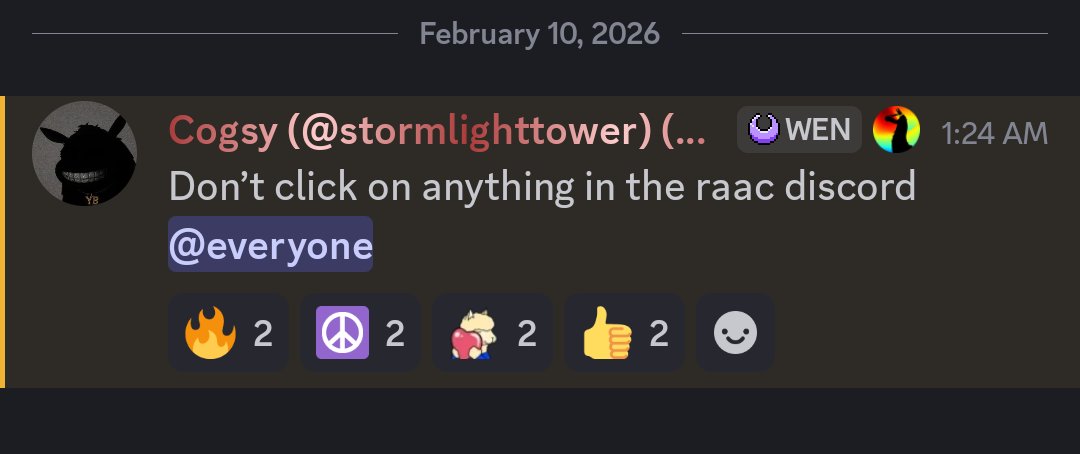 RAAC Discord appears to be compromised, do not interact!2026-02
 Hardware wallet users face challenges claiming Dymension airdrop tokens, with Solana claimants and Ledger/Trezor users encountering hurdles. Discord reports and X reveal initial access issues for Phantom wallet users paired with Ledger hardware wallets.2024-02
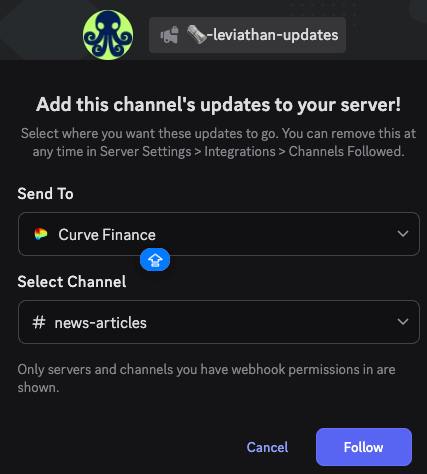 Want 24/7 crypto news powered by Leviathan in your Discord server? Visit #leviathan-updates and click Follow!2025-04
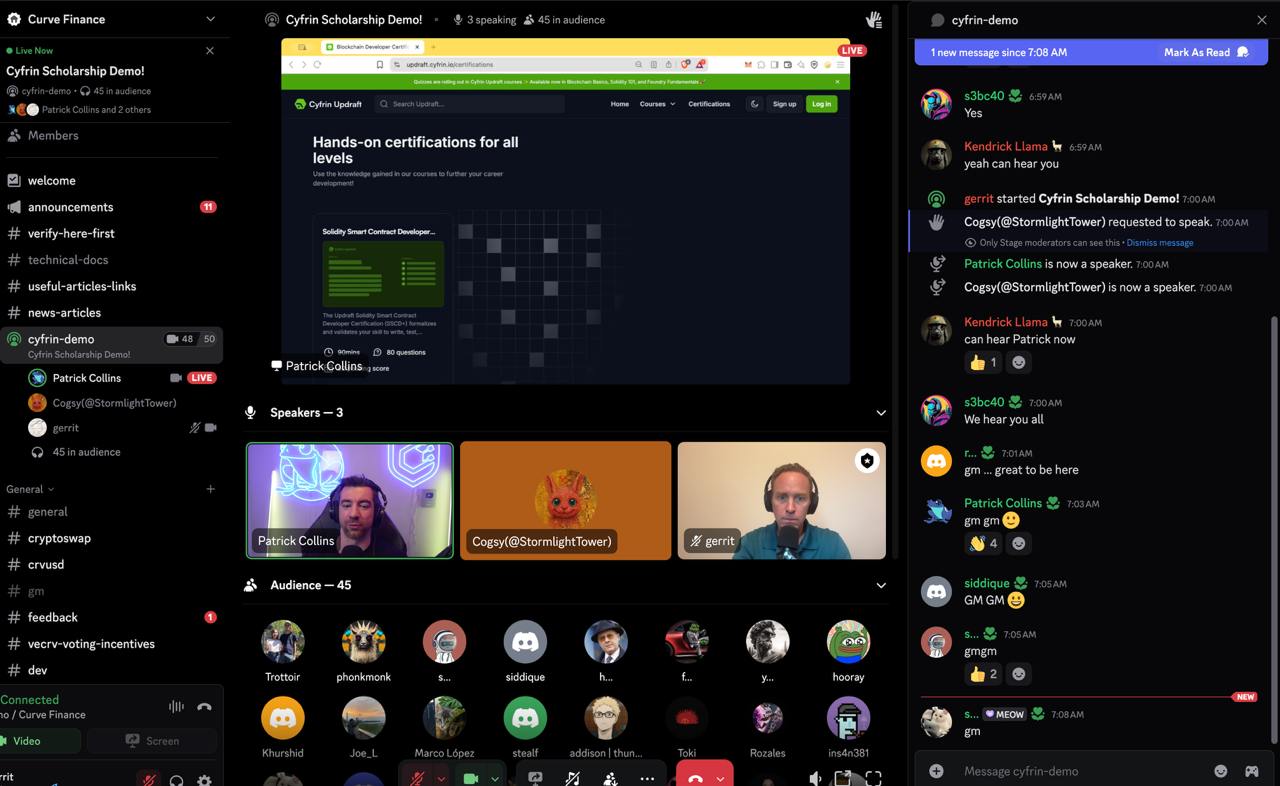 Patrick Collins of Cyfrin Updraft providing a live demo of the Curve coursework, live now in Discord2025-05
A real-time voice, video, and text chat platform organized into community-run servers, Discord has become one of the default gathering places for crypto projects to coordinate communities, run campaigns, and distribute rewards.
Originally built in 2015 for gamers who needed low-latency voice chat while playing together, the platform has grown into a general-purpose community hub with more than 200 million monthly active users and roughly 150 million daily actives. For the crypto industry, it sits alongside Telegram and X as one of the three channels where token communities actually live.
How Discord is structured
Discord organizes communication into servers (also called "guilds"), each of which contains channels for text or voice. Channels can be grouped, gated, and assigned different permissions, which is the feature that makes the platform attractive to crypto teams. A project can keep an open #announcements channel for the public, a #dev channel for contributors, and token-gated areas reserved for holders or for users who have completed specific actions.
Access inside a server is controlled by roles — labels an administrator assigns to members that unlock channels, mention privileges, or status. In crypto communities, roles frequently map to on-chain or contribution-based status. Convex Finance, for example, recently rewarded members who had claimed "OG" or "Veteran" roles in its server with 200 $CVX each as a loyalty gesture, a pattern that depends entirely on Discord's role system as a record of who showed up early.
The platform also supports bots — automated accounts that extend a server's functionality. Bots handle moderation, verification, quest tracking, and "token gating," the process of confirming that a connected wallet holds a particular asset before granting a role. This bot layer is where most crypto-specific functionality is bolted on, since Discord itself has no native blockchain features.

AdEx evolves from blockchain ad network to solving Web3 user fragmentation after nearly a decade.
Why crypto communities adopted it
Three properties drove adoption. First, persistent, topic-segmented chat suits projects that need to run governance discussion, technical support, and marketing in parallel without one drowning out the others. Second, token gating lets teams create exclusivity tied to ownership rather than to an invite list. Third, events tooling — scheduled voice "stages," AMAs, and community calls — matches how crypto projects communicate roadmap updates.
Recent newsroom coverage shows the range of these uses. The Injective Ambassador Program runs scheduled community calls on Discord to discuss program changes and tooling. Horizen launched a series of Discord community calls to surface staking updates, ecosystem momentum, and builder introductions. Kaspa-adjacent communities have used Discord "parleys" to unveil technical proposals. Binance hosts AMAs and game-leaderboard events on its server, including a recent campaign sharing 5,000 USDC in rewards and a 300K-milestone AMA. The common thread is that Discord serves as the synchronous town square where a project's most engaged members assemble in real time, while broadcast channels like Telegram or X reach a wider, more passive audience.
Readers treat Discord compromise alerts as protocol-level threat signals, not platform IT news — the reflexive click on 'PSA: X Discord hacked' is a risk-management act, implying the community has learned that a compromised Discord is the first move in a draining attack.
Rewards, quests, and the campaign economy
A large share of crypto activity on Discord now revolves around structured reward campaigns. Rather than simple chat, projects run quests — sequences of tasks such as joining a server, following an account, or testing a product — that pay out tokens, stablecoins, or allowlist spots.
Ethereum's foundation-affiliated teams launched a Discord quest that reportedly drew 500,000 views and thousands of submissions with weekly crypto rewards. The WOO X Pro ecosystem ran prize pools exceeding $1,400 spread across X, Discord, and Telegram simultaneously. Sui's Walrus storage project wrapped a multi-week "Sessions" builder competition that paid winners in WAL tokens and included a dedicated prize for Discord participants. Builder communities increasingly use Discord-login playtest trackers to tie bug reports back to identifiable contributors.
Tooling vendors have formalized this. Platforms such as Zealy — referenced in the Injective program's expansion — provide quest boards that integrate with Discord roles, turning community participation into a measurable, gamified funnel. The economic logic mirrors a product launch: a project uses time-boxed reward events to convert curious onlookers into role-holding, wallet-connected members ahead of a token generation event, mainnet rollout, or feature release. Cancore's Genesis program and Convex's veteran rewards are variations on the same idea — using Discord status as the ledger of who qualifies for distribution.
Cancore launches Genesis program to reward early adopters and contributors as Mainnet rolls out.
This is generous of them! I hope this continues for those who stay with the project
The AI agent layer
A newer development is the deployment of AI agents directly inside Discord servers. An agent here is an autonomous software actor that can read messages, answer questions, and take actions without a human typing each response.
Gaming-focused communities are early adopters. The Arena platform, which says 100,000-plus gamers compete across titles like VALORANT and Free Fire, introduced an AI community manager named Tío, built with Saga, to engage players across Discord and WhatsApp. The framing in that announcement — "gaming communities are becoming autonomous" — captures the ambition: agents that moderate, onboard, and even transact on a community's behalf. Workshops such as Conflux's "AI Agent Payments on Stablecoins" session, run on its Discord, point toward agents that move value, not just messages. Audiera's appearance on a Binance community Discord call to discuss an "Agent-native economy" reflects the same convergence of AI, on-chain payments, and community chat.
This layer remains experimental. Agents that can act inside a chat where scams already proliferate raise obvious questions about trust and authorization, and most current deployments are scoped narrowly to engagement and support rather than handling funds.
- 01Discord server compromise PSAs
Multiple projects' Discords were hijacked for phishing links, making rapid community warnings the highest-urgency content on this topic.
- 02Governance censorship via Discord
The MakerDAO banning of PaperImperium and GFX Labs raised whether Discord moderation can be weaponized to silence dissent and tilt governance outcomes.
- 03Discord as crypto infrastructure layer
Headlines about MoonPay, Bitkraft, and MEV Scanner integrating with Discord signal that the platform has become load-bearing social infrastructure for Web3 protocols.
- 04Airdrop access failures surfaced on Discord
Dymension claimants used Discord to surface hardware-wallet incompatibilities, showing the platform as the de-facto bug-report venue during high-stakes token events.
- 05Community news bot integrations
Leviathan and other services distributing live DeFi headlines into Discord servers reflect a reader appetite for ambient intelligence inside their existing community hubs.
Security: the platform's central weakness
Discord's openness is also its biggest liability for crypto users, and this is the area where the platform's reputation has deteriorated most. Because anyone can join a server and message members, it has become a primary hunting ground for fraud.
Common attacks include support impersonation (a scammer posing as an admin offering to "help" with a stuck transaction), fake giveaways, malicious links, and compromised official accounts that broadcast drainer links to verified members. Security researchers note that organized networks treat these scams as professional operations with scripts and quotas, and Chainalysis data attributes billions in annual losses to social-engineering on chat platforms. Newsroom items capture the live threat: one project warned that its server was compromised and told members to avoid links and crypto sends; another flagged builders submitting work on a "vulnerable Discord" amid security risks.
The defensive baseline is consistent and worth stating plainly: no legitimate team will ever ask for a seed phrase or private key; official support does not initiate DMs; users should verify a member's role on the official server and cross-check usernames against a project's verified website before trusting anyone. Discord publishes its own deceptive-practices policy, and exchanges including Coinbase have issued guidance on the specific tactics targeting crypto servers.
The security burden has consequences for platform choice. Some founders are reducing reliance on Discord for support precisely because phishing in help channels has proven hard to eliminate even with active moderation. The direction is not uniform, however. Cardano founder Charles Hoskinson said he intends to move community discussion from X to Discord, citing "drama, lies, and endless rage" on the former — a reminder that each platform's tradeoffs are weighed differently by different teams.

RAAC Discord appears to be compromised, do not interact!
I hope many could see the posts
Discord versus Telegram
For crypto specifically, the platform is usually compared to Telegram, and the two serve overlapping but distinct roles. Telegram favors fast, mobile-first broadcast and large open groups, and its bot ecosystem is tightly woven into trading and wallet workflows. Discord favors structured, role-gated communities with richer permissions, threaded discussion, and scheduled voice events.
In practice many projects run both: a Telegram channel for announcements and price chatter, and a Discord server for governance, contributor coordination, and reward campaigns. The WOO X Pro and Binance examples — campaigns spanning X, Discord, and Telegram at once — show that teams treat the three as a portfolio rather than substitutes, distributing the same reward pool across each to maximize reach.
- 2023-04exploit
Arbitrum Discord compromised
- 2023-11governance
PaperImperium banned from MakerDAO Discord
- 2024-04exploit
Ethena Discord hacked
- 2024-04exploit
Renzo Discord compromised amid LRT launch period
- 2024-11milestone
MoonPay acquires Helio for $175M, citing Discord payments use case
- 2025-01exploit
Discord crypto trading bot shut down after critical exploit at $16.5M valuation
The business behind the platform
Discord remains a private company, though that may change. In January 2026 it confidentially filed for an initial public offering, working with Goldman Sachs and JPMorgan toward a potential U.S. listing, after reportedly rejecting an earlier acquisition approach from Microsoft. Valuation estimates have varied widely — secondary markets priced it well below its 2021 peak of roughly $15 billion — and the central scrutiny is monetization, given an estimated $725 million in 2024 revenue against its large user base.
This matters to crypto communities because Discord's revenue comes from Nitro subscriptions and platform features, not from any native crypto integration, and its terms of service have at times sat awkwardly with token-gating and blockchain use cases. A public Discord under shareholder pressure to monetize could expand commerce features, tighten policy enforcement, or both — either of which would ripple through the projects that depend on it.
Outlook
Discord's role in crypto is likely to remain central but increasingly specialized. Expect its strengths — role gating, structured communities, and reward campaigns — to deepen, with AI agents handling more onboarding and moderation, while support functions and high-stakes coordination continue migrating partly to other channels as teams respond to persistent fraud. A successful IPO would pressure the company to monetize, which could reshape how token communities are allowed to operate on the platform. For users, the durable takeaways are unchanged: treat unsolicited DMs as hostile, verify roles and identities through official sources, and never expose private keys — regardless of which server, quest, or reward is on offer.
Latest Discord news
AdEx evolves from blockchain ad network to solving Web3 user fragmentation after nearly a decade.Cancore launches Genesis program to reward early adopters and contributors as Mainnet rolls out.RAAC Discord appears to be compromised, do not interact!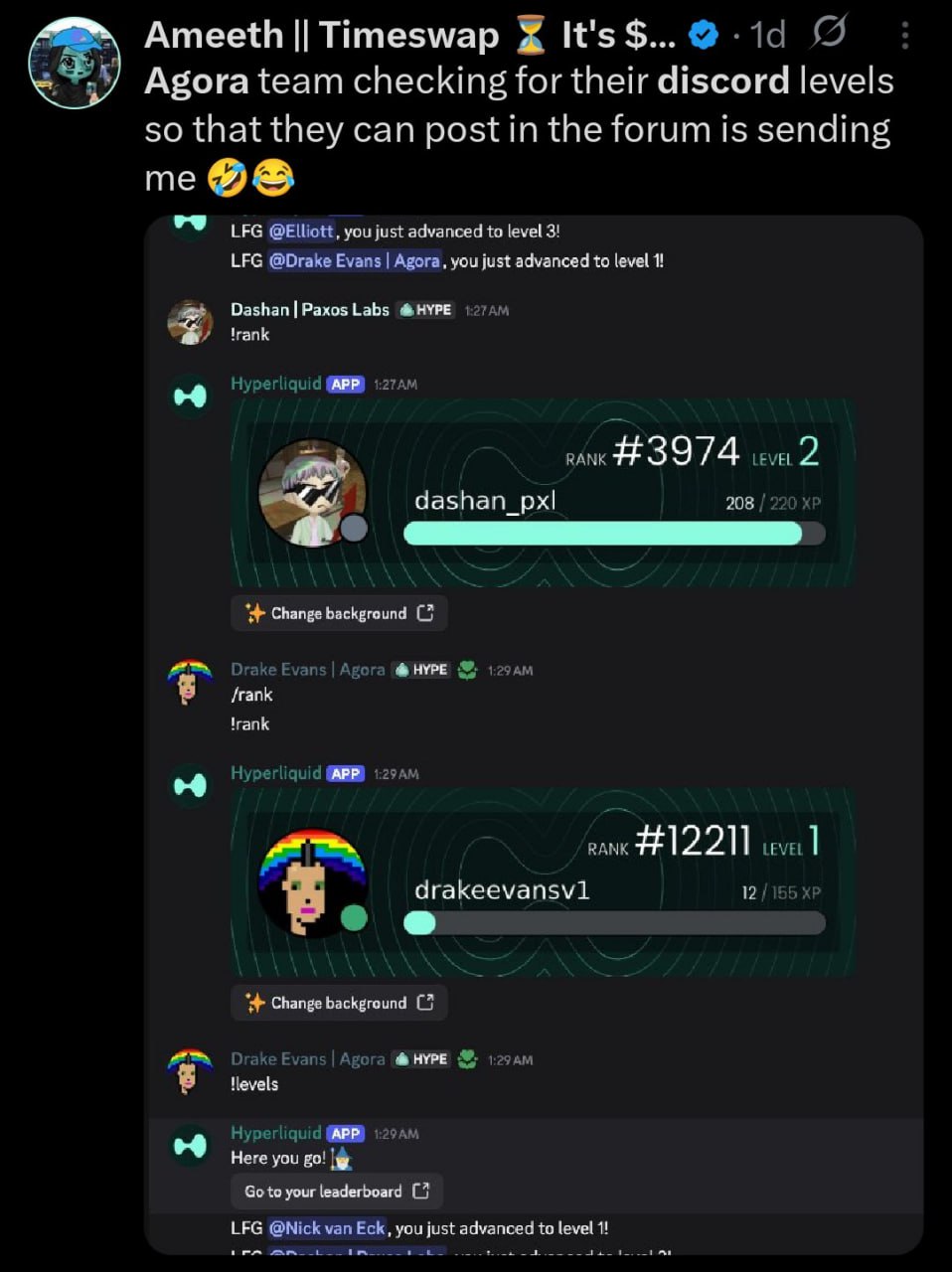 USDH bidding is peak crypto. Bunch of multi-billion dollar companies CEOs having to fight like rats for their lives getting proposals in, but having to speak in cat and role grind discord just to submit. Simply amazing to witness. !rank.
 Leviathan News headline feed now streaming in RAAC Discord. RAAC Bot challenges & rewards coming soon! Want decentralized $SQUID-powered headlines streamed to keep your community informed on the latest DeFi news? Reach out to Leviathan!
 Linea's New Liquidity Hub - With Trantor From Etherex!
Join us live with Trantor to discuss Etherex and building on Linea!
After the interview - the Etherex community call on their Discord!
6 PM EST
10 PM UTC
Linea's New Liquidity Hub - With Trantor From Etherex!
Join us live with Trantor to discuss Etherex and building on Linea!
After the interview - the Etherex community call on their Discord!
6 PM EST
10 PM UTCCommunity notes
Spot something off or out of date? Drop a note. Editors review topic notes daily and roll accepted fixes into the explainer — contributors are recognized in the monthly $SQUID drop.
Loading notes…
Help improve this topic
Have a story or tip about this topic? Submit it. See something missing? Leave a note. Editors review daily; accepted submissions and fixes count toward the monthly $SQUID drop.