
Deep explainer on how Apple’s iOS shapes crypto: security architecture, wallets and exchanges, DeFi and gaming, policy and censorship risks, and the trade-offs versus Android, with guidance for users and developers building on this mobile frontier.
+23 sources across the wider coverage universe
 X launches Custom Timelines powered by Grok, letting users pin niche topics to their home feed with AI-driven personalization, rolling out first to Premium users on iOS2026-04
 Kaspersky flags 26 fake wallet apps on iOS App Store mimicking MetaMask, Ledger, and Trust Wallet — Apple removes all2026-04
 Apple patches iOS bug that let FBI forensically extract deleted Signal messages from iPhone notification cache2026-04
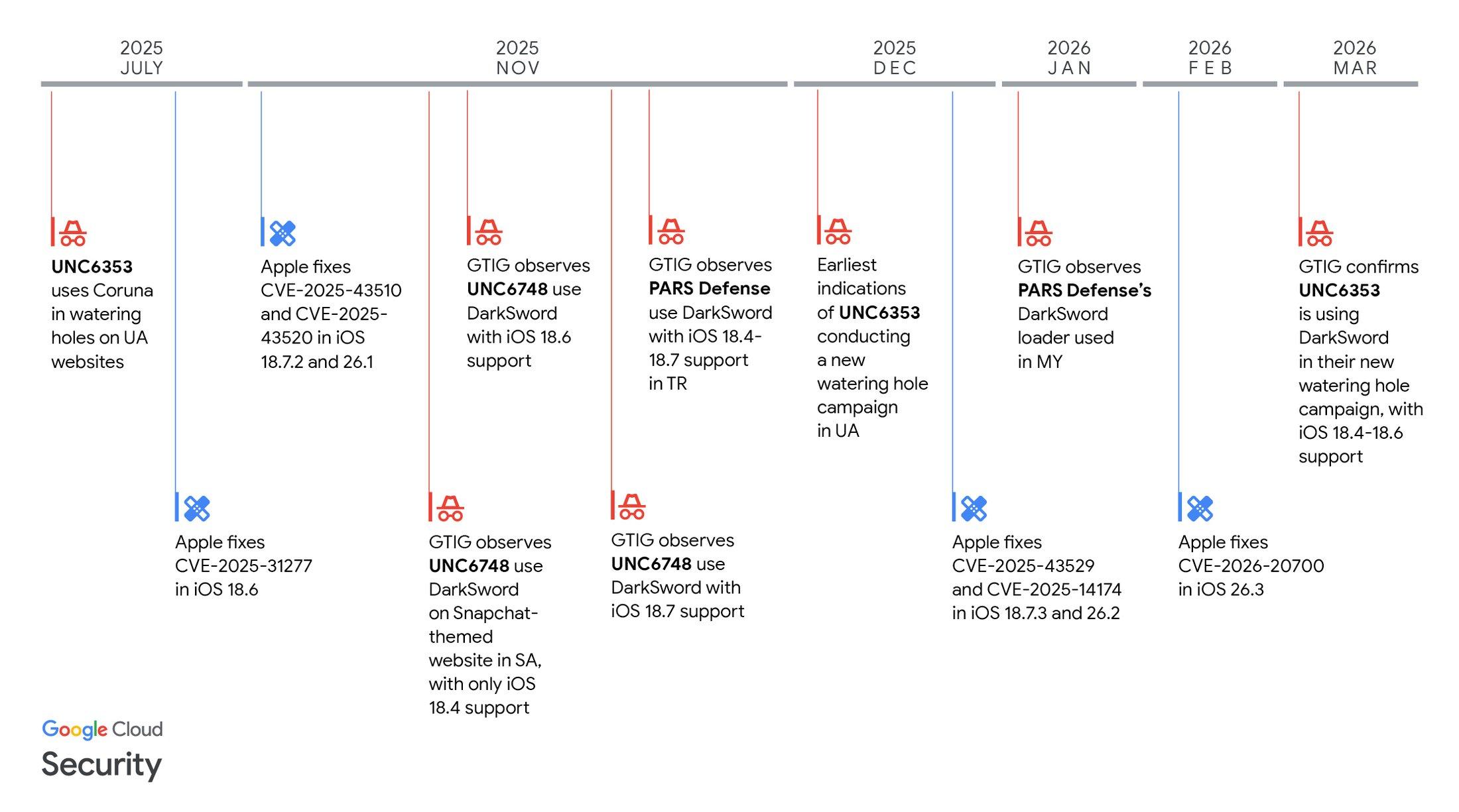 Google exposes DarkSword iOS exploit chain that siphons crypto wallet data from unpatched iPhones via Safari2026-03
 Mobile privacy in 2025 is basically dead on stock Android and iOS. Pixels + GrapheneOS are now the gold standard. If you’re not hardening your device, you’re handing Big Tech your entire life.2025-11
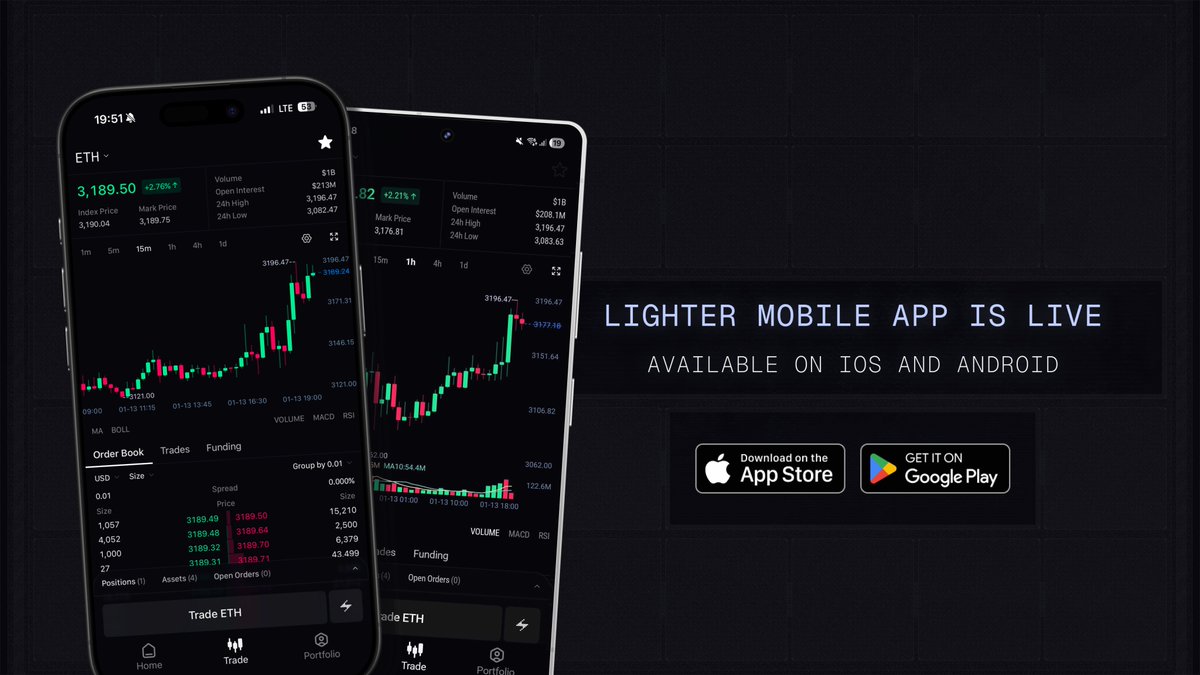 Lighter releases mobile app for iOS and Android, bringing perps and RWAs to handheld devices and launching 100,000 LIT mobile-exclusive trading competition starting Jan 152026-01
iOS and Crypto: How Apple’s Mobile Platform Became a Frontline for Digital Assets
iOS is Apple’s mobile operating system that powers iPhones and iPads, and it has quietly evolved from a general-purpose smartphone platform into one of the most important interfaces for storing, trading, and spending cryptoassets. For the crypto ecosystem, iOS now functions as a high-stakes environment where security architecture, app store policies, user experience design, and global regulation intersect to shape how millions of people interact with digital money every day.
iOS in Context: From Mobile OS to Financial Infrastructure
Understanding iOS in a crypto context starts with recognizing that it is not merely an operating system but a tightly integrated stack of hardware, software, and services overseen by Apple. This vertical integration gives Apple unusual control over what software runs on the platform, how it accesses hardware security features, and how it is distributed and monetized. That control has significant implications for crypto, because wallets, exchanges, and DeFi frontends must operate within Apple’s rules if they want access to the vast iPhone user base. For many users, the crypto experience is not “on Ethereum” or “on Aptos” in a practical sense; it is “on my iPhone,” framed by iOS-level permissions, notifications, app updates, and security prompts.
The evolution of iOS has mirrored a broader shift in smartphones from communication devices to financial command centers. Banking apps, neobrokerage platforms, and payment services normalized the idea that a phone is a primary interface for savings, trading, and day‑to‑day spending. Crypto applications—custodial exchanges, non‑custodial wallets, games, and stablecoin payment apps—have followed that path, slotting into an ecosystem where users expect always‑on connectivity, biometric authentication, and seamless integrations with contact lists and messaging. As a result, design choices by Apple’s iOS team, from notification behavior to biometric APIs, become de facto policy decisions for how digital assets are used in the wild.
Apple has also positioned iOS as part of a broader family of platforms that share a common design language and security philosophy, including macOS, watchOS, and visionOS. This cross‑platform approach has interesting consequences for crypto. A wallet or exchange that starts on iOS can potentially extend to macOS, creating a multi‑device experience where a user checks balances on their watch, conducts larger transactions on a laptop, and monitors markets on an iPhone. Features like Apple Intelligence and an updated Siri, rolling out across iOS 27 and other Apple operating systems, hint at a future where AI‑mediated assistance may be layered on top of financial and blockchain activity. These directions underscore why crypto teams increasingly treat iOS as a strategic platform, not a secondary interface.
At the same time, Apple’s emphasis on design coherence and controlled distribution comes with trade‑offs. The App Store is the mandatory distribution channel for most users, and Apple’s App Review Guidelines shape what crypto teams are allowed to deploy and how quickly they can iterate. While this gatekeeping can filter out obvious malware and improve baseline security, it also introduces frictions and uncertainties that are especially sensitive in crypto, where protocols change rapidly, regulatory interpretations lag, and new financial primitives—from perpetual futures to confidential transactions—need to be tested in production. The story of iOS in crypto is, therefore, a story of negotiation: between innovation and control, between security and openness, and between Apple’s priorities and the needs of users whose primary assets may now live on their phones.

X launches Custom Timelines powered by Grok, letting users pin niche topics to their home feed with AI-driven personalization, rolling out first to Premium users on iOS
Security Architecture: How iOS Protects (and Exposes) Crypto Users
Sandboxing, Hardware Security, and the Promise of a “Safer” Phone
A central reason crypto developers and high‑value users pay close attention to iOS is its security model. Apple designed iOS around strict application sandboxing, which isolates each app from others and from sensitive parts of the system. This architecture, combined with code signing and mandatory distribution through the App Store for mainstream users, makes it substantially harder for mass‑market malware to spread compared with more open ecosystems. For crypto, this reduces some risks that plague desktop environments, such as arbitrary keyloggers or clipboard‑stealing malware silently intercepting seed phrases.
Under the hood, modern iPhones rely on hardware features such as the Secure Enclave, a dedicated coprocessor that handles sensitive operations like biometric authentication and key storage. While Apple does not expose the Secure Enclave as a general‑purpose hardware wallet for arbitrary crypto keys, its use for device unlock and some payment flows shapes user expectations and can indirectly protect crypto apps by encouraging widespread adoption of Face ID or Touch ID as a second factor. When a crypto wallet integrates biometrics for transaction approval, it is effectively piggybacking on this hardware security model, even though the underlying private keys are usually managed in OS‑level keystores or the app’s own encrypted storage.
The security architecture also includes permission frameworks governing access to cameras, microphones, contact lists, and local networks. These are not uniquely “crypto features,” but they are highly relevant. For example, a wallet that reads QR codes for addresses or connects to local hardware devices must request camera or network permissions, and misconfigurations can create privacy leaks. Apple’s evolving privacy prompts and indicators—such as the visual cues when an app uses the camera or microphone—give users more visibility into sensitive operations, but they also complicate wallet UX design. Developers must strike a balance between asking for enough permissions to deliver functionality and not overwhelming users with prompts that they do not understand or that they reflexively deny.
Finally, Apple’s investment in secure defaults extends to software update mechanisms. iOS updates are delivered centrally and, for supported devices, often adopted relatively quickly compared with the fragmented Android ecosystem. From a crypto risk perspective, this means that critical security patches—for example, for WebKit bugs or kernel exploits—can be rolled out to many users in a short timeframe, reducing the window of exposure. However, the reliance on OS updates also creates situations where new app features or security fixes require users to be on particular iOS versions, and those with older devices or constrained data plans can lag behind, creating a long tail of vulnerable users.
App Review, Malware, and the Limits of Platform Gatekeeping
Apple’s App Store Review Guidelines are often presented as a line of defense against malicious or low‑quality apps, including in the financial and crypto categories. The guidelines are divided into sections such as Safety, Performance, Business, Design, and Legal, and they explicitly address issues like fraud, deceptive behavior, and user data protection. In principle, this means that obviously malicious crypto wallets or fake exchanges should be caught at review time, preventing them from reaching end users. This centralized screening has helped foster a perception that downloading from the App Store is intrinsically safer than sideloading or using uncurated markets.
In practice, however, the crypto space has seen concrete examples of the limits of this model. Researchers at Kaspersky reported discovering twenty‑six fake crypto wallet apps on the iOS App Store, mimicking well‑known brands such as Ledger, Trust Wallet, and MetaMask. These applications apparently passed Apple’s review process despite being designed to trick users into entering seed phrases or otherwise compromising their funds. Apple subsequently removed the apps after being alerted, but the episode illustrates that App Store review is not a guarantee of authenticity in the fast‑moving world of crypto branding and forked codebases. For a user who types “Ledger” into the App Store search box, a convincing impostor can be almost indistinguishable from a legitimate client.
This tension is particularly acute in crypto because many projects are open source, and cloning a wallet’s public interface is relatively easy. A malicious actor can copy the design of a reputable app, change a few lines of code to redirect recovery phrases to their own server, and submit it under a similar name. Even if Apple eventually cracks down, the period between launch and removal can be sufficient for significant theft. The Kaspersky case underscores the importance of independent verification by users, such as following official links from a protocol’s website or social accounts, rather than relying solely on App Store search results.
For developers, Apple’s guidelines can also be double‑edged. On the one hand, clearly articulated expectations around user safety push teams toward better practices in onboarding, disclosure, and error handling. On the other hand, the guidelines’ business and legal sections can constrain innovation in areas like non‑custodial wallets, decentralized exchanges, or tokenized securities, where rules about fees, KYC, and jurisdictional compliance may be in flux. Crypto teams operating on iOS have to design not only against technical threats but also against the possibility of app rejection or removal based on evolving interpretations of Apple’s policies.
Advanced Threats: Pegasus, Forensics, and Notification Leaks
While Apple’s marketing often emphasizes privacy and security, the history of iOS vulnerabilities shows that the platform is not immune to sophisticated attacks. Pegasus, the commercial spyware suite developed by the Israeli firm NSO Group, famously exploited multiple zero‑day vulnerabilities in iOS to silently compromise target devices, exfiltrating messages, calls, and other data without user awareness. Pegasus campaigns highlighted that state‑level or well‑resourced actors can pierce even hardened mobile operating systems when there is sufficient incentive, and high‑net‑worth crypto holders or politically exposed persons may fall squarely within the threat models of such actors.
Beyond zero‑day exploitation, forensic analysis has revealed more mundane but still concerning data leakage paths related to app notifications. Reporting on a U.S. criminal case showed that the FBI was able to forensically extract copies of incoming Signal messages from an iPhone’s notification database, even after the Signal app itself had been deleted. These notifications, which might include message content depending on user settings, were stored in iOS system structures that persisted beyond the app’s removal and were accessible through forensic tools. For privacy‑conscious crypto users who discuss key management, transaction details, or operational security in supposedly secure messaging apps, such leaks can introduce unexpected exposure.
Apple has responded over time by patching specific vulnerabilities and tightening how notifications and system logs handle sensitive content, but the broader lesson is that iOS’s security is an evolving process rather than a static guarantee. Users can mitigate some risks through settings—for example, disabling message previews on the lock screen or opting for minimal notification content—but they cannot entirely control what is stored at the OS level. For crypto, where the confidentiality of seed phrases, multisig coordination messages, or OTC deal terms may be critical, it is risky to assume that using an encrypted messenger on iOS automatically eliminates forensic footprints.
These advanced threats also interact with crypto‑specific features like push notifications for price alerts or transaction confirmations. Many wallets and exchanges send rich notifications with token names, amounts, and partial addresses. If these are logged in notification databases or accessible in backups, they may create a detailed time‑stamped trail of a user’s trading and DeFi activity, even if on‑chain addresses are pseudonymous. This interplay between system‑level logging and financial metadata is not unique to iOS, but Apple’s deep integration of services and strong incentives for iCloud backup mean that users must think carefully about their threat models when enabling convenience features.
Hardening iOS for High-Value Crypto Holders
Given these realities, sophisticated crypto users increasingly treat iOS as part of a broader operational security posture rather than as an inherently safe environment. Security practitioners often recommend baseline hardening steps for iPhones that hold or manage significant digital assets, including aggressive update practices, conservative app installation, and minimizing the number of apps with broad permissions. Although the specifics can vary, the goal is to reduce the attack surface and limit the potential impact if one layer of defense fails.
One common strategy is to segregate roles across devices. A user might maintain a primary iPhone for general communication, social apps, and lower‑value wallets, while reserving a secondary device—updated, stripped of non‑essential apps, and perhaps kept mostly offline—for managing larger holdings or signing high‑value transactions. Such a “clean phone” setup does not eliminate exploitation risks, but it narrows the pathways through which a compromise is likely to occur. When combined with hardware wallets for long‑term storage, this can significantly reduce the chance that a single iOS compromise results in catastrophic loss.
Configuration settings also matter. Features like automatic iCloud backups, while convenient, can potentially duplicate sensitive wallet data or private information to cloud storage. Many non‑custodial wallets explicitly avoid backing up seed phrases to iCloud, but users may still store screenshots, notes, or other hints that, if synced, could be abused. Turning off unnecessary sync features, reviewing which apps have access to contacts and photos, and disabling lock screen previews for sensitive apps can collectively reduce exposure. For those at heightened risk, more radical steps—such as turning off iMessage, limiting notification content, or using “Lockdown Mode” where available—may be warranted when handling high‑value keys.
Finally, high‑value crypto users must consider supply‑chain and ecosystem risks. Even if their own device is carefully hardened, interactions with third‑party apps, exchanges, and dapps can introduce vulnerabilities. Balancing convenience and control often means opting for minimal, well‑audited app stacks and being wary of brand‑new wallets or trading interfaces that lack a security track record. On iOS, where App Store presence can lend a false sense of legitimacy, this kind of skepticism is particularly important.
Leviathan readers click iOS + crypto stories almost exclusively when a phone-level exploit creates a direct path to wallet theft — app launches and OS updates only spike when the framing is 'your keys are at risk right now,' not 'new feature available.'
The iOS Crypto App Landscape
Custodial Exchanges: Coinbase and the CeFi–Mobile Bridge
Custodial exchange apps are often the first touchpoint between mainstream users and crypto on iOS. Coinbase’s official app for iPhone and iPad positions itself as a trusted platform to buy, sell, trade, stake, and earn across crypto, stocks, prediction markets, derivatives, and more. By packaging both digital assets and traditional securities into a single interface, Coinbase effectively turns iOS into a multi‑asset brokerage terminal, where users can move between Bitcoin, tokenized markets, and equities without leaving the app. This convergence underscores how mobile platforms blur the boundary between crypto and legacy finance.
For many users, custodial apps offer a comparatively gentle onboarding experience. They abstract away private key management, provide familiar features like two‑factor authentication and customer support, and often integrate with fiat on‑ramps such as bank transfers or card payments. On iOS, where Apple Pay and the device’s secure element are already normalized, the conceptual leap from tapping to buy coffee to tapping to buy ETH is relatively small. Exchange apps leverage this muscle memory, and their presence on both iOS and Android reinforces the perception that crypto is simply another asset class accessible via the same devices used for everything else.
At the same time, custodial apps on iOS embody a key trade‑off. Users gain convenience and, in some cases, regulatory protections, but they do so by entrusting their assets and data to centralized entities. For iOS users in jurisdictions where certain tokens are restricted, the app’s behavior can be shaped by exchange compliance constraints and geofencing, not by the capabilities of the underlying blockchains. Regional differences—for example, which tokens are available to New York residents—are encoded into the app experience alongside UI elements and notification settings. When Coinbase extends support for additional assets in its iOS and Android apps, such as Wrapped Ronin or Centrifuge for particular user segments, it is effectively pushing a policy decision to millions of devices at once.
Self-Custodial Wallets and DeFi Gateways
On the other side of the spectrum, self‑custodial wallets on iOS position the device as a direct interface to blockchains, with private keys held under user control. Petra, the Aptos wallet built by Aptos Labs, is a clear example. The Petra iOS app allows users to store, manage, and use assets on the Aptos network, functioning as a gateway to that ecosystem’s tokens and dapps. Aptos Labs has also introduced Confidential APT, an opt‑in privacy feature on mainnet that encrypts transaction amounts and balances, while keeping sender and recipient addresses visible, and Petra became the first mobile wallet to integrate this capability on both Android and iOS. That integration illustrates how iOS can serve as a vehicle for advanced on‑chain privacy features, provided wallets expose appropriate controls and explanations.
These self‑custodial wallets often go beyond simple transfers. They integrate staking, DeFi protocol access, NFT viewing, and governance participation into a single mobile interface. For chains like Aptos, mobile‑first design is particularly salient because many users in emerging markets treat their phones as their primary or only computing device. An iOS app that supports Confidential APT, for instance, brings privacy‑enhancing technology to a potentially global user base without requiring a desktop client. However, it also raises educational challenges: users must understand what is and is not concealed on‑chain, how view keys work if they exist, and what legal implications private balances might entail in their jurisdictions.
Multi‑chain wallets and ecosystem‑specific clients coexist on iOS, ranging from Bitcoin‑only applications to generalist tools that support dozens of networks. Interoperability features such as WalletConnect, deep links, and universal links enable iOS browsers and apps to hand off signing requests to wallets, turning the phone into a secure signing oracle for web‑based dapps. This architecture can be powerful but also fragile; misconfigured deep links or phishing campaigns exploiting URL schemes can trick users into authorizing unintended transactions. On iOS, the closed environment reduces some kinds of malware but does not remove the cognitive attack surface created by complex signing flows and multiple apps vying for default wallet status.
New wallets continue to arrive with specialized value propositions. Projects like Verge Slim, a light client for the Verge currency ecosystem, have been standardizing on specific mnemonic formats and seed lengths across platforms, announcing the adoption of an 18‑word wallet standard on Windows, macOS, and Linux, with an iOS version following on a short delay. That kind of cross‑platform standardization makes it easier for users to back up and restore wallets across devices, but staggered launches also highlight the fact that iOS support often trails desktop or Android in time‑sensitive upgrades. For protocol communities, the lag between launching a new mnemonic standard or feature and shipping iOS support can be a period of elevated risk if users are caught between incompatible wallet versions.
Self‑custodial, mobile‑first products are also becoming more sophisticated on the payments side. The Firma team, for example, has launched an iOS beta for a product offering stablecoins, self‑custodial accounts, and global transfers built on the eCash infrastructure, with early commentary highlighting the combination of stable value and user‑controlled keys. Such applications frame iOS devices as conduits for cross‑border money movement that does not depend on traditional intermediaries, yet they must still operate within Apple’s app policies and each jurisdiction’s regulatory environment. This dual accountability—to on‑chain rules and off‑chain app store and legal requirements—defines much of the iOS self‑custodial landscape.
Payments, Gift Cards, and Real-World Spending
Beyond investment and DeFi, iOS has become a venue for spending crypto or crypto‑adjacent value in everyday contexts. One illustrative model is the use of gift card platforms that accept cryptocurrency payments. eGifter, for instance, allows users to buy gift cards with Litecoin via its website or through its mobile apps on iOS and Android. Through this interface, an iOS user can effectively convert LTC into store‑specific credits usable at mainstream retailers, without directly touching a bank account or traditional card rails. For practical purposes, the phone becomes a relay between on‑chain funds and off‑chain goods and services.
Stablecoin‑based payment apps, such as those built on networks like eCash, push this concept further by providing stable value denominated in fiat currencies for remittances or merchant payments. When such apps are deployed as self‑custodial clients on iOS, they can offer low‑friction experiences that resemble neobank apps while preserving some of crypto’s censorship resistance and global reach. However, they must navigate not only technical security but also app store compliance, including clarifying how they handle KYC, fraud, and chargebacks in an environment where Apple expects clear accountability for financial services.
Fintech and social platforms are also edging closer to native crypto functionality on iOS. X Money, for example, appears in the App Store as a budgeting and expense tracking app with multi‑currency support and more advanced features for users looking to centralize “all your money moves” on iPhone. While X Money’s core proposition is currently framed around traditional finance, its tight coupling with the broader X platform—which has introduced Cashtags, real‑time charts, and financial data displays—creates an obvious path for future integration with tokenized assets and crypto rails. On iOS, where X also controls a high‑engagement social feed, the line between chatting about a stock or token, seeing a chart, and taking action through a linked financial app is getting progressively thinner.
Specialized Trading Apps and Derivatives
As crypto markets have matured, derivatives, options, and structured products have moved from niche to mainstream for active traders, and iOS is increasingly a first‑class environment for accessing these markets. Aevo, a derivatives‑focused platform, offers trading in options, perpetual futures, and other products within a single margin account, using a hybrid model of off‑chain matching with on‑chain settlement on Ethereum. Its mobile interface is optimized for trading on phones, and the project has emphasized delivering a responsive mobile experience that complements its web interface. Although Aevo’s current mobile focus has been more pronounced on Android, the platform has flagged iOS support as a priority, with caveats around jurisdictional exclusions such as the U.S. and U.K. to comply with regulatory constraints.
For iOS users, this kind of app brings institutional‑grade trading mechanics to a handheld device, but it also amplifies certain risks. Leveraged products are sensitive to latency, slippage, and rapid market moves—conditions under which mobile connectivity issues or UI mis‑taps can be expensive. Apple’s policies around financial apps and gambling have historically required clear disclosures about risk, and derivatives platforms must adapt their onboarding flows accordingly to satisfy App Review while still serving sophisticated traders. From a broader ecosystem perspective, the rise of mobile derivatives trading implies that liquidations, volatility spikes, and cascading margin calls can increasingly be triggered from pockets and public transit, not just from multi‑monitor trading desks.
Specialized trading apps also intersect with social and content platforms on iOS. X’s Cashtags feature, which launched initially in the U.S. and Canada and later expanded globally for iOS users, shows real‑time financial data when users tap on tagged ticker symbols. The platform has iterated on charting capabilities, introducing larger charts that can be embedded into posts and expanded before sharing, with availability on iOS and web. This kind of integration invites a more impulsive, attention‑driven style of trading, as users can see charts, commentary, and sentiment in one place and then pivot to a trading app with a few taps. For crypto markets, which already exhibit high volatility and meme‑driven dynamics, the blending of real‑time price feeds into social iOS experiences may intensify speculative cycles and create new behavioral risks.
Web3 Gaming and Game Hubs on iOS
Gaming has long been a major driver of app engagement on iOS, and Web3 projects are increasingly trying to tap into that distribution channel. Some approaches rely on streaming or remote play to bring PC games to phones; the GameHub app, for example, allows users to play PC games on an iPhone or iPad while also providing calibration tools for game controllers, requiring at least iOS 17. While GameHub itself is not a crypto wallet, a number of Web3‑enabled games use similar patterns to offload heavy computation or graphics to other machines while exposing tokenized economies and NFTs through mobile‑friendly interfaces.
At the store and platform layer, alternative app ecosystems such as ONE Store are positioning themselves as bridges between traditional mobile gaming and Web3. ONE Store, backed by tens of millions of installs, has articulated a strategy to function as a full‑stack game hub for Web2 games in markets like Korea, while evolving into a Web3 game store globally, with plans to reach iOS users. This vision implies an ecosystem where discovery, social features, gameplay, and tokenized asset management are intertwined, potentially abstracting away some of the complexity of wallets and cross‑chain bridges. For iOS, whose App Store rules around NFTs and crypto have sometimes been restrictive, the emergence of game‑hub layers and cross‑platform stores raises questions about how much Web3 functionality can be embedded without running afoul of Apple’s guidelines.
On the ground, Web3 games on iOS often operate within constraints such as limited on‑device minting, reliance on external marketplaces, or use of custodial in‑game wallets to simplify user onboarding. Some titles adopt hybrid monetization models that combine in‑app purchases via Apple’s payment system with off‑app token mechanics. As iOS versions of popular Web3 games roll out alongside Android and PC clients, developers must navigate both gameplay balance and regulatory considerations, especially when tokens are traded as speculative assets. The ability of iOS to reach casual gamers who might never consciously download a “wallet” app makes it a potent channel for mainstreaming crypto, but also a sensitive one for regulators concerned about youth exposure and gambling‑like mechanics.
iOS vs Android for Crypto: Openness, Security, and Launch Dynamics
Platform Openness, Sideloading, and Store Policies
The relationship between iOS and Android is central to any serious discussion of mobile crypto. Android, largely stewarded by Google, has historically been more permissive about sideloading apps and using alternative app stores, giving users and developers more freedom but also more responsibility. On Android, crypto teams can distribute APKs directly, partner with third‑party stores, or experiment with features that might violate the policies of a major platform, at the cost of fragmenting their user base and potentially exposing users to greater malware risk. This openness has made Android a common initial target for experimental or high‑risk crypto applications.
By contrast, iOS has traditionally restricted app installation to the official App Store for most users, enforcing a centralized review process and tighter technical controls. Apple’s App Store Review Guidelines reflect not only technical and UX criteria but also business and legal considerations, meaning that some categories of crypto app—especially those involving unregulated securities, high‑leverage trading, or alternative payment rails—face more hurdles to approval. This centralization can slow the launch of new features or delay parity with Android versions, but it also filters out certain obvious abuses and provides a single point of policy negotiation for major crypto companies.
The question of sideloading on iOS is evolving, particularly in response to regulatory pressures in some jurisdictions that seek to force open mobile ecosystems. If iOS were to embrace broader sideloading or third‑party app stores, it could significantly change the calculus for crypto distribution. On one hand, it might allow more experimental DeFi clients, non‑KYC exchanges, or regionally disfavored apps to reach users; on the other hand, it could weaken some of the protective benefits of Apple’s curation, leading to an increase in malware or fake wallets. The Kaspersky example of fake wallet apps slipping past App Review suggests that centralization is not a panacea, but it remains a meaningful guardrail.
Feature Parity, Launch Timing, and Regional Frictions
Launch timing across platforms often reveals underlying priorities and constraints. Several recent projects have rolled out new features or even entire apps on Android first, with iOS following later. Derivatives platform Aevo has emphasized its Android mobile experience while promising iOS support in the near term, partly because of Apple’s stricter rules and partly because some features are restricted for users in jurisdictions such as the United States and the United Kingdom. Similarly, DashPay’s integration of decentralized swaps via Maya Protocol initially went live on Android, with the team signaling that iOS support would follow. In the Verge Slim wallet ecosystem, adoption of an 18‑word mnemonic standard has been implemented across desktop platforms, with the iOS app lagging by a couple of weeks.
These patterns highlight how iOS can function as a bottleneck in bringing crypto innovation to mobile. A protocol might finalize its smart contracts and backend infrastructure, ship Android clients, and still spend weeks or months navigating the App Review process, adjusting UI language, or modifying features to comply with Apple’s guidelines. During that period, users on different platforms may experience different capabilities and security postures, potentially fragmenting communities and complicating support. For example, if Android users can access a new swap feature while iOS users cannot, documentation, tutorials, and risk disclosures must account for platform differences.
Regional frictions further complicate this picture. Because iOS apps are typically distributed via country‑specific App Stores tied to Apple IDs, developers can implement geofencing at the download level as well as within the app. Derivatives platforms like Aevo, which exclude certain jurisdictions due to regulatory compliance concerns, can combine App Store restrictions with in‑app checks to enforce these rules. Android’s broader distribution options make it somewhat harder to fully block users from downloading an APK, even if geofencing is applied at the service level. In practice, this means that iOS users may face more rigid access controls for certain high‑risk or regulatory‑sensitive crypto services.
UX Differences and Developer Choices
User experience on iOS and Android also diverges in ways that affect crypto adoption. iOS is known for consistent hardware profiles, a relatively narrow set of screen sizes, and tight integration of system UI conventions. This homogeneity simplifies design and testing for crypto apps, allowing teams to invest in polished, predictable workflows for onboarding, transaction signing, and multi‑factor authentication. Android, in contrast, must support a wider array of device capabilities and OS versions, which can make it harder to ensure that complex flows—such as hardware wallet pairing via Bluetooth or secure QR scanning—work uniformly across the installed base.
Developers’ choices about which platform to prioritize are shaped by these UX and fragmentation considerations as well as by user demographics. High‑income, institutional, or North American user segments skew more heavily toward iOS, while Android dominates in many emerging markets where mobile‑only users drive significant crypto volume. DeFi‑focused and NFT‑heavy products often seek iOS presence early because of the platform’s association with high‑value users and cultural cachet, while experimental protocols or regionally targeted remittance services may emphasize Android first.
On the developer tooling side, the iOS ecosystem encourages native development in Swift or Objective‑C and offers frameworks like SwiftUI for building responsive interfaces. Crypto‑specific SDKs are emerging for decentralized storage and on‑chain data access; for instance, community projects like the iWalrusSDK provide Swift tooling for iOS and macOS developers to upload, download, and cache data on decentralized storage networks such as Walrus. These SDKs fold into native app architectures, enabling iOS apps to interface directly with decentralized infrastructure without sacrificing the performance and UX benefits of native code.
To crystallize some of these differences, it is helpful to compare iOS and Android as crypto platforms along several dimensions.
| Dimension | iOS (Apple) | Android (Google/others) |
|---|---|---|
| App distribution | Primarily via Apple App Store with centralized review and guidelines. | Google Play plus third‑party stores and sideloading; more fragmented policies. |
| Malware/fake app risk | Lower baseline but non‑zero; fake wallet apps have slipped through review. | Higher baseline due to sideloading and varied curation; user vigilance critical. |
| Launch timing for new crypto features | Often delayed relative to Android due to stricter review and policy negotiation. | Frequently used as first launch platform for experimental features or new protocols. |
| Regulatory geofencing | App Store distribution tied to region; easier to enforce strict download‑level restrictions. | Harder to prevent APK downloads; geofencing usually enforced at service level. |
| Device fragmentation | Limited range of hardware and OS versions; easier to optimize UX. | Wide range of devices and OS versions; UX can be inconsistent. |
This comparison underscores that neither platform is universally “better” for crypto; rather, they offer different trade‑offs. iOS’s controlled environment provides security and predictability at the cost of slower iteration and tighter policy constraints, while Android’s openness fosters experimentation but demands more from both developers and users in managing risk.

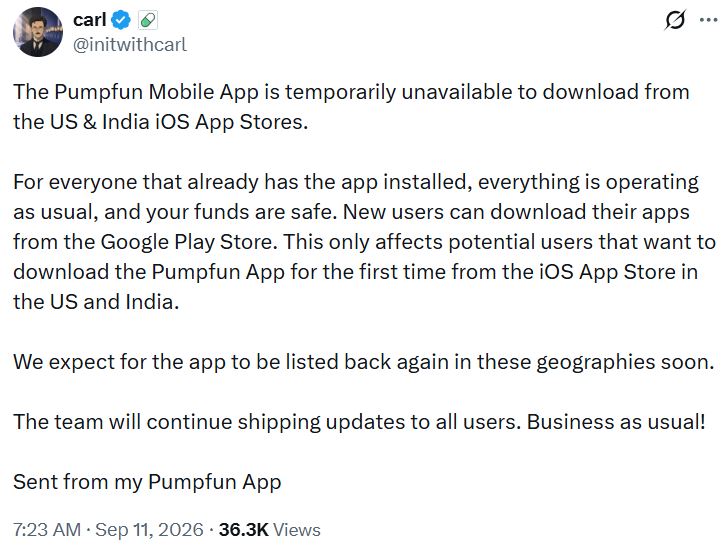
Pump.fun iOS app temporarily pulled from US and India App Stores, team says funds are safe
Policy, Censorship, and Economic Risks on iOS
Apple’s App Review Rules and Crypto
Apple’s App Store Review Guidelines explicitly cover financial apps, including those dealing with virtual currencies, and address issues ranging from fraud prevention to legal compliance. Apps that facilitate the transmission of money, whether fiat or crypto, must often partner with licensed financial institutions or demonstrate that they are authorized under applicable law. For centralized exchanges and regulated neobrokers, this is a manageable requirement, but for decentralized protocols designed to be permissionless, mapping those architectures onto Apple’s compliance expectations can be challenging.
Historically, Apple has been wary of apps that circumvent its in‑app purchase system for digital goods, and it has sometimes applied these rules to NFT marketplaces or token sales, requiring the use of Apple’s payment rails and associated fees for certain in‑app transactions. While incremental policy shifts and court rulings have chipped away at some of Apple’s restrictions, the company still wields substantial discretion over how crypto‑related monetization is handled. This can affect everything from the viability of micro‑transaction‑heavy NFT games to the design of staking interfaces that reward users with protocol tokens.
For non‑custodial wallets that do not directly process fiat or act as financial service providers, the primary compliance burden is to avoid facilitating illegal activity or violating sanctions. However, Apple may still scrutinize features like privacy coins, mixers, or protocols that could be perceived as enabling untraceable transactions. The integration of privacy features like Confidential APT into mobile wallets such as Petra must be framed carefully, emphasizing opt‑in use and transparent documentation of what is visible on‑chain. If Apple deems certain privacy technologies too risky, it could pressure developers to limit or disable those features on iOS, even if they remain available on Android or desktop.
Carrier Lock-In and App Blocking in iOS 27
A more recent axis of concern for crypto users is the emerging possibility of carrier‑level leverage over app availability on iOS. Reports based on strings found in iOS 27 have suggested that Apple is working on a feature that would allow carriers to block access to most apps on an iPhone if the user falls behind on their bill payments. The referenced string indicates that if a balance is not paid by a contract‑specified time, the carrier “may block access to most of your apps and their associated subscriptions on this iPhone.” While details are still evolving, the implication is that non‑payment of a telecom bill could trigger a broad clampdown on app usage enforced at the OS level.
For crypto, this introduces a novel form of economic risk. If wallets, exchanges, and payment apps can be rendered unusable because of a carrier dispute, a user’s practical access to their digital assets may be impaired even though the underlying blockchains remain permissionless. In emergencies—such as political unrest, capital controls, or personal crises—the ability to transact with crypto is often cited as a resilience benefit. But if the device itself can be locked down to the point where most apps cannot launch, that benefit is partly undermined. The reported iOS 27 behavior suggests that carrier relationships and contract terms may become another factor in crypto users’ operational risk management.
There are also strategic implications. Carriers and platform owners could, in principle, use such capabilities as leverage in business negotiations or respond to state mandates to restrict access to particular categories of app. While it is speculative to assume worst‑case scenarios, the mere existence of carrier‑mediated app blocking at the OS level increases the system’s collective attack surface. Users who rely heavily on iOS for crypto may want to consider redundancies, such as secondary devices, hardware wallets, or cross‑platform access strategies, in case their primary phone becomes constrained by factors unrelated to the blockchain.
Jurisdictional Compliance, KYC, and Geofencing
iOS apps that provide access to financial services, including crypto, must reckon with a patchwork of regulations across regions and asset types. Custodial exchanges incorporate KYC procedures into their iOS onboarding flows, collecting identity documents and personal data as dictated by local laws. Derivatives platforms like Aevo enforce jurisdictional exclusions through a combination of App Store availability, IP checks, and in‑app controls, explicitly excluding users in markets such as the U.S. and U.K. from accessing certain products. These safeguards are not unique to iOS but are enforced in ways that align with Apple’s expectations for legal compliance in financial apps.
Non‑custodial apps, while theoretically less entangled with KYC, still face pressure to avoid facilitating sanctions violations or unlicensed money transmission. In practice, some DeFi frontends implement soft geofencing, hiding particular pools or tokens from users connecting from certain IP ranges, even if the underlying smart contracts remain accessible at the protocol level. On iOS, where Apple IDs and App Store accounts are tied to billing countries, developers have an additional signal they can use to tailor or restrict functionality. This can lead to asymmetries where an iOS user with a U.S. App Store account sees a different app experience than an Android user sideloading an APK while using a VPN.
These jurisdictional dynamics also shape product design. Some protocols choose to emphasize non‑financial aspects of their apps on iOS—for example, NFT viewing, on‑chain identity, or read‑only analytics—while keeping trading or higher‑risk features on web or Android clients. Others design modular apps where a core wallet is available globally, but certain in‑app modules representing leverage, derivatives, or synthetic stocks are selectively enabled based on location. The interplay between regulatory risk, Apple’s guidelines, and user expectations of feature parity is likely to remain a central tension for crypto apps on iOS.
Data, Surveillance, and Behavioral Risks in Trading Apps
Beyond formal regulation and censorship, iOS trading and wallet apps also raise softer but no less real risks related to data collection and behavioral shaping. Apps may collect extensive analytics on user behavior, device characteristics, and transaction patterns. Even when data is pseudonymous, the combination of on‑chain addresses, device identifiers, and usage patterns can yield powerful profiles. Apple has pushed developers to improve disclosure around tracking and data use through App Privacy labels, but users may not fully grasp what is being collected or how it might be used.
Trading‑adjacent features on social platforms exacerbate these concerns. X’s Cashtags and chart integrations expose users to real‑time price data in contexts optimized for engagement rather than prudent investment. iOS users can tap cashtags to see charts, news, and community commentary, and they may be nudged by notifications or algorithmic feeds toward trending tickers. When financial decisions are made in such environments, bounded by mobile UX constraints and social pressure, impulsive behaviors and herd dynamics can be amplified. If financial or crypto apps incorporate similar attention‑driven design patterns—such as streaks, gamified rewards, or exploitative push notifications—users’ capacity for reasoned decision‑making may be compromised.
From a surveillance standpoint, the combination of app‑level analytics, OS‑level logging, and potential forensic access to notifications, as illustrated by the Signal case, raises important questions. Crypto users who assume that their holdings are pseudonymous or that their operational security stops at the wallet may overlook how much metadata is created around their activity. On iOS, aggregated data could be accessible to app providers, analytics partners, and, in some contexts, law enforcement or state actors. For those handling sensitive transactions, considering these layers of visibility is essential to constructing a realistic threat model.
- 01zero-day exploits targeting wallets↗
Headlines framing iMessage and Safari exploits as silent, no-click vectors to crypto theft drove the highest engagement because readers perceived immediate, personal asset risk.
- 02iPhone hardening against spyware↗
The GrapheneOS/Pegasus-style framing resonated by positioning stock iOS as actively dangerous for crypto holders, converting a privacy topic into a treasury-protection imperative.
- 03fake wallet apps in App Store↗
Kaspersky's discovery of 26 App Store clones mimicking MetaMask, Ledger, and Trust Wallet collapsed readers' assumption that Apple curation provides security.
- 04DeFi app launches on iOS
MetaMask Rewards, Ledger enterprise, Lighter perps, and Polymarket's return showed readers that iOS is becoming the primary DeFi onboarding surface, pulling in product-aware followers.
- 05Apple App Store choke-point power↗
The Fortnite removal illustrated that Apple can unilaterally delist any app, including wallets and exchanges, making App Store dependency an existential risk for crypto products.
- 06critical iOS update urgency
PSA-style headlines demanding immediate iOS updates performed above expectation because they translated abstract CVEs into a concrete, time-sensitive action readers could take.
Interface Innovations: How iOS Shapes Crypto UX
Widgets, Notifications, and Real-Time Markets
One of iOS’s most visible contributions to the crypto experience is its rich notification and widget system. Wallets and exchanges use push notifications to alert users about price moves, order executions, large transfers, and governance events. These ambient cues can be helpful, but they can also create a constant sense of urgency that encourages frequent checking and reactive trading. The design of notification content—how much detail is included in the alert, whether amounts and token names are visible on the lock screen—has both UX and privacy implications, as shown by forensic work on notification databases.
Home screen widgets allow users to embed snippets of financial dashboards directly into their iOS interface. A widget might show the current price of BTC, the user’s total portfolio value, or the status of a DeFi position. While these elements make crypto more present in daily life, they also normalize the idea of continuous monitoring. For some users, this may be empowering; for others, it may reinforce compulsive checking and reduce the emotional distance needed to stick to long‑term strategies. Developers must design these interfaces with an awareness of their psychological impact, not just their aesthetic appeal.
Social platforms on iOS further influence crypto UX. X’s History tab, rolled out on iOS to help users track bookmarks, long videos, articles, and likes, illustrates how the platform is building persistent spaces for financial and crypto content alongside general media. Users can save threads about trading strategies, protocol updates, or regulatory changes and revisit them later, building a personalized research archive. Combined with Cashtags and advanced charting tools, this turns X on iOS into something resembling a hybrid between a news terminal and a social network. For crypto teams, integrating with such ecosystems—through shareable charts, deep links, or wallet connect hooks—offers powerful distribution but also exposure to the platform’s engagement‑optimization logic.
AI, Apple Intelligence, and Financial Assistants
Apple’s announcement of Apple Intelligence, an AI layer integrated into iOS 27, iPadOS, macOS, and other platforms, signals a future where on‑device AI could mediate many user interactions. The updated Siri and system‑wide intelligence features are expected to help users manage tasks, summarize information, and interact with apps more naturally. In a crypto context, this opens up intriguing but fraught possibilities. A user might one day ask Siri to summarize their portfolio performance, explain a DeFi position’s risk exposure, or even initiate a transaction by voice.
From a UX standpoint, AI assistants could lower barriers to entry by translating complex concepts into plain language and guiding users through multi‑step processes like setting up multi‑sig wallets or participating in governance votes. However, these benefits hinge on correct and secure integration. Misinterpretations, hallucinated explanations, or poorly scoped permissions could lead users to make misinformed decisions or inadvertently authorize actions they do not fully understand. If Apple Intelligence is given access to notification content, app data, or sensitive fields, privacy considerations become even more acute.
Crypto apps on iOS will face decisions about how deeply to integrate with Apple’s AI APIs. Some may embrace AI co‑pilots within their own apps, using on‑device inference to maintain privacy while offering smart assistance. Others may be more cautious, restricting AI features to non‑sensitive functions. In any case, the trend toward AI‑mediated interaction underscores the importance of clear, verifiable explanations in financial contexts and the need for users to retain ultimate control over their keys and transactions, even as conversational interfaces become more common.
Multi-App Ecosystems: X Money, History Tabs, and Financial Feeds
The gravitational pull of multi‑app ecosystems is particularly strong on iOS, where platform‑level integrations and coordinated updates can transform how users think about money. X Money’s presence as an iOS app focused on budgeting and expense tracking, combined with the X main app’s financial data features, hints at a future where social feeds, news, and account management converge. A user might see a cashtag for a stock or cryptoasset, inspect its chart, read commentary, and then move to X Money or another linked app to adjust their allocations—all within the same ecosystem.
The History tab’s consolidation of bookmarks, likes, and saved articles makes it easier for users to curate ongoing research on specific tokens, protocols, or macro themes, potentially improving informational depth. At the same time, the same infrastructure can be used to surface “trending” financial narratives that steer attention toward particular assets, whether or not they are fundamentally sound. In such environments, the boundary between independent research and algorithmically boosted hype can blur, especially on mobile devices where screen real estate is limited and visual cues matter disproportionately.
For crypto teams, the question is how to participate in these ecosystems without losing direct relationships with users. Deep links, shareable charts, and “open in wallet” buttons can make it easier for users to transition from browsing to transacting, but they also risk subordinating projects’ communications to platform algorithms. On iOS, where switching between apps is fast and background execution limitations shape how wallets operate, designing seamless yet transparent transitions is critical. Users should be able to see clearly when they are moving from a content environment to a transaction environment and what permissions they are granting at each step.
Confidentiality Features: Confidential APT and Mobile Privacy
Privacy‑enhancing technologies on blockchains pose unique UX and policy challenges on iOS. Aptos’s Confidential APT feature, which encrypts transaction amounts and balances while keeping senders and recipients visible, represents a nuanced approach that aims to protect user privacy without fully obscuring transaction graphs. When integrated into Petra’s iOS wallet, this functionality allows users to opt into confidential transfers and balances directly from their phones. The app must provide clear explanations of what confidentiality entails, how viewing keys or audit mechanisms (if any) work, and what trade‑offs exist between privacy and composability.
From Apple’s perspective, such features must be evaluated under safety and legal guidelines. If privacy mechanisms are deemed to facilitate money laundering or evade regulatory oversight, Apple may pressure developers to restrict their use, especially in certain jurisdictions. For users, the presence of privacy features on iOS means that their phone becomes both a shield and a potential choke point. If platform policies change or laws evolve, app updates could alter or remove privacy functionality, even while the underlying protocol remains capable. This dynamic reinforces the importance of open standards and multi‑client ecosystems, where users can choose alternative access methods if one platform becomes restrictive.
At the same time, privacy features can mitigate some risks discussed earlier. If transaction amounts and balances are encrypted on‑chain, then even if on‑chain activity is correlated with a user’s iOS device, the richness of exposed financial metadata may be reduced. However, this does nothing to prevent exposure through off‑chain channels such as notifications, analytics, or forensic captures. As with many aspects of crypto security, privacy on iOS depends on an interplay of protocol design, client implementation, platform policy, and user behavior.
Developer Perspective: Building Crypto Apps for iOS
Technical Stack: Swift, SDKs, and Web3 Libraries
Building crypto applications for iOS typically involves a combination of native development in Swift or Objective‑C and the integration of specialized Web3 libraries and SDKs. Developers must interface with blockchain networks via RPC endpoints, handle key generation and storage, and implement signing flows that respect both security and UX constraints. For performance and user trust, critical cryptographic operations are often implemented in native code, while logic around network requests and UI flows leverages frameworks like SwiftUI.
As decentralized storage and data availability layers become more prominent, iOS developers are integrating SDKs that allow apps to store and retrieve off‑chain data without relying solely on centralized backends. The iWalrusSDK, for example, is a community‑built Swift toolkit that helps iOS and macOS developers upload, download, and cache data on the Walrus decentralized storage network. By providing a native path to interact with Walrus, the SDK lowers the barrier for mobile apps to incorporate resilient, censorship‑resistant storage of user data or media, which is relevant for NFT galleries, social feeds, or on‑chain analytics tools.
Cross‑platform approaches like React Native, Flutter, or Unity are also common in crypto, especially for teams targeting both Android and iOS from a single codebase. While these frameworks can accelerate development and ensure feature parity, they may complicate tight integrations with iOS‑specific security features or advanced UX patterns. For example, implementing hardware‑backed key storage or leveraging the latest notification APIs may require native modules or sidecar code. Teams must weigh the benefits of rapid cross‑platform iteration against the potential security and UX advantages of deeply native iOS implementations.
Compliance and Design Constraints
Beyond technical challenges, iOS crypto developers must navigate Apple’s design and compliance expectations. The App Store Review Guidelines specify not only functional requirements but also design principles, such as clarity, user control, and consistency. For crypto apps, this translates into clear onboarding explaining risks, transparent display of fees, and robust handling of errors like failed transactions or network congestion. App Review may reject applications that appear misleading, overly complex for their intended audience, or careless about user funds.
In financial contexts, Apple also expects robust mechanisms for user support and dispute resolution. While decentralized protocols cannot reverse on‑chain transactions, apps that interface with them are still expected to provide users with clear contact avenues and explanations. This can be tricky for DAO‑governed projects or thin‑client frontends with minimal centralized infrastructure. Developers may need to build educational content and troubleshooting flows directly into the app to demonstrate to Apple that users will not be abandoned if something goes wrong.
Design constraints extend to how apps present speculative activity. Apple has policies around gambling and contests that can apply to NFT loot boxes, random rewards, or gamified staking yields. Developers must carefully distinguish skill‑based mechanics from chance‑based ones and may need to implement age gates or region‑specific feature toggles. Failure to do so can result in app rejection or removal, with potential knock‑on effects on token prices and community sentiment. For crypto teams, “designing for App Review” becomes a core discipline, not an afterthought.
Cross-Platform Apps and Game Hubs
As the line between games, social apps, and financial interfaces blurs, cross‑platform game hubs are emerging as important distribution and monetization channels. ONE Store’s evolution into a full‑stack game hub for Web2 titles in markets like Korea and a Web3 game store globally illustrates this trend, with plans to bring the experience to iOS users. Developers building for such hubs must ensure that their apps comply not only with Apple’s policies but also with the hub’s own standards for Web3 integration, token usage, and community features.
Game‑centric apps like GameHub, which enables playing PC games on iPhone or iPad and includes calibration tools for controllers, show how iOS can serve as a thin client for more compute‑intensive experiences. When Web3 elements are added—whether in the form of tokenized assets, on‑chain achievements, or decentralized matchmaking—developers must handle wallet integration, key management, and on‑chain transaction flows in ways that fit within both iOS UX conventions and App Store rules. For instance, relying on external wallets via deep links or WalletConnect may satisfy some policy concerns, but it can complicate the user journey.
Cross‑platform Web3 gaming strategies often involve launching on PC first, then Android, and finally iOS, reflecting both technical and policy frictions. Developers may test token economies and marketplace dynamics in environments where iteration is easier and regulation is less stringent before committing to the more scrutinized iOS ecosystem. As iOS support comes online, teams must reconcile different user cohorts’ expectations, ensuring that iOS players are not disadvantaged or placed at elevated risk due to platform limitations.
Testing, Security Audits, and Responsible Launch
Given the high stakes of managing real user funds, responsible crypto teams treat iOS app launches as serious events that require extensive testing and review. TestFlight, Apple’s beta distribution tool, provides a mechanism for distributing pre‑release versions to testers under controlled conditions. Teams can use TestFlight to validate UX flows, error handling, and basic security assumptions before a wider App Store release. However, TestFlight itself is subject to App Review and time limits, so it is not a panacea.
Security audits are also crucial. While smart contract audits are standard practice for DeFi protocols, mobile client code must also be scrutinized for vulnerabilities such as insecure key storage, poor random number generation, or unsafe use of third‑party libraries. For iOS, this may involve penetration testing, static analysis, and review of how the app interacts with the Keychain, local storage, and networking stack. Given incidents like fake wallet apps passing App Review, users have limited ability to independently verify app safety, making transparent security practices a key differentiator.
Responsible launch processes also include clear communication about supported OS versions and known limitations. Newsroom coverage has noted, for instance, that some fintech or crypto‑adjacent apps may require recent iOS versions such as 17.5, raising concerns that users on older, unpatched devices could be locked out of features or forced into insecure workarounds. While staying current is generally good for security, abrupt version mandates can fragment user bases and disproportionately affect those with older hardware. Developers must balance the desire to leverage the latest iOS capabilities with the need to support a realistic range of devices in the field.

Kaspersky flags 26 fake wallet apps on iOS App Store mimicking MetaMask, Ledger, and Trust Wallet — Apple removes all
Risk Management for iOS Crypto Users
Threat Model: From Fake Wallets to State-Level Adversaries
For individual iOS users, effective risk management starts with a realistic threat model. At the low end, users face scams and frauds that exploit App Store search, social media promotion, or phishing to trick them into installing fake wallet apps or revealing seed phrases. The Kaspersky case of twenty‑six fake wallet apps impersonating brands like Ledger, Trust Wallet, and MetaMask on the App Store shows that even official channels are not immune to such tactics. In this threat band, diligence in verifying app publishers, using official links, and mistrusting unsolicited support or “airdrop” offers goes a long way.
At the higher end, sophisticated malware or surveillance frameworks like Pegasus pose more existential threats. While most users are unlikely to be targeted by state‑level actors, journalists, activists, large holders, and ecosystem leaders may be. In such scenarios, assuming that iOS is impervious is dangerous. Device‑level compromises can expose not only crypto apps but also secure messengers, note‑taking apps, and password managers, allowing adversaries to reconstruct seeds or intercept recovery flows. For these users, the best practice is often to avoid storing large amounts directly on mobile wallets, leveraging hardware devices and operational compartmentalization instead.
Between these extremes lies a host of intermediate risks, such as forensic analysis by law enforcement, opportunistic malware exploiting known but unpatched vulnerabilities, and data harvesting by apps or analytics providers. The Signal notification case shows that even privacy‑focused apps can leave recoverable traces on iOS, and similar patterns may apply to crypto notifications or logs. Users must decide how much forensic resilience they require and configure devices accordingly, recognizing that perfect invisibility is rarely achievable.
Operational Security: Device Hygiene and Wallet Segmentation
Practical operational security on iOS involves several interlocking habits. Keeping the OS and apps up to date is foundational, as many high‑impact vulnerabilities are patched quickly once discovered. Delaying updates, especially for devices used to manage funds, extends exposure to known exploits. At the same time, users should avoid installing untrusted configuration profiles or beta OS builds on devices used for serious crypto activity, since these can introduce instability or new attack surfaces.
Segmenting wallets by purpose and value is another core strategy. A “spending wallet” on an iPhone, holding small balances for day‑to‑day use, can coexist with a “vault” wallet whose keys are stored on a hardware device or an offline machine. The iOS wallet should be treated as hot or warm storage, with the understanding that mobile devices are more likely to be lost, stolen, or compromised. Within the iOS environment, using separate apps for different roles—for example, one wallet for DeFi experimentation and another for long‑term positions—can limit the blast radius if a single app is found to be insecure.
Device hygiene extends to physical security and social engineering resilience. Using strong passcodes, enabling biometric authentication, and disabling face unlock when under duress can help protect against coercion or opportunistic theft. Avoiding public Wi‑Fi for sensitive operations, or using trusted VPNs when necessary, reduces network‑level risks. Being cautious about screen‑sharing or screen‑recording, particularly when seed phrases or QR codes are visible, prevents accidental leaks. Many of these practices are standard for high‑value digital life in general, but they take on added urgency when significant crypto assets are a few taps away.
App Permissions, Updates, and Version Fragmentation
Managing app permissions is a practical way for iOS users to reduce the amount of data exposed and the potential harm from compromised apps. Limiting access to contacts, photos, location, and local networks to apps that genuinely need them can curtail the spread of personal information. For crypto apps, this may mean denying access to contacts unless features like address books or referral programs provide compelling value, and reviewing notification settings to avoid oversharing transaction details on the lock screen.
Version fragmentation—when different users run different versions of iOS and apps—creates its own risk profile. As noted, some applications, including financial and crypto‑adjacent ones, may require recent OS versions like iOS 17.5 to function, sometimes for security reasons, sometimes to unlock new features. Users on older devices that cannot upgrade may find themselves locked out of updated apps or tempted to use unofficial builds and workarounds. In the context of X Money, for instance, concerns have been raised that strict OS version mandates could lock users on vulnerable older versions out of financial features, potentially driving them toward less secure alternatives. While details vary by app, the broader pattern is that staying current on iOS versions is generally safer but not always accessible to everyone.
Users should also be wary of “update fatigue.” Crypto apps update frequently to add chains, tokens, or protocol integrations, and each update may alter permissions, introduce new SDKs, or change security assumptions. Reading changelogs, monitoring community feedback, and delaying non‑urgent updates until initial bugs are ironed out can be prudent, especially when the app manages significant funds. However, delaying updates that patch critical security vulnerabilities is risky, so users must balance caution with the need to close known holes.
Social Engineering, Phishing, and App Store Impersonation
Despite all the focus on technical exploits, many successful attacks against crypto holders on iOS rely on social engineering. Phishing messages that impersonate support from reputable wallets or exchanges, fake airdrop announcements, or urgent warnings about “compromised accounts” can trick users into revealing credentials or installing malicious apps. On iOS, attackers may direct victims to App Store listings for fraudulent apps, banking on the assumption that “if it’s in the App Store, it must be safe.” The Kaspersky‑documented fake wallet apps exemplify this tactic.
Users should adopt a default posture of skepticism toward unsolicited communications and verify claims through independent channels. That includes navigating directly to official websites or app publisher pages rather than following links from emails or DMs, and cross‑checking app developer names and reviews. When in doubt, seeking confirmation from known community channels or friends can prevent impulse installs. Remember that legitimate teams rarely, if ever, ask users to share seed phrases or private keys, especially via support chats or email.
Even within legitimate apps, social features can introduce risks. In‑app chats, forums, or comment sections may be used to spread scams, pump‑and‑dump schemes, or questionable investment advice. On iOS, where screen size and UI design can compress information into small spaces, verifying the authenticity of posters or distinguishing official announcements from user posts can be difficult. Users must learn to separate app‑level trust from user‑generated content, applying critical thinking even when the conversation takes place inside a reputable wallet or exchange.
- 2022-01regulatory
Polymarket banned from US market
FBI extracts deleted Signal messages from iPhone notification cache
Kaspersky flags 26 fake crypto wallet apps on iOS App Store; Apple removes all
Apple patches iOS bug exploited by FBI for forensic Signal extraction
- 2025-10exploit
DarkSword iOS exploit chain begins targeting unpatched iPhones to siphon crypto wallet data
- 2025-11launch
Ledger launches iOS enterprise app with native TRON support for institutional transaction approval
- 2026-01launch
Lighter releases iOS/Android perps and RWA app with 100,000 LIT trading competition
- 2026-06regulatory
Polymarket iOS app rolls out via waitlist following CFTC approval for US re-entry
iOS as Gateway to Tokenized Assets and Real-World Finance
Tokenized Equities and Synthetic Stocks
As crypto markets mature, the boundary between on‑chain and off‑chain assets is blurring. Platforms that tokenize traditional equities or offer synthetic exposure to stocks, indices, and commodities are increasingly accessible via mobile apps. Some projects allow users to hold positions in large companies like Apple, Microsoft, or Tesla through tokenized instruments, often marketed with phrases emphasizing self‑custody and permissionless access. On iOS, such apps can turn a phone into a cross‑asset portfolio manager, where tokenized Apple shares and native cryptocurrencies sit side by side.
These instruments raise complex questions about regulation, pricing, and settlement. Are tokenized equities legally equivalent to the underlying shares, or are they derivative claims? How are dividends, splits, or corporate actions handled on‑chain? For iOS users, much of this complexity is abstracted away in the app interface, but it lurks beneath the surface. If an app promises that users “live inside these companies” and can now hold a position in them without asking permission, the iOS UI must still grapple with disclosures, disclaimers, and regional availability constraints, even if the underlying protocol aims to be borderless.
Stablecoins, Remittances, and Everyday Payments
Stablecoins and payment apps form another axis of real‑world impact. Products like Firma’s iOS beta, which provide stablecoins, self‑custodial accounts, and global transfers on top of architectures like eCash, are designed to make cross‑border payments as easy as sending a message. On iOS, where contact lists, messaging, and notifications are deeply integrated, these apps can offer near‑frictionless experiences for sending value to friends, family, or merchants in other countries, bypassing traditional remittance providers.
Gift card platforms like eGifter extend this logic to spending, letting users convert cryptocurrencies like Litecoin into store‑specific credits redeemable at mainstream retailers via iOS and Android apps. In practice, an iOS user can hold value in LTC, purchase a gift card, and scan or enter it at checkout to buy goods, turning crypto into groceries or clothing without involving cash or banks. These workflows are especially appealing in contexts where local banking infrastructure is weak, or where users desire a buffer between their on‑chain activity and their everyday spending patterns.
At the same time, stablecoin and payment apps must manage risks related to counterparty exposure, peg stability, and regulatory shifts. Users may not fully understand who holds the underlying reserves for their stablecoins, under what legal regimes, or what happens if an issuer faces enforcement actions. On iOS, where UX is optimized for ease, the temptation to bury such complexities is strong. Responsible products must surface critical information without overwhelming users, helping them understand what they actually hold and what recourse they may or may not have.
Data, Reputation, and On-Chain Identity
Finally, iOS is increasingly a locus for data‑driven crypto products that track contributions, reputation, and on‑chain history. Apps that aggregate user activity across protocols, such as data platforms reaching milestones of millions of contributions and launching iOS alpha tests, position the phone as a dashboard for Web3 identity. Users can see their interactions, governance votes, NFT collections, and on‑chain achievements consolidated into a narrative of “who they are” in crypto.
Such identity layers can be used for reputation‑based access, airdrops, or credit scoring, blurring the line between wallet and social profile. On iOS, where identity is already mediated by Apple IDs, contact lists, and messaging profiles, this introduces subtle tensions. How much should on‑chain behavior be linked to off‑chain identities stored in the phone? What happens if a phone is lost or compromised—does an attacker gain not only assets but also a detailed reputation profile? As these questions become more pressing, users and developers alike must think carefully about what “self‑sovereign identity” means in a mobile‑first context.
Conclusion
iOS has evolved into one of the most consequential arenas for crypto adoption, innovation, and risk. Apple’s tightly controlled ecosystem, with its emphasis on security, design consistency, and curated distribution, has made iPhones and iPads attractive platforms for wallets, exchanges, and payment apps. Users benefit from strong sandboxing, hardware‑backed security features, and relatively fast OS update cycles, which collectively reduce some categories of malware and fragmentation risk. At the same time, incidents involving fake wallet apps, advanced spyware like Pegasus, and forensic recovery of encrypted messages from notification caches reveal that iOS is neither infallible nor impermeable to sophisticated threats.
The crypto app landscape on iOS spans custodial exchanges like Coinbase, self‑custodial wallets such as Petra integrating privacy features like Confidential APT, payment platforms for stablecoins and gift cards, derivatives trading clients like Aevo, and Web3 gaming experiences delivered via game hubs and remote play. This diversity reflects both the maturation of crypto as an asset class and the flexibility of iOS as a financial interface. Yet it also surfaces enduring frictions, from delayed feature parity relative to Android and desktop to the constraints of Apple’s App Store Review Guidelines, which require developers to reconcile decentralized architectures with centralized compliance expectations.
Policy and economic risks add further complexity. The prospect of carrier‑enabled app blocking in iOS 27, geofencing‑driven access restrictions for derivatives and certain tokens, and the behavioral effects of real‑time price data integrated into social feeds all influence how safely and freely iOS users can engage with digital assets. Moreover, as AI assistants like Apple Intelligence begin to mediate more interactions, the stakes rise for correct, transparent explanations and secure integration of conversational interfaces into financial workflows. In this environment, both users and developers must be proactive about operational security, rigorous testing, and honest communication about risks and trade‑offs.
Ultimately, iOS is not simply “good” or “bad” for crypto. It is a powerful, opinionated platform whose design choices, security model, and policies profoundly shape what kinds of crypto experiences are possible and who can access them. For users, understanding these dynamics is part of becoming a sophisticated participant in the digital asset ecosystem. For developers and projects, treating iOS as a first‑class environment means engaging seriously with its constraints, investing in security and UX, and planning for long‑term resilience across platforms and regulatory regimes.
Outlook
Looking ahead, iOS is likely to remain a central but contested space for crypto. On one trajectory, tighter integration of AI through Apple Intelligence, refined notification and widget systems, and growing collaboration with social and fintech platforms like X Money could make iPhones even more indispensable as personal finance hubs. In this scenario, the most successful crypto apps will be those that harness iOS’s UX strengths while preserving user sovereignty through self‑custody, clear privacy controls, and honest risk disclosures.
On another trajectory, regulatory pressures, carrier‑level controls, and Apple’s own risk calculus around privacy technologies and high‑leverage financial products could constrain what is possible on iOS, pushing more experimental or permissionless activity toward Android, desktop, or browser‑based clients. Developers may respond by architecting multi‑platform strategies that ensure core protocol access regardless of any single platform’s policies, while treating iOS as a polished but partially gated frontend.
In both scenarios, the responsibility of iOS crypto users will increase. Owning digital assets on a phone entails understanding not only private keys and on‑chain mechanics but also OS updates, app store policies, and the subtle ways that notifications, social feeds, and AI assistants influence decisions. Those who treat iOS as a powerful but imperfect tool—complemented by hardware wallets, diversified access paths, and a skeptical eye toward hype—will be best positioned to navigate the evolving relationship between Apple’s ecosystem and the decentralized world it now helps to mediate.
Latest iOS news
X launches Custom Timelines powered by Grok, letting users pin niche topics to their home feed with AI-driven personalization, rolling out first to Premium users on iOSPump.fun iOS app temporarily pulled from US and India App Stores, team says funds are safeKaspersky flags 26 fake wallet apps on iOS App Store mimicking MetaMask, Ledger, and Trust Wallet — Apple removes allApple patches iOS bug that let FBI forensically extract deleted Signal messages from iPhone notification cache Telegram briefly disappeared from Apple's iOS App Store worldwide before being restored, with neither Apple nor Telegram explaining the temporary removalGoogle exposes DarkSword iOS exploit chain that siphons crypto wallet data from unpatched iPhones via Safari
Sources
20 records from 10 domains
apple.com
developer.apple.com
en.wikipedia.org
facebook.com
apps.apple.com
x.com
- x.com· nikitabier / status / 2044482407517102137
- x.com· WalrusProtocol / status / 2054171292660604941
- x.com· AptosLabs / status / 2068000985080045767
- x.com· Dashpay / article / 2065496861012586721
- x.com· nikitabier / status / 2054349560114454862
- x.com· vergecurrency / status / 2053828904717103123
- x.com· henrychang10000 / status / 2067669645973479925
aevo.xyz
binance.com
egifter.com
404media.co
Community notes
Spot something off or out of date? Drop a note. Editors review topic notes daily and roll accepted fixes into the explainer — contributors are recognized in the monthly $SQUID drop.
Loading notes…
Help improve this topic
Have a story or tip about this topic? Submit it. See something missing? Leave a note. Editors review daily; accepted submissions and fixes count toward the monthly $SQUID drop.