
A neutral explainer on real estate tokenization for crypto readers: how property tokens work, the institutional turn led by Goldman Sachs, RWA settlement and standards, yield products, and the real risks behind the hype.
+18 sources across the wider coverage universe
 RAAC opens $1.135M bond for tokenized real estate token $IREET, with 45-day lockup timed to RAACLend debut2026-04
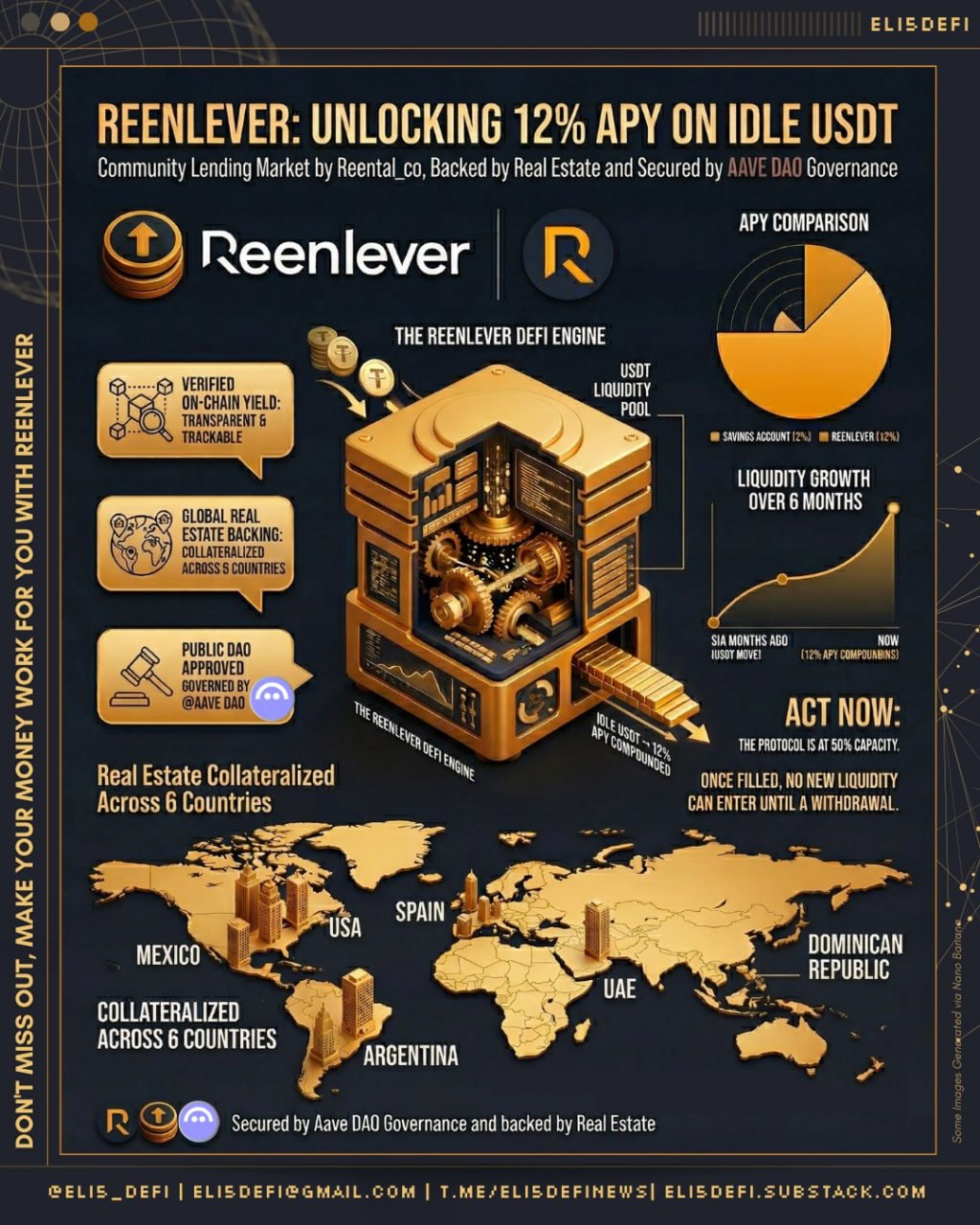 Real estate company Reental's community lending market, Reenlever generates 12% APY on idle USDT.2026-04
 Caliber taps Chainlink compliance and distribution rails for real estate fund tokenization2026-07
 Goldman Sachs tokenizes real estate fund shares on GS DAP with Apex and Archax2026-06
 Integra partners with SettleMint to power real estate tokenization across UAE and U.S.2026-06
 Birch Hill and Groma launch first institutional onchain REIT lending market, enabling $150M tokenized real estate to back USDC loans via Morpho-Yearn stack2026-03
Property — land and buildings — is one of the oldest stores of value, and a growing share of the crypto industry is trying to represent ownership of it as tokens that live on public or permissioned blockchains. This page explains how property tokenization works, why it has become a flagship use case for real-world assets, and where the practical limits still lie.
What "tokenizing" property actually means
Tokenization is the process of issuing a digital token that represents a legal claim on an asset. For real estate, the token almost never represents the deed itself. Instead it represents a share in a legal wrapper — typically a special-purpose vehicle (SPV), a fund, or a trust — that holds the underlying building or mortgage. Ownership of the token confers economic rights (rental income, appreciation, redemption) defined by that wrapper's documents, not a direct on-chain transfer of the land registry entry.
This distinction matters. A blockchain can record who holds a token with cryptographic finality, but the enforceability of the claim behind it still depends on courts, registries, and custodians in the jurisdiction where the property sits. "Onchain" describes where the ownership ledger lives; it does not, by itself, change the off-chain legal stack.
Two broad models dominate. Fractional ownership splits a single property or portfolio into many tokens so smaller investors can buy a slice — the model marketed heavily in markets like the United Arab Emirates, where platforms such as Stake and ACE have pushed fractional real estate to retail buyers (the newsroom's UAE coverage). Fund tokenization instead digitizes shares of an existing institutional real estate fund, keeping the fund structure intact while replacing paper share registers with blockchain records.

Real estate company Reental's community lending market, Reenlever generates 12% APY on idle USDT.
Why real estate became a flagship RWA
Real-world assets (RWAs) are off-chain instruments — Treasuries, private credit, commodities, equities, property — issued or recorded as tokens. The category has expanded quickly: the on-chain RWA market excluding stablecoins crossed roughly $32 billion in May 2026, up more than 200% year over year, with some analysts projecting it could approach $100 billion by year-end (RWA market data). Within that mix, tokenized Treasuries and private credit lead by size, with real estate a smaller but frequently cited segment.
Property is attractive to tokenize for a few structural reasons. It is large — the global market is measured in the hundreds of trillions of dollars — and notoriously illiquid, with high minimum ticket sizes and slow settlement. Proponents argue that putting fund interests onchain can compress settlement times, automate distributions, widen the investor base, and enable secondary transferability that traditional private real estate lacks. As one framing from the newsroom's coverage put it, RWAs "don't introduce new financial primitives" but bring "existing instruments onto programmable rails with onchain settlement and global access."
Coinbase CEO Brian Armstrong has publicly argued that tokenizing RWAs could streamline trading of real estate and stocks alike, and the thesis that tokenized real-world assets are a primary catalyst for crypto's mainstream adoption appears repeatedly in industry commentary. That enthusiasm should be read alongside the counterpoint, discussed below, that much of the promised efficiency is harder to capture than slides suggest.
Leviathan readers click tokenized real estate most heavily when the promise collapses — fraud, platform malpractice, and collateral failure collectively dominated the top three slots, outperforming all infrastructure buildout and yield-farming angles, revealing an audience tracking accountability rather than adoption.
The institutional turn
The most consequential recent development is the entry of large traditional finance institutions. In June 2026 Goldman Sachs, working with fund servicer Apex Group, UK-regulated digital asset exchange Archax, asset manager LRC Group, and interoperability provider Ownera, launched a tokenized real estate fund on the bank's Digital Asset Platform (GS DAP) (CoinDesk). The vehicle is structured as the LRC Tokenized Real Estate Fund SCSp, a Luxembourg SICAV-RAIF, with LRC (roughly €3.6 billion in assets under management) as investment manager and Archax as custodian and first distributor; Goldman issued the first blockchain-native fund tokens in late April 2026.
The Goldman structure is instructive because it is deliberately conservative: a regulated Luxembourg fund, institutional-only distribution, and a permissioned platform. It tokenizes fund interests, not deeds, and keeps depositary, administration, and banking in established hands. This is the pattern most large institutions are following — using blockchain as a more efficient register and settlement layer rather than as a route around regulation.
Infrastructure providers are racing to serve that demand. Integra partnered with SettleMint to power real estate tokenization across the UAE and the U.S.; tokenization platforms are integrating with high-throughput chains like Aptos to offer issuers regulated rails to launch RWA tokens; and asset-data tooling such as zkDatabase markets verifiable, privacy-preserving infrastructure so the data behind a tokenized building can be audited from source. The recurring theme is that credible institutional tokenization needs more than a smart contract — it needs custody, compliance, and verifiable data plumbing.

Caliber taps Chainlink compliance and distribution rails for real estate fund tokenization
Settlement, standards, and the hard part
A common misconception is that the difficult engineering problem is issuing the token. It usually is not. As industry practitioners have noted, the challenge with tokenized vaults "isn't tokenization, it's settlement": Treasuries, private credit, and real estate do not settle with the same assumptions as crypto-native assets. Property transactions involve appraisals, title checks, escrow, and redemption queues that cannot clear in a single block.
This is why vault standards have evolved. ERC-4626 standardized the accounting interface for yield-bearing vaults, but it assumes deposits and redemptions are instant — a poor fit for assets that need days to value or unwind. ERC-7540 extended the model with asynchronous deposits and redemptions, letting a vault accept a request now and fulfill it later once off-chain settlement completes. That asynchronous pattern is the architecture much RWA infrastructure is converging on, because it mirrors how real assets actually clear.
Reliable, verifiable data is the second hard problem. A token is only as trustworthy as the off-chain information that backs it — appraised value, occupancy, debt service, title status. Bringing that data onchain in a private but auditable form is an active area, spanning oracle networks, zero-knowledge data systems, and, in the Bittensor ecosystem, subnets like SN46 (zipcodenetwork) that began with real estate appraisals and frame a longer-term vision of onchain credit and a new financial layer for real-world assets.
- 01ICO funds misappropriated into real estate
Bankera's luxury property spending of ICO proceeds hit the precise intersection of crypto founder fraud and tangible asset abuse that readers cannot look away from.
- 02RealT platform slumlording investigation
Rekt's accountability probe into RealT exposed the gap between tokenized property democratization rhetoric and the operator reality controlling underlying assets.
- 03Real estate-backed stablecoin collapse
USDR's 40% depeg and subsequent deprecation at 84% collateralization showed readers exactly how illiquid collateral fails a peg when on-chain liquidity evaporates faster than property can be monetized.
- 04Sovereign and institutional tokenization buildout
Dubai's secondary market launch, Saudi Arabia's national infrastructure rollout, and Goldman Sachs GS DAP tokenization signaled to readers that state and Wall Street legitimization is crossing from pilot to infrastructure.
- 05High-yield tokenized real estate protocols
iREET's 25%+ CRV APR and Reental's 12% APY attracted readers evaluating whether protocol incentives can make illiquid real estate yields competitive on-chain.
- 06Bitcoin displacing real estate as wealth store
Saylor and Balaji's framing of BTC as a superior long-term store of value over property resonated with readers already holding both asset classes and triangulating capital allocation.
Yield, lending, and emerging product designs
Beyond simple ownership, tokenized property is increasingly wrapped into yield and credit products. Treasury-backed yield vaults, tokenized credit, and fractional real estate are frequently cited as crypto's strongest RWA use cases for expanding access to institutional-grade assets. On the retail and DeFi-native end, protocols are layering lending on top: real estate platform Reental's community lending market reported double-digit APY on idle stablecoins, and RAAC opened a bond for a tokenized real estate token ($IREET) with a fixed lockup, advertising elevated APR via its lending protocol.
These designs illustrate both the appeal and the risk. Composability — the ability to use a tokenized building as collateral, route it into a vault, or pair it with stablecoin liquidity — is what blockchain adds over a paper REIT share. But layering DeFi leverage and advertised double-digit yields on an illiquid, slow-settling asset reintroduces the maturity-mismatch and liquidation risks that crypto has learned about the hard way. Yield figures attached to property tokens deserve the same scrutiny as any structured product: what funds the return, and what happens when redemptions spike.
Adjacent to tokenization is a separate "Bitcoin-meets-property" thesis. Investor Grant Cardone has promoted a strategy pairing real estate cash flow with Bitcoin treasury accumulation, arguing it can outperform traditional REITs; commentators have flagged that such leverage-and-volatility combinations carry hidden risks. This is conceptually distinct from tokenizing property — it uses property income to buy crypto rather than representing property as crypto — but the two narratives often appear together in market coverage.
Goldman Sachs tokenizes real estate fund shares on GS DAP with Apex and Archax
Risks, skepticism, and open questions
Tokenization does not repeal real estate's fundamentals. Markets remain cyclical, and some analysts have warned of a large property correction; a token does not insulate holders from the underlying asset's price moves, vacancy, or interest-rate sensitivity. Liquidity, the headline selling point, is also conditional: a token is only as liquid as the secondary market and the redemption terms allow, and many offerings impose lockups precisely because the underlying cannot be sold quickly.
There is meaningful skepticism inside the industry itself. At least one prominent voice has called tokenized real estate "way overhyped," arguing the efficiency gains are smaller than marketed once legal, custodial, and compliance costs are counted. Regulatory and legal exposure is real too: securities-law treatment varies by jurisdiction, and ongoing investor investigations into real-estate-linked public companies are a reminder that the asset class attracts litigation regardless of the technology layer. For investors, the practical checklist is unglamorous — who holds the asset, which court enforces the claim, how redemptions clear, and whether the data behind the token is independently verifiable.
A final open question is novelty risk in the tooling itself. Experiments such as autonomous AI agents for real estate token trading, unveiled at industry conferences, point to where the space wants to go, but automated trading of thin, illiquid token markets is unproven and warrants caution.
- 2023-10exploit
USDR stablecoin depegs 40% after on-chain DAI reserves drained
- 2024-03governance
Rekt publishes 'slumlording on the blockchain' investigation into RealT
- 2024-09governance
Tangible team announces USDR deprecation at 84% collateralized, pivots to real estate index tokens
- 2025-01regulatory
Saudi Arabia launches national blockchain-based real estate tokenization infrastructure under Vision 2030
- 2025-04regulatory
Dubai opens licensed secondary market trading for tokenized real estate assets
- 2025-09launch
Birch Hill and Groma launch $150M institutional onchain REIT lending market via Morpho-Yearn stack
- 2026-05launch
Tokenopoly debuts AI agent for autonomous real estate token trading at Consensus 2026
Outlook
The direction of travel is clear: serious capital is moving from pilots to production, with institutions favoring regulated fund tokenization on permissioned rails and retail platforms pushing fractional access in receptive jurisdictions. The constraints are equally clear — settlement, verifiable data, and enforceable legal claims remain the binding limits, not token issuance. Expect steady growth concentrated in fund-wrapper structures and credit products, alongside continued debate about how much of the efficiency promise survives contact with off-chain reality. Tokenized property is best understood today as a better register and distribution layer for an old, illiquid asset class, not a transformation of the asset itself.
Latest Real Estate news
Real estate company Reental's community lending market, Reenlever generates 12% APY on idle USDT.Caliber taps Chainlink compliance and distribution rails for real estate fund tokenizationGoldman Sachs tokenizes real estate fund shares on GS DAP with Apex and ArchaxIntegra partners with SettleMint to power real estate tokenization across UAE and U.S. Leviathan Atlas is now charting RAAC, from gold-backed pmUSD to tokenized real estateBirch Hill and Groma launch first institutional onchain REIT lending market, enabling $150M tokenized real estate to back USDC loans via Morpho-Yearn stack
Community notes
Spot something off or out of date? Drop a note. Editors review topic notes daily and roll accepted fixes into the explainer — contributors are recognized in the monthly $SQUID drop.
Loading notes…
Help improve this topic
Have a story or tip about this topic? Submit it. See something missing? Leave a note. Editors review daily; accepted submissions and fixes count toward the monthly $SQUID drop.