
In‑depth explainer on Sam Bankman‑Fried (SBF): his rise via Alameda and FTX, the 2022 collapse, fraud trial and 25‑year sentence, ties to CZ/Binance, prison life, Trump pardon bid, Caroline Ellison’s role, and lessons for crypto markets and regulation.
+5 sources across the wider coverage universe
 CZ's memoir reveals SBF asked for billions 'like a bologna sandwich' as FTX imploded2026-04
 Ex-Celsius CEO Mashinsky files pro se motion to vacate 12-year fraud sentence, blames SBF for CEL manipulation2026-05
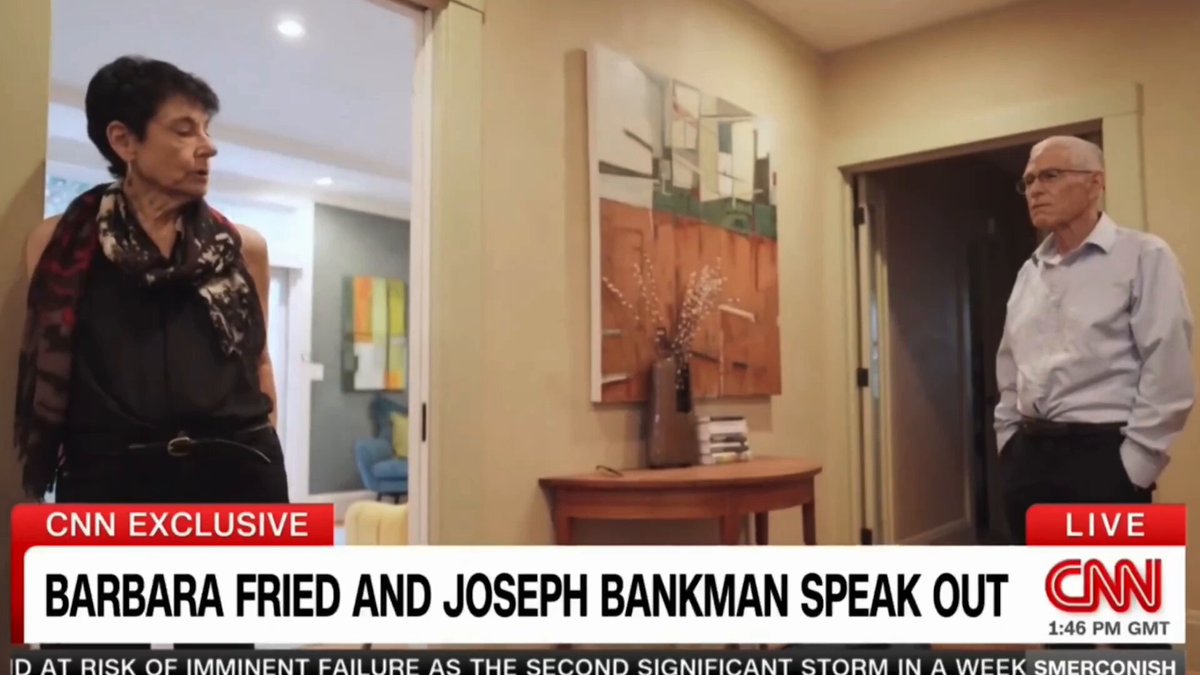 SBF's Mom Speaks Out on Potential Trump Pardon2026-03
 As slick as ever, SBF oils up President Donald Trump2026-03
 Senator Lummis torches SBF, blasting the pardon‑seeker by warning her Clarity Act would lock him up longer than 25 years and slamming his failed 2022 bid to buy a softer crypto bill.2026-02
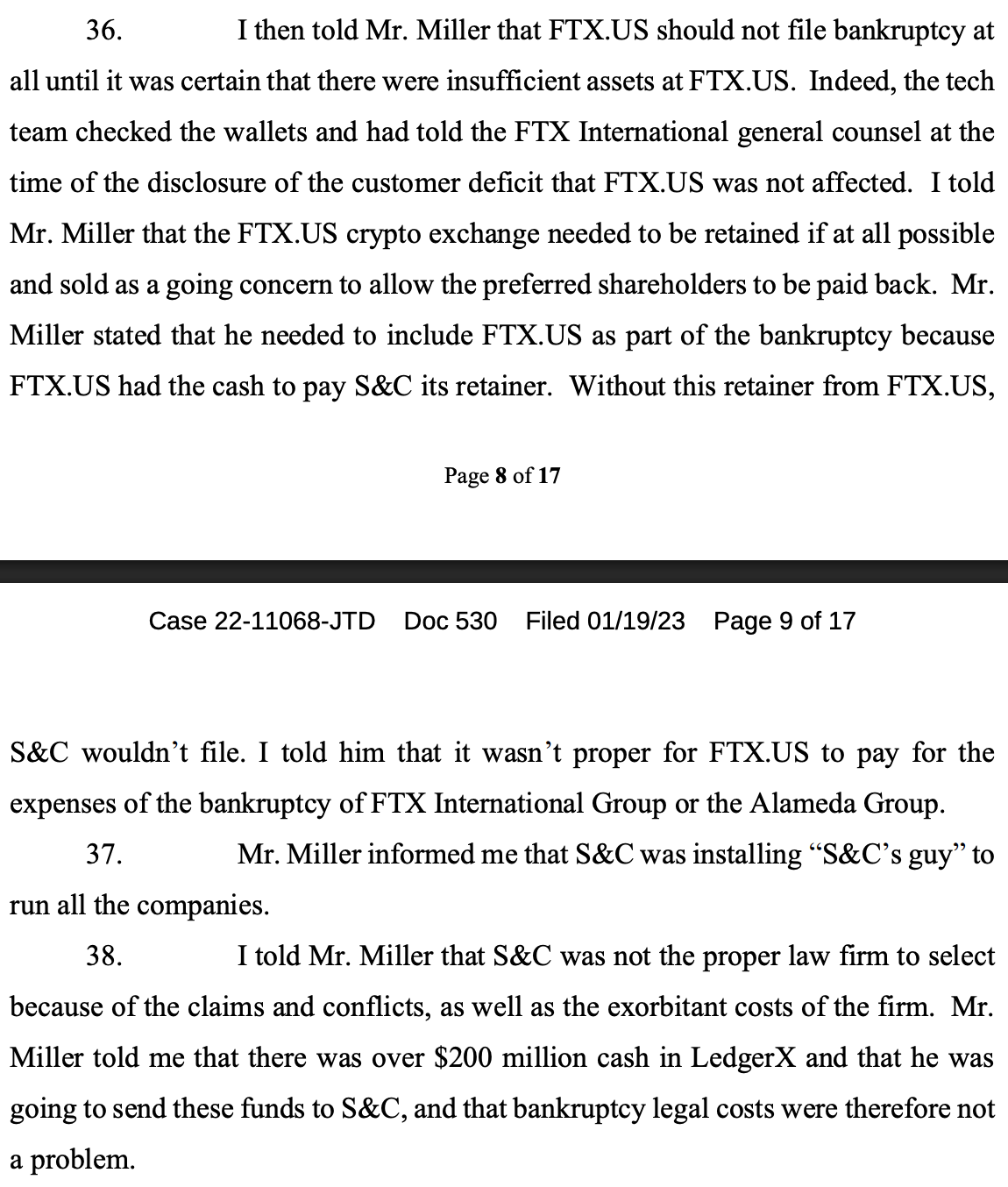 SBF claims FTX was never truly bankrupt and alleges company lawyers staged a bogus bankruptcy filing to enrich themselves.2026-02
Once hailed as the face of a new crypto era, Sam Bankman-Fried (SBF) is now a convicted fraudster serving a 25‑year U.S. federal prison sentence for crimes tied to the collapse of his exchange FTX and trading firm Alameda Research. His rise and fall have become a central case study for crypto markets, regulation, and the risks of centralized platforms.
Who is Sam Bankman-Fried (SBF)?
Sam Bankman-Fried, born in 1992 and educated as a physicist at MIT, emerged in the late 2010s as one of the most visible and influential entrepreneurs in the digital asset industry. Before founding his own firms, he worked at the quantitative trading shop Jane Street Capital, where he gained exposure to high-frequency trading and complex derivatives strategies that later informed his approach to crypto markets. In 2017 he launched Alameda Research, a crypto trading firm, and in 2019 he founded FTX, a derivatives-focused cryptocurrency exchange that quickly became one of the largest offshore platforms by volume. Within a few years he was widely portrayed as a “crypto wunderkind,” with a net worth once estimated in the tens of billions of dollars on paper, and his personal brand—disheveled appearance, shorts, and socks in Washington hearing rooms—became part of the industry’s mythology.
Beyond trading and technology, SBF cultivated an identity as an adherent of the Effective Altruism movement, publicly claiming he aimed to “earn to give” by making large fortunes in order to donate them to global priorities like pandemic preparedness. He also became one of the largest political donors in the United States during the 2020 and 2022 cycles, making substantial contributions to mostly Democratic causes while reportedly channeling additional funds to Republicans through associates, a pattern that later drew the attention of prosecutors and regulators. As FTX grew into a multibillion‑dollar business with over a hundred affiliated entities worldwide, he presented himself as a champion of stricter crypto regulation, testifying before Congress and meeting with regulators in Washington and abroad.
This public persona—hyper-rational quantitative trader, altruist, and “responsible” industry face—stood in sharp contrast to the revelations that emerged after FTX’s collapse in November 2022. Evidence presented at trial showed that, from near the beginning of FTX’s life, customer assets were secretly routed to Alameda Research, which used them to fund high‑risk bets, political donations, venture investments, and lavish spending on sponsorships and real estate. The gap between the carefully curated image and the underlying business practices is central to understanding both his trial and the broader loss of trust that rippled through the crypto industry after FTX failed.
As of his 2024 sentencing, Bankman-Fried is a convicted felon found guilty on seven counts of fraud and conspiracy, including wire fraud on FTX customers and lenders, securities and commodities fraud conspiracies, and money laundering conspiracy. He was ordered to serve 25 years in prison and to forfeit more than $11 billion, a sum intended to reflect the magnitude of the fraud against customers, investors, and lenders. Even so, his case remains in motion: he is pursuing a new trial, has filed a clemency petition, and continues to argue—largely through prison‑approved communications—that FTX’s failure was a matter of liquidity, not insolvency, and that he is not criminally culpable.

CZ's memoir reveals SBF asked for billions 'like a bologna sandwich' as FTX imploded
Building Alameda Research and FTX
The foundation of SBF’s empire was Alameda Research, a trading firm launched in 2017 to exploit arbitrage opportunities in still‑fragmented crypto markets. Alameda became known for strategies like capturing price discrepancies between exchanges and between different regions, with media reports at the time highlighting its role in exploiting the “Kimchi premium” and other cross‑venue spreads, although the firm itself remained largely opaque. In practice, Alameda and later FTX operated in a tight orbit: Alameda served as an early liquidity provider for FTX’s order books, and internal records later showed that the boundaries between the exchange and the trading firm were far more porous than their public messaging suggested.
FTX, founded in 2019 and nominally based in Antigua and Barbuda with headquarters in The Bahamas, was designed to serve sophisticated traders with perpetual futures, options, and leveraged tokens rather than competing primarily on spot markets. The exchange innovated on product design and risk management tooling, offering cross‑margining, an automated liquidation engine, and a single universal collateral pool in which users could post a range of tokens and stablecoins to back their positions. In a December 2021 congressional hearing, SBF touted these systems as a model for a “24/7 risk engine” that could reduce the kinds of overnight and weekend risk seen in traditional markets, emphasizing that crypto platforms like FTX updated positions and collateral in real time. That testimony later took on an ironic cast as evidence emerged that FTX’s internal risk controls did not apply in similar fashion to Alameda, which enjoyed effectively unlimited, secret credit on the platform.
The growth of FTX was turbocharged by heavy venture funding, aggressive marketing, and strategic partnerships. Between 2019 and 2022, the company raised billions of dollars from major venture funds and institutional investors at valuations that eventually exceeded $30 billion. It bought naming rights to a major U.S. sports arena, ran Super Bowl ads with celebrities, and signed brand deals with high‑profile athletes and entertainers, using customer funds and investor capital to burnish an image of solidity and mainstream acceptance. As FTX.com targeted international users, SBF also launched FTX US as a more limited, ostensibly compliant exchange for U.S. residents, even as internal communications later suggested that the operational boundaries between the entities were blurry and that customer funds across the group were not properly segregated.
In the early days, Binance and its founder Changpeng Zhao (CZ) played a key role in FTX’s ascent. Binance invested in FTX in 2019 and helped bootstrap the exchange’s liquidity and user base before FTX later bought back Binance’s equity stake using a mix of cash and its own exchange token, FTT. This transaction created a structural vulnerability: Binance became one of the largest holders of FTT, which doubled as collateral within the FTX ecosystem and as a key component of Alameda’s balance sheet. When relations between SBF and CZ deteriorated in 2022, this overlap became a critical fault line that would help destabilize FTX’s funding and trigger a broader crisis of confidence.
Alongside business growth, SBF pursued influence in Washington and other political centers. He donated heavily to politicians and political action committees, positioned himself as an expert on crypto policy, and became a regular presence in hearings and roundtables on digital asset regulation. His public rhetoric framed FTX as an ally of regulators, pushing for clearer rules and stricter oversight of offshore exchanges even as his own platform was allegedly commingling customer deposits with Alameda’s trading capital in ways that would be unthinkable for a regulated securities or futures venue. This gap between advocacy and practice has fueled intense post‑collapse scrutiny of both his lobbying efforts and the political system that embraced him.
Readers click SBF stories not for fraud mechanics but for the spectacle of a fallen billionaire who keeps trying to game systems — pardon bids, PR campaigns, appeal arguments, and celebrity prison cellmates — revealing a fascination with whether elite manipulation ever truly stops working.
The Collapse of FTX and the Role of Binance
The failure of FTX in November 2022 unfolded with extraordinary speed, but underlying stresses had been building for months. One academic analysis suggests that the collapse of the Terra‑Luna ecosystem in May 2022 was a pivotal event that significantly reduced liquidity on FTX and tightened funding conditions for Alameda’s leveraged positions. As asset prices fell across the crypto market, Alameda reportedly suffered large losses, and rather than allowing the trading firm to fail, SBF and close associates allegedly funneled billions of dollars in FTX customer funds to cover the shortfall. According to court filings and testimony, this misappropriation began as early as 2019 and continued through successive market cycles, masked by opaque internal accounting and preferential treatment for Alameda on the FTX platform.
The immediate spark for the crisis came in early November 2022, when reporting on Alameda’s balance sheet raised questions about the extent to which its solvency depended on illiquid FTT tokens and other assets tied to FTX. Binance’s CZ publicly announced that his firm would liquidate its remaining FTT holdings, citing “recent revelations,” and his tweets amplified market fears about FTX’s financial health. As FTT’s price slid and users rushed to withdraw funds from FTX, the exchange faced a classic liquidity crisis: it did not have enough liquid assets to meet customer withdrawal requests, in part because a large portion of deposits had already been transferred to Alameda and deployed into risky bets, venture deals, and other illiquid positions.
During this critical period, SBF reached out to CZ seeking an emergency bailout. In later memoir and interview accounts, CZ described how SBF informally asked for billions of dollars—initially around $2 billion, then as much as $6 billion—to plug the hole, allegedly doing so “as casually as ordering a sandwich,” a phrase that has since become shorthand in the industry for the perceived nonchalance with which FTX’s leadership treated massive shortfalls. Binance briefly signed a nonbinding letter of intent to acquire FTX but withdrew after a short due‑diligence review, citing concerns about FTX’s balance sheet and potential regulatory risks. Without the lifeline, the run on FTX accelerated and quickly became terminal.
On November 11, 2022, FTX Trading Ltd., along with more than a hundred affiliated entities including FTX US and Alameda Research, filed for Chapter 11 bankruptcy protection in the U.S. Bankruptcy Court for the District of Delaware. Court documents indicated that the group reported between $10 and $50 billion in both assets and liabilities, underscoring the massive scale of the enterprise and the complexity of the unwinding process. Subsequent investigations by the new management and regulators revealed an estimated $8 billion shortfall in customer accounts, making FTX’s collapse one of the largest financial failures in recent U.S. history, particularly within the crypto sector.
Academic work analyzing market data around the collapse has argued that Binance’s public actions significantly accelerated the unraveling of FTX, triggering a systemic reaction that rippled across crypto markets. According to this research, Binance’s tweets and the subsequent withdrawal of its acquisition offer amplified existing doubts, contributing to a generalized flight from centralized exchanges and leveraged positions. The same analysis emphasizes that the deeper cause of the disaster was not a single tweet or rivalry but the fragility created by opaque leverage, concentrated governance, and the commingling of customer assets with trading capital—features that are structurally common to many centralized finance (CeFi) platforms in crypto.
FTX’s bankruptcy proceedings have been unusually consequential. Under new leadership, the estate has spent years tracing and recovering assets, including clawbacks from investors and counterparties and the liquidation of venture stakes acquired with customer funds. By 2024–2025, administrators reported that they had recovered up to approximately $16.5 billion, enough in principle to repay most, and possibly all, customer claims at face value, though not necessarily to compensate for lost time or opportunity cost. This surprising prospect of substantial recovery has become a key point in SBF’s public narrative, as he argues that the eventual financial outcome is inconsistent with the prosecution’s portrayal of catastrophic loss. Prosecutors and many observers counter that recovery depends on post‑collapse asset appreciation and does not negate the alleged fraud or the risks to customers when the hole first emerged.
- 01Celebrity prison spectacle↗
The P-Diddy cellmate story (874 clicks, the top performer by a factor of 2x) shows readers are drawn to SBF's ongoing life as tabloid fodder, not just legal proceedings.
- 02Trump pardon pursuit↗
Multiple articles on SBF lobbying Trump, his mother's public appeals, and senator backlash collectively drew hundreds of clicks, revealing strong reader appetite for whether political access can override a 25-year sentence.
- 03Sentencing drama arc↗
Readers followed the sentencing in real time across at least four separate articles — the live thread, the 20-year report, the corrected 25-year report, and the preview — suggesting high emotional investment in the final number.
- 04SBF image versus reality↗
Prosecutors' use of SBF's profanity-laden regulator messages directly punctured his carefully constructed 'effective altruist pro-oversight' persona, which readers found compelling as character exposure.
- 05Co-conspirator sentencing contrast↗
The Caroline Ellison sentencing article — framing her potential zero-prison outcome against SBF's 25 years and Ryan Salame's 7.5 — tapped reader interest in how cooperation deals play out asymmetrically.
- 06FTX collapse market aftermath↗
The Robinhood stock buyback and VC funding drought articles show readers tracking the lasting structural damage FTX caused to crypto capital formation, not just the personal drama.
Criminal Charges, Trial, and Conviction
The criminal phase of SBF’s saga began in December 2022. On December 12, he was arrested in The Bahamas at the request of U.S. authorities, after which he was extradited to the United States to face federal charges in the Southern District of New York. The indictment alleged that, beginning in 2019, he orchestrated a sweeping scheme to defraud FTX customers by misappropriating their deposits, to defraud investors through misleading statements about FTX’s financial condition and risk controls, and to defraud lenders to Alameda by concealing the firm’s true balance sheet and special access to FTX funds. The charges also encompassed conspiracy to commit commodities and securities fraud and conspiracy to commit money laundering, reflecting the cross‑jurisdictional nature of FTX’s operations and the multiple regulatory regimes implicated.
In the October 2023 trial, government prosecutors presented evidence that FTX customer deposits were funneled to Alameda through a special line of credit and backdoor features in FTX’s code that allowed Alameda to maintain negative balances and avoid liquidation. Witnesses described how Alameda used these funds to make venture investments, repay loans, and cover trading losses, often without customers’ knowledge or consent. A central pillar of the prosecution case was testimony from SBF’s inner circle, including Alameda’s former CEO Caroline Ellison and other senior executives who pled guilty and cooperated. Ellison testified that SBF directed her to use FTX customer funds to plug holes in Alameda’s balance sheet and to create misleading financial statements for lenders, undermining defense claims that any commingling was inadvertent or that she acted independently.
The defense argued that FTX’s collapse was primarily a result of market conditions, poor risk management, and mistakes rather than intentional fraud. SBF’s lawyers contended that he believed Alameda’s positions were hedged and that FTX’s risk engine and collateral pools were sufficient to handle volatility until the November 2022 run overwhelmed the system. They emphasized the complex nature of crypto markets, the novelty of FTX’s products, and the alleged role of Binance and CZ in precipitating a liquidity crisis. However, the jury was unconvinced. After roughly five hours of deliberations on November 2, 2023, it returned a verdict of guilty on all seven counts. The potential maximum sentence on these charges was more than 100 years in prison, a reflection of the statutory maximums associated with each count.
On March 28, 2024, U.S. District Judge Lewis Kaplan sentenced Bankman-Fried to 25 years in federal prison, along with an order to forfeit approximately $11.02 billion. In the sentencing hearing, Kaplan emphasized the seriousness and scope of the crimes, describing the fraud as vast, deliberate, and prolonged. Commentators noted that while the sentence was substantially below the theoretical maximum, it was still among the harsher penalties imposed in a crypto‑related financial fraud case. Some observers compared SBF to Bernie Madoff, with figures such as financier Anthony Scaramucci explicitly calling him “the Bernie Madoff of crypto.” Although the calculation of loss and harm was complicated by the volatile value of crypto assets and subsequent recoveries by the bankruptcy estate, the court focused on the intentional deception and misuse of customer deposits rather than the eventual asset recovery outcomes.
Parallel to the criminal case, civil regulators also took action. On December 13, 2022, the U.S. Securities and Exchange Commission charged SBF with defrauding equity investors in FTX by concealing the diversion of customer funds to Alameda and misrepresenting FTX’s risk management and automated liquidation systems. The Commodity Futures Trading Commission filed its own charges related to fraud and material misrepresentations regarding FTX’s derivatives platform and the safeguarding of customer assets. While these civil actions have largely proceeded in the background of the criminal case, they contribute to a comprehensive legal framework that frames the FTX saga as both a criminal fraud and a regulatory failure, and they provide a template for future enforcement in the crypto sector.
Caroline Ellison’s case has also attracted attention as a contrast to SBF’s outcome. After pleading guilty and cooperating, she was eventually sentenced to two years in prison and ordered to forfeit $11 billion for her role in the conspiracy to defraud FTX customers and lenders. Although the nominal forfeiture figure mirrors the scale of SBF’s penalty, the far shorter custodial sentence underscores how U.S. courts often differentiate between masterminds and cooperating witnesses in complex fraud cases. For many in the crypto community, the disparity has provoked debate about proportional accountability and the incentives that the justice system creates for insiders who come forward after a scheme collapses.

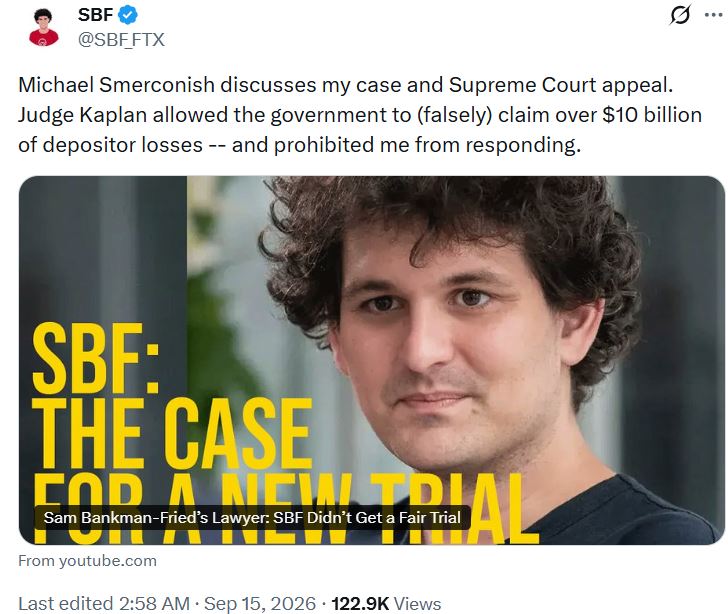
SBF says Smerconish discussed his case and Supreme Court appeal, claims Kaplan blocked his response
Life in Prison and Ongoing Legal Fights
Following his conviction, SBF was initially held at the Metropolitan Detention Center (MDC) in Brooklyn, a notoriously harsh pretrial facility that has housed a range of high‑profile defendants. Media reports indicated that while there, he struggled with access to necessary medication and with the constraints of limited internet and discovery access, conditions his lawyers argued impeded his ability to participate in his defense and appellate planning. After sentencing, his location shifted within the federal Bureau of Prisons system. For a period he was housed in a medium‑security facility in Victorville, California, then moved to a lower‑security institution near Los Angeles, and eventually to a low‑security federal correctional facility in Santa Barbara, California. These transfers, while routine in the federal system, were closely watched given the intense media focus on his case.
From prison, SBF has continued to maintain his innocence and to assert that FTX was fundamentally solvent at the time of its collapse, claiming it suffered from a liquidity crunch rather than a capital deficit. In his public statements and legal filings, he has advanced a narrative in which lawyers and crisis managers allegedly pushed FTX into unnecessary bankruptcy, both to protect themselves and to profit from professional fees and asset sales. In 2025, roughly two years after his conviction, he filed a motion seeking a new trial on the basis of what he described as “newly discovered evidence” about FTX’s bankruptcy process. Specifically, he argued that FTX’s attorneys forged or improperly filed bankruptcy documents without his authorization, over his objections, and that their actions misrepresented the true financial condition of the exchange.
Prosecutors have forcefully opposed these efforts. In a March 2025 filing, the government urged Judge Kaplan to deny the retrial motion, characterizing SBF’s claims as legally insufficient and factually unsupported. They emphasized that the alleged “new evidence” about bankruptcy filings would not negate the core trial evidence showing that customer funds were diverted to Alameda and that lenders and investors were misled about FTX’s financial condition. Additional controversy arose around a letter SBF attempted to send to the court from prison, which was shipped via FedEx despite restrictions on inmates using that service; tracking data and address inconsistencies fueled questions about how the letter was prepared and transmitted, and the government cited these irregularities as yet another reason to be skeptical of his procedural tactics.
In parallel with his legal appeals, SBF has turned to clemency and political channels. In June 2026, a clemency petition filed on his behalf appeared on the U.S. Department of Justice’s Office of the Pardon Attorney website, categorized as a “pardon after completion of sentence.” This classification suggests a formal request to clear his conviction after serving his term rather than an immediate commutation, although press reports and political commentary have blurred these distinctions. The petition is listed as pending review, and the Office does not publicly disclose substantive details about ongoing evaluations, leaving the contents of his plea largely a matter of speculation.
The political dimension is intensified by his parents’ advocacy and by SBF’s apparent efforts to align himself with the policy positions of President Donald Trump, whose administration has taken a more permissive and industry‑friendly stance toward crypto than its predecessor. Coverage indicates that his parents, both law professors, have engaged with media and political figures to explore the possibility of a presidential pardon or other relief, framing their son’s sentence as excessive and the prosecution as politically tinged. At the same time, SBF has used prison‑approved communications to praise some of Trump’s actions, including decisions on foreign policy, and to argue that replacing former SEC Chair Gary Gensler with Paul Atkins was a positive step for the crypto industry. He has claimed that the Biden‑era Department of Justice was biased against him and that media guidelines led to disproportionately negative coverage, assertions that prosecutors and critics reject as baseless and self‑serving.
Despite this outreach, Trump has publicly distanced himself from the idea of a pardon, telling The New York Times in early 2026 that he did not plan to grant clemency for Bankman-Fried. Independent reporting has described the SBF pardon effort as “becalmed amid regulatory storms,” noting that while other crypto‑linked figures, including Binance’s CZ, have speculated about or hoped for favorable treatment from the administration, there is no clear sign that the White House intends to intervene in SBF’s case. For now, his best prospects lie in the regular appellate process, where he can challenge aspects of his conviction and sentence on legal grounds, though trial judges and appellate courts rarely overturn jury verdicts in complex financial fraud cases absent clear procedural error.
Media accounts of his daily life in prison depict a figure attempting to maintain routines similar to his pre‑arrest habits, albeit within the constraints of incarceration. Reports suggest that he is treated for clinical depression and ADHD, taking prescription medication and spending considerable time reading, writing, and engaging in legal work. New York Magazine has reported that he has mused about launching a new token or crypto project after his release, framing it as a way to “make customers whole” or to demonstrate the soundness of his prior ideas in a more transparent structure. Whether such ambitions are realistic, given his felony conviction and the likelihood of lifetime bans from regulated financial activities in many jurisdictions, is an open question, but the fact that he entertains them underscores a persistent belief in his own expertise and a reluctance to fully accept the verdict rendered by the courts.
FTX exchange founded by SBF
FTX files Chapter 11 bankruptcy
SBF arrested in the Bahamas, extradited to US
Criminal trial begins in SDNY
SBF convicted on all seven federal counts
SBF sentenced to 25 years in federal prison
- 2024-09regulatory
Caroline Ellison sentenced to 2 years after cooperation
SBF files formal pardon application to Trump administration
Key Figures Around SBF: Caroline Ellison, CZ, and Others
No account of SBF’s story is complete without understanding the roles of those closest to him, particularly Caroline Ellison and Changpeng Zhao. Ellison, a Stanford‑educated mathematician and former Jane Street trader, joined Alameda Research and eventually became its CEO. She was both a senior executive and, at times, romantically involved with SBF, an overlap that complicated internal governance and blurred professional boundaries. As Alameda’s leader, she oversaw many of the firm’s high‑leverage strategies and its use of FTX customer funds, and in her testimony she described a culture in which SBF’s directives were paramount, even when they conflicted with risk management best practices or basic fiduciary duties. Her cooperation with prosecutors, including detailed accounts of how loans were misrepresented and how balance sheets were dressed up for lenders, was crucial to the government’s case and is widely seen as a key factor in SBF’s conviction.
When Ellison was sentenced to two years in prison and ordered to forfeit $11 billion, many observers compared her punishment to SBF’s 25‑year term. Some argued that the disparity was appropriate, given her cooperation and the central role he played as the architect and public face of the scheme. Others pointed out that she had been chief executive of Alameda during the period in which much of the misappropriation occurred, raising questions about how responsibility should be apportioned among co‑conspirators in complex organizational frauds. In any event, the court’s treatment of Ellison illustrates how U.S. prosecutors structure incentives for insiders to turn state’s evidence in exchange for reduced penalties, a strategy that can be particularly effective in white‑collar cases where documentary evidence is voluminous but intent is contested.
Changpeng Zhao, or CZ, occupies a very different role in the SBF narrative—as both early benefactor and eventual antagonist. As founder of Binance, the world’s largest crypto exchange by trading volume, CZ invested in FTX during its early growth phase and helped it gain credibility and liquidity. Later, as FTX’s ambitions grew and its political influence in Washington expanded, tensions between the two leaders reportedly increased, fueled by competition for market share and divergent views on regulatory engagement. The buyout of Binance’s stake in FTX, paid largely in FTT tokens, left Binance holding a large position in a token that was deeply intertwined with FTX’s capital structure.
In November 2022, as doubts mounted about FTX and Alameda, CZ announced that Binance would liquidate its FTT holdings, triggering a sharp price drop and a loss of confidence in FTX’s solvency. According to a Binance‑authored summary of events and CZ’s later memoir, SBF reached out requesting a multibillion‑dollar bailout, repeatedly revising the amount as the hole in FTX’s balance sheet became clearer, a sequence CZ likened to asking for “billions like a bologna sandwich.” Binance briefly explored a rescue but backed away after reviewing FTX’s internal financials, citing the scale of the problems and the likelihood of regulatory action. While some SBF supporters and critics of Binance argue that CZ’s actions were opportunistic or destabilizing, academic research and regulatory commentary generally stress that FTX’s underlying misuse of customer funds was the primary cause of its failure, and that Binance’s decisions simply accelerated an inevitable collapse.
Beyond Ellison and CZ, the FTX story intersects with a broader cast of industry figures and adversaries. Former Celsius CEO Alex Mashinsky, himself convicted in a separate fraud case and sentenced to 12 years in prison, has attempted to blame some of Celsius’s token‑price woes on alleged manipulation by SBF and FTX, a narrative that underscores how failed executives sometimes invoke SBF as a catch‑all explanation for their own mismanagement. Crypto‑focused on‑chain sleuths and open‑source intelligence enthusiasts have also used tools like Telegram scraping utilities and blockchain analytics dashboards to track mentions of SBF and related entities, reflecting the ongoing fascination with his case among traders and researchers.
The SBF saga is further intertwined with other enforcement actions and regulatory developments. Binance and CZ have faced their own legal challenges over anti‑money‑laundering failures and sanctions compliance, including allegations about processing funds linked to Iran, although these matters are distinct from FTX’s fraud case. The juxtaposition of SBF’s fraud conviction and CZ’s regulatory settlements highlights the spectrum of legal risk in crypto: from outright misappropriation of customer funds, which prosecutors treat as classic fraud, to compliance failures and structural violations that may be resolved with fines, governance changes, and more limited custodial sentences. For policymakers, the twin cases offer complementary examples of how to calibrate penalties and reforms across different types of misconduct.
SBF held de facto unilateral control over FTX customer funds, Alameda Research, and political donation flows with no meaningful board or audit oversight.
FTX operated across multiple jurisdictions while SBF actively lobbied regulators, and the collapse triggered sweeping congressional hearings and new exchange oversight frameworks globally.
FTX commingled billions in customer deposits with Alameda trading capital, creating a hidden liquidity crisis that became fatal the moment Binance publicly exited its FTT position.
The FTX collapse wiped out venture confidence for years, with crypto VC funding failing to recover to pre-FTX levels even as token prices rebounded.
CZ's decision to liquidate Binance's FTT holdings triggered the bank run, illustrating how a single large counterparty action can cascade into exchange insolvency within 72 hours.
SBF, Politics, and Regulatory Fallout
SBF’s political footprint is one of the most distinctive features of his story. At the height of his influence, he was courted by lawmakers from both parties, invited to testify before Congress, and consulted on draft legislation intended to provide clarity on digital asset regulation. In a December 2021 hearing on crypto and systemic risk, he argued that platforms like FTX offered a more transparent “24/7 risk system” than traditional markets, touting the benefits of real‑time margining and on‑chain settlement. He presented FTX as a model exchange that could help bring U.S. derivatives oversight into the digital age, framing the platform as a partner to regulators rather than an adversary.
Behind the scenes, however, prosecutors later alleged that SBF was using misappropriated customer funds to fuel his political giving and philanthropic projects. His donations to candidates, PACs, and advocacy groups were said to be funded in part by Alameda’s credit lines from FTX, which were themselves backed by customer deposits. This dynamic raised uncomfortable questions for recipients of his largesse, some of whom pledged to return the money or donate it to charity after the fraud allegations surfaced. It also exposed weaknesses in campaign finance transparency, as some contributions were allegedly funneled through straw donors or corporate vehicles, obscuring their true origin.
The collapse of FTX and SBF’s indictment shifted the political narrative dramatically. Legislators who had previously appeared with him on panels or praised his expertise quickly distanced themselves, and opponents of crypto seized on the scandal as evidence that the industry was fundamentally prone to fraud and abuse. Senators such as Cynthia Lummis and Elizabeth Warren, who already held strong views on digital asset regulation but from different ideological perspectives, criticized SBF’s conduct and rejected his subsequent attempts to endorse or influence bills like the “Clarity” Act after his conviction. Coverage has described how Lummis, in particular, warned that her legislative proposals would have subjected conduct like SBF’s to even harsher penalties, effectively “locking him up longer than 25 years,” and rejected any suggestion that his late‑stage endorsements lent credibility to her bill.
The regulatory response extended beyond rhetoric. The SEC’s December 2022 charges against SBF framed FTX’s failures as classic securities fraud, emphasizing misstatements to equity investors and the concealment of related‑party dealings. The CFTC’s case highlighted how FTX’s derivatives platform operated in U.S. markets without properly safeguarding customer assets or adhering to traditional futures market rules. Collectively, these actions signaled that U.S. regulators viewed major offshore exchanges as within their enforcement reach, especially when they served U.S. users or raised capital from U.S. investors. For centralized platforms, the post‑FTX environment has meant heightened scrutiny of custody arrangements, proof‑of‑reserves disclosures, and the segregation of customer assets from proprietary trading operations.
The industry’s own response has included a push toward greater transparency, at least in form. Binance, for example, has issued a series of “proof of reserves” reports, the forty‑third of which was published in 2026, detailing its on‑chain balances and liabilities in an attempt to reassure users about its solvency. While such attestations do not always provide a full picture of an exchange’s financial health—particularly off‑chain liabilities and contingent exposures—they represent an attempt to address precisely the kind of opacity that allowed FTX’s misuse of funds to persist for years. At the same time, proponents of decentralized finance (DeFi) have pointed to FTX as evidence that centralized intermediaries are the weak link in crypto, arguing that on‑chain protocols with transparent, programmatic rules can mitigate, though not eliminate, the risks of human fraud.
SBF’s ongoing political maneuvers from prison, including his clemency petition and public praise of Trump’s policies, have produced a complicated response. Some in the crypto community see his outreach to the Trump administration as a pragmatic recognition that presidential power could, in theory, shorten his sentence or clear his record. Others view it as yet another example of opportunism, shifting alliances to whatever configuration seems most personally advantageous. The White House’s public rejection of a pardon at this stage, and bipartisan criticism of his conduct, suggest that SBF has become more of a cautionary tale than a policy partner in Washington, at least for the foreseeable future.
Ex-Celsius CEO Mashinsky files pro se motion to vacate 12-year fraud sentence, blames SBF for CEL manipulation
Reputation, Narratives, and Crypto Culture
The cultural impact of SBF’s rise and fall extends far beyond the legal record. For several years, he embodied a particular archetype of the “crypto founder”: young, mathematically gifted, aggressively casual in dress and demeanor, yet fluent in both the language of DeFi and the jargon of Beltway policymaking. His public embrace of Effective Altruism and his stated intention to donate most of his wealth to global causes allowed many observers—including journalists, investors, and policymakers—to frame him as a “good billionaire,” someone whose pursuit of profit was yoked to a broader moral project. This narrative made it easier for stakeholders to overlook red flags about FTX’s governance, related‑party dealings, and meteoric, largely unaudited growth.
After the collapse, these same traits were reinterpreted in a far more negative light. The messy hair and T‑shirts in high‑stakes settings became symbols of arrogance and disdain for traditional norms; the rapid speech and game‑theoretical digressions were recast as manipulative rather than merely eccentric. Comparisons to Bernie Madoff emphasized not only the scale of the alleged fraud but also the social dynamics of trust: like Madoff, SBF cultivated a carefully constructed persona that persuaded sophisticated investors and gatekeepers to suspend skepticism. Memoirs, podcasts, and documentaries have since dissected how this persona was built and why so many people embraced it, raising uncomfortable questions about hero worship in tech and finance.
Within the crypto community, SBF’s legacy is contested. Some see him as an outlier whose misconduct should not taint the broader ecosystem, pointing out that the worst abuses at FTX involved basic violations of financial trust rather than novel cryptographic mechanisms. From this perspective, FTX’s failure is evidence that centralized custodians, even those operating in crypto, must be subjected to robust regulatory oversight and corporate governance standards. Others argue that SBF’s ability to raise billions from top‑tier investors and to shape legislation reveals deeper structural problems in how crypto projects are financed, marketed, and integrated into mainstream finance. The fact that even sophisticated funds and regulators were misled by his narrative has become a warning about the dangers of conflating founder charisma with institutional soundness.
SBF has also become a recurring reference point in other enforcement and bankruptcy cases. Executives at other failed platforms, like Celsius’s Mashinsky, have invoked him as a kind of external villain whose actions supposedly distorted token prices or undermined confidence in their own platforms. Meanwhile, on‑chain sleuths and Telegram OSINT tools track references to SBF and his associated entities across public channels, using his name as a keyword to map networks of influence and conversation in real time. These practices illustrate how his story functions as a cultural touchstone as much as a legal case, shaping discourse about risk, accountability, and governance across the crypto space.
Even now, with a 25‑year sentence in place, SBF continues to generate fascination. New York Magazine’s reporting that he has contemplated launching a new token after his release, potentially as part of an effort to rebuild a fortune or “make things right,” has sparked debate about the ethics and feasibility of allowing convicted financial criminals to reenter the industry. Some argue that crypto’s permissionless nature makes it difficult to prevent such attempts outright, especially for projects that operate outside traditional regulatory perimeters. Others contend that market participants and gatekeepers—exchanges, custodians, institutional investors—bear responsibility for refusing to platform individuals whose track record includes massive fraud and deception. In this respect, the SBF saga functions as an ongoing test of whether the industry can internalize hard lessons or whether it is destined to repeat them.
Lessons for Crypto Investors and Builders
For crypto investors, FTX’s downfall under SBF’s leadership underscored the importance of basic risk management principles that can sometimes be obscured by technical jargon and rapid innovation. Chief among these is counterparty risk: when users deposit assets on a centralized exchange, they are effectively lending those assets to the platform and relying on it to honor withdrawal requests, segregate funds, and avoid using deposits for speculative purposes. In FTX’s case, customers were told that their assets were safe and that the exchange did not use them for proprietary trading, yet internal practices diverged sharply from this representation. The result was that when market conditions turned and a run occurred, the exchange could not meet its obligations, despite having previously been valued in the tens of billions of dollars.
One practical lesson is the value of self‑custody and diversification. While centralized exchanges remain important for liquidity and on‑ramps, relying on a single platform for the bulk of one’s assets exposes users to idiosyncratic failure risk. FTX collapsed in a matter of days once doubts about its solvency surfaced and Binance withdrew its tentative rescue, offering little time for late movers to exit. The speed of the run was amplified by social media, where tweets from CZ and others rapidly shifted market sentiment and triggered automated selling and withdrawals. For traders and investors, this episode demonstrated how information cascades in crypto can be faster and more volatile than in traditional markets, making it important to plan for the possibility that exit windows may be extremely short.
For builders and exchange operators, FTX’s failure highlights the need for robust internal controls, independent governance, and clear separation between customer funds and proprietary activities. The commingling of assets between FTX and Alameda, facilitated by preferential margining and secret code paths, violated basic norms of market structure and custodial responsibility. In response, some exchanges have adopted more stringent proof‑of‑reserves regimes and engaged third‑party auditors to validate not only on‑chain balances but also liabilities, although the quality and scope of such attestations vary widely. The long‑term effectiveness of these efforts will depend on whether they are backed by enforceable standards and regulatory oversight or remain purely voluntary marketing tools.
From a regulatory standpoint, the SBF case provides a vivid demonstration of how traditional legal concepts apply in a crypto context. Fraud statutes that predate Bitcoin by decades proved fully capable of addressing misrepresentations and misappropriation involving digital assets. The SEC’s and CFTC’s cases against SBF illustrate that regulators are willing to assert jurisdiction over offshore entities when they touch U.S. investors or markets, and that crypto‑specific features of a platform do not immunize it from long‑standing rules about disclosures, conflicts of interest, and customer asset protection. As new legislative proposals like the Clarity Act and other crypto frameworks are debated, FTX serves as a reference point for both proponents and critics of stricter rules, shaping the terms of discussion about what kinds of oversight are necessary and proportionate.
Finally, there is a broader governance lesson about the dangers of founder‑centric cultures and unchecked power. At FTX, SBF effectively controlled both the exchange and Alameda, appointed close friends and romantic partners to key roles, and resisted efforts to impose more formal structures or outside oversight. This concentration of authority allowed him to implement complex financial engineering, but it also meant that when his judgments were flawed—or when he allegedly chose to prioritize growth and political influence over customer safety—there were few effective internal checks. For an industry that often celebrates charismatic founders and rapid execution, the FTX story serves as a reminder that sustainable innovation requires institutional resilience, not just individual brilliance.
Outlook
Looking ahead, SBF’s personal trajectory seems relatively clear in the near term: barring a successful appeal, retrial, or extraordinary act of clemency, he is likely to spend many years in federal prison, with the possibility of release somewhat earlier than the full 25‑year term under good‑time credit provisions. His ongoing legal motions and clemency petition will keep his name in the news, but historical patterns suggest that courts are unlikely to overturn a fraud conviction supported by extensive documentary evidence and multiple cooperating witnesses. The more interesting questions concern his long‑term legacy and the ways in which the crypto industry and regulatory landscape will evolve in response to the FTX episode.
If FTX’s bankruptcy administrators succeed in returning most or all customer funds, as current recovery estimates suggest, public anger may gradually soften, at least among those made financially whole. However, the case has already entrenched a narrative among policymakers that large, lightly regulated crypto intermediaries pose unacceptable risks to consumers and markets, a view likely to drive more stringent oversight even as institutional crypto adoption advances through channels like regulated ETFs and broker‑dealer platforms. For DeFi advocates, SBF’s downfall will continue to be a powerful argument that trust‑minimized, on‑chain systems are preferable to opaque centralized custodians, though DeFi’s own governance and security challenges remain unresolved.
Within crypto culture, SBF will probably remain a contested figure: for some, a byword for fraud and hubris; for others, a complex cautionary tale about ambition, incentives, and the fragility of reputation. His musings about launching a new token after prison may or may not ever materialize, but the fact that market participants even debate whether they would invest with him again speaks volumes about the speculative, narrative‑driven character of the sector he helped shape. Ultimately, the most enduring impact of “SBF” may be as a reference case in law schools, policy debates, and industry risk manuals—a reminder that technology cannot, by itself, substitute for basic ethics, sound governance, and the hard work of building institutions worthy of trust.
Latest SBF news
CZ's memoir reveals SBF asked for billions 'like a bologna sandwich' as FTX implodedSBF says Smerconish discussed his case and Supreme Court appeal, claims Kaplan blocked his responseEx-Celsius CEO Mashinsky files pro se motion to vacate 12-year fraud sentence, blames SBF for CEL manipulationSBF's Mom Speaks Out on Potential Trump PardonAs slick as ever, SBF oils up President Donald TrumpSenator Lummis torches SBF, blasting the pardon‑seeker by warning her Clarity Act would lock him up longer than 25 years and slamming his failed 2022 bid to buy a softer crypto bill.Sources
18 records from 16 domains
en.wikipedia.org
abcnews.com
ofi.la.gov
youtube.com
fortune.com
binance.com
foxbusiness.com
arxiv.org
aicryptocore.xyz
kucoin.com
coinmarketcap.com
citationneeded.news
dlnews.com
github.com
mexc.com
cybernews.com
Community notes
Spot something off or out of date? Drop a note. Editors review topic notes daily and roll accepted fixes into the explainer — contributors are recognized in the monthly $SQUID drop.
Loading notes…
Help improve this topic
Have a story or tip about this topic? Submit it. See something missing? Leave a note. Editors review daily; accepted submissions and fixes count toward the monthly $SQUID drop.