
In crypto, SDKs bundle tools, libraries and APIs that let apps, DeFi protocols and AI agents integrate wallets, payments, yield and cross‑chain liquidity quickly, making them the invisible infrastructure steering how Web3 is built and used.
+15 sources across the wider coverage universe
 Velora identifies and unpublishes malicious npm package version in supply chain attack targeting its DEX aggregator SDK2026-04
 Tempo releases Accounts SDK enabling passkey-based wallets with 1-line integration, bringing Face ID logins, transaction simulation, and gas sponsorship to apps2026-04
 Cosmos SDK v0.54.4 ships state-breaking security fixes, urges chains to coordinate upgrades immediately2026-07
 Breez SDK turns BTC balances into USDC and USDT payouts across 30-plus chains2026-06
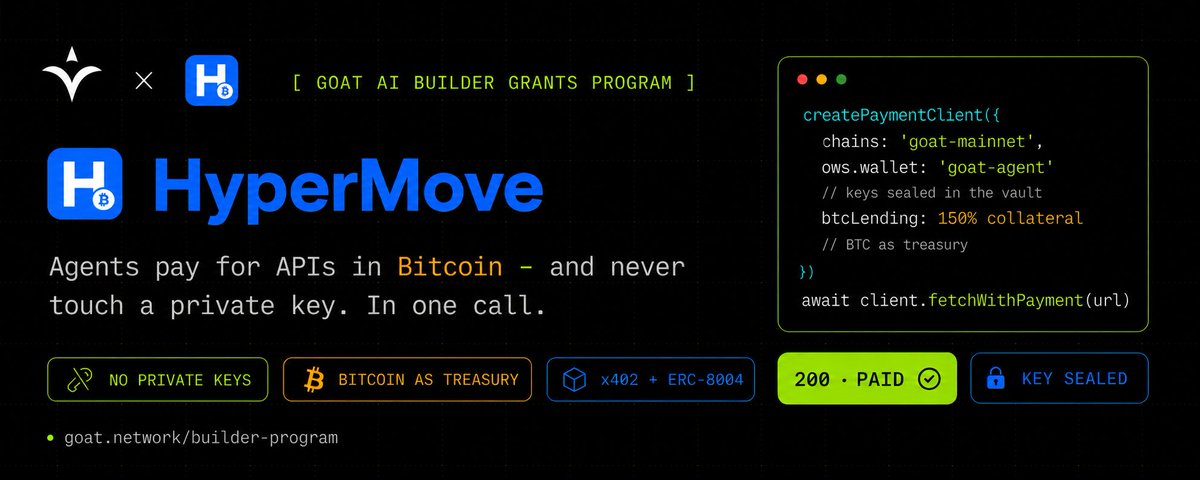 HyperMove launches Bitcoin-backed payment SDK for AI agents, enabling API payments via BTC collateral, x402 rails and vault-secured signing without private keys2026-06
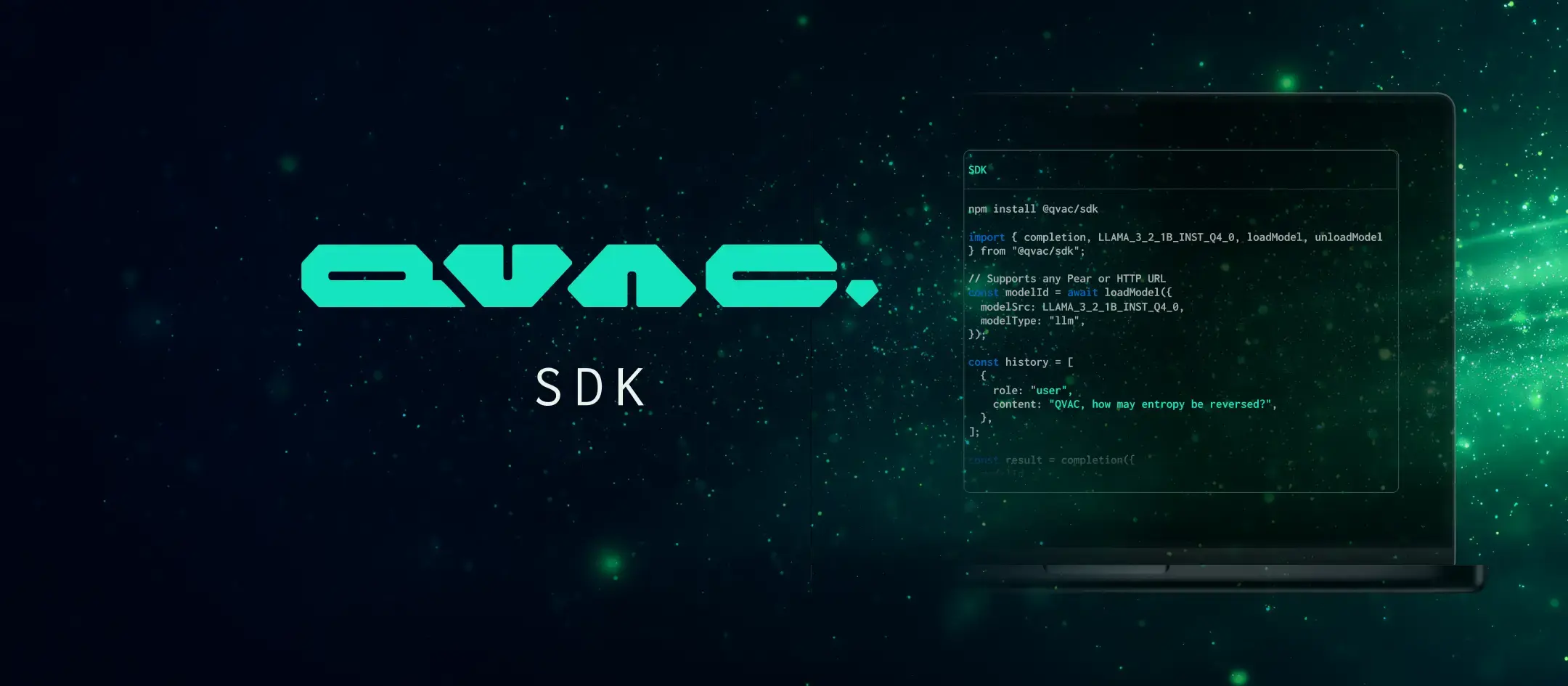 Tether launches QVAC SDK, open-source toolkit for on-device AI and peer-to-peer inference across platforms2026-04
SDKs in Crypto: The Developer Toolkits Powering Web3, DeFi, and AI Agents
An SDK, or software development kit, is a bundle of tools, libraries, and often one or more APIs that lets developers build applications for a specific platform faster and more reliably, instead of wiring everything from scratch. In crypto, SDKs have become the connective tissue between complex blockchain infrastructure and the apps, payments flows, yield strategies, and AI agents that users and institutions actually interact with.
1. Introduction: The Invisible Infrastructure Behind Web3
Behind almost every modern crypto product sits at least one SDK, quietly doing the heavy lifting. When a user taps to connect a wallet, swaps tokens across chains, funds a DeFi yield strategy, or lets an AI agent rebalance a portfolio, the visible interface is only the last mile of a much larger stack. Underneath, SDKs translate between the app’s business logic and a tangle of blockchains, smart contracts, APIs, compliance rules, and signing systems. They package that complexity into something a developer can call from a few lines of code and safely ship to production.
This abstraction layer matters because blockchains are not simple platforms to build on. Each chain has its own transaction formats, fee models, signing rules, and quirks; DeFi protocols add further abstractions for liquidity pools, lending markets, and derivatives; and regulations increasingly require detailed checks on who is sending what to whom. Without SDKs, every app team would need to reinvent all of this infrastructure, and every launch would involve months of low-level cryptography, security audits, and protocol integrations before a single user could send a payment. SDKs compress that effort and standardize common patterns.
The rise of AI and autonomous agents inside crypto only increases the need for robust, composable toolkits. AI agents that trade, provide liquidity, or pay for services on-chain must interact programmatically with multiple blockchains, payment rails, and identity systems, often in real time. That is difficult to do safely if each team wires directly to raw node APIs. Purpose-built SDKs give agents higher-level primitives—such as “swap this asset across networks” or “fund this on-chain job with stablecoin yield”—that can be composed and audited, rather than improvised on the fly.
Recent product launches illustrate how central SDKs have become to the crypto stack. Payment-focused SDKs like Banxa’s crypto payments tools, GoMining’s GoBTC Pay SDK, and HyperMove’s Bitcoin-backed payment SDK for AI agents aim to make BTC and stablecoins feel like native payment methods across web and mobile commerce. DeFi infrastructure SDKs like SODAX’s cross-network execution toolkit and stablecoin-focused SDKs around unified USDT liquidity integrate trading, bridging, and yield into a single developer surface. Wallet and identity SDKs from Trust Wallet, Dfns, Coinbase, Samsung, and BNBAgent abstract away key management, user onboarding, and compliance. Taken together, they show that “SDK” is no longer a niche developer term; it is one of the main levers steering how crypto actually gets used.
The rest of this explainer unpacks what SDKs are, how they differ from APIs, why they matter so much in crypto and DeFi, how they intersect with AI agents and yield, and what to look for when evaluating them. The goal is not to teach you how to code with any specific SDK, but to make you fluent in the concepts, trade‑offs, and design patterns that show up whenever a new toolkit is launched or integrated into a Web3 app.

Velora identifies and unpublishes malicious npm package version in supply chain attack targeting its DEX aggregator SDK

npm supply chain attacks against DeFi SDKs are a different beast than hitting a general-purpose lib like axios — a compromised DEX aggregator SDK sits directly in the transaction signing path, meaning the payload doesn't need a RAT or C2 callback, it just needs to swap the recipient address or skim approval transactions. Post-axios (Sapphire Sleet, March 2026), every protocol shipping an npm package should be running automated diffing on published versions against their source repo, but most don't — @velora-dex/sdk has 771 stars and 114 forks, so the blast radius of even a single malicious patch version landing in downstream dApps is non-trivial. Catching it fast and unpublishing is table stakes; the harder question is whether any integrators pulled that version during the window it was live, because npm caches and lockfiles mean "unpublished" doesn't mean "uninstalled."
2. SDKs and APIs: Core Concepts for Crypto Builders
2.1 What Is an SDK?
In software engineering, an SDK is a curated set of tools that helps developers build for a specific platform or ecosystem. IBM describes an SDK as a software development kit that typically bundles libraries, code samples, debuggers, documentation, and sometimes frameworks or runtime components tailored to one operating system, hardware platform, or service. The goal is to give developers all the building blocks they need to implement common tasks without constantly switching contexts or rewriting boilerplate.
In the crypto context, the “platform” served by an SDK might be a blockchain network, a wallet infrastructure provider, a payments gateway, or a DeFi execution layer. Samsung’s Blockchain Platform SDK, for example, packages functions that a decentralized app needs to manage blockchain accounts and send transactions, abstracting over differences between networks like Ethereum and Tron. SODAX’s SDK bundles the capabilities needed to route swaps, lending, and borrowing across more than eighteen integrated networks, hiding the complexity of cross-network execution under a single layer.
What distinguishes an SDK from a grab‑bag of open source libraries is the intention to form a coherent toolkit. A good SDK provides not only code, but also conventions and patterns. It often includes testing utilities, recommended security practices, and opinionated defaults for how to talk to a platform. For a crypto app team, this can mean inheriting sane gas-handling logic, default timeout and retry behavior, and battle‑tested transaction construction and signing mechanisms, rather than re‑implementing each of these details.
2.2 What Is an API, And How Do They Relate?
An API, or application programming interface, is a contract that specifies how software components interact. APIs define the methods, parameters, data formats, and error codes used when one system calls another, whether over HTTP, gRPC, or direct function invocation. An API can be as simple as a single endpoint that returns a token price, or as complex as a full non-custodial wallet interface for creating accounts, signing transactions, and managing NFTs.
From IBM’s perspective, an API may appear as one of the tools within a larger SDK, or as a standalone interface that developers call directly. The API describes what operations are available and how to invoke them; the SDK typically wraps that API in language‑specific libraries, higher‑level abstractions, and supportive tooling. Coinbase’s non‑custodial wallet APIs, for instance, expose operations for programmatically creating wallets and managing accounts inside a trusted execution environment, while SDKs and client libraries provide developers with idiomatic ways to call those APIs from their apps.
In crypto, APIs usually live at the boundary of a service: a node provider’s endpoint, an exchange’s REST interface, or a compliance provider’s Travel Rule messaging system. SDKs sit one layer up. A payments SDK might call multiple underlying APIs—one for address validation, another for transaction submission, another for Travel Rule checks—but expose a single “sendPayment” function with sensible defaults. A DeFi SDK might accept a simple “swap asset A for asset B at best price” instruction, while internally routing through liquidity pools, bridges, and price oracles across chains.
2.3 Why the Distinction Matters in Web3
Understanding the difference between SDKs and APIs is not just semantics; it shapes how teams design and govern their stack. Building directly on APIs gives maximum control and transparency but demands more engineering effort, familiarity with each protocol’s nuances, and greater responsibility for security. Leaning on SDKs accelerates time‑to‑market and leverages shared best practices but adds a layer of abstraction that must be trusted, audited, and maintained as dependencies change.
Crypto heightens this trade‑off because mistakes are hard to reverse. A mis‑signed transaction, an incorrect chain ID, or a bug in nonce handling can lead to real loss of funds. This is why we see wallet and transaction SDKs from providers like Dfns or Coinbase emphasizing secure key management and transaction infrastructure that developers can access without building or maintaining custom integrations of their own. When the SDK is battle‑tested across hundreds of clients, the probability of hitting obscure edge cases is reduced, though never eliminated.
On the other hand, relying too heavily on a single SDK can centralize risk. If a cross‑network liquidity SDK goes down or changes its fee structure, dozens of DeFi apps may be affected. If a popular wallet SDK enforces certain compliance rules or blocks specific addresses, those decisions ripple across the ecosystem. For crypto teams, the strategic question is not “SDK or API” but “where do we accept abstraction, and where do we maintain direct control?” In practice, most serious apps combine both: SDKs for common primitives like wallet connection and cross‑chain swaps, direct API access where differentiated logic or regulatory obligations demand it.
Readers click SDK stories not for developer ergonomics but for capability compression: the top-clicked stories are those where a single SDK collapses an entire stack — passkey auth, full DeFi rails, or AI payment execution — into a one-liner, while the supply-chain attack story reveals that this same trust shortcut is precisely what attackers exploit.
3. Why SDKs Have Become Central Infrastructure in Crypto and DeFi
3.1 Complexity and Fragmentation Across Chains
Crypto started with a single chain and a simple send‑and‑receive model, but today it spans dozens of base layers, rollups, and sidechains, each with its own ecosystem of apps. SODAX’s SDK, for example, explicitly targets more than eighteen networks ranging from Ethereum and Arbitrum to Solana, Sui, Stellar, and Polygon. Stablecoin platforms like USDT0 aim to make a single asset, such as USDT, available across more than twenty chains as a unified supply. Wallet connectors like TrustConnect are built for “every chain” from day one, with native support for EVM networks, Bitcoin, and Solana.
For developers, this fragmentation means that a simple business requirement—let users hold USDT, trade major tokens, and pay in BTC—translates into a complex integration puzzle across chains and standards. Without SDKs, every new chain would force teams to grapple with a new RPC standard, new transaction types, and often new security pitfalls. SDKs tackle this by providing normalizing layers: a consistent interface that maps onto heterogeneous infrastructures. When SODAX adds ten new BNB Smart Chain assets, or fifteen new Ethereum tokens, partner applications can usually “pick them up automatically” through the SDK, instead of writing per‑asset routing logic.
This normalization is especially important for cross‑network yield and liquidity strategies. A DeFi app might want to route user deposits into the highest‑yielding pools across chains, or offer tokenized stock exposures like xStocks that are held natively on one chain but tradable from many. It is not feasible for each consumer app to build and maintain a full cross‑chain stack. Instead, they rely on SDKs from specialized providers whose primary job is to coordinate this complexity and present it as a small set of primitives.
3.2 Time‑to‑Market and the Economics of Launch
In a competitive environment where new apps and protocols launch weekly, time‑to‑market is critical. A startup building a neobank‑style app, a payroll system, or a yield product on top of a stablecoin platform may not have the luxury of spending a year on infrastructure before shipping a beta. SDKs compress that timeline by giving teams pre‑built building blocks for transfers, bridging, swaps, and yield accounting, often with sample code that can be adapted to specific use cases.
Stable’s early SDKs, for example, are framed as powering the backend for neobanks, payroll providers, wallets, or yield products built on its value‑transfer rails, bundling transfers, bridges, and swaps into one interface. Similarly, Banxa’s crypto payments SDK advertises “seamless integration” of secure, scalable transactions across web and mobile platforms, positioning itself as a way to add crypto payment support without building a payments stack from scratch. When GoMining launches a GoBTC Pay SDK and matching API to let merchants and wallet providers integrate native Bitcoin payments, the implicit promise is that adding BTC checkout or payouts can be done as a normal development task rather than an R&D project.
For founders and product managers, SDKs shift the economics of launch. Instead of hiring specialized protocol engineers and security experts for every layer, they can assemble a product by orchestrating several vetted SDKs—wallet connection, payments, DeFi aggregation, compliance—and focusing their scarce resources on user experience, differentiation, and distribution. This does not eliminate risk, but it changes its profile: from low‑level technical risk to vendor, governance, and composability risk.
3.3 Security, Compliance, and Institutional Requirements
Crypto’s early ethos often downplayed regulation, but as the sector matures, compliance requirements now shape infrastructure choices, especially for institutional or enterprise users. Travel Rule obligations require virtual asset service providers to exchange personal information or cryptographic proofs before certain transfers are confirmed, with non‑compliance exposing them to fines, license suspensions, and loss of banking access. Security expectations around key management, transaction signing, and data encryption are also far higher for regulated institutions than for hobbyist projects.
Sdk providers have responded by baking security and compliance features directly into their tooling. Dfns’ wallet infrastructure, for example, offers SDKs that give Python development teams direct access to its wallet, transaction, and signing capabilities, reducing the need for custom integrations while centralizing security hardening. Its integration with Notabene enables Travel Rule compliance flows where encrypted payloads are forwarded for validation and policy decisions—allowing, blocking, or flagging transactions—can be enforced automatically. Coinbase’s non‑custodial wallet offering similarly emphasizes that users maintain full custody of assets, while private key security is handled inside a trusted execution environment, and server‑side operations are accessed via authenticated APIs and supporting SDKs.
Identity and reputation layers for AI agents are also being rolled into SDKs. BNBAgent’s SDK on BNB Chain offers a modular framework for building agents that come with standardized identity, commerce, payments, and memory capabilities, reducing the chance that each team implements these security‑critical primitives differently. Pieverse’s use of the BNB Agent SDK to run agents‑as‑a‑service—allowing agent‑to‑agent on‑chain commerce flows with ERC‑8183 and on‑chain identities via ERC‑8004—illustrates how security, identity, and payments can converge into a single agent‑oriented toolkit.
The net effect is that SDKs increasingly serve as enforcement points for security and compliance norms. This can make building safer and simpler, but it also subtly centralizes power: the principles encoded in SDKs may determine which use cases are easy, which are discouraged, and how much flexibility developers have in implementing alternative designs.
3.4 The Shift to Embedded and Invisible Crypto
Another reason SDKs matter is that many users no longer want or need a standalone “crypto app.” Instead, they experience blockchain capabilities embedded inside familiar interfaces—such as a game, a fintech app, or a messaging platform. Coinbase’s non‑custodial wallet tools explicitly support this pattern: wallets can be embedded directly into an app, with users signing in using email, SMS, or social login, never handling seed phrases or browser extensions, yet still retaining full custody of assets. For developers, the bridge between their conventional app and the underlying Web3 infrastructure is an SDK.
Wallet connection SDKs such as TrustConnect are built precisely to make this embedding seamless. TrustConnect is an open‑source, free wallet connection library that allows developers to add connectivity across EVM chains, Bitcoin, and Solana without negotiating licensing tiers or tracking per‑user fees, and with full UI customization. This makes it easier for an app that already has a strong user base to quietly add Web3 features like NFT trading or DeFi access without forcing users to mentally shift into “crypto mode” or install specialized extensions.
As crypto becomes more “invisible” in this way, the developers orchestrating SDKs become the primary gatekeepers of how blockchain technology is expressed to users. The choice of SDKs shapes which chains are supported, which assets can be held or traded, which payment methods are offered, and how identity and compliance are handled—essentially embedding policy decisions into code.
4. Major Categories of Crypto SDKs
Although the boundaries are fuzzy and many toolkits span multiple domains, it is useful to group crypto SDKs into several broad categories. Each category reflects a distinct problem surface—wallets, payments, liquidity, identity—even as they increasingly interlock in real applications.
4.1 Wallet and Key Management SDKs
Wallets are the core user interface to crypto, and wallet SDKs are the primary mechanism by which apps integrate wallet functionality. The stakes are high, because these SDKs touch private keys and signing flows. At one end of the spectrum are device‑centric toolkits like Samsung’s Blockchain Platform SDK, which help developers manage blockchain accounts and transactions, offering pre‑built UI components for cryptocurrency payments on supported chains such as Ethereum and Tron. Here the SDK abstracts the device’s secure storage and signing capabilities, exposing convenience functions to app developers.
At the other end are infrastructure providers like Dfns, which offers SDKs that let teams access its wallet, transaction, and signing infrastructure directly from languages like Python. Rather than each application managing keys, Dfns runs a hardened signing system and exposes programmable controls via an SDK, with features like encrypted transaction flows and integrated Travel Rule compliance through partners like Notabene. This model appeals to regulated platforms that want programmatic control without assuming full cryptographic and compliance burden internally.
Coinbase positions its non‑custodial wallet tools similarly, but with an emphasis on embedded wallets and familiar Web2-style sign‑in. Users authenticate via email, SMS, or social logins, while keys are managed in a trusted execution environment; developers access wallet functions via secure APIs, with client libraries and SDKs simplifying integration. This architecture allows an ordinary app to present itself as any other Web2 service, even while the backend uses on‑chain assets and DeFi primitives such as lending, borrowing, and yield farming.
Connection‑layer SDKs, such as TrustConnect, sit between user wallets and decentralized applications. TrustConnect allows developers to add wallet connectivity across EVM chains, Bitcoin, and Solana quickly, with a library that is free, open‑source under Apache 2.0, and not metered by monthly active users. The SDK abstracts away differences among wallet types and networks, while giving devs control over UI and connection flows. As more wallets and chains emerge, these connection SDKs become critical interoperability layers.
4.2 Payments and Commerce SDKs
Payments are one of crypto’s original promises, and specialized SDKs now address the complexities of integrating crypto payments into real‑world commerce and digital services. Banxa’s crypto payments SDK exemplifies this: it offers developers an easy way to integrate secure and scalable crypto payment flows into web and mobile apps, so that users can buy, sell, and transact with cryptocurrencies without leaving the host app. The SDK handles backend details like payment routing, rates, and compliance, while exposing a relatively simple integration surface.
GoMining’s GoBTC Pay SDK, paired with its API, focuses specifically on native Bitcoin payments. By letting merchants and wallet providers integrate BTC payments, it aims to make Bitcoin a drop‑in payment option, rather than a parallel experience confined to crypto‑specific interfaces. This kind of SDK typically deals with address management, transaction fee estimation, and potentially off‑chain settlement or batching strategies, depending on the provider’s design.
HyperMove’s n‑payment SDK shows how payments infrastructure is evolving for AI‑driven environments. Its toolkit allows AI agents to use Bitcoin as collateral for paying for services on the GOAT Network, while eliminating the need for developers to expose private keys directly. By securing signing in a vault‑like system and using BTC‑backed collateral rails, the SDK combines elements of DeFi, risk management, and agent‑oriented payments into a single package. This is a concrete example of how the “user” of a payments SDK might increasingly be another piece of software—a trading agent, a content bot, a cross‑app assistant—rather than a human tapping a checkout button.
BNBAgent’s SDK directly targets this agent‑commerce nexus on BNB Chain. Instead of forcing developers to assemble separate tools for identity, commerce, payments, and persistent memory, it offers a modular framework where AI agents can be built, deployed, and monetized using standardized on‑chain patterns. Pieverse’s use of the BNB Agent SDK lets every hosted agent transact with other agents on‑chain through ERC‑8183 commerce flows—such as creating, funding, submitting, and settling jobs—while leveraging ERC‑8004 on‑chain identity. In this model, payments, identity, and job lifecycle are all mediated through a single agent‑oriented SDK, making the underlying complexity of BNB Chain and its smart contracts largely invisible to application developers.
4.3 DeFi, Trading, Liquidity, and Yield SDKs
DeFi often involves orchestrating multiple smart contracts and assets in search of better liquidity or yield. SDKs in this category aim to provide a “single pane of glass” for these operations, abstracting away the underlying routing logic, gas optimizations, and protocol quirks. SODAX is a prominent example, describing itself as an execution and liquidity system that enables DeFi actions—such as swaps, lending, and borrowing—across more than eighteen networks including Solana, Sui, Stellar, Ethereum, Arbitrum, and Polygon. Its SDK coordinates these activities through a single layer, powered by protocol‑owned liquidity and intent‑based execution, while normalizing underlying complexity so partner apps do not need to handle per‑asset or per‑chain differences.
One way to see the value of such a toolkit is to look at how SODAX handles asset expansion. When ten new BNB Smart Chain assets like CAKE, FDUSD, XRP, ADA, DOGE, and LINK (BEP20) are added to the SODAX‑supported set, they immediately become tradable from applications integrated across those eighteen networks, with a Solver system coordinating execution. When fifteen new Ethereum assets or additional Solana tokens such as BONK, JUP, JitoSOL, and mSOL go live, partners again “pick them up automatically,” gaining cross‑network trading and yield routing for the full set. The SDK’s abstraction layer means apps can focus on how to present new asset categories—like native BSC DeFi tokens or oracles—to users, rather than on integrating each token manually.
Similarly, SODAX’s integration of tokenized stocks via xStocks—such as CRCLx, TSLAx, SPYx, NVDAx, QQQx, MSTRx, COINx, and GOOGLx, held natively on Solana but tradable from other networks—shows how DeFi SDKs are becoming bridges to real‑world assets. For an app developer, adding a “trade tokenized stocks” feature may require little more than enabling relevant asset IDs and UI components; the underlying cross‑network mechanics are handled by the SDK.
Stablecoin SDKs like the ones built around USDT0 extend this model to value transfer and yield. USDT0 makes Tether’s USDT available across Ethereum, Solana, Arbitrum, and more than twenty chains as a single unified supply, smoothing over differences among chain representations. Stable’s SDKs bundle deposits, rewards, transfers, bridging, and swaps into a single interface, allowing developers building neobanks, payroll systems, wallets, or yield products to rely on one set of primitives for moving and growing value. In practice, this means that yield—once a complex DeFi configuration—can be turned into a predictable composable primitive inside applications.
Finally, analytics and dashboard SDKs, such as those surfaced in Web3 tool lists like Alchemy’s catalog, complement execution toolkits by aggregating positions, APYs, and risk metrics. A DeFi yield dashboard built as an SDK allows other apps to embed strategy discovery, performance tracking, and risk assessment without rebuilding query and visualization pipelines from scratch. Over time, this pushes DeFi further toward a modular “money Lego” model, where both execution and analytics are consumed as pluggable components.
4.4 Identity, Compliance, and Governance SDKs
Identity and compliance have historically been under‑served in the SDK landscape, but that is changing. BNBAgent’s framework for AI agents includes explicit modules for identity and reputation, enabling ERC‑8004‑style on‑chain identities to be associated with agents as they transact. This gives downstream apps and counterparties a way to reason about an agent’s history and capabilities beyond a raw address.
Compliance‑oriented SDKs, such as Dfns’ integration with Notabene, bring Travel Rule workflows into developer tooling. Instead of treating compliance as an external process, Dfns’ SDK can forward encrypted payloads to Notabene, receive validation results, and automatically enforce policies such as allowing, blocking, or flagging transfers. From a developer’s perspective, this turns a complex regulatory requirement into a set of functions and callbacks within their codebase.
Governance SDKs are less prominent in the sources cited here but increasingly important, as DAOs and protocols seek to embed voting, delegation, and parameter management into apps. While not yet as standardized as wallet or payments SDKs, this category is likely to converge on patterns where proposing, voting, and executing governance decisions can be integrated via a small set of SDK calls rather than bespoke frontends.

Tempo releases Accounts SDK enabling passkey-based wallets with 1-line integration, bringing Face ID logins, transaction simulation, and gas sponsorship to apps

Passkey-based wallets in one line of code. The onboarding friction for crypto just dropped by an order of magnitude. No seed phrases, no extensions — just biometrics. The question is whether passkey wallets can handle the complexity of DeFi or if they are limited to simple transfers.
5. SDKs and the Rise of AI Agents in DeFi
5.1 From Human‑Driven to Agent‑Driven DeFi
AI agents are software entities that can perceive their environment, make decisions, and act autonomously to pursue specified goals. In DeFi, commentators have argued that AI agents are the missing link in overcoming liquidity fragmentation and inefficiencies, because they can monitor markets continuously, rebalance positions, and route orders in real time while learning from every data point. Rather than relying solely on human traders or static smart contracts, DeFi ecosystems may gradually populate with agents representing users, treasuries, or strategies.
For this vision to work in practice, agents need reliable infrastructure. They must be able to query on‑chain and off‑chain state, sign transactions securely, manage identities, comply with relevant rules, and interact with multiple chains and protocols. Doing all of this via low‑level node APIs is not only cumbersome but dangerous, since a mis‑constructed transaction or leakage of keys would compromise the agent’s owner. This is where agent‑centric SDKs enter the picture.
Platforms like SODAX explicitly position their SDKs as suitable for AI agents, promoting cross‑network execution and unified liquidity as features that agents can “read and build directly” across eighteen or more chains. By turning multi‑chain swaps, lending, and yield operations into standardized calls, such SDKs let agents focus on higher‑level strategies and intents, rather than on protocol plumbing. At the same time, specialized payment SDKs like HyperMove’s allow agents to fund service usage with Bitcoin collateral under vault‑secured signing, preventing keys from being exposed to the agent code itself. This separation of concerns—strategy in the agent, keys and execution in the SDK—mirrors best practices in human‑driven systems.
5.2 Agent‑Native Primitives in SDKs
Agent‑focused SDKs differ from traditional ones not only by their marketing but by the primitives they expose. BNBAgent’s SDK offers identity, commerce, payments, and memory as modular components for agent builders, effectively creating a standardized operating system for agents on BNB Chain. Identity primitives let agents associate themselves with on‑chain credentials; commerce primitives define patterns for issuing and fulfilling jobs; payment primitives handle settlement; memory primitives give agents a persistent store of context and history on which they can condition future decisions.
Pieverse, by building agents‑as‑a‑service on BNBAgent, illustrates how these primitives translate into workflows. Each hosted agent can engage in agent‑to‑agent commerce flows using ERC‑8183, moving through states like job creation, funding, submission, and settlement all fully on‑chain. ERC‑8004 identity support sits atop this, allowing agents to prove who they are and how they have behaved. An SDK that wraps these standards lets developers treat them as simple functions—“createJob,” “fund,” “submit,” “settle”—rather than wrestling with raw ABI calls and event parsing.
Execution‑oriented SDKs like SODAX bring complementary primitives at the liquidity layer. For an AI agent tasked with optimizing a portfolio, the key operations might be “rebalance to target weights,” “harvest yield,” or “rotate into safer assets under stress,” rather than “call Uniswap pool X with these parameters.” SODAX’s intent‑based execution model and unified liquidity across many chains allow agents to express such higher‑level intents and rely on the SDK’s Solver layer to find suitable paths, coordinate cross‑network trades, and route capital.
5.3 Security and Governance for Agent SDKs
Agent‑centric SDKs must grapple with an even more challenging security model than human‑centric ones. An AI agent may generate or modify its own strategies, call sequences, and even code, increasing the risk of unanticipated behavior. Payment SDKs such as HyperMove attempt to mitigate this by ensuring that agents never handle raw private keys; signing happens in a vault environment, while Bitcoin is locked as collateral to back the agent’s obligations. Wallet and transaction SDKs from providers like Dfns or Coinbase can similarly be integrated into agent architectures, providing policy‑controlled signing capabilities rather than direct key access.
Identity and reputational primitives within SDKs can further support governance of agents. If an agent’s identity is tied to an ERC‑8004 credential, and its actions are recorded under that identity, counterparties and platforms can choose to blacklist misbehaving agents or preferentially transact with those that have a history of honest execution. SDK‑level hooks for such governance—such as callbacks on suspicious activity, or configurable policy engines—could become a differentiating feature as more agents come online.
However, concentrating agent capabilities into a few popular SDKs also raises systemic risk. A bug in a widely used agent SDK could propagate through many autonomous systems simultaneously, amplifying market impact. From a governance perspective, understanding who maintains these SDKs, how they are audited, and how upgrades are rolled out becomes as important as understanding the underlying protocols themselves.
5.4 From “User Interface” to “Agent Interface”
One way to understand the long‑term impact of agent‑oriented SDKs is to imagine a future where the primary “user” of a DeFi or payments platform is not a human reading a web page, but an agent making API and SDK calls. In such a world, SDK design becomes a first‑class interface design problem. The primitives exposed, the defaults chosen, and the clarity of documentation will all influence which strategies are common, which risks are minimized, and how capital flows across networks.
The sources we have surveyed already hint at this shift. SODAX speaks about making execution “consumable for your AI agents,” and BNBAgent, HyperMove, and Pieverse are explicitly targeting agent‑to‑agent commerce and payments. For crypto news audiences, this suggests a new lens: when evaluating a new SDK launch, it is worth asking not only how it serves human developers, but also how it will shape the behavior of the non‑human agents that may soon become major participants in Web3.
- 01Passkey wallet one-liner abstraction↗
Tempo's promise of Face ID wallets and gas sponsorship via a single integration line hit the threshold where developer convenience becomes a mass-market unlock, not just a quality-of-life improvement.
- 02Local private AI toolkits↗
Tether's on-device, peer-to-peer AI SDK tapped a distinct anxiety — readers want AI capability without cloud surveillance — making privacy the differentiating SDK feature, not just a checkbox.
- 03Wallet connection unification↗
MetaMask Connect replacing its legacy SDK signals the fragmentation tax on developers is finally being addressed at the infrastructure layer, which readers recognized as a structural shift, not an incremental update.
- 04Supply chain npm injection attacks
Velora's malicious package discovery made concrete the abstract risk that SDK ecosystems inherit from npm dependency chains, converting a developer-ops concern into a visible security event with real consequences.
- 05AI agent autonomous payment rails↗
AgentPay and WLFI's USD1 agent wallet stories collectively drew sustained clicks because they defined what 'agents holding money' actually means in practice — self-custody, policy controls, and real-time settlement, not just API keys.
- 06ZK and MPC composable privacy
Umbra and Starkzap both framed privacy as a default infrastructure layer rather than an opt-in feature, which readers engaged with as a credible architectural claim rather than marketing.
6. Evaluating a Crypto SDK: Security, Reliability, and Developer Experience
6.1 Security Models and Key Management
Security is the first axis for judging any crypto SDK, because the stakes involve real assets and potentially regulatory liabilities. Wallet and transaction SDKs should offer clear documentation on how keys are stored, how signing is performed, what encryption is used in transit and at rest, and what guarantees exist around the signing environment. Coinbase, for example, stresses that its non‑custodial wallet keys are managed inside a trusted execution environment and that users retain full custody of assets even though the app experience feels like a typical Web2 login. Dfns describes its wallet infrastructure and SDKs as giving developers direct access to wallet and signing capabilities without building custom integrations, implying that keys and transaction flows benefit from a hardened, centrally maintained environment.
Compliance‑linked security is also important. Dfns’ integration with Notabene shows how Travel Rule processes can be embedded into SDK behavior: encrypted customer and transaction data can be forwarded, counterparties matched, and transfer decisions—allow, block, flag—returned and enforced automatically. For institutions, this kind of feature may make the difference between a usable SDK and one that fails compliance review. Payments SDKs that target merchants will likewise need robust controls around AML/KYC, sanctioned address screening, and dispute resolution.
For agent‑oriented SDKs, security models must consider that the caller may be untrusted or partially trusted software. HyperMove’s approach of using BTC collateral and vault‑secured signing is one design that mitigates key exposure risk, at the cost of requiring a collateralization and liquidation framework. Over time, we can expect to see more SDKs articulate explicit security models for agent usage, including fine‑grained permissions, rate limits, and policy‑based approvals that can adapt as agent intelligence evolves.
6.2 Reliability, Scalability, and Enterprise Readiness
Beyond security, enterprises evaluating SDKs want to know whether they can trust them at scale. This includes technical considerations—uptime, latency, throughput, versioning—as well as operational ones—support, SLAs, auditability, and upgrade paths. While many early crypto SDKs were community‑maintained and loosely versioned, newer offerings position themselves as enterprise‑grade, emphasizing versioned releases, migration guidance, and audit‑friendly logging.
Cross‑network execution systems like SODAX, for example, must maintain reliability across many underlying chains. When new assets are added on BNB Smart Chain, Ethereum, or Solana, the SDK’s behavior must remain backward compatible for existing integrations while surfacing new capabilities cleanly. The Solver layer that coordinates trades, lending, and yield flows becomes a critical infrastructure component; if it fails or behaves unexpectedly, the impact cascades across all partner apps. Enterprise users will look for transparency into how such Solvers are designed, how failover is handled, and how disputes or anomalies are resolved.
Wallet connection libraries like TrustConnect gain trust by being open‑source and free, but enterprise users will still want to understand their dependency graph, release cadence, and governance model. A hybrid SDK aimed at large platforms might go further, offering configuration‑driven pricing rules, environment flags, product allowlists, and full purchase auditability, so that the integration can satisfy internal controls and external auditors without bespoke code. Such features are part of what makes an SDK not just a code bundle but a piece of operational infrastructure.
6.3 Developer Experience and Composability
Finally, developer experience (DX) is critical to adoption. A technically powerful SDK is of limited value if its documentation is poor, installation is brittle, or its abstractions do not fit real‑world needs. Positive DX factors include clear API and function signatures, thorough examples, sandbox environments, and idiomatic language bindings for major ecosystems (JavaScript/TypeScript, Python, mobile platforms, and so on). The best SDKs feel like well‑designed libraries that fit naturally into existing application architectures, rather than alien frameworks that force rewrites.
Composability is an increasingly important aspect of DX. Developers rarely integrate a single SDK; more often, they combine a wallet connection SDK, a DeFi execution SDK, a payments SDK, and a compliance SDK within the same app. This means that each toolkit must play nicely with others: avoiding global namespace pollution, offering flexible configuration options, and exposing events or hooks that other components can listen to. For example, a payments SDK may need to integrate with a wallet SDK’s signing flow and a compliance SDK’s address screening, without forcing the developer into a rigid end‑to‑end funnel.
Open‑source licensing and transparent governance can further enhance developer confidence. TrustConnect’s Apache 2.0 license and absence of MAU‑based pricing make it attractive for teams that want to avoid lock‑in or unpredictable costs. Meanwhile, catalogs of Web3 SDKs such as Alchemy’s list give developers an overview of the ecosystem and competing options, encouraging a healthy marketplace of tools where no single provider dominates every layer. For crypto news readers, understanding these DX considerations helps interpret why some SDK launches gain traction and others fade: it is rarely just about raw technical capability.
7. Case Studies: How SDKs Shape Real Crypto Products
7.1 SODAX: Cross‑Network Execution and Tokenized Assets
SODAX offers a good illustration of how a single SDK can serve as the backbone for many different apps. At its core, SODAX is an execution and liquidity system that coordinates swaps, lending, and borrowing through a single layer across more than eighteen networks, including Ethereum, Arbitrum, Polygon, Solana, Sui, and Stellar. Its SDK exposes a normalized interface such that a DeFi app can request asset trades or yield‑generating flows without worrying about which network or protocol provides the underlying liquidity.
This abstraction enables SODAX to act as a distribution layer for new assets. When ten new BNB Smart Chain tokens—including DeFi stalwarts like CAKE and newer perpetuals DEX tokens such as ASTER—are added, along with stablecoins, major L1 representations, and an oracle token like LINK (BEP20), every partner app automatically gains the ability to route trades, lending, and yield flows in these assets from across SODAX’s integrated networks. Subsequent expansions to support fifteen additional Ethereum assets and multiple Solana tokens like BONK, JUP, JitoSOL, and mSOL further broaden this palette. For users of those apps, this often appears simply as “more supported assets,” but the enabling factor is the SDK’s capacity to normalize them.
SODAX’s integration of tokenized stocks via xStocks adds another layer of complexity. Assets such as TSLAx, SPYx, NVDAx, MSTRx, COINx, and GOOGLx represent real‑world equities but are held natively on Solana; SODAX’s SDK lets apps on other networks trade these tokenized stocks as if they were local, with the infrastructure handling cross‑network coordination. For a developer building a cross‑asset trading app or AI agent, this means that crypto, stablecoins, and tokenized equities can all be addressed through a common interface.
The SODAX SDK’s positioning around AI agents—highlighting cross‑network execution and unified liquidity as “consumable” for agents—further shows how a DeFi SDK can become a substrate not just for human‑facing apps but for autonomous strategies. When reading about new asset additions or features in such an SDK, it is useful to remember that their impact propagates through many downstream products, from trading UIs to AI‑driven allocators.
7.2 Stable, USDT0, and Yield‑Enabled Stablecoin SDKs
Stablecoin infrastructure has also moved toward SDK‑driven design. USDT0, for example, makes Tether’s USDT available across Ethereum, Solana, Arbitrum, and more than twenty other blockchains as a single unified supply, smoothing the experience for developers and users who would otherwise have to juggle multiple chain‑specific representations. On top of this, Stable’s SDK v0 focuses on providing core primitives such as transfer, bridge, and swap operations, forming the backbone for apps that move value over its network.
By bundling deposits, rewards, transfers, bridging, and swaps, Stable’s SDKs enable neobanks, payroll providers, wallets, and yield products to rely on a consistent interface for both payments and yield. An app could allow users to deposit funds, earn yield, bridge assets to other chains, and spend from the same balance, while the SDK handles underlying routing and reward calculations. This convergence of payments and yield into a single toolkit reflects a broader trend: the notion that “idle balances” should default to safe, composable yield strategies by design.
In a world where many competing stablecoin and yield platforms exist, SDK quality can become a competitive differentiator. Projects that provide clear, robust SDKs make it easier for app builders to integrate their rails; those that do not may struggle to win embedded use cases, even if their underlying economics are compelling. For a crypto news audience, announcements about “SDK v0” or “yield folded into the SDK” signal a move toward developer‑driven distribution rather than just direct‑to‑user marketing.
7.3 BNBAgent and Pieverse: Identity and Commerce for AI Agents
BNBAgent’s SDK on BNB Chain presents a coherent approach to agent infrastructure, combining identity, commerce, payments, and memory into one modular framework. This packaging matters because AI agent builders might otherwise string together several disparate tools for identity management, payment routing, and state storage, each with its own integration quirks. By offering a standardized framework to build, deploy, and monetize agents, the BNBAgent SDK lowers barriers to entry and increases the likelihood of interoperable agent ecosystems on BNB Chain.
Pieverse’s agents‑as‑a‑service model demonstrates how this SDK can be used in practice. Every agent hosted by Pieverse can transact with other agents on‑chain using ERC‑8183 commerce flows—going through stages like job creation, funding, submission, and settlement—and can associate itself with ERC‑8004 on‑chain identity. Payments and identity thus become native components of the agent runtime, mediated by the BNBAgent SDK and underlying BNB Chain smart contracts.
For observers, the key takeaway is that agent infrastructure is not limited to compute and models; on‑chain identity, reputation, and payments are equally critical. SDKs that successfully encode these patterns may define the dominant “grammar” of agent interactions on a given chain, just as early Web2 SDKs influenced the shape of mobile app experiences.
7.4 Wallet Rails: TrustConnect, Dfns, and Coinbase
Wallet‑related SDKs illustrate different philosophies of where key management and control should sit. TrustConnect, from Trust Wallet, is designed as a free, open‑source connection library that helps developers add wallet connectivity to any Web3 app across EVM chains, Bitcoin, and Solana. It does not itself hold keys or enforce a custody model; rather, it standardizes the handshake between apps and user‑controlled wallets, with optional UI customization. This aligns with a more “classic” Web3 ethos where users bring their own wallets and apps simply need to talk to them smoothly.
Dfns, by contrast, offers SDKs that surface wallet, transaction, and signing infrastructure that it operates, allowing developers—especially Python teams—to tap into secure signing without building custom integrations for each chain. By integrating Travel Rule compliance via Notabene, Dfns targets regulated entities that want both cryptographic and regulatory controls handled by a specialist provider. Here, the SDK wraps not just a technical interface but a service model governed by SLAs and compliance obligations.
Coinbase’s non‑custodial wallet APIs and their surrounding SDKs occupy a hybrid space. Users see an embedded wallet interaction with familiar sign‑in methods like email or SMS, without manually backing up seed phrases, while still retaining full custody of their assets; developers integrate via APIs authenticated with secure keys, relying on Coinbase to manage the underlying key infrastructure inside a trusted execution environment. The SDKs in this model make it easy for consumer apps to embed “invisible” crypto, letting users swap or participate in DeFi without confronting low‑level wallet management.
These differing models underscore why “wallet SDK” is not a single category; it spans connection libraries, infrastructure access kits, and embedded wallet frameworks, each with distinct risk and governance implications.
7.5 Payments and Commerce: Banxa, GoBTC Pay, and HyperMove
Payments‑oriented SDKs show how crypto is converging with traditional commerce and emerging AI‑driven economies. Banxa’s crypto payments SDK provides an interface for integrating secure, scalable crypto transactions into web and mobile platforms, enabling checkout experiences that feel similar to card payments but settle in digital assets. Merchants can add crypto payment options without becoming protocol experts, while the SDK handles backend complexity and compliance.
GoMining’s GoBTC Pay SDK takes a Bitcoin‑centric approach, enabling merchants and wallet providers to integrate native BTC payments into their offerings. This moves beyond “pay with crypto via an intermediary” to true Bitcoin‑denominated commerce, albeit with a supporting SDK that handles address management, fee policies, and potential reconciliations. For observers tracking Bitcoin’s evolution from store‑of‑value narrative to transactional utility, such SDKs are important infrastructural steps.
HyperMove’s n‑payment SDK pushes payments into the AI agent domain, allowing agents to use Bitcoin as collateral for service payments on the GOAT Network, with cryptographic safeguards to avoid exposing private keys. This suggests a world where agents themselves subscribe to services, pay for compute, data, or other agents’ outputs, and settle via programmable payment rails that are largely invisible to human owners. For these scenarios, the security, composability, and expressiveness of the SDK become critical determinants of what is possible.
OneKey founder says team reproduced transaction-replacement attack on Ledger Ethereum app; Ledger says bug fixed in SDK update but here is the catch
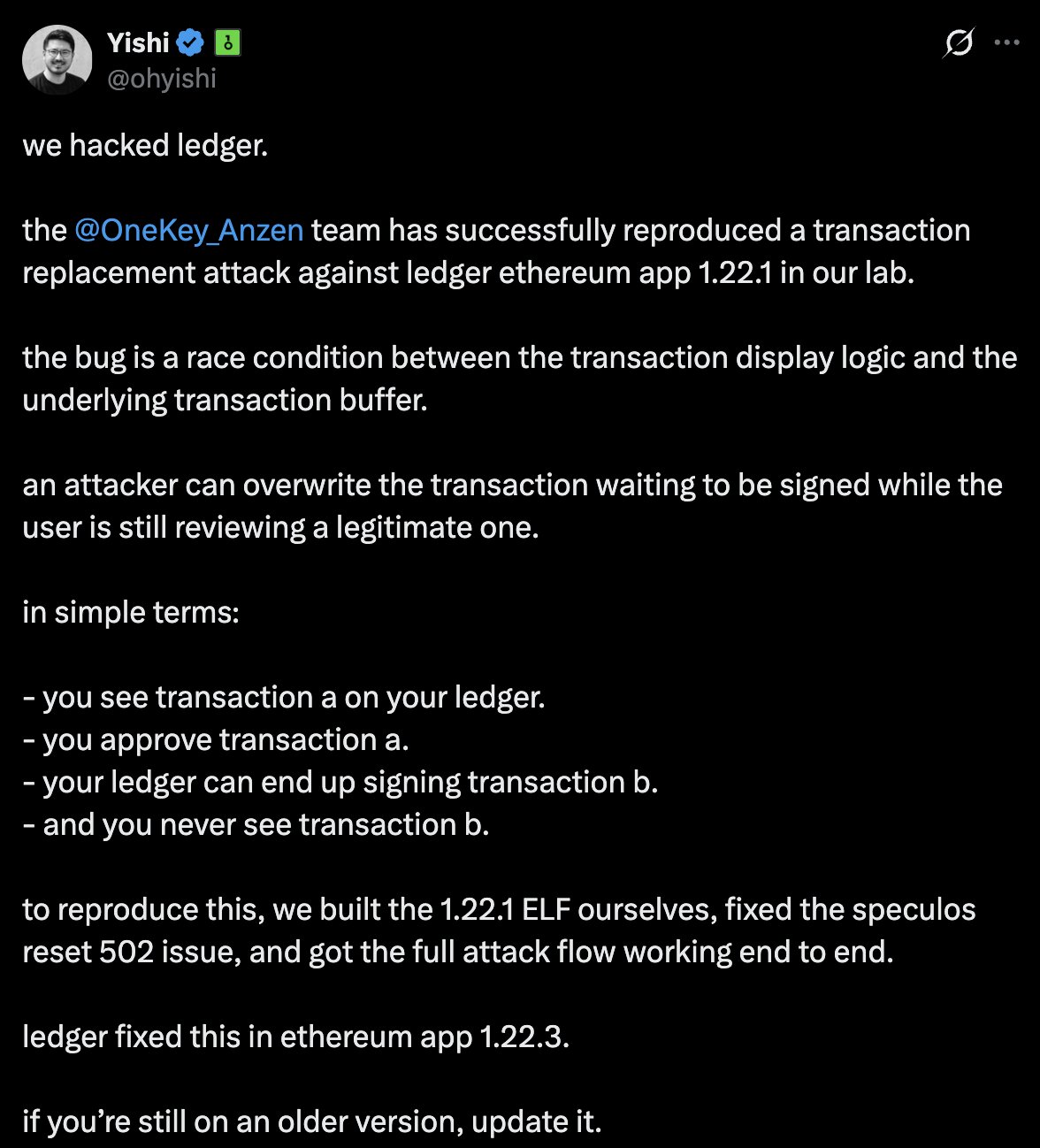
8. Risks, Trade‑Offs, and Decentralization Questions
SDKs bring clear benefits in speed and reliability, but they also introduce new risks and trade‑offs that are especially salient in a decentralization‑minded ecosystem.
One risk is centralization of power in infrastructure providers. When many apps depend on the same SDK for cross‑chain swaps, stablecoin transfers, or wallet interactions, that SDK becomes a potential choke point. If policies change, fees rise, or certain addresses are blocked—perhaps in response to regulatory pressure—those decisions propagate widely. Compliance‑embedded SDKs like Dfns’ Travel Rule integration can be seen as both necessary adaptations and centralizing forces, because they codify a particular interpretation of regulation into widely used code. For some builders, that may be acceptable or even desirable; for others, it may conflict with decentralization goals.
A second risk is systemic technical failure. A bug or downtime in a widely used SDK—say an execution layer like SODAX, or a wallet framework used by hundreds of apps—could freeze or misroute transactions across the ecosystem. While traditional software also suffers from shared library vulnerabilities, the irreversible nature of many crypto transactions raises the stakes. This underscores the importance of audits, conservative upgrade practices, and clear versioning in SDKs that touch real funds.
A third set of trade‑offs concerns transparency and inspectability. SDKs often encapsulate complex logic that may not be fully visible to integrators, especially if they are closed‑source. For example, an SDK that routes trades among multiple DEXes and bridges might implement proprietary algorithms for path selection and slippage management. While this can be a competitive advantage, it limits the ability of app developers and users to understand how their trades are executed. Open‑source SDKs like TrustConnect alleviate some concerns, but even open code can be hard to audit thoroughly in practice.
Finally, there are governance questions about who controls SDK roadmaps. If an SDK becomes a de facto standard for a given function—such as agent commerce on BNB Chain or stablecoin yield strategies on a particular platform—the entity maintaining it wields significant influence over how that function evolves. Community‑driven governance, transparent improvement proposals, and multi‑stakeholder input can mitigate this, but many current SDKs are still governed centrally by their originating teams. For decentralization advocates, pushing for more open and accountable SDK governance may be as important as protocol‑level governance.
- 2024-10launch
Tether unveils Local AI SDK at Lugano Plan ₿ conference
MetaMask Connect launches to replace legacy SDK
- 2025-04exploit
Velora supply chain attack via malicious npm package version
World Liberty Financial launches AgentPay SDK for AI agent USDC payments
- 2025-06launch
Sui ships Messaging SDK beta to mainnet with E2E encrypted wallet-linked chat
- 2025-09launch
Tether releases QVAC SDK as open-source on-device AI inference toolkit
Tempo releases Accounts SDK enabling passkey-based wallets with 1-line integration
- 2026-01launch
Starknet launches Starkzap v2 SDK bundling swaps, lending, bridging, and confidential payments
9. How SDKs Are Reshaping Web3 App Architecture
SDKs do not just simplify isolated tasks; they are reshaping how entire Web3 apps are architected. A typical modern crypto app might embed wallets via a provider’s SDK, connect user wallets through TrustConnect, route trades and yield via SODAX, manage stablecoin transfers and rewards via a stablecoin SDK, and comply with Travel Rule obligations via Dfns—all orchestrated from its own backend.
In such an architecture, the app becomes an orchestrator of SDKs rather than a monolithic protocol integration. Business logic is expressed in terms of SDK primitives: “connect wallet,” “create USDT0 deposit,” “bridge to another chain,” “swap via unified liquidity,” “initiate compliant transfer,” “trigger AI agent job.” The app’s own code handles user experience, state management, access control, and any custom off‑chain logic, but delegates much of the on‑chain work to SDKs.
This modularity has advantages. It allows teams to swap components as better options appear, or to experiment with new SDKs in specific regions or features without rewriting the entire stack. It also enables richer applications: a social app can add tipping and NFT collectibles; a game can add on‑chain assets and agent‑driven economies; a fintech app can add yield‑bearing stablecoin accounts and multi‑chain transfers, all through configuration and limited new code.
However, the architecture also introduces SDK sprawl and integration complexity. Each SDK may have its own initialization sequence, error handling patterns, and logging formats, increasing cognitive load for developers. Cross‑cutting concerns like observability, security monitoring, and incident response must be coordinated across multiple providers. From an operational standpoint, this looks increasingly like a microservices ecosystem, but with the twist that many of the services are third‑party SDKs rather than internal components.
For AI‑heavy systems, the picture becomes even more layered. An AI agent might call a DeFi execution SDK for routing, a payments SDK for settlement, a wallet SDK for signing, an identity SDK for proving credentials, and a data SDK for fetching market context. The chain of dependencies can be deep, and debugging a misbehavior may require tracing through multiple SDKs’ logs and behaviors. Designing clear boundaries, robust testing harnesses, and simulation environments becomes essential.
For a crypto news audience, understanding this architectural shift helps contextualize why SDK launches, expansions, and incident reports receive increasing attention. They are no longer just “developer tools”; they are building blocks that shape the reliability, reach, and governance of the entire Web3 stack.
10. Conclusion
SDKs in crypto sit at the intersection of engineering pragmatism and decentralization ideals. On the one hand, they are a practical response to the complexity of modern blockchain ecosystems, providing standardized, battle‑tested ways to integrate wallets, payments, DeFi, yield, identity, and compliance across many chains. Examples like SODAX’s cross‑network execution toolkit, Stable’s unified stablecoin and yield SDKs, BNBAgent’s agent‑oriented framework, and wallet tools from TrustConnect, Dfns, and Coinbase show how diverse and powerful these toolkits have become.
On the other hand, SDKs concentrate power and decision‑making in new places. By embedding security practices, compliance rules, routing logic, and even identity and governance patterns directly into code, SDK maintainers shape what is easy or hard to build, who can participate, and under what conditions. This influence is amplified when AI agents, rather than humans, become the primary consumers of SDKs, because agents may rely even more heavily on the default primitives exposed to them.
For readers and builders in the crypto space, fluency in SDK concepts is now as important as understanding base‑layer consensus mechanisms. Evaluating a new SDK launch means asking about security models, scalability, openness, governance, and how the SDK fits into a broader ecosystem of tools and regulations. It also means recognizing that SDK decisions are not just technical; they carry implications for decentralization, competition, and user autonomy.
Outlook
Looking ahead, SDKs are likely to become even more central to crypto’s evolution. As chains proliferate and specialized protocols emerge for everything from real‑world assets to AI‑native marketplaces, few apps will integrate directly with each underlying protocol. Instead, they will rely on layers of SDKs that aggregate liquidity, abstract complexity, and enforce security and compliance norms. Cross‑network execution systems will continue to generalize from tokens to tokenized stocks and other real‑world claims, while stablecoin SDKs will blur the line between payments and yield.
AI agents will accelerate this trajectory. As more capital is managed by autonomous or semi‑autonomous agents, the demand for robust, agent‑native SDKs with clear security and governance models will grow. Payment and identity SDKs like those from HyperMove and BNBAgent, execution SDKs like SODAX, and compliance SDKs like Dfns will form the backbone of these agent economies. The interfaces these SDKs expose—what they make easy, what they make impossible—will strongly influence how agents behave and how markets evolve.
At the same time, pressure will mount for greater transparency, open‑source code, and community governance of critical SDKs, echoing earlier debates around protocol and governance token control. Catalogs of Web3 SDKs and comparative analyses will help developers avoid lock‑in and foster competition. For news audiences, tracking SDK launches, expansions, and governance developments will remain a key way to understand where crypto is headed, because these toolkits are increasingly where infrastructure decisions get made—and where the next wave of apps, payments flows, yields, and AI agents will be born.
Latest SDK news
Velora identifies and unpublishes malicious npm package version in supply chain attack targeting its DEX aggregator SDKTempo releases Accounts SDK enabling passkey-based wallets with 1-line integration, bringing Face ID logins, transaction simulation, and gas sponsorship to appsOneKey founder says team reproduced transaction-replacement attack on Ledger Ethereum app; Ledger says bug fixed in SDK update but here is the catchBreez SDK turns BTC balances into USDC and USDT payouts across 30-plus chains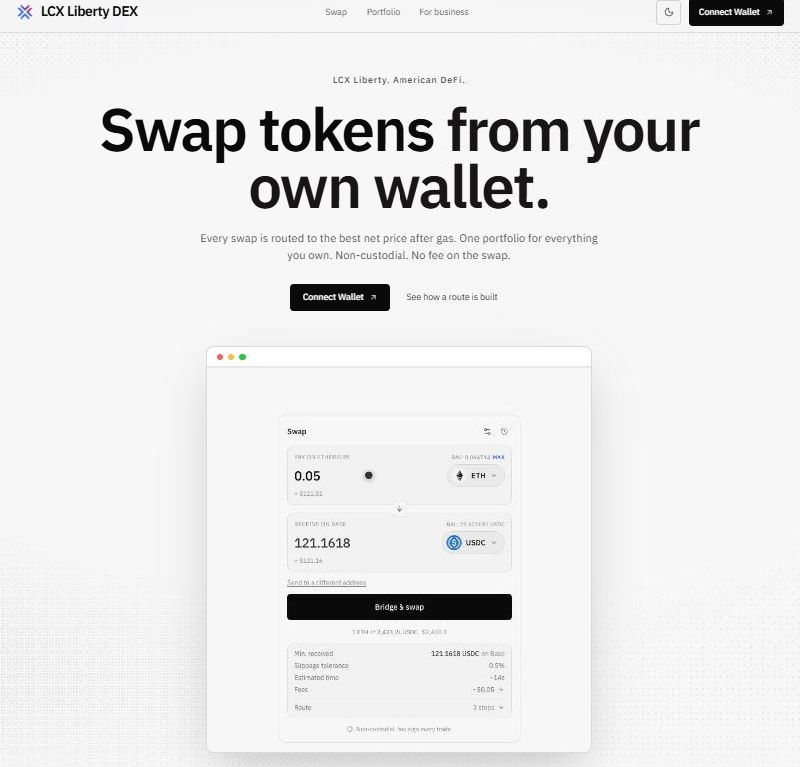 LCX launches Liberty DEX, opening its self-built routing engine to builders via API, SDK and MCPHyperMove launches Bitcoin-backed payment SDK for AI agents, enabling API payments via BTC collateral, x402 rails and vault-secured signing without private keys
Sources
20 records from 13 domains
ibm.com
banxa.com
developer.samsung.com
pub.towardsai.net
sodax.com
bnbchain.org
trustwallet.com
x.com
youmind.com
usdt0.to
dfns.co
docs.cdp.coinbase.com
alchemy.com
Community notes
Spot something off or out of date? Drop a note. Editors review topic notes daily and roll accepted fixes into the explainer — contributors are recognized in the monthly $SQUID drop.
Loading notes…
Help improve this topic
Have a story or tip about this topic? Submit it. See something missing? Leave a note. Editors review daily; accepted submissions and fixes count toward the monthly $SQUID drop.