
Texas is a central hub for U.S. crypto — home to major Bitcoin mining, a state BTC reserve, $9M in PAC electoral spending, and active SEC fraud enforcement against fake-AI crypto schemes.
+14 sources across the wider coverage universe
 SEC sues Texas man over alleged $12.3M crypto fraud, claiming fake AI trading bots were used to lure investors into a scheme with Ponzi-like payouts2026-05
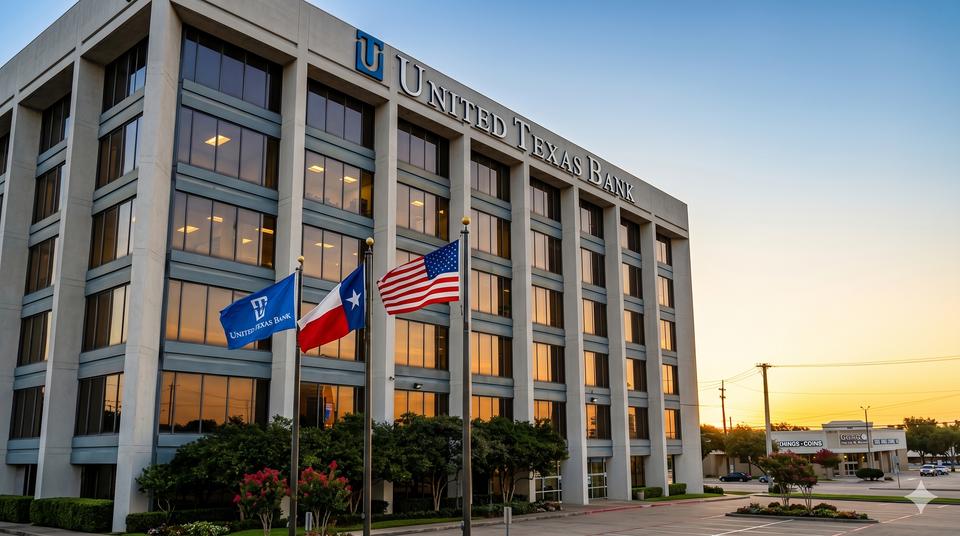 United Texas Bank gains OCC charter, clears $10B a month for crypto firms2026-05
 Hut 8 prices $4.25B non-recourse notes to fund 352 MW Texas AI data center project2026-06
 Core Scientific pivots from Bitcoin mining to AI, converting Texas site into 1.5GW data center campus with 1GW capacity aimed at leasing demand2026-04
 Texas Lt. Gov. Dan Patrick directs Senate to probe crypto kiosks, prediction market gambling loopholes2026-04
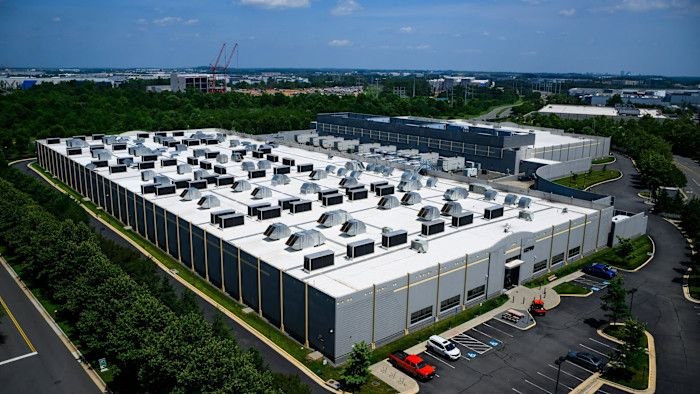 Google moves to fund multi-billion Texas AI hub leased to Anthropic, adding ~500MW capacity amid surging demand for next-gen model training infrastructure2026-03
Texas has emerged as one of the most consequential states in the United States for cryptocurrency policy, infrastructure, and politics — a role shaped by cheap energy, a business-friendly regulatory climate, and a political culture increasingly receptive to digital assets.
Why Texas Matters for Crypto
No single U.S. state has attracted more Bitcoin mining capacity, more crypto-focused political spending, or more ambitious state-level digital asset legislation than Texas. The reasons are structural: Texas operates its own deregulated power grid (ERCOT), has no state income tax, and has a history of welcoming energy-intensive industries. Those characteristics made it a natural destination for Bitcoin miners when Chinese regulators expelled the industry in 2021, and the state has since doubled down — building policy frameworks, seeding sovereign Bitcoin reserves, and becoming a battleground for crypto-industry electoral influence.

Hut 8 wins Poolin bankruptcy auction for Texas data centers with $140 million bid

The Power Grid Advantage and Bitcoin Mining
Texas hosts a significant share of global Bitcoin hashrate. The ERCOT grid's unique design allows large industrial consumers — including miners — to participate in demand-response programs, curtailing power use during peak periods in exchange for payments. This flexibility transformed what might otherwise be a liability (high power consumption) into an economic feature: miners effectively act as a controllable load that can help stabilize the grid.
As that model matures, regulatory frameworks are adapting. A new ERCOT power grid allocation framework has been proposed to accommodate Bitcoin miners that are transitioning into AI data center operators — a dual-use model that several large mining companies are pursuing. The distinction matters because AI inference workloads run continuously, unlike Bitcoin miners that can curtail on short notice, and grid planners need to account for that difference in load forecasting.
Hut 8, one of the largest publicly traded Bitcoin mining companies, exemplifies the trend. In 2025 it priced $4.25 billion in non-recourse notes to fund a 352-megawatt AI data center project in Texas — a scale of investment that signals the state is being treated as a Tier 1 location for next-generation compute infrastructure, not just cheap-power crypto mining.
Texas readers click hardest on enforcement and legal battles against the SEC — not on crypto adoption wins — revealing that the dominant anxiety is regulatory overreach, not whether Texas actually becomes a Bitcoin reserve state.
Texas and the Strategic Bitcoin Reserve
One of the more structurally significant developments is Texas's move to establish a state-level Strategic Bitcoin Reserve. Initially, proposals centered on Bitcoin exchange-traded funds (ETFs) as a way to gain BTC exposure without direct custody. Those plans have since shifted toward direct Bitcoin custody — meaning the state would hold actual BTC rather than shares in a fund. The distinction matters for long-term balance-sheet integrity and for avoiding the counterparty exposure that ETF wrappers introduce.
To steward this process, Texas appointed industry insiders to its Strategic Bitcoin Reserve committee. Among the appointees: an executive from CleanSpark, a major Bitcoin mining firm with substantial Texas operations, and the CEO of another Bitcoin mining company. The appointments reflect a pattern visible across the Trump-era federal push for crypto-friendly policy — operators with direct industry experience being placed in institutional advisory roles rather than traditional finance or academic economists.
The move also mirrors, at a state level, proposals that have circulated at the federal level during the Trump administration for a national Bitcoin reserve. Texas, which frequently positions itself as a policy laboratory for the rest of the country, appears to be stress-testing that concept at a state scale.
Crypto's Growing Political Footprint in Texas
Few states have seen as concentrated crypto PAC spending as Texas. In the 2026 primary cycle, crypto-aligned super PACs including Fairshake and Protect Progress — heavily funded by Coinbase and other major industry players — spent approximately $9 million in Texas primaries, backing candidates in both parties who expressed support for digital assets. The spending paid off: several pro-crypto challengers won, and the industry helped unseat Rep. Al Green, a longtime Democratic congressman whose positions on crypto regulation were unfavorable to the industry.
The electoral intervention is part of a deliberate national strategy: by demonstrating that the crypto industry can move primary elections — not just general elections — PACs are establishing credibility as a political force capable of punishing incumbents, not just rewarding allies. Texas, with its competitive primaries and large congressional delegation, provides a high-profile stage for that demonstration.
Senate and House runoffs in Texas have attracted additional attention from crypto PACs. The Fellowship PAC, a pro-digital-asset group, endorsed Ken Paxton for Senate, extending the industry's reach into statewide races. Prediction markets have in several instances favored crypto-backed challengers over incumbents, suggesting that capital alone is not the only factor — the industry has developed meaningful ground-game credibility.
President Trump has weighed in directly on Texas politics, making pointed public statements about specific candidates. The intersection of Trump's political brand with crypto-industry electoral goals creates a feedback loop: Trump's base is receptive to crypto-friendly messaging, crypto PACs are aligned with Trump-affiliated candidates in many cases, and Texas primaries are where that coalition is being field-tested.
- 01SEC jurisdiction lawsuits Texas
Crypto industry fighting back against SEC authority in Texas courts drew the most clicks, framing Texas as the legal battleground for defining regulatory limits.
- 02Texas Bitcoin strategic reserve
The progression from bill proposal to legislative passage to governor signature made Texas the first U.S. state to move toward holding BTC as a reserve asset.
- 03CryptoFX Ponzi Latino investors
A $300M Houston-based Ponzi scheme targeting 40,000+ predominantly Latino investors combined scale, community harm, and named perpetrators into a high-click story.
- 04Crypto-adjacent bank enforcement
Federal Reserve and OCC actions against Texas-based banks exposed the fragility of crypto-friendly banking and drew readers tracking systemic banking risk.
- 05Bitcoin mining Texas energy credits
Riot's $31.7M in Texas grid energy credits revealed that mining profitability in Texas is as much about power arbitrage as Bitcoin price.
- 06Crypto fraud and kidnapping crime
Violent crypto crime — both the $8M kidnapping forced transfer and the fake-AI-trading-bot fraud — showed readers that crypto wealth is now a physical security target.
Banking Realignment: United Texas Bank and the OCC Pivot
On the institutional side, United Texas Bank completed a significant regulatory pivot by switching its primary federal regulator to the Office of the Comptroller of the Currency (OCC). The move matters for crypto specifically because the OCC has issued guidance more permissive of crypto-related banking activities than some state regulators.
Following the switch, United Texas Bank reportedly processes upward of $10 billion per month for crypto firms. That volume positions it as a systemically important rail for the industry — a role that has proven fragile at other institutions. The collapses of Silvergate Bank and Signature Bank in 2023 left the crypto industry with a narrow set of banking partners willing to handle high-volume digital asset flows. United Texas Bank's explicit pivot toward that market, with OCC regulatory backing, represents a new entrant willing to serve a gap that has been underserved since those failures.

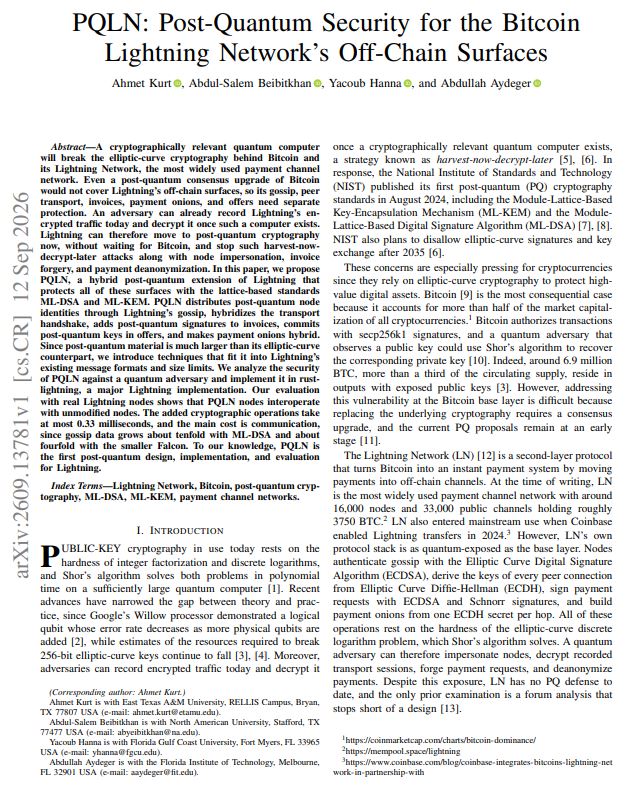
East Texas A&M students say they built first post-quantum security for Bitcoin Lightning
SEC Enforcement and Fraud Schemes
Texas's prominence in crypto has a shadow side: it is also a recurring venue for fraud prosecutions and SEC enforcement actions.
The Securities and Exchange Commission filed charges against a Texas man accused of running a $12.3 million crypto scheme built on fabricated AI trading bots. According to the SEC's complaint, the scheme operated with Ponzi-like mechanics — early investors were paid with funds from later investors while the artificial intelligence trading infrastructure that was marketed to them did not exist or did not function as represented. The use of AI as a marketing hook is consistent with a broader pattern the SEC has identified in fraud cases: real technological buzzwords (AI, blockchain, automated trading) deployed as cover for unsophisticated frauds.
Separately, two Texas brothers pleaded guilty to an $8 million armed cryptocurrency home invasion — a violent crime in which victims were targeted because they were known to hold significant crypto holdings. These cases underscore a security risk that has grown alongside Bitcoin's price appreciation: the physical danger faced by individuals whose crypto wealth becomes publicly or semi-publicly known. Unlike bank accounts, self-custodied crypto can be coerced at gunpoint with no fraud reversal mechanism.
Together, these cases reflect the dual character of Texas as a crypto jurisdiction: genuine institutional and infrastructure development alongside a persistent fraud and crime problem that the SEC and federal prosecutors continue to address.
Regulatory and Legal Landscape
Texas does not have a comprehensive state-level crypto licensing framework equivalent to New York's BitLicense, which has historically made it more permissive for startups and exchanges. The state has instead relied on its existing Money Services Business framework, administered by the Texas Department of Banking, to cover most crypto operations.
That relatively light touch has drawn companies that found New York's requirements burdensome, but it has also meant less regulatory clarity on some edge cases. The SEC's active enforcement in Texas — the AI trading bot case, and other cases involving unregistered securities offerings — suggests that federal oversight is filling the gap that state regulators leave.
On the legislative side, Texas has been active. Bills related to digital asset property rights, Bitcoin mining regulation, and state reserve mechanisms have moved through the legislature with varying degrees of success. The Strategic Bitcoin Reserve shift from ETF to direct custody, for instance, required legislative action to clarify custodial authority.
- 2022-09regulatory
SEC emergency action halts CryptoFX Houston Ponzi
- 2023-05regulatory
Federal Reserve cease-and-desist against United Texas Bank
- 2023-08milestone
Riot earns $31.7M Texas energy credits during heat wave
- 2023-09regulatory
SEC charges 17 in $300M CryptoFX Ponzi scheme
- 2024-07regulatory
Texas files emergency cease-and-desist against Abra for insolvency
- 2024-11regulatory
Texas judge rules Treasury overreached in Tornado Cash sanctions
- 2025-06milestone
Texas governor signs Strategic Bitcoin Reserve Bill (SB 21)
- 2025-06milestone
United Texas Bank obtains OCC charter, clears $10B/month for crypto firms
Energy, Environment, and the Bitcoin Mining Debate
The presence of large-scale Bitcoin mining in Texas generates ongoing debate about energy use and grid reliability. Critics argue that mining operations compete with residential customers for power during peak demand periods and that the grid benefits of demand-response participation are overstated. Supporters counter that miners provide flexible demand that helps stabilize ERCOT and that they frequently locate near stranded or curtailed renewable energy sources, absorbing power that would otherwise be wasted.
The transition of some mining operations toward AI data center infrastructure complicates this picture. AI workloads require more consistent power draw than Bitcoin mining, reducing the demand-response flexibility that regulators and grid operators have relied on. The new ERCOT framework for grid allocation is partly a response to this shift — an attempt to classify and manage AI-converted mining facilities under rules appropriate to their actual operating characteristics rather than treating them as interchangeable with traditional Bitcoin mining operations.
Outlook
Texas is unlikely to retreat from its position as a central node in the U.S. crypto economy. The combination of infrastructure buildout (mining, AI data centers, banking rails), political entrenchment through PAC spending, and state-level policy ambition (the Bitcoin reserve) points toward deeper integration rather than retrenchment. Federal crypto legislation, if it passes in the current congressional session, will interact with Texas's existing frameworks in ways that are still being worked out — particularly around securities classification, stablecoin regulation, and banking access. The state's willingness to serve as an early adopter of the Bitcoin reserve model will be closely watched by other states weighing similar proposals. On the fraud and enforcement side, Texas's high profile means it will continue to attract both legitimate operators and those who exploit the industry's marketing vocabulary to defraud investors — and the SEC has shown no sign of reducing its Texas docket.
Latest Texas news
Community notes
Spot something off or out of date? Drop a note. Editors review topic notes daily and roll accepted fixes into the explainer — contributors are recognized in the monthly $SQUID drop.
Loading notes…
Help improve this topic
Have a story or tip about this topic? Submit it. See something missing? Leave a note. Editors review daily; accepted submissions and fixes count toward the monthly $SQUID drop.