
Explores how “birthdays” shape crypto, from genesis blocks and NFT anniversaries to airdrops, regulation, and cryptographic birthday attacks, helping traders and builders read milestone narratives beyond the marketing.
+12 sources across the wider coverage universe
 Happy Birthday Vitalik!2025-01
 Leviathan News congratulates CRVHub, the user-friendly community-built Curve ecosystem resource on its one-year anniversary2025-04
 Today is the fifth birthday of the very eventful Curve DAO deployment2025-08
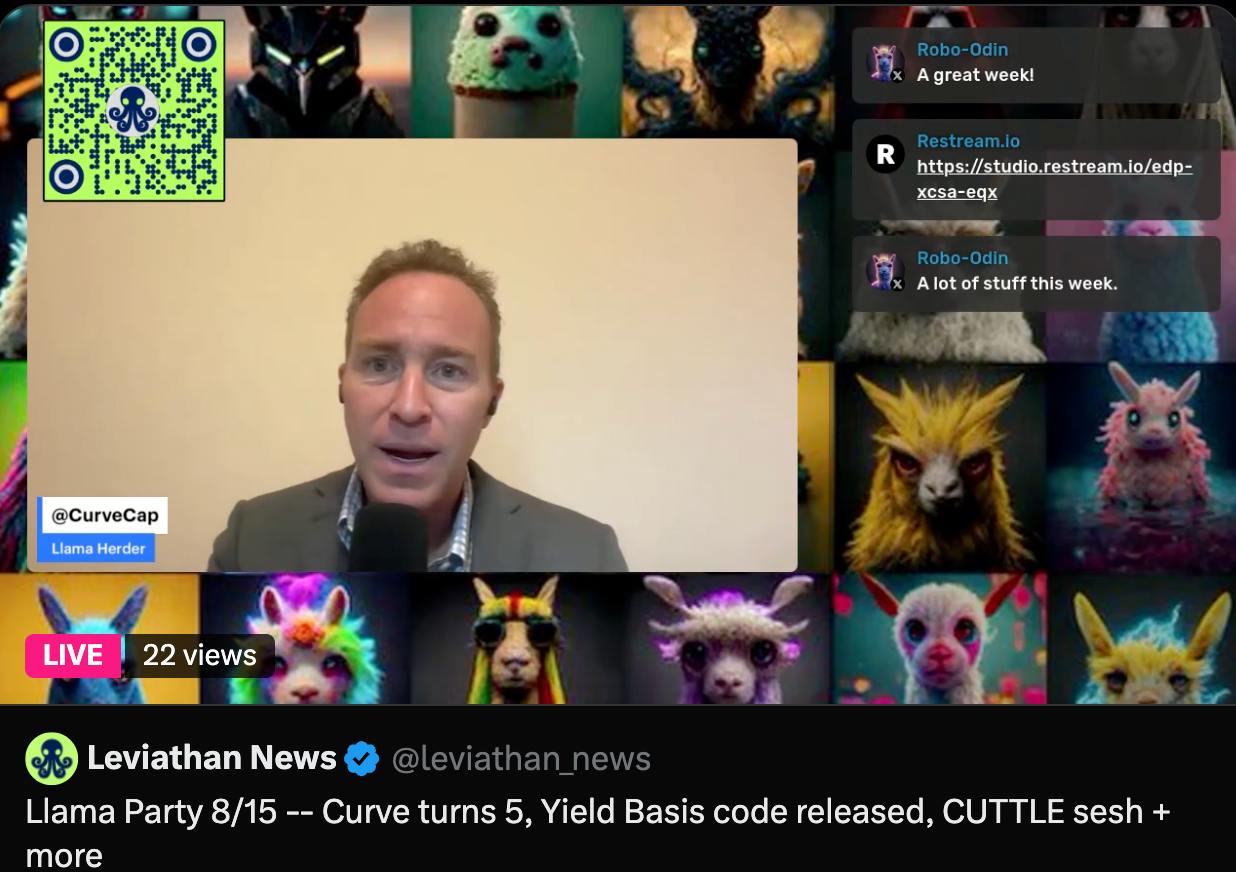 Leviathan Livestream: Llama Party talking Curve's 5th Birthday, Yield Basis shipped, CUTTLE sesh + more2025-08
Birthdays in Crypto: From Genesis Blocks to Airdrops
In digital finance, a birthday is more than candles and cake: it is any meaningful anniversary that marks the birth, maturation, or reinvention of a blockchain, token, protocol, community, or even a nation’s crypto policy. In practice, these dates become powerful coordination points for marketing campaigns, governance changes, regulatory signaling, and even cryptographic theory, shaping how traders, builders, regulators, and citizens interpret the story of crypto over time.
From Human Rituals to Protocol Anniversaries
The idea of a birthday is fundamentally about time, memory, and identity, and those same themes translate directly into crypto. Human societies use birthdays and national anniversaries to tell stories about who they are and what they value, whether that is a family gathering or a country reflecting on revolution and independence. In crypto, networks and communities adopt similar rituals, using launch dates and yearly milestones to declare that a protocol has survived, evolved, or entered a new phase of its life. These symbolic dates help make abstract, global, always-on systems feel more human and narratable.
In traditional culture, national birthdays such as a 250th anniversary of a revolution become focal points for books, speeches, and political projects that reinterpret founding values for a new era. Crypto increasingly plugs into those same narratives. Commentators on the approaching 250th birthday of the United States, for example, have framed debates about digital assets, financial freedom, and state power as a continuation of older arguments about liberty and centralized authority. At the same time, crypto’s own internal birthdays—like Bitcoin’s genesis block anniversary or the launch of an NFT collection—create parallel calendars that communities use to mark their progress.
Within the industry, the word “birthday” is used flexibly. It can mean the day a genesis block was mined, the day a mainnet went live, the date a token contract was deployed, the launch of a marketplace or identity network, or the anniversary of a major upgrade that changed a protocol’s economics. Bitcoin’s “birthday” is often tied to the mining of its genesis block on January 3, 2009, when the first block reward of 50 BTC was created and an infamous newspaper headline about bank bailouts was embedded in the data. Ethereum’s birthday, by contrast, is commonly celebrated as July 30, 2015, when its Frontier mainnet launched and the genesis block of the Ethereum blockchain was created. Different communities choose different origin moments, but the idea is the same: at some point, the system was born.
These anniversaries matter because they anchor how participants think about risk and maturity. A protocol celebrating its first birthday is arguably still in its infancy, with technology, governance, and regulatory status all in flux. By the time a network reaches a sixth or seventh birthday, narratives of resilience and staying power begin to dominate coverage, as has been the case in commentary around Solana’s sixth anniversary and its ability to survive technical and market shocks while continuing to attract builders. The language of birthdays turns abstract timelines into intuitive categories, such as “too young to regulate harshly” or “old enough to be considered critical infrastructure,” shaping how everyone from investors to regulators approach crypto.
Human rituals, digital networks
The translation of human birthday rituals into crypto can be seen in the way communities design commemorations. Traditional birthdays often involve gifts, speeches, and gatherings; crypto birthdays mirror these with airdrops, protocol speeches in the form of governance posts or presidential-style messages, and IRL events that bring online communities together. National anniversaries like the United States’ 250th birthday also become stage sets for broader reflections on technology and governance, with authors and commentators linking the story of the American Revolution to contemporary debates about digital currencies and decentralized power. In that sense, crypto birthdays are part of a much older human habit: using dates on a calendar as tools for storytelling and moral argument.
Digital networks add a twist because, unlike a person, a protocol can have many plausible “birth” events. Some argue that a chain is born when its white paper is published; others point to the instant the first block is mined or the moment tokens become freely transferable on mainnet. Pi Network, for instance, has highlighted both its initial launch and the later transition from an enclosed mainnet to an open network that allows external connectivity, treating the latter as a kind of coming-of-age milestone even as it celebrates a sixth official anniversary on Pi Day. This layered life cycle invites multiple birthdays—launch, mainnet, open network, and major upgrades—each with different symbolic weight.
Because crypto networks are borderless, their birthdays form transnational rituals. A Solana or Ethereum birthday party might be celebrated simultaneously in New York, Lagos, Seoul, and online Discord channels, blending cultural traditions and time zones into a shared event. When PayPal announced that its PYUSD stablecoin would also be available on Solana, for example, the news was unveiled at a global industry conference but quickly became part of a broader narrative about Solana’s maturing ecosystem and its ability to attract mainstream financial partners. These are not just technology milestones; they are cultural events that signal who sees value in a given chain at a given moment.
Types of crypto birthdays
For a crypto-native audience, it is helpful to distinguish several recurring kinds of birthdays, because each carries different implications. Network birthdays are tied to the underlying blockchain itself—Bitcoin, Ethereum, Solana, Pi Network, COTI, Cellframe and others—usually pegged to the genesis block or mainnet launch. Token birthdays refer to the deployment of a specific token contract or the listing of a token on a major marketplace or exchange, which often triggers liquidity, governance rights, and regulatory attention. Community birthdays track the founding of NFT collections, DAOs, or social clubs like the Bored Ape Yacht Club. Finally, there are political or regulatory birthdays, such as the anniversary of a key law or the symbolic use of a national birthday to announce pardons or reform proposals related to crypto.
Each type of birthday sets up different expectations. A mainnet anniversary might prompt evaluation of network reliability, transaction volume, and developer traction, as seen in celebrations of the COTI V2 mainnet’s first year, which emphasize hundreds of millions of privacy-preserving transactions and dozens of ecosystem partnerships. A token birthday is more likely to focus on price performance, circulating supply, vesting cliffs, and whether promised use cases have appeared. Community birthdays invite questions about culture and cohesion: are NFT holders still engaged; has the DAO stayed active; does the identity network continue to onboard users, as in the case of Moca Network’s third birthday and millions of AIR accounts? On the regulatory side, a national 250th anniversary can become a rhetorical anchor for debates about clemency for crypto defendants or the future of digital assets in a country’s legal framework, reinforcing that “birthday” in crypto is never just about cake.

Leviathan Livestream: Llama Party talking Curve's 5th Birthday, Yield Basis shipped, CUTTLE sesh + more

Great LLama party
Network and Protocol Birthdays: Genesis, Mainnet, and Beyond
Network birthdays are the backbone of crypto’s calendar. They mark when a new ledger began committing blocks to history, when a consensus mechanism first secured value, and when a chain moved from speculative idea to running infrastructure. Bitcoin’s genesis block, mined on a small server in early 2009, is widely considered the birth of decentralized digital currency, with its embedded newspaper headline about bank bailouts becoming a founding myth of crypto’s anti-fragility narrative. Every January, Bitcoin’s birthday coverage revisits that scene, using it as a lens to evaluate how far the ecosystem has come and how far it still diverges from the legacy financial system it was partly reacting against.
Ethereum’s birthday plays a comparable role for programmable money. When the Frontier mainnet launched on July 30, 2015, creating the Ethereum genesis block, it introduced a general-purpose smart contract platform that expanded crypto’s narrative from “digital gold” to a global programmable settlement layer. Annual Ethereum birthdays offer a chance to measure how that original vision has played out across DeFi, NFTs, DAOs, and layer-2 scaling solutions. Media, developers, and policymakers all use these dates to reassess questions of programmability, security, and regulatory classification, especially as Ethereum’s design has evolved from proof-of-work to proof-of-stake, showing how birthdays can mark not only births but successive transformations.
Genesis blocks and the birth of a ledger
Technically, a blockchain’s “birth” is its genesis block: the first block in the chain, with no parent, which defines the initial state of the ledger and often encodes special parameters or messages. In Bitcoin’s case, that genesis block set a block reward of 50 BTC and, through its data payload, referenced contemporaneous headlines about banking crises, signaling both the time of creation and the ideological backdrop. Many subsequent chains have followed this pattern, embedding cultural or political messages in their genesis blocks to document the context of their birth. These messages function like digital birth certificates, anchoring the network in history.
The genesis block is also a technical starting point. It fixes the hash function used, block size parameters, difficulty adjustment rules, and—in some designs—the pre-mine or initial allocation of tokens. Ethereum’s genesis block, created with the launch of the Frontier network, incorporated the pre-sale allocations and initial state that would enable smart contracts and decentralized applications to be built on top. Each year when the community marks Ethereum’s birthday, analysts often revisit debates about that initial distribution, subsequent forks, and whether the chain’s evolution has adhered to its original social contract. Genesis birthdays thus invite both celebratory and critical reflection, especially when viewed against later governance crises or forks.
Newer networks similarly treat their genesis anniversaries as a chance to prove that they have delivered on launch promises. Privacy-focused chains that rely on advanced cryptographic techniques, such as garbled circuits, highlight throughput metrics and real-world integrations on their mainnet birthdays, underlining that their protocols are not merely experimental but processing real payments, DeFi transactions, and AI workloads at scale. These narratives say, in effect, “we were born a year or several years ago with certain ambitions, and on this birthday we can show what has actually happened.” For observers trying to judge whether a network is viable, genesis and mainnet anniversaries offer convenient checkpoints.
Mainnet launch versus enclosed or phased networks
The question of what exactly counts as a mainnet birthday has become more complex as projects adopt multi-phase launch strategies. Traditionally, a mainnet launch was a single date on which the network flipped from testnet to production, often accompanied by token generation and exchange listings. Today, teams increasingly roll out in stages: limited-access mainnet, enclosed mainnet where transfers are restricted, gradual permissionless opening, and then further upgrades. Pi Network illustrates this pattern vividly. Its mainnet blockchain entered an enclosed phase at the end of 2021, allowing the community to begin migrating balances and building applications while external connectivity remained limited. Only later, as the project approached its sixth anniversary, did it emphasize an “open network” phase that more closely resembles a conventional launch.
These phased approaches dissect the idea of a birthday into multiple events: protocol birth, user migration, open-access launch, and sometimes later governance decentralization. For media and market participants, this raises the question of which date matters. A regulatory body might care most about the date tokens become freely transferable, because that is when trading, speculation, and potential securities law issues intensify. Developers might celebrate the initial mainnet deployment as the true technical birth, while marketers design campaigns around more public-facing milestones like an “open network” switch or first listing on a major exchange. The same network can thus acquire several birthdays, each with its own community and regulatory meaning.
COTI’s evolution from earlier versions to its V2 mainnet is another example of how chains frame birthdays around specific design leaps rather than absolute beginnings. When the COTI V2 mainnet went live, its team presented it as the start of scalable, on-demand privacy for real-world web3 adoption, and later coverage of the mainnet’s first birthday emphasized concrete metrics such as over 110 million on-chain transactions and integrations across DeFi, payments, AI, and healthcare. In that narrative, the “birthday” is tied to a particular architecture—garbled circuits in this case—rather than the broader project’s original inception. For readers, the lesson is to ask what exactly is being celebrated: the brand, the chain, the privacy layer, or a specific version.
Solana, Cellframe, and the culture of chain anniversaries
Some networks lean heavily into birthday culture as a way to frame their persistence through cycles. Solana, for example, marked its sixth birthday with messaging that emphasized builder resilience and the endurance of its code despite periods of public doubt, echoing a broader narrative that the ecosystem had weathered outages, market crashes, and regulatory headwinds while continuing to grow. Coverage of Solana’s birthday has increasingly paired these cultural messages with concrete developments such as rising DeFi activity, NFT volumes, and integrations like PayPal’s decision to bring PYUSD to Solana, underscoring that birthdays can be used to tie qualitative community spirit to quantitative metrics. For investors and regulators, these dual narratives can be persuasive in arguing that a chain is no longer experimental but part of the core market infrastructure.
Smaller or more specialized networks use birthdays for similar positioning, even if their communities are more niche. Cellframe, for instance, has highlighted its mainnet birthday with community parties, AMAs, and ecosystem updates, using the anniversary to showcase progress in areas like ecosystem projects, contests, and research collaborations. These events are not just marketing; they function as periodic governance touchpoints where teams explain what has been built, how funds have been used, and what roadmaps look like for the next year. In a world where many projects fade quietly, simply having multiple birthdays becomes an informal proof of survival.
Birthdays also create shared memory across disparate ecosystems. When the Bitcoin genesis block’s anniversary coincides with other chains’ milestones or with historic dates like national revolutions, media coverage tends to draw connections between them. Readers are invited to see the birth of Bitcoin alongside the birth of modern democracies or digital payment networks, reinforcing a sense that crypto’s calendar is gradually being woven into broader historical timelines. For a crypto news audience, recognizing how these narratives are crafted helps separate genuine technological achievement from symbolic staging.
Readers click 'birthday' content not for celebration itself but as a legitimacy checkpoint — the Vitalik story dominated because it anchors Ethereum's entire trajectory to a single person, while Curve's anniversary drove the next cluster because it gave the community a defensible moment to argue the protocol survived its existential crises.
NFTs, Gaming Universes, and Community Birthdays
If base-layer networks have constitutional birthdays, NFT and gaming communities have something closer to club anniversaries. In these cases, the birthday marks the emergence of a shared culture, inside jokes, visual motifs, and sometimes real-world gatherings that go far beyond the underlying smart contracts. The Bored Ape Yacht Club (BAYC), for instance, began as a collection of unique digital collectibles on Ethereum, but quickly evolved into a social club whose membership is signaled by token ownership and whose lore is sustained through events, merchandise, and collaborations. BAYC birthdays are less about contract deployment dates and more about the ongoing life of the club, often involving themed campaigns or “bounties” that reward long-term community participation.
For NFT communities, birthdays serve as tests of whether the project has transcended its initial speculative phase. In the first year, conversation might revolve around floor prices and flipping. By the second or third birthday, the focus shifts to whether the team has delivered on roadmaps, whether IP is being leveraged in media or gaming partnerships, and whether the community still feels vibrant. BAYC’s birthday celebrations, which have included special events and rewards framed as pirate-themed bounties, illustrate how teams try to keep the narrative fresh and playful even as the market matures, reinforcing the idea that membership is an evolving experience rather than a static JPEG. These cultural cues become important signals for traders evaluating whether an NFT brand has staying power.
Bored Ape Yacht Club and the NFT clubhouse
The Bored Ape Yacht Club’s origin story frames its genesis as the opening of an exclusive digital clubhouse where each Ape avatar serves as a membership card. From that initial mint, the project has layered on additional collections, metaverse experiments, and in-person events, turning yearly birthdays into checkpoints for brand expansion. On anniversaries, BAYC often uses quests, bounties, or limited-edition items to reward holders, borrowing mechanics from gaming rather than traditional fine art. This pattern has influenced many subsequent NFT projects, which now see birthdays as opportunities to deepen their universes through narrative arcs rather than merely releasing new tokens.
Birthday-themed campaigns also allow NFT communities to re-engage holders who might have become passive. A “birthday bounty” or special field trip adventure can serve as a soft re-onboarding moment, reminding people why they joined the club in the first place and providing new content for social media, which in turn sustains secondary market interest. Even when floor prices are down, ritualized events can reaffirm social bonds, which in many NFT projects are the real source of value. For outside observers, tracking how a collection handles its second or third birthday can be more informative than watching its first few weeks of speculative trading.
Game worlds like My Neighbor Alice
Blockchain games often treat birthdays as seasonal events within their virtual worlds. My Neighbor Alice, a multiplayer builder game with its own ALICE token, has used extended airdrop campaigns tied to milestones as a way to reward players and promote engagement. In one such campaign, the project announced plans to distribute hundreds of thousands of ALICE tokens over several months starting in early June, branding the program as an “Adventure Airdrop Party” rather than a one-off giveaway. The structure effectively turned an anniversary period into an in-game festival, giving users reasons to log in, complete quests, and invite friends.
Such campaigns illustrate how game economies merge marketing with tokenomics. A birthday airdrop can serve as both a loyalty program and a mechanism for wider token distribution, especially when it is structured over time rather than as a single snapshot event. However, these designs also create expectations: if every birthday brings a significant airdrop, long-term players may begin to time their activity and holdings around anticipated rewards. For token issuers, there is a delicate balance between making anniversaries special and creating a dependency that distorts organic engagement. Observers should examine not only the headline size of these airdrops but also their conditions, frequency, and impact on in-game and secondary-market behavior.
Identity networks and metaverse brands
Outside pure gaming and NFTs, birthdays are increasingly visible in identity and reputation networks. Moca Network, for example, has framed its third birthday as a milestone in building what it describes as a large-scale identity network for enterprises, highlighting the growth of millions of AIR accounts and live onboarding across multiple partners. Here, the birthday is tied not to art or gameplay, but to the maturation of an infrastructure layer that aims to provide verifiable identity and reputation across Web3 experiences. Celebrating such milestones is a way to reassure enterprise partners that the network has both traction and endurance.
These identity-focused birthdays intersect with broader metaverse narratives, where digital identities persist across multiple virtual environments and applications. As brands and platforms experiment with interoperable avatars and cross-platform logins, the birthday of an identity network can become a marker for trust: has the system had enough time in production to surface edge cases, resist attacks, and comply with emerging regulations around data protection and know-your-customer requirements? The answers will influence whether marketplaces, games, and even financial applications are willing to rely on such networks as a layer of shared truth. For readers, paying attention to how identity networks frame their birthdays—through technical milestones or marketing slogans—provides clues about where they see themselves on the path from startup to critical infrastructure.
Birthday Campaigns, Airdrops, and the Business of Attention
In practice, many crypto participants encounter “birthday” language first and foremost in marketing. Teams frequently use anniversaries to launch airdrops, trading competitions, NFT mints, or product updates designed to capture attention in a crowded information environment. The logic is intuitive: birthdays create a natural hook for stories and can be justified internally as periodic opportunities to reward loyal users. However, not all birthday campaigns are equal. Some are tightly aligned with product milestones and long-term incentives; others are thinly disguised attempts to inflate metrics or offload tokens under the cover of celebration.
From a market-structure perspective, birthday campaigns concentrate activity around predictable points in time. Just as earnings seasons in traditional markets create cyclical volatility, major anniversaries can produce bursts of volume, liquidity shifts, and sometimes short-term price dislocations in associated tokens. A large airdrop to existing users may increase circulating supply and prompt selling, while a well-designed campaign that requires long-term staking or participation in governance could actually reduce float and support prices. For DeFi protocols, the design of these campaigns interacts with liquidity on venues like Curve, Uniswap, and centralized exchanges, as well as with cross-chain bridges that move assets between ecosystems.
Airdrops as birthday presents
Airdrops are the most common “birthday gift” that projects offer their communities. My Neighbor Alice’s “Adventure Airdrop Party,” which allocated 500,000 ALICE tokens to be distributed over four months starting in early June, is a clear example of how an anniversary can be used to structure ongoing engagement rather than a single snapshot reward. Participants in such campaigns typically earn tokens by performing in-game actions, providing liquidity, or promoting the project, allowing the team to combine user acquisition with celebratory branding. The term “party” in this context is as much about marketing as it is about player experience.
Agent-economy projects like Swarms have adopted similar birthday strategies. To mark its second anniversary, the Swarms ecosystem announced a $10,000 birthday giveaway aimed at builders who publish tokenized agents on its platform, integrating the campaign with the launch of new software components and the expansion of its marketplace to support stablecoins. Here, the birthday becomes a framing device for incentivizing the exact behavior the protocol wants—more agents, more marketplace activity—while also rewarding early adopters. In both cases, the key question for observers is whether the underlying incentives are sustainable once the party is over.
Credit and payment protocols also use birthdays to frame growth narratives and reward users. Huma Finance, which describes itself as the first “PayFi” network enabling instant, borderless payment financing for businesses and institutions, has emphasized multi-billion-dollar transaction volumes processed as it marks successive anniversaries, using those dates to highlight progress toward the founding vision. Birthday communications often bundle such metrics with new product announcements or partner integrations, positioning the protocol as increasingly central to global money movement. For a discerning reader, it is important to parse which metrics are independently verifiable and which are internal estimates, and to compare them year-on-year rather than accepting a single birthday snapshot.
Marketplaces, stablecoins, and liquidity
Anniversaries intersect with market structure when they coincide with new listings or marketplace launches. Swarms’ second birthday, for example, was accompanied by news that its marketplace had expanded to support stablecoins, a change that can significantly alter liquidity dynamics for agents and services traded on the platform. Such changes affect not only user experience but also risk management, since stablecoin support introduces new counterparty and regulatory considerations. When birthday announcements include marketplace upgrades, readers should examine how those changes interact with fee structures, custody arrangements, and potential exposure to regulatory scrutiny.
Stablecoins themselves have begun to accumulate their own birthdays, often marked by expansion to new chains. PayPal’s PYUSD, originally launched on Ethereum, later announced availability on Solana at a major industry conference, positioning the move as an evolution toward faster, cheaper payments and programmable transfers. The ability for users to move PYUSD between Ethereum and Solana without additional fees was highlighted as a technological improvement, effectively turning the expansion into a kind of multi-chain birthday for the asset. For DeFi participants, stablecoin birthdays on new chains translate into opportunities for yield farming, liquidity provision on AMMs like Curve, and integration into lending markets.
The interplay between birthdays, stablecoins, and marketplaces can be summarized by looking at how liquidity migrates. When a token’s anniversary is coupled with a new listing on a high-volume marketplace or DEX pool, there may be short-term distortions as speculative capital chases incentives. Over time, the durability of that liquidity depends less on the birthday framing and more on the fundamental demand for the token’s utility, whether that is payment, governance, or participation in an NFT or gaming ecosystem. Seasoned traders learn to treat birthday campaigns as signals to review fundamentals rather than ends in themselves.
Tokenomics, vesting cliffs, and launch anniversaries
Beneath the surface of celebratory graphics, birthdays often coincide with hard tokenomics realities. Many projects structure vesting schedules, lockups, and cliff releases around one-year, two-year, or three-year anniversaries of token generation events. As a result, a token’s first birthday may bring significant increases in circulating supply as early investors, team members, or advisors gain the right to sell. Media coverage that focuses solely on birthday airdrops can obscure these structural supply shifts, which may have a larger impact on price and liquidity than any promotional campaign.
Coverage of tokens nearing their first birthday under regulatory scrutiny, including those associated with sanctions-evasion concerns or high-risk DeFi practices, illustrates another dimension of birthday narratives. A token approaching its first anniversary might be framed as graduating from the “experimental” stage into a period where watchdogs are expected to take a harder look, especially if volumes remain high and use cases involve cross-border flows that touch sensitive jurisdictions. In such cases, the anniversary becomes a hook for discussions about compliance obligations, KYC/AML integration, and potential enforcement actions.
Builders should therefore think of birthdays not only as marketing opportunities but as predictable inflection points in a token’s economic and regulatory life cycle. Aligning major unlocks with transparent communications and clear use-of-proceeds plans can mitigate some of the reputational risk that comes with sudden supply increases. Conversely, attempting to distract from large unlocks through flashy birthday campaigns may backfire if sophisticated participants perceive the strategy as obfuscation. For readers, the safest approach is to treat any birthday announcement as an invitation to scrutinize the underlying tokenomics.
Today is the fifth birthday of the very eventful Curve DAO deployment
National Birthdays and the Politics of Crypto
Beyond protocols, the concept of a birthday carries significant political weight. National anniversaries in particular provide an occasion for leaders, commentators, and movements to reinterpret histories in light of current challenges, and crypto is increasingly part of these conversations. As the United States approaches the 250th anniversary of its Declaration of Independence, for example, writers like Eric Metaxas have used the occasion to revisit the founding period, emphasizing themes of faith, courage, and resistance to centralized power. While such works are not primarily about crypto, their framing of state authority and individual liberty inevitably shapes how digital assets debates are perceived in the broader culture.
Political actors have also floated birthday-linked initiatives related to clemency and regulatory reform. Speculation about mass pardons tied to a nation’s 250th birthday, including for people convicted under financial or crypto-related statutes, demonstrates how symbolic dates can be used to justify policy resets or amnesties. Whether or not such proposals materialize, the rhetoric itself underscores that birthdays are seen as legitimate moments to question past decisions and outline future directions. For crypto, which often sits uneasily at the edge of existing legal categories, national anniversaries can become platforms for both backlash and integration.
America 250: founding myths meet digital money
The “America 250” project illustrates how deeply anniversaries are embedded in political culture. Commentators, including Metaxas in his lengthy exploration of the American Revolution, frame the 250th birthday as a chance to revisit the births of political institutions and ask what those origins mean for current debates over governance, rights, and economic systems. For crypto advocates, this kind of discourse opens space to argue that decentralized ledgers align with founding ideals such as checks on centralized power, free association, and property rights. Critics, meanwhile, may use the same anniversary to warn of speculative excess and the need for robust regulation to protect citizens.
Presidential messages marking the birthdays of foundational figures like James Madison or Andrew Jackson, or inventors like Alexander Graham Bell, similarly become opportunities to draw lines from historical innovation to modern technology. When these messages reference themes like communication, finance, or frontier experimentation, crypto is often implicitly in the background, even if not mentioned by name. The narrative arc from quill-and-ink constitutions to telegraphs to digital networks sets the stage for debates about what a 21st-century monetary system should look like as a nation enters its third century of existence.
Clemency, regulation, and symbolism
Speculation about mass pardons timed to a national birthday, including for individuals convicted in high-profile financial crimes or crypto-related offenses, highlights another role of anniversaries: symbolic resets. Tying clemency to a 250th birthday allows leaders to cast such decisions as acts of renewal and reconciliation rather than purely political calculations. Yet this symbolism can cut both ways. If pardons are seen as undercutting hard-won regulatory frameworks or encouraging future misconduct in areas like market manipulation or sanctions evasion, the same birthday that was meant to symbolize unity may instead spark controversy about the rule of law.
Regulators like the SEC and CFTC are not usually in the business of birthday symbolism, but their actions are frequently interpreted through that lens. When coverage links a major classification decision or enforcement action to the birthday of a prominent network like Solana, it implies a narrative: either that the protocol has matured enough to warrant clearer treatment under the law, or that authorities are belatedly catching up with a fast-moving ecosystem. Whether or not such timing is intentional, it influences how market participants perceive the stability and predictability of the regulatory environment.
Ultimately, national birthdays remind crypto audiences that digital assets do not exist in a vacuum. They operate within political communities that periodically pause to reassess foundational values. For builders and investors, aligning product narratives with these broader reflections—without resorting to shallow patriotism or opportunistic framing—can be a way to show that their projects are attuned to societal concerns rather than purely speculative.
Global commemorations and state-backed crypto
Beyond the United States, other countries also use national birthdays and revolutionary anniversaries to frame debates about digital money, including central bank digital currencies (CBDCs) and state-sanctioned crypto experiments. While specific examples fall outside the scope of the sources here, the pattern is recognizable: major anniversaries of independence or modernization often coincide with policy announcements, pilot launches, or rhetorical commitments to technological leadership. Birthdays thus become policy deadlines as much as commemorations.
For state-backed projects, birthdays can serve as performance reviews. A CBDC issued on the 50th anniversary of a central bank’s founding, for instance, will be judged on its first and second birthdays by metrics such as adoption rates, impact on financial inclusion, and effect on commercial banking sectors. If those metrics are not publicly released, the credibility of official birthday messaging may suffer. Observers should be wary of purely celebratory narratives around governmental digital currency birthdays that lack clear data, especially in contexts where independent scrutiny is limited.
In this way, birthdays at the national level mirror those in the private crypto sector: they are moments of both storytelling and accountability. The difference is that when states are involved, the stakes include not only investor returns but the shape of entire monetary systems.
- 01Vitalik founder-milestone framing
At 147 clicks, his birthday functions as a proxy for 'is Ethereum still on track' — readers treat it as an annual credibility audit of the protocol's guiding figure.
- 02Curve DAO fifth-year reckoning↗
Three separate Curve-anniversary headlines (CRVHub, Curve DAO 5th, Llama Party livestream) clustered in the top four, showing readers wanted to stress-test whether Curve survived its 2023 exploit and CRV depeg narrative.
- 03Protocol anniversary metric dumps↗
COTI V2 (110M transactions, 80+ partners) and Moca Network (3.3M AIR accounts) used birthday framing to publish growth proof — readers clicked to verify whether stated traction was real.
- 04Birthday airdrop incentive mechanics↗
ALICE's 100K-token drop and Swarms' $10K builder giveaway attached financial upside directly to anniversary events, drawing clicks from readers evaluating whether the reward was worth participating.
- 05Solana birthday plus regulatory catalyst↗
The Solana 6th-birthday headlines only registered clicks when bundled with the SEC/CFTC commodity classification news, revealing readers ignored the birthday itself and clicked for the regulatory signal.
- 06Community livestream anniversary events↗
The Llama Party Curve birthday stream pulled 26 clicks — second only to the headline-only Curve DAO post — showing readers use anniversary livestreams as real-time sentiment gauges for protocol communities.
The Mathematics of Birthdays: Probability, Hashes, and Attacks
Beyond symbolism, birthdays have a precise meaning in cryptography and security engineering. The “birthday problem” is a classic probability puzzle that asks how many people need to be in a room before there is a better-than-even chance that two share the same birthday. Surprisingly, the answer is only 23, thanks to the combinatorial explosion of possible pairs. This counterintuitive result underpins the concept of “birthday attacks” on hash functions, where an attacker exploits the same combinatorial effect to find collisions—two different inputs that produce the same hash output—with far fewer attempts than naive intuition might suggest.
For blockchain systems, which rely heavily on hash functions for block linking, transaction IDs, and sometimes address generation, understanding the birthday phenomenon is critical. Designers choose output lengths for hash functions, such as 256 bits, specifically to make birthday attacks computationally infeasible with current and foreseeable technology. When white papers discuss collision resistance and security levels, they are implicitly referencing the math of birthdays, even if they do not use the term explicitly.
The classic birthday problem
The classic birthday problem assumes that each day of the year is equally likely to be a person’s birthday and asks: how many randomly chosen people are needed so that the probability of at least one pair sharing a birthday exceeds 50 percent? The result—23—is striking because it is much lower than most people expect. The explanation lies in the number of pairs formed as the group grows. With \(n\) people, there are \(n(n-1)/2\) possible pairs, so the opportunities for a match scale quadratically, while the number of possible birthdays remains fixed at 365.
In hash functions, we can think of the “days of the year” as the possible outputs, often denoted \(H\), and the “people” as random inputs being hashed. If a hash function has \(H = 2^l\) possible outputs, where \(l\) is the bit length, the expected number of random inputs needed to find a collision—two inputs with the same hash—is proportional to the square root of \(H\). More precisely, under ideal conditions where outputs are uniformly distributed, a collision is expected after about \(1.25\sqrt{H}\) evaluations of the function on average. This is the mathematical core of the birthday phenomenon.
For a 64-bit hash function, for example, there are approximately \(1.8 \times 10^{19}\) possible outputs, yet a collision can be found in roughly \(5.38 \times 10^9\) attempts on average, which is relatively tractable with modern hardware. This is why 64-bit hashes are considered insecure for collision resistance. In contrast, a 256-bit hash has \(H = 2^{256}\) possible outputs, and the birthday bound implies that around \(2^{128}\) attempts would be needed to find a collision—astronomically beyond today’s capabilities. The birthday problem thus directly informs the choice of hash sizes in cryptocurrencies.
Birthday attacks on hash functions
A birthday attack is a brute-force method that leverages the birthday paradox to find collisions in hash functions. Rather than trying to find a preimage for a specific hash value, an attacker generates many random inputs and computes their hashes, looking for any pair that collides. Because the expected work grows with the square root of the output space size rather than linearly, this strategy is much more efficient than naive guessing. In practice, successful birthday attacks depend not only on the math but also on practical implementation details such as memory usage, algorithmic optimizations, and whether the hash function behaves as an ideal random function.
In quantum computing contexts, there is a contested but often-cited result suggesting that quantum algorithms can further reduce the complexity of finding hash collisions, potentially to around \(2^{l/3}\) operations for an \(l\)-bit hash, compared to \(2^{l/2}\) classically. If such algorithms become practical, the effective security level of current hash functions would drop, prompting the need for longer outputs or different primitives. For blockchains, which depend on the immutability of historical hashes, this is not a theoretical concern: if collisions become feasible, the integrity of blockchains could be undermined.
Despite these theoretical risks, most major cryptocurrencies today use hash functions with sufficiently long outputs and robust designs to make birthday attacks infeasible under current conditions. Bitcoin’s use of SHA-256 and Ethereum’s use of Keccak-based functions, for example, provide large output spaces and have withstood extensive cryptanalysis. Nevertheless, engineers designing new protocols or compression layers must be aware of the birthday bound when choosing hash sizes, especially if those hashes will be used for consensus or critical identifiers. Shortening hash outputs to save space may inadvertently open the door to birthday attacks.
Why blockchains over-engineer hash security
Given the enormous safety margins suggested by 256-bit hash functions, one might ask why blockchains do not economize by choosing smaller output lengths, especially in storage-constrained environments. The answer lies partly in the irreversible nature of many blockchain operations. Once a protocol is widely deployed and billions of dollars of value depend on its hashes, changing the underlying primitives becomes extremely difficult. Designing for the long term therefore means planning for not only current computational capabilities but also future advances, including quantum computers and algorithmic breakthroughs.
Moreover, blockchains often layer additional uses on top of hash functions, such as Merkle trees for transaction inclusion proofs, commitment schemes for privacy, and random beacons for consensus. Each of these uses has its own security considerations and may interact in unexpected ways. By choosing generous hash sizes, designers create a buffer against emergent attack strategies that exploit cross-protocol interactions. The birthday problem is simple to state, but in complex systems, its implications can be subtle.
For readers of crypto news, understanding the basics of birthday attacks provides a useful lens for evaluating security claims. When a project touts a novel, lightweight hash or compression scheme that reduces output length, it is worth asking how that change impacts collision resistance and whether the design has been audited with the birthday bound in mind. Conversely, when protocols like COTI emphasize privacy mechanisms built on advanced cryptographic constructions, knowing that those constructions rely on well-understood hash behavior can increase confidence that the system will not quietly succumb to combinatorial vulnerabilities.
The Birthday Effect and Market Psychology
The term “birthday effect” has another meaning in the social sciences: a statistical pattern in which the likelihood of death appears to increase on or near a person’s birthday. Studies in countries such as England and Wales, Switzerland, Ukraine, and the United States have found evidence that mortality risk spikes around birthdays, with proposed mechanisms including increased alcohol consumption, psychological stress, and a tendency for terminally ill patients to “hold on” until a milestone date. While the robustness of the effect is debated, the idea that birthdays are psychologically charged moments is widely recognized.
In financial markets, including crypto, similar psychological forces can influence behavior around anniversaries. Traders may treat protocol birthdays as natural times to re-evaluate positions, realize profits, or make bold speculative bets, creating temporary distortions in volume and volatility. Community members may feel a heightened sense of loyalty or FOMO during birthday events, leading them to buy tokens, participate in airdrops, or overlook warning signs. Analysts talk of “anniversary effects” when prices tend to react around recurring dates like Bitcoin halving events, though establishing causality can be challenging.
Mortality spikes on birthdays
Empirical research on the birthday effect suggests that the increased mortality risk around birthdays may be driven by a combination of behavioral and physiological factors. People may celebrate more heavily, consuming more alcohol and engaging in riskier activities; psychological stress about aging or unmet expectations can exacerbate underlying health conditions; and some terminally ill individuals may experience a kind of motivational exhaustion after reaching a “last” birthday milestone. The effect has been observed not only in general populations but also in specific cohorts, such as professional athletes, indicating that the phenomenon is not limited to any one demographic.
While these studies focus on physical mortality, the broader lesson is that arbitrarily chosen dates can acquire disproportionate emotional significance. In crypto, where communities often pour identity and hope into projects, birthdays can trigger similar surges of emotion—whether optimism or anxiety. A project approaching its first birthday after a turbulent launch may see both celebratory messaging and quiet fears about sustainability collide in the minds of participants. Recognizing that these reactions are partly a function of calendar-based salience can help individuals step back and assess risks more rationally.
Calendar-based biases in trading
Behavioral finance has long documented calendar anomalies such as the January effect, turn-of-the-month effects, and holiday effects, where returns systematically deviate from average patterns around specific dates. In crypto, the calendar is more complex, mixing traditional holidays, earnings seasons for public companies with large BTC or ETH holdings, and protocol-specific events like halvings and birthdays. Market participants may fall prey to confirmation bias, seeing patterns that fit narratives about “birthday pumps” or “anniversary dumps” even when underlying data is noisy.
Birthday-themed campaigns accentuate these biases by concentrating news and incentives around specific dates. A well-advertised airdrop or governance vote on a protocol’s anniversary may draw in short-term traders seeking quick gains, amplifying volatility. At the same time, long-term holders might interpret price spikes around birthdays as validation of their thesis, reinforcing HODL behavior. Without careful analysis, these dynamics can lead to overreactions—both euphoric and fearful—that are not grounded in fundamentals.
For sophisticated participants, the existence of calendar effects can be an opportunity rather than a trap. If one can objectively measure how prices and volumes behave around birthdays and other anniversaries, there may be strategies to provide liquidity or hedge exposure in ways that profit from predictable patterns. However, executing such strategies requires robust data and humility about causality. Not every birthday volatility spike is a repeatable phenomenon; sometimes it is simply the confluence of unrelated news.
Community sentiment cycles around anniversaries
Beyond prices, birthdays shape community sentiment cycles. The first birthday of a network often carries a narrative of survival—proof that the project has not rug-pulled or been abandoned. The second and third birthdays can bring questions about whether roadmaps are being delivered, whether governance is decentralizing, and whether the initial excitement has translated into real usage. By the time a chain like Solana reaches its sixth birthday, coverage tends to emphasize perseverance, builder loyalty, and the ability to attract major integrations despite setbacks. These narratives can reinforce commitment among core contributors even when markets are rough.
Conversely, a birthday can also catalyze disillusionment if promised features are repeatedly delayed. If each anniversary passes with recycled slogans and no substantive progress, community members may begin to see the date not as a celebration but as an annual reminder of missed opportunities. Social media sentiment analysis often shows spikes in both positive and negative emotion around anniversaries, reflecting this mixed psychology. For crypto news readers, paying attention to how communities talk about their own birthdays—whether with genuine reflection or defensive messaging—can be a useful indicator of project health.

Leviathan News congratulates CRVHub, the user-friendly community-built Curve ecosystem resource on its one-year anniversary
Compliance, Risk, and the “Age” of Crypto Assets
In legal and compliance contexts, the “age” of an asset or account carries concrete implications. Many jurisdictions distinguish between short-term and long-term capital gains based on a one-year holding period, making the first birthday of a token acquisition a potentially important tax milestone. Financial institutions often conduct periodic reviews of customer accounts, including annual KYC refreshes and risk assessments, which can be thought of as account birthdays in the compliance sense. For tokens and protocols, regulators may also look at how long an asset has been trading when deciding whether to prioritize enforcement, under the logic that older, larger markets pose different systemic risks than small, experimental ones.
Crypto adds complexity because assets can move across borders and platforms quickly, and because pseudonymous addresses complicate traditional notions of account age. Nevertheless, compliance teams at exchanges, custodians, and OTC desks track the provenance and “dwell time” of assets, sometimes flagging coins that have recently emerged from mixing services or sanctioned entities. When politically sensitive tokens associated with privacy or sanctions-evasion narratives near their first or second birthdays, scrutiny tends to intensify, especially in regulatory environments focused on tightening controls over DeFi and cross-chain bridges.
Legal age, long-term holding, and tax
In many tax regimes, holding an asset beyond one year qualifies gains for lower long-term capital gains tax rates, compared to higher rates for short-term gains. For active crypto traders and long-term investors alike, the birthday of a particular acquisition—rather than the token’s overall birth—is therefore crucial. Advisors often counsel clients to keep careful records of acquisition dates and to consider the tax implications of selling just before or just after a one-year holding period. In volatile markets, the temptation to sell ahead of a token’s acquisition anniversary for risk management reasons must be weighed against potential tax costs.
Token issuers and protocol teams must also be aware of how their own token holdings age, particularly if those holdings are subject to lockups or vesting schedules. Once a team’s allocation passes its vesting cliff and the tokens become freely disposable, the combination of market impact and tax considerations may influence selling behavior. Aligning internal treasury management with transparent communication about unlock schedules can help reduce market surprises around these internal birthdays. For readers, tracking public vesting schedules and comparing them to market behavior around those dates remains an essential part of due diligence.
Sanctions, privacy, and the first year of a protocol
Privacy-focused protocols and tokens often face the most intense compliance scrutiny in their first year, as regulators assess whether they are facilitating illicit activity such as sanctions evasion or money laundering. Coverage of privacy protocols nearing their first birthday with rising concerns about their use in sanctionable jurisdictions underscores how quickly reputational risk can accumulate. A protocol that launches with the promise of censorship-resistant privacy may find itself the subject of enforcement actions or blacklisting if it fails to implement appropriate safeguards or governance mechanisms.
COTI’s V2 mainnet offers a contrasting narrative, positioning privacy not as an anti-compliance feature but as a tool for secure, regulated transactions across DeFi, payments, AI, and healthcare. By emphasizing partnerships and real-world use cases that require adherence to data protection and financial regulations, the project uses its first-year metrics to argue that privacy can coexist with compliance. For policymakers, such examples are important to distinguish from protocols that explicitly market themselves as tools to evade oversight.
The key point is that birthdays in the first one to two years of a protocol’s life are inflection points for regulatory categorization. How projects communicate and govern themselves around these dates can set the tone for years to come, influencing whether they are seen as legitimate financial infrastructure or as problem platforms.
Payment networks, PYUSD, and PayFi
On the payments side, anniversaries for stablecoins and PayFi networks highlight the convergence of traditional fintech and crypto rails. Huma Finance, which positions itself as a PayFi network enabling instant, borderless payment financing, has used its birthdays to underline cumulative transaction volumes exceeding billions of dollars, suggesting that its model is gaining traction among businesses and institutions. These milestones are often paired with messaging about regulatory compliance, underwriting standards, and partnerships, signaling to both users and regulators that the network is maturing into a serious financial player.
PayPal’s PYUSD stablecoin occupies a related but distinct space, bridging mainstream consumers and crypto infrastructure. When PayPal announced that PYUSD would also be available on Solana, it framed the expansion as a way to offer faster and cheaper transactions, leveraging Solana’s high throughput while maintaining access through familiar interfaces like the PayPal and Venmo wallets. The ability to transfer PYUSD from Ethereum to Solana without additional fees was emphasized as a user-friendly feature, effectively celebrating a kind of “birth” of PYUSD on a new chain. Future birthdays of PYUSD may well be measured not just by age but by cross-chain adoption and integration into DeFi.
For regulators, the birthdays of such payment networks and stablecoins will likely serve as checkpoints for evaluating systemic importance. A stablecoin that has survived several years without major depegging events and has demonstrated robust risk management might be treated differently from a newly launched asset. Conversely, anniversaries may prompt reviews of whether a stablecoin has grown too large or interconnected without adequate safeguards. For readers, understanding these dynamics helps contextualize both celebratory and critical coverage.
Bitcoin genesis block mined — block 0
Curve DAO deployed on Ethereum mainnet
Solana mainnet beta launch
Curve DAO 5th birthday; community Llama Party livestream
Swarms 2nd anniversary; $10K builder giveaway launched
Solana 6th birthday; SEC/CFTC classify SOL as digital commodity
How to Read Birthday News as a Participant
Given the breadth of meanings attached to birthdays in crypto—from genesis blocks to national anniversaries to cryptographic attacks—readers need a framework for interpreting birthday-themed news. Not every “Happy Birthday” post signals something material; some are simple cultural rituals. Others, however, embed significant information about network maturity, regulatory positioning, or technical security. The challenge is to separate signal from noise without becoming cynical about genuine milestones.
For traders and investors, birthday coverage is often a prompt to revisit fundamentals. When a network celebrates a mainnet anniversary, it is reasonable to ask whether key metrics such as transaction throughput, active addresses, DeFi TVL, and developer activity have improved meaningfully since the prior birthday. For tokens, comparing circulating supply, treasury transparency, and governance participation year-on-year can reveal whether the project is progressing or merely surviving. Media narratives around birthdays provide useful pointers, but quantitative data remains the touchstone.
For traders and investors
From a trading perspective, birthdays can be catalysts for short-term price moves, especially when accompanied by airdrops, partnership announcements, or regulatory news. However, the direction of such moves is not guaranteed. A large birthday airdrop may generate optimism but also introduce sell pressure; a celebratory message without substance may be ignored or even interpreted as desperation. Avoiding reflexive reactions to birthday headlines means examining the specifics: what exactly is being announced, how does it change the protocol’s economics or risk profile, and how does it compare to prior years?
Investors with longer time horizons can use birthdays to periodically reassess thesis fit. If a project’s narrative at its third birthday is identical to its pitch at launch, with little concrete progress, that may be cause for concern. Conversely, a protocol that has delivered significant features, navigated regulatory developments, and maintained or grown its community may warrant continued confidence even if short-term price action has been disappointing. In this way, birthdays function as built-in review dates that can help counteract both inertia and panic.
For builders and communities
Builders should treat birthdays as opportunities for transparent communication rather than mere marketing spectacles. Anniversaries are natural times to publish retrospectives on what worked, what failed, and how governance and roadmap priorities have evolved. Sharing metrics, including the less flattering ones, can build trust more effectively than polished slogans. Incorporating community feedback into birthday announcements—such as highlighting user-created tools, art, or governance proposals—also reinforces that the project is more than its core team.
At the same time, builders must be mindful of regulatory and security optics. Overhyping speculative aspects of a token or downplaying risks in birthday messaging can attract unwelcome scrutiny from regulators and security researchers. Given the role of birthdays as focal points for attention, they are also attractive times for attackers to attempt exploits, phishing campaigns, or social engineering, banking on heightened emotional engagement. Clear communication about security practices and caution around external links or unofficial campaigns is therefore essential during anniversary periods.
For policymakers and observers
For policymakers, birthdays and anniversaries offer convenient windows to engage with crypto developments without appearing reactive to every market fluctuation. National birthdays like America’s 250th can provide a backdrop for thoughtful speeches about the role of innovation, regulation, and freedom in the digital economy, connecting constitutional principles to modern financial infrastructure. However, tying major policy shifts too closely to symbolic dates risks compromising the perception of impartiality. A well-timed announcement may leverage attention, but sound policymaking should rest on evidence and consultation, not merely on calendar symbolism.
Observers, including journalists and academics, can use birthdays as organizing devices for longitudinal analysis. Comparing conditions at successive anniversaries—whether of Bitcoin’s genesis block, Ethereum’s mainnet, or Solana’s network—allows for richer storytelling about growth, setbacks, and resilience. Similarly, tracking the evolution of birthday campaigns, from simplistic giveaways to sophisticated, compliance-aware incentive programs, sheds light on the maturing of crypto’s marketing and governance practices. In all these cases, birthdays become tools for structuring inquiry rather than ends in themselves.
Conclusion
Birthdays in crypto are deceptively simple. On the surface, they resemble familiar human rituals: candles, parties, and sentimental reflections about how far we have come. Underneath, they encapsulate a complex interplay of technology, economics, regulation, psychology, and narrative. Network birthdays mark the beginning of ledgers that now settle trillions of dollars in value; token birthdays intersect with vesting schedules, tax rules, and market microstructure; community anniversaries test the durability of cultures built around NFTs, gaming, and identity networks. National birthdays bring in a wider political frame, where debates about digital assets are refracted through centuries-old arguments about sovereignty and liberty.
Cryptographic notions like the birthday problem and birthday attacks remind us that these concepts are not merely metaphorical but mathematically precise, influencing how engineers choose hash sizes and design security protocols. Sociological constructs like the birthday effect highlight how calendar-based milestones can distort behavior, whether in health outcomes or trading decisions, and why anniversaries in crypto sometimes produce volatility that exceeds what fundamentals alone would imply. For compliance professionals, the “age” of a protocol or token shapes risk assessments, from sanctions concerns to the systemic importance of stablecoins and PayFi networks like Huma and PYUSD on Solana.
For a crypto news audience, the practical takeaway is twofold. First, treat birthday stories as prompts for deeper examination rather than uncritical celebration. Ask what, exactly, is being born or reborn: a mainnet, a major upgrade, a new regulatory status, or merely a marketing slogan. Second, recognize that birthdays—as focal points for narrative, incentives, and attention—offer both opportunities and traps. They can catalyze meaningful governance debates, community-building, and technical milestones, but they can also mask structural risks or serve as vehicles for short-term speculation. Navigating this landscape requires both skepticism and an appreciation for the human need to mark time.
Outlook
Looking ahead, birthdays in crypto are likely to become even more layered. As protocols accumulate years of history, their anniversaries will attract not only enthusiasts but also regulators, institutional investors, and mainstream media, all seeking to interpret crypto’s trajectory through the lens of age and maturity. At the same time, emerging technologies—from quantum-resistant cryptography to cross-chain stablecoins—will reshape the technical and economic meanings of “birth” and “anniversary” in decentralized systems. For participants across the ecosystem, the challenge will be to harness the coordinating power of birthdays for genuine progress, while resisting the temptation to let calendar dates dictate judgment in a space where innovation and risk do not follow a neat schedule.
Latest Birthday news
Leviathan Livestream: Llama Party talking Curve's 5th Birthday, Yield Basis shipped, CUTTLE sesh + moreToday is the fifth birthday of the very eventful Curve DAO deploymentLeviathan News congratulates CRVHub, the user-friendly community-built Curve ecosystem resource on its one-year anniversaryHappy Birthday Vitalik!Sources
19 records from 11 domains
facebook.com
boredapeyachtclub.com
youtube.com
x.com
huma.finance
dailycoin.com
en.wikipedia.org
crossexamined.org
instagram.com
solana.com
phemex.com
Community notes
Spot something off or out of date? Drop a note. Editors review topic notes daily and roll accepted fixes into the explainer — contributors are recognized in the monthly $SQUID drop.
Loading notes…
Help improve this topic
Have a story or tip about this topic? Submit it. See something missing? Leave a note. Editors review daily; accepted submissions and fixes count toward the monthly $SQUID drop.