
The ECB shapes crypto markets through interest rates, stablecoin rules, digital euro development, and EU regulatory architecture. Here's what every crypto investor needs to understand about Europe's central bank.
+9 sources across the wider coverage universe
 ECB study finds euro area crypto owners chase returns while crypto payers seek cash-like privacy2026-04
 ECB backs plan to shift EU crypto firm oversight from national regulators to ESMA2026-04
 ECB board member Isabel Schnabel says a digital euro is essential to counter stablecoin risks, warning dollar-backed tokens could strengthen U.S. monetary dominance2026-06
 ECB partners ECPC, Nexo, and Berlin Group to reuse open payment standards, slashing digital euro integration costs ahead of 2027 pilot and targeted 2029 rollout2026-04
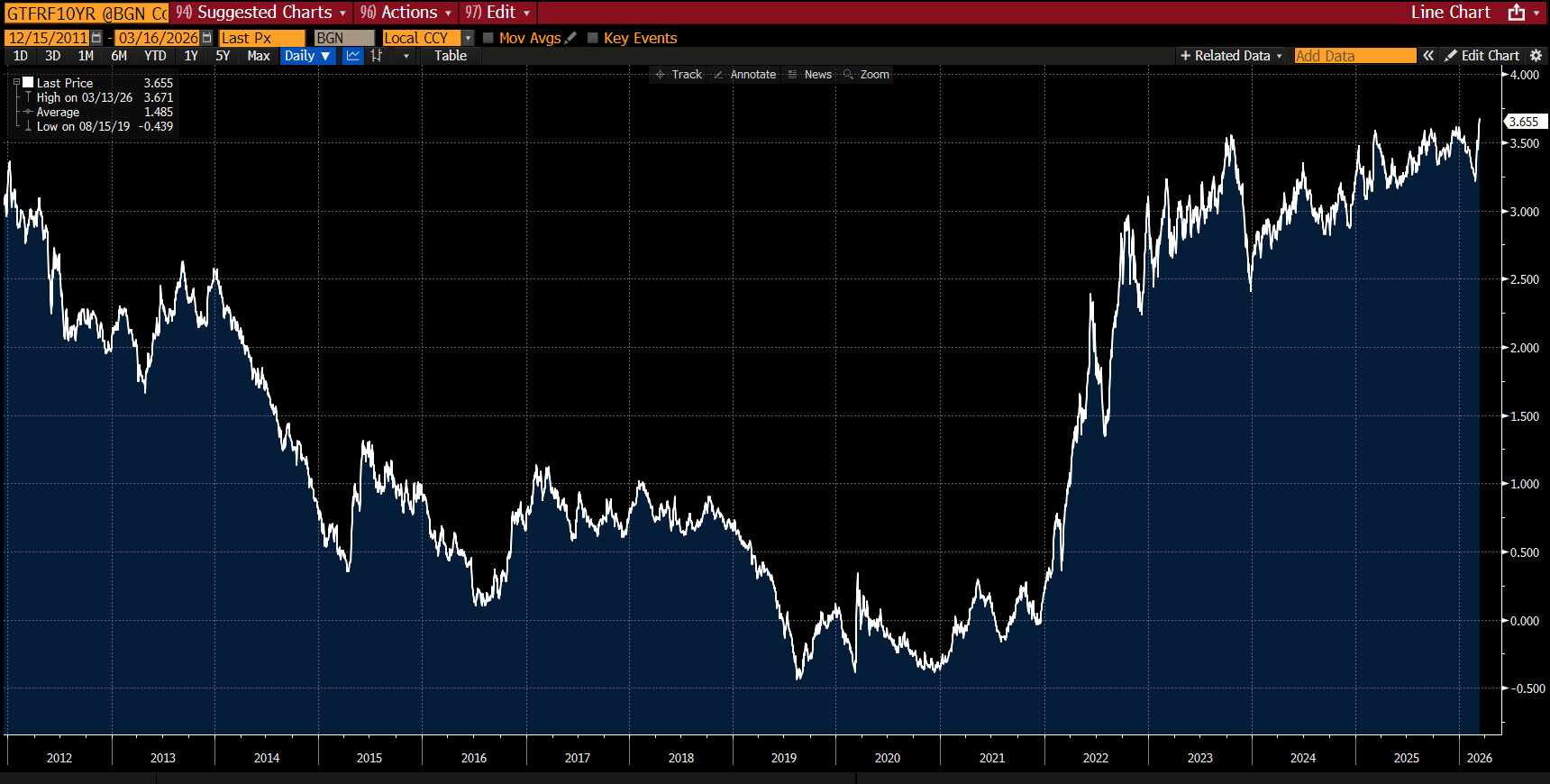 Oil shock slams Europe’s bond markets, driving French 10-year yields to 2011 highs and putting the ECB in a tighter policy trap than the Fed ahead of this week’s meeting.2026-03
 ECB rejects looser euro stablecoin rules over bank risks as tokens hold 0.3% of supply2026-05
Europe's monetary authority sits at the center of a widening debate over stablecoins, central bank digital currencies, and who controls the future of the euro in an increasingly tokenized financial world.
What Is the European Central Bank?
The European Central Bank (ECB) is the central bank for the 20 countries that share the euro, collectively forming the eurozone. Established in 1998 and headquartered in Frankfurt, Germany, it sets monetary policy for roughly 350 million people — controlling interest rates, managing inflation, and acting as a lender of last resort to the eurozone banking system. Its governing council includes the presidents of each national central bank plus six executive board members, with Christine Lagarde serving as president since 2019.
For most of its history, the ECB was of passing interest to crypto markets — a macro variable that moved FX rates and risk appetite. That changed as stablecoins scaled, the digital euro project advanced, and MiCA (the EU's Markets in Crypto-Assets regulation) gave the ECB a formal stake in shaping how crypto assets interact with the monetary system.

ECB and EU central banks push to dump MiCA’s 60% bank-deposit mandate for stablecoins, calling short-dated liquid assets a safer reserve mix that won’t leave banks holding flighty cash.

The ECB's Mandate and Monetary Tools
The ECB's primary mandate is price stability, defined as inflation close to but below 2% over the medium term. To achieve this, it sets three key interest rates: the main refinancing rate, the marginal lending facility rate, and the deposit facility rate. These rates cascade through the eurozone banking system, influencing mortgage costs, corporate borrowing, and — indirectly — risk asset valuations including crypto.
As of June 2025, the ECB's deposit facility rate was expected to reach 2.25%, up from 2.00% at the prior meeting, as the bank navigated persistent inflation partly driven by energy prices. Lagarde has noted that rising energy costs create "ripple effects" across other sectors, complicating the path toward easing. Rate decisions arrive roughly every six weeks and tend to move markets across asset classes simultaneously — a 25-basis-point surprise can reprice Bitcoin as readily as European equities.
Readers are not clicking for digital euro technical specs — they're clicking for the sovereignty conflict: whether Brussels or Washington will control the monetary rails Europeans actually use, with US dollar stablecoins as the live weapon in that fight.
The ECB and Stablecoins: A Deepening Conflict
The most consequential recent intersection between the ECB and crypto concerns euro-denominated stablecoins. Stablecoins — crypto tokens pegged to a reference asset — have become critical infrastructure in decentralized finance and cross-border payments. The largest by volume remain dollar-backed (USDT, USDC), but the euro stablecoin market has grown, prompting regulators to weigh how permissive the rules should be.
The ECB's answer has been emphatically cautious. In mid-2025, the bank pushed back against proposals circulating among EU finance ministers to ease reserve and issuance requirements for euro stablecoins. In communications to ministers reported by Reuters, the ECB warned that broader euro stablecoin issuance could erode bank deposit bases, constrain lending, and make interest-rate transmission — the mechanism by which rate decisions reach households and businesses — measurably harder to manage.
The concern is structural. When consumers hold stablecoins rather than bank deposits, commercial banks lose a funding source they use to make loans. At scale, this disintermediates the banking system from monetary policy. The ECB has further observed that euro stablecoins currently represent roughly 0.3% of the total stablecoin supply, meaning dollar-backed tokens dominate. ECB board member Isabel Schnabel has argued this asymmetry itself poses a sovereignty risk: if dollar-backed stablecoins become the default digital payment layer in Europe, U.S. monetary policy gains undue influence over European financial conditions — a form of "digital dollarization."
Lagarde has gone further, describing stablecoins as structurally inefficient for enhancing the euro's global role, arguing that a privately issued peg cannot substitute for sovereign monetary infrastructure. This puts the ECB in tension with parts of the industry and, notably, with the Bundesbank, Germany's central bank, which has signaled more openness to euro stablecoin development under tight guardrails.

ECB urges EU to tighten crypto rules, widen stablecoin interest ban
The ECB, Binance, and MiCA Politics
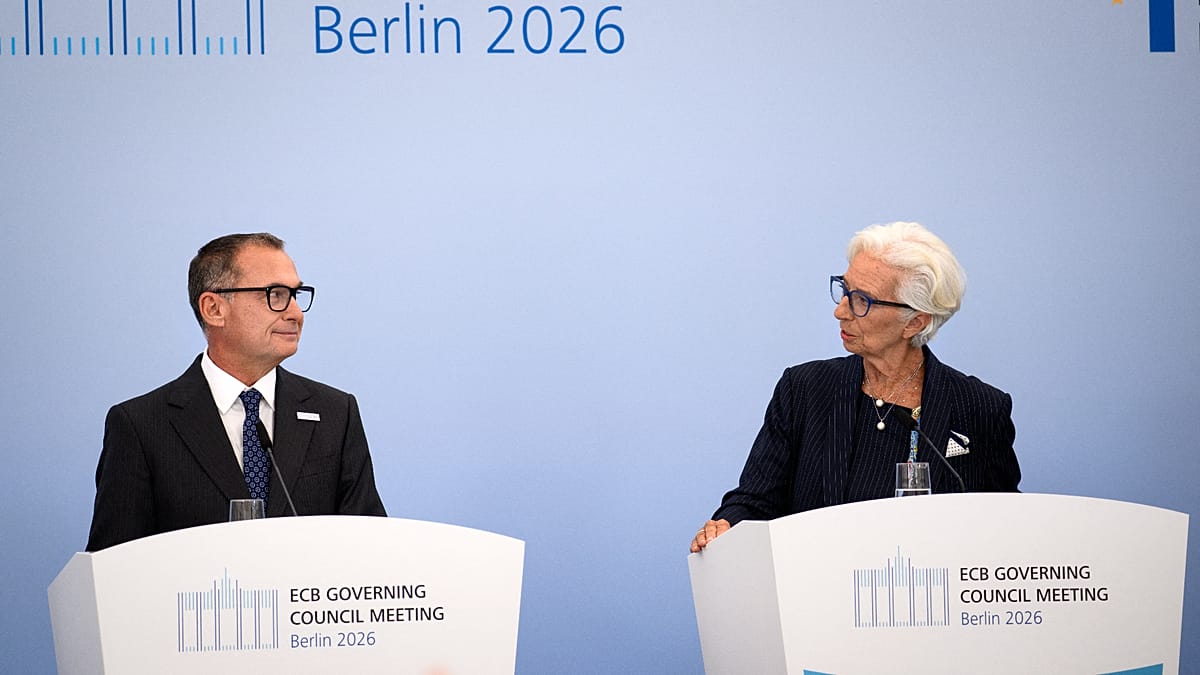
The ECB's skepticism extends to how crypto firms gain access to the EU market. French crypto publication The Big Whale reported that Lagarde expressed opposition to Binance's bid to secure a MiCA license in France — potentially its last viable pathway into the EU market after regulatory difficulties elsewhere. While the ECB does not directly license crypto asset service providers (that authority falls to national regulators and, increasingly, ESMA), Lagarde's reported opposition illustrates the bank's role as an informal gatekeeper shaping political conditions around crypto authorization.
MiCA, which came fully into force in late 2024, created a passporting framework: a license granted in one EU member state allows operation across all 27. France's AMF regulator became a candidate licensing hub partly due to its existing relationship with several crypto firms. The ECB's influence here is indirect but real — when the institution's president signals discomfort, national regulators take note.
The Digital Euro: Europe's CBDC Bet
Rather than accommodate private stablecoins, the ECB is developing its own answer: the digital euro, a central bank digital currency (CBDC) designed for retail use by eurozone citizens. The project entered a preparation phase in November 2023, following two years of investigation, with a targeted pilot around 2027 and a possible full rollout by 2029.
The digital euro would be a direct liability of the ECB — the digital equivalent of a banknote — rather than a bank deposit or a private token. Key design choices include an offline payment capability (important for resilience), holding limits to prevent mass bank disintermediation, and interoperability with existing payment infrastructure.
In 2025, the ECB announced partnerships with the European Payments Council (EPC), payments firm Nexo, and the Berlin Group to reuse open payment standards, aiming to cut integration costs for banks and merchants significantly ahead of the pilot. A separate initiative, the "Pontes" project, explored how central bank money could serve as a settlement anchor for tokenized financial markets — a signal that the ECB is thinking beyond retail payments toward wholesale tokenization.
Schnabel's framing is pointed: a digital euro is not merely a payment upgrade but a geopolitical instrument, countering the dominance of dollar-backed stablecoins in global digital commerce. Without a public digital currency alternative, she argues, Europe cedes monetary sovereignty to private issuers operating under U.S. legal frameworks.

ESM backs ECB's Pontes platform to settle tokenized wholesale assets in central-bank money

Tokenized Markets and the ECB's Role in Infrastructure
Beyond the digital euro, the ECB has engaged with the broader tokenization of financial markets — the shift toward representing bonds, equities, and other assets as tokens on distributed ledger infrastructure. In 2025, the bank published analysis on how central bank money could anchor tokenized settlement, warning against fragmentation: if tokenized markets develop on incompatible rails, settlement risk increases and monetary policy transmission weakens.
This connects to a broader endorsement by the ECB of centralizing crypto oversight within the EU under ESMA, the European Securities and Markets Authority, headquartered in Paris. The ECB publicly backed proposals to shift supervisory authority over crypto asset service providers from national regulators toward the pan-EU watchdog, arguing that fragmented national supervision creates regulatory arbitrage and systemic blind spots. For crypto firms, this matters because a more centralized ESMA regime would mean consistent rules across the bloc rather than forum-shopping between permissive and strict member states.
- 01US stablecoin Eurozone sovereignty threat
The scenario of dollar-backed crypto draining EU capital and weakening ECB monetary control pulled the single highest-clicked headline and anchored multiple follow-ons, making it the defining reader anxiety on this topic.
- 02Digital euro timeline and political resistance
Readers tracked every milestone — Lagarde's October 2025 readiness claim, the pivotal 2026 parliamentary vote, and the 2029 targeted rollout — while also clicking on the pushback from banks, conservatives, and French and German lawmakers favoring Bitcoin instead.
- 03ECB stablecoin ban and restriction push
The ECB's drive to ban cross-jurisdictional euro stablecoins and reject looser rules resonated because it frames the regulator as an active combatant against crypto market structure, not just a commentator.
- 04DLT and blockchain settlement infrastructure
Headlines on ECB-confirmed blockchain settlements by 2026, the dual-track Pontes/Appia DLT strategy, and wholesale market probes attracted readers interested in the ECB quietly building parallel crypto-compatible rails even while opposing private stablecoins.
- 05CBDC privacy and centralization fears
The tension between the ECB framing the digital euro as a public trust instrument and critics warning it threatens financial privacy and decentralization drove sustained engagement across multiple headlines.
- 06ECB DeFi governance critique
The ECB paper finding that top 100 holders control 80%+ of governance tokens in major DeFi protocols gave readers an institutional data point challenging DeFi's decentralization narrative from an unexpected source.
How ECB Policy Moves Crypto Markets
Even setting aside the regulatory agenda, the ECB remains a primary macro driver for crypto prices through conventional monetary channels:
Interest rates and risk appetite. Higher ECB rates strengthen the euro, reduce global liquidity, and tend to weigh on speculative assets including cryptocurrencies. Conversely, rate cuts — or credible signals of easing — have historically coincided with renewed risk appetite. The ECB's rate cycle is closely watched alongside the U.S. Federal Reserve's decisions, as divergence between the two drives EUR/USD, which in turn affects the dollar-denominated price of crypto assets.
Inflation and purchasing power. Persistent inflation in the eurozone has been a dual narrative for crypto: some European retail investors treated Bitcoin as an inflation hedge, while high rates made yield-bearing alternatives more attractive. Lagarde's warnings about energy-driven inflation feeding through to other sectors suggest the rate environment may remain elevated longer than markets hoped.
Banking sector stability. The ECB's supervisory arm oversees significant eurozone banks. Stress in the banking sector — as seen periodically since 2022 — can trigger both flight to safety (negative for crypto) and renewed interest in non-custodial assets (a longer-term positive narrative).
Risks the ECB Sees in the Crypto Ecosystem
The ECB has consistently flagged several categories of risk:
- Monetary disintermediation. Large-scale stablecoin adoption drains deposits from banks, weakening credit creation and rate transmission.
- Contagion from crypto instability. While the ECB has assessed direct crypto exposure of eurozone banks as limited, it warns that growing interconnections — particularly through tokenized money market funds and on-chain DeFi protocols — create transmission channels for shocks.
- Dollar dominance via private tokens. Dollar-backed stablecoins operating at scale in Europe effectively extend Fed policy into the eurozone, reducing the ECB's independent control over financial conditions.
- Regulatory fragmentation. Until MiCA and ESMA centralization mature, inconsistent national rules create systemic gaps that bad actors exploit.
- 2025-10milestone
Lagarde declares digital euro technically ready
- 2026-01regulatory
ECB confirms blockchain-based wholesale settlements by 2026
- 2026-03regulatory
ECB grants non-bank payment providers Eurosystem access
- 2026-06launch
Pontes DLT pilot connecting to Eurosystem core systems targets launch
- 2026-09governance
Pivotal EU parliamentary vote on digital euro framework
- 2027-01milestone
ECB and partners target digital euro integration pilot with open payment standards
- 2029-01launch
Digital euro targeted public rollout pending EU legislative approval
Outlook
The ECB is unlikely to soften its stance on euro stablecoins in the near term. Lagarde's public framing — that privately issued euro-pegged tokens represent "structural weaknesses" rather than opportunities — reflects a settled institutional view, not a negotiating position. The digital euro project will consume significant political capital, with a pilot expected around 2027 and full deployment targeting 2029 if the ECB and EU co-legislators can agree on enabling legislation.
For crypto markets, the key variables to watch are: the pace of ESMA centralization and what it means for licensing timelines; whether the digital euro design ultimately competes with or complements private payment tokens; and how the ECB navigates the tension between financial stability conservatism and the competitive pressure from U.S. dollar stablecoin dominance. Europe is building a regulatory architecture for digital finance — the ECB is its most powerful, and most cautious, architect.
Latest ECB news
ECB and EU central banks push to dump MiCA’s 60% bank-deposit mandate for stablecoins, calling short-dated liquid assets a safer reserve mix that won’t leave banks holding flighty cash.ECB urges EU to tighten crypto rules, widen stablecoin interest banESM backs ECB's Pontes platform to settle tokenized wholesale assets in central-bank moneyCommunity notes
Spot something off or out of date? Drop a note. Editors review topic notes daily and roll accepted fixes into the explainer — contributors are recognized in the monthly $SQUID drop.
Loading notes…
Help improve this topic
Have a story or tip about this topic? Submit it. See something missing? Leave a note. Editors review daily; accepted submissions and fixes count toward the monthly $SQUID drop.